Abstract—Telecommunications operators are well versed in deploying 2G and 3G wireless networks. These networks presently support the mobile business user and/or retail consumer wishing to place conventional voice calls and data connections. The electrical power industry has recently commenced transformation of its distribution networks by deploying smart monitoring and control devices throughout their networks. This evolution of the network into a ‘smart grid’ has also motivated the need to deploy wireless technologies that bridge the communication gap between the smart devices and information technology systems. The requirements of these networks differ from traditional wireless networks that communications operators have deployed, which have thus far forced energy companies to consider deploying their own wireless networks. We present our experience in deploying wireless networks to support the smart grid and highlight the key properties of these networks. These characteristics include application awareness, support for large numbers of simultaneous cell connections, high service coverage and prioritized routing of data. We also outline our target blueprint architecture that may be useful to the industry in building these networks. By observing our experiences, telecommunications operators and equipment manufacturers will be able to augment their current networks and products in a way that accommodates the needs of the emerging industry of smart grid and intelligent electrical networks.
Index Terms— wireless, intelligent network, smart grid.
I. INTRODUCTION
Thus far, the telecommunications industry has deployed mobile networks that have focused mainly on the needs of retail consumers. These networks have advanced considerably from their analogue origins to encompass 3G mobile networks, broadband wireless networks such as WiFi and WiMax, and are now progressing towards LTE 4G networks. While wireless networks have evolved to support the needs of the mobile user, new applications for mobile data are emerging. Recently, the power and energy distribution industry have commenced transformations of their electrical networks to build intelligence within their electricity grids. These new networks augment the electrical power network with telecommunications infrastructure. In effect, the electrical power grid and communications technology are converging to form the intelligent grid [1].
Manuscript received 4th December, 2009, accepted 26th December 2009.
A. Clark is with EnergyAustralia, Sydney, NSW Australia. His current position is Manager, Intelligent Networks at EnergyAustralia. (e-mail: [email protected]).
C. J. Pavlovski is with the IBM, Brisbane, Australia. He is the Chief Architect, Technology & Innovation, and member of the IBM Academy of
Traditionally, the telecommunications operators have offered several alternative mobile network solutions for enterprise and retail customers. Although recent 3G and wireless networks have boasted a significant broadband capability, these networks have been largely overlooked by energy companies seeking to wirelessly enable their smart grids. Often, the telecommunications operator is viewed as an option for ‘difficult to access customers’ or as a backhaul mechanism for localized mesh radio or powerline carrier solutions. Instead, energy distributors have tended to deploy their own wireless infrastructure to support their grid transformations. There are several factors that have contributed to this deployment approach including the need to support several thousand simultaneous devices, higher qualities of service, and priority for mission-critical data traffic.
In this paper we elaborate upon our experiences in deploying wireless networks to support the transformation of the electricity network into an intelligent network. In particular, we describe our case study to smart grid enable the power and distribution network, highlighting the characteristics of these wireless networks. These requirements may be expressed as a need to support application awareness within the wireless and fixed networks, as opposed to the traditional requirements of the mobile consumer. The key contributions of this paper, therefore, are to:
• Describe industry projects, as a case study in deploying wireless networks to smart grid enable the electricity network.
• Analyze wireless internetworking requirements to highlight the key application aware properties of these intelligent networks.
• Outline a blueprint architecture for internetworking that supports the needs of the electrical power industry.
Our experiences and observations will help telecommunication operators to augment and extend their mobile and wireless network offerings to support smart energy grid initiatives. Observing the requirements and architecture outlined here may assist all industry participants to provide practical alternatives to the self-build approach currently pursued by the electrical power industry. In addition to enhancing the 3G network, progression towards 4G Long Term Evolution (LTE) networks may be refined in a way that accommodates grid application awareness requirements in addition to the needs of mobile retail consumers.
Wireless Networks for the Smart Energy Grid:
Application Aware Networks
II. RELATED WORK AND MOTIVATIONS
Although there is considerable literature on smart grid technologies and (independently) wireless internetworking, there appears to be limited work that addresses both these aspects of intelligent networks together. Nevertheless, there are several published works that address certain characteristics of this technology convergence.
In [2], we have previously outlined our experience in deploying several smart grid projects and focus the discussion on the information and communications technologies required to support these deployments. More precisely, a ‘control room of the future’ is described that is required by energy distributors in order to support and manage a combined electricity grid and telecommunications network.
There is work on identifying the key steps to implementing a smart grid [3], where a 10 step plan is put forward by the authors to convert their electricity distribution grids to a smart grid. Among the key observations made, Collier points out that the reality of a smart grid is that it needs to be enabled with digital communications that support fast, real-time, and two-way communications. To support these needs a wide variety of digital communications are employed including voice/data radio, fiber, satellite, WiFi, WiMax and other internet related communications mediums. DeBlasio and Tom also observe the need for full two-way communications to the components of the smart grid and note that a set of interoperability frameworks of protocols and standards are necessary [4]. The need for agreed standards is also pointed out by Bennett and Highfill [5].
An alternative view is put forward on how to enable a smart grid by deploying mesh networks [6]. The authors suggest that using a highly connected mesh network will support a simpler approach for addressing the needs of high density environments. Further work on applying Orthogonal Frequency-Division Multiple Access (OFDMA) based communications is presented in [7]. An approach is presented to overcome the suggested problem that wireless networks are not able to access all grid locations. A NIST report on interoperability standards for smart grid also briefly touches upon the possible need for establishing several standards for wireless communications, including mesh networks and wireless star topologies [8]; posing the question of whether the benefits of vendor interoperability outweigh the risk of stifling creativity?
Although there is literature that touches upon aspects of the need to apply wireless technologies, there is as yet no comprehensive analysis of the challenges in deploying wireless solutions, and in particular how existing telecommunications operator wireless offerings compare to the needs of the smart grid operator. A primary objective of our work is to highlight these challenges in enabling the electrical grid with wireless technologies. Hence, a key motivation for this work is to share our observations from enabling the grid as an intelligent network so that telecommunications operators are able to accommodate the needs of the electrical power industry as this field continues to evolve. One view of electricity suppliers is that as their smart grid requirements continue to develop, integrating further a communications infrastructure with their electrical grid, the
current self build and deploy approaches may not be viable in the longer term. As such, traditional mobile operators and wireless network operators are well positioned to provide the necessary support to the electrical power industry as these needs develop. By observing our work, such initiatives by telecommunications operators will be supported.
III. EVOLUTION OF THE SMART GRID
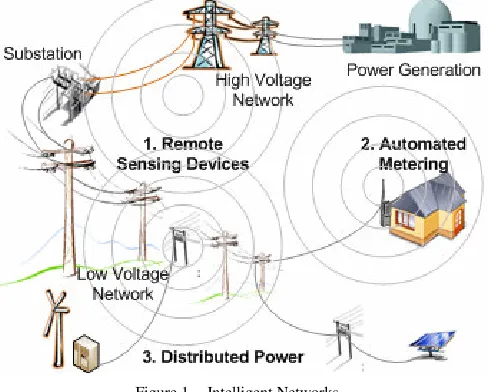
[image:2.595.308.552.307.503.2]Smart grid initiatives have included a range of intelligent technologies. For the most part, electricity distributors have focused on three key areas (see Figure 1): household devices for automated meter reading of electrical usage, remote sensing devices for monitoring & control of the electrical network, and management of distributed power energy sources such as solar at the home. There are several other grid enhancements which are also addressed including smart (real-time) pricing, in-home energy saving devices, and support for hybrid electrical vehicles [9]. In this paper we focus upon the first three smart grid enablers which predominantly feature within the electricity industry.
Figure 1. Intelligent Networks
Before outlining our case study projects for intelligent networks, we briefly describe several key elements of the smart grid. These are, automated metering at the home, remote sensing of the electrical network and incorporation of distributed power (micro-generation) such as solar and wind. Collectively, these elements of the smart grid create an increase in demand for ad-hoc communication between various devices, motivating the need to implement wireless networks in a way that supports communications for distributed locations. As such, the transformation to a smart grid is also a process of convergence of both the electrical grid and the communications internetworking technologies. Hence, a smart grid is a symbiotic overlay of these two networks.
A. Remote Sensing: Monitoring and Control
Remote sensing of the network has been undertaken for some time in energy distribution grids using Supervisory Control and Data Access (SCADA) solutions. These systems have already been used to monitor and control other infrastructure utilities such as gas and water. In the context of electrical grids, these systems are deployed to the high voltage (132kV) network of the electrical grid, typically representing in the order of hundreds of thousands of monitoring and control points. These assets usually include high voltage switches, transformers, and transmission lines. As the electrical grid transforms into a smart grid these monitoring and control points increase exponentially. The monitoring and control points are fundamentally extended to the medium (11kV) and low voltage (415V) networks, which introduces a further one million remote sensing points in our case study. Finally, the smart grid also extends into the customer premises for remote sensing and power management, adding several million more control points.
Remote sensing, monitoring and control are an essential component of the smart grid. The capability bestows an opportunity to better manage network growth, improve utilization of the grid, and reduce time to repair network faults and black-outs; with the remote control of network switching elements. As the number of sensing devices increase the communication needs of the network increases proportionally. In addition, access to remote locations also means that some form of wireless technology becomes fundamental to solving the communications gap.
B. Automated Metering
Automated metering (smart metering) includes functions to remotely read customers’ electrical usage, manage load control, monitor for electrical faults, and support appliance-level reporting. To enable these and other functions, a two-way communications channel to the smart meter is necessary to support readings and proactive action. There are obvious gains in conducting many of these functions remotely in terms of productivity, repair time, and accuracy. However, the key benefits are conferred to the customer, providing greater transparency of electrical usage, charging, and their carbon impact upon the environment. C. Distributed Power
Distributed forms of power such as photovoltaic, wind, and solar thermal, are anticipated by the industry as vital to meeting future power needs. The management and control of these sources to inject power within the grid will require not only automated metering, but also fine-grained monitoring and control with these assets which now logically forming part of the electrical grid. As such, this shall further increase the need for secure and reliable communications to urban and remote locations, with wireless technologies vital to ensuring 100 per cent coverage. In addition to the infusion of distributed power, there is also the potential requirement for supporting electrical vehicles upon the grid. This need alone may prove to be a disruptive requirement to the smart grid, with further granular support necessary to manage both distributed (home) and monolithic (power station) distribution of power for vehicle refueling (recharge).
IV. CASE STUDIES:SMART GRID WIRELESS NETWORKING
The smart grid technologies discussed in the previous sections have been implemented and trialed in our projects. We now elaborate upon these case study implementations and illustrate the factors that contributed to the selection of the various wireless technologies we deployed.
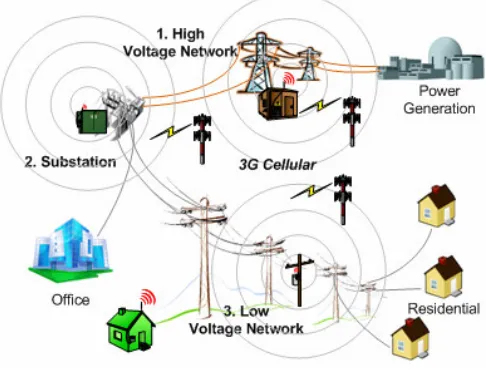
[image:3.595.308.551.303.489.2]A. 3G Cellular for Remote Sensing of the Electrical Grid In describing our remote monitoring and control solution, we first observe that network coverage for a broad range of locations was necessary. In order to achieve coverage, the remote devices deployed were fitted with wireless modems that enabled communication on a range of frequencies and protocols. This allowed selection of either 2G Edge, 3G HSPDPA, with a flexible architecture to accommodate LTE when deployed by carriers. Provisions were also made for alternative networks such as WiMAX. Technologies such as Mesh networking were also considered, however there were several challenges regarding its use; these are discussed further in the next sub-section.
Figure 2. Remote Sensing via Cellular Network
In Figure 2, the distributed monitoring and control solution is illustrated for high, medium and low voltage networks. Remote sensing devices are attached to various control points within the electrical grid, including substations housing transformers, poles, switches and electrical feeder circuits. The sensing devices monitor voltage, phase, current and power. This data is collected and transmitted over 3G wireless and fixed networks to several IT systems responsible for storing, analyzing, and reporting on the data. Vital to these operations is the raising of network alarms and events.
guaranteed level of service delivery (quality of service). We view these attributes as key application aware requirements. Presently, service guarantees and quality of service to ensure priority message delivery for smart grids have not been fully explored and will ultimately determine the extent to which the 3G networks are employed. The issue of security is also critical to prevent cyber attackers; for example, from injecting false control messages into the communications stream to alter the network and cause black-outs or outages. The conventional security measures available with cellular technology are likely not to be sufficient to cater for the needs of securing full control messages within a smart grid.
The issue of availability is a further challenge. Clearly cellular networks had been designed with the human user in mind, with support for several tens or hundreds of channels per cell. The deployment needs of the smart grid dictate that several thousand devices require in the order of 10,000 channels per cell depending on the cell size and geographical area. For the most part these devices may share the available channels. During outage scenarios however, a high level of simultaneous connectivity will be required. As such, channel availability needs some form of guarantee from the service provider. The need for asymmetric traffic that caters for higher uplink traffic is also necessary, which is perhaps a contradictory requirement to existing broadband download traffic patterns experienced by operators. To overcome some of these shortcomings, one approach considered from our case study is a capability for static device roaming with several network providers. For example, if the primary cellular network is unable to allocate a data channel, perhaps due to an outage or all channels consumed, then the device is able to transmit over an alternative 3G or 4G network, hence simulating (since there is no physical movement) roaming between networks. Alternatively, multiple SIMS may be deployed, however the aggregated costs to address all these requirements, together with operator costs, meant the financial impact is an order of magnitude in excess of an internally managed solution.
B. WiMax for Last Mile Connectivity
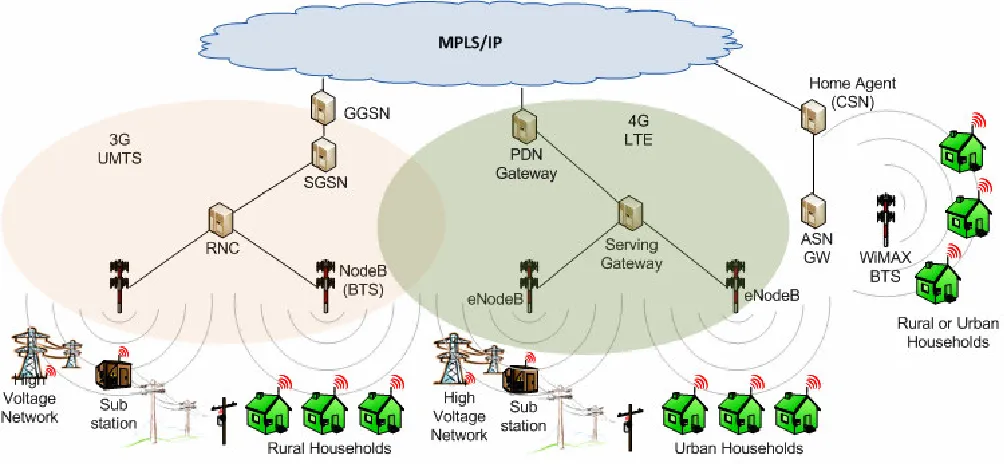
A number of technologies were evaluated as candidates for the last mile of communications connectivity to households (and in some cases network monitoring devices of the low voltage grid). These fell into two basic classifications: 1) use of commercial networks from telecommunications providers, such as mobile cellular; or 2) technologies that were to be deployed and managed internally by the electricity supplier, such as WiMAX, powerline broadband (or narrowband), or RF Mesh networks.
Commercial network services from the telecommunications operators were also considered, but they did not meet all the requirements (many of these needs are similar to the requirements for remote sensing of the electrical grid). Although 3G cellular is well proven and stable the application aware issues to be considered regarding its use were:
• A reliable message transfer service is mandatory to ensure mission-critical data such as remote sensing, monitoring and control were not lost.
• High quality of service guarantees to ensure that remote sensing and control data was given higher priority over general voice and data traffic.
• Households require 100 per cent coverage, and while urban areas are generally covered rural areas often pose a difficulty.
• Most cells are configured for a limited number of cell connections, which may be insufficient for large-scale household deployments. In some cases, a base station may need to cater for up to 10,000 devices.
• A high degree of security to prevent malicious attack, including encryption, mutual authentication, and data integrity.
[image:4.595.310.547.273.468.2]• Response time is critical, from idle to active, granting the ability to establish connection with the network and transmit data rapidly.
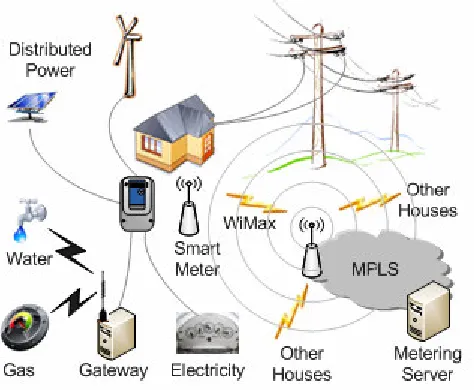
Figure 3. Last Mile Wireless Networking
A large scale WiMAX pilot was conducted with over 80,000 households in five different trial sites. Data was collected from over 20,000 smart meters over a six month period. The pilot studies showed that with the trial sites, full connectivity to over 97 per cent of customers is achievable. The performance of the trial indicated that a control function, such as for controlling the hot water load, could be undertaken within 10 seconds. The final solution approach taken is illustrated in Figure 3, showing WiMAX connectivity to the electricity smart meters. The communications backbone was over an MPLS network, all deployed with carrier grade internetworking technologies.
security, privacy, and customer perspective. A further concern is a lack of proven ability to scale and offer telecommunications industry standards; such as IP data networking and implementation of security policies. In addition, we observe that the electricity industry, regardless of who operates the network, is better positioned when deploying standard telecommunications technologies as opposed to introducing its own solutions. Finally, by accepting market trends for telecommunications, longer term certainty is enhanced.
The summary observation with regards to the last mile was the need to select several technologies and suppliers to ensure the 100 per cent coverage required by the electricity supplier. Ultimately, it is anticipated that a combination of several wireless solutions will provide breadth of coverage in an economical way.
C. Smart Village and Home Area Network
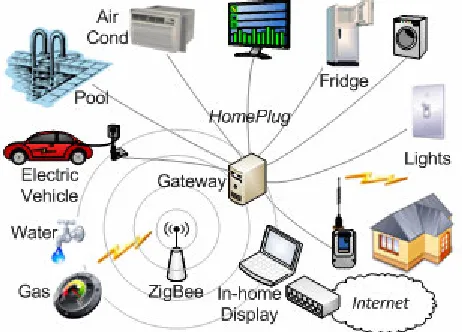
[image:5.595.54.285.397.563.2]A further smart grid project that makes use of the deployed wireless communication systems is our Smart Village project. This trial involves the deployment of smart electricity, gas, and water metering devices to over 1,000 houses. The trial encompasses monitoring of a range of electrical appliances within the home, an electric vehicle study, and the use of distributed power to a subset of the pilot houses. The commencement of this trial has been recently publicly announced [10]. The following diagram (Figure 4) illustrates the components and scope of the trial.
Figure 4. Home Area Network (HomePlug AV & ZigBee Wireless)
Within the home, ZigBee wireless technology has been deployed for communication between several remote metering devices including gas and water. Other technologies which have suitable electrical power connectivity are connected using the HomePlug AV standard. The HomePlug devices include pool water pump, stereo, television, fridge, lighting, and electric vehicle or scooters. The electrical usage of these systems can be monitored by the householder. The data collected from the trial will be made publicly available (with consumer consent) to universities and research groups to study the outcomes.
The rationale for these technology choices rests on industry initiatives to converge existing HomePlug and ZigBee standards with the smart meter. Devices within the home will be able to link directly to the smart meter using these standards. Similarly, the existing solution will also allow for
interoperability using future versions of the ZigBee standard as the Smart Energy Profile becomes a more widely accepted industry standard. Our experience shows that both a wireless and a powerline solution are necessary to address all the needs of a smart home. However, we note the importance of interoperability between the various technologies within the home in order to support real-time energy communications.
A future component to be added is the use of local home display of electricity, via a dedicated In-Home Display (IHD) unit or other handheld devices. This will enable the user to monitor their energy consumption, and hence carbon footprint, and will be accessible over regular broadband home networking installations such as WiFi or (as in our study) using the Homeplug AV standard. Individual device consumption data is retrieved from the smart metering devices installed within the home and is measured in several ways including financial spend, CO2 emission, and energy in kilowatts. Averages are also shown with respect to the community allowing home owners to compare their energy consumption behavior with others. These group comparisons are voluntary, requiring the user to subscribe. Other broadcast and control data transmitted to the community are published (or retrieved) from the metering server (see Figure 3).
During implementation we observed that ZigBee wireless and HomePlug, in their current form, posed several difficulties. The standards for these technologies are emerging, and so a significant degree of customization was necessary to cater for the transactions required of the smart community project. These technologies require refinement for broad adoption and the results of our trial may contribute to these standards.
V. SMART GRID WIRELESS ARCHITECTURE:ABLUEPRINT
Based upon our experiences in deploying several smart grid solutions and the networks required to support these systems we now outline our target blueprint architecture, illustrated in Figure 5. We suggest an approach where existing 3G networks are able to offer some form of limited coverage for remote control and sensing devices to the high voltage networks. There are fewer monitoring devices that are deployed to these systems and existing SCADA-based solutions predominately cater for the needs of monitoring & control to these high voltage networks. Where additional monitoring capability is required, the 3G network may be used for this access, and could be extended to some degree to the medium and low voltage networks. The approach is viewed as providing only limited coverage due to the increased number of devices that require connectivity. Furthermore, the 3G solution is only viewed as an interim approach as there is lack of support to address quality of service and reliability in data transmission. Moreover, an application aware network is required by the energy industry. This uniquely positions 4G solutions, such as WiMAX and Long Term Evolution (LTE), to be able to address the needs of the smart grid network.
Figure 5. Smart Grid Wireless Architecture: Blueprint
In addition, the increased bandwidth will bestow the opportunity to allocate a higher number of channels (in lieu of bandwidth per channel) as the need arises for the smart grid. Hence, in the blue print the LTE 4G is viewed as being more suitable to addressing high and medium voltage monitoring and control, as well as connectivity to urban households. Due to the use of higher frequencies (and resulting reduced transmission distances), rural coverage may not be practical and the shortfall in coverage may be addressed with local deployments of WiMAX by the electricity supplier.
If the issues of application awareness are addressed by 3G deployments (i.e. security, service guarantees, etc.), perhaps through deep packet inspection, then existing 3G implementations may provide a more comprehensive option. However, issues will remain in the scale of support for numerous devices and network coverage. There is also some debate as to the competitive position of WiMAX versus LTE. However, from our experiences we view these technologies as complimentary to the needs of the intelligent smart grid network. For smart grids, LTE is well positioned to provide broad network coverage to the majority of urban population areas, with natural migration from incumbent 3G deployments. Where coverage is omitted, WiMAX may be deployed by the electricity supplier to ensure 100 per cent coverage across both urban and rural areas. In addition, WiMAX deployment may provide fail-over in mission critical or sensitive smart grid locations.
The architecture outlined and requirements identified in this paper may be useful to the energy industry in building their smart grid networks and this may be considered by telecommunications operators as they seek to refine and offer compelling networking solutions to support smart grid initiatives.
VI. SUMMARY &CONCLUSIONS
In this paper, we present our experiences as a case study in deploying several wireless internetworking solutions to support our smart grid solutions. We analyze our
deployments, highlight the key issues observed during implementation, and observe the application awareness requirements for smart grids. Building upon these experiences, we define the key aware for smart grids and outline our blueprint for deploying future internetworking solutions, highlighting the scope of connectivity that these networking options address.
ACKNOWLEDGMENT
We thank Daniela Meleo for her helpful comments and suggestions to this paper.
REFERENCES
[1] J.M. Barroso, “The ‘Intelligent Grid: Electric Power Grid and Telecom Convergence”, IEC Newsletter, International Engineering Consortium, Vol. 1, 2008. http://www.iec.org/newsletter/october08_1.
[2] A. Clark, C.J. Pavlovski, and J. Fry, “Transformation of Energy Systems: The Control Room of the Future”, IEEE Electrical Power and Energy Conference 2009, Montreal Canada, October 2009. To appear. [3] S.E. Collier, “Ten Steps to a Smarter Grid”, IEEE Rural Electrical
Power Conference, April 2009, pp.B2-B7.
[4] R. DeBlasio ande C. Tom, "Standards for the Smart Grid", IEEE Energy 2030 Conference, Atlanta USA, November 2008, pp.1-7. [5] C. Bennett and D. Highfill, "Networking AMI Smart Meters", IEEE
Energy 2030 Conference, Atlanta USA, November 2008, pp.1-8. [6] D. Divan and H. Johal, "A Smarter Grid for Improving System
Reliability and Asset Utilization", CES/IEEE 5th International Power Electronics and Motion Control Conference, Shanghai, China, August 2006, pp.1-7.
[7] G.N. Srinivasa Prasanna, A. Lakshmi, et al., "Data communication over the smart grid", IEEE International Symposium on Power Line Communications and Its Applications, (ISPLC 2009), Dresden, April 2009, pp.273-279.
[8] National Institute of Standards and Technology (NIST), “Report to NIST on the Smart Grid Interoperability Standards Roadmap”, Electric Power Research Institute (EPRI), August 2009.
[9] A. Vojdani, “Smart Integration”, IEEE Power and Energy Magazine, Vol. 6, Iss. 6, December 2008, pp. 71-79.