Dependency-based Discourse Parser for Single-Document Summarization
Yasuhisa Yoshida, Jun Suzuki, Tsutomu Hirao, and Masaaki Nagata
NTT Communication Science Laboratories, NTT Corporation 2-4 Hikaridai, Seika-cho, Soraku-gun, Kyoto, 619-0237 Japan
{yoshida.y,suzuki.jun,hirao.tsutomu,nagata.masaaki}@lab.ntt.co.jp
Abstract
The current state-of-the-art single-document summarization method gen-erates a summary by solving a Tree Knapsack Problem (TKP), which is the problem of finding the optimal rooted sub-tree of the dependency-based discourse tree (DEP-DT) of a document. We can obtain a gold DEP-DT by transforming a gold Rhetorical Structure Theory-based discourse tree (RST-DT). However, there is still a large difference between the ROUGE scores of a system with a gold DEP-DT and a system with a DEP-DT obtained from an automatically parsed RST-DT. To improve the ROUGE score, we propose a novel discourse parser that directly generates the DEP-DT. The evaluation results showed that the TKP with our parser outperformed that with the state-of-the-art RST-DT parser, and achieved almost equivalent ROUGE scores to the TKP with the gold DEP-DT.
1 Introduction
Discourse structures of documents are believed to be highly beneficial for generating informa-tive and coherent summaries. Several discourse-based summarization methods have been devel-oped, such as (Marcu, 1998; Daum´e III and Marcu, 2002; Hirao et al., 2013; Kikuchi et al., 2014). Moreover, the current best ROUGE score for the summarization benchmark data of the RST-discourse Treebank (Carlson et al., 2002) has been provided by (Hirao et al., 2013), whose method also utilizes discourse trees. Thus, the discourse-based summarization approach is one promising way to obtain high-quality summaries.
One possible weakness of discourse-based sum-marization techniques is that they rely greatly on
the accuracy of the discourse parser they use. For example, the above discourse-based summa-rization methods utilize discourse trees based on the Rhetorical Structure Theory (RST) (Mann and Thompson, 1988) for their discourse information. Unfortunately, the current state-of-the-art RST parser, as described in (Hernault et al., 2010), is insufficient as an off-the-shelf discourse parser. In fact, there is empirical evidence that the qual-ity (i.e., ROUGE score) of summaries from auto-parsed discourse trees is significantly degraded compared with those generated from gold dis-course trees (Marcu, 1998; Hirao et al., 2013).
From this background, the goal of this paper is to develop an appropriate discourse parser for discourse-based summarization. We first focus on one of the best discourse-based single document summarization methods as proposed in (Hirao et al., 2013). Their method formulates a single doc-ument summarization problem as a Tree Knap-sack Problem (TKP) over a dependency-based dis-course tree (DEP-DT). In their method, DEP-DTs are automatically transformed from (auto-parsed) RST-discourse trees (RST-DTs) by heuristic rules. Instead, we develop a DEP-DT parser, that di-rectly provides DEP-DTs for their state-of-the-art discourse-based summarization method. We show that summaries generated by our parser improve the ROUGE scores to almost the same level as those generated by gold DEP-DTs. We also inves-tigate the way in which the parsing accuracy helps to improve the ROUGE scores.
2 Single-Document Summarization as a Tree Knapsack Problem
Hirao et al. (2013) formulated single-document summarization as a TKP that is run on the DEP-DT. They obtained a summary by trimming the DEP-DT, i.e. the summary is a rooted subtree of the DEP-DT.
Suppose that we haveN EDUs in a document,
Root!
N! S!
N! S! N! S!
S! N! N! S! S! N! S! N!
N! N!
N! S!
Elaboration!
Background! Elaboration!
Elaboration!
Contrast! Contrast!
Evidence!
Example!
Concession! Antithesis!
(a)
Background Elabora.on
Elabora.on
Elabora.on Elabora.on
Concession Example
Evidence An.thesis
(b)
Background Elabora.on Elabora.on
Elabora.on Elabora.on
Concession Example
Evidence An.thesis
[image:2.595.78.524.64.223.2](c)
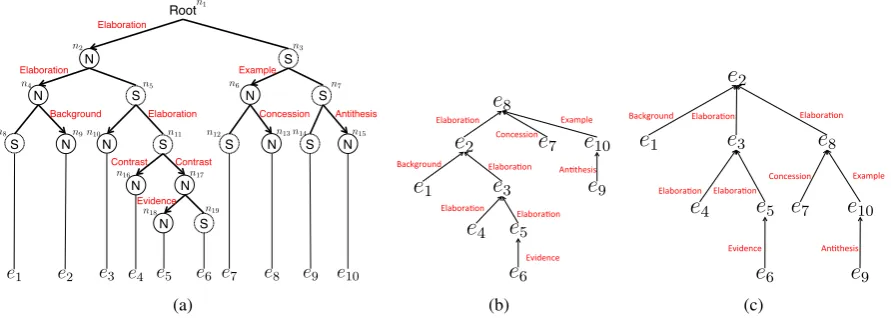
Figure 1: Examples of RST-DT and DEP-DT.e1,· · ·, e10are EDUs. (a) Example of an RST-DT from
(Marcu, 1998).n1,· · ·, n19are the non-terminal nodes. (b) Example of the DEP-DT obtained from the
incorrect RST-DT that is made by swapping the Nucleus-Satellite relationship of the noden2 and the
noden3. (c) The correct DEP-DT obtained from the RST-DT in (a).
and thei-th EDUei hasli words. Lis the
maxi-mum number of words allowed in a summary. In
the TKP, if we selectei, we need to select its
par-ent EDU in the DEP-DT. We denote parpar-ent(i) as
the index of the parent ofei in the DEP-DT.xis
an N-dimensional binary vector that represents a
summary, i.e.xi = 1denotes thateiis included in
the summary. The TKP is defined as the following ILP problem:
maximize
x
∑N
i=1F(ei)xi
s.t. ∑Ni=1lixi≤L
∀i:xparent(i)≥xi
∀i:xi∈ {0,1},
whereF(ei)is the score ofei. We defineF(ei)as
follows:
F(ei) =
∑
w∈W(ei)tf(w, D)
Depth(ei) ,
whereW(ei) is the set of words contained in ei.
tf(w, D)is the term frequency of wordwin a
doc-umentD. Depth(ei)is the depth ofeiin the
DEP-DT.
3 Tree Knapsack Problem with
Dependency-based Discourse Parser
3.1 Motivation
In (Hirao et al., 2013), they automatically ob-tain the DEP-DT by transforming from the parsed RST-DT. We simply followed their method for
ob-taining the DEP-DTs1. The transformation
algo-rithm can be found in detail in (Hirao et al., 2013). Figure 1(a) shows an example of the RST-DT. Ac-cording to RST, a document is represented as a tree whose terminal nodes correspond to elementary discourse units (EDUs) and whose non-terminal nodes indicate the role of the contiguous EDUs, namely, ‘nucleus (N)’ or ‘satellite (S)’. Since a nu-cleus is more important than a satellite in terms of the writer’s purpose, a satellite is always a child of a nucleus in the RST-DT. Some discourse relations between a nucleus and a satellite or two nuclei are defined.
Since the TKP of (Hirao et al., 2013) employs a DEP-DT obtained from an automatically parsed RST-DT, their method strongly relies on the ac-curacy of the RST parser. For example, in Fig-ure 1(a), if the RST-DT parser incorrectly sets
the node n2 as Satellite and the noden3 as
Nu-cleus, we obtain an incorrect DEP-DT in Figure 1(b) because the transformation algorithm uses the Nucleus-Satellite relationships in the RST-DT. The dependency relationships in Figure 1(b) are quite different from that of the correct DEP-DT in Figure 1(c). In this example, the parser failed to
determine the most salient EDUe2, that is the root
EDU of the gold DEP-DT. Thus, the summary ex-tracted from this DEP-DT will have a low ROUGE score.
The results motivated us to design a new dis-course parser fully trained on the DEP-DTs and
Discourse) Dependency) Parser Document Summary Discourse)Dependency)Parser Tree)Knapsack)Problem Parser)Training)Phase Summariza;on)Phase e2# e1# e3# e8#
e10# e4# e5# e7#
e9# e6# Elabora3on# Elabora3on# Elabora3on#Elabora3on# An3thesis# Example# Evidence# Concession# Background# e2#
e1# e3# e8# e10# e4# e5# e7#
e9# e6# Elabora3on# Elabora3on# Elabora3on#Elabora3on# An3thesis# Example# Evidence# Concession# Background# e2# e1# e3# e8#
e10# e4# e5# e7#
e9# e6# Elabora3on# Elabora3on# Elabora3on#Elabora3on# An3thesis# Example# Evidence# Concession# Background# DEP=DTs e2# e1# e3# e8#
e10# e4# e5# e7#
e9# e6# Elabora3on# Elabora3on# Elabora3on#Elabora3on# An3thesis# Example# Evidence# Concession# Background# DEP=DT Root$ N$ S$
N$ S$ N$ S$
S$ N$N$ S$ S$ N$S$ N$ N$ N$
N$ S$ e1$ e2$e3$e4$e5$ e6$ e7$ e8$e9$e10$
Elabora7on$ Background$ Elabora7on$ Elabora7on$ Contrast$ Evidence$ Example$ Concession$An7thesis$ Root$ N$ S$
N$ S$ N$ S$
S$ N$N$ S$ S$ N$S$ N$ N$ N$
N$ S$ e1$ e2$e3$e4$e5$ e6$ e7$ e8$e9$e10$
Elabora7on$ Background$ Elabora7on$ Elabora7on$ Contrast$ Evidence$ Example$ Concession$An7thesis$ Root$ N$ S$
N$ S$ N$ S$
S$ N$N$ S$ S$ N$S$ N$ N$ N$
N$ S$ e1$ e2$e3$e4$e5$ e6$ e7$ e8$e9$e10$
Elabora7on$ Background$ Elabora7on$ Elabora7on$ Contrast$ Evidence$ Example$ Concession$ An7thesis$ RST=DTs Transforma;on)Algorithm (a) e2# e1# e3# e8#
e10# e4# e5# e7#
e9# e6# Elabora3on# Elabora3on# Elabora3on#Elabora3on# An3thesis# Example# Evidence# Concession# Background# RST$Parser Document Root$ N$ S$
N$ S$ N$ S$ S$ N$N$ S$ S$ N$S$ N$
N$ N$ N$ S$ e1$ e2$e3$e4$e5$ e6$ e7$ e8$e9$e10$
Elabora7on$ Background$ Elabora7on$ Elabora7on$ Contrast$ Evidence$ Example$ Concession$ An7thesis$ Summary RST$Parser Transforma3on$Algorithm Tree$Knapsack$Problem Parser$Training$Phase Summariza3on$Phase Root$ N$ S$ N$ S$ N$ S$ S$ N$N$ S$ S$ N$S$ N$
N$ N$ N$ S$ e1$ e2$e3$e4$e5$ e6$ e7$ e8$e9$e10$
Elabora7on$ Background$ Elabora7on$ Elabora7on$ Contrast$ Evidence$ Example$ Concession$An7thesis$ Root$ N$ S$
N$ S$ N$ S$ S$ N$N$ S$ S$ N$S$ N$
N$ N$ N$ S$ e1$ e2$e3$e4$e5$ e6$ e7$ e8$e9$e10$
Elabora7on$ Background$ Elabora7on$ Elabora7on$ Contrast$ Evidence$ Example$ Concession$An7thesis$ Root$ N$ S$
N$ S$ N$ S$ S$ N$N$ S$ S$ N$S$ N$
N$ N$ N$ S$ e1$ e2$e3$e4$e5$ e6$ e7$ e8$e9$ e10$
Elabora7on$ Background$ Elabora7on$ Elabora7on$ Contrast$ Evidence$ Example$ Concession$ An7thesis$ RST>DTs RST>DT DEP>DT (b)
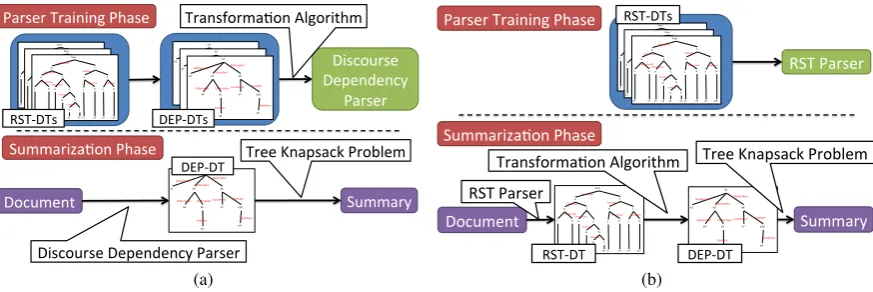
Figure 2: (a) Overview of our proposed method. In the parser training phase, the parser is trained on the DEP-DTs, and in the summarization phase, the document is directly parsed into the DEP-DT. (b) Overview of (Hirao et al., 2013). In the parser training phase, the parser is trained on RST-DTs, and in the summarization phase, the document is parsed into the RST-DT, and then transformed into the DEP-DT.
that could directly generate the DEP-DT. Figure 2(a) shows an overview of the TKP combined with our DEP-DT parser. In the parser training phase, we transform RST-DTs into DEP-DTs, and di-rectly train our parser with the DEP-DTs. In the summarization phase, our method parses a raw document directly into a DEP-DT, and generates a summary with the TKP.
3.2 Description of Discourse Dependency Parser
Our parser is based on the first-order Maximum Spanning Tree (MST) algorithm (McDonald et al., 2005b). Our parser extracts the features from the
EDUei and the EDU ej. We use almost the
fea-tures as those shown in (Hernault et al., 2010).
Lexical N-gram features use the beginning (or
end) lexical N-grams (N ∈ {1,2,3}) in ei and
ej. We also include POS tags for the beginning
(or end) lexical N-grams (N ∈ {1,2,3}) ineiand
ej. Organizational featuresinclude the distance
between ei and ej. They also include the
num-ber of tokens, and features for identifying whether
or not ei andej belong to the same sentence (or
paragraph). Soricut et al. (2003) introduced
dom-inance set features. They include syntactic labels and the lexical heads of head and attachment nodes along with their dominance relationship. We
can-not use thestrong compositionality featuresand
rhetorical structure features described in (Her-nault et al., 2010) because we have to know the subtree structures in advance when using these features.
To train the parser, we choose the Margin
In-fused Relaxed Algorithm (MIRA) (McDonald et al., 2005a; Crammer et al., 2006). We denote
s(w,y) = wTfy as a score function given a
weight vector w and a DEP-DT y. L(y,y?) is
a loss function, and we define it as the number of EDUs that have an incorrect parent EDU in a
pre-dicted DEP-DTy? = arg max
y s(w,y). Then, we
solve the following optimization problem:
min
w ||w−w
(t)||
s.t. s(w,y)−s(w,y?)≥L(y,y?), (1)
wherew(t)is a weight vector in thet-th iteration.
3.3 Redesign of Loss Function for Tree Knapsack Problem
When we make a summary by solving a TKP, we do not necessarily need a DEP-DT where all of the parent-child relationships are correct. This is be-cause we rarely select the EDUs around the leaves in the DEP-DT. On the other hand, the parent-child relationships around the root EDU in the DEP-DT are important because we often select the EDUs around the root EDU. Incorporating these intuitions enables us to develop a DEP-DT parser optimized for the TKP. To incorporate this infor-mation, we define the following loss function:
LDepth(y,y?) = ∑
(i,r,j)∈y
[1−I(y?, i, j)]
Depth(ei) , (2)
where I(y?, i, j) is an indicator function that
[image:3.595.81.518.63.209.2]DEP-DTy?and0otherwise. In Section 4, we
re-port results with the original loss functionL(·,·)
and with the modified loss functionLDepth(·,·).
4 Experimental Evaluation
4.1 Corpus
We used the RST-DT corpus (Carlson et al., 2002) for our experimental evaluations. The corpus con-sists of 385 Wall Street Journal articles with RST annotation, and 30 of these documents also have one human-made reference summary. We used these 30 documents as the test documents for the summarization evaluation, and used the remaining 355 RST annotated documents as the training data for the parser. Note that we did not use the 30 test documents for the summarization evaluation when we trained the parser.
4.2 Summarization Evaluation
We compared the following three systems that dif-fer in the way they obtain the DEP-DT.
TKP-GOLD Used a DEP-DT converted from a gold RST-DT.
TKP-DIS-DEP Used a DEP-DT automatically parsed by our discourse dependency-based parser (DIS-DEP). Figure 2(a) shows an overview of this system.
TKP-DIS-DEP-LOSS Used a DEP-DT automat-ically parsed by our discourse dependency-based parser (DIS-DEP). Figure 2(a) shows an overview of this system. It is trained with the loss function defined in equation (2).
TKP-HILDA Used a DEP-DT obtained by trans-forming a RST-DT parsed by HILDA, a state-of-the-art RST-DT parser (Hernault et al., 2010). Figure 2(b) shows an overview of this system.
Hirao et al. (2013) proved that TKP-HILDA outperformed other methods including Marcu’s method (Marcu, 1998), a simple knapsack model, a maximum coverage model and LEAD method
that simply takes the firstLtokens (L= summary
length). Thus, we only employed TKP-HILDA as our baseline.
We follow the evaluation conditions described in (Hirao et al., 2013). The number of tokens in each summary is determined by the number in the
ROUGE-1 ROUGE-2
TKP-GOLD 0.321 0.112
TKP-DIS-DEP 0.319 0.109
TKP-DIS-DEP-LOSS 0.323 0.121
[image:4.595.307.531.62.134.2]TKP-HILDA 0.284 0.093
Table 1: ROUGERecall scores
human-annotated reference summary. The aver-age length of the reference summaries corresponds to about 10% of the words in the source document. This is also the commonly used evaluation con-dition for single-document summarization evalu-ation on the RST-DT corpus. We employed the recall of ROUGE-1, 2 as the evaluation measures. Table 1 shows ROUGE scores on the RST-DT corpus. We can see DIS-DEP and TKP-DIS-DEP-LOSS outperformed TKP-HILDA, and achieved almost the same ROUGE scores as TKP-GOLD. Wilcoxon’s signed rank test in terms of ROUGE rejected the null hypothesis, “there is a difference between HILDA and TKP-DIS-DEP (or TKP-TKP-DIS-DEP-LOSS)” (Wilcoxon, 1945). This would be because test documents are relatively small.
We analyzed the differences between the pro-posed systems (DEP and TKP-DIS-DEP-LOSS) and TKP-HILDA. First, we evaluated the overlaps between the EDUs in summaries gen-erated by the system and the EDUs in summaries generated by TKP-GOLD. To see the overlaps, we calculated the average F-value using Recall and
Precision defined as follows: Recall = |Ss ∩
Sg|/|Sg|, Precision = |Ss ∩Sg|/|Ss|, where Ss
is a set of EDUs in a summary generated by a
sys-tem, andSga set of EDUs in a summary generated
by TKP-GOLD. The first line in Table 2 shows the results. TKP-DIS-DEP and TKP-DIS-DEP-LOSS outperformed TKP-HILDA as regards the aver-age F-values. The result revealed that TKP-DIS-DEP and TKP-DIS-TKP-DIS-DEP-LOSS have more EDUs in common with TKP-GOLD than TKP-HILDA. This result is evidence that TKP-DIS-DEP and TKP-DIS-DEP-LOSS outperformed TKP-HILDA in terms of ROUGE score.
TKP-DIS-DEP TKP-DIS-DEP-LOSS TKP-HILDA
Avg F-value 0.532? 0.532? 0.415
RA 0.933? 0.933? 0.733
Avg DAS 0.847? 0.843? 0.596
[image:5.595.133.465.63.118.2]?: significantly better than TKP-HILDA (p < .05)
Table 2: Average F-value, Root Accuracy (RA), and average Dependency Accuracy in Summary (DAS). Wilcoxon’s signed rank test in terms of average F-value, RA and DAS accepted the null hypothesis.
TKP-GOLD:
Elcotel Inc. expects fiscal second-quarter earnings to trail 1988 results. Elcotel, a telecommunications company, had net income of $272,000, or five cents a share, in its year-earlier second quarter.The lower results, Mr. Pierce said. Elcotel will also benefit from moving into other areas. Elcotel has also developed an automatic call processor. Automatic call processors will provide that system for virtually any telephone, Mr. Pierce said, not just phones.
TKP-DIS-DEP, TKP-DIS-DEP-LOSS:
Elcotel Inc. expects fiscal second-quarter earnings to trail 1988 results. Elcotel, a telecommunications company, had net income of $272,000, or five cents a share, in its year-earlier second quarter. George Pierce, chairman and chief executive officer, said in an interview. Although Mr. Pierce expects that line of business to strengthen in the next year. Elcotel will also benefit from moving into other areas. Elcotel has also developed an automatic call processor.
TKP-HILDA:
Elcotel Inc. expects fiscal second-quarter earnings to trail 1988 results. That several new products will lead to a “much stronger” performance in its second half. George Pierce, chairman and chief executive officer, said in an interview. Mr. Pierce said Elcotel should realize a minimum of $10 of recurring net earnings for each machine each month. Elcotel has also developed an automatic call processor. Automatic call processors will provide that system for virtually any telephone.
Figure 3: Summaries of wsj 2317. The sentences shown in bold-face are the root EDUs in each DEP-DT of the summary.
of DEP-DT with high accuracy.
Third, to evaluate the coherency of the gener-ated summaries, we compared the average Depen-dency Accuracy in Summary (DAS), which is de-fined as follows:
DAS(S) = 1
|S|
∑
e∈S
δ(e),
δ(e) =
{
1 (if parent(e)∈S)
0 (otherwise),
where S is a set of EDUs contained in the
sum-mary and parent(e) returns the parent EDU of e
in the gold DEP-DT. DAS(S)measures the rate of
the correct parent-child relationships inS. When
DAS equals 1, the summary is a rooted subtree of the gold DEP-DT. The third line in Table 2 shows the results. The results demonstrate that the sum-maries generated by DEP or TKP-DIS-DEP-LOSS tend to preserve the upper level depen-dency relationships between the EDUs within the gold DEP-DT.
Figure 3 shows summaries of wsj 2317 gener-ated by the three systems. The EDUs correspond-ing to the root of the DEP-DT are used in each system shown in boldface. We can see that the
root EDU in the gold DEP-DT is found in the summaries generated by DIS-DEP and TKP-DIS-DEP-LOSS, but not in the summary gener-ated by TKP-HILDA.
5 Conclusion
In this paper, we proposed a novel dependency-based discourse parser for single-document sum-marization. The parser enables us to obtain the DEP-DT without transforming the RST-DT. The evaluation results showed that the TKP with our parser outperformed that with the state-of-the-art RST-DT parser, and achieved almost equivalent ROUGE scores to the TKP with the gold DEP-DT.
References
Lynn Carlson, Daniel Marcu, and Mary Ellen
Okurowski. 2002. Rst discourse treebank,
ldc2002t07.
Hal Daum´e III and Daniel Marcu. 2002. A noisy-channel model for document compression. In Pro-ceedings of the 40th Annual Meeting of the Associa-tion for ComputaAssocia-tional Linguistics (ACL), pages 449 – 456, Philadelphia, PA, July 6 – 12.
Hugo Hernault, Helmut Prendinger, Mitsuru Ishizuka, et al. 2010. Hilda: a discourse parser using support vector machine classification. Dialogue and Dis-course, 1(3).
Tsutomu Hirao, Yasuhisa Yoshida, Masaaki Nishino, Norihito Yasuda, and Masaaki Nagata. 2013. Single-document summarization as a tree knapsack problem. InProceedings of the 2013 Conference on EMNLP, pages 1515–1520.
Yuta Kikuchi, Tsutomu Hirao, Hiroya Takamura, Man-abu Okumura, and Masaaki Nagata. 2014. Single document summarization based on nested tree struc-ture. InProceedings of the 52nd Annual Meeting of the Association for Computational Linguistics (Vol-ume 2: Short Papers), pages 315–320, Baltimore, Maryland, June. Association for Computational Lin-guistics.
Sujian Li, Liang Wang, Ziqiang Cao, and Wenjie Li. 2014. Text-level discourse dependency parsing. In
Proceedings of the 52nd Annual Meeting of the As-sociation for Computational Linguistics (Volume 1: Long Papers), pages 25–35, Baltimore, Maryland, June. Association for Computational Linguistics. William C. Mann and Sandra A. Thompson. 1988.
Rhetorical structure theory: Toward a functional the-ory of text organization. Text, 8(3):243–281. Daniel Marcu. 1998. Improving summarization
through rhetorical parsing tuning. In Proc. of The 6th Workshop on VLC, pages 206–215.
Ryan McDonald, Koby Crammer, and Fernando Pereira. 2005a. Online large-margin training of de-pendency parsers. In Proceedings of the 43rd An-nual Meeting on Association for Computational Lin-guistics, ACL ’05, pages 91–98, Stroudsburg, PA, USA. Association for Computational Linguistics. Ryan McDonald, Fernando Pereira, Kiril Ribarov, and
Jan Hajic. 2005b. Non-projective dependency pars-ing uspars-ing spannpars-ing tree algorithms. In Proceed-ings of Human Language Technology Conference and Conference on Empirical Methods in Natural Language Processing, pages 523–530, Vancouver, British Columbia, Canada, October. Association for Computational Linguistics.
Radu Soricut and Daniel Marcu. 2003. Sentence level discourse parsing using syntactic and lexical infor-mation. In Proceedings of the 2003 Human Lan-guage Technology Conference of the North Ameri-can Chapter of the Association for Computational Linguistics.