Open Language Learning for Information Extraction
Mausam, Michael Schmitz, Robert Bart, Stephen Soderland, and Oren Etzioni Turing Center
Department of Computer Science and Engineering University of Washington, Seattle
{mausam,schmmd,rbart,soderlan,etzioni}@cs.washington.edu
Abstract
Open Information Extraction (IE) systems ex-tract relational tuples from text, without re-quiring a pre-specified vocabulary, by iden-tifying relation phrases and associated argu-ments in arbitrary sentences. However, state-of-the-art Open IE systems such as REVERB
andWOE share two important weaknesses –
(1) they extract only relations that are medi-ated by verbs, and (2) they ignore context, thus extracting tuples that are not asserted as factual. This paper presents OLLIE, a sub-stantially improved Open IE system that ad-dresses both these limitations. First, OLLIE
achieves high yield by extracting relations me-diated by nouns, adjectives, and more. Sec-ond, a context-analysis step increases preci-sion by including contextual information from the sentence in the extractions. OLLIEobtains 2.7 times the area under precision-yield curve (AUC) compared to REVERB and 1.9 times the AUC ofWOEparse.
1 Introduction
While traditional Information Extraction (IE)
(ARPA, 1991; ARPA, 1998) focused on identifying and extracting specific relations of interest, there has been great interest in scaling IE to a broader set of relations and to far larger corpora (Banko et al., 2007; Hoffmann et al., 2010; Mintz et al., 2009; Carlson et al., 2010; Fader et al., 2011). However, the requirement of having pre-specified relations of interest is a significant obstacle. Imagine an intel-ligence analyst who recently acquired a terrorist’s laptop or a news reader who wishes to keep abreast of important events. The substantial endeavor in
1. “After winning the Superbowl, the Saints are now the top dogs of the NFL.”
O: (the Saints; win; the Superbowl)
2. “There are plenty of taxis available at Bali airport.” O: (taxis; be available at; Bali airport)
3. “Microsoft co-founder Bill Gates spoke at ...” O: (Bill Gates; be co-founder of; Microsoft) 4. “Early astronomers believed that the earth is the
center of the universe.”
R: (the earth; be the center of; the universe) W: (the earth; be; the center of the universe) O: ((the earth; be the center of; the universe) AttributedTobelieve; Early astronomers) 5. “If he wins five key states, Romney will be elected
President.”
R,W: (Romney; will be elected; President) O: ((Romney; will be elected; President)
[image:1.612.320.530.239.438.2]ClausalModifierif; he wins five key states) Figure 1:OLLIE(O) has a wider syntactic range and finds extractions for the first three sentences where REVERB
(R) and WOEparse (W) find none. For sentences #4,5,
REVERBandWOEparsehave an incorrect extraction by
ignoring the context thatOLLIEexplicitly represents.
analyzing their corpus is thediscoveryof important
relations, which are likely not pre-specified. Open IE (Banko et al., 2007) is the state-of-the-art approach for such scenarios.
However, the state-of-the-art Open IE systems,
REVERB (Fader et al., 2011; Etzioni et al., 2011)
andWOEparse(Wu and Weld, 2010) suffer from two
key drawbacks. Firstly, they handle a limited sub-set of sentence constructions for expressing relation-ships. Both extract only relations that are mediated by verbs, and REVERBfurther restricts this to a sub-set of verbal patterns. This misses important infor-mation mediated via other syntactic entities such as nouns and adjectives, as well as a wider range of verbal structures (examples #1-3 in Figure 1).
Secondly, REVERB and WOEparse perform only a local analysis of a sentence, so they often extract relations that are not asserted as factual in the sen-tence (examples #4,5). This often occurs when the relation is within a belief, attribution, hypothetical or other conditional context.
In this paper we present OLLIE(OpenLanguage
Learning for Information Extraction), 1 our novel
Open IE system that overcomes the limitations of previous Open IE by (1) expanding the syntactic scope of relation phrases to cover a much larger number of relation expressions, and (2) expand-ing the Open IE representation to allow additional context information such as attribution and clausal
modifiers. OLLIE extractions obtain a dramatically
higher yield at higher or comparable precision rela-tive to existing systems.
The outline of the paper is as follows. First, we provide background on Open IE and how it relates to Semantic Role Labeling (SRL). Section 3 de-scribes the syntactic scope expansion component,
which is based on a novel approach that learnsopen
pattern templates. These are relation-independent dependency parse-tree patterns that are automati-cally learned using a novel bootstrapped training set.
Section 4 discusses thecontext analysiscomponent,
which is based on supervised training with linguistic and lexical features.
Section 5 compares OLLIE with REVERB and
WOEparse on a dataset from three domains: News, Wikipedia, and a Biology textbook. We find that
OLLIE obtains 2.7 times the area in precision-yield
curves (AUC) as REVERB and 1.9 times the AUC
asWOEparse. Moreover, for specific relations
com-monly mediated by nouns (e.g., ‘is the president
of’) OLLIE obtains two order of magnitude higher
yield. We also compareOLLIEto a state-of-the-art
SRL system (Johansson and Nugues, 2008) on an IE-related end task and find that they both have com-parable performance at argument identification and have complimentary strengths in sentence analysis. In Section 6 we discuss related work on pattern-based relation extraction.
2 Background
Open IEsystems extract tuples consisting of argu-ment phrases from the input sentence and a phrase
1
Available for download at http://openie.cs.washington.edu
from the sentence that expresses a relation between the arguments, in the format (arg1; rel; arg2). This is done without a pre-specified set of relations and with
no domain-specific knowledge engineering. We
compareOLLIEto two state-of-the-art Open IE
sys-tems: (1) REVERB (Fader et al., 2011), which
uses shallow syntactic processing to identify rela-tion phrases that begin with a verb and occur
be-tween the argument phrases;2 (2) WOEparse (Wu
and Weld, 2010), which uses bootstrapping from en-tries in Wikipedia info-boxes to learn extraction
pat-terns in dependency parses. Like REVERB, the
relation phrases begin with verbs, but can handle long-range dependencies and relation phrases that
do not come between the arguments. Unlike RE
-VERB, WOE does not include nouns within the
re-lation phrases (e.g., cannot represent ‘is the
presi-dent of’ relation phrase). Both systems ignore con-text around the extracted relations that may indi-cate whether it is a supposition or conditionally true rather than asserted as factual (see #4-5 in Figure 1).
The task ofSemantic role labeling is to identify
arguments of verbs in a sentence, and then to clas-sify the arguments by mapping the verb to a se-mantic frame and mapping the argument phrases to roles in that frame, such as agent, patient, instru-ment, or benefactive. SRL systems can also identify and classify arguments of relations that are mediated by nouns when trained on NomBank annotations. Where SRL begins with a verb or noun and then looks for arguments that play roles with respect to that verb or noun, Open IE looks for a phrase that ex-presses a relation between a pair of arguments. That phrase is often more than simply a single verb, such as the phrase ‘plays a role in’, or ‘is the CEO of’.
3 Relational Extraction inOLLIE
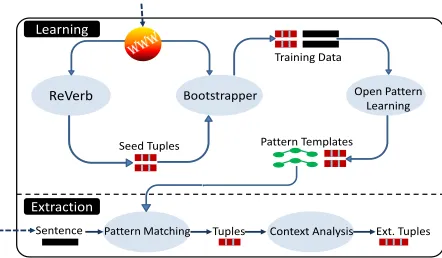
Figure 2 illustratesOLLIE’s architecture for learning
and applying binary extraction patterns. First, it uses
a set of high precision seed tuples from REVERBto
bootstrap a large training set. Second, it learnsopen
pattern templatesover this training set. Next,OLLIE
applies these pattern templates at extraction time. This section describes these three steps in detail.
Fi-nally, OLLIE analyzes the context around the tuple
(Section 4) to add information (attribution, clausal modifiers) and a confidence function.
2
ReVerb
Seed Tuples
Training Data
Open Pattern Learning Bootstrapper
Pattern Templates
Pattern Matching Context Analysis
Sentence Tuples Ext. Tuples
[image:3.612.75.296.56.185.2]Extraction Learning
Figure 2: System architecture: OLLIEbegins with seed tuples from REVERB, uses them to build a bootstrap training set, and learns open pattern templates. These are applied to individual sentences at extraction time.
3.1 Constructing a Bootstrapping Set
Our goal is to automatically create a large training set, which encapsulates the multitudes of ways in which information is expressed in text. The key ob-servation is that almost every relation can also be
ex-pressed via a REVERB-style verb-based expression.
So, bootstrapping sentences based on REVERB’s
tu-ples will likely capture all relation expressions. We start with over 110,000 seed tuples – these are
high confidence REVERB extractions from a large
Web corpus (ClueWeb)3 that are asserted at least
twice and contain only proper nouns in the argu-ments. These restrictions reduce ambiguity while
still covering a broad range of relations. For
ex-ample, a seed tuple may be (Paul Annacone; is the
coach of; Federer) that REVERB extracts from the
sentence “Paul Annacone is the coach of Federer.” For each seed tuple, we retrieve all sentences in a Web corpus that contains all content words in the tuple. We obtain a total of 18 million sentences. For our example, we will retrieve all sentences that contain ‘Federer’, ‘Paul’, ‘Annacone’ and some syn-tactic variation of ‘coach’. We may find sentences like “Now coached by Annacone, Federer is win-ning more titles than ever.”
Our bootstrapping hypothesis assumes that all these sentences express the information of the orig-inal seed tuple. This hypothesis is not always true. As an example, for a seed tuple (Boyle; is born in; Ireland) we may retrieve a sentence “Felix G. Whar-ton was born in Donegal, in the northwest of Ireland, a county where the Boyles did their schooling.”
3
http://lemurproject.org/clueweb09.php/
To reduce bootstrapping errors we enforce addi-tional dependency restrictions on the sentences. We only allow sentences where the content words from arguments and relation can be linked to each other via a linear path of size four in the dependency parse. To implement this restriction, we only use the sub-set of content words that are headwords in the parse tree. In the above sentence ‘Ireland’, ‘Boyle’ and ‘born’ connect via a dependency path of length six, and hence this sentence is rejected from the training set. This reduces our set to 4 million (seed tuple, sentence) pairs.
In our implementation, we use Malt Dependency Parser (Nivre and Nilsson, 2004) for dependency parsing, since it is fast and hence, easily applica-ble to a large corpus of sentences. We post-process the parses using Stanford’s CCprocessed algorithm, which compacts the parse structure for easier extrac-tion (de Marneffe et al., 2006).
We randomly sampled 100 sentences from our bootstrapping set and found that 90 of them sat-isfy our bootstrapping hypothesis (64 without de-pendency constraints). We find this quality to be sat-isfactory for our needs of learning general patterns.
Bootstrapped data has been previously used to generate positive training data for IE (Hoffmann et
al., 2010; Mintz et al., 2009). However, previous
systems retrieved sentences that only matched the two arguments, which is error-prone, since multiple
relations can hold between a pair of entities (e.g.,
Bill Gates is the CEO of, a co-founder of, and has a high stake in Microsoft).
Alternatively, researchers have developed sophis-ticated probabilistic models to alleviate the effect of noisy data (Riedel et al., 2010; Hoffmann et al., 2011). In our case, by enforcing that a sentence ad-ditionally contains some syntactic form of the rela-tion content words, our bootstrapping set is naturally much cleaner.
Moreover, this form of bootstrapping is better suited for Open IE’s needs, as we will use this data to generalize to other unseen relations. Since the relation words in the sentence and seed match, we can learn general pattern templates that may apply to other relations too. We discuss this process next.
3.2 Open Pattern Learning
OLLIE’s next step is to learn general patterns that
-Extraction Template Open Pattern
1. (arg1; be{rel} {prep}; arg2) {arg1} ↑nsubjpass↑ {rel:postag=VBN} ↓{prep∗}↓ {arg2} 2. (arg1;{rel}; arg2) {arg1} ↑nsubj↑ {rel:postag=VBD} ↓dobj↓ {arg2} 3. (arg1; be{rel}by; arg2) {arg1} ↑nsubjpass↑ {rel:postag=VBN} ↓agent↓ {arg2} 4. (arg1; be{rel}of; arg2) {rel:postag=NN;type=Person} ↑nn↑ {arg1} ↓nn↓ {arg2}
[image:4.612.113.502.55.136.2]5. (arg1; be{rel} {prep}; arg2) {arg1} ↑nsubjpass↑ {slot:postag=VBN;lex∈announce|name|choose...} ↓dobj↓ {rel:postag=NN} ↓{prep∗}↓ {arg2}
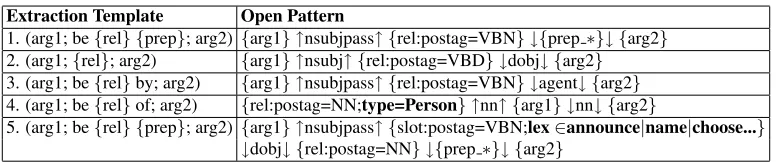
Figure 3: Sample open pattern templates. Notice that some patterns (1-3) are purely syntactic, and others are seman-tic/lexically constrained (in bold font). A dependency parse that matches pattern #1 is shown in Figure 4.
LIElearnsopen pattern templates– a mapping from
a dependency path to an open extraction, i.e., one
that identifies both the arguments and the exact
(REVERB-style) relation phrase. Figure 3 gives
ex-amples of high-frequency pattern templates learned by OLLIE. Note that some of the dependency paths are completely unlexicalized (#1-3), whereas in other cases some nodes have lexical or semantic restrictions (#4, 5).
Open pattern templates encode the ways in which a relation (in the first column) may be expressed in a sentence (second column). For example, a relation (Godse; kill; Gandhi) may be expressed with a dependency path (#2) {Godse}↑nsubj↑{kill:postag=VBD}↓dobj↓{Gandhi}.
To learn the pattern templates, we first extract the dependency path connecting the arguments and re-lation words for each seed tuple and the associated sentence. We annotate the relation node in the path with the exact relation word (as a lexical constraint) and the POS (postag constraint). We create a re-lation template from the seed tuple by normalizing ‘is’/‘was’/‘will be’ to ‘be’, and replacing the rela-tion content word with {rel}.4
If the dependency path has a node that is not part
of the seed tuple, we call it aslotnode. Intuitively,
if slot words do not negate the tuple they can be skipped over. As an example, ‘hired’ is a slot word for the tuple (Annacone; is the coach of; Federer) in the sentence “Federer hired Annacone as a coach”. We associate postag and lexical constraints with the slot node as well. (see #5 in Figure 3).
Next, we perform several syntactic checks on each candidate pattern. These checks are the con-straints that we found to hold in very general pat-terns, which we can safely generalize to other un-seen relations. The checks are: (1) There are no slot
4Our current implementation only allows a single relation content word; extending to multiple words is straightforward – the templates will require rel1, rel2,. . .
nodes in the path. (2) The relation node is in the middle of arg1 and arg2. (3) The preposition edge (if any) in the pattern matches the preposition in the
relation. (4) The path has nonnoramodedges.
If the checks hold true we accept it as a purely syntactic pattern with no lexical constraints.
Oth-ers aresemantic/lexical patternsand require further
constraints to be reliable as extraction patterns.
3.2.1 Purely Syntactic Patterns
For syntactic patterns, we aggressively general-ize to unseen relations and prepositions. We remove all lexical restrictions from the relation nodes. We
convert all preposition edges to an abstract{prep ∗}
edge. We also replace the specific prepositions in extraction templates with{prep}.
As an example, consider the sentences, “Michael Webb appeared on Oprah...” and “...when Alexan-der the Great advanced to Babylon.” and associ-ated seed tuples (Michael Webb; appear on; Oprah) and (Alexander; advance to; Babylon). Both these data points return the same open pattern after
gen-eralization: “{arg1} ↑nsubj↑ {rel:postag=VBD}
↓{prep ∗}↓ {arg2}” with the extraction template
(arg1, {rel} {prep}, arg2). Other examples of
syn-tactic pattern templates are #1-3 in Figure 3.
3.2.2 Semantic/Lexical Patterns
Patterns that do not satisfy the checks are not as general as those that do, but are still important. Con-structions like “Microsoft co-founder Bill Gates...”
work for some relation words (e.g., founder, CEO,
director, president, etc.) but would not work for
other nouns; for instance, from “Chicago Symphony Orchestra” we should not conclude that (Orchestra; is the Symphony of; Chicago).
‘hired’ by ‘fired’ or ‘considered’ then the extraction would be false.
To enable such patterns we retain the lexical
con-straints on the relation words and slot words.5 We
collect all patterns together based only on the syn-tactic restrictions and convert the lexical constraint into a list of words with which the pattern was seen. Example #5 in Figure 3 shows one such lexical list.
Can we generalize these lexically-annotated pat-terns further? Our insight is that we can generalize a list of lexical items to other similar words. For
example, if we see a list like{CEO, director,
presi-dent, founder}, then we should be able to generalize
to ‘chairman’ or ‘minister’.
Several ways to compute semantically similar words have been suggested in the literature like
Wordnet-based, distributional similarity, etc. (e.g.,
(Resnik, 1996; Dagan et al., 1999; Ritter et al., 2010)). For our proof of concept, we use a simple overlap metric with two important Wordnet classes – Person and Location. We generalize to these types
when our list has a high overlap (> 75%) with
hy-ponyms of these classes. If not, we simply retain the original lexical list without generalization. Example #4 in Figure 3 is a type-generalized pattern.
We combine all syntactic and semantic patterns and sort in descending order based on frequency of occurrence in the training set. This imposes a natural ranking on the patterns – more frequent patterns are likely to give higher precision extractions.
3.3 Pattern Matching for Extraction
We now describe how these open patterns are used to extract binary relations from a new sentence. We first match the open patterns with the dependency parse of the sentence and identify the base nodes for arguments and relations. We then expand these to convey all the information relevant to the extraction. As an example, consider the sentence: “I learned that the 2012 Sasquatch music festival is scheduled for May 25th until May 28th.” Figure 4 illustrates the dependency parse. To apply pattern #1 from Figure 3 we first match arg1 to ‘festival’, rel to ‘scheduled’ and arg2 to ‘25th’ with prep ‘for’. However, (festi-val, be scheduled for, 25th) is not a very meaningful extraction. We need to expand this further.
5For highest precision extractions, we may also need seman-tic constraints on the arguments. In this work, we increase our yield by ignoring the argument-type constraints.
learned_VBD
I_PRP scheduled_VBN
that_IN festival_NN is_VBZ 25th_NNP 28th_NNP
the_DET 2012_CD Sasquatch_NNP music_NN May_NNP_11 May_NNP_14
nsubj ccomp
complm
nsubjpass auxpass prep_for prep_until
[image:5.612.328.527.54.139.2]det num nn nn nn nn
Figure 4: A sample dependency parse. The col-ored/greyed nodes represent all words that are extracted from the pattern{arg1} ↑nsubjpass↑ {rel:postag=VBN} ↓{prep∗}↓ {arg2}. The extraction is (the 2012 Sasquatch Music Festival; is scheduled for; May 25th).
For the arguments we expand on amod, nn, det,
neg, prep of, num, quantmod edges to build the noun-phrase. When the base noun is not a proper
noun, we also expand on rcmod, infmod, partmod,
ref, prepc ofedges, since these are relative clauses
that convey important information. For relation
phrases, we expand onadvmod, mod, aux, auxpass,
cop, prtedges. We also includedobjandiobjin the case that they are not in an argument. After identi-fying the words in arg/relation we choose their order as in the original sentence. For example, these rules will result in the extraction (the Sasquatch music fes-tival; be scheduled for; May 25th).
3.4 Comparison withWOEparse
OLLIE’s algorithm is similar to that of WOEparse
– both systems follow the basic structure of boot-strap learning of patterns based on dependency parse paths. However, there are three significant
differ-ences. WOE uses Wikipedia-based bootstrapping,
finding a sentence in a Wikipedia article that
con-tains the infobox values. SinceWOEdoes not have
access to a seed relation phrase, it heuristically as-signs all intervening words between the arguments in the parse as the relation phrase. This often results in under-specified or nonsensical relation phrases. For example, from the sentence “David Miscavige learned that after Tom Cruise divorced Mimi Rogers,
he was pursuing Nicole Kidman.” WOE’s heuristics
will extract the relationdivorced was pursuing
be-tween ‘Tom Cruise’ and ‘Nicole Kidman’. OLLIE,
in contrast, produces well-formed relation phrases
by basing its templates on REVERBrelation phrases.
Secondly, WOE does not assign semantic/lexical
restrictions to its patterns, and thus, has lower preci-sion due to aggressive syntactic generalization.
rela-tion phrases that do not include nouns, thus missing important relations such as ‘is the president of’. In
our experiments (see Figure 5) we findWOEparseto
have lower precision and yield thanOLLIE.
4 Context Analysis inOLLIE
We now turn to the context analysis component, which handles the problem of extractions that are not
asserted as factual in the text. In some cases,OLLIE
can handle this by extending the tuple representation with an extra field that turns an otherwise incorrect tuple into a correct one. In other cases, there is no
re-liable way to salvage the extraction, andOLLIEcan
avoid an error by giving the tuple a low confidence.
Cases whereOLLIE extends the tuple
representa-tion include condirepresenta-tional truth and attriburepresenta-tion. Con-sider sentence #4 in Figure 1. It is not asserting that
the earth is the center of the universe. OLLIE adds
anAttributedTofield, which makes the final
extrac-tion valid (see OLLIE extraction in Figure 1). This
field indicates who said, suggested, believes, hopes, or doubts the information in the main extraction.
Another case is when the extraction is only condi-tionally true. Sentence #5 in Figure 1 does not assert as factual that (Romney; will be elected; President), so it is an incorrect extraction. However, adding a condition (“if he wins five states”) can turn this
into a correct extraction. We extend OLLIEto have
a ClausalModifier field when there is a dependent clause that modifies the main extraction.
Our approach for extracting these additional fields makes use of the dependency parse structure. We
find that attributions are marked by accomp(clausal
complement) edge. For example, in the parse of sen-tence #4 there is a ccomp edge between ‘believe’ and ‘center’. Our algorithm first checks for the pres-ence of a ccomp edge to the relation node. However, not all ccomp edges are attributions. We match the
context verb (e.g., ‘believe’) with a list of
commu-nication and cognition verbs from VerbNet (Schuler, 2006) to detect attributions. The context verb and its
subject then populate theAttributedTofield.
Similarly, the clausal modifiers are marked by
ad-vcl(adverbial clause) edge. We filter these lexically,
and add a ClausalModifier field when the first word of the clause matches a list of 16 terms created using a training set:{if, when, although, because, ...}.
OLLIE has high precision for AttributedTo and
ClausalModifier fields, nearly 98% on a develop-ment set, however, these two fields do not cover all the cases where an extraction is not asserted as
fac-tual. To handle others, we trainOLLIE’s confidence
function to reduce the confidence of an extraction if its context indicates it is likely to be non-factual.
We use a supervised logistic regression classifier for the confidence function. Features include the frequency of the extraction pattern, the presence of AttributedTo or ClausalModifier fields, and the po-sition of certain words in the extraction’s context, such as function words or the communication and cognition verbs used for the AttributedTo field. For example, one highly predictive feature tests whether or not the word ‘if’ comes before the extraction when no ClausalModifier fields are attached. Our training set was 1000 extractions drawn evenly from Wikipedia, News, and Biology sentences.
5 Experiments
Our experiments evaluate three main questions. (1)
How doesOLLIE’s performance compare with
exis-ting state-of-the-art open extractors? (2) What are the contributions of the different sub-components
withinOLLIE? (3) How doOLLIE’s extractions
com-pare with semantic role labeling argument identifi-cation?
5.1 Comparison of Open IE Systems
Since Open IE is designed to handle a variety of domains, we create a dataset of 300 random sen-tences from three sources: News, Wikipedia and Bi-ology textbook. The News and Wikipedia test sets are a random subset of Wu and Weld’s test set for
WOEparse. We ran three systems,OLLIE, REVERB
andWOEparse on this dataset resulting in a total of
1,945 extractions from all three systems. Two
an-notators tagged the extractions as correct if the sen-tence asserted or implied that the relation was true. Inter-annotator agreement was 0.96, and we retained the subset of extractions on which the two annotators agree for further analysis.
All systems associate a confidence value with an extraction – ranking with these confidence values generates a precision-yield curve for this dataset. Figure 5 reports the curves for the three systems.
We find thatOLLIEhas a higher performance,
preci-0.5 0.6 0.7 0.8 0.9 1
0 100 200 300 400 500 600
OLLIE ReVerb WOE
Yield
Prec
isi
on
[image:7.612.332.523.56.128.2]parse
Figure 5: Comparison of different Open IE systems.OL
-LIE achieves substantially larger area under the curve than other Open IE systems.
sion. OLLIEfinds 4.4 times more correct extractions
than REVERBand 4.8 times more thanWOEparseat
a precision of about 0.75. Overall, OLLIE has 2.7
times larger area under the curve than REVERBand
1.9 times larger thanWOEparse.6 We use the
Boot-strap test (Cohen, 1995) to find thatOLLIE’s better
performance compared to the two systems is highly statistically significant.
We perform further analysis to understand the
rea-sons behind the high yield fromOLLIE. We find that
40% of the OLLIEextractions that REVERB misses
are due toOLLIE’s use of parsers – REVERBmisses
those because its shallow syntactic analysis cannot skip over the intervening clauses or prepositional phrases between the relation phrase and the argu-ments. About 30% of the additional yield is those extractions where the relation is not between its ar-guments (see instance #1 in Figure 1). The rest are
due to other causes such asOLLIE’s ability to handle
relationships mediated by nouns and adjectives, or
REVERB’s shallow syntactic analysis, etc. In
con-trast,OLLIEmisses very few extractions returned by
REVERB, mostly due to parser errors.
We find that WOEparse misses extractions found
by OLLIE for a variety of reasons. The primary
cause is thatWOEparsedoes not include nouns in
re-lation phrases. It also misses some verb-based pat-terns, probably due to training noise. In other cases,
WOEparse misses extractions due to ill-formed rela-tion phrases (as in the example of Secrela-tion 3.4: ‘di-vorced was pursuing’ instead of the correct relation ‘was pursuing’).
While the bulk of OLLIE’s extractions in our test
6Evaluating recall is difficult at this scale – however, since yield is proportional to recall, the area differences also hold for the equivalent precision-recall curves.
[image:7.612.81.287.57.179.2]Relation OLLIE REVERB incr. is capital of 8,566 146 59x is president of 21,306 1,970 11x is professor at 8,334 400 21x is scientist of 730 5 146x
Figure 6:OLLIEfinds many more correct extractions for relations that are typically expressed by noun phrases – up to 146 times that of REVERB. WOEparseoutputs no instances of these, because it does not allow nouns in the relation. These results are at point of maximum yield (with comparable precisions around 0.66).
set were verb-mediated, our intuition suggests that there exist many relationships that are most
natu-rally expressed via noun phrases. To demonstrate
this effect, we chose four such relations –is
capi-tal of, is president of, is professor at,andis scientist
of. We ran our systems on 100 million random
sen-tences from the ClueWeb corpus. Figure 6 reports the yields of these four relations.7
OLLIE found up to 146 times as many
extrac-tions for these relaextrac-tions than REVERB. Because
WOEparsedoes not include nouns in relation phrases, it is unable to extract any instance of these relations. We examine a sample of the extractions to verify that noun-mediated extractions are the main reason for
this large yield boost over REVERB(73% of OLLIE
extractions were noun-mediated). High-frequency noun patterns like “Obama, the president of the US”, “Obama, the US president”, “US President Obama” far outnumber sentences of the form “Obama is the president of the US”. These relations are seldom the primary information in a sentence, and are typically mentioned in passing in noun phrases that express the relation.
For some applications, noun-mediated relations are important, as they associate people with work places and job titles. Overall, we think of the results in Figure 6 as a “best case analysis” that illustrates the dramatic increase in yield for certain relations, due to syntactic scope expansion in Open IE.
5.2 Analysis ofOLLIE
We perform two control experiments to understand the value of semantic/lexical restrictions in pattern learning and precision boost due to context analysis component.
7
0 0.2 0.4 0.6 0.8 1
0 10 20 30 40 50 60
OLLIE OLLIE[Lex] OLLIE[syn]
Yield
Prec
isi
[image:8.612.323.527.57.178.2]on
Figure 7: Results on the subset of extractions from pat-terns with semantic/lexical restrictions. Ablation study on patterns with semantic/lexical restrictions. These pat-terns without restrictions (OLLIE[syn]) result in low pre-cision. Type generalization improves yield compared to patterns with only lexical constraints (OLLIE[lex]).
Are semantic restrictions important for open pat-tern learning? How much does type generalization help? To answer these questions we compare three
systems –OLLIEwithout semantic or lexical
restric-tions (OLLIE[syn]), OLLIE with lexical restrictions
but no type generalization (OLLIE[lex]) and the full
system (OLLIE). We restrict this experiment to the
patterns whereOLLIEadds semantic/lexical
restric-tions, rather than dilute the result with patterns that would be unchanged by these variants.
Figure 7 shows the results of this experiment on
our dataset from three domains. As the curves
show, OLLIE was correct to add lexical/semantic
constraints to these patterns – precision is quite low without the restrictions. This matches our intuition, since these are not completely general patterns and generalizing to all unseen relations results in a large
number of errors. OLLIE[lex] performs well though
at lower yield. The type generalization helps the yield somewhat, without hurting the precision. We believe that a more data-driven type generalization that uses distributional similarity (e.g., (Ritter et al., 2010)) may help much more. Also, notice that over-all precision numbers are lower, since these are the more difficult relations to extract reliably. We con-clude that lexical/semantic restrictions are valuable
for good performance ofOLLIE.
We also compare our full system to a version that does not use the context analysis of Section 4.
Fig-ure 8 comparesOLLIEto a version (OLLIE[pat]) that
does not add the AttributedTo and ClausalModifier fields, and, instead of context-sensitive confidence function, uses the pattern frequency in the training
0.5 0.6 0.7 0.8 0.9 1
0 100 200 300 400 500 600
OLLIE OLLIE[pat]
Yield
Prec
isi
on
Figure 8: Context analysis increases precision, raising the area under the curve by 19%.
set as a ranking function. 10% of the sentences have an OLLIE extraction with ClausalModifier and 6% have AttributedTo fields. Adding ClausalModifier corrects errors for 21% of extractions that have a ClausalModifier and does not introduce any new er-rors. Adding AttributedTo corrects errors for 55% of the extractions with AttributedTo and introduces an error for 3% of the extractions. Overall, we find thatOLLIEgives a significant boost to precision over
OLLIE[pat] and obtains 19% additional AUC.
Finally, we analyze the errors made by OLLIE.
Unsurprisingly, because of OLLIE’s heavy reliance
on the parsers, parser errors account for a large part of OLLIE’s errors (32%). 18% of the errors are due to aggressive generalization of a pattern to all un-seen relations and 12% due to incorrect application of lexically annotated patterns. About 14% of the
er-rors are due to important context missed byOLLIE.
Another 12% of the errors are because of the limita-tions of binary representation, which misses impor-tant information that can only be expressed in n-ary tuples.
We believe that as parsers become more robust
OLLIE’s performance will improve even further. The presence of context-related errors suggests that there is more to investigate in context analysis. Finally, in the future we wish to extend the representation to include n-ary extractions.
5.3 Comparison with SRL
Our final evaluation suggests answers to two im-portant questions. First, how does a state-of-the-art Open IE system do in terms of absolute recall? Sec-ond, how do Open IE systems compare against state-of-the-art SRL systems?
[image:8.612.81.287.57.179.2]their arguments, then mapping the verb or noun to a semantic frame and determining the role that each argument plays in that frame. These verbs and nouns need not make the full relation phrase, although, re-cent work has shown that they may be converted to Open IE style extractions with additional post-processing (Christensen et al., 2011).
While a direct comparison between OLLIE and
a full SRL system is problematic, we can compare
performance of OLLIEand the argument
identifica-tion step of an SRL system. We set each system the following task – “based on a sentence, find all noun-pairs that have an asserted relationship.” This task is permissive for both systems, as it does not require finding an exact relation phrase or argument bound-ary, or determining the argument roles in a relation.
We create a gold standard by tagging a random 50 sentences of our test set to identify all pairs of NPs that have an asserted relation. We only counted relation expressed by a verb or noun in the text, and did not include relations expressed simply with “of” or apostrophe-s. Where a verb mediates between an argument and multiple NPs, we represent this as a binary relation for all pairs of NPs.
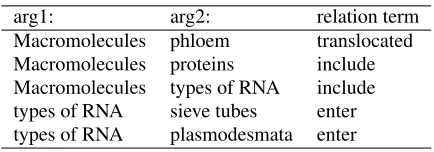
For example the sentence, “Macromolecules translocated through the phloem include proteins and various types of RNA that enter the sieve tubes through plasmodesmata.” has five binary relations.
arg1: arg2: relation term
Macromolecules phloem translocated Macromolecules proteins include Macromolecules types of RNA include types of RNA sieve tubes enter types of RNA plasmodesmata enter
We find an average of 4.0 verb-mediated relations and 0.3 noun-mediated relations per sentence.
Eval-uatingOLLIEagainst this gold standard helps to
an-swer the question of absolute recall: what percent-age of binary relations expressed in a sentence can our systems identify.
For comparison, we use a state-of-the-art SRL system from Lund University (Johansson and Nugues, 2008), which is trained on PropBank (Martha and Palmer, 2002) for its verb-frames and NomBank (Meyers et al., 2004) for noun-frames. The PropBank version of the system won the very competitive 2008 CONLL SRL evaluation.
We conduct this experiment by manually
[image:9.612.316.536.57.102.2]compar-LUND OLLIE union Verb relations 0.58 (0.69) 0.49 (0.55) 0.71 (0.83) Noun relations 0.07 (0.33) 0.13 (0.13) 0.20 (0.33) All relations 0.54 (0.67) 0.47 (0.52) 0.67 (0.80)
Figure 9: Recall ofLUNDandOLLIEon binary relations. In parentheses is recall with oracle co-reference. Both systems identify approximately half of all argument pairs, but have lower recall on noun-mediated relations.
ing the outputs ofLUNDandOLLIEagainst the gold
standard. For each pair of NPs in the gold standard we determine whether the systems find a relation with that pair of NPs as arguments. Recall is based on the percentage of NP pairs where the head nouns matches head nouns of two different arguments in an extraction or semantic frame. If the argument value is conjunctive, we count a match against the head noun of each item in the list. We also count cases where system output would match the gold standard, given perfect co-reference.
Figure 9 shows the recall for OLLIE and LUND,
with recall based on oracle co-referential matches
in parentheses. Our analysis shows strong recall
for both systems for verb-mediated relations: LUND
finding about two thirds of the argument pairs and
OLLIE finding over half. Both systems have low recall for noun-mediated relations, with most of
LUND’s recall requiring co-reference. We observe
that a union of the two systems raises recall to 0.71 for verb-mediated relations and 0.83 with co-reference, demonstrating that each system is identi-fying argument pairs that the other missed.
It is not surprising that OLLIE has recall of
ap-proximately 0.5, since it is tuned for high precision extraction, and avoids less reliable extractions from constructions such as reduced relative clauses and gerunds, or from noun-mediated relations with long-range dependencies. In contrast, SRL is tuned to identify the argument structure for nearly all verbs and nouns in a sentence. The missing recall from SRL is primarily where it does not identify both ar-guments of a binary relation, or where the correct argument is buried in a long argument phrase, but is not its head noun.
It is surprising that LUND, trained on
[image:9.612.76.293.438.514.2]tar-get relation is between Clarcor and the products it
makes. LUNDidentifies a framemaker.01 in which
argument A0 has head noun ‘maker’ and A1 is a PP headed by ‘products’, missing the actual name of the
maker without co-reference post-processing. OLLIE
finds the extraction (Clarcor; be a maker of; packag-ing and filtration products) where the heads of both arguments matched those of the target. In another
example,LUNDidentifies “his” and “brother” as the
arguments of the frame brother.01, rather than the
actual names of the two brothers.
We can draw several conclusions from this exper-iment. First, nouns, although less frequently mediat-ing relations, are much harder and both systems are
failing significantly on those – OLLIE is somewhat
better. Two, neither systems dominates the other; in fact, recall is increased significantly by a union of the two. Three, and probably most importantly, significant information is still being missed by both systems, and more research is warranted.
6 Related Work
There is a long history of bootstrapping and pat-tern learning approaches in traditional
informa-tion extracinforma-tion, e.g., DIPRE (Brin, 1998),
Snow-Ball (Agichtein and Gravano, 2000), Espresso (Pan-tel and Pennacchiotti, 2006), PORE (Wang et al., 2007), SOFIE (Suchanek et al., 2009), NELL (Carl-son et al., 2010), and PROSPERA (Nakashole et al., 2011). All these approaches first bootstrap data based on seed instances of a relation (or seed data from existing resources such as Wikipedia) and then learn lexical or lexico-POS patterns to create an ex-tractor. Other approaches have extended these to learning patterns based on full syntactic analysis of a sentence (Bunescu and Mooney, 2005; Suchanek et al., 2006; Zhao and Grishman, 2005).
OLLIEhas significant differences from the
previ-ous work in pattern learning. First, and most impor-tantly, these previous systems learn an extractor for
each relation of interest, whereasOLLIE is an open
extractor. OLLIE’s strength is its ability to
gener-alize from one relation to many other relations that are expressed in similar forms. This happens both via syntactic generalization and type generalization of relation words (sections 3.2.1 and 3.2.2). This ca-pability is essential as many relations in the test set are not even seen in the training set – in early
exper-iments we found that non-generalized pattern learn-ing (equivalent to traditional IE) had significantly less yield at a slightly higher precision.
Secondly, previous systems begin with seeds that consist of a pair of entities, whereas we also
in-clude the content words from REVERB relations in
our training seeds. This results in a much higher precision bootstrapping set and high rule preci-sion while still allowing morphological variants that cover noun-mediated relations. A third difference is in the scale of the training – REVERByields millions of training seeds, where previous systems had orders
of magnitude less. This enablesOLLIEto learn
pat-terns with greater coverage.
The closest to our work is the pattern learning
based open extractor WOEparse. Section 3.4
de-tails the differences between the two extractors. An-other extractor, StatSnowBall (Zhu et al., 2009), has an Open IE version, which learns general but shal-low patterns. Preemptive IE (Shinyama and Sekine, 2006) is a paradigm related to Open IE that first groups documents based on pairwise vector cluster-ing, then applies additional clustering to group en-tities based on document clusters. The clustering steps make it difficult for it to scale to large corpora.
7 Conclusions
Our work describes OLLIE, a novel Open IE
ex-tractor that makes two significant advances over
the existing Open IE systems. First, it expands
the syntactic scope of Open IE systems by identi-fying relationships mediated by nouns and adjec-tives. Our experiments found that for some rela-tions this increases the number of correct
extrac-tions by two orders of magnitude. Second, by
an-alyzing the context around an extraction, OLLIE is
able to identify cases where the relation is not as-serted as factual, but is hypothetical or conditionally
true. OLLIE increases precision by reducing
con-fidence in those extractions or by associating addi-tional context in the extractions, in the form of
at-tribution and clausal modifiers. Overall, OLLIE
ob-tains 1.9 to 2.7 times more area under precision-yield curves compared to existing state-of-the-art
open extractors. OLLIEis available for download at
Acknowledgments
This research was supported in part by NSF grant IIS-0803481, ONR grant N00014-08-1-0431, DARPA contract FA8750-09-C-0179 and the Intelligence Advanced Research Projects Ac-tivity (IARPA) via Air Force Research Laboratory (AFRL) con-tract number FA8650-10-C-7058. The U.S. Government is au-thorized to reproduce and distribute reprints for Governmen-tal purposes notwithstanding any copyright annotation thereon. The views and conclusions contained herein are those of the au-thors and should not be interpreted as necessarily representing the official policies or endorsements, either expressed or im-plied, of IARPA, AFRL, or the U.S. Government. This research is carried out at the University of Washington’s Turing Center.
We thank Fei Wu and Dan Weld for providing WOE’s code and Anthony Fader for releasing REVERB’s code. Peter Clark, Alan Ritter, and Luke Zettlemoyer provided valuable feedback on the research and Dipanjan Das helped us with state-of-the-art SRL systems. We also thank the anonymous reviewers for their comments on an earlier draft.
References
E. Agichtein and L. Gravano. 2000. Snowball: Ex-tracting relations from large plain-text collections. In
Procs. of the Fifth ACM International Conference on Digital Libraries.
ARPA. 1991. Proc. 3rd Message Understanding Conf.
Morgan Kaufmann.
ARPA. 1998. Proc. 7th Message Understanding Conf.
Morgan Kaufmann.
M. Banko, M. Cafarella, S. Soderland, M. Broadhead, and O. Etzioni. 2007. Open information extraction from the Web. InProcs. of IJCAI.
S. Brin. 1998. Extracting Patterns and Relations from the World Wide Web. InWebDB Workshop at 6th Interna-tional Conference on Extending Database Technology, EDBT’98, pages 172–183, Valencia, Spain.
Razvan C. Bunescu and Raymond J. Mooney. 2005. A shortest path dependency kernel for relation extrac-tion. InProc. of HLT/EMNLP.
Andrew Carlson, Justin Betteridge, Bryan Kisiel, Burr Settles, Estevam R. Hruschka Jr., and Tom M. Mitchell. 2010. Toward an architecture for never-ending language learning. InProcs. of AAAI.
Janara Christensen, Mausam, Stephen Soderland, and Oren Etzioni. 2011. An analysis of open informa-tion extracinforma-tion based on semantic role labeling. In
Proceedings of the 6th International Conference on Knowledge Capture (K-CAP ’11).
Paul R. Cohen. 1995. Empirical Methods for Artificial Intelligence. MIT Press.
Ido Dagan, Lillian Lee, and Fernando C. N. Pereira. 1999. Similarity-based models of word cooccurrence probabilities. Machine Learning, 34(1-3):43–69.
Marie-Catherine de Marneffe, Bill MacCartney, and Christopher D. Manning. 2006. Generating typed de-pendency parses from phrase structure parses. In Lan-guage Resources and Evaluation (LREC 2006). Oren Etzioni, Anthony Fader, Janara Christensen,
Stephen Soderland, and Mausam. 2011. Open infor-mation extraction: the second generation. In Proceed-ings of the International Joint Conference on Artificial Intelligence (IJCAI ’11).
Anthony Fader, Stephen Soderland, and Oren Etzioni. 2011. Identifying relations for open information ex-traction. InProceedings of EMNLP.
Raphael Hoffmann, Congle Zhang, and Daniel S. Weld. 2010. Learning 5000 relational extractors. In Pro-ceedings of the 48th Annual Meeting of the Association for Computational Linguistics, ACL ’10, pages 286– 295.
Raphael Hoffmann, Congle Zhang, Xiao Ling, Luke S. Zettlemoyer, and Daniel S. Weld. 2011. Knowledge-based weak supervision for information extraction of overlapping relations. InACL, pages 541–550. Richard Johansson and Pierre Nugues. 2008. The
ef-fect of syntactic representation on semantic role label-ing. In Proceedings of the 22nd International Con-ference on Computational Linguistics (COLING 08), pages 393–400.
Paul Kingsbury Martha and Martha Palmer. 2002. From treebank to propbank. InProceedings of the Third In-ternational Conference on Language Resources and Evaluation (LREC 02).
A. Meyers, R. Reeves, C. Macleod, R. Szekely, V. Zielin-ska, B. Young, and R. Grishman. 2004. Annotating Noun Argument Structure for NomBank. In Proceed-ings of LREC-2004, Lisbon, Portugal.
Mike Mintz, Steven Bills, Rion Snow, and Dan Jurafsky. 2009. Distant supervision for relation extraction with-out labeled data. In ACL-IJCNLP ’09: Proceedings of the Joint Conference of the 47th Annual Meeting of the ACL and the 4th International Joint Conference on Natural Language Processing of the AFNLP: Volume 2, pages 1003–1011.
Ndapandula Nakashole, Martin Theobald, and Gerhard Weikum. 2011. Scalable knowledge harvesting with high precision and high recall. InProceedings of the Fourth International Conference on Web Search and Web Data Mining (WSDM 2011), pages 227–236. Joakim Nivre and Jens Nilsson. 2004. Memory-based
dependency parsing. InProceedings of the Conference on Natural Language Learning (CoNLL-04), pages 49–56.
44th Annual Meeting of the Association for Computa-tional Linguistics (ACL’06).
P. Resnik. 1996. Selectional constraints: an information-theoretic model and its computational realization.
Cognition.
Sebastian Riedel, Limin Yao, and Andrew McCallum. 2010. Modeling relations and their mentions without labeled text. InECML/PKDD (3), pages 148–163. Alan Ritter, Mausam, and Oren Etzioni. 2010. A latent
dirichlet allocation method for selectional preferences. InProceedings of the 48th Annual Meeting of the As-sociation for Computational Linguistics (ACL ’10). Karin Kipper Schuler. 2006. VerbNet: A
Broad-Coverage, Comprehensive Verb Lexicon. Ph.D. thesis, University of Pennsylvania.
Y. Shinyama and S. Sekine. 2006. Preemptive informa-tion extracinforma-tion using unrestricted relainforma-tion discovery. InProcs. of HLT/NAACL.
Fabian M. Suchanek, Georgiana Ifrim, and Gerhard Weikum. 2006. Combining linguistic and statistical analysis to extract relations from web documents. In
Procs. of KDD, pages 712–717.
Fabian M. Suchanek, Mauro Sozio, and Gerhard Weikum. 2009. Sofie: a self-organizing framework for information extraction. In Proceedings of WWW, pages 631–640.
Gang Wang, Yong Yu, and Haiping Zhu. 2007. Pore: Positive-only relation extraction from wikipedia text. In Proceedings of 6th International Semantic Web Conference and 2nd Asian Semantic Web Conference (ISWC/ASWC’07), pages 580–594.
Fei Wu and Daniel S. Weld. 2010. Open information extraction using Wikipedia. InProceedings of the 48th Annual Meeting of the Association for Computational Linguistics (ACL ’10).
Shubin Zhao and Ralph Grishman. 2005. Extracting re-lations with integrated information using kernel meth-ods. InProcs. of ACL.