Abstract —Simply supported nonlinear beam resting on linear elastic foundation and subjected to harmonic loading is investigated. Parametric study is carried out in the view of the linear model of the problem. Hamilton’s principle is utilized in deriving the governing equations. Well known forced duffing oscillator equation is obtained. The equation is analyzed numerically using Runk-Kutta technique. Three main parameters are investigated: the damping coefficient, the natural frequency, and the coefficient of the nonlinear term. Stability regions are unveiled.
Index Terms— Elastic Foundation, Nonlinear Beam,
Parametric Study.
I. INTRODUCTION
There are many applications for beam on elastic foundation mainly in mechanical and civil engineering e.g. disc brake pad, shafts supported on ball, roller, or journal bearings, vibrating machines on elastic foundations, network of beams in the construction of floor systems for ships, buildings, and bridges, submerged floating tunnels, buried pipelines, railroad tracks etc. The elastic foundation for the beam part is supplied by the resilience of the adjoining portions of a continuous elastic structure. More details of the applications of this concept are discussed by Hetenyi [1]. Beams on elastic foundations received great attention of researches due to its wide applications in engineering. Hetenyi [1] and Timoshenko [2] presented an analytical solution for beams on elastic supports using classical differential equation approach, and considering several loading and boundary conditions.
It is well known in engineering that a beam supported by discrete elastic supports spaced at equal intervals acts analogously to a beam on an elastic foundation and that the appropriateness of that analogy depends on the flexural rigidity of the beam as well as the stiffness and spacing of the supports. Ellington investigated conditions under which a beam on discrete elastic supports could be treated as equivalent to a beam on elastic foundation [3].
Beams resting on elastic foundations have been studied extensively over the years due to the wide application of this system in engineering. This system according to the literature can be divided at least into three categories. The first category is “linear beam on linear elastic foundation”. Example of this type can be found in references [4]-[18]. The applications in this category include but not limited to Euler - Bernoulli beam, Timoshenko beam, Winkler foundation, Pasternak foundation, tensionless foundation,
1
Mechanical and Industrial Engineering Department, College of Engineering, Sultan Qaboos University, PO Box 33, Al Khoud 123, Muscat, Oman, Fax: 2414-1316, Phone: 2414-2675, or, +968-2414-2655, [email protected]. On Leave from Mechanical Engineering Department, Faculty of engineering and Technology, University of Jordan, Amman 11942, Jordan.
single parameter or two parameter foundation, static loading, harmonic loading and moving loading.
The second category is “linear beam on nonlinear elastic foundation” [18]-[24]. In this category the foundation is considered to have nonlinear stiffness. Also this type includes different boundary and loading conditions according to the engineering application.
The third category is nonlinear beam on linear elastic foundation [25]-[37]. Usually the beam nonlinearity means large deflections. Most of the studies related to this category have analyzed the system either using boundary element method or boundary integral equation method. Similar to the above two categories, there is wide variety of boundary and loading conditions being applied to such system according to the application.
Nonlinear beam subjected to harmonic distributed load resting on linear elastic foundation is investigated in this research. The study is carried out in the view of the linearized model of the system. Well known duffing equation is obtained using Hamilton’s principle. Three main parameters are investigated: the damping coefficient, the natural frequency, and the coefficient of the nonlinear term. The effect of these parameters on the system stability is unveiled. Up to the author’s knowledge, this work is not published in the literature.
II. PROBLEM STATEMENT
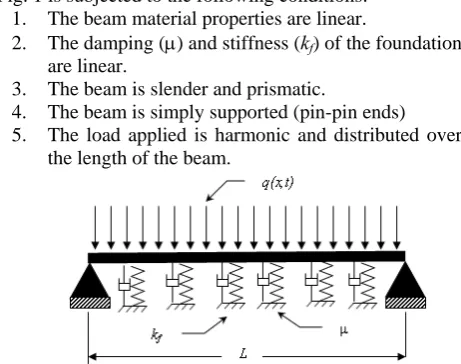
Nonlinear beam resting on elastic foundation that is shown in Fig. 1 is subjected to the following conditions:
1. The beam material properties are linear.
2. The damping () and stiffness (kf) of the foundation
are linear.
3. The beam is slender and prismatic.
4. The beam is simply supported (pin-pin ends)
5. The load applied is harmonic and distributed over
the length of the beam.
[image:1.595.317.548.493.675.2]
Fig. 1: schematic drawing of the beam on elastic foundation.
III. MATHEMATICAL FORMULATION
A. Kinetic Energy
The rotary inertia of the beam will be neglected since the beam is slender.
Dynamics of Nonlinear Beam on Elastic
Foundation
1
2 2 (1)
Where : material density, A: beam cross sectional area, L:
beam length, w=w(x,t): beam transverse displacement (in
y-direction).
B. Potential Energy:
The potential energy due to bending can be calculated as the following:
1 2
2
(2)
Where
The formulation of the due to stretching potential energy can be casted as the following [38]:
2 1
2 (3)
The elastic foundation is assumed to have constant linear spring modulus. This results in,
1
2 (4)
The load is uniform along the length of the beam and varies harmonically with respect to time. Therefore,
, . ,
. . . ,
(5)
Where P: amplitude of excitation and e: excitation
frequency
C. Derivation of governing equation
The lagrangian is defined as the following:
1 2
2 sin
2 1 2
By applying Hamilton’s principle
0
1 2
2 sin
2 1
2 0
Denote the first and the second integral by F1 and F2
respectively. This gives
0
Integrating the first and the second term by parts with
respect to x the result is the following equation:
2
2
2 sin
2
2
2
2
2 0
(6)
Since is arbitrary, the following can be concluded from
the above equation:
The governing equation comes from setting the expression within the brackets in (6) equal to zero. Upon carrying out the indicated differentiations, the governing can be rewritten as
,
sin (7)
where ,
2
It is obvious that (7) is the duffing oscillator equation. This equation is going to be recasted into a more familiar form in the next section. The boundary and initial conditions can be obtained from the remaining terms in (6).
The boundary conditions at x=0 and x=L are
Either ′′is zero or w is prescribed (8a)
Either ′′is zero or w is prescribed (8b)
Either 2
′ is zero or w is prescribed (8c)
Boundary conditions (8a) correspond to end moments and
slopes respectively. In (8b), w corresponds to end
pre-stretching. For the pinned ends, the boundary conditions are:
0 0
0 0
These boundary conditions must be satisfied by the mode shapes of the system. This fact will be used in the following sections as the criteria for selecting the form of the mode shape equation.
Finally the initial conditions for are
Either
2 is zero or is prescribed
In this case, it will be assumed that the system starts from rest i.e. the initial displacement and velocity is zero.
D. Discretization and linearization
The following expression is used for w(x, t) in order to
discretize the problem
, (9)
For simplicity the limits of the above summation, the
subscript of w, and the time dependence of w will be implied
in the equations that follow. It is evident from (9) that the pinned ends boundary condition (8a) are satisfied since transverse displacements at 0 and L are zero, and the end slopes are free (implying zero bending moments at the ends). Equation (9) represents series summation of N modes
each has time dependent amplitude response, with
spatial sine function. Substituting (9) into the original integral expressions for the kinetic and potential energy of (1) through (5) then applying the Lagrangian and utilizing the orthogonality, the following equation comes out:
4 4
32
4
(10)
Lagrangian’s equation for each mode can be written as the following:
0 1,2, … … , (11)
Substituting (10) in (11) and carry out the differentiation yields,
2 2 2
8 0
(12)
A simplified form of (12) results after rearranging the coefficients and defining some new coefficients. The concise form and the coefficient definitions are
wn+ ω02n4 1+ 1
4 0 (13)
Where
ω02 ωf2
ω02 ωf2
Writing (13) for a single mode and inserting the linear damping term gives,
wn+ 2μ ω02n4 1+ 1
4 0 (14)
Where µ is the damping coefficient
This makes it clear that the above equation represent unforced damped duffing oscillator. Recasting (14) into the following:
+ 2μ 0 (15)
Where ω02n4 1+ 1
4
In order to linearize the system for the first mode (n=1) the
system is converted into first order ordinary differential equations by the following substitution
→ →
Applying this to (15)
, 2μ − −
0 , 2μ − − 0
From the above equations it is obvious that (0, 0) is the only critical point for the system. So the equivalent linear system is obtained by expanding the above equation using Taylor series about (0, 0), so the remaining linear terms are
, 2μ −
The corresponding Jacobi matrix is
0 1
− 2μ
So the Eigenvalues of J are
,
0, 2μ
μ
The following can be said about (0, 0):
Stable and attractive as long as 0.
Stable if 0.
Unstable if 0.
A node as long as 0
A spiral point if 0
A center if 0
The general solution of the linearized unforced system is
√ √
Applying the initial conditions 0 , 0 the
constants of integration are going to be as the following:
√
2√
√
2√
E. Simulation of the nonlinear system
2μ sin (16)
where
ω02n4 1+ ωf2
ω02,
1
4
ω02 , 1, ωf2 ,
It is obvious that the strength of the nonlinearity is inversely proportional to the square of the radius of gyration of the beam. This indicates that the nonlinearity remains weak as long as the beam is relatively slender as assumed in this study. Finally, the frequency equation can be simplified to
The apparent natural frequency of the system is the square root of the sum of the squares of the natural frequencies of the beam and the elastic foundation.
The nonlinear second order ordinary differential equation is converted into a system of first order ordinary differential equations. This is suitable for numerical study using Runge-Kutta Techniques.
sin − 2μ − −
IV. RESULTS AND DISCUSSION
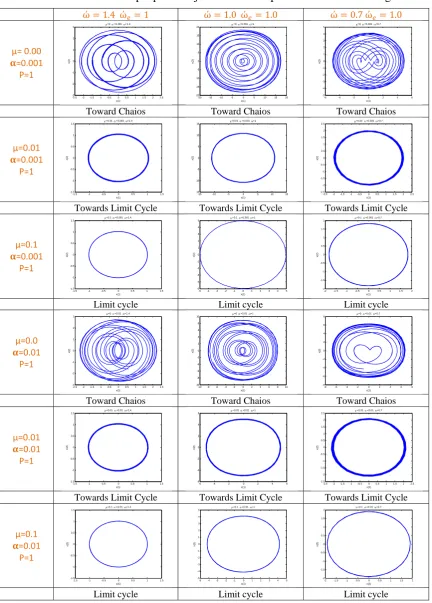
The results for simply supported beam on elastic foundation are presented in Tables I and II. Table I represents sample phase diagrams of the studied ranges. Table II shows the time response for toward chaos cases that are presented in Table I. The phase diagram and the time response are collected after long period of time to be sure that the system has passed the transient range. The duffing (16) is solved using MATLAB package by utilizing the Runga-Kutta ODE (Ordinary Differential Equation) solver. The equation which represents the system under investigation is of cubic nonlinearity with harmonic excitation.
The sample results present the effect of the damping when the system has weak, medium and strong nonlinearity for excitation frequencies below, at and above resonance. The whole study is considering weak nonlinearity that does not
exceed =0.1 and those levels of weak, medium and strong
within that range. Only the first mode is considered in this study. The parameters range covered in this investigation are
for =0.0 through 0.1, = 0.001 through 0.1 and natural
frequency = 0.7 through 1.4. It can be seen from Table I
that when there is no damping the system is tending toward chaos however when little damping is applied the system is tending towards limit cycle.
It is obvious that the damping and the nonlinearity are the most effective parameters in controlling the chaotic behavior of the system. As long as the radius of gyration for the beam under consideration is large i.e., the beam is more towards slender, the nonlinearity is going to be weak. This means that the contribution of the stretching energy to the behavior of the system is going to be low. The damping system dissipates the oscillating energy and provides a control over the system behavior. For the linear system, as long as damping coefficient is positive, the transient response is going to decrease exponentially and the homogenous response (due to the forcing excitation) is bounded even at resonance. For undamped linear system homogenous response is not bounded and the response is increasing with time. For the nonlinear system, the response is tending
toward chaos as it can be seen in table 1 for =0.0. However
when the damping increases the system is transferring from chaos to limit cycle. For the resonance case of no damping i.e., the excitation frequency equals the natural frequency, the linear system has increasing amplitude response whereas the nonlinear system is tending toward chaos with bounded amplitude. Also for the nonlinear case (within the range of investigation) as long as there is no damping the system is tending toward chaos.
V. CONCLUSION
The behavior of nonlinear beam on elastic foundation is unveiled. It is found that the system is stable and controllable as long as the damping coefficient is non zero
and positive. As the nonlinearity increases more damping is required to prevent it from moving towards chaos. For first mode shape the natural frequency could be calculated as square root of the sum of squares of both natural frequency of the beam and the foundation. The strength of the nonlinearity is inversely proportional to the square of the radius of gyration, i.e. as long as the beam more towards slender the nonlinearity is weaker. The stretching potential energy is responsible for generating the cubic nonlinearity in the system.
VI. REFERENCES
[1] M. Hetenyi, Beams on elastic foundations. Ann Arbor, MI: University of Michigan Press; 1946, 1961.
[2] S. Timoshenko’ Strength of materials, Part II, advanced theory and problems. Third ed. Princeton, NJ: Van Nostrand; 1956. [3] J.P. Ellington, “The beam on discrete elastic supports”, Bulletin
of the International Railway Congress Association, vol. 34, no. 12, 1957, pp. 933–941.
[4] Sato Motohiro, Kanie Shunji and Mikami Takashi, “Structural modeling of beams on elastic foundations with elasticity couplings”, Mechanics Research Communications, vol. 34, 2007, pp. 451–459.
[5] C. Miranda and K. Nair, “Finite beams on elastic foundation”,
ASCE Journal of Structure Division, vol. 92, 1966, pp. 131-142. [6] T. M. Wang and J. E., “Stephens Natural frequencies of
Timoshenko beams on Pasternak foundations”, Journal of Sound and Vibration, vol. 39, 1977, pp. 149-155.
[7] T. M. Wang and L. W., “Gagnon Vibrations of continuous Timoshenko beams on Winkler-Pasternak foundations”, Journal
of Sound and Vibration, vol. 51, 1977, pp. 149-155.
[8] M. Eisenberger and J. Clastornik, “Beams on variable two-parameter elastic foundation”, Computers and Structures, vol. 23, 1986, pp. 351-356.
[9] Wang C M, Lam K Y, He X O. Exact solution for Timoshenko beams on elastic foundations using Green’s functions. Mechanics of Structures & Machines, 1998, 26 101-113. [10] T. M. Wang and J. E. Stephens, “Natural frequencies of
Timoshenko beams on Pasternak foundations”, Journal of
Sound and Vibration, vol. 39, 1977, pp. 149-155.
[11] T. M. Wang and L. W. Gagnon, “Vibrations of continuous Timoshenko beams on Winkler-Pasternak foundations”, Journal of Sound and Vibration, vol. 51, 1977, pp. 149-155.
[12] M. Eisenberger and J. Clastornik, “Beams on variable two-parameter elastic foundation”, Computers and Structures, vol. 23, 1986, pp. 351-356.
[13] R. H. Gutierrez, P. A. Laura and R. E. Rossi, “Fundamental frequency of vibration of a Timoshenko beam of non-uniform thickness”, Journal of Sound and Vibration, vol. 145, 1991, pp. 241-245.
[14] W. L. Cleghorn and B. Tabarrok, “Finite element formulation of tapered Timoshenko beam for free lateral vibration analysis”,
Journal of Sound and Vibration, vol. 152, 1992, pp. 461-470. [15] Faruk Fırat Çalım, “Dynamic analysis of beams on viscoelastic
foundation”, European Journal of Mechanics A/Solids, vol. 28, 2009, pp. 469–476
[16] L. SUN, “A Closed-Form Solution Of A Bernoulli-Euler Beam On A Viscoelastic Foundation Under Harmonic Line Loads”,
Journal of Sound and vibration, vol. 242, no. 4, 2001, pp. 619-627
[17] Seong-Min Kim, “Stability and dynamic response of Rayleigh beam–columns on an elastic foundation under moving loads of constant amplitude and harmonic variation”, Engineering
Structures, vol. 27, 2005, pp. 869–880.
[18] Garinei, “Vibrations of simple beam-like modelled bridge under harmonic moving loads”, International Journal of Engineering Science, vol. 44, 2006, pp. 778–787
[19] MO Yihua, OU Li and ZHONG Hongzhi, “Vibration Analysis of Timoshenko Beams on a Nonlinear Elastic Foundation”,
Tsinghua Science And Technology, vol. 14, No. 3, June 2009, pp. 322-326.
[20] F. W. Beaufait and P. W. Hoadley, “Analysis of elastic beams on nonlinear foundations’, Computers and Structures, vol. 12, 1980, pp. 669-676.
[22] N. R. Naidu and G. V. Rao, “Free vibration and stability behavior of uniform beams and columns on non-linear elastic foundation”, Computers & Structures, vol. 58, 1996, pp. 1213-1215.
[23] N. Rajasekhara Naidu and G. Venkateswara Rao, “Free Vibration And Stability Behaviour Of Uniform Beams And Columns On Nonlinear Elastic Foundation”, Computers & Structures, vol. 58, No. 6, 1996, pp. 1213-1215.
[24] Pellicano and F. Mastroddi, “Nonlinear Dynamics of a Beam on Elastic Foundation”, Nonlinear Dynamics, vol. 14, 1997, pp.335–355.
[25] Ashraf Ayoub, “Mixed formulation of nonlinear beam on foundation elements”, Computers and Structures, vol. 81, 2003, pp. 411–421.
[26] J. T. Katsikadelis, and A. E. Armenakas, “Analysis of clamped plates on elastic foundation by boundary integral equation method”, Transactions of the ASME, vol. 51, 1984, pp. 574-580. [27] J. Puttonen and P. Varpasuo, “Boundary element analysis of a
plate on elastic foundations’ International Journal of Numerical
Methods in Engineering, vol. 23, 1986, pp. 287-303.
[28] T. Horibe, “An analysis for large deflection problems of beams on elastic foundations by boundary integral equation method”,
Transaction of Japan Society of Mechanical Engineers (JSME), vol. 53, No. 487, A, 1987, pp. 622-629.
[29] E. J. Sapountakis and J. T. Katsikadelis, “Unilaterally supported plates on elastic foundations by Boundary element method”,
Transactions of American Society of Mechanical Engineers (ASME), vol. 59, 1992, pp. 580-586.
[30] Horibe, T., “Boundary Integral Equation Method Analysis for Beam-Columns on Elastic Foundation”, Transaction of Japan Society of Mechanical Engineers (JSME), vol. 62, No. 601, A, 1996, pp 2067-2071.
[31] Tadashi Horibe and Naoki Asano, “Large Deflection Analysis of Beams on Two-Parameter Elastic Foundation Using the Boundary Integral Equation Method”, JSME International Journal, A, vol. 44, No. 2, 2001, pp. 231-236
[32] N. Kamiya, and Y. Sawaki, “An Integral Equation Approach to Finite Deflection of Elastic Plates, Load-deflection curves of beam on Pasternak foundation (C-C, y=100)” International
Journal Non-Linear Mechanics, vol. 17, No. 3, 1984, pp. 187-194.
[33] S. Miyake, M. Nonaka, and N. Tosaka, “Geometrically Nonlinear Bifurcation Analysis of Elastic Arch by the Boundary-Domain Element Method”, Boundary Elements XII, vol. 1, 1990, pp. 503-514.
[34] Ashraf Ayoub, “Mixed formulation of nonlinear beam on foundation elements”, Computers and Structures, vol. 81, 2003, pp. 411–421.
[35] S. Lenci and A. M. Tarantino, “Chaotic Dynamics of an Elastic Beam Resting on a Winkler-type Soil”, Chaos, Solutions & Fractals, vol. 7, No. 10, 1996, pp. 160-1614,
[36] B. Kang and C.A. Tan, “Nonlinear response of a beam under distributed moving contact load”, Communications in Nonlinear Science and Numerical Simulation, vol. 11, 2006, pp. 203–232. [37] I Coskun and H. Engin, “Non-Linear Vibrations of a Beam on
an Elastic Foundation”, Journal of Sound and Vibration, vol. 223, no. 3, 1999, pp. 335-354.
[38] I. Shames, and C. Dym, Energy and finite element methods in
Table I: Presentation of sample phase trajectories for the parameters under investigation.
ώ 1.4 ώ 1 ώ 1.0 ώ 1.0 ώ 0.7 ώ 1.0
µ= 0.00 =0.001 P=1
Toward Chaios Toward Chaios Toward Chaios
µ=0.01 =0.001 P=1
Towards Limit Cycle Towards Limit Cycle Towards Limit Cycle
µ=0.1 =0.001 P=1
Limit cycle Limit cycle Limit cycle
µ=0.0 =0.01 P=1
Toward Chaios Toward Chaios Toward Chaios
µ=0.01 =0.01 P=1
Towards Limit Cycle Towards Limit Cycle Towards Limit Cycle
µ=0.1 =0.01 P=1
Limit cycle Limit cycle Limit cycle
-2.5 -2 -1.5 -1 -0.5 0 0.5 1 1.5 2 2.5 -3 -2 -1 0 1 2 3
=0 =0.001 =1.4
x(1)
x(
2
)
-20 -15 -10 -5 0 5 10 15 20
-20 -15 -10 -5 0 5 10 15 20
=0 =0.001 =1
x(1)
x(
2
)
-6 -4 -2 0 2 4 6
-5 -4 -3 -2 -1 0 1 2 3 4 5
=0 =0.001 =0.7
x(1)
x(
2
)
-1.5 -1 -0.5 0 0.5 1 1.5
-1.5 -1 -0.5 0 0.5 1 1.5
=0.01 =0.001 =1.4
x(1)
x(
2
)
-15 -10 -5 0 5 10 15
-15 -10 -5 0 5 10 15
=0.01 =0.001 =1
x(1)
x(
2
)
-2.5 -2 -1.5 -1 -0.5 0 0.5 1 1.5 2 2.5 -2.5 -2 -1.5 -1 -0.5 0 0.5 1 1.5 2 2.5
=0.01 =0.001 =0.7
x(1)
x(
2
)
-1.5 -1 -0.5 0 0.5 1 1.5
-1.5 -1 -0.5 0 0.5 1
1.5 =0.1 =0.001 =1.4
x(1)
x(
2
)
-5 -4 -3 -2 -1 0 1 2 3 4 5
-5 -4 -3 -2 -1 0 1 2 3 4
5 =0.1 =0.001 =1
x(1)
x(
2
)
-2 -1.5 -1 -0.5 0 0.5 1 1.5 2 -2 -1.5 -1 -0.5 0 0.5 1 1.5
2 =0.1 =0.001 =0.7
x(1)
x(
2
)
-2.5 -2 -1.5 -1 -0.5 0 0.5 1 1.5 2 2.5 -3 -2 -1 0 1 2 3
=0 =0.01 =1.4
x(1)
x(
2
)
-10 -8 -6 -4 -2 0 2 4 6 8 10
-10 -8 -6 -4 -2 0 2 4 6 8 10
=0 =0.01 =1
x(1)
x(
2
)
-8 -6 -4 -2 0 2 4 6 8
-8 -6 -4 -2 0 2 4 6 8
=0 =0.01 =0.7
x(1)
x(
2
)
-1.5 -1 -0.5 0 0.5 1 1.5
-1.5 -1 -0.5 0 0.5 1 1.5
=0.01 =0.01 =1.4
x(1)
x(
2
)
-6 -4 -2 0 2 4 6
-6 -4 -2 0 2 4 6
=0.01 =0.01 =1
x(1)
x(
2
)
-2.5 -2 -1.5 -1 -0.5 0 0.5 1 1.5 2 2.5 -2.5 -2 -1.5 -1 -0.5 0 0.5 1 1.5 2 2.5
=0.01 =0.01 =0.7
x(1)
x(
2
)
-1.5 -1 -0.5 0 0.5 1 1.5
-1.5 -1 -0.5 0 0.5 1
1.5 =0.1 =0.01 =1.4
x(1)
x(
2
)
-5 -4 -3 -2 -1 0 1 2 3 4 5
-5 -4 -3 -2 -1 0 1 2 3 4
5 =0.1 =0.01 =1
x(1)
x(
2
)
-2 -1.5 -1 -0.5 0 0.5 1 1.5 2 -2 -1.5 -1 -0.5 0 0.5 1 1.5
2 =0.1 =0.01 =0.7
x(1)
x(
2
µ=0.00 =0.1 P=1
Toward Chaios Toward Chaios Toward Chaios
µ=0.01 =0.1 P=1
Towards Limit Cycle Towards Limit Cycle Towards Limit Cycle
µ=0.1 =0.1 P=1
Limit cycle Limit cycle Limit cycle
Table II: Illustration of time response of the chaotic cases.
ώ 1.4 ώ 1 ώ 1.0 ώ 1.0 ώ 0.7 ώ 1.0
µ= 0.00 =0.001 P=1 µ=0.0 =0.01 P=1 µ=0.00 =0.1 P=1
-2 -1.5 -1 -0.5 0 0.5 1 1.5 2 -3 -2 -1 0 1 2
3 =0 =0.1 =1.4
x(1)
x(
2
)
-4 -3 -2 -1 0 1 2 3 4
-5 -4 -3 -2 -1 0 1 2 3 4
5 =0 =0.1 =1
x(1)
x(
2
)
-5 -4 -3 -2 -1 0 1 2 3 4 5
-6 -4 -2 0 2 4
6 =0 =0.1 =0.7
x(1)
x(
2
)
-1 -0.8-0.6 -0.4 -0.2 0 0.2 0.4 0.6 0.8 1 -1 -0.8 -0.6 -0.4 -0.2 0 0.2 0.4 0.6 0.8 1
=0.01 =0.1 =1.4
x(1)
x(
2
)
-2.5 -2 -1.5 -1 -0.5 0 0.5 1 1.5 2 2.5 -2.5 -2 -1.5 -1 -0.5 0 0.5 1 1.5 2 2.5
=0.01 =0.1 =1
x(1)
x(
2
)
-4 -3 -2 -1 0 1 2 3 4
-3 -2 -1 0 1 2 3
=0.01 =0.1 =0.7
x(1)
x(
2
)
-1 -0.8 -0.6 -0.4 -0.2 0 0.2 0.4 0.6 0.8 1 -1 -0.8 -0.6 -0.4 -0.2 0 0.2 0.4 0.6 0.8 1
=0.1 =0.1 =1.4
x(1)
x(
2
)
-2.5 -2 -1.5 -1 -0.5 0 0.5 1 1.5 2 2.5 -2.5 -2 -1.5 -1 -0.5 0 0.5 1 1.5 2 2.5
=0.1 =0.1 =1
x(1)
x(
2
)
-4 -3 -2 -1 0 1 2 3 4
-3 -2 -1 0 1 2 3
=0.1 =0.1 =0.7
x(1)
x(
2
)
350 400 450 500
-3 -2 -1 0 1 2 3 t x( 2 )
=0 =0.001 =1.4
300 320 340 360 380 400 420 440 460 480 500 -20 -15 -10 -5 0 5 10 15 20 t x( 2 )
=0 =0.001 =1
250 300 350 400 450 500
-4 -3 -2 -1 0 1 2 3 4 5 t x( 2 )
=0 =0.001 =0.7
350 400 450 500
-3 -2 -1 0 1 2 3 t x( 2 )
=0 =0.01 =1.4
320 340 360 380 400 420 440 460 480 500 -10 -8 -6 -4 -2 0 2 4 6 8 10 t x( 2 )
=0 =0.01 =1
300 350 400 450 500
-8 -6 -4 -2 0 2 4 6 8 t x( 2 )
=0 =0.01 =0.7
360 380 400 420 440 460 480 500 -3 -2 -1 0 1 2 3 t x( 2 )
=0 =0.1 =1.4
350 400 450 500
-5 -4 -3 -2 -1 0 1 2 3 4 t x( 2 )
=0 =0.1 =1
340 360 380 400 420 440 460 480 500 -6 -4 -2 0 2 4 6 t x( 2 )