Classifying Temporal Relations with Simple Features
Paramita Mirza Fondazione Bruno Kessler
and University of Trento Trento, Italy
Sara Tonelli Fondazione Bruno Kessler
Trento, Italy
Abstract
Approaching temporal link labelling as a classification task has already been ex-plored in several works. However, choos-ing the right feature vectors to build the classification model is still an open is-sue, especially for event-event classifica-tion, whose accuracy is still under 50%. We find that using a simple feature set re-sults in a better performance than using more sophisticated features based on se-mantic role labelling and deep sese-mantic parsing. We also investigate the impact of extracting new training instances using in-verse relations and transitive closure, and gain insight into the impact of this boot-strapping methodology on classifying the full set of TempEval-3 relations.
1 Introduction
In recent years, temporal processing has gained in-creasing attention within the NLP community, in particular since TempEval evaluation campaigns have been organized on this topic (Verhagen et al., 2007; Verhagen et al., 2010; UzZaman et al., 2013). In particular, the classification of tem-poral relations holding between entities such as events and temporal expressions (timex) is crucial to build event timelines and to reconstruct the plot of a story. This could be exploited in decision sup-port systems and document archiving applications, among others.
In this work we focus on the problem of clas-sifying temporal relation types, assuming that the links between events and time expressions are al-ready established. This task is part of Tempeval-3 evaluation campaign, hence we follow the guide-lines and the dataset provided by the organizers, so that we can compare our system with other systems participating in the challenge. Recent
works have tried to address this complex classifi-cation task by using sophisticated features, based on deep parsing, semantic role labelling and dis-course parsing (D’Souza and Ng, 2013; Laokulrat et al., 2013). We argue that a simpler approach, based on lexico-syntactic features, achieves com-parable results, while reducing the processing time needed to extract the features. Besides, the perfor-mance of complex NLP tools may strongly vary when moving to new domains, affecting in turn the classification performance, while our approach is likely to be more stable across different domains.
Our features include some basic information on the position, the attributes and the PoS tags of events and timexes, as well as other information obtained from external lexical resources such as a list of typical event durations and a list of temporal signals. The few processing steps required include PoS-tagging, dependency parsing and the seman-tic tagging of connectives (based on the parser out-put).
We also investigate the impact of extending the number of training instances through inverse rela-tions and transitive closure, which is a ‘simplified’ version of temporal closure covering only entities connected via the same relation type.
2 Related Work
The task we deal with in this paper was proposed as part of the TempEval-3 shared task (UzZaman et al., 2012). Compared to previous TempEval campaigns, the TempEval-3 task involved recog-nizing the full set of temporal relations in TimeML (14 types) instead of a reduced set, increasing the task complexity. This specific temporal relation classification task becomes the main focus of this paper.
Supervised classification of temporal relation types has already been explored in some earlier works. Mani et al. (2006) built a MaxEnt classi-fier to label the temporal links using training data
which were bootstrapped by applying temporal closure. Chambers et al. (2007) focused on clas-sifying the temporal relation type of event-event pairs using previously learned event attributes as features. However, both works use a reduced set of temporal relations, obtained by collapsing the relation types that inverse each other into a single type.
Our work is most similar to the recent work by D’Souza and Ng (2013). The authors perform the same task on the full set of temporal rela-tions, but adopt a much more complex approach. They utilize lexical relations extracted from the Merriam-Webster dictionary and WordNet (Fell-baum, 1998), as well as semantic and discourse features. They also introduce 437 hand-coded rules to build a hybrid classification model.
Since we conduct our experiments based on TempEval-3 task setup, this work is also compa-rable with the systems participating in the task. UzZaman et al. (2013) report that three groups submitted at least one system run to the task. The best performing one (Laokulrat et al., 2013) uses, among others, sentence-level semantic in-formation from a deep syntactic parser, namely predicate-argument structure features. Another system (Chambers, 2013) is composed of four MaxEnt classifiers, two of which have been trained for event-event links (inter- and intra-sentence) and two for event-time links. The third-ranked system (Kolya et al., 2013), instead, im-plements a much simpler set of features account-ing for event tense, modality and aspect, event and timex context, etc.
3 Temporal Link Labelling
In this section we detail the task of temporal re-lation labelling, the features implemented in our classification system and the strategy adopted to bootstrap new training data.
3.1 Task description
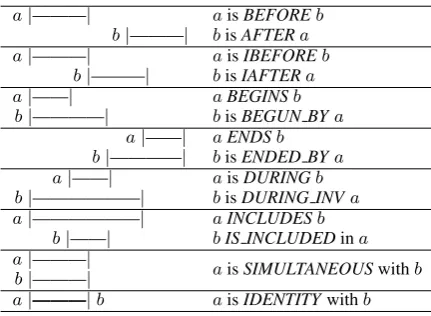
The full set of temporal relations specified in TimeML version 1.2.1 (Saur´ı et al., 2006) con-tains 14 types of relations, as illustrated in Table 1. Among them there are six pairs of relations that in-verse each other.
Note that according to TimeML 1.2.1 annota-tion guidelines, the difference between DURING
and IS INCLUDED (also their inverses) is that
DURINGrelation is specified when an event
per-sists throughout a temporal duration (e.g. John
drovefor5 hours), whileIS INCLUDEDrelation is specified when an event happens within a tem-poral expression (e.g. JohnarrivedonTuesday).
a|———| aisBEFOREb b|———| bisAFTERa a|———| aisIBEFOREb
b|———| bisIAFTERa
a|——| aBEGINSb
b|————| bisBEGUN BYa a|——| aENDSb b|————| bisENDED BYa a|——| aisDURINGb b|——————| bisDURING INVa a|——————| aINCLUDESb
b|——| bIS INCLUDEDina a|———| aisSIMULTANEOUSwithb
b|———|
[image:2.595.307.523.127.285.2]a|———|b aisIDENTITYwithb
Table 1: Temporal relations in TimeML annota-tion
In TimeML annotation, temporal links are used to (i) establish the temporal order of two events (event-event pair), (ii) anchor an event to a time expression (event-timexpair) and (iii) establish the temporal order of two time expressions ( timex-timexpair).
The problem of determining the label of a given temporal link can be regarded as a classification problem. Given an ordered pair of entities (e1,
e2) that could be either event-event, event-timex
or timex-timexpair, the classifier has to assign a certain label, namely one of the 14 temporal rela-tion types. We train a classificarela-tion model for each category of entity pair, as suggested in several pre-vious works (Mani et al., 2006; Chambers, 2013). However, because there are very few examples of timex-timex pairs in the training corpus, it is not possible to train the classification model for these particular pairs. Moreover, they only add up to 3.2% of the total number of extracted entity pairs; therefore, we decided to disregard these pairs.
3.2 Feature set
and on the output of the addDiscourse tagger (Pitler and Nenkova, 2009).
Some features are computed independently based on either e1 or e2, while some others are
pairwise features, which are computed based on both elements. Some pairwise features are only relevant for event-event pairs, for example, the information on discourse connectives and the binary features representing whether two events have the same event attributes or not. Similarly, the features related to time expression attributes are only relevant for event-timex pairs, since this information can only be obtained if e2 is a
time expression. The selection of features that contribute to the improvement of event-event and event-timex classification will be detailed in Section 4.3.
String features. The tokens and lemmas of
e1ande2.
Grammatical features. The part of speech (PoS) tags of e1 and e2, and a binary feature
indicating whether e1 and e2 have the same
PoS tag. The binary feature only applies to event-event pairs since we do not include the PoS tag of a time expression in the feature set of event-timex pairs. The grammatical informa-tion is obtained using the Stanford CoreNLP tool.1
Textual context. The textual order, sentence distance and entity distance ofe1 ande2. Textual
order is the appearance order of e1 ande2 in the
text, while sentence distance measures how fare1
ande2 are from each other in terms of sentences,
i.e. 0 if they are in the same sentence. The entity distance is only measured if e1 ande2 are in the
same sentence, and corresponds to the number of entities occurring between e1 ande2 (i.e. if they
are adjacent, the distance is 0).
Entity attributes. Event attributes and time expression attributes of e1 and e2 as specified
in TimeML annotation. Event attributes consist of class, tense, aspect and polarity, while the attributes of a time expression are its type, value
and dct (indicating whether a time expression is the document creation time or not). Events falling under the category of noun, adjective and
1http://nlp.stanford.edu/software/
corenlp.shtml
preposition do not have tense and aspect attributes in TimeML. We retrieve this information by extracting the tense and aspect of the verbs that govern them, based on their dependency relation. For event-event pairs we also include four binary features representing whether e1 ande2 have the
same event attributes or not.
Dependency relations. Similar to D’Souza and Ng (2013), we use the information related to the dependency relation between e1 ande2. We
include as features (i) the type of the dependency relation that exists between them, (ii) the depen-dency order which is either governor-dependent
or dependent-governor and (iii) binary features indicating whether e1/e2 is the root of the
sen-tence. This information is based on the collapsed representation of dependency relations provided by the parsing module of Stanford CoreNLP. Consider the sentence “John left the office and
drove back home for 20 minutes”. Using the
collapsed typed dependencies we could get the di-rect relations between the existing entities, which are conj and(left, drove) and prep for(drove, minutes).
Event durations. To our knowledge, we are the first to exploit event duration information as features for temporal relation classification. In fact, duration can be expressed not only by a predicate’s tense and aspect but also by its
aktionsart, i.e. the inherent temporal information connected to the meaning of a predicate. The typical event duration allows us to infer, for instance, that a punctual event is more likely to be contained in a durative one. If we consider the sentence “State-run television broadcast footage of Cuban exilesprotestingin Miami”, this feature would tell us thatbroadcastlasts forhourswhile
protesting lasts for days, thus contributing in determining the direction of DURING relation between the events.
The approximate duration for an event is obtained from the list of 1000 most frequent verbs and their duration distributions compiled by Gusev et al. (2011).2 The types of duration include seconds, minutes, hours, days, weeks,
months, years and decades. We also add the duration difference betweene1ande2as a feature
2The list is available athttp://cs.stanford.edu/
with the value varied betweensame,lessormore. Similar to tense and aspect attributes for events, the duration of events under the category of noun, adjective and preposition are estimated by the governing verb. As for time expressions, their durations are estimated from their type and value attributes using a set of simple rules, e.g. the duration of Thursday morning (with the type of
TIMEand the value ofxxxx-xx-xxTMO) ishours.
Temporal signals. Derczynski and Gaizauskas (2012) show the importance of temporal signals in temporal link labelling. We take this into account by integrating in our features the list of signals extracted from TimeBank 1.2 corpus3. We believe that the system performance will benefit from distinguishing between event-related signals and timex-related signals, therefore we manually split the signals into two separate lists. Signals such as when, as and then are commonly used to temporally connect events, while signals such asat,for andwithinmore likely occur with time expressions. There are also signals that are used in both cases such asbefore, after anduntil, and those kind of signals are added to both lists.
Besides the signal token, the position of the sig-nal with respect to the events or time expressions is also an important feature. Consider the position of a signal in the sentences (i)“John taught high school before he worked at a bank” and (ii)
“BeforeJohn taught high school, he worked at a bank”, which is crucial to determine the order of John’s occupations. We also include in the feature set whether a signal occurs at the beginning of a sentence, as it is usually used to temporally relate events in different sentences, e.g. “John taught high school.Previously, he worked at a bank.”
Temporal discourse connectives. Consider the following sentences:
(i) “John has been taking that driving course
sincethe accident that took place last week.”
(ii) “John has been taking that driving course
sincehe wants to drive better.”
In order to label the temporal link holding be-tween two events, it is important to know whether there are temporal connectives in the surrounding 3The list is available athttp://www.timeml.org/
site/timebank/browser_1.2/displayTags. php?treshold=1&tagtype=signal&sort=alpha
context, because they may contribute in identify-ing the relation type. For instance, it may be rele-vant to distinguish whethersinceis used as a tem-poral or a causal cue (example (i) and (ii) resp.). This information about discourse connectives is acquired using the addDiscourse tool (Pitler and Nenkova, 2009), which identifies connectives and assigns them to one of four semantic classes: Tem-poral, Expansion, ContingencyandComparison. Note that this is a much shallower approach than the one proposed by D’Souza and Ng (2013), who perform full discourse parsing.
We include as feature whether a discourse con-nective belonging to theTemporalclass occurs in the textual context of e1 ande2. Similar to
tem-poral signals, we also include in the feature set the position of the discourse connective with respect to the events.
3.3 Inverse Relations and Transitive Closure Since Mani et al. (2006) demonstrate that boot-strapping training data through temporal closure results in quite significant improvements, we try to provide the classifier with more data to learn from using the inverse relations and closure-based inferred relations.
There are six pairs of relation types in TimeML that inverse each other (see Table 1). By switch-ing the order of the entities in a given pair and la-belling the pair with the inverse relation type, we basically multiply the number of training data.
As for temporal closure, there have been at-tempts to apply it to improve temporal relation classification. Mani et al. (2006) use SputLink (Verhagen, 2005), which was developed based on Allen’s closure inference (Allen, 1983), to infer the relations based on temporal closure. UzZaman and Allen (2011b) employ Timegraph (Gerevini et al., 1995) to implement the scorer for TempEval-3 evaluation, since precision and recall for temporal relation classification are computed based on the closure graph.
We use a simpler approach to obtain the closure graph of temporal relations, by applying the tran-sitive closureonly within the same relation type, e.g. e1 BEFOREe2 ∧e2 BEFORE e3→e1
BE-FORE e3. It can be seen aspartial temporal clo-sure since it produces only a subset of the rela-tions produced by temporal closure, which covers more complex cases, e.g.e1BEFOREe2∧e2
As shown in Fischer and Meyer (1971), the problem of finding the transitive closure of a di-rected acyclic graph can be reduced to a boolean matrix multiplication. For each temporal relation type, we build its boolean matrix with the size of
n×n, n being the number of entities in a text. Given a temporal relation type Rand its boolean matrixM, the transitive closure-based relations of
Rcan be inferred from the matrixM2 by
extract-ing its non-zero elements.
4 Experiment Description
4.1 Dataset
Since we want to compare our work with ex-isting approaches to temporal relation classifica-tion, we use the same training and test data as in Tempeval-3 challenge4. Two types of train-ing data were made available in the challenge: TBAQ-cleanedandTE3-Silver-data. The former includes a cleaned and improved version of the AQUAINT TimeML corpus, containing 73 news report documents, and theTimeBankcorpus, with 183 news articles. TE3-Silver-data, instead, is a 600K word corpus annotated by the best perform-ing systems at Tempeval-2, which we do not use in our experiments.
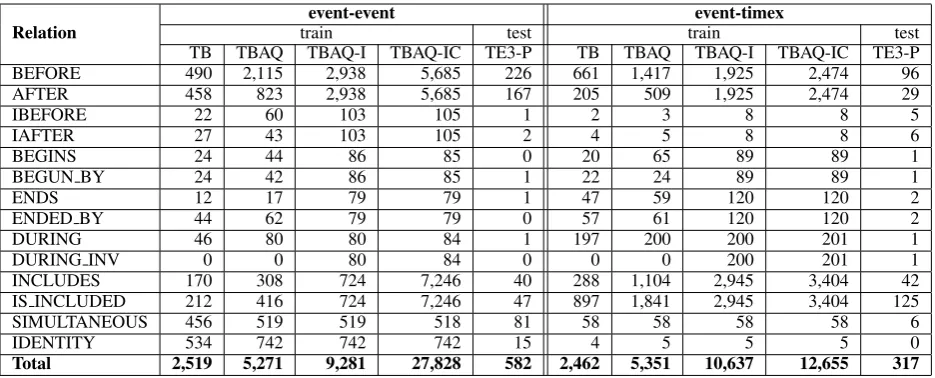
Our test data is the newly created TempEval-3-platinum evaluation corpus that was anno-tated/reviewed by the Tempeval-3 task organizers. The distribution of the relation types in all previ-ously mentioned datasets is shown in Table 2. We report also the statistics obtained after applying in-verse relations and transitive closure, that increase the number of training instances.
It is worth noticing thatDURING INV relation does not exist in the training data but appears in the test data. In this case, inverse relations help in au-tomatically acquiring training instances. The BE-FORE relation corresponds to the majority class and makes the instance distribution quite unbal-anced, especially in the TBAQ corpus. Finally, five event-timex instances in the TBAQ training data are labeled withIDENTITY relation and can be assumed to be falsely annotated.
4.2 Experimental Setup
We build our classification models using the Sup-port Vector Machine (SVM) implementation
pro-4http://www.cs.york.ac.uk/
semeval-2013/task1/index.php?id=data
vided by YamCha5. The experiment involves con-ducting 5-fold cross validation on the TimeBank corpus to find the best combination of features for the event-event and event-timex classifiers. We first run our experiments using YamCha default parameters (pairwise method for multi-class clas-sification and polynomial kernel of degree 2). Af-ter identifying the best feature sets for the two classifiers, we evaluate them using different ker-nel degrees (from 1 to 4).
4.3 Feature Engineering
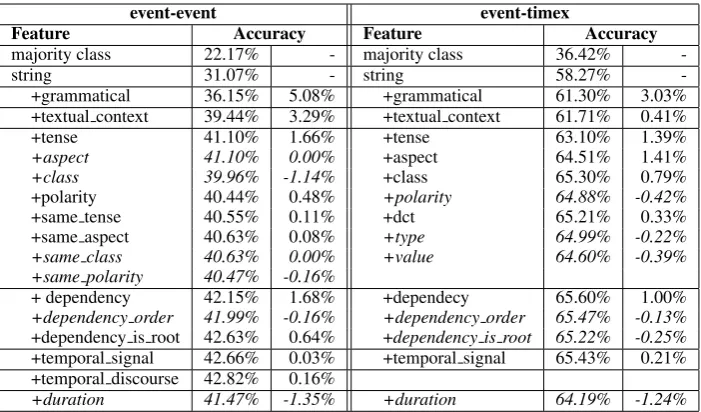
In order to select from our initial set of features only those that improve the accuracy of the event-event and event-event-timex classifiers, we incremen-tally add them to the baseline (the model with string feature only), and compute their contribu-tion. Table 3 shows the results of this selection process, by including the average accuracy from the 5-fold cross validation.
In Table 3, we report the feature contributions of theentity attributesanddependency relationssets in more details, because within those categories only some of the features have a positive impact on accuracy. Instead, for features withintextual con-text, signal and discourse categories, incremen-tally adding each feature results in increasing ac-curacy, therefore we report only the overall accu-racy of the feature group. Similarly, forduration
features, adding each feature incrementally results in decreasing accuracy.
Regarding entity attributes, it can be seen that
aspect and class features have no positive im-pact on the accuracy of event-event classifica-tion, along with pairwise featuressame classand
same polarity. As for event-timex classification, all event attributes except for polarity contribute to accuracy improvements. Among time expres-sion attributes, only the information about whether a time expression is a document creation time or not (dctfeature) helps improving the classifier.
The dependency order feature does not give positive contribution to the accuracy in both cases. Besides, information on whether an event is the root of the sentence (dependency is root feature) is not relevant for event-timex classification.
Adding thetemporal signalfeature very slightly improves the accuracy of event-event classifica-tion, not as much as its contribution to event-timex
5http://chasen.org/˜taku/software/
Relation trainevent-event test trainevent-timex test TB TBAQ TBAQ-I TBAQ-IC TE3-P TB TBAQ TBAQ-I TBAQ-IC TE3-P
BEFORE 490 2,115 2,938 5,685 226 661 1,417 1,925 2,474 96
AFTER 458 823 2,938 5,685 167 205 509 1,925 2,474 29
IBEFORE 22 60 103 105 1 2 3 8 8 5
IAFTER 27 43 103 105 2 4 5 8 8 6
BEGINS 24 44 86 85 0 20 65 89 89 1
BEGUN BY 24 42 86 85 1 22 24 89 89 1
ENDS 12 17 79 79 1 47 59 120 120 2
ENDED BY 44 62 79 79 0 57 61 120 120 2
DURING 46 80 80 84 1 197 200 200 201 1
DURING INV 0 0 80 84 0 0 0 200 201 1
INCLUDES 170 308 724 7,246 40 288 1,104 2,945 3,404 42
IS INCLUDED 212 416 724 7,246 47 897 1,841 2,945 3,404 125
SIMULTANEOUS 456 519 519 518 81 58 58 58 58 6
IDENTITY 534 742 742 742 15 4 5 5 5 0
[image:6.595.72.540.61.250.2]Total 2,519 5,271 9,281 27,828 582 2,462 5,351 10,637 12,655 317
Table 2: The distribution of each relation type in the datasets for both event-event and event-timex pairs. TBstands for TimeBank corpus,TBAQdenotes the combination of TimeBank and AQUAINT corpora, TBAQ-I denotes the TBAQ corpus augmented with inverse relations, TBAQ-ICis the TBAQ corpus with both inverse relations and transitive closure, and TE3-P is the TempEval-3-platinum evaluation corpus.
classification. However, together with the tem-poral discoursefeature, they positively affect ac-curacy, confirming previous findings (Derczynski and Gaizauskas, 2012).
Surprisingly, adding event duration feature de-creases the accuracy in both cases. This might be caused by the insufficient coverage of the event duration resource, since around 20% of the train-ing pairs contain at least an event whose duration is unknown. Moreover, we employ the approxi-mate duration of a verb event as a feature without considering the context and discourse. For exam-ple, according to the distributions in the duration resource, the eventattackhas two likely durations,
minutesanddecades, withdecadesbeing slightly more probable thanminutes. In the sentence “Is-rael has publicly declared that it will respondto an Iraqiattackon Jordan.”, the classifier fails to recognize the IBEFORE relation between attack
andrespond (attack happens immediately before
respond), because the duration feature ofattackis recognized as decades, while in this context the
attackmost probably occurs withinseconds. According to the analysis of the different fea-ture contributions, we define the best classification models for both event-event pairs and event-timex pairs as the models using combinations of features that have positive impacts on the accuracy, based on Table 3. Given the best performing sets of fea-tures, we further experiment with different kernel degrees in the same 5-fold cross validation
sce-nario.
The best classifier performances are achieved with the polynomial kernel of degree 4, both for event-event and event-timex classification. The accuracy for event-event classification is43.69%, while for event-timex classification it is 66.62%. However, using a high polynomial kernel degree introduces more complexity in training the classi-fication model, thus more time is required to train such models.
event-event event-timex
Feature Accuracy Feature Accuracy
majority class 22.17% - majority class 36.42%
-string 31.07% - string 58.27%
-+grammatical 36.15% 5.08% +grammatical 61.30% 3.03% +textual context 39.44% 3.29% +textual context 61.71% 0.41%
+tense 41.10% 1.66% +tense 63.10% 1.39%
+aspect 41.10% 0.00% +aspect 64.51% 1.41%
+class 39.96% -1.14% +class 65.30% 0.79%
+polarity 40.44% 0.48% +polarity 64.88% -0.42%
+same tense 40.55% 0.11% +dct 65.21% 0.33%
+same aspect 40.63% 0.08% +type 64.99% -0.22%
+same class 40.63% 0.00% +value 64.60% -0.39%
+same polarity 40.47% -0.16%
+ dependency 42.15% 1.68% +dependecy 65.60% 1.00% +dependency order 41.99% -0.16% +dependency order 65.47% -0.13% +dependency is root 42.63% 0.64% +dependency is root 65.22% -0.25% +temporal signal 42.66% 0.03% +temporal signal 65.43% 0.21% +temporal discourse 42.82% 0.16%
[image:7.595.124.475.61.267.2]+duration 41.47% -1.35% +duration 64.19% -1.24%
Table 3: Feature contributions for event-event and event-timex classification. Features initalicshave a negative impact on accuracy and are not included in the final feature set.
5 Evaluation
We perform two types of evaluation. In the first one, we evaluate the system performance with the best feature sets and the best parameter configu-ration using the four training sets presented in Ta-ble 2. Our test set is the TempEval-3-platinum cor-pus. The goal of this first evaluation is to specifi-cally investigate the effect of enriching the training data with inverse relations and transitive closure. We compute the system accuracy as the percent-age of the correct labels out of all annotated links. In the second evaluation, we compare our sys-tem to the syssys-tems participating in the task on sys- tem-poral relation classification at TempEval-3. The test set is again TempEval-3-platinum, i.e. the same one used in the competition. The task or-ganizers introduced an evaluation metric (UzZa-man and Allen, 2011a) capturing temporal aware-ness in terms of precision, recall and F1-score. To compute precision and recall, they verify the cor-rectness of annotated temporal links using tempo-ral closure, by checking the existence of the iden-tified relations in the closure graph. In order to replicate this type of evaluation, we use the scorer made available to the task participants.
5.1 Evaluation of the Effects of Inverse Relations and Transitive Closure
Table 4 shows the classifiers’ accuracies achieved using different training sets. After performing a randomization test between the best performing classifier and the others, we notice that on
event-event classification the improvement is significant (p < 0.005) only between TBAQ and TimeBank. This shows that only extending the TimeBank cor-pus by adding AQUAINT is beneficial. In all other cases, the differences are not significant. Applying inverse relations and transitive closure extends the number of training instances but makes the dataset more unbalanced, thus it does not result in a sig-nificant improvement.
Training data event-event event-timex
TimeBank 42.61% 71.92%
TBAQ 48.28% 73.82%
TBAQ-I 47.77% 74.45%
[image:7.595.327.505.457.510.2]TBAQ-IC 46.39% 74.45%
Table 4: Classifier accuracies with different train-ing data
This result is in contrast with the improvement brought about by temporal closure reported in Mani et al. (2006). The difference between our approach and Mani et al.’s is that (i) we apply only the transitive closure instead of the full temporal one, and (ii) our classification task includes 14 re-lations, while the other authors classify 6 relations. In our future work, we will investigate whether the benefits of closure are affected by the number of relations, or whether our simplified version is ac-tually outperformed by the full one.
Furthermore, we plan to investigate the effect of
5.2 Evaluation of the System Performance in TempEval-3 task
We train our classifiers for event-event pairs and event-timex pairs by exploiting the best feature combination and best configuration acquired from the experiment, and using the best reported dataset for each classifier as the training data. Even though it has been shown that inverse relations and transitive closure do not bring significantly posi-tive impact to the accuracy, using the TBAQ-IC corpus as the training set for event-timex classifi-cation is still the best option. The two classifiers are part of a temporal classification system called
TRelPro.
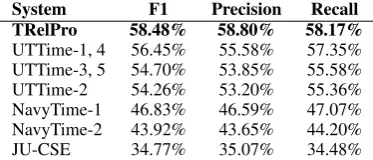
We compare in Table 5 the performance of
TRelPro to the other systems participating in Tempeval-3 task, according to the figures reported in (UzZaman et al., 2013).TRelProis the best per-forming system both in terms of precision and of recall.
[image:8.595.308.534.60.224.2]System F1 Precision Recall TRelPro 58.48% 58.80% 58.17% UTTime-1, 4 56.45% 55.58% 57.35% UTTime-3, 5 54.70% 53.85% 55.58% UTTime-2 54.26% 53.20% 55.36% NavyTime-1 46.83% 46.59% 47.07% NavyTime-2 43.92% 43.65% 44.20% JU-CSE 34.77% 35.07% 34.48% Table 5: Tempeval-3 evaluation on temporal rela-tion classificarela-tion
In order to analyze which are the most com-mon errors made byTRelPro, we report in Table 6 the number of true positives (tp), false positives (fp) and false negatives (fn) scored by the system on each temporal relation. The system generally fails to recognizeIBEFORE,BEGINS,ENDSand
DURINGrelations, along with their inverse rela-tions, primarily because of the skewed distribution of instances in the training data, especially in com-parison with the majority classes. This explains also the large number of false positives labelled for theBEFOREclass (event-event pairs) and for the
IS INCLUDED class (event-timex pairs), which are the majority classes for the two pairs respec-tively.
6 Conclusion
We have described an approach to temporal link labelling using simple features based on lexico-syntactic information, as well as external lexical resources listing temporal signals and event
dura-Relation tpevent-eventfp fn tpevent-timexfp fn
BEFORE 186 186 40 82 17 14
AFTER 63 40 104 14 7 15
IBEFORE 0 0 1 0 0 5
IAFTER 0 0 2 0 0 6
BEGINS 0 0 0 0 0 1
BEGUN BY 0 0 0 0 0 1
ENDS 0 0 1 0 0 2
ENDED BY 1 1 0 0 0 2
DURING 0 0 1 0 2 1
DURING INV 0 0 0 0 0 1
INCLUDES 1 2 39 27 13 15
IS INCLUDED 2 4 45 114 40 11
SIMULTANEOUS 20 33 61 0 0 6
[image:8.595.87.274.348.428.2]IDENTITY 9 35 6 0 1 0
Table 6: Relation type distribution for TempEval-3-platinum test data, annotated with TRelPro. The
tp fields indicate the numbers of correctly anno-tated instances, while the fp/fn fields correspond to false positives/negatives.
tions. We find that by using a simple feature set we can build a system that outperforms the systems built using more sophisticated features, based on semantic role labelling and deep semantic parsing. This may depend on the fact that more complex features are usually extracted from the output of NLP systems, whose performance impacts on the quality of such features.
We find that bootstrapping the training data with inverse relations and transitive closure does not help improving the classifiers’ performances sig-nificantly as it was reported in previous works, es-pecially in event-event classification where the ac-curacy decreases instead. In the future, we will further investigate the reason of this difference. We will also explore other variants of closure, as well as over-sampling techniques to handle the highly skewed dataset introduced by closure.
Finally, the overall performance of our system, using the best models for both event-event and event-timex classification, outperforms the other systems participating in the TempEval-3 task. This confirms our intuition that using simple features and reducing the amount of complex semantic and discourse information is a valuable alternative to more sophisticated approaches.
Acknowledgments
References
James F. Allen. 1983. Maintaining knowledge about temporal intervals. Commun. ACM, 26(11):832– 843, November.
Nathanael Chambers, Shan Wang, and Dan Juraf-sky. 2007. Classifying temporal relations between events. InProceedings of the 45th Annual Meeting of the ACL on Interactive Poster and Demonstra-tion Sessions, ACL ’07, pages 173–176, Strouds-burg, PA, USA. Association for Computational Lin-guistics.
Nate Chambers. 2013. Navytime: Event and time or-dering from raw text. In Second Joint Conference on Lexical and Computational Semantics (*SEM), Volume 2: Proceedings of the Seventh International Workshop on Semantic Evaluation (SemEval 2013), pages 73–77, Atlanta, Georgia, USA, June. Associ-ation for ComputAssoci-ational Linguistics.
Leon Derczynski and Robert J. Gaizauskas. 2012. Us-ing Signals to Improve Automatic Classification of Temporal Relations. CoRR, abs/1203.5055.
Jennifer D’Souza and Vincent Ng. 2013. Classify-ing Temporal Relations with Rich LClassify-inguistic Knowl-edge. In Proceedings of the 2013 Conference of the North American Chapter of the Association for Computational Linguistics: Human Language Tech-nologies, pages 918–927.
Christiane Fellbaum, editor. 1998. WordNet: An Elec-tronic Lexical Database. MIT Press.
Michael J. Fischer and Albert R. Meyer. 1971. Boolean matrix multiplication and transitive closure. In SWAT (FOCS), pages 129–131. IEEE Computer Society.
Alfonso Gerevini, Lenhart Schubert, and Stephanie Schaeffer. 1995. The temporal reasoning tools Timegraph I-II. International Journal of Artificial Intelligence Tools, 4(1-2):281–299.
Andrey Gusev, Nathanael Chambers, Pranav Khaitan, Divye Khilnani, Steven Bethard, and Dan Juraf-sky. 2011. Using query patterns to learn the dura-tion of events. In Proceedings of the Ninth Inter-national Conference on Computational Semantics, IWCS ’11, pages 145–154, Stroudsburg, PA, USA. Association for Computational Linguistics.
Anup Kumar Kolya, Amitava Kundu, Rajdeep Gupta, Asif Ekbal, and Sivaji Bandyopadhyay. 2013. Ju cse: A crf based approach to annotation of tem-poral expression, event and temtem-poral relations. In Second Joint Conference on Lexical and Computa-tional Semantics (*SEM), Volume 2: Proceedings of the Seventh International Workshop on Semantic Evaluation (SemEval 2013), pages 64–72, Atlanta, Georgia, USA, June. Association for Computational Linguistics.
Natsuda Laokulrat, Makoto Miwa, Yoshimasa Tsu-ruoka, and Takashi Chikayama. 2013. Uttime: Temporal relation classification using deep syntactic features. InSecond Joint Conference on Lexical and Computational Semantics (*SEM), Volume 2: Pro-ceedings of the Seventh International Workshop on Semantic Evaluation (SemEval 2013), pages 88–92, Atlanta, Georgia, USA, June. Association for Com-putational Linguistics.
Inderjeet Mani, Marc Verhagen, Ben Wellner, Chong Min Lee, and James Pustejovsky. 2006. Ma-chine learning of temporal relations. InProceedings of the 21st International Conference on Compu-tational Linguistics and the 44th annual meeting of the Association for Computational Linguistics, ACL-44, pages 753–760, Stroudsburg, PA, USA. Association for Computational Linguistics.
Emily Pitler and Ani Nenkova. 2009. Using syn-tax to disambiguate explicit discourse connectives in text. In Proceedings of the ACL-IJCNLP 2009 Conference Short Papers, ACLShort ’09, pages 13– 16, Stroudsburg, PA, USA. Association for Compu-tational Linguistics.
Roser Saur´ı, Jessica Littman, Robert Gaizauskas, An-drea Setzer, and James Pustejovsky, 2006. TimeML Annotation Guidelines, Version 1.2.1.
Naushad UzZaman and James Allen. 2011a. Tem-poral Evaluation. In Proceedings of the 49th An-nual Meeting of the Association for Computational Linguistics: Human Language Technologies, pages 351–356, Portland, Oregon, USA, June. Association for Computational Linguistics.
Naushad UzZaman and James F. Allen. 2011b. Tem-poral evaluation. InACL (Short Papers), pages 351– 356. The Association for Computer Linguistics. Naushad UzZaman, Hector Llorens, James F. Allen,
Leon Derczynski, Marc Verhagen, and James Puste-jovsky. 2012. TempEval-3: Evaluating Events, Time Expressions, and Temporal Relations. CoRR, abs/1206.5333.
Naushad UzZaman, Hector Llorens, Leon Derczyn-ski, James Allen, Marc Verhagen, and James Puste-jovsky. 2013. Semeval-2013 task 1: Tempeval-3: Evaluating time expressions, events, and temporal relations. In Second Joint Conference on Lexical and Computational Semantics (*SEM), Volume 2: Proceedings of the Seventh International Workshop on Semantic Evaluation (SemEval 2013), pages 1–9, Atlanta, Georgia, USA, June. Association for Com-putational Linguistics.
Marc Verhagen, Roser Saur´ı, Tommaso Caselli, and James Pustejovsky. 2010. SemEval-2010 task 13: TempEval-2. In Proceedings of the 5th Interna-tional Workshop on Semantic Evaluation, SemEval ’10, pages 57–62, Stroudsburg, PA, USA. Associa-tion for ComputaAssocia-tional Linguistics.