Proceedings of NAACL-HLT 2019, pages 3246–3256 3246
An Effective Label Noise Model for DNN Text Classification
Ishan Jindal1, Daniel Pressel2, Brian Lester2, and Matthew Nokleby1
1Wayne State University, Detroit MI 48202 2Interactions Digital Roots, Ann Arbor MI 48104
{ishan.jindal, matthew.nokleby}@wayne.edu,
{dpressel, blester}@interactions.com
Abstract
Because large, human-annotated datasets suf-fer from labeling errors, it is crucial to be able to train deep neural networks in the pres-ence of label noise. While training image classification models with label noise have re-ceived much attention, training text classifica-tion models have not. In this paper, we pro-pose an approach to training deep networks that is robust to label noise. This approach in-troduces a non-linear processing layer (noise model) that models the statistics of the la-bel noise into a convolutional neural network (CNN) architecture. The noise model and the CNN weights are learned jointly from noisy training data, which prevents the model from overfitting to erroneous labels. Through ex-tensive experiments on several text classifica-tion datasets, we show that this approach en-ables the CNN to learn better sentence repre-sentations and is robust even to extreme label noise. We find that proper initialization and regularization of this noise model is critical. Further, by contrast to results focusing on large batch sizes for mitigating label noise for image classification, we find that altering the batch size does not have much effect on classifica-tion performance.
1 Introduction
Deep Neural Networks (DNNs) have led to sig-nificant advances in the fields of computer vi-sion (He et al.,2016), speech processing (Graves et al., 2013) and natural language processing (Kim, 2014; Young et al., 2018; Devlin et al., 2018). To be effective, supervised DNNs rely on large amounts of carefully labeled training data. However, it is not always realistic to assume that example labels are clean. Humans make mistakes and, depending on the complexity of the task, there may be disagreement even among expert la-belers. Further, samples drawn from the class con-ditional densities with overlapping supports gives
rise to the label noise in training datasets. To sup-port noisy labels in data, we need new training methods that can be used to train DNNs directly from the corrupted labels to significantly reduce human labeling efforts. Zhu and Wu (2004) per-form an extensive study on the effect of label noise on classification performance of a classifier and find that noise in input features is less important than noise in training labels.
In this work, we add a noise model layer on top of our target model to account for label noise in the training set, following (Jindal et al., 2016; Sukhbaatar et al., 2014). We provide extensive experiments on several text classification datasets with artificially injected label noise. We study the effect of two different types of label noise; Uni-form label flipping (Uni), where a clean label is swapped with another label sampled uniformly at random; and Random label flipping (Rand)where a clean label is swapped with another label from the given number of labels sampled randomly over a unit simplex.
We also study the effect of different initializa-tion, regularizainitializa-tion, and batch sizes when training with noisy labels. We observe that proper initial-ization and regularinitial-ization helps the noise model learn to be robust to even extreme amounts of noise. Finally, we use low-dimensional projec-tions of the features of the training examples to understand the effectiveness of the noise model.
2 Related Work
Learning from label noise is a widely studied problem in the classical machine learning set-ting. Earlier works (Brodley and Friedl, 1999; Rebbapragada and Brodley, 2007; Manwani and Sastry,2013) consider learning from noisy labels for a wide range of classifiers including SVMs (Natarajan et al., 2013) and fisher discriminants (Lawrence,2001). Traditional approaches handle label noise by detecting and eliminating the cor-rupted labels. More details about these approaches can be found in (Fr´enay and Verleysen,2014).
Recently, DNNs have made huge gains in performance over traditional methods on large datasets with very clean labels. However large real-world datasets often contain label errors. A number of works have attempted to address this problem of learning from corrupted labels for DNNs. These approaches can be divided into two categories; attempts to mitigate the effect of label noise using auxiliary clean data, and attempts to learn directly from the noisy labels.
Presence of auxiliary clean data: This line of research exploits a small, clean dataset to cor-rect the corrupted labels. For instance, Li et al. (2017) learn a teacher network with clean data to re-weight a noisy label with a soft label in the loss function. Similarly,Veit et al.(2017) use the clean data as a label correction network. One can use this auxiliary source of information to do infer-ence over latent clean labels (Vahdat,2017). Fur-ther,Yao et al.(2018) models the auxiliary trust-worthiness of noisy image labels to alleviate the effect of label noise. Though these methods show very promising results, the absence of clean data in some situations might hinder the applicability of these methods.
Learning directly from noisy labels: This re-search directly learns from the noisy labels by designing a robust loss function, or by model-ing the latent labels. For instance, Reed et al. (2014), apply bootstrapping to the loss function to have consistent label prediction for similar im-ages. Similarly, Joulin et al.(2016) alleviate the label noise effect by adequately weighting the loss function using the sample number. Jiang et al. (2017) propose a sequential meta-learning model that takes in a sequence of loss values and outputs the weights for the labels.Ghosh et al.(2017) fur-ther explores the conditions on loss functions such that the loss function is noise tolerant.
A number of approaches learn the transition from latent labels to the noisy labels. For example, Mnih and Hinton (2012) propose a noise adapta-tion framework for symmetric label noise. Based on this work, several other works (Sukhbaatar et al.,2014;Jindal et al.,2016;Patrini et al.,2017; Han et al., 2018) account for the label noise by learning a noisy layer on top of a DNN where the learned transition matrix represents the label flip probabilities. Similarly,Xiao et al.(2015) propose a probabilistic image conditioned noise model. Azadi et al.(2015) proposed an image regulariza-tion technique to detect and discard the noisy la-beled images. Other approaches include building two parallel classifiers (Misra et al.,2016) where one classifier deals with image recognition and the other classifier models humans reporting bias.
All of these approaches have targeted image classification. In this work, we propose a frame-work for learning from noisy labels for text clas-sification using a DNN architecture. Similar to (Sukhbaatar et al.,2014;Jindal et al.,2016;Patrini et al., 2017), we append a non-linear processing layer on top of this architecture to model the la-bel noise. This layer helps the base architecture to learn better representations, even in the presence of label noise. We empirically show that, for bet-ter classification performance, the knowledge of noise transition matrix is not needed. Instead, the process forces the DNN to learn better sentence representations.
3 Problem Statement
In a supervised text classification setting where
xi ∈ Rdis a d-dimensional word embedding of the ith word in a sentence of length l (padded wherever necessary), we represent the sample as a temporal embedding matrix X ∈ Rd×l which belongs to one of theKclasses. Let the noise-free training set be denoted by
D={(X1, y1),(X2, y2),· · · ,(Xn, yn)},
by an unknown noise distribution. Let this noisy
training set be denoted by
D0={(X1, y01),(X2, y20),· · · ,(Xn, y
0
n)},
whereyi0represents the corrupted label for the sen-tenceXi. In this work, we suppose the label noise isclass-conditional, where the noisy label yi0 de-pends only on the true labelyi, but not on the input
Xior any other labelsyj ory0j. Under this model, the label noise is characterized by the conditional distribution
p(y0 =i|y=j) = Φij,
which we describe via the K × K column-stochastic matrix Φij, parameterized by a matrix
Q={Φij}.
In our experiments, we artificially inject label noise into the training and validation sets. We fix the noise distribution Φij and, for a training sample, we generate a noisy label by drawing i.i.d from this noise distributionΦij. However, we do not alter the test labels.
Though the proposed approach works for any noise distribution, for this study, we focus on two different types of label flip distributions. We use a noise model parameterized by the overall proba-bility of a label error, denoted by0≤p≤1. For a noise levelp, we set the noise distribution matrix
Φ = (1−p)I+ p
KII
K, (1)
and we call it Uniform label flip noise model. Here, I represents the identity matrix and II de-notes the all-ones matrix. Similarly, we describe therandom label flip noise modelas
Φ = (1−p)I+p∆, (2)
whereI is the identity matrix, and ∆is a matrix with zeros along the diagonal and remaining en-tries of each column are drawn uniformly and in-dependently from theK−1-dimensional unit sim-plex. The label error probability for each class is p, while the probability distributionwithinthe er-roneous classes is drawn uniformly at random.
Our objective is to train a classifier on the noisy labeled sample categories on the training set D0 such that it jointly makes accurate predictions of the true labelyand learns the noise transition ma-trix simultaneously, givenX. For the noisy dataset D0, it is straightforward to train a classifier that
predicts thenoisy labels using conditional distri-bution for the noisy labeled input sentenceX:
p(y0 = ˆy0|X) =X
i
p(y0 = ˆy0|y= ˆyi)
p(y= ˆyi|X)
. (3)
One can learn the classifier associated withp(y0 = ˆ
y0|x)via standard training on the noisy setD0. To predict the clean labels by learning the conditional distribution p(y = ˆyi|x) requires more effort, as we cannot extract the “clean” classifier from the noisy classifier when the label noise distribution is unknown.
3.1 Proposed Framework
We refer to the DNN model without the final layer as thebase modelor networkwithout noise model (WoNM). This model, along with the non-linear layer, is trained via back-propagation on the noisy training dataset. The non-linear processing layer in thenoise modeltransforms the base model out-puts to match the noisy labels during the forward pass better and presents the denoised labels to the base model during the backward pass. The noise layer is parameterized by a square matrix
Ψ∈RK×K). At test time, we remove this learned noise model and use the output of the base model as final predictions.
We refer to the base model parameters as Θ. The base model outputs a probability distribu-tion over the number of K categories denoted as p(y= ˆyi|X; Θ)∀i ∈ {1,2,· · · , K}. During the forward pass the noise model transforms this out-put to obtain the noisy labels as
p y0|X; Θ,Ψ
=σ(Ψ×p(y|X; Θ)), (4)
whereσ(·)represents the usual softmax operator. Note that both the equations (3) and (4) compute the probability distribution over noisy labels – our noise model does not learn a noise transition ma-trix. However, we assert that the knowledge of ex-act noise statistics is neither necessary nor suffi-cient for the better prediction results.
minimizing thecross-entropyloss:
L(Θ,Ψ;D0) =−1 n
n X
i=1
logp y0|Xi; Θ,Ψ
=−1 n
n X
i=1
log [σ(Ψ×p(y|Xi; Θ))]yi
(5)
Similar to (Sukhbaatar et al., 2014), we initial-ize the noise model weights to the identity ma-trix. Since DNNs have high capacity, we may encounter the situation when the base model it-self absorbs all the label noise and, thus, the noise model does not learn anything at all. In order to avoid this situation, and to prevent overfitting, we apply l2 regularization to the noise model. How-ever, we want the noise model to overfit the la-bel noise. In the experiment section, we observe that with proper regularization and weight initial-ization the noise model absorbs most of the label noise. Finally, we train the entire network accord-ing to the followaccord-ing loss function:
L=−1 n
n X
i=1
log [σ(Ψ×p(y|Xi; Θ))]yi
+1 2λ||Ψ||
2 2. (6)
Here, λ is a tuning parameter and we validate the value of λby repeating the experiment mul-tiple times with mulmul-tiple λ values over different datasets and choose the one with better classifica-tion performance on the validaclassifica-tion set for the re-spective datasets. A value ofλ= 0.01works best.
4 Datasets and Experimental Setup
In this section, we empirically evaluate the per-formance of the proposed approach for text clas-sification and compare our results with the other methods.
4.1 General Setting
In all the experiments, we use a publicly-available deep learning library Baseline – a fast model development tool for NLP tasks ( Pres-sel et al., 2018). For all the different datasets, we choose a commonly-used, high-performance model from (Kim, 2014) as a base model. To examine the robustness of the proposed ap-proach, we intentionally flip the class labels with 0% to 70% label noise, in other words:
T
ext
Data
Dataset K L N T Type
SST-2 2 19 76961 1821 Balanced
TREC 6 10 5000 500 Not Balanced
AG-News 4 38 110K 10K Balanced
[image:4.595.307.525.61.120.2]DBpedia 14 29 504K 70K Balanced
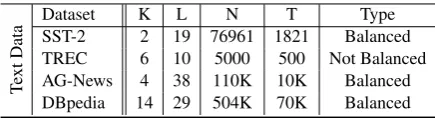
Table 1: Summary of text classification datasets; K: denotes the number of classes, L: represents the aver-age length of sentence, N: denotes the number of train-ing samples, T: represents the number of test samples, Type: describes whether the dataset is balanced.
p ∈ {0.0,0.1,0.2,0.3,0.4,0.5,0.6,0.7}, and observe the effect of different types of label flip-ping, such as uniform (Uni) and random (Rand) label flipping, along with instance-dependent la-bel noise. For all the experiments, we use early stopping based on validation set accuracy where the class labels in validation are also corrupted.
We indicate the performance of a standard deep network Without Noise model (WoNM) on the noisy label dataset. We also plot the results for the stacked Noise Model Without Regularization (NMWoRegu)and stackedNoise Model With Reg-ularization (NMwRegu). Unless otherwise stated, in all the deep networks with the stacked noise model, we initialize the noise layer parameters as an identity matrix. We further analyze the effect of the noise layer initialization on the overall perfor-mance. We defineTDwReguas the stacked noise model with regularization, initialized with true in-jected noise distribution and RandwRegu as the stacked noise model with regularization, initial-ized randomly. We run all experiments five times and report the mean accuracy.
4.2 Datasets
Here, we describe all the text classification datasets used to evaluate the performance of the proposed approach. The base model architecture is the same for all datasets. For each set, we tune the number of filter windows and filter lengths us-ing the development set. Along with the descrip-tion, we also provide the hyper-parameters we se-lected for each. Table 1 summarizes the basic statistic of the datasets.
1. SST-21 (Socher et al., 2011): Stanford Sen-timent Treebank dataset for predicting the sentiment of movie reviews. The classifica-tion task involves detecting positive or neg-ative reviews. Using the base model with
SST
-2
Batch Size 50 100 Label Flips Random Random
Noise% Clean Labels 10 20 30 40 45 47 50 0 10 20 30 40 45 47 50 WoNM 87.27% 83.29% 79.08% 73.42% 64.03% 58.1% 54.73% 49.7% 86.53% 81.44% 75.58% 71.88% 63.39% 57.12% 55.81% 52.32%
TDwRegu01 86.88% 85.37% 84.92% 83.29% 78.53% 74.01% 51.95% 49.5% 86.88% 84.88% 85.08% 82.41% 76.09% 70.10% 58.98% 49.86%
NMWoRegu 87.28% 86.2% 84.07% 81.29% 70.42% 62.27% 55.76% 48.42% 86.66% 84.72% 83.03% 78.2% 66.65% 61.32% 57.11% 52.24% NMwRegu001 86.08% 85.01% 83.82% 81.97% 73.18% 62.18% 55.63% 48.87% 86.51% 85.26% 84.37% 81.05% 69.54% 60.89% 56.8% 51.6%
NMwRegu01 87.78% 86.04% 85.04% 82.7% 77.43% 66.96% 61.5% 49.08% 86.33% 85.17% 85.10% 81.9% 76.2% 65.47% 58.92% 52.46%
TREC
Batch Size 10
Label Flips Uniform Random
Noise% Clean data 10 20 30 40 50 60 70 0 10 20 30 40 50 60 70 WoNM 92.8% 87.6% 83.6% 75.87% 67.27% 57.4% 46.27% 42.8% 92.8% 85.93% 82.2% 74.0% 68.4% 53.53% 48.2% 31.47%
TDwRegu01 50.87% 45.33% 45.4% 36.33% 25.87% 28.33% 16.87% 16.87% 50.87% 56.4% 36.8% 24.0% 25.47% 22.6% 18.8% 22.6%
NMWoRegu 92.33% 88.07% 84.67% 76.4% 68.47% 58.4% 50.07% 41.33% 92.07% 85.87% 84.27% 72.47% 66.53% 50.13% 44.6% 33.0%
NMwRegu001 92.47% 90.53% 88.07% 81.6% 73.47% 64.07% 55.87% 43.67% 92.4% 88.53% 86.4% 77.2% 67.67% 54.67% 47.93% 34.87% NMwRegu01 92.73% 90.8% 89.53% 88.67% 84.93% 79.67% 69.67% 52.4% 92.7% 90.33% 90.6% 86.47% 83.07% 70.93% 65.2% 33.4%
Batch Size 50
Label Flips Uniform Random
Noise% Clean Labels 10 20 30 40 50 60 70 0 10 20 30 40 50 60 70 WoNM 92.8% 87.27% 83.07% 75.00% 69.13% 61.53% 50.13% 39.8% 92.8% 86.00% 81.2% 76.2% 64.07% 52.4% 47.4% 34.13%
TDwRegu01 55.73% 50.4% 44.73% 39.6% 22.27% 25.67% 14.93% 21.00% 55.73% 45% 44.93% 27.73% 27.87% 22.6% 17.87% 22.6%
NMWoRegu 92.6% 87.73% 83.33% 76.33% 70.67% 56.8% 48.2% 39.67% 92.60% 85.27% 83.00% 73.6% 65.8% 50.4% 45.93% 30.73%
NMwRegu001 92.53% 90.73% 87.20% 82.53% 73.93% 65.07% 52.87% 44.60% 92.53% 88.% 87.2% 79.07% 71.2% 51.67% 49.00% 33.40%
NMwRegu01 92.53% 91.33% 90.27% 88.47% 83.87% 77.87% 68.73% 55.67% 92.53% 90.00% 90.2% 85.93% 82.6% 71.4% 67.33% 37.53%
A
G-Ne
ws
Batch Size 100
Label Flips Uniform Random
Noise% Clean Labels 10 20 30 40 50 60 70 0 10 20 30 40 50 60 70 WoNM 92.31% 89.96% 87.42% 84.55% 79.96% 75.42% 68.78% 59.94% 92.31% 89.71% 86.11% 79.05% 76.04% 65.09% 45.79% 38.12%
TDwRegu01 92.47% 92.25% 92.15% 92.04% 84.87% 77.56% 63.13% 47.83% 92.68% 92.09% 91.99% 61.81% 62.44% 70.26% 24.99% 38.12%
NMWoRegu 91.94% 91.89% 91.21% 90.51% 89.29% 88.02% 86.25% 79.88% 91.97% 91.79% 91.00% 90.04% 88.82% 86.49% 77.66% 43.01%
NMwRegu001 92.47% 92.21% 91.82% 91.21% 90.71% 89.61% 88.43% 85.32% 92.62% 92.14% 91.5% 91.07% 90.2% 88.68% 64.01% 55.11%
NMwRegu01 92.55% 92.23% 92.2% 91.98% 91.7% 91.23% 90.54% 89.78% 92.57% 92.23% 91.96% 91.69% 91.13% 90.77% 76.64% 62.04% Batch Size 1024
Label Flips Uniform Random
Noise% Clean Labels 10 20 30 40 50 60 70 0 10 20 30 40 50 60 70 WoNM 92.42% 89.77% 87.04% 84.07% 79.77% 74.54% 67.59% 59.41% 92.29% 89.47% 85.78% 80.51% 75.99% 65.55% 45.50% 39.75%
TDwRegu01 92.61% 92.37% 92.18% 92.07% 84.92% 62.74% 63.43% 47.59% 92.54% 92.34% 91.82% 53.81% 69.04% 48.88% 25.05% 46.9%
NMWoRegu 92.16% 91.51% 90.80% 89.58% 85.58% 79.96% 70.79% 62.89% 92.22% 91.61% 90.33% 86.92% 82.61% 71.49% 48.96% 39.96%
NMwRegu001 92.4% 92.13% 91.88% 91.46% 90.14% 89.07% 86.96% 80.94% 92.54% 91.87% 91.38% 90.42% 99.18% 86.78% 75.74% 50.11%
NMwRegu01 92.66% 92.2% 92.29% 92.09% 91.7% 91.24% 90.72% 89.88% 92.57% 92.11% 91.99% 91.57% 91.2% 90.5% 77.93% 61.12%
DBpedia
Batch Size 512
Label Flips Uniform Random
Noise% Clean Labels 30 50 70 75 80 85 90 0 30 50 70 75 80 85 90 WoNM 99.01% 95.19% 89.59% 74.01% 67.73% 57.87% 47.48% 34.01% 99.01% 94.72% 86.08% 62.87% 53.13% 40.78% 26.6% 12.42%
NMWoRegu 98.93% 95.07% 90.2% 78.32% 73.65% 66.24% 54.24% 40.9% 98.93% 93.55% 84.53% 25.96% 54.84% 42.96% 29.25% 12.97%
NMwRegu001 99.04% 98.94% 98.81% 98.61% 98.52% 98.33% 98.13% 97.53% 99.04% 98.93% 98.82% 98.62% 98.48% 98.33% 89.00% 11.36%
NMwRegu01 99.01% 98.89% 98.71% 98.45% 98.32% 98.10% 97.76% 97.15% 98.92% 99.01% 98.88% 98.72% 98.10% 97.67% 38.62% 16.27% Batch Size 1024
Label Flips Uniform Random
Noise% Clean Labels 30 50 70 75 80 85 90 0 30 50 70 75 80 85 90 WoNM 98.96% 97.93% 96.47% 90.49% 68.07% 59.78% 48.06% 55.29% 98.96% 94.75% 86.36% 63.75% 53.39% 40.87% 26.18% 11.9%
NMWoRegu 98.87% 97.37% 95.71% 89.54% 72.79% 66.49% 55.27 60.7% 98.87% 93.96% 85.6% 44.85% 54.32% 42.21% 28.63% 12.51%
NMwRegu001 98.97% 98.9% 98.79% 98.53% 98.50% 98.32% 98.19% 97.27% 98.97% 98.83% 98.51% 98.1% 98.49% 98.32% 83.79% 10.51%
[image:5.595.73.529.61.452.2]NMwRegu01 98.92% 98.79% 98.58% 98.26% 98.32% 98.09% 97.79% 96.54% 98.92% 98.88% 98.72% 98.35% 98.12% 97.72% 33.10% 15.94%
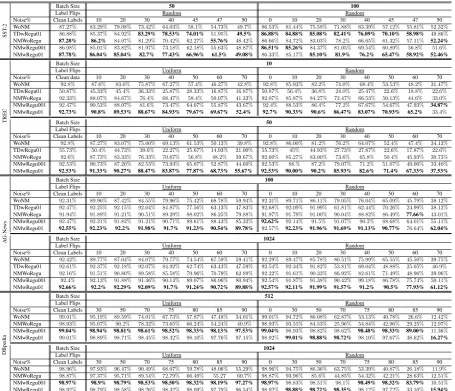
Table 2: Test performance for different text classification datasets
clean labels we obtain classification accuracy of87.27%. For this dataset, the base model network architecture consists of an input and embedding layer +[3,4,5] feature windows with 100 feature maps each and dropout rate
0.5with batch size 50.
2. TREC2 (Voorhees and Tice, 1999): A ques-tion classificaques-tion dataset consisting of fact based questions divided into broad seman-tic categories. We use a six-class version of TREC dataset. For this dataset, the base model network architecture consists of an in-put and embedding layer + [3] one feature windows with 100 feature maps and dropout rate0.5with batch size 10.
2http://cogcomp.cs.illinois.edu/Data/
QA/QC/
3. Ag-News3 (Zhang et al., 2015): A large-scale, four-class topic classification dataset. It contains approx 110K training samples. For this dataset, the base model network ar-chitecture consists of Input layer + Embed-ding layer + [3,4,5] feature windows with 200 feature maps and dropout rate0.5 with batch size 100.
4. DBpedia3(Zhang et al.,2015): A large scale 14-class topic classification dataset contain-ing36K training samples per category. For this dataset, the base model network archi-tecture consists of Input layer + Embedding layer +[1,2,3,4,5,7]feature windows with 400 feature maps each and dropout rate0.5
with batch size 1024.
3
For all the datasets, we use Rectified Linear Units (ReLU) and fix the base model architec-ture. We use early stopping on dev. sets for all the datasets. We run all the experiments 5 times and report the average classification accu-racy in Table 2. We train all the networks end-to-end via stochastic gradient descent over shuf-fled mini-batches with the Adadelta update rule (Zeiler,2012) except for the DBpedia, where we use SGD. In order to improve base model per-formance, we initialize the word embedding layer with the publicly availableword2vecword vectors (Mikolov et al., 2013) for all the datasets except for DBpedia, where we use GloVe embeddings (Pennington et al.,2014).
(a) (b)
(c) (d)
[image:6.595.79.286.279.546.2](e) (f)
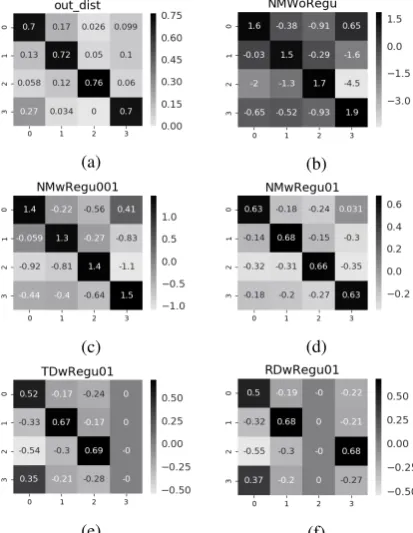
Figure 1: AG-News Dataset: a) Input random label noise; (b-f) learned weight matrix learned by different noise models.
5 Results and Discussion
We evaluate the performance of our model in Ta-ble2for each datasets in the presence of uniform and random label noise and compare the perfor-mance with the base model (WoNM) as our base-line. For all datasets, the proposed approach is sig-nificantly better than the baseline for both random and uniform label noise. For all datasets, we ob-serve a gain of approximately30%w.r.t the base-line in the presence of extreme label noise. We do observe a drop in classification accuracy as we
increase the percentage of label noise but even at the extreme label noise our method outperformed the baseline method. Interestingly, if we assume an oracle to determine prior knowledge of true noise distribution (TDwRegu01), it does not nec-essarily improve classification performance, espe-cially for multi-class classification problems. For binary classification, using the SST-2 dataset, we did observe that the noise model initialized with the true noise distribution works better than all the other models. In addition to this, we also observe a slight performance gain for the proposed approach over the baseline with clean labels – perhaps due to label noise inherent in the datasets.
5.1 Effect of Different Regularizers
The NMwRegu01performs better in all cases for both types of label noise. We plot the weight ma-trix learned by all the noise models in all the noise regimes. For brevity, we only plot the weight ma-trix for AG-News datasets with 30% label noise in Fig.1. We find that l2 regularization diffuses the diagonal weight elements and learns more smoothed off-diagonal elements which resemble the corresponding input label noise distribution in Fig. 1d. This also means that, without regulariza-tion, the noise model has less ability to diffuse the diagonal elements which leads to poor classifica-tion performance. Therefore, we use a regularizer (l2) to diffuse the diagonal entries.
In some cases, especially for low label noise, we find thel2 regularization with a small penalty works better than a large penalty since, for low la-bel noise, learning a less diffuse noise is beneficial. The proposed approach scales to a large number of label categories, as evident from the experiments on DBpedia dataset in the last row of Table .2.
[image:6.595.310.526.619.710.2](a) Classification accuracy (b) Noise model norm
(a) TREC [Uniform] (b) AG-News [Uniform] (c) DBpedia [Uniform]
(d) TREC [Random] (e) AG-News [Random] (f) DBpedia [Random]
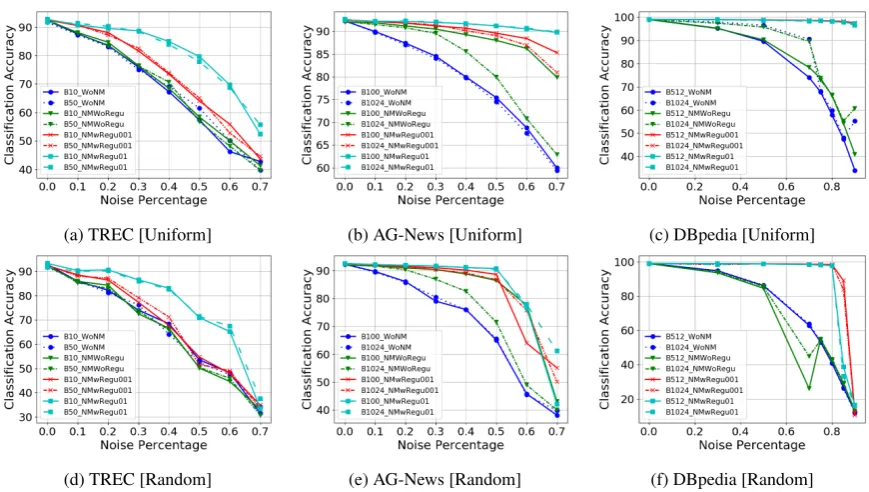
Figure 3: Effect of batch size on label noise classification for different datasets. [Best viewed in color]
5.2 Effect of Different Scaling Factors on Noise Layer Initialization
We initialize the noise model weights as identity matrices with gain equal to the number of classes (gain = K) for all experiments. We observe the effect of different gain values on the overall per-formance of the proposed network in Fig.2where on x-axis we vary the scaling factor – a function of number of classes in the dataset. We plot the classification performance for the DBpedia dataset with 50% random noise. For each noise model in Fig. 2a, we find that setting the gain to K works best and any other gain results in poor per-formance.
In Fig. 2b we plot the Frobenius norm of the learned noise model weights with respect to the different gain values. We find that, using the high gain initialization, the model learns a high noise model norm, resulting in poor classification per-formance. This finding provides support to the claim in (Liao et al.,2018) that “higher layer norm leads to highest test errors.”
5.3 Effect of Batch Size
We also observe the effect of different batch sizes on performance as described in (Rolnick et al., 2017). For all datasets, we do observe small per-formance gains for highly non-uniform noisy la-bels, for instance70%, in Fig.3row 2. However, for uniform label flips, we do not observe
perfor-TRB TRPr
Data(N%) WoNM Noisy True NMwRegu01 Noisy True
SST2 (40%) 70.24 70.95 79.24 82.32 73.90 83.25
AG (70%) 59.70 52.44 79.18 90.33 86.27 89.4
AG (60%) 83.25 68.8 88.28 90.45 87.77 90.78
TREC (40%) 66.80 63.4 79.0 73.40 69.6 83.2
[image:7.595.81.516.61.307.2]TREC (20%) 83.6 80.0 86.0 87.40 83.6 90.0
Table 3: SVM Classification
mance gains with increasing batch size.
5.4 Instance Dependent Label Noise
We further investigate the performance of the pro-posed approach on instance-dependent label noise by flipping each class labels with different noise percentages as shown in Fig. 4a. For brevity, we present results on AG-News dataset in Fig. 4. On this type of label noise, the performance of the proposed approach is far better than the baseline with a performance improvement of ∼ 6%. The noise model learned by the proposed approach is shown in Fig. 4b and we show the normalized weight matrix in Fig. 4c. We observe that the learned noise model is able to capture the input label noise statistics and is highly correlated to the input noise distribution with Pearson Correlation Coefficient0.988.
5.5 Understanding Noise Model
(a) (b) (c)
Figure 4: AG-News Dataset: a) input instance dependent label noise; b) learned weight matrix by proposed ap-proach; c) column normalization of (b).
Iteration 0 Iteration 5 Iteration 10 Iteration 18
(a) Proposed model
Iteration 0 Iteration 5 Iteration 10 Iteration 18
(b) No noise model stacked
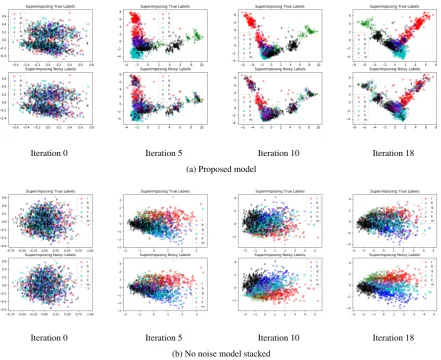
Figure 5: t-SNE visualization of the last layer activations of a base network before softmax for TREC Dataset with
50%corrupted labels; First row in (a) when the corresponding true labels are superimposed on the t-SNE data points; Second row in (a) when the noisy labels are superimposed onto the t-SNE data points. [Best viewed in color]
the last fully-connected layer’s activations for all the training samples and treat them as the learned feature representation of the input sentence. We get two different sets of feature representations, one corresponding to the base model (TRB), and the other corresponding to the proposed model (TRPr). Given these learned feature
[image:8.595.77.519.221.581.2]Simi-larly, we train two SVMs for the proposed model. After training, we evaluate the performance of all the learned SVMs on clean test data in Table 3, where the 1st column represents the corresponding model performance, “Noisy” and “True” column represents the SVM performance when trained on noisy and clean labels, respectively. We run these experiments for different datasets with different label noise.
The SVM, trained on TRB and noisy labels, is very close to the base model performance (3). This suggests that the base model is just fitting the noisy labels. On the other hand, when we train an SVM on the TRPr representations with true labels as tar-gets, the SVM achieves the proposed model per-formance. This means that the proposed approach helps the base model to learn better feature repre-sentations even with the noisy targets, which sug-gest that this noise model is learning a label de-noising operator.
We analyze the representation of training sam-ples in feature domain by plotting the t-SNE em-beddings (Van Der Maaten,2014) of the TRB and TRPr. For brevity, we plot the t-SNE visualiza-tions for TREC dataset with 50% label noise in Fig.5.
For each network, we show two different t-SNE plots. For example in Fig. 5awe plot two rows of t-SNE embeddings for the proposed model. In the first row of Fig. 5a, each training sample is rep-resented by its corresponding true label, while in the second row (the noisy label plot) each training sample is represented by its corresponding noisy label. We observe that, as the learning process pro-gresses, the noise model helps the base model to cluster the training samples in the feature domain. With each iteration, we can see the formation of clusters in Row 1. However, in Row 2, when the noisy labels are superimposed, the clusters are not well separated. This means that the noise model denoises the labels and presents the true labels to the base network to learn.
In Fig. 5b, we plot two rows of t-SNE embed-dings of the TRB representations. It seems that the network directly learns the noisy labels. This provides further evidence to support (Zhang et al., 2016)’s finding that the deep network memorizes data without knowing of true labels. In Row 2 of Fig. 5b, we can observe that the network learns noisy features representations which can be well clustered according to given noisy labels.
6 Conclusion
In this work, we propose a framework to enable a DNN to learn better sentence representations in the presence of label noise for text classification tasks. To model the label noise, we append a non-linear noise model on top of the standard DNN ar-chitecture. With proper initialization and regular-ization, the noise model is able to absorb most of the label noise and helps the base model to learn better sentence representations.
Acknowledgments
We thank the anonymous reviewers for their de-tailed and insightful comments. We would also like to thank Patrick Haffner, Sagnik Ray Choud-hury, Yanjie Zhao and Amy Hemmeter for their valuable discussions with us during the course of this research.
References
Samaneh Azadi, Jiashi Feng, Stefanie Jegelka, and Trevor Darrell. 2015. Auxiliary image regulariza-tion for deep cnns with noisy labels. arXiv preprint arXiv:1511.07069.
Carla E Brodley and Mark A Friedl. 1999. Identifying mislabeled training data. Journal of artificial intel-ligence research, 11:131–167.
Jacob Devlin, Ming-Wei Chang, Kenton Lee, and Kristina Toutanova. 2018. Bert: Pre-training of deep bidirectional transformers for language understand-ing.arXiv preprint arXiv:1810.04805.
Benoˆıt Fr´enay and Michel Verleysen. 2014. Classifica-tion in the presence of label noise: a survey. IEEE transactions on neural networks and learning sys-tems, 25(5):845–869.
Aritra Ghosh, Himanshu Kumar, and PS Sastry. 2017. Robust loss functions under label noise for deep neu-ral networks. InAAAI, pages 1919–1925.
Alex Graves, Abdel-rahman Mohamed, and Geoffrey Hinton. 2013. Speech recognition with deep recur-rent neural networks. InAcoustics, speech and sig-nal processing (icassp), 2013 ieee internatiosig-nal con-ference on, pages 6645–6649. IEEE.
Bo Han, Jiangchao Yao, Gang Niu, Mingyuan Zhou, Ivor Tsang, Ya Zhang, and Masashi Sugiyama. 2018. Masking: A new perspective of noisy super-vision. arXiv preprint arXiv:1805.08193.
Lu Jiang, Zhengyuan Zhou, Thomas Leung, Li-Jia Li, and Li Fei-Fei. 2017. Mentornet: Regularizing very deep neural networks on corrupted labels. arXiv preprint arXiv:1712.05055.
Ishan Jindal, Matthew Nokleby, and Xuewen Chen. 2016. Learning deep networks from noisy la-bels with dropout regularization. In Data Mining (ICDM), 2016 IEEE 16th International Conference on, pages 967–972. IEEE.
Armand Joulin, Laurens van der Maaten, Allan Jabri, and Nicolas Vasilache. 2016. Learning visual fea-tures from large weakly supervised data. In Euro-pean Conference on Computer Vision, pages 67–84. Springer.
Yoon Kim. 2014. Convolutional neural networks for sentence classification. InProceedings of the 2014 Conference on Empirical Methods in Natural Lan-guage Processing (EMNLP), pages 1746–1751.
Neil D Lawrence. 2001. Estimating a kernel fisher dis-criminant in the presence of label noise. InICML. Citeseer.
Yuncheng Li, Jianchao Yang, Yale Song, Liangliang Cao, Jiebo Luo, and Li-Jia Li. 2017. Learning from noisy labels with distillation. InICCV, pages 1928– 1936.
Qianli Liao, Brando Miranda, Andrzej Banburski, Jack Hidary, and Tomaso Poggio. 2018. A surprising lin-ear relationship predicts test performance in deep networks. arXiv preprint arXiv:1807.09659.
Naresh Manwani and PS Sastry. 2013. Noise tolerance under risk minimization. IEEE transactions on cy-bernetics, 43(3):1146–1151.
Tomas Mikolov, Ilya Sutskever, Kai Chen, Greg S Cor-rado, and Jeff Dean. 2013. Distributed representa-tions of words and phrases and their compositional-ity. InAdvances in neural information processing systems, pages 3111–3119.
Ishan Misra, C Lawrence Zitnick, Margaret Mitchell, and Ross Girshick. 2016. Seeing through the human reporting bias: Visual classifiers from noisy human-centric labels. InProceedings of the IEEE Confer-ence on Computer Vision and Pattern Recognition, pages 2930–2939.
Volodymyr Mnih and Geoffrey E Hinton. 2012. Learn-ing to label aerial images from noisy data. In Pro-ceedings of the 29th International conference on ma-chine learning (ICML-12), pages 567–574.
Nagarajan Natarajan, Inderjit S Dhillon, Pradeep K Ravikumar, and Ambuj Tewari. 2013. Learning with noisy labels. InAdvances in neural information pro-cessing systems, pages 1196–1204.
Giorgio Patrini, Alessandro Rozza, Aditya Kr-ishna Menon, Richard Nock, and Lizhen Qu. 2017. Making deep neural networks robust to label noise:
A loss correction approach. In Proceedings of the IEEE Conference on Computer Vision and Pattern Recognition, pages 1944–1952.
Jeffrey Pennington, Richard Socher, and Christopher Manning. 2014. Glove: Global vectors for word representation. InProceedings of the 2014 confer-ence on empirical methods in natural language pro-cessing (EMNLP), pages 1532–1543.
Daniel Pressel, Sagnik Ray Choudhury, Brian Lester, Yanjie Zhao, and Matt Barta. 2018. Baseline: A library for rapid modeling, experimentation and de-velopment of deep learning algorithms targeting nlp. In Proceedings of Workshop for NLP Open Source Software (NLP-OSS), pages 34–40. Association for Computational Linguistics.
Umaa Rebbapragada and Carla E Brodley. 2007. Class noise mitigation through instance weighting. In
European Conference on Machine Learning, pages 708–715. Springer.
Scott Reed, Honglak Lee, Dragomir Anguelov, Chris-tian Szegedy, Dumitru Erhan, and Andrew Rabi-novich. 2014. Training deep neural networks on noisy labels with bootstrapping. arXiv preprint arXiv:1412.6596.
David Rolnick, Andreas Veit, Serge Belongie, and Nir Shavit. 2017. Deep learning is robust to massive la-bel noise. arXiv preprint arXiv:1705.10694.
Richard Socher, Jeffrey Pennington, Eric H Huang, Andrew Y Ng, and Christopher D Manning. 2011. Semi-supervised recursive autoencoders for predict-ing sentiment distributions. In Proceedings of the conference on empirical methods in natural lan-guage processing, pages 151–161. Association for Computational Linguistics.
Sainbayar Sukhbaatar, Joan Bruna, Manohar Paluri, Lubomir Bourdev, and Rob Fergus. 2014. Train-ing convolutional networks with noisy labels. arXiv preprint arXiv:1406.2080.
Arash Vahdat. 2017. Toward robustness against la-bel noise in training deep discriminative neural net-works. InAdvances in Neural Information Process-ing Systems, pages 5596–5605.
Laurens Van Der Maaten. 2014. Accelerating t-sne us-ing tree-based algorithms. The Journal of Machine Learning Research, 15(1):3221–3245.
Andreas Veit, Neil Alldrin, Gal Chechik, Ivan Krasin, Abhinav Gupta, and Serge J Belongie. 2017. Learn-ing from noisy large-scale datasets with minimal su-pervision. InCVPR, pages 6575–6583.
Tong Xiao, Tian Xia, Yi Yang, Chang Huang, and Xi-aogang Wang. 2015. Learning from massive noisy labeled data for image classification. In Proceed-ings of the IEEE Conference on Computer Vision and Pattern Recognition, pages 2691–2699.
Jiangchao Yao, Jiajie Wang, Ivor W Tsang, Ya Zhang, Jun Sun, Chengqi Zhang, and Rui Zhang. 2018. Deep learning from noisy image labels with quality embedding. IEEE Transactions on Image Process-ing.
Tom Young, Devamanyu Hazarika, Soujanya Poria, and Erik Cambria. 2018. Recent trends in deep learning based natural language processing. IEEE Computational Intelligence Magazine, 13(3):55–75.
Matthew D Zeiler. 2012. Adadelta: an adaptive learn-ing rate method.arXiv preprint arXiv:1212.5701.
Chiyuan Zhang, Samy Bengio, Moritz Hardt, Ben-jamin Recht, and Oriol Vinyals. 2016. Understand-ing deep learnUnderstand-ing requires rethinkUnderstand-ing generalization.
arXiv preprint arXiv:1611.03530.
Xiang Zhang, Junbo Zhao, and Yann LeCun. 2015. Character-level convolutional networks for text clas-sification. In Advances in neural information pro-cessing systems, pages 649–657.