2588
The World in My Mind: Visual Dialog
with Adversarial Multi-modal Feature Encoding
Yiqun Yao123, Jiaming Xu12∗and Bo Xu1234
1Institute of Automation, Chinese Academy of Sciences (CASIA). Beijing, China
2Research Center for Brain-inspired Intelligence, CASIA
3University of Chinese Academy of Sciences
4Center for Excellence in Brain Science and Intelligence Technology, CAS. China
{yaoyiqun2014,jiaming.xu,xubo}@ia.ac.cn
Abstract
Visual Dialog is a multi-modal task that re-quires a model to participate in a multi-turn human dialog grounded on an image, and gen-erate correct, human-like responses. In this paper, we propose a novel Adversarial Multi-modal Feature Encoding (AMFE) framework for effective and robust auxiliary training of visual dialog systems. AMFE can force the language-encoding part of a model to generate hidden states in a distribution closely related to the distribution of real-world images, resulting in language features containing general knowl-edge from both modalities by nature, which can help generate both more correct and more general responses with reasonably low time cost. Experimental results show that AMFE can steadily bring performance gains to dif-ferent models on difdif-ferent scales of data. Our method outperforms both the supervised learn-ing baselines and other fine-tunlearn-ing methods, achieving state-of-the-art results on most met-rics of VisDial v0.5/v0.9 generative tasks.
1 Introduction
In recent years, there has been a rising atten-tion in Artificial Intelligence on how to train a model to understand visual inputs from the physi-cal world, and communicate them with human lan-guage. Typical problems include Visual Question Answering (VQA) (Antol et al.,2015) and Image Captioning (Xu et al.,2015). These tasks require a model to read an image and generate a proper response, such as answering a question grounded on the image, or generating a sentence to describe the image. As a more difficult extension, Visual Dialog (De Vries et al., 2017;Das et al., 2017a;
Mostafazadeh et al.,2017) is a cluster of tasks fea-turing two agents conducting a multi-turn dialog grounded on an image. A model is usually trained
∗Corresponding Author
to predict every single response of one agent in the two, based on the image and dialog history. There are also some different task settings such as directly training two agents to complete a goal-driven cooperative task such as Guessing Game (Das et al.,2017b).
Tasks involving both the physical world (vi-sual images) and abstract world (languages) share a core issue: how to establish connections be-tween these two worlds, and is there a frame-work to leverage these connections for learning? Temporarily, the majority of answers are learning end-to-end models with multi-modal feature fu-sion (Kim et al.,2016;Fukui et al.,2016;Yu et al.,
2018). These methods usually merge the visual and language features into rich representations containing information from both sides. Some cross-modal attention methods (Lu et al., 2016;
Nam et al., 2017) formulate the visual-language connections explicitly by parameterizing the atten-tion weights to learn whether there is high corre-lation within certain pairs of language and visual feature vectors. However, in all these works, the merged representations or attention weights are only learned from pairwise (one image, one sen-tence) co-occurrence, and serve for the optimiza-tion of a loss funcoptimiza-tion only related to the final ground-truth response. In fact, the features from both sides are not truly connected in an aspect of general distributions, but only merged into a new vector for each training/testing sample. We sup-pose that this is not good enough for a model to distill knowledge from both of the two worlds be-cause the language/visual vectors do not contain knowledge from the other modality in the bottom level before they are merged.
distribution, or vice versa. For example, when a neural network based model receives a natural language sentencexas input, it encodes xinto a sequence of high-dimensional continuous vectors. All these language vectors can be projected into another latent space to have a new distributionpl. We train the language encoder to let the new distri-butionplbe the same as, or very close to, the dis-tributionpvof allimage featuresobserved and en-coded in the task data. Since we can partly recover a real-world image distribution from the language vectors achieved in this way, these language vec-tors intrinsically contain both language semantics and real-world image properties. This is a higher-level connection between the two worlds.
In order to train a model to generate samples subject to a certain distribution pv from an orig-inal distribution pl, Generative Adversarial Net-works (GANs) have been proved very effective (Goodfellow et al., 2014; Arjovsky et al., 2017;
Miyato et al., 2018). Lample et al. (2018) used adversarial training on the vectors produced by sentence encoders for different languages in unsu-pervised machine translation. However, different languages in their task are in single modality and share encoder structures, making the same method not directly usable and extendable for multi-modal tasks with largely different prior distributions and complex encoder structures with attention. In our work, we propose Adversarial Multi-modal Feature Encoding (AMFE), a novel GAN-based training schedule with an attention-based sample-selecting method, which can successfully force the multi-modal vectors to have closely related dis-tributions, benefitting the performances of various visual dialog systems.
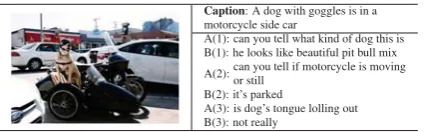
We test our method on the VisDial (Das et al.,
2017a) benchmark (one example is shown in Ta-ble 1). A normal sample of VisDial contains an image and 10 turns of question-answering di-alog from two people grounded on the image. A series of models have been proposed to solve the task, including memory and attention based models (Das et al., 2017a), reinforcement learn-ing (Das et al., 2017b), knowledge transfer tech-niques (Lu et al., 2017) and GAN (Wu et al.,
2017). Wu et al. (2017) designed a complex at-tention model and applied GAN in a traditional way to force the generated tokens to mimic real-world language (language vs. language), mak-ing their model only trainable through sequence
Caption: A dog with goggles is in a motorcycle side car
A(1): can you tell what kind of dog this is B(1): he looks like beautiful pit bull mix A(2):can you tell if motorcycle is moving
or still B(2): it’s parked
[image:2.595.312.526.61.127.2]A(3): is dog’s tongue lolling out B(3): not really
Table 1: An example from VisDial dataset.
sampling and reinforcement learning. Our work, on the other hand, applies a directly differentiable GAN on continuous vectors as a multi-modal fea-ture encoding method (language vs. image).
Our contributions include:
• We propose AMFE: a novel Adversarial Multi-modal Feature Encoding framework to benefit visual dialog models. The core idea is to force features from different modalities to have closely related distributions.
• We develop efficient AMFE implementa-tions, including a novel attention-based sam-ple selecting method, for various commonly-used visual dialog models.
• Experimental results show that AMFE brings robust performance gains to different visual dialog models. We achieve state-of-the-arts on most metrics of VisDial v0.5/v0.9 genera-tive tasks.
2 Related Work
2.1 Visual Dialog
Visual Dialog is a cluster of tasks sharing two properties: multi-turn and cross-modality. VisDial (Das et al., 2017a) is a widely-used benchmark with question-answering style dialogs grounded on real-world images. As a special case of dia-log generation tasks, VisDial share some of the research concerns with single-modal natural lan-guage dialog generation (Dhingra et al., 2016;
the answerer. The distance between the guess-ing and the target image is used as reward for re-inforcement learning. In some extreme settings, such a task definition can even lead to emergence of a new language between robots (Kottur et al.,
2017). After per-training, using their reinforce-ment learning method as an auxiliary loss can also bring performance gain in standard VisDial met-rics such as mean rank.
However, generating a reward based on just one target image for a training sample may lead to a kind of overfitting. Language is highly abstract: one dialog can correctly describe a lot of different scenes in real world, so why should we force a dia-log to fit one single example among them? There-fore, generating a reward from adversarial training is a more efficient way because it goes beyond in-dividual samples into distributions. There are two previous works (Wu et al.,2017;Lu et al.,2017) that use GAN-like methods to boost the perfor-mances of pre-trained VisDial models. (Wu et al.,
2017) proposes to use adversarial reinforcement learning. A discriminator is trained to distinguish the tokens of real/generated answers, and the an-swerer (generator) is trained via RL using a reward related to the score given by discriminator. This method is very effective, but using both RL Monte Carlo and GAN brings high computational cost. Also, a lot of tricks are involved for a good train-ing. Our method, on the other hand, does not need Monte-Carlo sampling to compute immediate re-ward while generating each of theN words in a sentence (O(N)time cost). (Lu et al.,2017) uses a knowledge-transferring method between gener-ative and discrimingener-ative task settings. However, this requires the models on both settings to be pre-trained well enough. Our work is also an adver-sarial learning based method, but it is more robust, time-efficient and effective.
2.2 GAN for Generative Tasks
GAN (Goodfellow et al., 2014; Arjovsky et al.,
2017;Miyato et al.,2018) has raised much atten-tion because of its ability to directly generate sam-ples subject to a target distribution. Many training techniques have been proposed to solve the unsta-ble training prounsta-blems of GAN (Gulrajani et al.,
2017; Kurach et al., 2018). Wasserstein GAN (WGAN) (Arjovsky et al., 2017) is a success-ful method using critic learning loss and weight clipping operations. We borrow some ideas from
WGAN in the adversarial training of our model. GAN well suits the image generation tasks be-cause image signals are continuous and thus dif-ferentiable, enabling the gradient directly flowing back from the discriminator to generator. In lan-guage generation tasks, however, how to deal with the discrete sequence of symbols generated by the generator has long been a problem. A widely-used solution is applying RL with rewards generated by the discriminator (Wang et al.,2018;Li et al.,
2017). As mentioned above, this is time-costing because RL needs to explore a large action space by sampling multiple action sequence. Besides, how the immediate reward is computed after gen-erating each word is also a difficult problem.
Another solution is to avoid the discrete prob-lem by applying adversarial training on the hidden states of the generator. This requires that there is a known distribution p for the hidden states we want the model to generate. A successful case is reported by (Lample et al., 2018): using ad-versarial training to restrict the hidden states of source language and target language (both from vanilla LSTMs) into a same latent space can boost the performance of unsupervised machine transla-tion. Our AMFE framework is also an adversar-ial training on the language hidden states, but we are the first to use this kind of methods to estab-lish connections between different modalities. Our training procedure is also largely different from (Lample et al., 2018) with our modified WGAN-like algorithm and a novel attention-based sam-ple selection method: they are critical for training convergency on multi-modal tasks, with complex attention-based model structures.
3 Model
We first define the task and our framework for-mally, and then describe how it is implemented and trained on different visual dialog models.
3.1 VisDial Task Definition
Image Encoding
Language Encoding
hv hl
A: Is there a man or a woman? B: I think he is
man. ... A: How old does
man look? B: He has white hair, so probably 60's.
Sample Selection
Adversarial
High Level Encoding and
Decoding
B: I think he is young.
Supervised
A-Bot
[image:4.595.87.276.73.240.2]AMFE Image
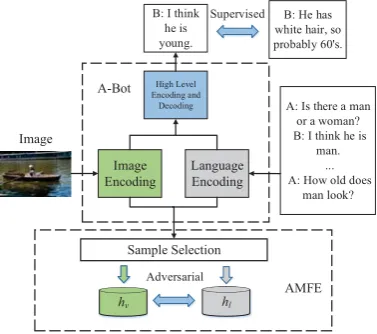
Figure 1: AMFE framework with a generative encoder-decoder model and multi-modal adversarial training.
predictionaˆt:
ˆ
at=ABot(qt, I, H0∼t−1). (1)
3.2 AMFE Framework
The goal of our Adversarial Multi-modal Feature Encoding (AMFE) is to restrict the distribution of feature representations from one modality m1 to be closely related to that from another modality m2. We take m1 = l(anguange) and m2 = v(isual). Specifically, A-Bot encodes language inputs into vectors hl, and visual inputs into hv, respectively. We wanthlandhv to have indistin-guishable distributions:
hl, hv ∼p(h). (2)
To achieve this goal, we use a discriminative model (named D-Bot) to classify whether a vec-tor encoded by A-Bot comes from modality l or v. D-Bot is trained with real hl andhv samples, while A-Bot is trained to generate language vec-torshl that can confuse D-Bot to classify them as labelv. Figure1shows our framework.
3.3 A-Bot
We implement our AMFE method on two commonly-used visual dialog models, using them as A-Bot. The two A-Bot models are named Hi-erarchical Recurrent Encoder (HRE) and History-Conditioned Image Attentive Encoder (HCIAE), respectively. A-Bot learns to predict the right an-swer in each turn. In this process, it also encodes language and visual inputs intohlandhvsamples, which we use for AMFE training.
3.3.1 Hierarchical Recurrent Encoder (HRE)
HRE is a hierarchical LSTM (Hochreiter and Schmidhuber, 1997) model used in (Das et al.,
2017a,b). In HRE, a pre-trained Convolutional Neural Network (CNN) encodes the image into a single feature vector, which is further mapped into a visual representationIby a trainable Multi-Layer Perceptron (MLP). In each turnt, the tion is encoded by a word-level LSTM into a ques-tion vectorqt, and the dialog history in the previ-ous step Ht−1 is encoded by another LSTM into vectorft−1. There is a state-trackerLST Mst on the top level:LST Mstis forwarded one step each turn, integrating all the encoded vectors mentioned above. It reads the encoded history ft−1, image vectorI, the questionqtand the previous hidden statest−1 from itself, and produces the new hid-den state representationst:
st=LST Mst([qt, I, ft−1], st−1), (3)
where[·]stands for concatenation.
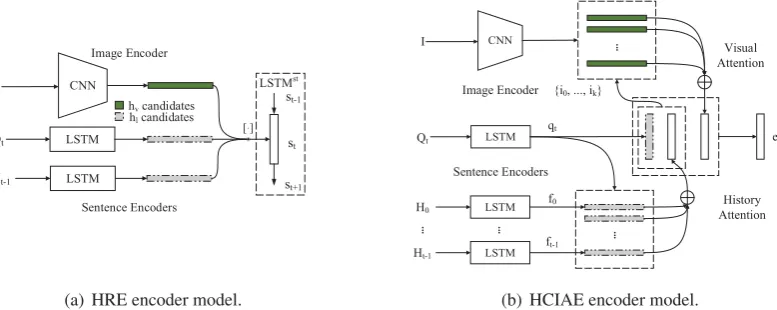
The answer decoder in HRE is an LSTM that takes st as initial state, and predicts one word at a time by a softmax probability over the vocabu-lary, to generate the whole answer sentence. Fig-ure2(a) shows the encoder structure of HRE. We use image vectorsI ashv samples (dark green) in AMFE, and both theqandf vectors ashlsamples (pink).
3.3.2 History-Conditioned Image Attentive Encoder (HCIAE)
HCIAE model (Lu et al., 2017) contains an tex-tual attention on all history vectors based on the question, and a visual attention based on both the history and the question. In detail, it uses a pre-trained CNN to encode the image into a set of vi-sual feature vectors V. Each vector in V is fur-ther passed through a trainable MLP, resulting in a visual feature set{i0, ...iK−1}. In each turn t, the question is encoded by an LSTM into vector qt; the dialog history {H0, H1, ..., Ht−1} is en-coded by another word-level LSTM into vectors {f0, ..., ft−1}. The attention weight between qt and each history vectorfjis computed as:
ztj =ωTatanh(Wffj+Wqqt),
αjt =sof tmax(ztj), (4)
LSTM
LSTM CNN I
Qt
Ht-1
st
st-1
st+1
LSTMst
Image Encoder
Sentence Encoders
[·]
hv candidates
hl candidates
(a) HRE encoder model.
LSTM
LSTM
LSTM CNN
I
Qt
H0
Ht-1
et
... ... ...
...
Sentence Encoders Image Encoder
History Attention Visual Attention
{i0, ..., ik}
qt
f0
ft-1
[image:5.595.120.509.94.249.2](b) HCIAE encoder model.
Figure 2: A-Bot models we use for AMFE training. The intermediate vectors used ashv andhlcandidates in AMFE are colored dark green and pink, respectively.
question and history features. A memory vector ˆ
mtis computed by:
ˆ mt=
t−1
j=0
αjtfj. (5)
The memory vector is further used as a key to compute a similar visual attention over {i0, ...ik−1} to achieve a final image vector ˆvt. The final output of the encoder is computed by:
et=tanh(We[qt,mˆt,vˆt]), (6)
where We ∈ Rd×3d is trainable parameters; [·]
stands for concatenation.
The answer decoder is an LSTM like that of HRE, taking et as input. Figure 2(b) shows the structure of HCIAE encoder. HCIAE produces more visual vectors for each image than HRE. We take all the q and f vectors as hl candidates of AMFE, and the spatial visual features{i0, ...ik−1} as candidates forhv.
3.4 D-Bot
Despite the multiple choices of A-Bot, our D-Bot is always an MLP with two hidden layers of size 512 and ReLU activation. It is used to compute a loss function that forces all the hl samples to be subject to the same distributionp(h)as the visual vectors hv. D-Bot takes a vector h in size d as its input, and predicts the probability of h com-ing from real image distribution and the visual en-coder:
ˆ
pv(modality=v|h) =DBot(h). (7)
D-Bot is the discriminator from a GAN view-point. A-Bot must learn to confuse D-Bot in or-der to generate language features indistinguishable from image features.
3.5 Training
3.5.1 Loss Functions
To train our model, we use standard supervised training with cross-entropy loss function for pre-training, and add in adversarial training to produce an auxiliary loss to improve feature encoding.
The supervised learning loss is:
Lsu = 1 N
N
n=1
−log(p(wt
n|wt<n)), (8)
whereNis the full length of the decoded sentence. For adversarial learning, A-Bot is trained to minimize the probability that D-Bot predicts the generated features to be fake samples. Following WGAN (Arjovsky et al.,2017), we do not use log-arithm but directly optimize the likelihood itself:
Ladv =−Ehl[DBot(hl)]. (9)
We sumLadv as an auxiliary loss with a tunable weightλ, making A-Bot minimize:
LG=Lsu+λLadv. (10)
On the other hand, D-Bot maximizes the fol-lowing objective to distinguish real-world image vectorshv from the language vectorshl:
LD =Ehv[DBot(hv)]−Ehl[DBot(hl)]. (11)
3.5.2 Attention-based Sample Selection
We have specified where the hl andhv samples come from while using different A-Bots in Sec-tion3.3. Typically, for each batch of samples with batch-sizeM, in each turnt, there areM question vectors andM×thistory vectors ashlcandidates. For HRE encoder, there are M image vectors as hv candidates, while the number isM×Kfor the HCIAE encoder; K is the number of “pixels” in the final CNN feature-map. Thus, it is impossible to use all the generated samples in AMFE. For a successful training, the selected samples must be efficient, informative and balanced.
While using HCIAE, in order to computeLadv, we use M question vectors and M ∗ w history vectors ashlsamples. The history vectors are se-lected using textual attention weightsαjtproduced by the temporary model: for each dialog, we pick the top w history vectors with the highest atten-tion weights. We call this Attenatten-tion-based Sample Selection (AbS). While computingLD to train D-Bot, we use the same technique on the image, us-ing the top-attendedM∗wimage vectors, together with anotherM image vectors randomly sampled from the dataset as positive sampleshv. The M question vectors and M ∗ w history vectors are used as a pool of negative sampleshl. In our ex-periments,w= 1,2works well.
While using HRE, since the model always “at-tends” onft−1 by default (Eq. 3), we directly se-lect qt and ft−1 as hl samples. We use the M image vectors I in this batch, together with an-other M image vectors randomly sampled from the dataset as the pool ofhv. The full training pro-cedure is specified in Algorithm1.
4 Experiments
4.1 The VisDial Dataset
VisDial is a visual dialog dataset based on MS COCO (Lin et al., 2014) images. There are 10 turns of human-posed question-answering dialogs on each image, with the questioner kept not seeing the image during the data collection process. For generative models, a model must give the proba-bility of generating each candidate answer with-out seeing other candidates, and the rank of the ground-truth answer in the 100 candidates is used to compute different evaluation metrics; for dis-criminative models, the model can read and en-code all the candidate answers and directly assign scores on them. According to the nature of GANs
Algorithm 1AMFE Training Procedure.
Require: αthe learning rate;cthe clipping parameter;M the batch size;w0the initial D-Bot parameters;θ0the
ini-tial A-Bot parameters; dialog samples. Pre-train A-Bot withLsu(Eq.8). whileθhas not convergeddo
SampleMturns of(q, H, I, a)dialog samples. Forward A-Bot and selecthlby attention weights.
ComputeLadv=− M
k=1DBot(h
k l)).
ComputeLsuwith ground-truth answers using (Eq.8).
Updateθto minimizeLG=Lsu+λLadv.
Switch to D-Bot training.
Select image vectorshvby attention weights.
Re-generatehlsamples using the updated A-Bot.
ComputeLD= M
k=1DBot(h
k v)−
M
k=1DBot(h
k l).
Updatewto maximizeLD.
Clip D-Bot weightwinto range(−c, c).
end while
and similarities to real-world application scenar-ios, we use the generative setting for our model: it is equipped with a sequential decoder instead of a scoring module.
For fair and sufficient comparison, we evaluate our model on both VisDial v0.5 and VisDial v0.9. VisDial v0.5 has 68k COCO images, for a total of 680k QA-pairs. Following (Das et al., 2017a) and (Das et al.,2017b), we use 50,729 images for training, 7,663 for validation and 9,628 for testing. Visdial v0.9 has 123,287 images. There are dif-ferent splitting of train/valid/test in previous work. We follow (Lu et al.,2017) to use 82k for training, 1k for validation and 40k for testing.1
We compare our results to several existing mod-els on the VisDial dataset, including:
• Answer Prior(Das et al.,2017a): directly
en-coding answer candidates with an LSTM and scoring by a linear model that captures the frequency of answers in the training set.
• NN-QI (Das et al., 2017a): a k-Nearest
Neighborhood method considering only the question and the image. Unlike generative methods, both Answer Prior and NN-QI need to know the answer candidates.
• LF-QIH-G(Das et al.,2017a): a Late Fusion
encoder that encodes the question, image and history separately. The encoded features are concatenated and linearly transformed to a
1
joint representation. The answer is produced by a generative decoder.
• HRE(Das et al.,2017b): the HRE model in-troduced in Section3.3.
• HREA-QIH-G(Das et al.,2017a): a modified
HRE A-Bot with attention to dialog history.
• MN-QIH-G (Das et al., 2017a): a Memory
Network encoder that stores each piece of di-alog history embeddings in an explicit mem-ory. These embeddings can be attended and fused while generating the answer.
• HCIAE(Lu et al.,2017): the HCIAE model
introduced in Section3.3.
• CoAtt (Wu et al., 2017): this is a
previ-ous state-of-the-art model with a more com-plex co-attention encoder; the decoder is en-hanced by adversarial reinforcement learning for better answer generation.
4.2 AMFE for HRE
We first test the efficiency of AMFE on the simpler A-Bot model: HRE. We use VisDial v0.5 as our benchmark for fair comparison with other HRE-based models and auxiliary training methods.
4.2.1 Implementation Details
For Visdial v0.5 dataset, we follow the preprocess-ing procedure and hyper-parameters described in (Das et al.,2017b). We pass each image through a pre-trained VGG-16 (Simonyan and Zisserman,
2015) CNN, and pick the single f7 vector as in-put image feature. We limit the maximum lengths of captions, questions and answers to be 40, 20 and 20, respectively; we remove words appearing less than 5 times in the training set, and replace them by a UNK token. We use vector size 300 for word embedding and 512 for all language and vi-sual feature vectors. All LSTMs have two layers.
We pre-train A-Bot withLsu for 20 epochs be-foreLadv is added in. The batch-size is set to be 32. After each update of A-Bot, we perform 5 D-Bot updates. We use the 32 encoded image vectors in the batch, together with 32 image vectors ran-domly sampled from the dataset, to form 64 posi-tive samples; for negaposi-tive samples, we use the 32 question vectors and 32 history vectors (t−1) from the updated A-Bot. We use Adam (Kingma and Ba,2014) for A-Bot and RMSprop (Tieleman and Hinton,2012) algorithm for D-Bot to perform gra-dient descending. The learning rate is set to 1e-3
Model MRR R@1 R@5 R@10 Mean
[image:7.595.316.518.61.137.2]Answer Prior 0.311 19.85 39.14 44.28 31.56 NN-QI 0.385 29.71 46.57 49.86 30.90 LF-QIH-G 0.430 33.27 51.96 58.09 23.04 HREA-QIH-G 0.442 34.47 53.43 59.73 21.83 MN-QIH-G 0.443 34.62 53.74 60.18 21.69 HRE-MLE 0.436 33.02 53.41 60.09 21.83 Frozen-Q-Multi 0.437 33.22 53.67 60.48 21.13 HRE-AMFE 0.445 34.62 53.95 60.76 20.98
Table 2: VisDial v0.5 evaluation results. The five met-rics are mean reciprocal rank, recall of the ground-truth answer in the top-1/5/10 ranked candidates (higher is better), and the mean rank of the ground-truth answer (lower is better).
for pre-training, further decayed to 5e-5; after ad-versarial training starts, the learning rate is fixed to 5e-5 for both A- and D-Bot. In the weight clip-ping step of WGAN (Arjovsky et al., 2017), we use a clipping parameterc= 0.01.
4.2.2 VisDial v0.5 Evaluation Results
4.3 AMFE for HCIAE
In this section, we test the efficiency of AMFE for the HCIAE model with attention. We use VisDial v0.9 as our benchmark for fair comparison with (Lu et al.,2017).
4.3.1 Implementation Details
For Visdial v0.9 dataset, we follow the preprocess-ing procedure and HCIAE structure described in (Lu et al.,2017). We pass each image through a pre-trained VGG-19 CNN, resulting in a 512× 7×7 feature-map as visual input. To speed up convergence, we add a Batch Normalization (Ioffe and Szegedy,2015) after the MLP that further en-codes these visual vectors. We limit the maximum lengths of captions, questions and answers to be 24, 16 and 8, respectively. All LSTMs have only one layer.
HCIAE can be trained with either supervised loss (HCIAE-G-MLE) or with multi-loss involv-ing knowledge-transfer (HCIAE-G-DIS). We test AMFE in both settings. For HCIAE-G-MLE, we pre-train HCIAE model with supervised loss for 20 epochs using learning rate 4e-4, and switch to AMFE training with learning rate 5e-5. For HCIAE-G-DIS, we start from the generative model trained with AMFE, together with a pre-trained HCIAE discriminative model. We follow the original knowledge-transfer training schedule, and add ourLadv to the original mixed loss func-tion with weight 1. We use batch-size 32 for AMFE training, although the original paper used 128. Other settings are kept the same. For more details please see (Lu et al.,2017).
4.3.2 VisDial v0.9 Evaluation Results
Table3shows the results on v0.9. All the HCIAE results are picked from (Lu et al., 2017), and all CoAtt results are picked from (Wu et al., 2017); CoAtt-GAN-TF stands for training a CoAtt model with adversarial reinforcement learning and super-vised teacher-forcing; HCIAE-AMFE stands for using AMFE on an HCIAE-G-MLE pre-trained model; HCIAE-GD-AMFE means using AMFE as an additional loss to join the HCIAE-G-DIS multi-loss training.
On VisDial v0.9, we observe that using AMFE on HCIAE can also boost the performances. Com-paring HCIAE-G-MLE and HCIAE-AMFE, we can observe the same advantage over supervised training as on HRE, indicating that our method works for different dataset scales and A-Bot
struc-Model MRR R@1 R@5 R@10 Mean
[image:8.595.310.523.61.161.2]Answer Prior 0.374 23.55 48.52 53.23 26.50 NN-QI 0.427 33.13 50.83 58.69 19.62 LF-QIH-G 0.520 41.83 61.78 67.59 17.07 HREA-QIH-G 0.524 42.28 62.33 68.17 16.79 MN-QIH-G 0.526 42.29 62.85 68.88 17.06 CoAtt-G-MLE 0.541 44.32 63.82 69.75 16.47 CoAtt-GAN-TF 0.558 46.10 65.69 71.74 14.43 HCIAE-G-MLE 0.539 44.06 63.55 69.24 16.01 HCIAE-G-DIS 0.546 44.35 65.28 71.55 14.23 HCIAE-AMFE 0.547 44.40 65.35 71.69 14.42 HCIAE-GD-AMFE 0.554 45.42 66.09 72.30 14.11
Table 3: VisDial v0.9 evaluation results. The five met-rics are mean reciprocal rank, recall of the ground-truth answer in the top-1/5/10 ranked candidates, (higher is better) and the mean rank of the ground-truth answer (lower is better).
tures; comparing HCIAE-AMFE and HCIAE-G-DIS, AMFE is a competitive method for auxiliary training. Combining AMFE and HCIAE-G-DIS achieves better results than previous state-of-the-art (Wu et al., 2017) on R@5, R@10 and mean rank, and comparable on MRR and R@1. Besides, AMFE trains reasonably faster because we avoid the O(N) time cost for Monte-Carlo sampling while computing temporary rewards (Wu et al.,
2017).
We explain the efficiency of AMFE in two as-pects. Firstly, AMFE is an adversarial training procedure forcing the language to be encoded into a distribution closely connected to the images. With attention-based sample selection, the most informative samples from both modalities are able to transfer knowledge. Secondly, like Batch Nor-malization, AMFE contributes to bring better nu-merical properties to the intermediate tensors in a network, especially on their means and vari-ances, which could potentially benefit model per-formance.
4.4 Ablation Study
Both the weight of adversarial loss and the attention-based sample selection are critical to good performance. Table4 shows ablation stud-ies on these factors on HCIAE and VisDial v0.9.
Model MRR R@1 R@5 R@10 Mean
HCIAE-G-MLE 0.539 44.06 63.55 69.24 16.01 AMFE-standard 0.547 44.40 65.35 71.69 14.42 w/o AbS 0.537 44.03 63.52 69.33 15.45
λ= 0.1 0.538 44.10 63.59 69.18 16.07
λ= 10 0.534 44.01 62.83 68.64 16.56
#1 Caption: There are several airplanes parked on the tarmac.
Question Ground Truth HRE-MLE HRE-AMFE
1. are these commercial airplanes yes they are yes yes
2. do they have company names on them 1 says UNK and other looks like it says UNK yes , but i ca n’t read them yes , but i ca n’t read them 3. are all of planes white they are white 1 has blue andyellow on it and other 2 have red and blue no they are white no they are all white 4. are there people visible yes there are 4 people visible yes yes
5. can you tell what sex they are looks like they are all men it is male i think they are both male 6. are any of them wearing sunglasses i think maybe 1 is it ’s hardto tell they are kind of far away i ca n’t tell i can only see their backs i ca n’t tell , they are far away 7. are they dressed for warm or cold weather looks like warm weatherthey are wearing their safety gear they are wearing jackets and shorts looks warm out
8. are there any trees visible in far background there are lot of trees no trees at all yes there are trees in background 9. can you see any planes taking off or landing no they all appear to be parked no i do n’t no i do n’t
10. are there any pilots visible inside no i do not see any no i do not see any no there are not #2 Caption: Some trucks move down a city road , while children play nearby.
Question Ground Truth HRE-MLE HRE-AMFE
1. how many children are there i see 2 i can see 3 clearly 3 others are too far away i see 1 2. girls or boys bot boys girls i think they are boys 3. is there fire no emergency not that i can see not that i can see 4. is anyone on fire truck that you can see i can barely she driver no it ’s just him no
5. what are kids playing they look more likethey are walking then playing i think they are hockey they are n’t shown 6. does it look sunny out not at all yes yes
7. is it black and white picture no it is not no no 8. is it snowing no it is not no it is not no it is not 9. is it raining no , but it may soon no it is not no it is not
[image:9.595.74.526.61.228.2]10. do you see dark clouds yes i do no no
Table 5: Two examples in VisDial v0.5 dataset for case study.
4.5 Human Evaluation
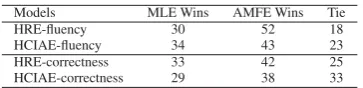
The above results show that AMFE is especially strong at more “general” metrics such as R@5 and mean rank. To confirm that adversarial training on hidden states can help much to generate re-sponses that are more natural, we randomly se-lect 100 dialog samples from both VisDial v0.5 and v0.9 dataset, and ask two human subjects to vote for the responses generated by two groups of models: HRE-MLE vs. HRE-AMFE on v0.5, and HCIAE-G-MLE vs. HCIAE-AMFE on v0.9, both with beam-size 5. Model names are hidden while voting. We ask the human subjects to consider two metrics separately: (1) the fluency of the generated answer sentences and (2) the correctness of the an-swers compared to the ground-truths. As shown in Table6, AMFE wins all the votes with different metric and different models, indicating that AMFE is robust in generating more natural responses.
Models MLE Wins AMFE Wins Tie
HRE-fluency 30 52 18
HCIAE-fluency 34 43 23
HRE-correctness 33 42 25
HCIAE-correctness 29 38 33
Table 6: Human voting result on 100 samples from Vis-Dial v0.5 and v0.9.
5 Case Studies
We randomly sample some dialogs from VisDial v0.5 validation set and illustrate the ground-truth answers and the generated answers with/without AMFE. Two results are shown in Table5. In the first example, the model trained with AMFE gen-erates a right vs. wrong answer in the 8-th turn, and a grammatically better response in the 5-th turn, compared to supervised pre-training. In the
second example, the model trained with AMFE has a generally right understanding of the ques-tions and the image, while the HRE-MLE model is generating response as if it does not see the image. This indicates that encoding language features in the image space leads to better understanding on both modalities.
6 Conclusion
We propose AMFE: an unsupervised multi-modal feature encoding framework and its implementa-tions on different commonly-used visual dialog models. Our core idea is to force features from different modalities to have closely related distri-butions. Experiments show that AMFE can bring performance gains to both simple and complex models on different scales of VisDial dataset. Fu-ture work will possibly be visualizing the visual and language features encoded by AMFE to find more straightforward interpretations, as well as trying our method on more complex structures, discriminative models, and on discriminative tasks such as VQA and visual reasoning.
Acknowledgements
[image:9.595.91.273.538.582.2]References
Stanislaw Antol, Aishwarya Agrawal, Jiasen Lu, Mar-garet Mitchell, Dhruv Batra, C Lawrence Zitnick, and Devi Parikh. 2015. Vqa: Visual question an-swering. In Proceedings of the IEEE international conference on computer vision, pages 2425–2433.
Martin Arjovsky, Soumith Chintala, and L´eon Bot-tou. 2017. Wasserstein gan. arXiv preprint arXiv:1701.07875.
Abhishek Das, Satwik Kottur, Khushi Gupta, Avi Singh, Deshraj Yadav, Jos´e MF Moura, Devi Parikh, and Dhruv Batra. 2017a. Visual dialog. In Proceed-ings of the IEEE Conference on Computer Vision and Pattern Recognition, volume 2.
Abhishek Das, Satwik Kottur, Jos´e MF Moura, Stefan Lee, and Dhruv Batra. 2017b. Learning cooperative visual dialog agents with deep reinforcement learn-ing. InProceedings of the IEEE international con-ference on computer vision.
Harm De Vries, Florian Strub, Sarath Chandar, Olivier Pietquin, Hugo Larochelle, and Aaron C Courville. 2017. Guesswhat?! visual object discovery through multi-modal dialogue. InCVPR, volume 1, page 3.
Bhuwan Dhingra, Lihong Li, Xiujun Li, Jianfeng Gao, Yun-Nung Chen, Faisal Ahmed, and Li Deng. 2016. Towards end-to-end reinforcement learning of dia-logue agents for information access. arXiv preprint arXiv:1609.00777.
Akira Fukui, Dong Huk Park, Daylen Yang, Anna Rohrbach, Trevor Darrell, and Marcus Rohrbach. 2016. Multimodal compact bilinear pooling for visual question answering and visual grounding. arXiv preprint arXiv:1606.01847.
Ian Goodfellow, Jean Pouget-Abadie, Mehdi Mirza, Bing Xu, David Warde-Farley, Sherjil Ozair, Aaron Courville, and Yoshua Bengio. 2014. Generative ad-versarial nets. In Advances in neural information processing systems, pages 2672–2680.
Ishaan Gulrajani, Faruk Ahmed, Martin Arjovsky, Vin-cent Dumoulin, and Aaron C Courville. 2017. Im-proved training of wasserstein gans. In Advances in Neural Information Processing Systems, pages 5767–5777.
Sepp Hochreiter and J¨urgen Schmidhuber. 1997. Long short-term memory. Neural computation, 9(8):1735–1780.
Sergey Ioffe and Christian Szegedy. 2015. Batch nor-malization: Accelerating deep network training by reducing internal covariate shift. In International conference on machine learning, pages 448–456.
Jin-Hwa Kim, Kyoung-Woon On, Woosang Lim, Jeonghee Kim, Jung-Woo Ha, and Byoung-Tak Zhang. 2016. Hadamard product for low-rank bi-linear pooling. arXiv preprint arXiv:1610.04325.
Diederik P Kingma and Jimmy Ba. 2014. Adam: A method for stochastic optimization. arXiv preprint arXiv:1412.6980.
Satwik Kottur, Jos´e MF Moura, Stefan Lee, and Dhruv Batra. 2017. Natural language does not emerge’naturally’in multi-agent dialog. arXiv preprint arXiv:1706.08502.
Karol Kurach, Mario Lucic, Xiaohua Zhai, Marcin Michalski, and Sylvain Gelly. 2018. The gan land-scape: Losses, architectures, regularization, and nor-malization.arXiv preprint arXiv:1807.04720.
Guillaume Lample, Ludovic Denoyer, and Marc’Aurelio Ranzato. 2018. Unsupervised machine translation using monolingual corpora only. InICLR.
Jiwei Li, Will Monroe, Alan Ritter, Michel Galley, Jianfeng Gao, and Dan Jurafsky. 2016. Deep rein-forcement learning for dialogue generation. arXiv preprint arXiv:1606.01541.
Jiwei Li, Will Monroe, Tianlin Shi, S´ebastien Jean, Alan Ritter, and Dan Jurafsky. 2017. Adversar-ial learning for neural dAdversar-ialogue generation. arXiv preprint arXiv:1701.06547.
Tsung-Yi Lin, Michael Maire, Serge Belongie, James Hays, Pietro Perona, Deva Ramanan, Piotr Doll´ar, and C Lawrence Zitnick. 2014. Microsoft coco: Common objects in context. In European confer-ence on computer vision, pages 740–755. Springer.
Chia-Wei Liu, Ryan Lowe, Iulian V Serban, Michael Noseworthy, Laurent Charlin, and Joelle Pineau. 2016. How not to evaluate your dialogue system: An empirical study of unsupervised evaluation met-rics for dialogue response generation. arXiv preprint arXiv:1603.08023.
Jiasen Lu, Anitha Kannan, Jianwei Yang, Devi Parikh, and Dhruv Batra. 2017. Best of both worlds: Trans-ferring knowledge from discriminative learning to a generative visual dialog model. InAdvances in Neu-ral Information Processing Systems, pages 314–324.
Jiasen Lu, Jianwei Yang, Dhruv Batra, and Devi Parikh. 2016. Hierarchical question-image co-attention for visual question answering. InAdvances In Neural Information Processing Systems, pages 289–297.
Takeru Miyato, Toshiki Kataoka, Masanori Koyama, and Yuichi Yoshida. 2018. Spectral normalization for generative adversarial networks. InICLR.
Hyeonseob Nam, Jung-Woo Ha, and Jeonghee Kim. 2017. Dual attention networks for multimodal rea-soning and matching. InProceedings of the IEEE Conference on Computer Vision and Pattern Recog-nition, pages 299–307.
Iulian Vlad Serban, Alessandro Sordoni, Yoshua Ben-gio, Aaron C Courville, and Joelle Pineau. 2016. Building end-to-end dialogue systems using gener-ative hierarchical neural network models. InAAAI, volume 16, pages 3776–3784.
Iulian Vlad Serban, Alessandro Sordoni, Ryan Lowe, Laurent Charlin, Joelle Pineau, Aaron C Courville, and Yoshua Bengio. 2017. A hierarchical latent variable encoder-decoder model for generating di-alogues. InAAAI, pages 3295–3301.
Karen Simonyan and Andrew Zisserman. 2015. Very deep convolutional networks for large-scale image recognition. InICLR.
Alessandro Sordoni, Michel Galley, Michael Auli, Chris Brockett, Yangfeng Ji, Margaret Mitchell, Jian-Yun Nie, Jianfeng Gao, and Bill Dolan. 2015. A neural network approach to context-sensitive gen-eration of conversational responses. arXiv preprint arXiv:1506.06714.
Tijmen Tieleman and Geoffrey Hinton. 2012. Lecture 6.5-rmsprop: Divide the gradient by a running av-erage of its recent magnitude. COURSERA: Neural networks for machine learning, 4(2):26–31.
Xin Wang, Wenhu Chen, Yuan-Fang Wang, and William Yang Wang. 2018. No metrics are perfect: Adversarial reward learning for visual storytelling. arXiv preprint arXiv:1804.09160.
Qi Wu, Peng Wang, Chunhua Shen, Ian Reid, and An-ton van den Hengel. 2017. Are you talking to me? reasoned visual dialog generation through adversar-ial learning. arXiv preprint arXiv:1711.07613.
Kelvin Xu, Jimmy Ba, Ryan Kiros, Kyunghyun Cho, Aaron Courville, Ruslan Salakhudinov, Rich Zemel, and Yoshua Bengio. 2015. Show, attend and tell: Neural image caption generation with visual atten-tion. InInternational conference on machine learn-ing, pages 2048–2057.