3126
Mitigating Uncertainty in Document Classification
Xuchao Zhang†‡, Fanglan Chen†, Chang-Tien Lu†, Naren Ramakrishnan† †Discovery Analytics Center, Virginia Tech, Falls Church, VA, USA
‡NEC Laboratories America, Inc, Princeton, NJ, USA
†{xuczhang, fanglanc, ctlu, naren}@vt.edu,‡[email protected]
Abstract
The uncertainty measurement of classifiers’ predictions is especially important in applica-tions such as medical diagnoses that need to ensure limited human resources can focus on the most uncertain predictions returned by ma-chine learning models. However, few existing uncertainty models attempt to improve over-all prediction accuracy where human resources are involved in the text classification task. In this paper, we propose a novel neural-network-based model that applies a new dropout-entropy method for uncertainty measurement. We also design a metric learning method on feature representations, which can boost the performance of dropout-based uncertainty methods with smaller prediction variance in accurate prediction trials. Extensive experi-ments on real-world data sets demonstrate that our method can achieve a considerable im-provement in overall prediction accuracy com-pared to existing approaches. In particular, our model improved the accuracy from 0.78 to 0.92 when 30% of the most uncertain pre-dictions were handed over to human experts in “20NewsGroup” data.
1 Introduction
Machine learning algorithms are gradually taking over from the human operators in tasks such as machine translation (Bahdanau et al.,2014), opti-cal character recognition (Mithe et al.,2013), and face recognition (Parkhi et al., 2015). However, some real-world applications require higher accu-racy than the results achieved by state-of-the-art algorithms, which makes it difficult to directly ap-ply these algorithms in certain scenarios. For ex-ample, a medical diagnosis system (van der West-huizen and Lasenby,2017) is expected to have a very high accuracy to support correct decision-making for medical practitioners. Although do-main experts can achieve a high performance in
these challenging tasks, it is not always feasible to rely on limited and expensive human input for large-scale data sets. Therefore, if we have a model with 70% prediction accuracy, it is intu-itive to ask what percentage of the data should be handed to domain experts to achieve an overall ac-curacy rate above 90%? To maximize the value of limited human resources while achieving de-sirable results, modeling uncertainty accurately is extremely important to ensure that domain experts can focus on the most uncertain results returned by machine learning models.
train-ing is used in some uncertainty models ( Goodfel-low et al., 2014;Lakshminarayanan et al., 2017;
Mandelbaum and Weinshall,2017). However, due to its dependence on gradient-based methods to generate adversarial examples, the method is not applicable to discrete text data.
In order to simultaneously address all these problems in existing methods, the work presented in this paper adopts a DNN-based approach that incorporates a novel dropout-entropy uncertainty measurement method along with metric learning in the feature representation to handle the uncer-tainty problem in the document classification task. The study’s main contributions can be summarized as follows:
• A novel DNN-based text classification model is proposed to achieve higher model accuracy with limited human input. In this new ap-proach, a reliable uncertainty model learns to identify the accurate predictions with smaller estimated uncertainty.
• Metric learning in feature representation is designed to boost the performance of the dropout-based uncertainty methods in the text classification task. Specifically, the shortened intra-class distance and enlarged inter-class distance can reduce the prediction variance and increase the confidence for the accurate predictions.
• A new dropout-entropy method based on the Bayesian approximation property of Dropout in DNNs is presented. Specifically, we mea-sure the model uncertainty in terms of the in-formation entropy of multiple dropout-based evaluations combined with the de-noising mask operations.
• Extensive experiments on real-world data sets demonstrate that the effectiveness of our proposed approach consistently outperforms existing methods. In particular, the macro-F1 score can be increased from 0.78 to 0.92 by assigning 25% of the labeling work to human experts in a 20-class text classification task.
The rest of this paper is organized as follows. Section 2 reviews related work, and Section 3
provides a detailed description of our proposed model. The experiments on multiple real-world data sets are presented in Section 4. The paper
concludes with a summary of the research in Sec-tion5.
2 Related Work
The work related to this paper falls into two sub topics, described as follows.
2.1 Model Uncertainty
Existing uncertainty models are usually based on Bayesian models, which is Traditional Bayesian models such as Gaussian Process (GP), can mea-sure uncertainty of model. However, as a non-parametric model, the time complexity of GP is increased by the size of data, which makes it in-tractable in many real world applications.
Conformal Prediction (CP) was proposed as a new approach to obtain confidence values (Vovk et al.,1999). Unlike the traditional underlying al-gorithm, conformal predictors provide each of the predictions with a measure of confidence. Also, a measure of “credibility serves as an indicator of how suitable the training data are used for the clas-sification task (Shafer and Vovk, 2008). Differ-ent from Bayesian-based methods, CP approaches obtain probabilistically valid results, which are merely based on the independent and identically distributed assumption. The drawback of CP methods is their computational inefficiency, which renders the application CP not applicable for any model that requires long training time such as Deep Neural Networks.
With the recently heated research on DNNs, the associated uncertainty models have received a great deal of attention. Bayesian Neural Networks are a class of neural networks which are capable of modeling uncertainty (Denker and LeCun, 1990) (Hern´andez-Lobato and Adams, 2015). These models not only generate predictions but also pro-vide the corresponding variance (uncertainty) of predictions. However, as the number of model parameters increases, these models become com-putationally more expensive (Wang and Yeung,
2016). Lee et al. proposed a computationally ef-ficient uncertainty method that treats Deep Neu-ral Networks as Gaussian Processes (Lee et al.,
problem of representing uncertainty in deep learn-ing without sacrificlearn-ing the computational com-plexity. Dropout-based methods have also been extended to various tasks such as computer vi-sion (Kendall and Gal,2017), autonomous vehicle safety (McAllister et al., 2017) and medical de-cision making (van der Westhuizen and Lasenby,
2017).
However, few of these methods are specifically designed for text classification and lack of consid-erations on improving the overall accuracy in the scenario that domain experts can be involved in the process.
2.2 Metric Learning
Metric learning (Xing et al., 2003; Weinberger et al., 2006) algorithms design distance metrics that capture the relationships among data repre-sentations. This approach has been widely used in various machine learning applications, includ-ing image segmentation (Gong et al., 2013), face recognition (Guillaumin et al., 2009), document retrieval (Xu et al.,2012), and collaborative filter-ing (Hsieh et al., 2017). Weinberger et al. pro-posed a large margin nearest neighbor (LMNN) method (Weinberger et al., 2006) in learning a metric to minimize the number of class impostors based on pull and push losses. However, as yet there have been no report of work focusing specifi-cally on mitigating prediction uncertainties. Man-delbaum and Weinshall (Mandelbaum and Wein-shall, 2017) measured model uncertainty by the distance when comparing to the feature represen-tations in training data, but this makes the uncer-tainty measurement inefficient because it requires an iteration over the entire training data set. To the best of our knowledge, we are the first to apply metric learning to mitigate model uncertainty in the text classification task. We also demonstrate that metric learning can be applied to dropout-based approaches to improve their prediction un-certainty.
3 Model
In this section, we propose a DNN-based approach to predict document categories with high confi-dence for the accurate predictions and high un-certainty for the inaccurate predictions. The over-all architecture of the proposed model is presented in Section3.1. The technical details for the met-ric loss and model uncertainty predictions are
de-Figure 1:Overall Architecture of Proposed Model
scribed in Sections3.2and3.3, respectively.
3.1 Model Overview
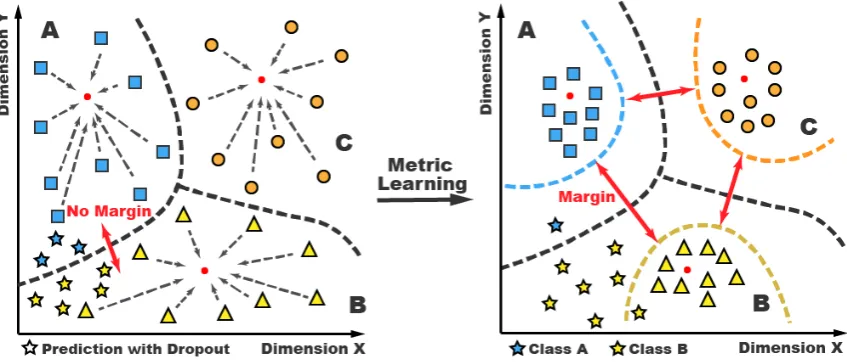
[image:3.595.310.520.60.304.2]Figure 2:Feature representations with no metric learning (left) and metric learning (right).
improvement (Srivastava et al., 2014). However, since there is only one fully-connected layer in our model, we opted to add one Dropout layer after the CNN layer, not only to prevent overfitting, but also to measure prediction uncertainty (Gal and Ghahramani, 2016). The Dropout operation will be randomly applied to the activations during the training and uncertainty measurement phrases, but will not be applied to the evaluation phrase. 4)
Output layers. The output is connected by a fully connected layer and the softmax. The loss func-tion of our model is the combinafunc-tion of the cross entropy loss of the prediction and the metric loss of the feature representation. We regard the output of the Dropout layer as the representation of the document and deposit it into a metric loss func-tion. The purpose here is to penalize large dis-tance feature representations in the same class and small distance feature representations among dif-ferent classes. The details of the metric loss func-tion will be described in Secfunc-tion3.2.
3.2 Metric Learning on Text Features
For uncertainty learning in text feature space, our purpose is to ensure the Euclidean distance be-tween intra-class instances is much smaller than the inter-class instances. To achieve this, we use metric learning to train the desirable embeddings. Specifically, let ri and rj be the feature
repre-sentations of instancesiandj, respectively, then the Euclidean distance between them is defined as D(ri,rj) = d1kri−rjk22, wheredis the
dimen-sion of the feature representation.
Suppose the data instances in the training data contain n classes and these are categorized into
n subsets {Sk}nk=1, where Sk denotes the set of
data instances belong to classk. Then the intra-class loss penalizes the large Euclidean distance between the feature representations in the same class, which can be formalized as Equation (1).
Lintra(k) =
2 |Sk|2− |Sk|
X
i,j∈Sk,i<j
D(ri,rj)
(1) where |Sk|represents the number of elements
in set Sk. The loss is the sum of all the feature
distances between each possible pair in the same class set. Then, the loss is normalized by the num-ber of unique pairs belonging to each class set.
The inter-class loss ensures large feature dis-tances between different classes, which is formally defined as Equation (2).
Linter(p, q) =
1 |Sp| · |Sq|
X
i∈Sp,j∈Sq
m−D(ri,rj)
+
(2) where m is a metric margin constant to dis-tinguish between the intra- and inter-classes and [z]+ = max(0, z)denotes the standard hinge loss.
defined in Equation (3). This combines the intra-class loss and inter-intra-class loss for all the intra-classes.
Lmetric =
n
X
k=1
Lintra(k) +λX
i6=k
Linter(k, i)
(3) whereλis a pre-defined parameter to weight the importance of the intra- and inter-class losses. We setλto 0.1 by default.
Figure2illustrates an example of a three-class feature representation in two dimensions. The left-hand figure shows the feature distribution trained with no metric learning. Obviously, the feature distance of the intra-class is large, sometimes even exceeding those of the inter-class distance near the decision boundary. However, the features trained by metric learning, shown in the right-hand fig-ure, exhibit clear gaps between the inter-class pre-dictions. This means the predictions with dropout are less likely to result in an inaccurate prediction and even reduce the variance of dropout prediction trials. The example shown in Figure2 has eight dropout predictions, three of which are classified to an inaccurate class when no metric learning is applied compared to only one inaccurate predic-tion with metric learning.
3.3 Uncertainty Measurement
Bayesian models such as the Gaussian process (Rasmussen, 2004) provide a powerful tool to identify low-confidence regions of input space. Recently, Dropout (Srivastava et al.,2014), which is used in deep neural networks, has been shown to serve as a Bayesian approximation to represent the model uncertainty in deep learning (Gal and Ghahramani,2016). Based on this work, we pro-pose a novel information-entropy-based dropout method to measure the model uncertainty in com-bination with metric learning for text classifica-tion. Given an input data instance x∗, we as-sume the corresponding output of our model isy∗. The output computed by our model incorporates a dropout mechanism in its evaluation mode, which means the activations of intermediate layers with Dropout are not reduced by a factor. When we re-peat the processktimes, we obtain the output vec-tory∗ = {y1∗, . . . , yk∗}. Note that the outputs are not the same since the output here is generated by applying dropout after the feature representation layer in Figure1.
[image:5.595.313.517.59.279.2]Given the output y∗ ofk trials with Dropout,
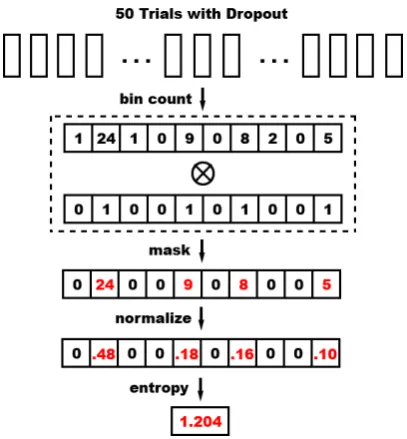
Figure 3:Example of the dropout-entropy method.
our proposed uncertainty method has the follow-ing four steps, as shown in Figure 3: (1) Bin count. We use bin count to calculate the frequency of each class. For example, if the class 2 appears 24 times in the dropout output vectory∗, the bin count for class2is24. (2)Mask. We use the mask step to avoid random noises in the frequency vec-tor. In this step, we set the largestmelements to have their original values and the remaining ones to zero. The value ofm is usually chosen to be 2/3of the total class number when the total classes are over 10; otherwise, we just skip the step. (3)
Normalization. We use the normalization step to calculate the probabilities of each class. (4) In-formation entropy. The information entropy is calculated byu =−Pc
i=1pk(i) logpk(i), where
pk(i) represents the frequency probability of the
i-th class in a totalktrials andcis the number of classes. We use the entropy value as the uncer-tainty score here, in which the smaller the entropy value is, the more confident the model is in the output. Take the case in Figure3 as an example. When the frequency of class 2 is 24, the entropy is1.204. If the output of the50trials all belong to class2, the entropy becomes0.401, which means that the model is less uncertain about the predic-tive results.
4 Experiment
Uncertainty Ratio(Micro F1, Improved Ratio)
0% 10% 20% 30% 40%
PL-Variance 0.760 0.799(5.10%) 0.815(7.30%) 0.827(8.87%) 0.840(10.52%)
Distance 0.780 0.784(0.59%) 0.787(0.94%) 0.795(1.91%) 0.800(2.58%)
NNGP 0.637 0.659(3.44%) 0.670(5.04%) 0.678(6.44%) 0.689(8.11%)
Dropout 0.758 0.792(4.47%) 0.827(9.08%) 0.851(12.18%) 0.879(15.93%)
Dropout + Metric 0.781 0.823(5.38%) 0.863(10.53%) 0.892(14.31%) 0.921(18.05%)
DE 0.760 0.807(6.25%) 0.849(11.73%) 0.888(16.79%) 0.917(20.70%)
DE + Metric 0.781 0.835(6.93%) 0.878(12.47%) 0.918(17.62%) 0.944(20.92%)
Uncertainty Ratio(Macro F1, Improved Ratio)
0% 10% 20% 30% 40%
PL-Variance 0.751 0.789(5.05%) 0.806(7.24%) 0.818(8.87%) 0.830(10.49%)
Distance 0.773 0.777(0.48%) 0.779(0.81%) 0.786(1.76%) 0.789(2.15%)
NNGP 0.624 0.647(3.56%) 0.657(5.27%) 0.665(6.54%) 0.675(8.13%)
Dropout 0.749 0.781(4.22%) 0.813(8.46%) 0.833(11.10%) 0.860(14.74%)
Dropout + Metric 0.773 0.816(5.47%) 0.853(10.33%) 0.878(13.59%) 0.906(17.14%)
DE 0.752 0.796(5.96%) 0.835(11.05%) 0.872(16.04%) 0.900(19.70%)
[image:6.595.76.523.71.332.2]DE + Metric 0.774 0.826(6.70%) 0.866(11.97%) 0.904(16.87%) 0.929(20.02%)
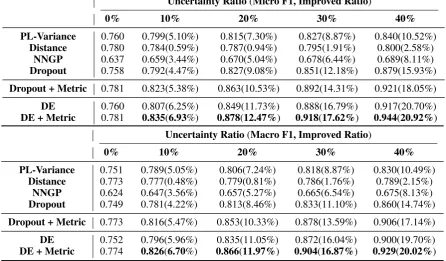
Table 1: Uncertainty Scores for the 20 NewsGroup Dataset (20 Categories)
After an introduction of the experiment settings in Section 4.1, we compare the performance achieved by the proposed method against those of existing state-of-the-art methods, along with an analysis of the parameter settings and metric learn-ing in Section 4.2. Due to space limitation, the detailed experiment results on different sequence models can be accessed in the full version here1. The source code can be downloaded here2.
4.1 Experimental Setup
In our experiments, all word vectors are initial-ized by pre-trained Glove (Pennington et al.,2014) word vectors, by default. The word embedding vectors are pre-trained in Wikipedia 2014 with a word vector dimension of 200. We trained all the DNN-based models with a batch size of 32 sam-ples with a momentum of 0.9 and an initial learn-ing rate of 0.001 uslearn-ing the Adam (Kingma and Ba,
2014) optimization algorithm.
4.1.1 Datasets and Labels
We conducted experiments on three publicly avail-able datasets: 1)20 Newsgroups3 (Lang, 1995):
1
https://xuczhang.github.io/papers/ naacl19_uncertainty_full.pdf
2
https://github.com/xuczhang/ UncertainDC
3
http://qwone.com/˜jason/20Newsgroups/
The data set is a collection of 20,000 docu-ments, partitioned evenly across 20 different news groups; 2) IMDb Reviews (Maas et al., 2011): The data set contains 50,000 popular movie re-views with binary positive or negative labels from the IMDb website; and 3) Amazon Reviews
(McAuley and Leskovec,2013): The dataset is a collection of reviews from Amazon spanning the time period from May 1996 to July 2013. We used review data from the Sports and outdoors category, with 272,630 data samples and rating labels from 1 to 5.
For all three data sets, we randomly selected 70% of the data samples as the training set, 10% as the validation set and 20% as the test set.
4.1.2 Evaluation Metrics
In order to answer the question ”What percentage of data should be transferred to domain experts to achieve an overall accuracy rate above 90%?”, we measure the classification performance in terms of various uncertainty ratios. Specifically, assuming the entire testing set S has size n and an uncer-tainty ratior, we can remove the most uncertain samples Sr from S based on the uncertainty
ra-tio r, where the size of the uncertainty set Sr is
r·n. We assume the uncertain samplesSrhanded
Uncertainty Ratio(Accuracy, Improved Ratio)
0% 10% 20% 30% 40%
PL-Variance 0.878 0.911(3.69%) 0.937(6.70%) 0.955(8.71%) 0.970(10.42%)
Distance 0.884 0.893(0.95%) 0.892(0.91%) 0.893(1.04%) 0.895(1.24%)
Dropout 0.880 0.912(3.72%) 0.936(6.43%) 0.957(8.75%) 0.969(10.20%)
Dropout + Metric 0.884 0.917(3.73%) 0.944(6.78%) 0.961(8.70%) 0.973(10.11%)
DE 0.878 0.911(3.70%) 0.937(6.71%) 0.956(8.83%) 0.969(10.33%)
DE + Metric 0.883 0.918(3.91%) 0.944(6.87%) 0.961(8.78%) 0.973(10.20%)
Uncertainty Ratio(F1 Score, Improved Ratio)
0% 10% 20% 30% 40%
PL-Variance 0.880 0.913(3.68%) 0.939(6.67%) 0.956(8.65%) 0.971(10.34%)
Distance 0.885 0.894(1.07%) 0.898(1.42%) 0.901(1.84%) 0.904(2.13%)
Dropout 0.881 0.914(3.70%) 0.938(6.41%) 0.958(8.67%) 0.971(10.13%)
Dropout + Metric 0.885 0.917(3.70%) 0.944(6.74%) 0.961(8.67%) 0.974(10.06%)
DE 0.880 0.913(3.67%) 0.939(6.67%) 0.957(8.77%) 0.970(10.25%)
[image:7.595.75.522.72.310.2]DE + Metric 0.884 0.918(3.88%) 0.944(6.83%) 0.961(8.73%) 0.974(10.14%)
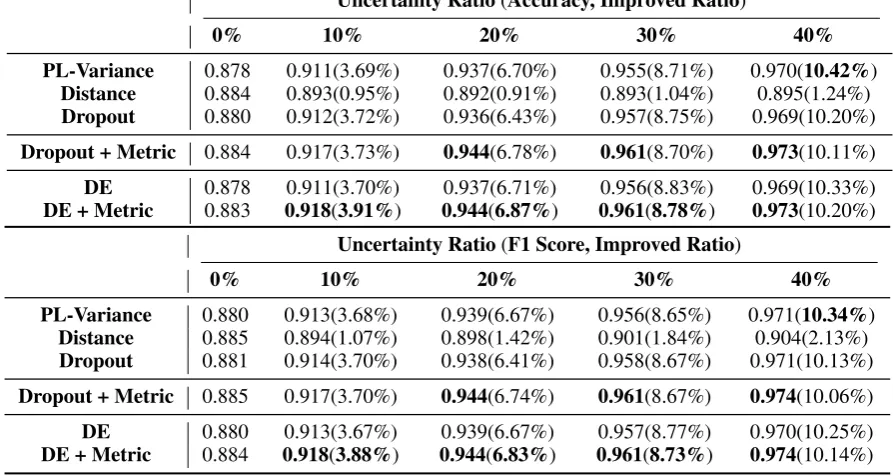
Table 2: Uncertainty Scores for the IMDb Dataset (2 Categories)
Uncertainty Ratio(Accuracy, Improved Ratio)
0% 10% 20% 30% 40%
PL-Variance 0.700 0.738(5.43%) 0.764(9.14%) 0.784(1.20%) 0.801(14.4%)
Distance 0.697 0.699(0.29%) 0.702(0.72%) 0.704(1.00%) 0.705(1.15%)
Dropout 0.700 0.735(5.00%) 0.764(9.14%) 0.800(14.29%) 0.831(18.71%)
Dropout + Metric 0.710 0.746(5.07%) 0.779(9.72%) 0.815(14.79%) 0.847(19.30%)
DE 0.700 0.739(5.57%) 0.773(10.43%) 0.806(15.14%) 0.836(19.43%)
DE + Metric 0.724 0.764(5.52%) 0.800(10.50%) 0.834(15.19%) 0.866(19.61%)
Table 3: Uncertainty Scores for the Amazon Dataset (5 Categories)
without uncertainty measurement concerns. For the binary classification task, we use the ac-curacy and F1-score to measure the classification performance based on the testing set S \Sr for
different uncertainty ratiosr. Similarly, for multi-class tasks, we use the micro-F1 and macro-F1 scores utilizing the same settings as for the binary classification.
4.1.3 Comparison Methods
The following methods are included in the per-formance comparison: 1) Penultimate Layer Vari-ance (PL-VariVari-ance). Activations before the soft-max layer in a deep neural network always re-veal the uncertainty of the prediction (Zaragoza and d’Alche Buc, 1998). As a baseline method, we use the variance of the output of a fully connected layer in Figure 1 as the uncertainty weight. 2) Deep Neural Networks as Gaussian
Processes (NNGP) (Lee et al., 2017). This ap-proach applies a Gaussian process to perform a Bayesian inference for deep neural networks, with a computationally efficient pipeline being used to compute the covariance function of the Gaussian process. The default parameter set-tings in the source code4 were applied in our ex-periments. 3) Distance-based Confidence (Dis-tance)(Mandelbaum and Weinshall, 2017). This method assigns confidence scores based on the data embedding compared to the training data. We set its nearest neighbor parameter k = 10. 4) Dropout (Gal and Ghahramani, 2016). Here, dropout training in DNNs is treated as an approx-imation of Bayesian inference in deep Gaussian processes. We set the sample number T as 100 in our experiments. 5) Dropout + Metric. In
[image:7.595.78.522.345.468.2]Uncertainty Ratio(Micro F1, Improved Ratio)
0% 10% 20% 30% 40%
Random DE 0.659 0.702(6.47%) 0.748(13.46%) 0.792(20.14%) 0.831(26.03%)
DE + Metric 0.660 0.705(6.85%) 0.752(13.92%) 0.802(21.57%) 0.845(28.04%)
Glove DE 0.760 0.807(6.25%) 0.849(11.73%) 0.888(16.79%) 0.917(20.70%)
[image:8.595.78.521.69.158.2]DE + Metric 0.781 0.835(6.93%) 0.878(12.47%) 0.918(17.62%) 0.944(20.92%)
[image:8.595.81.278.218.381.2]Table 4: Embedding vs. No Pre-trained Embedding
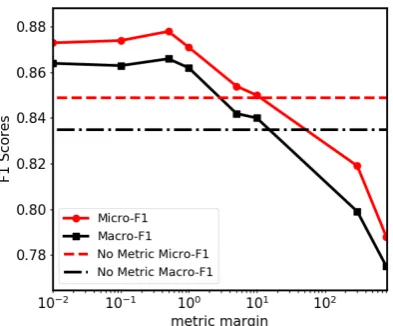
Figure 4: Prediction performance for different metric mar-gin settings.
order to validate the effectiveness of our metric learning, we applied our proposed metric learn-ing method to the Dropout method. The metric margin m and coefficient λ were set as 0.5 and 0.1, respectively. 6) Our proposed method. We evaluate our proposed method in two different set-tings, Entropy alone (DE) and Dropout-Entropy with metric learning (DE + Metric). Here, we set the sample number T = 100, coefficient
λ= 0.1and the metric margin may vary from dif-ferent data sets.
4.2 Experimental Results
This subsection presents the results of the uncer-tainty performance comparison and the analysis of the metric learning and parameter settings.
4.2.1 Uncertainty Results
Table1shows the Micro-F1 and Macro-F1 scores for ratios of uncertain predictions eliminated rang-ing from 10 to 40% for the 20NewsGroup data set. To demonstrate its effect, metric learning was also applied to the baseline method Dropout, and our proposed method DE. The improvement
ra-tio compared to the results with no uncertainty elimination, shown in the 0% column, are psented after the F1 scores. Based on these re-sult, we can conclude that: 1) Our proposed method, DE+Metric, significantly improves both the Micro- and Macro-F1 scores when a por-tion of uncertain predicpor-tions are eliminated. For example, the Micro-F1 improves from 0.78 to 0.92 when 30% of the uncertain predictions are eliminated. 2) Comparing the results obtained by DE and DE+Metric, metric learning signif-icantly improves the results obtained for differ-ent uncertainty ratio settings. Similar results can be observed when comparing the Dropout and Dropout+Metric. For example, the Micro-F1 scores for Dropout+Metric are around 5% bet-ter than the Dropout method alone, boosting them from 0.851 to 0.892, with a 30% uncertainty ratio. 3) The DE method outperforms all the other meth-ods when metric learning is not applied. Specif-ically, DE is around 4% better than the Dropout method in terms of the Micro-F1 score.
The results for IMDb and Amazon data sets are presented in Table 2 and Table 3. When com-paring our proposed model’s performance across three data sets, we found that the greater improve-ments are achieved on multi- instead of binary-class binary-classification data sets. One possible ex-planation is that a comparatively large portion of multi-class features are close to the decision boundary in the feature space. Through the met-ric learning strategy of minimizing intra-class dis-tance while maxmizing the inter-class insdis-tances, the feature distance between the inter-class predic-tions is enlarged and the quality of embeddings is greatly enhanced.
4.2.2 Analysis of Metric Learning
The impact of metric learning on feature repre-sentation is analyzed in this section. Figure 5
(a) No Metric Learning (b) Metric Marginm= 10
Figure 5:Feature visualization of 20 NewsGroup testing data set in two dimensions by t-SNE algorithm.
for the 20 NewsGroup testing data set, with Figure
5(a)presenting the features trained without metric learning and Figure 5(b) those trained by metric learning with a margin parameterm=10. We used the t-SNE algorithm (Maaten and Hinton,2008) to visualize the high dimensional features in the form of two dimensional images. From the results, we can clearly see that the distances between the inter-classes are significantly enlarged compared to the features trained without metric learning shown in Figure 5(a). This enlarged inter-class spac-ing means that dropout-based uncertainty meth-ods have smaller prediction variances in case their dropout prediction trials are accurate.
4.2.3 Parameter Analysis
The impact of the metric margin and word embed-dings are discussed in this section.
Metric Margin. Figure4 shows the impact of metric margin parameters, ranging from 0 to 800 on the 20 NewsGroup data set with a 20% uncer-tainty ratio. From the results, we can conclude that: (1) The prediction performance is not sen-sitive to the point at which the metric margin pa-rameter is set as long as its value is not extremely large. (2) Compared to the model trained with no metric learning, our methods consistently achieve better performance when the metric margin is set no larger than 10. When the metric margin is too large, however, the prediction cross-entropy loss is hard to minimize and thus dampens the overall prediction performance. (3) The results of Macro-F1 are similar to Micro-Macro-F1 with relatively small scores.
Impact of Word Embedding. We also analyzed the impact of our proposed methods on different word embedding initialization methods, including random and pre-trained Glove word vectors in 200 dimensions. Table4shows the results of Micro-F1 for the different uncertainty ratios. We can observe that: 1) The performance of Glove-based methods are around 15% better than that of the randomly initialized methods for different uncertainty ratios. 2) Metric learning based on a Glove initialization generally outperforms a random initialization. For instance, the F1 score of Glove rises by 0.29 when the uncertainty ratio is 20%, while for a random method it only increases by 0.04.
5 Conclusion
References
Dzmitry Bahdanau, Kyunghyun Cho, and Yoshua Ben-gio. 2014. Neural machine translation by jointly learning to align and translate. arXiv preprint arXiv:1409.0473.
John S. Denker and Yann LeCun. 1990. Transform-ing neural-net output levels to probability distribu-tions. InProceedings of the 3rd International Con-ference on Neural Information Processing Systems, NIPS’90, pages 853–859, San Francisco, CA, USA. Morgan Kaufmann Publishers Inc.
Yarin Gal and Zoubin Ghahramani. 2016. Dropout as a bayesian approximation: Representing model uncer-tainty in deep learning. InProceedings of the 33rd International Conference on International Confer-ence on Machine Learning - Volume 48, ICML’16, pages 1050–1059. JMLR.org.
Maoguo Gong, Yan Liang, Jiao Shi, Wenping Ma, and Jingjing Ma. 2013. Fuzzy c-means clustering with local information and kernel metric for image seg-mentation. IEEE Transactions on Image Process-ing, 22(2):573–584.
Ian J Goodfellow, Jonathon Shlens, and Christian Szegedy. 2014. Explaining and harnessing adver-sarial examples. arXiv preprint arXiv:1412.6572.
Matthieu Guillaumin, Jakob Verbeek, and Cordelia Schmid. 2009. Is that you? metric learning ap-proaches for face identification. InComputer Vision, 2009 IEEE 12th international conference on, pages 498–505. IEEE.
Jos´e Miguel Hern´andez-Lobato and Ryan Adams. 2015. Probabilistic backpropagation for scalable learning of bayesian neural networks. In Inter-national Conference on Machine Learning, pages 1861–1869.
Cheng-Kang Hsieh, Longqi Yang, Yin Cui, Tsung-Yi Lin, Serge Belongie, and Deborah Estrin. 2017. Collaborative metric learning. InProceedings of the 26th International Conference on World Wide Web, pages 193–201. International World Wide Web Con-ferences Steering Committee.
Mohit Iyyer, Jordan Boyd-Graber, Leonardo Claudino, Richard Socher, and Hal Daum´e III. 2014. A neural network for factoid question answering over para-graphs. InProceedings of the 2014 Conference on Empirical Methods in Natural Language Processing (EMNLP), pages 633–644.
Alex Kendall and Yarin Gal. 2017. What uncertainties do we need in bayesian deep learning for computer vision? InAdvances in neural information process-ing systems, pages 5574–5584.
Diederik P Kingma and Jimmy Ba. 2014. Adam: A method for stochastic optimization. arXiv preprint arXiv:1412.6980.
Balaji Lakshminarayanan, Alexander Pritzel, and Charles Blundell. 2017. Simple and scalable pre-dictive uncertainty estimation using deep ensembles. InAdvances in Neural Information Processing Sys-tems, pages 6405–6416.
Ken Lang. 1995. Newsweeder: Learning to filter net-news. In Proceedings of the Twelfth International Conference on Machine Learning, pages 331–339.
Jaehoon Lee, Yasaman Bahri, Roman Novak, Samuel S Schoenholz, Jeffrey Pennington, and Jascha Sohl-Dickstein. 2017. Deep neural networks as gaussian processes. arXiv preprint arXiv:1711.00165.
Andrew L. Maas, Raymond E. Daly, Peter T. Pham, Dan Huang, Andrew Y. Ng, and Christopher Potts. 2011. Learning word vectors for sentiment analy-sis. InProceedings of the 49th Annual Meeting of the Association for Computational Linguistics: Hu-man Language Technologies, pages 142–150, Port-land, Oregon, USA. Association for Computational Linguistics.
Laurens van der Maaten and Geoffrey Hinton. 2008. Visualizing data using t-sne. Journal of machine learning research, 9(Nov):2579–2605.
Amit Mandelbaum and Daphna Weinshall. 2017. Distance-based confidence score for neural network classifiers.arXiv preprint arXiv:1709.09844.
Rowan McAllister, Yarin Gal, Alex Kendall, Mark Van Der Wilk, Amar Shah, Roberto Cipolla, and Adrian Vivian Weller. 2017. Concrete problems for autonomous vehicle safety: Advantages of bayesian deep learning. International Joint Conferences on Artificial Intelligence, Inc.
Julian McAuley and Jure Leskovec. 2013. Hidden fac-tors and hidden topics: understanding rating dimen-sions with review text. In Proceedings of the 7th ACM conference on Recommender systems, pages 165–172. ACM.
Ravina Mithe, Supriya Indalkar, and Nilam Divekar. 2013. Optical character recognition. Interna-tional journal of recent technology and engineering (IJRTE), 2(1):72–75.
Omkar M Parkhi, Andrea Vedaldi, Andrew Zisserman, et al. 2015. Deep face recognition. InBMVC, vol-ume 1, page 6.
Jeffrey Pennington, Richard Socher, and Christo-pher D. Manning. 2014. Glove: Global vectors for word representation. InEmpirical Methods in Nat-ural Language Processing (EMNLP), pages 1532– 1543.
Carl Edward Rasmussen. 2004. Gaussian processes in machine learning. InAdvanced lectures on machine learning, pages 63–71. Springer.
Nitish Srivastava, Geoffrey Hinton, Alex Krizhevsky, Ilya Sutskever, and Ruslan Salakhutdinov. 2014.
Dropout: A simple way to prevent neural networks from overfitting. Journal of Machine Learning Re-search, 15:1929–1958.
Volodya Vovk, Alexander Gammerman, and Craig Saunders. 1999. Machine-learning applications of algorithmic randomness.
Hao Wang and Dit-Yan Yeung. 2016. Towards bayesian deep learning: A survey. arXiv preprint arXiv:1604.01662.
Kilian Q Weinberger, John Blitzer, and Lawrence K Saul. 2006. Distance metric learning for large mar-gin nearest neighbor classification. In Advances in neural information processing systems, pages 1473– 1480.
Jos van der Westhuizen and Joan Lasenby. 2017. Bayesian lstms in medicine. arXiv preprint arXiv:1706.01242.
Eric P Xing, Michael I Jordan, Stuart J Russell, and Andrew Y Ng. 2003. Distance metric learning with application to clustering with side-information. In
Advances in neural information processing systems, pages 521–528.
Zhixiang (Eddie) Xu, Minmin Chen, Kilian Q. Wein-berger, and Fei Sha. 2012. From sbow to dcot marginalized encoders for text representation. In
Proceedings of the 21st ACM International Confer-ence on Information and Knowledge Management, CIKM ’12, pages 1879–1884, New York, NY, USA. ACM.
Zichao Yang, Diyi Yang, Chris Dyer, Xiaodong He, Alex Smola, and Eduard Hovy. 2016. Hierarchi-cal attention networks for document classification. InProceedings of the 2016 Conference of the North American Chapter of the Association for Computa-tional Linguistics: Human Language Technologies, pages 1480–1489.
Hugo Zaragoza and Florence d’Alche Buc. 1998. Con-fidence measures for neural network classifiers. In