Proceedings of the 2nd Workshop on Deep Learning Approaches for Low-Resource NLP (DeepLo), pages 1–10 1
A Closer Look At Feature Space Data Augmentation For Few-Shot
Intent Classification
Varun Kumar, Hadrien Glaude, Cyprien de Lichy, Wlliam Campbell
Amazon Alexa Cambridge, MA, USA
{kuvrun,hglaude,cllichy,cmpw}@amazon.com
Abstract
New conversation topics and functionalities are constantly being added to conversational AI agents like Amazon Alexa and Apple Siri. As data collection and annotation is not scal-able and is often costly, only a handful of ex-amples for the new functionalities are avail-able, which results in poor generalization per-formance. We formulate it as a Few-Shot In-tegration (FSI) problem where a few examples are used to introduce a new intent. In this pa-per, we study six feature space data augmen-tation methods to improve classification per-formance in FSI setting in combination with both supervised and unsupervised representa-tion learning methods such as BERT. Through realistic experiments on two public conversa-tional datasets, SNIPS, and the Facebook Dia-log corpus, we show that data augmentation in feature space provides an effective way to im-prove intent classification performance in few-shot setting beyond traditional transfer learn-ing approaches. In particular, we show that (a) upsampling in latent space is a competi-tive baseline for feature space augmentation (b) adding the difference between two exam-ples to a new example is a simple yet effective data augmentation method.
1 Introduction
Virtual artificial assistants with natural language understanding (NLU) support a variety of func-tionalities. Throughout the lifespan of the de-ployed NLU systems, new functionalities with new categories, are regularly introduced. While techniques such as active learning (Peshterliev et al.,2018), semi-supervised learning (Cho et al.,
2019b) are used to improve the performance of ex-isting functionalities, performance for new func-tionalities suffers from the data scarcity problem.
Recently, Few-Shot Learning has been explored to address the problem of generalizing from a few
examples per category. While it has been exten-sively studied (Koch et al.,2015;Snell et al.,2017;
Vinyals et al., 2016) for image recognition, a lit-tle attention has been paid to improve NLU per-formance in the low-data regime. Moreover, re-searchers have been mostly working on the unre-alistic setting that considers tasks with few cate-gories unseen during (pre)training, each with only a few examples, and introduces new categories during test time. We argue that a more realistic set-ting is Few-Shot Integration (FSI) where new cat-egories with limited training data are introduced into an existing system with mature categories. FSI is well aligned with the goal of lifelong learn-ing of conversational agents and measures the per-formance in a real-life system setting when only a few examples of a new class are added to the existing data from the old classes. To address the poor generalization in data scare scenarios, several pre-training methods such as ELMo (Peters et al.,
2018), Generative pre-trained Transformer ( Rad-ford et al., 2018), BERT (Devlin et al., 2018), have been proposed which are trained on a large amount of unannotated text data. Such pre-trained models can be fine-tuned on a particular NLP task and have shown to greatly improve generaliza-tion. However, in FSI setting where only a handful of examples are provided, building accurate NLU model is still a challenging task.
learning setting (Schwartz et al.,2018) DELTA, 6)
linear delta which is a linear version of the delta encoder LINEAR. While UPSAMPLE, PERTURB, EXTRA and LINEAR doesn’t require any training
beyond hyper-parameter optimization, DELTAand CVAE are trained deep neural network generators. We compare these six FDA techniques on two open datasets for Intent Classification (IC) : SNIPS (Coucke et al., 2018) and Facebook Di-alog corpus (Gupta et al., 2018). We show that BERT combined with LINEARdata augmentation provides an effective method to bootstrap accurate intent classifiers with limited training data. We make the following contributions:
1. We propose the FSI evaluation, a relaxation of the few-shot learning setting that aims to better model the requirement of modern NLU systems. We provide a comprehensive eval-uation of FSI for text classification and show that UPSAMPLEand PERTURBare simple yet efficient baselines that are often neglected in few-shot learning evaluations.
2. We provide an in-depth analysis of various FDA methods. We show that complex meth-ods such as DELTAand CVAE do not always
improve over simple methods like LINEAR, and the performance heavily depends on the feature extractor.
3. Finally, we provide guidance on when and how to apply FDA for FSI. We show that FDA consistently provides gains on top of the unsupervised pre-training methods such as BERT in FSI setting.
2 Related work
Few-shot learning has been studied extensively in the computer vision domain. In particular, sev-eral metric learning based methods (Koch et al.,
2015;Vinyals et al.,2016;Snell et al.,2017; Rip-pel et al., 2015) has been proposed for few-shot classification where a model first learns an em-bedding space and then a simple metric is used to classify instances of new categories via proxim-ity to the few labeled training examples embedded in the same space. In addition to metric-learning, several meta-learning based approaches (Ravi and Larochelle,2016;Li et al.,2017;Finn et al.,2017) have been proposed for few-shot classification on unseen classes.
Recently, Few-Shot Learning on text data has been explored using metric learning (Yu et al.,
2018; Jiang et al., 2018). In (Yu et al., 2018), authors propose to learn a weighted combination of metrics obtained from meta-training tasks for a newly seen few-shot task. Similarly, in (Cheng et al.,2019), authors propose to use meta-metric-learning to learn task-specific metric that can han-dle imbalanced datasets.
Generative models are also widely used to improve classification performance by data aug-mentation. For example, generative models are used for data augmentation in image classifica-tion (Mehrotra and Dukkipati, 2017; Antoniou et al., 2018; Zhang et al., 2018), text classifica-tion (Gupta,2019), anomaly detection (Lim et al.,
2018). Data augmentation through deformation of an image has been known to be very effec-tive for image recognition. More advanced ap-proaches rely on Auto-Encoders (AEs) or Gener-ative Adversarial Networks (GANs). For exam-ple, in (Mehrotra and Dukkipati,2017) the authors combine metric-learning with data augmentation using GANs for few-shot learning. However, clas-sical generative approaches require a significant amount of training data to be able to generate good enough examples that will improve classification accuracy. To overcome this challenge, ( Hariha-ran and Girshick,2017) proposed to augment the training data in the feature space. This both eases the generation problem and enforces generation of discriminative examples. In addition, the authors propose to transfer deformations from base classes to new classes, which allows circumventing the data scarcity problem for new classes. Finally, in (Schwartz et al., 2018), authors used an Autoen-coder to encode transformations between pairs of examples of the same class and apply them to an example of the new class.
Generative models are a good candidate for FSI tasks, as one can just combine the generated data for new classes with the old classes training data (Hariharan and Girshick,2017;Wang et al.,
2018). For text classification, several text gen-eration based data augmentation techniques have also been explored (Hou et al.,2018;Zhao et al.,
2019;Guu et al.,2018;Yoo et al.,2018;Cho et al.,
utterances
intents
BERT
M L P
NLL
sentence embedding
(a) Learning the feature space
generator
M L P
NLL sentence
embedding
intents
generated sentence embedding
[image:3.595.77.288.60.246.2](b) Learning with augmented data
Figure 1: Data augmentation in the feature space
in latent(feature) space to solve a few-shot inte-gration problem for text classification.
3 Data Augmentation in Feature Space
Feature space data Augmentation (FDA) is an ef-fective method to improve classification perfor-mance on different ML tasks (Chawla et al.,2002;
Hariharan and Girshick,2017;Devries and Taylor,
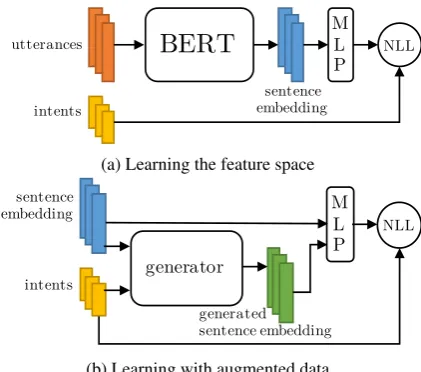
2017;Guo et al., 2019). As shown on Figure 1, FDA techniques usually work by first learning a data representation or feature extractor, and then generating new data for the low resource class in the feature space. After generating data, a classi-fier is trained with real and augmented data.
For IC, we finetune a pre-trained English BERT-Base uncased model1 to build our feature extrac-tor. The BERT model has 12 layers, 768hidden states, and12heads. We use the pooled represen-tation of the hidden state of the first special token ([CLS]) as the sentence representation. A dropout probability of 0.1 is applied to the sentence rep-resentation before passing it to the 1-layer Soft-max classifier. BERT Encoder and MLP classi-fier are fine-tuned using cross-entropy loss for IC task. Adam (Kingma and Ba, 2014) is used for optimization with an initial learning rate of5e−5. For data augmentation, we apply six different FDA methods, described below, to generate new examples in the feature space. Finally, we train a 1- layer Softmax classifier as in the feature learn-ing phase.
1https://github.com/huggingface/pytorch-transformers
3.1 Upsampling
The simplest method to augment training data for underrepresented categories is to duplicate the ex-isting training data. Upsampling is a well studied technique to handle the class imbalance problem (Estabrooks et al.,2004). We show that for intents with limited labeled data, upsampling the existing data in latent space consistently improves model performance, and thus is a good baseline method for FDA techniques. We call this method UPSAM
-PLE.
3.2 Random Perturbation
Adding random noise to the existing training data is another simple yet effective data augmentation technique. Random perturbation data augmenta-tion has been previously used to improve the per-formance of classification models as well as for sequence generation models. For example, ( Ku-rata et al.,2016) applied additive and multiplica-tive perturbation to improve the text generation for data augmentation. In our experiments, we apply both additive and multiplicative perturbation to the existing training data. We sample noise from a uniform distribution [-1.0, 1.0]. We use PERTURB
to refer to this method.
3.3 Conditional VAE
Conditional Variational Autoencoder (CVAE) is an extension of Variational Autoencoder (VAE) (Kingma and Welling,2013) which can be used to generate examples for a given category. All components of the model are conditioned on the category. First, we train CVAE on the sen-tence representations and then generate new ex-amples by sampling from the latent distribution. The encoder and decoder sub-networks are imple-mented as multi-layer perceptrons with a single hidden layer of2048units, where each layer is fol-lowed by a hyperbolic tangent activation. The en-coder outputZ is128-dimensional. Mean Square Error (MSE) loss function is used for reconstruc-tion. All models are trained with Adam optimizer with the learning rate set to10−3.
3.4 Linear Delta
class and then add it to a third example Xk also from the same class as shown in (1). We use LIN
-EARto refer to this method.
ˆ
X= (Xi−Xj) +Xk (1)
3.5 Extrapolation
In (Devries and Taylor, 2017), authors proposed to use extrapolation to synthesize new examples for a given class. They demonstrated that extrap-olating between samples in feature space can be used to augment datasets. In extrapolation, a new example,Xˆ is generated according to (2). In our experiments, we useλ= 0.5. We call this method EXTRA.
ˆ
X= (Xi−Xj)∗λ+Xi (2)
3.6 Delta-Encoder
Delta-Encoder (Schwartz et al.,2018) extends the idea of learning differences between two examples using an autoencoder-based model. It first extracts transferable intra-class deformations (deltas) be-tween same-class pairs of training examples, then applies them to a few examples of a new class to synthesize samples from that class. Authors show that Delta-Encoder can learn transferable defor-mations from different source classes which can be used to generate examples for unseen classes. While the authors used Delta-Encoder to generate examples for unseen classes, in our experiments, for FSI, we also use the examples from the tar-get class to the train both the feature extractor and the Delta-Encoder along with all other examples. Then we generate new examples for the target cat-egory using trained delta encoder. For data gener-ation, we try two different approaches to select a source sentence pair.
1. DeltaR: Sample a pair of sentences (Xi,Xj) from a randomly selected class. DELTAR ap-plies deltas from multiple source categories to synthesize new examples.
2. DeltaS: Sample a pair of sentences (Xi,Xj) from the target category. DELTAS applies deltas from the same target category.
The encoder and decoder sub-networks are im-plemented as multi-layer perceptrons with a single hidden layer of512units, where each layer is fol-lowed by a leaky ReLU activation (max(x,0.2∗
x)). The encoder outputZ is16-dimensional. L1
loss is used as reconstruction loss. Adam opti-mizer is used with a learning rate of 10−3. A high dropout with a50% rate is applied to all lay-ers, to avoid the model memorizing examples.
4 Experiment
4.1 Datasets
We evaluate different FDA techniques on two pub-lic benchmark datasets, SNIPS (Coucke et al.,
2018), and Facebook Dialog corpus (FBDialog) (Gupta et al.,2018). For SNIPS dataset, we use train, dev and test split provided by (Goo et al.,
2018)2.
SNIPS dataset contains7intents which are col-lected from the Snips personal voice assistant. The training, development and test sets contain
13,084,700and700utterances, respectively. FB-Dialog has utterances that are focused on naviga-tion, events, and navigation to events. FBDialog dataset also contains utterances with multiple in-tents as the root node. For our experiment, we exclude such utterances by removing utterances
with COMBINED intent root node. This leads
to31,218training,4,455development and9,019
testset utterances. Note that while SNIPS is a bal-anced dataset, FBDialog dataset is highly imbal-anced with a maximum8,860and a minimum of
4training examples per intent.
4.2 Simulating Few-Shot Integration
In virtual assistants, often a new intent develop-ment starts with very limited training data. To simulate the integration of a new intent, we ran-domly sample kseed training examples from the new intent, referred to as target intent, and keep all the data from other intents. We also remove the target intent data from the development set. We train the feature extractor on the resulting training data, and then generate 100, 512examples using different augmentation methods for the target in-tent. To account for random fluctuations in the re-sults, we repeat this process10 times for a given target intent and report the average accuracy with the standard deviation. In all experiments, models are evaluated on the full test set.
Size Method SNIPS FBDialog No Augmentation 98.14 (0.42) 94.99 (0.18)
5%
UPSAMPLE 98.14 (0.47) 95.01 (0.16) PERTURB 98.26(0.40) 94.98 (0.19) LINEAR 98.14 (0.45) 95.02(0.21) EXTRA 98.14 (0.45) 95.02(0.20) CVAE 98.14 (0.45) 94.98 (0.24) DELTAR 98.23 (0.46) 95.00 (0.22) DELTAS 98.26(0.42) 95.00 (0.20)
10%
UPSAMPLE 98.14 (0.47) 94.94 (0.18) PERTURB 98.23 (0.41) 94.98 (0.24) LINEAR 98.09 (0.50) 95.02(0.18) EXTRA 98.11 (0.49) 95.01 (0.19) CVAE 98.20 (0.42) 94.99 (0.26) DELTAR 98.26(0.42) 94.99 (0.21) DELTAS 98.23 (0.42) 94.97 (0.22)
20%
[image:5.595.91.274.59.320.2]UPSAMPLE 98.14 (0.45) 95.02 (0.12) PERTURB 98.14 (0.44) 94.99 (0.20) LINEAR 98.17 (0.43) 95.05 (0.23) EXTRA 98.14 (0.45) 95.07 (0.11) CVAE 98.11 (0.44) 94.98 (0.23) DELTAR 98.26(0.40) 95.08(0.19) DELTAS 98.20 (0.46) 95.04 (0.22)
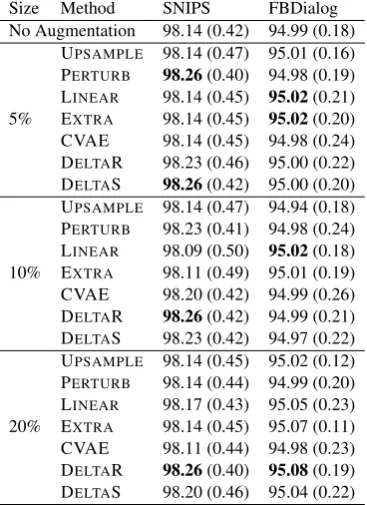
Table 1: IC accuracy on SNIPS and Facebook dataset with all training data, reported asmean (SD).
5 Results and Discussion
5.1 FDA For Data-Rich Classification
For both datasets, we generate5%,10%, and20%
examples using different FDA methods. Then, we train a classifier using both generated as well as real data. Table1shows that augmenting data in feature space provides only minor improvements in classification accuracy. In particular, on SNIPS dataset, PERTUB and DELTAR improve accuracy from98.14to98.26. On FBDialog dataset, DeltaR provides a minor gain,95.02to95.08over upsam-ple baseline.
5.2 Impact Of The Number Of Seed Examples
To understand the impact of the number of seed examples, we vary it to5,10,15,20,25, and30for SNIPS’s AddToPlaylist. For each experiment, we generate100examples using different FDA meth-ods. Figure2shows that as the number of seed ex-amples increases, the accuracy of the model goes up. We also observe that for a few seed examples
5- 15, LINEARoutperforms other FSA methods. Finally, gains are less significant after30seed ex-amples.
80 85 90 95 100
10 20 30
Number of seed examples
Intent Accur
acy
Method
[image:5.595.91.275.64.317.2]DeltaR DeltaS Linear No_aug Upsample
Figure 2: IC accuracy on SNIPS’s AddToPlaylist in-tent with varying number of seed examples. 100 ex-amples are generated using different FDA techniques. As indicated by the accuracy trend, increasing the seed examples leads to better performance.
5.3 Few-Shot Integration
We simulate FSI IC for all 7 intents of SNIPS dataset. For FBDialog dataset, we run simula-tions on the six largest intents, viz. GetDirecsimula-tions, GetDistance, GetEstimatedArrival, GetEstimated-Duration, GetInfoTraffic, and GetEvent. Since, BERT generalizes well with just30examples, to compare the effectiveness of different FDA meth-ods, we use10seed examples in FSI simulations. For each intent, we selectk= 10seed training ex-amples and use all training data for other intents.
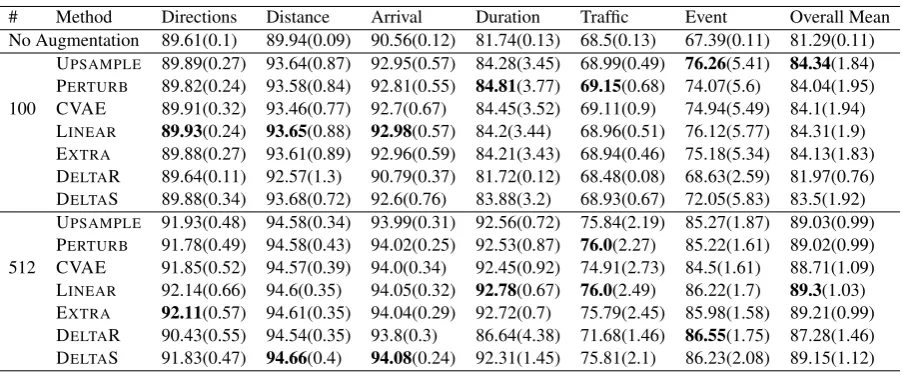
Table2shows average accuracy for all intents’ FSI simulations. Results on individual intent’s FSI simulations can be found in Appendix’s Table 5
and Table6. On both datasets, all FDA methods improve classification accuracy over no augmen-tation baseline. Also, UPSAMPLE provides huge gains over no augmentation baseline. Addition-ally, on both datasets, with 512 augmented ex-amples, LINEAR and DELTAS works better than PERTURBand UPSAMPLE.
5.4 Upsampling: Text Space vs Latent Space
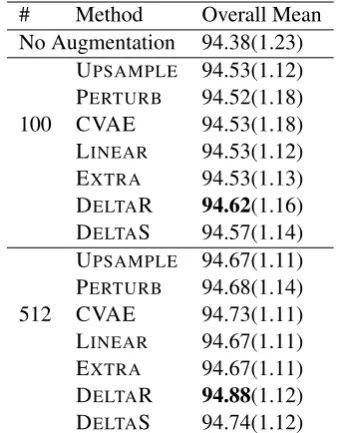
In this section, we explore how upsampling in text space impacts performances as it is supposed to both improve the feature extractor and the linear classifier, compared to UPSAMPLE. To investigate whether upsampling in text space helps FDA, we upsampled the10seed examples to100and repeat the FSI experiments on all7intents of the SNIPS dataset. Table 3 shows the mean accuracy of all
[image:5.595.311.522.64.205.2]# Method SNIPS FBDialog No Augmentation 87.46(2.87) 81.29(0.11)
100
UPSAMPLE 94.26(1.66) 84.34(1.84) PERTURB 94.18(1.74) 84.04(1.95) CVAE 94.10(1.83) 84.10(1.94) LINEAR 94.36(1.69) 84.31(1.9) EXTRA 94.30(1.68) 84.13(1.83) DELTAR 91.32(3.12) 81.97(0.76) DELTAS 94.28(1.92) 83.50(1.92)
512
[image:6.595.75.290.60.280.2]UPSAMPLE 95.68(0.86) 89.03(0.99) PERTURB 95.65(0.92) 89.02(0.99) CVAE 95.46(1.03) 88.71(1.09) LINEAR 95.87(0.87) 89.30(1.03) EXTRA 95.82(0.89) 89.21(0.99) DELTAR 95.33(1.56) 87.28(1.46) DELTAS 95.88(1.04) 89.15(1.12)
Table 2: Average IC accuracy for all intents’ FSI simu-lations on SNIPS and FBDialog dataset. For each sim-ulation,k = 10seed examples are used for target in-tent. Scores are reported asmean (SD). Refer to Ap-pendix’s Table5and Table6for individual intents’ re-sults.
observe that upsampling in text space improves the no augmentation baseline for all intents. The mean accuracy score improves from87.46to94.38. We also observe that different FDA techniques further improve model accuracy. Interestingly, upsam-pling in text space helps DELTAR the most. Sur-prisingly, upsampling in latent space provides bet-ter performance than upsampling in the text space. In particular, without upsampling the seed exam-ples to learn the feature extractor, the best score is95.88for DELTAS, whereas with text space up-sampling the best score decreases to94.88. This decrease in performance is only seen with BERT and not with the Bi-LSTM feature extractor (see Table 4). We hypothesize that upsampling text data leads to BERT overfitting the target category which results in less generalized sentence repre-sentations. Overall, we found that augmentation in the latent space seems to work better with BERT, and is more effective than text space upsampling.
5.5 Effect Of The Pre-trained BERT Encoder
In FSI setting, Fine-Tuned BERT model provides very good generalization performance. For exam-ple, for SNIPS’s RateBookIntent (columnBookin Table 5), it yields 96.81%accuracy. Overall for BERT representations, LINEARand DELTAS aug-mentation methods provide the best accuracy.
# Method Overall Mean No Augmentation 94.38(1.23)
100
UPSAMPLE 94.53(1.12) PERTURB 94.52(1.18) CVAE 94.53(1.18) LINEAR 94.53(1.12) EXTRA 94.53(1.13) DELTAR 94.62(1.16) DELTAS 94.57(1.14)
512
UPSAMPLE 94.67(1.11)
PERTURB 94.68(1.14) CVAE 94.73(1.11) LINEAR 94.67(1.11)
[image:6.595.331.501.62.279.2]EXTRA 94.67(1.11) DELTAR 94.88(1.12) DELTAS 94.74(1.12)
Table 3: IC accuracy on SNIPS dataset in the FSI set-ting, reported asmean (SD). The10seed examples are upsampled to100to train the feature extractor. Refer to Appendix’s Table7for individual intents’ results.
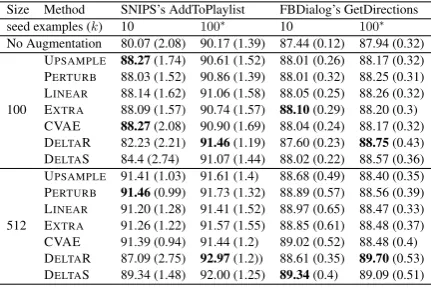
To investigate whether these augmentation im-provements can be generalized to other sentence encoders, we experiment with a Bi-LSTM sen-tence encoder. For feature learning, we use a 1-layer Bi-LSTM encoder followed by a single 1-layer softmax classifier. In our experiments, we use128
as hidden units and300dimension Glove embed-dings. For SNIPS dataset, we use10examples of AddToPlaylist intent and for FB Dialog dataset, we use10examples of GetDirections intent.
Size Method SNIPS’s AddToPlaylist FBDialog’s GetDirections seed examples (k) 10 100∗ 10 100∗
No Augmentation 80.07 (2.08) 90.17 (1.39) 87.44 (0.12) 87.94 (0.32)
100
UPSAMPLE 88.27(1.74) 90.61 (1.52) 88.01 (0.26) 88.17 (0.32) PERTURB 88.03 (1.52) 90.86 (1.39) 88.01 (0.32) 88.25 (0.31) LINEAR 88.14 (1.62) 91.06 (1.58) 88.05 (0.25) 88.26 (0.32) EXTRA 88.09 (1.57) 90.74 (1.57) 88.10(0.29) 88.20 (0.3) CVAE 88.27(2.08) 90.90 (1.69) 88.04 (0.24) 88.17 (0.32) DELTAR 82.23 (2.21) 91.46(1.19) 87.60 (0.23) 88.75(0.43) DELTAS 84.4 (2.74) 91.07 (1.44) 88.02 (0.22) 88.57 (0.36)
512
UPSAMPLE 91.41 (1.03) 91.61 (1.4) 88.68 (0.49) 88.40 (0.35) PERTURB 91.46(0.99) 91.73 (1.32) 88.89 (0.57) 88.56 (0.39) LINEAR 91.20 (1.28) 91.41 (1.52) 88.97 (0.65) 88.47 (0.33) EXTRA 91.26 (1.22) 91.57 (1.55) 88.85 (0.61) 88.48 (0.37) CVAE 91.39 (0.94) 91.44 (1.2) 89.02 (0.52) 88.48 (0.4) DELTAR 87.09 (2.75) 92.97(1.2)) 88.61 (0.35) 89.70(0.53) DELTAS 89.34 (1.48) 92.00 (1.25) 89.34(0.4) 89.09 (0.51)
Table 4: IC accuracy on SNIPS’s AddToPlaylist and FBDialog’s GetDirections in the FSI setting, reported asmean (SD). A1-layer Bi-LSTM model is used as a feature extractor.100∗represents10seed examples are
upsampled to100to train the feature extractor.
5.6 Is Delta-Encoder Effective On Text?
While on few-shot image classification, Delta-Encoder provides excellent generalization perfor-mance (Schwartz et al.,2018) on unseen classes, on text classification, its performance is heavily dependent on the feature extractor. We observe that in most cases, DELTAR performs worse than DELTAS which suggests that unlike for few-shot image classification, Delta-Encoder fails to learn variations which can be applied to a different cat-egory. In addition, in FSI with BERT encoder, DELTAS performance is close to LINEAR. This
in-dicates that in the low-data regime, simple subtrac-tion between BERT sentence representasubtrac-tions is a good proxy to learn intra-class variations. Upsam-pling data in text space improves Delta-Encoder performance for both BERT and Bi-LSTM en-coders. As shown in Table3, with upsampling in text space, DELTAR performs better than any other FDA method.
5.7 Qualitative Evaluation
We observe significant accuracy improvements in all FSI experiments for all FDA methods. Since UPSAMPLEand PERTURBalso provide significant
gains, it seems that most of the gains come from the fact that we are adding more data. However, in the FSI setting, LINEAR and DELTAS method consistently perform better than both UPSAMPLE
and PERTURB, which indicates that these meth-ods generate more relevant data than just noise, and redundancy. Here, we focus on visualizing generated examples from LINEAR, DELTAS and DELTAR methods using t-SNE.
Figure3shows visualizations for SNIPS’s Ad-dToPlaylist generated sentence representations us-ing different FDA methods. We use10seed exam-ples of AddToPlaylist and use BERT as sentence encoder. While data generated by LINEAR and EXTRA are close to the real examples, DELTAS and DELTAR generated examples form two
dif-ferent clusters. Since, Delta-Encoder performance improves when seed examples are upsampled in text space, we plot sentence examples from up-sampled data.
Figure 4 shows that when 10 seed examples are upsampled to 100, DELTAS cluster moves closer to the seed examples, and while most of the DELTAR generated data forms a separate cluster, a few of the generated examples are close to the seed examples. Since, in experiments with upsampled text examples, DELTAR performs better than other FDA methods, we hypothesize that DELTAR in-creases the amount of variability within the dataset by generating diverse examples which leads to a more robust model.
6 Conclusion and Future Work
In this paper, we investigate six FDA methods including UPSAMPLE, PERTURB, CVAE, Delta-Encoder, EXTRA, and LINEAR to augment train-ing data. We show that FDA works better when combined with transfer learning and provides an effective way of bootstrapping an intent classifier for new classes. As expected, all FDA methods become less effective when the number of seed ex-amples increases and provides minor gains in the full-data regime. Through comparing methods on two public datasets, our results show that LINEAR
is a competitive baseline for FDA in FSI setting, especially when combined with transfer learning (BERT).
Additionally, we provide empirical evidence that in few-shot integration setting, feature space augmentation combined with BERT provides bet-ter performance than widely used text space up-sampling. Given that pre-trained language mod-els provide state of the art performance on sev-eral NLP tasks, we find this result to be in particu-lar encouraging, as it shows potential for applying FDA methods to other NLP tasks.
[image:7.595.74.290.62.206.2]pro-60 40 20 0 20 40 60 60
40 20 0 20 40
[image:8.595.76.526.58.308.2]60 CVAE_aug BookRestaurant SearchScreeningEvent GetWeather RateBook Linear_aug Extrapolation_aug DeltaR_aug SearchCreativeWork DeltaS_aug PlayMusic AddToPlaylist
Figure 3:10seed examples
60 40 20 0 20 40 60
60 40 20 0 20 40
60 CVAE_augBookRestaurant
SearchScreeningEvent GetWeather RateBook Linear_aug Extrapolation_aug DeltaR_aug SearchCreativeWork DeltaS_aug PlayMusic AddToPlaylist
Figure 4:10seed examples are upsampled to100
Figure 5: t-SNE visualization of different data augmentation methods for AddToPlaylist intent. BERT encoder is used to learn sentence representations.
viding improvements in computer vision domain might not produce similar gains on NLP tasks, thus underlining the need to develop data augmen-tation methods specific to NLP tasks.
References
Anthreas Antoniou, Amos Storkey, and Harrison Ed-wards. 2018. Data augmentation generative adver-sarial networks.
Nitesh V Chawla, Kevin W Bowyer, Lawrence O Hall, and W Philip Kegelmeyer. 2002. Smote: synthetic minority over-sampling technique. Journal of artifi-cial intelligence research.
Yu Cheng, Mo Yu, Xiaoxiao Guo, and Bowen Zhou. 2019.Few-shot learning with meta metric learners.
Eunah Cho, He Xie, and William M Campbell. 2019a. Paraphrase generation for semi-supervised learning in nlu. In Proceedings of the Workshop on Meth-ods for Optimizing and Evaluating Neural Language Generation.
Eunah Cho, He Xie, John Lalor, Varun Kumar, and William M Campbell. 2019b. Efficient semi-supervised learning for natural language understand-ing by optimizunderstand-ing diversity. In IEEE Automatic Speech Recognition and Understanding Workshop.
Alice Coucke, Alaa Saade, Adrien Ball, Th´eodore Bluche, Alexandre Caulier, David Leroy, Cl´ement Doumouro, Thibault Gisselbrecht, Francesco Calta-girone, Thibaut Lavril, et al. 2018. Snips voice plat-form: an embedded spoken language understanding
system for private-by-design voice interfaces. arXiv preprint arXiv:1805.10190.
Jacob Devlin, Ming-Wei Chang, Kenton Lee, and Kristina Toutanova. 2018. Bert: Pre-training of deep bidirectional transformers for language understand-ing.arXiv preprint arXiv:1810.04805.
Terrance Devries and Graham W. Taylor. 2017. Dataset augmentation in feature space. ArXiv, abs/1702.05538.
Andrew Estabrooks, Taeho Jo, and Nathalie Japkowicz. 2004. A multiple resampling method for learning from imbalanced data sets. Computational intelli-gence.
Chelsea Finn, Pieter Abbeel, and Sergey Levine. 2017. Model-agnostic meta-learning for fast adaptation of deep networks. InProceedings of the 34th Interna-tional Conference on Machine Learning. JMLR.org.
Chih-Wen Goo, Guang Gao, Yun-Kai Hsu, Chih-Li Huo, Tsung-Chieh Chen, Keng-Wei Hsu, and Yun-Nung Chen. 2018. Slot-gated modeling for joint slot filling and intent prediction. InProceedings of the North American Chapter of the Association for Computational Linguistics.
Hongyu Guo, Yongyi Mao, and Richong Zhang. 2019. Augmenting data with mixup for sentence clas-sification: An empirical study. arXiv preprint arXiv:1905.08941.
Sonal Gupta, Rushin Shah, Mrinal Mohit, Anuj Ku-mar, and Mike Lewis. 2018. Semantic parsing for task oriented dialog using hierarchical representa-tions. arXiv preprint arXiv:1810.07942.
Kelvin Guu, Tatsunori B Hashimoto, Yonatan Oren, and Percy Liang. 2018. Generating sentences by editing prototypes. Transactions of the Association of Computational Linguistics.
Bharath Hariharan and Ross Girshick. 2017. Low-shot visual recognition by shrinking and hallucinat-ing features. In Proceedings of the International Conference on Computer Vision.
Yutai Hou, Yijia Liu, Wanxiang Che, and Ting Liu. 2018. Sequence-to-sequence data augmentation for dialogue language understanding. arXiv preprint arXiv:1807.01554.
Xiang Jiang, Mohammad Havaei, Gabriel Chartrand, Hassan Chouaib, Thomas Vincent, Andrew Jesson, Nicolas Chapados, and Stan Matwin. 2018. At-tentive task-agnostic meta-learning for few-shot text classification.
Diederik P Kingma and Jimmy Ba. 2014. Adam: A method for stochastic optimization. arXiv preprint arXiv:1412.6980.
Diederik P Kingma and Max Welling. 2013. Auto-encoding variational bayes. arXiv preprint arXiv:1312.6114.
Gregory Koch, Richard Zemel, and Ruslan Salakhut-dinov. 2015. Siamese neural networks for one-shot image recognition. InICML Deep Learning Work-shop.
Gakuto Kurata, Bing Xiang, and Bowen Zhou. 2016. Labeled data generation with encoder-decoder lstm for semantic slot filling. InINTERSPEECH.
Zhenguo Li, Fengwei Zhou, Fei Chen, and Hang Li. 2017. Meta-sgd: Learning to learn quickly for few-shot learning. arXiv preprint arXiv:1707.09835.
Swee Kiat Lim, Yi Loo, Ngoc-Trung Tran, Ngai-Man Cheung, Gemma Roig, and Yuval Elovici. 2018. Doping: Generative data augmentation for unsuper-vised anomaly detection with gan. In 2018 IEEE International Conference on Data Mining.
Akshay Mehrotra and Ambedkar Dukkipati. 2017.
Generative adversarial residual pairwise networks for one shot learning.
Stanislav Peshterliev, John Kearney, Abhyuday Jagan-natha, Imre Kiss, and Spyros Matsoukas. 2018. Ac-tive learning for new domains in natural language understanding. arXiv preprint arXiv:1810.03450.
Matthew E Peters, Mark Neumann, Mohit Iyyer, Matt Gardner, Christopher Clark, Kenton Lee, and Luke Zettlemoyer. 2018. Deep contextualized word rep-resentations. arXiv preprint arXiv:1802.05365.
Alec Radford, Karthik Narasimhan, Tim Salimans, and Ilya Sutskever. 2018. Improving language under-standing by generative pre-training.
Sachin Ravi and Hugo Larochelle. 2016. Optimization as a model for few-shot learning.
Oren Rippel, Manohar Paluri, Piotr Dollar, and Lubomir Bourdev. 2015. Metric learning with adaptive density discrimination. arXiv preprint arXiv:1511.05939.
Eli Schwartz, Leonid Karlinsky, Joseph Shtok, Sivan Harary, Mattias Marder, Abhishek Kumar, Rogerio Feris, Raja Giryes, and Alex Bronstein. 2018. Delta-encoder: an effective sample synthesis method for few-shot object recognition. InAdvances in Neural Information Processing Systems.
Jake Snell, Kevin Swersky, and Richard Zemel. 2017. Prototypical networks for few-shot learning. In I. Guyon, U. V. Luxburg, S. Bengio, H. Wallach, R. Fergus, S. Vishwanathan, and R. Garnett, ed-itors, Advances in Neural Information Processing Systems.
Oriol Vinyals, Charles Blundell, Tim Lillicrap, Koray Kavukcuoglu, and Daan Wierstra. 2016. Match-ing networks for one shot learnMatch-ing. In D. D. Lee, M. Sugiyama, U. V. Luxburg, I. Guyon, and R. Gar-nett, editors, Advances in Neural Information Pro-cessing Systems.
Yu-Xiong Wang, Ross Girshick, Martial Hebert, and Bharath Hariharan. 2018. Low-shot learning from imaginary data. InProceedings of the IEEE Confer-ence on Computer Vision and Pattern Recognition.
Kang Min Yoo, Youhyun Shin, and Sang goo Lee. 2018. Data augmentation for spoken language un-derstanding via joint variational generation.
Mo Yu, Xiaoxiao Guo, Jinfeng Yi, Shiyu Chang, Saloni Potdar, Yu Cheng, Gerald Tesauro, Haoyu Wang, and Bowen Zhou. 2018. Diverse few-shot text clas-sification with multiple metrics. In Proceedings of the North American Chapter of the Association for Computational Linguistics.
Ruixiang Zhang, Tong Che, Zoubin Ghahramani, Yoshua Bengio, and Yangqiu Song. 2018. Meta-gan: An adversarial approach to few-shot learning. InAdvances in Neural Information Processing Sys-tems.
Zijian Zhao, Su Zhu, and Kai Yu. 2019. Data augmen-tation with atomic templates for spoken language understanding. arXiv preprint arXiv:1908.10770.
A FSI experiment results for all intents
# Method Playlist Restaurant Weather Music Book Work Event Overall Mean No Augmentation 82.63(5.11) 87.86(3.53) 84.51(1.3) 88.07(2.37) 96.81(2.94) 85.14(1.53) 87.19(3.31) 87.46(2.87)
100
UPSAMPLE 92.24(2.96) 97.7(0.67) 96.44(0.75) 94.57(1.1) 97.96(0.82) 89.61(3.01) 91.26(2.35) 94.26(1.66) PERTURB 93.09(2.55) 97.41(0.92) 96.07(1.35) 94.39(1.13) 97.86(0.93) 89.36(2.76) 91.09(2.53) 94.18(1.74) CVAE 92.4(3.66) 97.47(0.67) 96.49(1.07) 94.36(1.26) 97.71(1.1) 89.1(2.79) 91.2(2.22) 94.1(1.83) LINEAR 92.61(3.02) 97.74(0.67) 96.44(0.77) 94.63(1.18) 97.97(0.78) 89.61(3.05) 91.53(2.34) 94.36(1.69) EXTRA 92.36(3.0) 97.74(0.66) 96.41(0.77) 94.6(1.18) 97.97(0.78) 89.47(3.11) 91.51(2.3) 94.3(1.68) DELTAR 87.07(4.67) 93.57(4.07) 91.0(4.23) 94.87(1.28) 97.66(1.42) 85.97(2.34) 89.11(3.84) 91.32(3.12) DELTAS 92.64(4.49) 97.76(0.7) 96.41(1.25) 94.99(0.92) 97.83(0.99) 88.69(2.69) 91.64(2.36) 94.28(1.92)
512
UPSAMPLE 95.3(1.09) 98.0(0.64) 97.63(0.34) 95.57(0.87) 98.03(0.55) 92.0(1.49) 93.26(1.05) 95.68(0.86) PERTURB 95.33(1.2) 97.94(0.6) 97.6(0.44) 95.5(0.91) 97.91(0.55) 92.03(1.78) 93.21(0.99) 95.65(0.92) CVAE 95.46(1.12) 97.89(0.62) 97.54(0.43) 95.36(1.02) 97.93(0.7) 91.34(2.17) 92.73(1.19) 95.46(1.03) LINEAR 95.39(1.1) 98.0(0.64) 97.67(0.36) 95.74(0.89) 98.04(0.5) 92.61(1.47) 93.66(1.13) 95.87(0.87) EXTRA 95.36(1.17) 98.0(0.64) 97.66(0.37) 95.74(0.88) 98.04(0.5) 92.29(1.52) 93.63(1.17) 95.82(0.89) DELTAR 95.36(1.74) 97.81(0.69) 97.6(0.44) 95.9(0.97) 97.74(1.02) 90.27(3.44) 92.61(2.64) 95.33(1.56) DELTAS 95.66(1.18) 97.96(0.59) 97.8(0.45) 95.91(0.88) 97.91(0.74) 92.26(2.57) 93.66(0.86) 95.88(1.04)
Table 5: IC accuracy on SNIPS dataset in the FSI setting (k= 10), reported asmean (SD).
# Method Directions Distance Arrival Duration Traffic Event Overall Mean No Augmentation 89.61(0.1) 89.94(0.09) 90.56(0.12) 81.74(0.13) 68.5(0.13) 67.39(0.11) 81.29(0.11)
100
UPSAMPLE 89.89(0.27) 93.64(0.87) 92.95(0.57) 84.28(3.45) 68.99(0.49) 76.26(5.41) 84.34(1.84) PERTURB 89.82(0.24) 93.58(0.84) 92.81(0.55) 84.81(3.77) 69.15(0.68) 74.07(5.6) 84.04(1.95) CVAE 89.91(0.32) 93.46(0.77) 92.7(0.67) 84.45(3.52) 69.11(0.9) 74.94(5.49) 84.1(1.94) LINEAR 89.93(0.24) 93.65(0.88) 92.98(0.57) 84.2(3.44) 68.96(0.51) 76.12(5.77) 84.31(1.9) EXTRA 89.88(0.27) 93.61(0.89) 92.96(0.59) 84.21(3.43) 68.94(0.46) 75.18(5.34) 84.13(1.83) DELTAR 89.64(0.11) 92.57(1.3) 90.79(0.37) 81.72(0.12) 68.48(0.08) 68.63(2.59) 81.97(0.76) DELTAS 89.88(0.34) 93.68(0.72) 92.6(0.76) 83.88(3.2) 68.93(0.67) 72.05(5.83) 83.5(1.92)
512
[image:10.595.75.527.302.489.2]UPSAMPLE 91.93(0.48) 94.58(0.34) 93.99(0.31) 92.56(0.72) 75.84(2.19) 85.27(1.87) 89.03(0.99) PERTURB 91.78(0.49) 94.58(0.43) 94.02(0.25) 92.53(0.87) 76.0(2.27) 85.22(1.61) 89.02(0.99) CVAE 91.85(0.52) 94.57(0.39) 94.0(0.34) 92.45(0.92) 74.91(2.73) 84.5(1.61) 88.71(1.09) LINEAR 92.14(0.66) 94.6(0.35) 94.05(0.32) 92.78(0.67) 76.0(2.49) 86.22(1.7) 89.3(1.03) EXTRA 92.11(0.57) 94.61(0.35) 94.04(0.29) 92.72(0.7) 75.79(2.45) 85.98(1.58) 89.21(0.99) DELTAR 90.43(0.55) 94.54(0.35) 93.8(0.3) 86.64(4.38) 71.68(1.46) 86.55(1.75) 87.28(1.46) DELTAS 91.83(0.47) 94.66(0.4) 94.08(0.24) 92.31(1.45) 75.81(2.1) 86.23(2.08) 89.15(1.12)
Table 6: IC accuracy on FBDialog dataset in the FSI setting (k= 10), reported asmean (SD).
# Method Playlist Restaurant Weather Music Book Work Event Overall Mean No Augmentation 96.0(1.69) 95.39(1.59) 96.41(1.18) 93.1(1.38) 97.79(0.77) 88.46(1.14) 93.49(0.87) 94.38(1.23)
100
UPSAMPLE 96.0(1.57) 95.87(1.26) 96.51(1.04) 93.19(1.25) 97.83(0.7) 88.63(1.21) 93.7(0.83) 94.53(1.12) PERTURB 96.1(1.64) 95.7(1.23) 96.43(1.28) 93.33(1.1) 97.8(0.77) 88.56(1.32) 93.7(0.9) 94.52(1.18) CVAE 96.07(1.46) 95.91(1.43) 96.43(1.31) 93.2(1.15) 97.83(0.78) 88.63(1.28) 93.66(0.86) 94.53(1.18) LINEAR 96.0(1.57) 95.89(1.26) 96.51(1.04) 93.19(1.25) 97.83(0.7) 88.63(1.21) 93.7(0.83) 94.53(1.12) EXTRA 96.0(1.57) 95.84(1.3) 96.51(1.04) 93.19(1.25) 97.83(0.7) 88.63(1.21) 93.7(0.83) 94.53(1.13) DELTAR 96.09(1.51) 95.74(1.46) 96.44(1.29) 93.56(0.95) 97.86(0.75) 88.79(1.25) 93.86(0.93) 94.62(1.16) DELTAS 96.11(1.52) 95.69(1.44) 96.46(1.29) 93.44(0.93) 97.86(0.75) 88.64(1.18) 93.76(0.89) 94.57(1.14)
512
[image:10.595.76.532.548.715.2]UPSAMPLE 96.07(1.54) 96.09(1.2) 96.6(1.06) 93.5(1.14) 97.87(0.69) 88.73(1.23) 93.8(0.92) 94.67(1.11) PERTURB 96.23(1.6) 96.17(1.23) 96.63(1.13) 93.49(1.03) 97.84(0.72) 88.6(1.3) 93.79(0.98) 94.68(1.14) CVAE 96.14(1.46) 96.24(1.18) 96.63(1.06) 93.6(1.08) 97.87(0.75) 88.76(1.29) 93.87(0.98) 94.73(1.11) LINEAR 96.07(1.54) 96.11(1.21) 96.6(1.06) 93.49(1.13) 97.87(0.69) 88.76(1.25) 93.8(0.92) 94.67(1.11) EXTRA 96.07(1.54) 96.13(1.18) 96.6(1.06) 93.5(1.14) 97.87(0.69) 88.73(1.25) 93.8(0.92) 94.67(1.11) DELTAR 96.29(1.52) 96.29(1.34) 96.71(1.1) 93.87(1.04) 97.86(0.75) 89.11(1.22) 94.03(0.89) 94.88(1.12) DELTAS 96.19(1.61) 96.2(1.23) 96.69(1.07) 93.61(0.96) 97.86(0.75) 88.84(1.28) 93.83(0.94) 94.74(1.12)