Proceedings of the First Workshop on Aggregating and Analysing Crowdsourced Annotations for NLP, pages 6–14
6
Word Familiarity Rate Estimation Using a Bayesian Linear Mixed Model
Masayuki Asahara
National Institute for Japanese Language and Linguistics, Japan
masayu-a at ninjal dot ac dot jp
Abstract
This paper presents research on word famil-iarity rate estimation using the ‘Word List by Semantic Principles’. We collected rating in-formation on 96,557 words in the ‘Word List by Semantic Principles’ via Yahoo! crowd-sourcing. We asked 3,392 subject participants to use their introspection to rate the familiar-ity of words based on the five perspectives of ‘KNOW’, ‘WRITE’, ‘READ’, ‘SPEAK’, and ‘LISTEN’, and each word was rated by at least 16 subject participants. We used Bayesian lin-ear mixed models to estimate the word famil-iarity rates. We also explored the ratings with the semantic labels used in the ‘Word List by Semantic Principles’.
1 Introduction
Compiling a lexicon is difficult work. In the lexicography field, there are two main types of methodology that are utilized to compile lexicons. One is a corpus-based methodology, which sup-ports the objectivity of the language resources and results. This methodology requires large-scale, balanced corpora to function, which do exist in several languages; for instance, there are several corpus databases for the Japanese language, such as the ‘Balanced Corpus of Contemporary Writ-ten Japanese’ (Maekawa et al., 2014), the ‘Cor-pus of Spontaneous Japanese’ (Maekawa et al.,
2000) and the ‘NINJAL Web Japanese Corpus’ (Asahara et al., 2014). In contrast to the corpus-based lexicography, the intuition-corpus-based method is more rooted in the subjective perspective of the lexicographer. Nowadays, however, we can per-form large-scale experiments that gather enough crowdsourced subjective perspectives to constitute objective linguistic data on individual words.
Generally, a lexicon covers several layers of lin-guistic features, such as pronunciation, morpho-logical information, part-of-speech or word class,
relevant syntactic phenomena, and semantic cat-egories. In addition, the terms in a lexicon in-clude additional features that are used in daily life. One such language resource in Japanese is the ‘Word Familiarity Rate’, which measures how familiar people are with a specific word by NTT1(Amano and Kondo, 1999). However, this
‘Word Familiarity Rate’ experiment was com-pleted more than twenty years ago, and it is there-fore possible that the usage and register of words have changed in the intervening years.
In this study, we construct a word familiar-ity rate database using entries extracted from the ‘Word List by Semantic Principles’ (
Bunrui goihyo, hereafter WLSP) (Kokuritsu Kokugo Kenkyusho, 2004). We uti-lized crowdsourcing to perform a large-scale sub-jective experiment on 96,557 WLSP entries. We asked the subject participants to rate the famil-iarity of words along five perspectives: KNOW, WRITE, READ, SPEAK, and LISTEN. The qual-ity of results gathered by crowdsourcing may be lower than that of results collected in a controlled experiment; however, the cost of constructing a crowdsourced study is lower than the cost of con-ducting an experiment. We utilized a Bayesian lin-ear mixed model (Sorensen et al.,2016) to allevi-ate noise in the data.
Our work makes the following contributions to the literature:
• We compiled a word familiarity rate database for thesaurus entries.
• We used crowdsourcing via human subject participants to explore word ratings.
• We introduced a Bayesian linear mixed model to this type of rate modelling.
Table 1: Example Entry from the ‘Word List by Semantic Principles’
‘Last Year’: 1.1642 Syntactic Semantic Category
Category Top Level Second Level Finest Level
Nominal Word Relation Time Past Time
1. .1 .16 .1642
• The word list was taken from the surface forms of WLSP. This enabled us to con-nect word familiarity rates with the seman-tic categories in a thesaurus. Kondo et al.
(2018) produced a correspondence table be-tween WLSP and UniDic (a lexicon with morphological information). The morpho-logical analyser MeCab enabled us to auto-matically annotate the familiarity rates using these resources.
• The preceding work introduced the contrast between character-based (WRITE, READ) and voice-based (SPEAK, LISTEN) perspec-tives. We contributed to the literature by also introducing a new contrast between production (WRITE, SPEAK) and reception (READ, LISTEN) perspectives.
The remainder of this paper is organised as follows. Section 2 presents related work on the ‘Word List by Semantic Principles’ and the ‘Word Familiarity Rate’ in Japanese. Section 3 displays the methodology that we used to develop the word familiarity ratings, namely, crowdsourcing and a Bayesian linear mixed model. Section 4 evaluates the results, and Section 5 presents a conclusion and discusses future research.
2 Related Work
2.1 ‘Word List by Semantic Principles’ The ‘Word List by Semantic Principles’ (
, WLSP) is one of the major thesauri for contemporary Japanese. The first version of the WLSP was released in 1964 by Kokuritsu Kokugo Kenkyusho (Kokuritsu Kokugo Kenkyusho,
1964), and a newer, expanded version was pub-lished in 2004 (Kokuritsu Kokugo Kenkyusho,
2004). Its comma separated value (CSV) file of the expanded version can be used for research purposes.2
2200,000 yen (+ tax) for commercial use.
The data include more than 90,000 words with four syntactic categories (nominal word, verbal word, modifer word, and other) and several hier-archical semantic levels. The categories are indi-cated with a one integer digit to the left of a radix point and with four fractional digits to the right of the radix point. Table1 shows an example of the word ‘ (Last Year)’, which is assigned a value of 1.1642. Here, the first ‘1’ presents the syntactic part, which is referred to as the ‘Nomi-nal Word’, while ‘1642’ presents the hierarchical semantic part, as follows: the first digit, ‘.1’, refers to the top-level semantic category ‘Relation’; the two digits ‘.16’ refer to the second-level seman-tic category ‘Time’; and the four digits ‘.1642’ re-fer to the finest-grained semantic category ‘Past Time’. These five digits are therefore referred to as the ‘WLSP number’. The syntactic categories are 1. Nominal Word, 2. Verbal Word, 3. Modifier Word, and 4. Other (e.g. Conjunction, Interjec-tion, Greeting).
We used all the words as the target words to be annotated for familiarity rates.
2.2 Word Familiarity Rate in Japanese Preceding work used two methods to estimate the word familiarity ratings: a word frequency-based (objective) and a cognitive experiment-based (sub-jective) method. The Nihongo-no goitokusei database(Amano and Kondo,1999) includes both objective and subjective data for word familiar-ity ratings. The data were constructed from 14 years of Asahi Shinbun newspaper articles, from 1985 to 1998. They used a morphological anal-yser, Sumomo, to analyse the articles and split the sentences into words.
compe-tence. The rating score is an integer from 1 (low-est) to 7 (high(low-est), and the number of target en-tries is 88,569 of character and voice-based stim-uli, from 69,084 words. The data gathering was held from September 1995 to July 1996 in the NTT institute. Even though the rating environ-ment was controlled, the estimation of the word familiarity was based on the average of ratings by participants. More sophisticated statistical analy-sis should be utilised for reducing the subject par-ticipant biases.
3 Methodology
3.1 DesignIn this section, we present our methodology for constructing a word familiarity rate lexicon at low cost. The word list constitutes 96,557 words taken from the WLSP. We did not prepare any voice data (oral pronunciations) for the lexical entries, but we did cover speech and hearing as two of the follow-ing five perspectives:
KNOW: how much do you know about the target word?
WRITE: how often do you write the word?
READ: how often do you read the word?
SPEAK: how often do you speak the word?
LISTEN: how often do you listen to the word?
In this design, we split the judgements between character-based (WRITE and READ) and voice-based (SPEAK and LISTEN) judgements and be-tween production (WRITE and SPEAK) and re-ception (READ and LISTEN) judgements. The participants gave five ratings for each factor, rang-ing from 5 (well known/often used) to 1 (little known/rarely used).
The rating data were collected not in person but on a crowdsourcing platform. We used ‘Yahoo! crowdsourcing’; 3,392 participants judged the word familiarity rates. The participants checked a stimulus word and answered rating scores for KNOW, WRITE, READ, SPEAK, and READ; at least 16 answers were collected for each word. The data were gathered on November, 2018. The data collection, which cost 1,455,494 yen, was completed within two weeks.
3.2 Model
The collected rating data is biased due to the use of the particular subject participants, which ne-cessitates that statistical methods should be used to resolve the biases. We used a Bayesian linear mixed model to measure the ratings. The graphical model used to estimate the ratings is shown in Fig-ure3:Nwordis the number of words, andNsubjis the number of participants; Indexi : 1. . . Nword is the index of words, and indexj : 1. . . Nsubj is the index of participants; andy(i)(j)is the rating
of KNOW, WRITE, READ, SPEAK, LISTEN, in whichyis generated by a Normal distribution with µ(i)(j)andσ, as follows:
y(i)(j)∼N ormal(µ(i)(j),σ).
Here, theσis a hyper-parameter of the standard deviation, andµ(i)(j)is a linear formula of slopes
γsubj(i) , slopesγword(i) and an interceptα:
µ(i)(j)=α+γword(i) +γ (j) subj.
The slopes are modelled by a Normal distribu-tion with the hyper-parameters of µword, σword,
µsubj,σsubj(means and standard deviations):
γword(i) ∼N ormal(µword,σword),
γsubj(j) ∼N ormal(µsubj,σsubj).
The word familiarity rates are composed by
γword(i) . On the other hand, the biases of subject
par-ticipants are modelled byγsubj(j) . We set the means
µwordandµsubjas 0.0 to make the average 0.0; we also set the standard deviationsσwordandσsubjas 1.0. We used R and Stan to model the data. We set an iteration at 5,000×4 chains with an initial warm-up of 100 iterations.
4 Data Analysis
0 200 400 600 800
-2 -1 0 1 2
Familiarity
count
KNOW
0 200 400 600
-2 -1 0 1 2
Familiarity
count
WRITE
0 200 400
-2 -1 0 1 2
Familiarity
count
READ
0 100 200 300 400 500
-2 -1 0 1 2
Familiarity
count
SPEAK
0 100 200 300 400
-2 -1 0 1 2
Familiarity
count
[image:4.595.97.503.88.497.2]LISTEN
Figure 1: Estimated Familiarities (γword(i) ): The Distribution of the Five Perspectives
0 10 20 30
-2 -1 0 1 2
Bias
count
[image:4.595.105.502.538.662.2]Subjects
Figure 2: Estimated Biases for the Subject Participants (γsubj(j) )
4.1 Distributions
famil-( )famil-( )
( )
~ ( , )
( )
~ ( , )
( )( )= + ( )
+ ( )
( )( )~ ( ( )( ), )
1 …
: 1 …
( )
( )
[image:5.595.139.463.83.242.2]( )( )
Figure 3: Graphical model for the Ratings
iarity ratingγword(i) , and the y-axis specifies the
fre-quencies. The five perspectives are distinguished in the histogram with different colours. As il-lustrated in Figure 1, KNOW has a higher fa-miliarity rating than the other perspectives, since it is the most fundamental perspective. The character-based perspectives (WRITE and READ) had lower familiarity ratings than the voice-based perspectives (SPEAK and LISTEN). Furthermore, the production perspectives (WRITE and SPEAK) had lower familiarity ratings than the reception perspectives (READ and LISTEN).
Figure2displays the histogram of the estimated subject participant biases. The x-axis specifies the estimated subject participant biasesγsubj(j) , and the
y-axis specifies the frequencies. The subject par-ticipant biases are modelled with standard normal distributions. We should introduce other distribu-tions for the biases in our future work. We did attempt to use other distributions in the model; however, only the standard normal distribution converged. In future work, we will increase the amount of rating data and again attempt to use other distributions.
4.2 Evaluation by Words
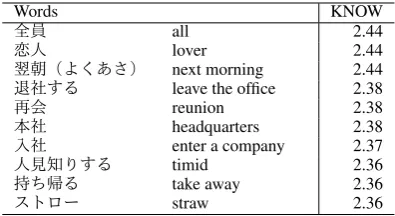
In this section, we describe the top (KNOWN) and bottom (UNKNOWN) 10 words for several per-spectives.
4.2.1 Known vs. Unknown
First, we reviewed KNOW, which is the most fun-damental perspective.
Tables2and3display the top 10 known and un-known words for the perspective KNOW,
respec-Table 2: The Top 10 Known Words (KNOW)
Words KNOW
all 2.44
lover 2.44 next morning 2.44 leave the office 2.38 reunion 2.38 headquarters 2.38 enter a company 2.37 timid 2.36 take away 2.36 straw 2.36
Table 3: The Top 10 Unknown Words
Words KNOW
embeded gutter -1.86 letter -1.86 authority -1.85 kanji radical -1.85 being busy with -1.84
staple fibre -1.82
valor -1.79
sleeveless overgarment
worn by pilgrims -1.79 the whole world -1.76 hypothesise -1.75
[image:5.595.312.510.316.424.2] [image:5.595.310.516.460.588.2]Table 4: Character-based Biased Words
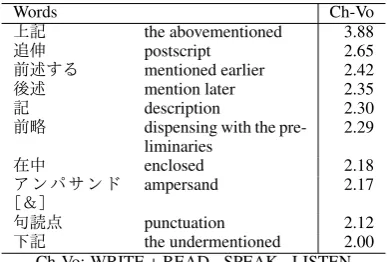
Words Ch-Vo
the abovementioned 3.88 postscript 2.65 mentioned earlier 2.42 mention later 2.35 description 2.30 dispensing with the
pre-liminaries 2.29 enclosed 2.18 ampersand 2.17
[image:6.595.89.283.102.233.2]punctuation 2.12 the undermentioned 2.00 Ch-Vo: WRITE + READ - SPEAK - LISTEN
Table 5: Voice-based Biased Words
Words Ch-Vo
shopping bag -3.07
tip -2.65
embezzle -2.59 bye bye -2.59 yoghurt -2.52 dryer -2.47 as it is -2.46 see you again -2.42 mucus -2.42 oof! -2.41 Ch-Vo: WRITE + READ - SPEAK - LISTEN
for (WRITE + READ - SPEAK - LISTEN). The difference between character-based (WRITE and READ) and voice-based (SPEAK and LISTEN) stimuli can be observed in the ‘Nihongo no goi tokusei’ database. Here, if the value is positive, the word tends to be used in written language. If the value is negative, the word tends to be used in spoken language.
Table 4shows the positively-valued examples. These words tend to be used in written documents or letters. Punctuation-related words ‘
(ampersand)’ and ‘ (punctuation)’ also appeared in the top 10 words. Table5shows the negatively-valued examples. These words tend to be used in conversations in daily life. The greeting ‘ (bye bye)’ and the interjection ‘
(oof!)’ are also observed. 4.2.3 Production vs. Reception
We surveyed the difference between the pro-duction (WRITE/SPEAK) and reception (READ/LISTEN) results and evaluated the (WRITE + SPEAK - READ - LISTEN) values. This approach is unique because no existing research has evaluated these perspectives.
The difference between production and
recep-Table 6: Production Biased Words
Words P-R
[image:6.595.318.505.258.404.2]capillary tube 0.76 matterand mind 0.73 erase 0.73 adhesive tape 0.72 two years 0.71 deep fryers 0.71 sing a song 0.71 feel weary 0.69 outward appearance 0.68 sequestered 0.66 P-R: WRITE + SPEAK - READ - LISTEN
Table 7: Reception Biased Words
Word P-R
commit someone to trial -2.93 right wing -2.71 filing charges -2.69 take a provincial tour -2.59 Takamori Saigo -2.52 murder -2.52
revolutionary -2.48 guard -2.47 well-informed people -2.42 retrial -2.41 P-R: WRITE + SPEAK - READ - LISTEN
tion thus seems to reflect whether or not the word is used in both mass media and in normal speech. Table6shows the production biased words, which tend to be technical terms. Some of the subject participants work histories (e.g. in the medical or music fields) explain certain words in Table 6, such as ‘ (capillary tube)’ and ‘ (adhe-sive tape)’ or traditional music ‘ (sing a song)’. Table7shows the reception biased words, and the negative words (‘ (murder)’ and ‘
(filling charges)’) are confirmed. The word ‘ (Takamori Saigo)’ also appears as a re-ception biased word in Table 6, which is the main character in a TV drama.
4.3 Evaluation by WLSP categories
[image:6.595.89.283.277.390.2]Table 8: The Top 10 Known Categories
Category KNOW
3.53 - -
Modifier-Nature-Creature 1.41 3.17 - -
Modifier-Relation-Space 1.41
2.10 - - Verb-Relation-Truth 1.35 3.56 - -
Modifier-Nature-Body 1.34
2.56 - - Verb-Nature-Body 1.32 2.14 - - Verb-Relation-Power 1.32 3.35 - - Relation-Action-Inter
Course 1.32 4.32 – Other-Vocative 1.31 4.31 – Other-Judgement 1.29 3.57 - - Modifier-Nature-Life 1.26
Table 9: The Top 10 Unknown Categories
Category KNOW
3.52 - -
Modifier-Nature-World 0.13
1.54 - -
Noun-Nature-Botanical 0.40 1.55 - - Noun-Nature-Animal 0.64 1.31 - -
Noun-Action-Language 0.66 1.23 - - Noun-Subject-Person 0.67 1.42 - -
Noun-Product-Garments 0.68 1.52 - - Noun-Nature-World 0.70 1.32 - - Noun-Action-Art 0.71 4.50 - Other-Animal Call 0.72
1.51 - -
Noun-Nature-Material 0.76
4.3.1 Known vs. Unknown
Tables 8 and 9 display the top 10 known and unknown word categories based on the perspec-tive KNOW, respecperspec-tively. As illustrated in Ta-bles 8and9, the known words tend to be modi-fiers or verbs, while the unknown words tend to be nouns. The most wellknown category is 3.53 ( -- : Modifier-Nature-Creature), which in-cludes gender-related words such as ‘ (fem-inine)’ (KNOW=1.81) and ‘ (masculine)’ (1.71). The least known category is 3.52 (
-- : Modifier-Nature-World), which includes rarely used words such as ‘ (bleak)’ (-1.46) and ‘ (big and high)’ (-1.35).
4.3.2 Character-based vs. Voice-based Figures 10 and 11 display the results for the character-based biased and voice-based biased categories, respectively. As shown in these tables, the nominal action and subject categories tend to be character-based biased, whereas the
voca-Table 10: Character-based Biased Categories
Category Ch-Vo
1.31 - -
Noun-Action-Language 0.13 1.32 - - Noun-Action-Art 0.11 1.25 - - Noun-Subject-Public
Private 0.11 1.23 - - Noun-Subject-Person 0.10 1.27 - -
Noun-Subject-Organisation 0.10 1.52 - - Noun-Nature-World 0.09 1.36 - -
Noun-Action-Treatment 0.08 2.31 - -
Verb-Action-Language 0.07 1.53 - -
Noun-Nature-Creature 0.07 3.52 - -
Modifier-Nature-World 0.07
Ch-Vo: WRITE + READ - SPEAK - LISTEN
Table 11: Voice-based Biased Categories
Category Ch-Vo
4.32 – Other-Vocative -0.59 4.30 – Other-Interjection -0.53 3.56 - -
Modifier-Nature-Body -0.44
2.56 - - Verb-Nature-Body -0.43 3.51 - -
Modifier-Nature-Material -0.42 3.18 - -
Modifier-Relation-Form -0.33
3.50 - -
Modifier-Nature-Nature -0.30 3.57 - -
Modifier-Nature-Creature -0.29 4.50 - Other-Animal Call -0.29
1.43 - - Noun-Product-Food -0.28
Ch-Vo: WRITE + READ - SPEAK - LISTEN
tive, interjection, modifiers, and animal call cate-gories tend to be voice-based biased. The highest-valued character-based category is 1.31 ( - -: Noun-Action-Language), which includes epistolary words such as ‘ (aforementioned)’ (WRITE+READ-SPEAK-LISTEN=3.87) and ‘
(p.s.)’ (2.65). The lowest valued voice-based biased category is 4.32 ( - : Other-Vocative), which includes ‘ (hello on phone)’ (-1.75).
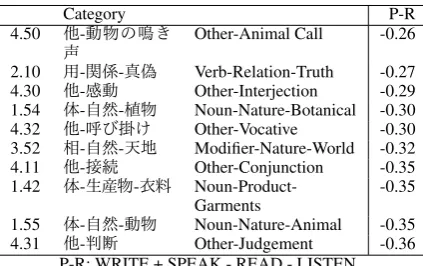
4.3.3 Production vs. Reception
Table 12: Production Biased Categories
Category P-R
4.50 - Other-Animal Call -0.26
2.10 - - Verb-Relation-Truth -0.27 4.30 - Other-Interjection -0.29 1.54 - - Noun-Nature-Botanical -0.30 4.32 - Other-Vocative -0.30 3.52 - - Modifier-Nature-World -0.32 4.11 - Other-Conjunction -0.35 1.42 - -
Noun-Product-Garments -0.35 1.55 - - Noun-Nature-Animal -0.35 4.31 - Other-Judgement -0.36
[image:8.595.82.294.102.235.2]P-R: WRITE + SPEAK - READ - LISTEN
Table 13: Reception Biased Categories
Category P-R
1.27 - -
Noun-Subject-Organization -0.62 1.36 - -
Noun-Action-Treatment -0.56 1.35 - -
Noun-Action-Intercourse -0.55 1.53 - - Noun-Nature-Creature -0.54 3.17 - -
Modifier-Relation-Space -0.54 1.24 - - Noun-Subject-Member -0.54 2.35 - - Verb-Action-Inter
Course -0.53 2.36 - - Verb-Action-Treatment -0.53 2.34 - - Verb-Action-Behaviour -0.52 3.14 - - Verb-Relation-Power -0.52
P-R: WRITE + SPEAK - READ - LISTEN
values for ProRec (WRITE + SPEAK READ -LISTEN) become negative, even for the produc-tion biased categories. The syntactic categories (excluding nouns, verbs, and modifiers) are pro-duction biased such as the animal call, interjection, vocative, and conjunction categories. The other production biased category is 4.50 (
-: Other-Animal Call), which includes words such as ‘ (croak)’ (WRITE+SPEAK-READ-LISTEN=0.45) and ‘ (croak)’ (0.23). The reception biased words refer to the vocabulary used on the news or in TV show such as nominal organisation, treatment, or in-tercourse. The reception biased category with the highest ranking is 1.27 ( - - : Noun-Subject-Organization), which includes words such as ‘ (Ministry of Health, Labour, and Welfare)’ (-2.23) and ‘ (Financial Services Agency)’ (-2.18).
4.4 Discussions
In this paper, we presented the word familiarity rating tendencies based on a crowdsourced study. The character-based (WRITE and READ) /voice-based (SPEAK and LISTEN) contrasting results confirm the findings in Nihongo no goi tokusei; however, in our data, we uniquely observe the con-trast between the production and reception cate-gories.
However, we still face the issue of normalis-ing the ratnormalis-ings. This study s proposed method, in which the mean and standard deviation are set to 0.0 and 1.0, respectively, is sufficient when rat-ing relative values or when arrangrat-ing ratrat-ings in a certain order. We also calculated the ratings with
γword(i) +µsubj+α; with this calculation, the ratings can be ranged from 1.0 to 5.0, excluding outliers. Though the normalization of ratings should be de-termined by the rating method used, calculating the valueγword(i) is sufficient for most uses.
5 Conclusions
We have presented a Japanese word familiarity rate database for entries in the WLSP. To do so, we used crowdsourcing to explore the word familiarity ratings in terms of five perspectives: KNOW, WRITE, READ, SPEAK, and LISTEN. A Bayesian linear mixed model was utilised to es-timate the ratings. The data3and code4are
pub-licly available. Our future work on this topic is as follows. In this paper, we modelled the word familiarity rates and the subject participant biases with the standard normal distribution. While we did attempt to model the rates and biases with other distributions, the MCMC estimation did not converge. In the future, we hope to perform the survey on a yearly basis (to enlarge the data size) in order to model other distributions. We will also enhance the target word list to include UniDic en-tries for content words. In addition, we plan to cre-ate a morphological analyser, which will extract the word familiarity rates.
Acknowledgments
This work was supported by JSPS KAK-ENHI Grants Number 17H00917, 18H05521, 18K18519, 19K00591, 19K00655 and a project of the Center for Corpus Development, NINJAL.
3https://cradle.ninjal.ac.jp/ 4https://github.com/masayu-a/
References
Shigeaki Amano and Tadahisa Kondo, editors. 1999.
Nihongo no goi tokusei (Lexical properties of Japanese). Sanseido, Tokyo.
Masayuki Asahara, Kikuo Maekawa, Mizuho Imada, Sachi Kato, and Hikari Konishi. 2014. Archiv-ing and analysArchiv-ing techniques of the ultra-large-scale web-based corpus project of ninjal, japan. Alexan-dria, 1–2:129–148.
Kokuritsu Kokugo Kenkyusho. 1964. Bunrui goihyo (Word List by Sementic Principles). Shuei Shuppan, Tokyo.
Kokuritsu Kokugo Kenkyusho. 2004. Bunrui goihyo zouho kaitei-ban (Word List by Sementic Principles, Revised and Enlarged Edition). Dainippon Tosho, Tokyo.
Asuko Kondo, Makiro Tanaka, and Masayuki Asahara. 2018. Alignment table between unidic and ‘word list by semantic principles’. InProceedings of The Eighth Conference of Japanese Association for Dig-ital Humanities (JADH2018), pages 125–128.
Kikuo Maekawa, Hanae Koiso, Sadaoki Furui, and Hi-toshi Isahara. 2000. Spontaneous speech corpus of japanese. InProceedings of LREC-2000, (Second International Conference on Language Resources and Evaluation), volume 2, pages 947–952.
Kikuo Maekawa, Makoto Yamazaki, Toshinobu Ogiso, Takehiko Maruyama, Hideki Ogura, Wakako Kashino, Hanae Koiso, Masaya Yamaguchi, Makiro Tanaka, and Yasuharu Den. 2014. Balanced corpus of contemporary written japanese. Language Re-sources and Evaluation, 48(2):345–371.