Proceedings of the Second Workshop on Machine Reading for Question Answering, pages 53–57 53
Improving the Robustness of Deep Reading Comprehension Models by
Leveraging Syntax Prior
Bowen Wu1, Haoyang Huang2, Zongsheng Wang1, Qihang Feng1, Jingsong Yu2,Baoxun Wang1
1Platform and Content Group, Tencent
2School of Software & Microelectronics, Peking University, Beijing, China
jasonbwwu, jasoawang, careyfeng, [email protected] [email protected], [email protected]
Abstract
Despite the remarkable progress on Machine Reading Comprehension (MRC) with the help of open-source datasets, recent studies indicate that most of the current MRC systems unfor-tunately suffer from weak robustness against adversarial samples. To address this issue, we attempt to take sentence syntax as the lever-age in the answer predicting process which previously only takes account of phrase-level semantics. Furthermore, to better utilize the sentence syntax and improve the robustness, we propose a Syntactic Leveraging Network, which is designed to deal with adversarial samples by exploiting the syntactic elements of a question. The experiment results indicate that our method is promising for improving the generalization and robustness of MRC models against the influence of adversarial samples, with performance well-maintained.
1 Introduction
As one of the ultimate goals of natural lan-guage processing, Machine Reading Comprehen-sion (MRC) has been attracting much attention from both the academical and industrial institu-tions (Richardson et al., 2013; Hermann et al.,
2015). Recently, most of the outstanding studies have benefited from the rapid development of ma-chine reading competitions with shared datasets, such as SQuAD (Rajpurkar et al., 2016), MS MARCO (Nguyen et al.,2017). According to the competition results, the Deep Learning based ap-proaches have shown significant strength on MRC tasks and achieved most of the top-ranked posi-tions (Wang et al.,2017;Yu et al.,2018).
Nevertheless, the very recent research in MRC indicates that simply chasing the performance im-provement on given datasets is unwise, since the generalization and robustness might be weakened due to the great fitting capability of DL models
trained on a specific corpus. Especially, the re-search on adversarial reading comprehension sam-ples conducted byJia and Liang(2017) has shown that the performances of most of the DL based MRC models decrease significantly on the adver-sarial samples. These adveradver-sarial samples are con-structed by simply appending one sentence similar to the question into the paragraph, without chang-ing the original answer. This work indicates that, apparently, there exists quite a gap between the current MRC approaches and the methodologies that really comprehend natural language passages. In this paper, we attempt to face the challenge brought by the RC adversarial samples and aim at proposing a reading comprehension system with better generalization and robustness. For this pur-pose, this paper presents a method to improve the answer inferencing process of MRC, by leverag-ing the probability function for estimatleverag-ing answer using the information related to sentence-question matching. Moreover, to further improve the ro-bustness of the MRC system, we propose a novel model named syntactic leveraging network which exploits the syntax of the question as the prior in-formation to match the answer-contained sentence and question more precisely.
2 Methodology
Most existent MRC methods predict answers by calculating probabilities of answer spans (i, j). For an answerastarts at positioni, ends atj and locates in sentencek, we denote it asa={i, j, k}. Given a questionqand a paragraphp, the proba-bility ofais computed by:
p(a|q,p) =ps(i|q,p)·pe(j|q,p) (1)
and:
ps(i|q,p) =fs(i|q,p)
pe(j|q,p) =fe(j|q,p)
Here functionsfsandfeare usually implemented
by neural networks to predict the probabilities. In most non-inferencing machine reading com-prehension datasets such as SQuAD, all infor-mation needed to identify answers can be found inside one single sentence (Raiman and Miller,
2017). In such datasets, given one question and one phrase inside a sentence, overall whether this phrase is the answer depends on two conditions: 1) if the phrase itself generally matches with the question; 2) if the syntactic elements in the sen-tence are precisely consistent with the syntactic el-ements in the question.
However, the experiment results in Jia and
Liang (2017) have shown that the current MRC
systems pay less attention to the second condition, thus can be easily attacked by question-related sentences as adversarial samples. We attribute this deficiency to the fact that the current models solely takes the phrase-level information into account when predicting the probabilityp(a|q,p), but fails to exploit the sentence-level matching between the answer-contained sentence and the question, which is of importance on evaluating the second condition. Consequently, we propose a new prob-ability function for estimating answers by consid-ering the sentence level matching degree:
p∗(a|q,p) =ps(i|q,p)·pe(j|q,p)·psent(k|q,p)α
psent(k|q,p) =fsent(q, sk)
(3) where sk is the k −th sentence in p. In
gen-eral,psentpredicts if the answerapresents in the
k−th sentence from the paragraph, it captures the matching between sentence and question as a leverage to improve the system robustness. α is the leveraging factor forpsent(k|q,p).
2.1 Syntactic Leveraging Network
Although theoretically fsent can be implemented
by any model aiming at evaluating the matching between two sentences, to correctly identify real answer-contained sentences from semantically-closed adversarial sentences, it is necessary to come up with a model which is capable of pre-cisely extracting and comparing the syntactic ele-ments within sentences and questions. Therefore Syntactic Leveraging Network (SLN) is proposed to predictpsent(k|q,p), so as to improve the
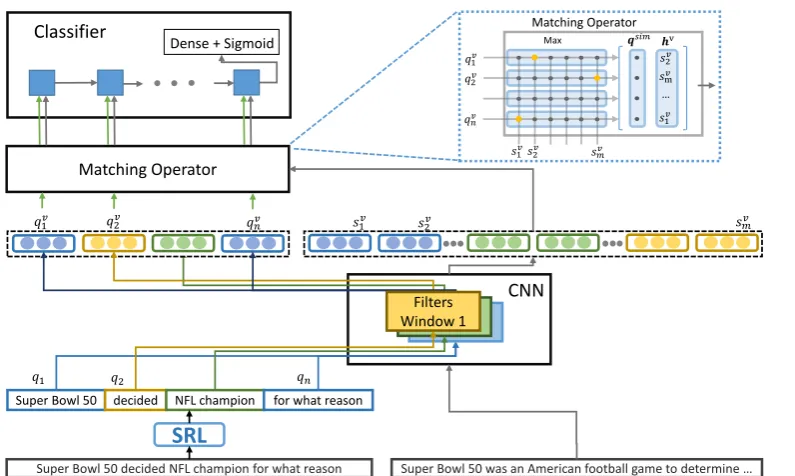
ro-bustness of MRC models. The structure of SLN is shown in Figure1, which consists of theSRL (Semantic role labeling) extractor, theCNN
en-coder, the Matching operator performing opti-mal transport (Tam et al.,2019) and a classifier.
2.1.1 SRL Extractor
We utilize SRL (Gildea and Jurafsky, 2002;
Khashabi et al.,2018) to analyze the syntax of sen-tences as prior information. In brief, it automat-ically produces syntactic analyses by exploiting generalizations from syntax-semantics links and assigns labels to phrases in a sentence based on their syntactic roles.
Given a questionq, the SRL extractor separates
qinto a sequence of phrasesQ, specifically:
Q=SRL(q) = [q1, q2, . . . , qn] (4)
with corresponding lengths L = [l1, l2, . . . , ln].
Here each qi represents one syntactic element
within the q, and each can also be considered as a condition that answer-contained sentences must satisfy. The SLN model takes such sequence of n-grams as inputs to represent the question.
2.1.2 CNN Encoder
The encoder projects the syntactic elements inQ andsinto real-valued vectors. Assuming CNN’s filter windows range from wmin to wmax with
each kernel size of k. ForqiinQ, it is only
trans-ferred into the filter window of sizeliin CNN:
qvi =CN Nli(qi) i∈[1, n] (5)
This CNN is performed followingKim(2014), so that the size of eachqivequals to the kernel size k. For sentence sof length L, it is first split into m1 separate phrases [s1, s2, . . . , sm], which
con-tains alln-grams (wmin ≤n < wmax) in the
sen-tence. Then, eachsiis transferred intosvj of size k
through CNN filters, such that:
sv= [sv1, sv2, . . . , svm] (6)
wheresvj andqvi represent pieces of semantics in the sentence and question.
2.1.3 Matching Operator
The matching operator is designed to evaluate if the sentence generally matches with the syntac-tic elements of the question. It first computes the cosine-similarity between each qiv andsvj, which gives a similarity matrixS∈Rn×m. Then we
im-plement the max pooling across the row of S to obtainqsim:
qsim=maxrow(S) = [qsim1 , q
sim
2 , . . . , q
sim
n ] (7)
1m= (w
Super Bowl 50 decided NFL champion for what reason Super Bowl 50 was an American football game to determine …
SRL
Super Bowl 50 decided NFL champion for what reason
CNN Filter CNN FilterFilters Window 1
CNN
Matching Operator
𝑞1𝑣
𝑞2𝑣
𝑞𝑛𝑣
𝑠1𝑣𝑠2𝑣 𝑠𝑚𝑣
𝒒𝑠𝑖𝑚
Matching Operator
𝑞1 𝑞2 𝑞𝑛
𝑞1𝑣 𝑞 2
𝑣 𝑞
𝑛𝑣 𝑠1𝑣 𝑠2𝑣 𝑠𝑚𝑣
Max
𝑠2𝑣
𝑠m𝑣
𝑠1𝑣 …
𝒉v
Classifier
[image:3.595.105.503.58.296.2]Dense + Sigmoid
Figure 1: The Architecture of Syntactic Leveraging Network
The value of eachqisim varies from 0 to 1, which indicates the degree of similarity of each syntactic elementqiins. Meanwhile,qisimequals to1if the
syntactic element qi exist exactly in the s, which
is a significant signal for the element matching. Furthermore, givenS, for eachqiv we compute its correspondinghvi. Specifically:
hvi = [svarg max
jSij;q
sim i ]
hv = [hv1, hv2, . . . , hvn] (8)
where svarg max
jSij is the vector representation
of the most semantically-similar phase in the sen-tence given qvi, and qisim represents the degree of similarity. Overall, hvi represents the most matched phase in the sentence for one syntactic element in the question and its corresponding de-gree of matching. Finally,hv is transferred from the Matching Operator as the output.
2.1.4 Classifier
The final classifier of SLN is designed to predict if the sentence matches with the question. It first concatenates the outputshvi from the matching op-erator withqvi as the LSTM inputs, such that:
ci =LST M(ci−1,[hi;qi]) (9)
The last LSTM hidden statescnis then transferred
into a dense layer followed by a sigmoid activation function, and binary cross-entropy is adopted as the loss function.
3 Experiments
3.1 Experimental Setups
Data Description. We implement our method on several end-to-end MRC models trained by SQuAD dataset, and evaluate their robustness before and after considering psent(k|q,p) using
the AddSent adversarial dataset (Jia and Liang,
2017). The training and test sets for MRC models are generated from SQuAD. To compute psent(k|q,p), we set those answer-contained
sen-tences in SQuAD as positive samples. For each positive sample, three sentences inside the same paragraph which do not contain answer are ran-domly chosen as negative samples, so that the positive/negative ratio is 1:3. All sentence-level matching models are trained on above samples as a binary-classification task using cross-entropy loss.
Baselines. Besides of SLN, we use relevance-LSTM and Inner-Attention (Liu et al., 2016) as baselines to compute fsent(q, sk).
Relevance-LSTM simply takes the last hidden states of the sentence and question for similarity computation, which is also used in the MRC model ofRaiman and Miller(2017); while Inner-Attention is the ab-breviation for the Bidirectional LSTM encoders with intra-attention, it utilizes the sentence’s rep-resentation to attend words appearing in itself. BiDAF (Seo et al., 2017) and MneReader (Hu
et al., 2017) are chosen as the back-end MRC
SQuAD AddSent
EM F1 EM F1
BiDAF
original 67.7 77.4 26.4 34.2
+Relevance-LSTM 67.8 77.6 26.4 34.2
+Inner-Attention 68.0 77.9 27.4 35.4
+SLN 67.7 77.5 28.4 36.4
MneReader
original 71.1 80.6 36.3 44.7
+Relevance-LSTM 70.8 80.1 36.1 44.3
+Inner-Attention 71.2 80.7 37.4 46.0
[image:4.595.81.281.60.185.2]+SLN 70.9 80.3 37.9 46.7
Table 1: Results on the MRC datasets
Accuracy P@1
Random Guess 75.0% 25.0%
Relevance-LSTM 83.2% 80.1%
Inner-Attention 87.8% 86.2%
[image:4.595.103.260.219.272.2]SLN 85.6% 82.7%
Table 2: Results on Sentence Matching
implementation (Chollet et al.,2015).
Parameter Settings. For SLN, we utilize the Al-lenNLP to perform SRL (Gardner et al., 2017), the filter windows are set from 1 to 8, with each kernel size of 128. The hidden size of LSTM is set as 128, while the size of the dense layer is set as 64. Adam (Kingma and Ba,2014) with learn-ing rate 0.001 is used to optimize SLN, the batch size is set as 8 and the models are trained for 50 epochs, with the early stop when the loss on vali-dation set starts to drop. Dropout rate is set to 0.2 to prevent overfitting (Srivastava et al.,2014). We utilize the pretrained 100-dim GloVe embeddings for all the models and set it as untrainable during training (Pennington et al.,2014). The leveraging factor α are all set as 0.25 for relevance-LSTM, Inner-Attention, and SLN.
For BiDAF and MneReader as back-end MRC models, we follow the exact hyperparameter set-tings of (Seo et al.,2017;Hu et al.,2017).
3.2 Results of the MRC Task
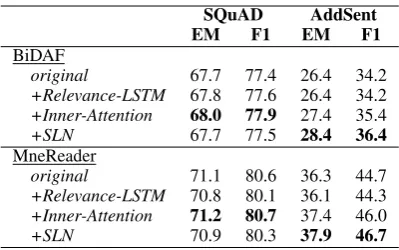
Table 1 details the performances of models on MRC datasets. The results show that both the per-formances of BiDAF and MneReader drop signif-icantly on the adversarial dataset, which indicates that current MRC models are not robust enough to distinguish the semantically similar candidates from answers. Concerning robustness, both Inner-Attention and SLN improve the EM and F1 of BiDAF and MneReader on AddSent dataset. This shows evidence that the robustness of MRC mod-els can be improved by properly exploiting the
sentence-level matching information. It can be also observed that introducing the sentence-level matching into the models overall is not detrimen-tal to the performances of models on the regular dataset, and the Inner-Attention even slightly in-creases the EM and F1 on regular SQuAD.
By contrary, Relevance-LSTM fails to improve the performance of current MRC models. We attribute this phenomenon to two reasons: 1) Relevance-LSTM mainly focuses on the seman-tics of the whole sentence to evaluate the relevance of two sentences, but current MRC models have already captured this information; 2) The word-level or phrase-word-level correspondence is important in identifying whether two sentences are talking about the same thing, which is also omitted in cur-rent End-to-End metric-oriented MRC models.
3.3 Analysis on Sentence Matching
The results of the sentence matching are shown in Table 2. It can be observed that Inner-Attention achieves the best performance. We attribute its high performance to the fact that its attention mechanism helps to capture the semantics clues on detecting answer-related sentences given the ques-tion. However, although the Inner-Attention out-performs SLN significantly on sentence matching, the results on Adversarial dataset show that SLN is more effective on robustness-promoting, reflected by the highest EM and F1 achieved by SLN on AddSent. Since most current MRC models have already modeled the high-level semantics in the sentences sufficiently, the attention mechanism in inner-attention might be redundant thus less effec-tive in identifying the adversarial samples. The performance of SLN on robustness-promotion fur-ther verifies our hypothesis that introducing the syntax information as leverage on answer predic-tion is a feasible way to enhance the robustness of MRC systems.
4 Conclusions
References
Franc¸ois Chollet et al. 2015. Keras.
Matthew Gardner, Joel Grus, Mark Neumann, Oyvind Tafjord, Pradeep Dasigi, Nelson F. Liu, Matthew E. Peters, Michael Schmitz, and Luke S. Zettlemoyer. 2017. Allennlp: A deep semantic natural language processing platform. CoRR, abs/1803.07640.
Daniel Gildea and Daniel Jurafsky. 2002. Automatic labeling of semantic roles. Computational Linguis-tics, 28(3):245–288.
Karl Moritz Hermann, Tomas Kocisky, Edward Grefenstette, Lasse Espeholt, Will Kay, Mustafa Su-leyman, and Phil Blunsom. 2015. Teaching ma-chines to read and comprehend. In Advances in neural information processing systems, pages 1693– 1701.
Minghao Hu, Yuxing Peng, and Xipeng Qiu. 2017. Re-inforced mnemonic reader for machine comprehen-sion.arXiv preprint arXiv:1705.02798.
Robin Jia and Percy Liang. 2017. Adversarial exam-ples for evaluating reading comprehension systems. In Proceedings of the 2017 Conference on Empiri-cal Methods in Natural Language Processing, pages 2021–2031.
Daniel Khashabi, Ashish Sabharwal, Tushar Khot, and Dan Roth. 2018. Question answering as global reasoning over semantic abstractions. In AAAI-18 AAAI Conference on Artificial Intelligence.
Yoon Kim. 2014. Convolutional neural networks for sentence classification. InProceedings of the 2014 Conference on Empirical Methods in Natural Lan-guage Processing (EMNLP), pages 1746–1751.
Diederik P Kingma and Jimmy Ba. 2014. Adam: A method for stochastic optimization. arXiv preprint arXiv:1412.6980.
Yang Liu, Chengjie Sun, Lei Lin, and Xiaolong Wang. 2016. Learning natural language inference using bidirectional lstm model and inner-attention. arXiv preprint arXiv:1605.09090.
Tri Nguyen, Mir Rosenberg, Xia Song, Jianfeng Gao, Saurabh Tiwary, Rangan Majumder, and Li Deng. 2017. Ms marco: A human-generated machine reading comprehension dataset. neural information processing systems.
Jeffrey Pennington, Richard Socher, and Christo-pher D. Manning. 2014. Glove: Global vectors for word representation. In Proceedings of the 2014 Conference on Empirical Methods in Natural Lan-guage Processing (EMNLP), pages 1532–1543.
Jonathan Raiman and John Miller. 2017. Globally nor-malized reader. In Proceedings of the 2017 Con-ference on Empirical Methods in Natural Language Processing, pages 1059–1069.
Pranav Rajpurkar, Jian Zhang, Konstantin Lopyrev, and Percy Liang. 2016. Squad: 100, 000+ questions for machine comprehension of text. InProceedings of the 2016 Conference on Empirical Methods in Nat-ural Language Processing, pages 2383–2392.
Matthew Richardson, Christopher JC Burges, and Erin Renshaw. 2013. Mctest: A challenge dataset for the open-domain machine comprehension of text. In Proceedings of the 2013 Conference on Empiri-cal Methods in Natural Language Processing, pages 193–203.
Min Joon Seo, Aniruddha Kembhavi, Ali Farhadi, and Hannaneh Hajishirzi. 2017. Bidirectional attention flow for machine comprehension. international con-ference on learning representations.
Nitish Srivastava, Geoffrey E. Hinton, Alex Krizhevsky, Ilya Sutskever, and Ruslan Salakhutdi-nov. 2014. Dropout: a simple way to prevent neural networks from overfitting. Journal of Machine Learning Research, 15(1):1929–1958.
Derek Tam, Nicholas Monath, Ari Kobren, Aaron Traylor, Rajarshi Das, and Andrew McCallum. 2019. Optimal transport-based alignment of learned character representations for string similarity. In
Proceedings of the 57th Annual Meeting of the Asso-ciation for Computational Linguistics, pages 5907– 5917.
Wenhui Wang, Nan Yang, Furu Wei, Baobao Chang, and Ming Zhou. 2017. Gated self-matching net-works for reading comprehension and question an-swering. InProceedings of the 55th Annual Meet-ing of the Association for Computational LMeet-inguistics (Volume 1: Long Papers), pages 189–198. Associa-tion for ComputaAssocia-tional Linguistics.