Proceedings of the 2019 Conference on Empirical Methods in Natural Language Processing 5489
Capsule Network with Interactive Attention for Aspect-Level
Sentiment Classification
12Chunning Du,12Haifeng Sun,12Jingyu Wang∗,12Qi Qi,12Jianxin Liao
12Tong Xu,12Ming Liu
1State Key Laboratory of Networking and Switching Technology,
Beijing University of Posts and Telecommunications, Beijing 100876, China
2EBUPT Information Technology Co., Ltd., Beijing 100191, China
{duchunning,sunhaifeng 1,wangjingyu,qiqi}@ebupt.com
Abstract
Aspect-level sentiment classification is a cru-cial task for sentiment analysis, which aims to identify the sentiment polarities of specific targets in their context. The main challenge comes from multi-aspect sentences, which ex-press multiple sentiment polarities towards different targets, resulting in overlapped fea-ture representation. However, most existing neural models tend to utilize static pooling op-eration or attention mechanism to identify sen-timental words, which therefore insufficient for dealing with overlapped features. To solve this problem, we propose to utilize capsule network to construct vector-based feature rep-resentation and cluster features by an EM rout-ing algorithm. Furthermore, interactive atten-tion mechanism is introduced in the capsule routing procedure to model the semantic re-lationship between aspect terms and context. The iterative routing also enables encoding sentence from a global perspective. Experi-mental results on three datasets show that our proposed model achieves state-of-the-art per-formance.
1 Introduction
Aspect-level sentiment classification is a fine-grained task in the field of sentiment analysis (Pang and Lee, 2008; Liu, 2012), which aims to infer the sentiment polarity (e.g., positive, neutral, negative) of a sentence with respect to the aspect. It demands to differentiate sentiments towards dif-ferent targets when there are multiple targets in one sentence. For example, given the mentioned aspect term {food, price, drinks}, and the sen-tence is“The food was definitely good, but when all was said and done, I just could not justify it for the price including 2 drinks,$100/person.”For aspect termfood, the sentimental polarity is
posi-∗
Corresponding author.
tive, but for aspect termprice, the polarity is neg-ative while for aspect termdrinks, the polarity is neutral. Recently, with the development of deep learning techniques, various neural networks are designed for this task and obtain promising results (Wang et al., 2016a; Ma et al., 2017; Fan et al.,
2018).
The main challenge in aspect-level sentiment classification is that one sentence expresses mul-tiple sentiment polarities, resulting in overlapped feature representation. Take the same example above, the sentence simultaneously reviews on ‘food’, ‘price’, and ‘drinks’, and expresses three different sentiment polarities. The highly over-lapped features will confuse the classifier seri-ously. However, most existing methods only keep the most active feature by max-pooling operation or utilize attention mechanism to find the senti-mental words, which fails to distinguish the over-lapped features.
Therefore, we propose a novel capsule net-work and iterative EM routing method with in-teractive attention (IACapsNet) to solve this prob-lem. Capsule network (Hinton et al.,2011;Sabour et al.,2017;Hinton et al.,2018) constructs vector-based feature representation. Capsules in adjacent layers are connected by dynamic routing, which shows strengths in distinguishing overlapped fea-tures by feature clustering (Sabour et al., 2017;
Zhang et al.,2019). In the aspect-level sentimen-tal classification task, the vector-based overlapped sentimental features towards different aspect terms will be clustered by an Expectation-Maximization (EM) routing algorithm, which makes the subse-quent classification more clear. Furthermore, we further devise an interactive attention-based rout-ing mechanism in order to highlight the word-level difference and model the semantic relationship be-tween aspect terms and context.
be viewed as a top-down attention mechanism, which is more efficient because of the global per-spective compared to the standard attention mech-anism. Standard attention mechanism in this task only considers a part of the context information in a sentence without considering the overall mean-ing conveyed by the sentence, which may intro-duce noise and downgrade the prediction accuracy, especially for complex sentences. For example, in an ironic statement for the aspect term “mac os”: “Maybe the mac os improvement were not the product they want to offer.”, the standard at-tention mechanism will highlight the sentimental word ‘improvement’ and confuse the classifier to make the wrong prediction to be positive. Our routing mechanism can tackle this by adjusting the contribution of each low-level capsule based on the high-level capsules (overall representation), and the iterative update makes the overall repre-sentation more accurate compared to other simi-lar top-down attention (Liu et al.,2018;Zhao and Zhang,2018).
Our proposed model (IACapsNet) is evaluated on three datasets: laptop, restaurant datasets from the SemEval 2014 Task 4 and Twitter collection. The experimental results show that our model outperforms other baseline methods and achieves state-of-the-art performance. Our contributions are summarized as follows:
• We apply capsule network to aspect-level sentiment classification to tackle the over-lapped features by feature clustering. To the best of our knowledge, there is no work that investigates the performance of capsule net-work in this task.
• An interactive attention mechanism is intro-duced in the capsule routing to help model the semantic relationship between aspect term and context.
2 Related work
2.1 Aspect Level Sentiment Classification
Traditional approaches have designed rich features about content and syntactic structures to capture the sentiment polarity (Jiang et al., 2011; P´erez-Rosas et al., 2012). However, These feature-based methods are labor-intensive and the perfor-mance highly depends on the quality of the fea-tures. Recently, deep learning methods are be-coming popular for aspect-level sentiment
classi-fication. Recurrent Neural Networks (RNNs) are the most commonly used technique for this task (Tang et al., 2016a). The attention mechanism is further introduced to model the target-context association (Wang et al., 2016b; Li et al., 2017;
Ma et al., 2017). Furthermore, Fan et al. (2018) proposed MGAN to integrate fine-grained atten-tion mechanisms, which is employed to character-ize the word-level interactions between aspect and context words. Very recently, CNN-based models have shown the strengths in efficiency to tackle the aspect-level sentiment classification (Xue and Li,
2018;Huang and Carley, 2018; Li et al., 2018). However, all the previous methods utilize static pooling operation or attention mechanism to lo-cate the sentimental words, which fails to handle the overlapped features. We introduces vector-based feature representation and feature clustering to address this.
2.2 Capsule Network
Capsule network was proposed to improve the rep-resentational limitations of CNN and RNN by ex-tracting features in the form of vectors. The tech-nique was firstly proposed in (Hinton et al.,2011) and improved in (Sabour et al.,2017;Hinton et al.,
2018), which is mainly devised for image process-ing domain. Introducprocess-ing capsules allows us to uti-lize a routing mechanism instead of pooling op-eration to generate high-level features which is a more efficient way for features encoding. Routing-by-agreement is able to cluster features in an itera-tive way, which achieved impressive performance recognizing highly overlapped digits.
Several types of capsule networks have been proposed for natural language processing. Yang et al. (2018) investigated capsule networks for text classification. They also found that capsule networks exhibit significant improvement when transferring single-label to multi-label text classi-fication. Similar property has also been observed in the task of relation extraction (Zhang et al.,
2019,2018). However, interactive word-level at-tention is not considered in these typical capsule routing methods.
3 Model
sentence over a specific aspect term, where y ∈ {positive, negative, neutral}. The overall archi-tecture is shown in Figure 1. It consists of the input embedding layer, bidirectional RNN layer, primary capsule layer, and output layer.
3.1 Input Embedding Layer
The context’s input representations of IACapsNet include word embeddingswnand position
embed-dings pn. The aspect term’s input representation
only consists of word embeddingwan.
Word embedding is a distributed representa-tion of a word, where words from the vocabulary are mapped to vectors. Initializing words vectors via pre-trained word vectors can improve the per-formance due to their ability to capture syntac-tic and semansyntac-tic information of words from large scale unlabeled text. In our model, we employ the pre-trained word vector GloVe (Pennington et al., 2014) to obtain the fixed word embedding wn, wna ∈ Rdw, where dw is the word vector
di-mension.
Considering that the context words with closer distance to an aspect may have higher influence on the sentiment analysis, we introduce position embedding to encode the relative distancernfrom
word wn to the aspect term. We define the
po-sition embedding matrix P ∈ Rdp×N, which is randomly initialized and updated during the train-ing process. Here, dp is the position embedding
dimension and N denotes the length of the sen-tence. The corresponding word’s position embed-dingspncan be obtained by looking up the
posi-tion embedding matrixP usingrn.
The input representation for each context word is the concatenation of word embeddings and po-sition embeddings:xn= [wn;pn]∈Rdw+dp.
3.2 Bidirectional Recurrent Networks Layer
The recurrent neural networks can capture long-distance dependencies within a sentence. A bidi-rectional recurrent neural network is the first layer of IACapsNet. The forward direction captures the left contexthlfor a word and the backward
direc-tion captures the right contexthr. We concatenate
the left context and the right context as the con-textualized word representationhcn, han ∈ R2×dl,
wheredl is the dimension of hidden state,haand
hcare the word representations for aspect term and context, respectively.
Context Bi-RNN
… … … …
… … … …
M a
Aspect Bi-RNN
… …
… …
…
pool
… pool
Interactive Attention
Primary capsules
Iterative Routing
Sentiment Classes
Ω"
Ω"#$
%$& %'&
%$ %( %) %'
*$ *( *) *'
[image:3.595.309.523.62.289.2]ℎ$, ℎ(, ℎ), ℎ', ℎ$& ℎ'&
Figure 1: The architecture of IACapsNet
3.3 Primary Capsule Layer
The primary capsule is a group of neurons ob-tained from the output of the convolutional oper-ation performed onhan andhcn. So, the output of capsule is a vector representing different proper-ties of the same objective. In aspect-level senti-ment classification task, the properties may con-tain the sentiment and aspect term features.
EM-based routing method (Hinton et al.,2018) is implemented in our model, and except for the high-dimensional outputM, there is one more ac-tivation probabilityain our capsule, which is like the activity in a standard neural net (shown in Fig-ure1).
3.4 Interactive Attention EM Routing
We have already decided on the outputs of all the capsulesΩLin primary capsule layer and we now
want to decide which capsules ΩL+1 to active in
the layer above and how to assign each active low-level capsule to one active higher-low-level capsule.
atten-tion mechanism in the opposite direcatten-tion, which can adjust the low-level word’s contribution based on the sentence global representation. Moreover, in order to model the semantic relationship be-tween aspect term and context, we further devise an interactive attention-based routing mechanism.
3.4.1 M-step
The M-step holds the assignment probabilitiesR constant and adjusts each Gaussian (i.e. high-level capsules) to maximize the sum of the weighted log probabilities that the Gaussian would generate the datapoints (i.e. low-level capsules) assigned to it. This procedure aims to obtain the overall repre-sentation among the low-level capsules for a given iteration.
Firstly, every primary capsule iis transformed byWij to cast a voteVij =MiWij for the output
of high-level capsulej. And we can get the mean µj of the votes from the input capsules and the
varianceσjabout that mean for each dimensionh:
µhj =
P
iRijVijh
P
iRij
, (1)
(σhj)2=
P
iRij(Vijh−µhj)2
P
iRij
, (2)
whereµhj is thehth component of the capsulej’s vectorized outputMj.
The activation probability of capsulejis calcu-lated by
costhj = (βu+log(σjh))
X
i
Rij, (3)
aj = sigmoid(λ(βα−
X
h
costhj)), (4)
whereβuandβαare trainable parameters denoting
fixed cost per input capsule when not activating it and fixed cost for coding the mean and variance of capsule j when activating it. The variance σ re-flects the degree of agreement. An intuitive under-standing of this activation probability is that if the votes from low-level capsules are not agreed on one level capsule, the activation of the high-level capsule should be low. λis an inverse tem-perature parameter set1e−3with a fixed schedule.
3.4.2 E-step
The E-step adjusts the assignment probabilitiesR for each datapoint (i.e. low-level capsule) to the
Gaussian (i.e. high-level capsules). This proce-dure aims to adjust the contribution of each cap-sule based on the high-level capcap-sule (i.e. overall representation) for a given iteration.
We firstly compute the negative log probability density of the vectorized vote under thej’s Gaus-sian distribution:
pj =
1
q QH
h 2π(σhj)2
exp(−
H
X
h
(Vijh−µhj)2
2(σjh)2 ).
(5) For capsuleiin primary capsule layer, the assign-ment probability is adjusted by:
Rij =
ajpj
P
jajpj
. (6)
Alternating E-step and M-step will route the output of capsule to a capsule in the layer above that receives a cluster of high-dimensional fea-tures.
Algorithm 1 Interactive attention EM routing. Capsuleiandjdenote a low-level and high-level capsule. ΩL andΩL+1 denote the low-level and
high-level capsules set, respectively.
1: procedure INTERACTIVE ATTENTION EM ROUTING(ai, Vij,αa→c,αc→a)
2: ∀capsulesiand capsulesj:Rij = |ΩL1+1|
3: ∀capsulesifrom context:ai =ai∗αan→c 4: ∀capsulesifrom aspect:ai=ai∗αcn→a 5: nis the token index from which the
cap-suleicomes.
6: forr iterations do
7: ∀j∈ΩL+1: M-STEP(ai,Rij,Vij,j) 8: ∀i∈ΩL: E-STEP(µj,σj,aj,Vij,i) 9: end for
10: returnaj 11: end procedure
12: procedureM-STEP(ai,Rij,Vij) 13: ∀capsulei:Rij =Rij ∗ai
14: ∀capsulej: computeµj andσj by Eq. 1
and2
15: ∀capsulej: computeaj by Eq.4 16: end procedure
17: procedureE-STEP(µj,σj,aj,Vij)
18: ∀ capsule j: compute pj and update Rij
3.4.3 Interactive Attention
The overlapped features in primary capsule layer can be routed and clustered to high-level cap-sules in an iterative way. However, purely alter-nating the E-step and M-step will ignore the re-lationship between the context and aspect term. It has been demonstrated that target and context can determine the representation of each other. And the coordination of targets and their contexts can remarkably enhance the performance of sen-timent classification (Ma et al., 2017;Fan et al.,
2018). Word-level attention, which has already been demonstrated to be essential is also ignored. So, apart from the assignment probabilities, we further introduce an interactive attention weightα which is learned interactively between the context and the aspect term.
Specifically, we implement scaled dot-product attention which can be described as mapping a query and a set of key-value pairs to a weight on the word-level token. The queries are the aver-aged representation of the context hc and the as-pect termhawhich are transformed to dimension
dkby trainable parameters:
qc=
PN
n hcn
N ∗W
q
c ∈Rdk, (7)
qa=
PN
n han
N ∗W
q
a ∈Rdk, (8)
The keys are the corresponding words’ represen-tation from aspect term and context which are also transformed to dimensiondk:
knc =hcn∗Wck∈Rdk, (9)
kna=han∗Wak∈Rdk, (10)
whereWcq,Waq,Wck,Wak∈R2dl∗dk
The attention weights can be computed as fol-lows:
san→c(qa, kcn) =
kcn∗qTa
√
dk
, (11)
scn→a(qc, kan) =
kan∗qcT
√
dk
, (12)
αan→c= exp(s
a→c
n (qa, knc))
PN
n=1exp(san→c(qa, knc))
, (13)
αcn→a= exp(s
c→a
n (qc, kna))
PN
n=1exp(scn→a(qc, kan))
. (14)
In order to ensure a proper magnitude of sn
avoiding pushing the softmax function into re-gions where it has extremely small gradients, we introduce the scaling factor √1
dk following
(Vaswani et al.,2017). We can thus get the word-level significance for each token in the context and aspect term in an interactive way, which will be adopted on each primary capsule’s activation probabilitya. We detail the whole routing algo-rithm in Algoalgo-rithm1.
3.5 Training Objective
In IACapsNet, each top-level capsule corresponds to a sentiment category. The activation probability aof each top-level capsule represents the proba-bility that the input sentence belongs to the corre-sponding category. We use a spread margin loss, Lk for each top-level capsulek to directly
maxi-mize the gap between the activation of the target class (at) and the activation of the other classes.
The total lossLis simply the sum of the losses of all top-level capsules:
L=X
k6=t
(max(0, m−(at−ak))2, (15)
where m is the margin which we set 0.9 with a fixed schedule.
4 Experiments
In this section, we conduct extensive experiments on three datasets to evaluate the proposed IACap-sNet.
4.1 Experimental Setup
The experiments are implemented on three datasets. The first two datasets are from the Se-mEval 2014 Task 4 (Pontiki et al., 2014), which contains reviews about laptops and restaurants, re-spectively. The third one is a Twitter dataset col-lected by (Dong et al., 2014). The statistics of these datasets are listed in Table 2. Following (Tang et al., 2016c), conflict category is removed from the SemEval 2014 datasets to avoid datasets getting unbalanced. Sentences are zero-padded to the length of the longest sentence in respective dataset. Results are measured by accuracy and Macro-Averaged F1 score.
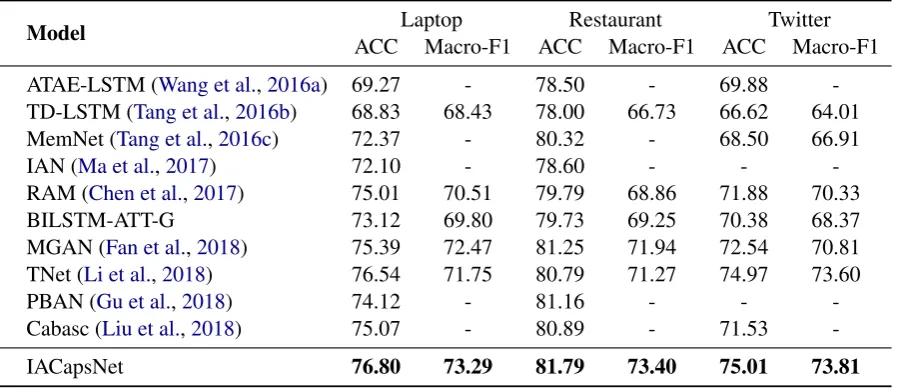
Model Laptop Restaurant Twitter ACC Macro-F1 ACC Macro-F1 ACC Macro-F1
ATAE-LSTM (Wang et al.,2016a) 69.27 - 78.50 - 69.88 -TD-LSTM (Tang et al.,2016b) 68.83 68.43 78.00 66.73 66.62 64.01 MemNet (Tang et al.,2016c) 72.37 - 80.32 - 68.50 66.91
IAN (Ma et al.,2017) 72.10 - 78.60 - -
-RAM (Chen et al.,2017) 75.01 70.51 79.79 68.86 71.88 70.33
BILSTM-ATT-G 73.12 69.80 79.73 69.25 70.38 68.37
MGAN (Fan et al.,2018) 75.39 72.47 81.25 71.94 72.54 70.81 TNet (Li et al.,2018) 76.54 71.75 80.79 71.27 74.97 73.60
PBAN (Gu et al.,2018) 74.12 - 81.16 - -
-Cabasc (Liu et al.,2018) 75.07 - 80.89 - 71.53
[image:6.595.78.531.63.257.2]-IACapsNet 76.80 73.29 81.79 73.40 75.01 73.81
Table 1: Experimental results. The baseline results are retrieved from the original papers and (Li et al.,2018)
out-of-vocabulary words are initialized by sam-pling from the uniform distributionU(−0.1,0.1). In the Bi-RNN layer, LSTM is utilized and the di-mension of the hidden state is 300. The didi-mension of the capsule’s output is 16. We use Adam opti-mizer (Kingma and Ba,2014) as our optimization method with5e−4learning rate. L2 regularization and dropout are adopted to avoid overfitting.
Dataset Positive Neural Negative Train Test Train Test Train Test Restaurant 2164 728 637 196 807 196 Laptop 994 341 464 169 870 128 Twitter 1561 173 3127 346 1560 173
Table 2: Summary statistics of the datasets.
4.2 Model Comparisons
IACapsNet is compared with the following meth-ods:
ATAE-LSTM(Wang et al.,2016a): An LSTM-based model which learns attention embeddings and combine them with the LSTM hidden states to predict the polarity.
TD-LSTM(Tang et al.,2016b): It employs two LSTMs to estimate the left context and the right context, respectively. The concatenated context representations perform the predictions.
IAN(Ma et al.,2017): An interactive attention is implemented on the representation of context and aspect learned by two LSTMs.
MemNet(Tang et al.,2016c): It applies atten-tion mechanism over the word embeddings
multi-ple times and predicts sentiment based on the top-most sentence representation.
RAM (Chen et al., 2017): Similar to Mem-Net, RAM is a multi-layer architecture where each layer consists of attention-based aggregation of word features and a GRU cell to learn the sentence representation.
BILSTM-ATT-G: (Zhang and Liu, 2017): It models left and right contexts using two attention-based LSTMs and introduces gates to measure the importance of left context, right context, and the entire sentence for the prediction.
MGAN(Fan et al.,2018): MGAN leverages the fine-grained and coarse-grained attention, which is further employed to characterize the word-level interactions between aspect and context words.
PBAN(Gu et al.,2018): PBAN concentrates on the position information of aspect terms and mu-tually models the relation between aspect term and sentence by employing bidirectional attention.
TNet (Li et al., 2018): It employs a CNN layer to extract salient features from the trans-formed word representations originated from a bi-directional RNN layer.
Cabasc (Liu et al., 2018): Cabasc employs sentence-level content attention mechanism to capture the important information about given as-pects from a global perspective.
4.3 Main Results
As shown in Table1, IACapsNet achieves the best performance on all the datasets. From Table1, we can have the following observations.
One main reason may be the attention mechanism in TD-LSTM that enables to notice the important parts based on the aspect term. BILSTM-ATT-G adopts a similar architecture with TD-LSTM by modeling left context and right context us-ing attention-based LSTM, which achieves better results than ATAE-LSTM. IAN and MGAN in-troduce the interactive attention in coarse-grained and multi-grained ways respectively and bring re-markable improvements. PBAN similarly utilize a fine-grained bidirectional attention and performs comparably with MGAN.
MemNet utilizes a more complex structure that contains nine computational layers, which updates the query vector at each hop. RAM also learns multiple attended vectors on the memory, which achieves superior results among the baseline mod-els, especially on Laptop dataset.
Our proposed IACapsNet consistently performs best on all the three datasets. The improvement is mainly attributed to the feature clustering ability to tackle the overlapped features and the iteratively updating on coupling coefficients, which consid-ers the overall meaning of the contexts. More-over, compared with Cabasc, which also incorpo-rates the overall representation to typical attention mechanism in a static way, our iterative method shows remarkable strengths.
4.4 Ablation Study
To analyze the effect of different components in-cluding the routing mechanism and the introduced interactive attention, we report the results of vari-ants of IACapsNet. The results in Table 3 indi-cate: (1) EM routing based IACapsNet outper-forms IACapsNet-Cosine, which routes capsules by cosine similarity (Sabour et al., 2017). One main reason maybe cosine saturates at 1, which is insensitive to the difference between a quite good agreement and a very good agreement. (2) Inte-grating interactive attention in routing mechanism brings a remarkable improvement on both routing mechanisms, which demonstrates the necessity to consider the relationship between the aspect and contexts during the routing procedure.
Moreover, EM routing also brings a boost on ef-ficiency with fewer trainable parameters and faster speed which is intuitively shown in Table4(IAN is listed as baseline). From the table, it is easy to conclude that IACapsNet is much more efficient than IACapsNet-Cosine with about 10% and 36%
decrease in the number of trainable parameters and running speed, respectively. Moreover, compared to IAN, IACapsNet achieves a much better accu-racy with fewer trainable parameters, meaning that capsule network is more efficient in feature encod-ing with fewer parameters. However, IACapsNet costs more time compared to IAN, which is the implicit deficiency of capsule network because of the iterative calculation during routing.
4.5 Effects of Routing Iteration Number
As our proposed IACapsNet involves iterative pro-cedure during routing. In this section, we investi-gate the effects of different routing iteration num-bers. Specifically, we conduct experiments on all the three datasets and vary routing iteration num-bers r from 1 to 4. The results are illustrated in Figure3.
The results show that IACapsNet achieves the best performance at routing iteration number 2, 3 and 3 on the dataset RESTAURANT, LAPTOP, and Twitter, respectively. When the number of iteration is 1, our capsule network degrades to a standard network, which obtains comparable re-sults with IAN. While increasingr to 4, the per-formance gets worse dramatically. Moreover, as the number of iteration increases to 4, it brings many difficulties to train IACapsNet. The model becomes more sensitive, which fluctuates greatly in loss and accuracy during training. Therefore, it is appropriate to limit the routing iteration number r and set it to be 2 or 3 depending on the perfor-mance.
Model Accuracy Macro-F1 IACapsNet-cosine routing 81.12 72.05 -w/o interactive attention 80.64 71.76 IACapsNet-EM routing 81.79 73.40 -w/o interactive attention 80.89 71.84
Table 3: Ablation study on Restaurant dataset. Cosine routing denotes routing measured by cosine similarity
(Sabour et al.,2017), and w/o means without.
4.6 Case Study
thefood was defin
itelygood ,
butwhen all was said anddone , I justcould n'tjustfy it , for the price-lr b-'
inclu
ding 2drinks , $ 100/
perso n
0.00 0.02 0.04
0.06 IAN (F)
IACapsNet (T)
-0.02 -0.01 0.00 0.01 Target: prices (Negative)
0.00 0.02 0.04 0.06
IAN (F) IACapsNet (T)
C
ou
pl
in
g
co
ef
fi
ci
en
ts Target: drinks (Neutral)
-0.02 -0.01 0.00 0.01 0.02 0.00
0.02 0.04
0.06 IAN (T)
IACapsNet (T)
[image:8.595.77.524.65.317.2]-0.010 -0.005 0.000 0.005 0.010 Target: food (Positive)
Figure 2: Routing Visualization
Model Para. Train Infer. IAN (Ma et al.,2017) 5.057 0.11 0.017 IACapsNet-cosine routing 4.614 0.33 0.044 IACapsNet 4.189 0.21 0.024
Table 4: Evaluation of efficiency. “Para.” denotes
the number of trainable parameters (M). “Train” and
“Infer.” denotes the training speed and inference
speed(second/step). Speed is measured on 1 NVIDIA p100 GPU with batch size 64.
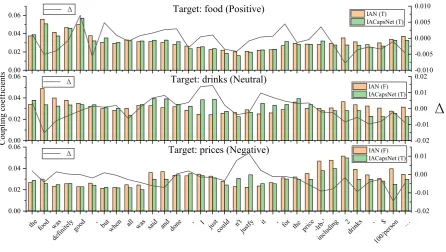
consisting of a long and complicated sentence and 3 aspect terms with 3 different sentimental polari-ties. Figure2shows this example and the visual-ization results of word-level coupling coefficients which are the sum of one word’s coupling coeffi-cients to the category. The attention weights from IAN are also shown as a baseline, which is nor-malized to the same scale with routing coupling coefficients. The line in the chart reflects the dif-ference∆. ‘F’ in Figure2means false sentiment classification, and ‘T’ means correct classification.
From the figure, we can observe that our rout-ing methods can adjust the attended words accord-ing to different aspect terms, which helps make all the predictions correctly. Moreover, our routing method can locate on the more important words more efficiently. For example, in terms of the as-pect ‘price’, the words “n’t” and “justify” is at-tended, which are the corresponding essential
sen-Figure 3: Effects of Routing Iteration Number
timental words. However, they are ignored by the ordinary attention mechanism, which leads a wrong prediction. This shows that our routing mechanism can capture important parts of a sen-tence more accurately.
4.7 Conclusion and Future Work
rout-ing to model the semantic relationship between as-pect term and sentence. The experimental results verify that IACapsNet outperforms baseline mod-els. The ablation and case studies show the effi-cacy of different proposed modules.
In the future, our theory can be generalized to other tasks that highly depends on the attention mechanism. For example, reading comprehension and machine translating.
Acknowledgements
This work was jointly supported by: (1) Na-tional Natural Science Foundation of China (No. 61771068, 61671079, 61471063, 61372120, 61421061); (2) Beijing Municipal Natural Sci-ence Foundation (No.4182041, 4152039); (3) the National Basic Research Program of China (No. 2013CB329102); (4) Fundamental Research Funds for the Central Universities under Grant 2018RC20; (5) BUPT Excellent Ph.D. Students Foundation.
References
Peng Chen, Zhongqian Sun, Lidong Bing, and Wei Yang. 2017. Recurrent attention network on
mem-ory for aspect sentiment analysis. InProceedings of
the 2017 Conference on Empirical Methods in Nat-ural Language Processing, EMNLP 2017, Copen-hagen, Denmark, September 9-11, 2017.
Li Dong, Furu Wei, Chuanqi Tan, Duyu Tang, Ming Zhou, and Ke Xu. 2014. Adaptive recursive neural network for target-dependent twitter sentiment
clas-sification. InProceedings of the 52nd Annual
Meet-ing of the Association for Computational LMeet-inguis- Linguis-tics, ACL 2014, June 22-27, 2014, Baltimore, MD, USA, Volume 2: Short Papers.
Feifan Fan, Yansong Feng, and Dongyan Zhao. 2018. Multi-grained attention network for aspect-level
sentiment classification. InProceedings of the 2018
Conference on Empirical Methods in Natural Language Processing, Brussels, Belgium, October 31 -November 4, 2018.
Shuqin Gu, Lipeng Zhang, Yuexian Hou, and Yin Song. 2018. A position-aware bidirectional atten-tion network for aspect-level sentiment analysis. In
Proceedings of the 27th International Conference on Computational Linguistics, COLING 2018, Santa Fe, New Mexico, USA, August 20-26, 2018.
Geoffrey Hinton, Sara Sabour, and Nicholas Frosst.
2018. Matrix capsules with em routing. In ICLR
2018.
Geoffrey E. Hinton, Alex Krizhevsky, and Sida D.
Wang. 2011. Transforming auto-encoders. In
Artificial Neural Networks and Machine Learning -ICANN 2011 - 21st International Conference on Ar-tificial Neural Networks, Espoo, Finland, June 14-17, 2011, Proceedings, Part I.
Binxuan Huang and Kathleen M. Carley. 2018. Param-eterized convolutional neural networks for aspect
level sentiment classification. InProceedings of the
2018 Conference on Empirical Methods in Natural Language Processing, Brussels, Belgium, October 31 - November 4, 2018.
Long Jiang, Mo Yu, Ming Zhou, Xiaohua Liu, and Tiejun Zhao. 2011. Target-dependent twitter
sen-timent classification. In The 49th Annual Meeting
of the Association for Computational Linguistics: Human Language Technologies, Proceedings of the Conference, 19-24 June, 2011, Portland, Oregon, USA.
Diederik P. Kingma and Jimmy Ba. 2014. Adam: A
method for stochastic optimization.ICLR.
Cheng Li, Xiaoxiao Guo, and Qiaozhu Mei. 2017. Deep memory networks for attitude identification. InProceedings of the Tenth ACM International Con-ference on Web Search and Data Mining, WSDM 2017, Cambridge, United Kingdom, February 6-10, 2017.
Xin Li, Lidong Bing, Wai Lam, and Bei Shi. 2018. Transformation networks for target-oriented
senti-ment classification. InProceedings of the 56th
An-nual Meeting of the Association for Computational Linguistics, ACL 2018, Melbourne, Australia, July 15-20, 2018, Volume 1: Long Papers.
Bing Liu. 2012. Sentiment Analysis and Opinion
Min-ing. Synthesis Lectures on Human Language
Tech-nologies. Morgan & Claypool Publishers.
Qiao Liu, Haibin Zhang, Yifu Zeng, Ziqi Huang, and Zufeng Wu. 2018. Content attention model for
as-pect based sentiment analysis. InProceedings of the
2018 World Wide Web Conference on World Wide Web, WWW 2018, Lyon, France, April 23-27, 2018. Dehong Ma, Sujian Li, Xiaodong Zhang, and Houfeng
Wang. 2017. Interactive attention networks for
aspect-level sentiment classification. In
Proceed-ings of the Twenty-Sixth International Joint Con-ference on Artificial Intelligence, IJCAI 2017, Mel-bourne, Australia, August 19-25, 2017.
Bo Pang and Lillian Lee. 2008. Opinion mining and
sentiment analysis. Foundations and Trends in
In-formation Retrieval.
Jeffrey Pennington, Richard Socher, and Christo-pher D. Manning. 2014. Glove: Global vectors for
word representation. In Proceedings of the 2014
Ver´onica P´erez-Rosas, Carmen Banea, and Rada Mi-halcea. 2012. Learning sentiment lexicons in span-ish. In Proceedings of the Eighth International Conference on Language Resources and Evaluation, LREC 2012, Istanbul, Turkey, May 23-25, 2012.
Maria Pontiki, Dimitris Galanis, John Pavlopoulos, Harris Papageorgiou, Ion Androutsopoulos, and Suresh Manandhar. 2014. Semeval-2014 task 4:
As-pect based sentiment analysis. InProceedings of the
8th International Workshop on Semantic Evaluation, SemEval@COLING 2014, Dublin, Ireland, August 23-24, 2014.
Sara Sabour, Nicholas Frosst, and Geoffrey E. Hinton.
2017. Dynamic routing between capsules. In
Ad-vances in Neural Information Processing Systems 30: Annual Conference on Neural Information Pro-cessing Systems 2017, 4-9 December 2017, Long Beach, CA, USA.
Duyu Tang, Bing Qin, Xiaocheng Feng, and Ting Liu. 2016a. Effective lstms for target-dependent
senti-ment classification. In COLING 2016, 26th
Inter-national Conference on Computational Linguistics, Proceedings of the Conference: Technical Papers, December 11-16, 2016, Osaka, Japan.
Duyu Tang, Bing Qin, Xiaocheng Feng, and Ting Liu. 2016b. Effective lstms for target-dependent
senti-ment classification. In COLING 2016, 26th
Inter-national Conference on Computational Linguistics, Proceedings of the Conference: Technical Papers, December 11-16, 2016, Osaka, Japan.
Duyu Tang, Bing Qin, and Ting Liu. 2016c. Aspect level sentiment classification with deep memory
net-work. In Proceedings of the 2016 Conference on
Empirical Methods in Natural Language Process-ing, EMNLP 2016, Austin, Texas, USA, November 1-4, 2016.
Ashish Vaswani, Noam Shazeer, Niki Parmar, Jakob Uszkoreit, Llion Jones, Aidan N. Gomez, Lukasz Kaiser, and Illia Polosukhin. 2017. Attention is all
you need. InAdvances in Neural Information
Pro-cessing Systems 30: Annual Conference on Neural Information Processing Systems 2017, 4-9 Decem-ber 2017, Long Beach, CA, USA.
Yequan Wang, Minlie Huang, Xiaoyan Zhu, and Li Zhao. 2016a. Attention-based LSTM for
aspect-level sentiment classification. InProceedings of the
2016 Conference on Empirical Methods in Natural Language Processing, EMNLP 2016, Austin, Texas, USA, November 1-4, 2016.
Yequan Wang, Minlie Huang, Xiaoyan Zhu, and Li Zhao. 2016b. Attention-based LSTM for
aspect-level sentiment classification. InProceedings of the
2016 Conference on Empirical Methods in Natural Language Processing, EMNLP 2016, Austin, Texas, USA, November 1-4, 2016.
Wei Xue and Tao Li. 2018. Aspect based sentiment
analysis with gated convolutional networks. In
Pro-ceedings of the 56th Annual Meeting of the Associa-tion for ComputaAssocia-tional Linguistics, ACL 2018, Mel-bourne, Australia, July 15-20, 2018, Volume 1: Long Papers.
Min Yang, Wei Zhao, Jianbo Ye, Zeyang Lei, Zhou Zhao, and Soufei Zhang. 2018. Investigating cap-sule networks with dynamic routing for text
classifi-cation. InProceedings of the 2018 Conference on
Empirical Methods in Natural Language Process-ing, Brussels, Belgium, October 31 - November 4, 2018.
Ningyu Zhang, Shumin Deng, Zhanling Sun, Xi Chen,
Wei Zhang, and Huajun Chen. 2018.
Attention-based capsule network with dynamic routing for
re-lation extraction. InProceedings of the 2018
Con-ference on Empirical Methods in Natural Language Processing, Brussels, Belgium, October 31 - Novem-ber 4, 2018.
Xinsong Zhang, Pengshuai Li, Weijia Jia, and Hai Zhao. 2019. Multi-labeled relation extraction with
attentive capsule network.AAAI.
Yue Zhang and Jiangming Liu. 2017. Attention
mod-eling for targeted sentiment. InProceedings of the
15th Conference of the European Chapter of the Association for Computational Linguistics, EACL 2017, Valencia, Spain, April 3-7, 2017, Volume 2: Short Papers.
Shenjian Zhao and Zhihua Zhang. 2018.
Attention-via-attention neural machine translation. In