Bachelorthesis
The effects of task complexity on motor preparation in a
typewriting task.
Jasper Smit S0160024
First Supervisor Dr. Elian de Kleine [email protected]
Department Cognitive Psychology and Ergonomics Faculty of Behavioral Sciences, Twente University
Second Supervisor Dr. Rob van der Lubbe
Department Cognitive Psychology and Ergonomics Faculty of Behavioral Sciences, Twente University
2
Abstract
The learning of a movement skill usually progresses from a more attentive phase to a more
automated phase, reducing the strain on cognitive capacity. Previous studies have pointed out
that different cognitive processes may underlie these different phases of motor skill
acquisition and may even be present during motor preparation. Various forms of task
complexity seem to influence event-related potentials such as the contingent negative
variation. In this study, the electroencephalogram was recorded of participants who copy
typed words which were manipulated in familiarity (Dutch and nonsense words) and length
(five and seven letter words). The most profound result of the present study was the absence
of a central CNV and a more pronounced CNV at parietal sites and an increased negative
CNV amplitude for unfamiliar words. This is not in line with results of studies who use
classical discrete sequence production tasks. These results may implicate that in highly
developed motor skills, motor preparation takes place on a higher cognitive level and in more
3
1.
Introduction
During our lifetime we learn all kinds of skills to help us interact with the world. Most of
these skills are not learned over night and take some time to master. Learning to play a
musical instrument or learning to drive a car is a process in which the learner performs
increasingly better with practice. In the beginning of the learning process, every single step
needs to be attended individually. A novice piano player will need his full attention to place
every single finger of his hand on the piano keyboard in order to play a chord. Eventually, a
more advanced player will put his fingers in the correct position without having to think about
it. The ability to learn these skills allows us to perform complex tasks, without having to focus
all our attention towards it. Because the use of these skills make up an important part of our
lives, it is vital to have a good understanding of how these cognitive processes work. This
study will explore the effects of task complexity on the cognitive load in such skills.
1.1 Theoretical framework
Fitts and Posner (1967) have suggested a three stage model on the acquisition of skills. Their
theory describes how a novice starts at a cognitive stage (1), where a lot of attention is needed
to perform the task at hand. Eventually, through practice, the novice will become enter the
associative stage (2) and is able to make subtle adjustments to execute the task more smoothly.
Eventually, the actor will end up in an automatic stage (3), where little cognitive resources are
required to perform the task quick and accurate. Cognitive science has advanced rapidly since
the days of Fitts and Posner and numerous studies have since looked into the acquisition of
motor skills and new evidence has lead to new insights (Gerloff, Corwell, Chen, Hallett, &
Cohen, 1997; Jenkins, Brooks, Frackowiak, & Passingham, 1994; Nattkemper & Ziessler,
4
also be represented by different cognitive mechanisms (Doyon & Benali, 2005; de Lange,
Hagoort, & Toni, 2005).
One well known mechanism which may help to explain the differences in the acquisition
of motor skills is known as motor chunking (Verwey, 2001). According to this concept,
sequences of small, individual movement actions that are frequently executed after another
(such as pressing down the clutch with one foot and reaching for the gear lever with your arm
to manually shift gear in a car) are grouped together to form one cognitive motor chunk. By
grouping the individual movement actions, the entire movement can be processed as a whole.
This reduces the cognitive load and makes it easier to perform these movements (Koch, 2007).
A promising approach to study the effects of motor preparation and motor chunking is
electroencephalography (EEG) as can be seen in recent studies (Dirnberger et al., 2000;
Gómez, Flores, & Ledesma, 2007; Leuthold & Schröter, 2011). By studying several event
related potentials (ERPs) derived from the EEG, new insights have been given concerning the
role of motor chunking. One of the ERPs of particular interest is the contingent negative
variation (CNV) which has been strongly identified with motor preparation in the past. The
CNV is a prolonged negative potential which can be measured between the first warning
stimulus and the imperative stimulus. It is most strongly measured in the central-parietal area
and particularly on the Cz and Pz electrode (Leynes, Allen, & Marsh, 1998). Although there is
very little doubt that the CNV is closely related to motor preparation and that task complexity
is reflected in it, it is still uncertain which exact cognitive processes are represented in the
CNV (van Boxtel & Brunia, 1994; Cui et al., 2000; Leynes et al., 1998).
Recent research has been conducted on the effects of a tasks complexity and the CNV.
There are various factors that contribute to the complexity or difficulty of a task. Cui et al.
(2000) have looked into the physical complexity of a task e.g. it is physically more easy to
5
thumb. They found a greater CNV amplitude before physically complex tasks and a smaller
CNV amplitude before physically easy tasks and have suggested that the CNV reflects the
level of preprogramming of the movement. In a study by Schröter & Leuthold (2009), the task
complexity was varied by moderating the length of the sequences that had to be performed.
They found an increased negative CNV before the execution of a task with multiple key
presses compared to a task involving a single key press, suggesting that it may reflect the
number of prepared key presses. De Kleine & van der Lubbe (2011) have examined a
completely different form of task complexity: the familiarity of a task. They found an
increased negative CNV when participants performed movement sequences which were
unknown to them compared to sequences which they had familiarized themselves with
(trained) before hand. The three before mentioned studies have shown that various forms of
task complexity influence the amplitude of the CNV.
The first two goals of the present study were to further investigate the increased CNV
amplitude for increased task complexity, in particular the aspects of task familiarity
(henceforth defined as the “task familiarity dimension”) and the aspect of stimulus length
(hereafter defined as the “stimulus length dimension”). Additionally, a third, exploratory goal
was set for this study concerning the nature of the given task. Most previous studies who have
looked into familiarity and sequence length, such as the studies by Schröter & Leuthold and
De Kleine & Van der Lubbe, have all used tasks which were highly similar to the Discrete
Sequence Production task (DSP). Participants in DSP experiments are asked to respond to a
series of key-specific stimuli which appear to them in a consistent and discrete order. Because
these sequences of stimuli and responses are always identical, the participants will be able to
perform the task faster and more accurate after a while because of a learning effect. The
hierarchical nature of the sequences and the fact that the stimuli are easy to manipulate make
6
arises with the use of the classical DSP task. In order to keep high experimental control and
optimal conditions for EEG measurement, most tasks are very simplified and stripped down
to a meaningless sequence of key presses. Often, these simple tasks hardly resemble everyday
life tasks and therefore generalization to everyday life may pose difficulties. In order to bridge
this gap between the laboratory and reality, this study has looked into a task which is a part of
our everyday life and therefore more natural, but at the same time shares the practical aspects
of the classical DSP tasks, namely typewriting.
In the past, Salthouse (1986) has pointed out that there are three reasons why typewriting
tasks are particularly practical for the analysis of skilled behavior. The first reason is the
availability of a large number of individuals with considerable typewriting skill because
typewriting is an important part of many modern jobs. Secondly, by using a computer, every
keystroke can easily and discretely be recorded. And thirdly because typewriting encompasses
the cognitively complex perceptual and motor processes. However, using a typewriting task
instead of the classical DSP task comes with its own limitations. Because the typewriting task
relies on words to be copied, there is a certain linguistic element involved. The reading,
comprehension and typing of words is a highly automated process which may also influence
motor processes (Pulvermüller, Hauk, Nikulin, & Ilmoniemi, 2005) and therefore the CNV.
Because of this linguistic element, it may be difficult to compare the results of this study with
the results of previous studies who used non-linguistic stimuli. There also may be a
fundamental difference between the reproduction of pre-learned sequences compared to
applying a more all-round, generic motor skill such as typewriting which developed through
years of experience (Gordon, Lee, Flament, Ugurbil, & Ebner, 1998). For example,
typewriting is a more robust skill which facilitates the typing of all kinds of different words,
7
1.2 Proposed experiment
In order to put the differences in task complexity (task familiarity and stimulus length
dimensions) to the test, the following experiment was designed. The task consisted of a
go/nogo task in which the participants had to copy type words which were presented on a
screen using a regular keyboard. To manipulate the familiarity aspect of task complexity, a
mix of two types of words was presented. Dutch words which frequently occur in the Dutch
language as familiar words and on the other hand pronounceable nonsense words as
unfamiliar words (similar to Wiggs & Martin, 1994). Because all participants were Dutch
native speakers and were advanced typists, it was assumed that the they would be able to use
visual and or motor chunks (already available to them through previous typing experience)
while typing the familiar Dutch words, but not so in the unfamiliar nonsense words condition.
The ability to make use of these motor chunks for the words in the familiar condition would
reduce the cognitive load and according to the results by De Kleine & Van der Lubbe (2011),
reduce the amplitude in CNV. It was therefore hypothesized that mean CNV amplitudes
would reveal increased negativity for unfamiliar words. Also, it was expected that familiar
words would be executed faster compared to unfamiliar words. To test the differences in the
stimulus length dimension, a mix of long, seven letter words and short, five letter words was
used. The longer words were expected to be more demanding on the cognitive capacity
compared to the smaller words. Based on the previous findings by Schröter & Leuthold
(2009), it was hypothesized that the CNV would reveal increased negativity for long words.
Also, it was predicted that the overall execution speed of the short words would be faster
compared to the longer words. It is not unlikely that the effect of familiarity was increased if
8
1.3 Thesis goals
In summary, the goal of the present study was threefold. The first goal was to analyze the
effect of stimulus familiarity on the CNV. The second goal was to study the effect of stimulus
length on the CNV. Finally, the third goal was to determine if similar CNV characteristics
could be measured during more realistic tasks compared to the stripped down sequence
reproduction tasks. This goal however, had an explorative function and was not tested in an
9
2.
Methods
2.1Participants
Sixteen students participated in the experiment (nine males and seven females), aged 18-22
years (mean: 20.06 years) from the University of Twente. Two participants were left-handed
and 14 right-handed, measured by the Annett Handedness Inventory by (Annett, 1970). The
mean typing speed of the participants was 63,37 words per minute, measured by the
continuous typing of a Dutch text for two minutes, using Typingmaster version 6.30
(TypingMaster Inc, 2005; e.g. Liang, Hwang, & Chang, 2008) . Participants were rewarded
course credits for participating. All participants gave written informed consent and reported
normal or corrected-to-normal vision. The study was approved by the local ethics committee
of the Faculty of Behavioral Sciences of the University of Twente and was performed
according to the Declaration of Helsinki.
2.2Stimuli and tasks
Participants were asked to place their fingers on the keyboard in front of the computer
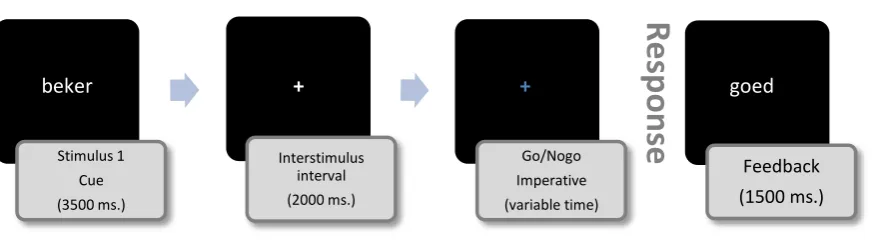
screen on the home row. One trial in the experiment consisted of four different stages (also
see Fig. 1). The first stage was a unique word which corresponded with one of the four
conditions (Short-Dutch words, Dutch words, Short-nonsense words and
Long-nonsense words) in the centre of the screen for 3500ms. It served as the informative cue.
During the second stage, a neutral, gray fixation cross was presented at the centre of the
screen which functioned as the preparation interval. After 2000ms the neutral fixation cross
would either change into a red or a blue cross (third stage). The changing color served as the
imperative stimulus. If a blue cross appeared, the “go” procedure was initiated and the
participant would type in the word which was presented at the first stage. During the typing of
10
remain fixated. Visual feedback on which keys were pressed was not shown during the typing.
When the last key (i.e. the fifth or the seventh) of a word sequence was pressed, feedback on
the performance of the task was given by showing the Dutch word “goed” if the response was
correct or “fout” if the response was incorrect (Dutch equivalents of “correct” and
“incorrect”). The red fixation cross indicated the initiation of the “nogo” condition, in which
case the participants were not to give a response. If after 3000ms no response was given the
word “goed” was shown as feedback for a correct response. If a key was pressed within the
3000ms interval, the word “fout” was shown, indicating a wrong response. The visual
feedback “goed” or “fout” was presented for 1500ms. After this, the trial was ended and a
new trial was presented immediately afterwards. A total of 200 trials were offered to each
participant with ten percent of the trials being “nogo” trials. The order in which the trials were
presented was randomized for each participant. A thirty second break was offered after every
twenty trials which allowed the participant to relax. Fig. 1 shows a schematic timeline of the
[image:10.595.76.514.524.644.2]order of presentation of the stimuli.
Fig. 1 Schematic overview of the task.
Stimulus 1 Cue (3500 ms.)
Interstimulus interval (2000 ms.)
Go/Nogo Imperative (variable time)
Feedback (1500 ms.)
beker + + goed
R
e
sp
o
n
11
Two dimensions were studied in this experiment: length and familiarity. Length would be
controlled by using short five letter words and long seven letter words. Familiarity was
controlled by using Dutch words and nonsense words. This resulted in four experimental
conditions: Short-Dutch words, Short-nonsense words, Dutch words and
Long-nonsense words. Each condition was represented by a wordlist containing 50 unique words.
Both short and long Dutch words were selected from a list of frequently used Dutch words
acquired from the Dutch institute of lexicology (INL). Verbs and words with strong action
related semantics (such as “hammer”) were not selected because of possible motor cortex
activation during reading of such words (Hauk, Johnsrude, & Pulvermüller, 2004). To create
the list of Non-sense words, three measures were taken into consideration to make sure that
the words had similar physical properties. First, all nonsense words used the exact same
letters as their Dutch counterparts. This was done to counterbalance for the physical difficulty
of the placement of the keys (e.g. the “t” and the “b” are particularly difficult to reach on a
qwerty keyboard). Second, all nonsense words would have to be pronounceable in Dutch.
Previous studies have shown that pronounceable words are easier to reproduce compared to
unpronounceable words (Gibson, Pick, Osser, & Hammond, 1962), therefore all words used
in this study were pronounceable in this study to counterbalance this effect. The third measure
ensured that if the Dutch word from which a nonsense word was derived contained a double
letter combination, the nonsense word also used the same double letter combination (e.g.
“apple” became “leppa”). This was done to counterbalance the execution speed effects of a
12
2.3Procedure
After participants had given their written informed consent, two small tests were
conducted before the actual experiment started. The first was the Annett Handedness
Inventory (Annett, 1970) to assess the handedness of the participants. The second was a
typing ability test to assess the participants typewriting speed. The test involved the copy
typing of a text for two minutes, after which the words per minute were calculated and the
percentage of typing errors. The same text was used for all participants. Participants who
scored below forty words per minute were considered unfit for the experiment and their data
were not used for analysis. After these tests, the EEG equipment was configured and the
electrodes were applied. Before the start of the experiment, the participants were given
instructions on how to respond during the experiment and to work as fast and accurate as
possible. After the 200 trials were completed, the experiment was ended.
2.4Recording and data processing
The experiment was ran on a Pentium 4 personal computer. The presentation of the stimuli,
registration of behavioral data (key presses) and production of external triggers were
regulated by experimentation software E-prime, version 2.0. Input for the behavioral data was
a QWERTY keyboard. The stimuli were presented using a CRT monitor placed on eye level,
approximately 40 cm in front of the participant. For the EEG recording, seventeen electrodes
were used in total (FPz, AFz, Fz, FCz, Cz, CPz, Pz, POz, Oz, F3, F4, C3, C4, P3, P4, PO7,
PO8). A horizontal and vertical electro-oculogram (EOG) were recorded using bipolar EOG
electrodes. The horizontal EOG electrodes were placed on the outer canthi of both eyes. The
vertical EOG was placed above and below the left eye. The signal from the EOG and EEG
electrodes were amplified using a Quick-Amp amplifier (72 channels, DC) and recorded with
13
The EEG and EOG data were sampled at a rate of 500 Hz. Measured activity was digitally
filtered online (low-pass 140 Hz, DC).
2.5Data analysis
For statistical analyses, Greenhouse-Geisser epsilon correction was applied whenever
appropriate. In total, two participants were left out from the final analysis. One participant
was removed from the data set because the session was not entirely recorded. The other
participant was excluded because of an insufficient score on the typing ability test (34 words
per minute, while the threshold for analysis was set at 40 words per minute). It was assumed
that motor preparation was similar in case of correct and incorrect responses, therefore EEG
analysis was performed on all data (correct and incorrect responses without artifacts), similar
to De Kleine and Van der Lubbe (2011). After visual inspection of the data, a new baseline
was calculated and set at 1600 and 1500 before the go/nogo signal which is comparable to De
Kleine & Van der Lubbe (2011). For statistical analysis, trials with artifacts (an amplitude
difference larger than 100 µV within 50 ms) and out of range values (values larger than +/-
250 µV for prefrontal electrodes, +/- 200 µV for frontal electrodes, +/- 150 µV for central
electrodes, and +/- 100 µV for parietal electrodes) were excluded from further analyses. Next,
EEG was corrected for EOG artifacts by the Gratton, Coles, and Donchin (1983) procedure.
Finally, a low-pass filter with a cut-off at 16 Hz was applied to average event-related brain
14
2.6Reaction time parameters
Reaction time (RT) analyses were only performed on the correctly executed go trials. This
was done because if one key press was incorrect, usually the following key presses were
delayed because the participant realized the mistake. Therefore those RT values did not reflect
the true nature of the task. A total of four separate reaction time analyses were performed.
The first RT test was the mean RT for the first key press and was defined as the interval
between the go signal and the first key press. A repeated-measures ANOVA was used with
task familiarity (2) and stimulus length (2) as within-subject factors. A second analysis was
performed on the averaged inter-key intervals (IKI; e.g.(Liang et al., 2008). A simple mean
RT analysis would not suffice as mean RT’s for short words would always be higher
compared to the long words. This is because the RT for the first key press is always higher
compared to the following key presses in the sequences and this has a higher impact on the
mean RT for short words compared to long words. A repeated measures ANOVA was used
with task familiarity (2) and stimulus length (2) as within-subject factors. The last two
separate RT analyses were performed on the task familiarity conditions because these could
be separated in two groups of short and long words so individual key presses could be
analyzed. Both groups of short and long words were subjected to a repeated-measures
ANOVA with task familiarity (2) and key (5 for short, 7 for long words) as within-subject
15
2.7EEG parameters
The CNV was calculated by averaging EEGs for all trials without artifacts from all
electrodes. Statistical analyses were performed on the values of the Cz and Pz electrodes as
De Kleine and Van der Lubbe (2011) found relevant differences on these sites. Averaged
activity was determined in 200ms intervals from -1000 to the go/nogo signal as these were the
intervals where most differences in CNV might be expected (e.g. Jankelowitz & Colebatch,
2002). A repeated-measures ANOVA was used with task familiarity (2), stimulus length (2),
electrode (2) and interval (5) as within-subject factors. After this analysis, it was decided that
an additional analysis on the last interval and the Pz electrode was useful. Therefore, a
repeated-measures ANOVA was used with task familiarity (2) and stimulus length (2) as
16
3.
Results
3.1 Behavioral measures
Before the behavioral data was analyzed, the incorrect and nogo trials were removed. The
PC was 89% in total. The distribution of the PC over the dimensions Familiarity and Length
were not unexpected and showed only small differences (PC 89.7 for familiar, 88.3 for
unfamiliar, 91.8 for small and 86.2 for long words). Furthermore, a graphic representation of
[image:16.595.89.522.296.469.2]the mean RT’s by both dimensions is presented in Fig. 2.
Fig. 2 Left: Mean RT for every key press by task familiarity dimension. Right: Mean RT for every key press by
stimulus length dimension.
Response times for the first key press were shorter for the familiar words compared to the
unfamiliar words (462,412 vs. 480,979 ms), F(1,14) = 7,030, p = 0.019. No significant
difference was found between the response times for the first key press in the Length
conditions F(1,14) = 0.885, p = 0.363. Also, no interaction effect was found for the response
times of the first key press between the Familiarity and Length conditions F(1,14) = 0.559, p
= 0.467. 100 200 300 400 500
1 2 3 4 5 6 7
M e an R T ( m s) Key press
Mean RT task familiarity dimension Unfamiliar Familiar 100 200 300 400 500
1 2 3 4 5 6 7
M e an R T ( m s) Keypress
Mean RT stimulus length dimension
Short
17
In order to compare the effects of the different dimensions on the overall RTs, average
inter-key intervals (IKI; e.g.(Liang et al., 2008) were calculated. Analysis on the average IKIs
revealed a main effect on task familiarity dimension F(1,14) = 20.826, p < 0.001. Familiar
words were executed faster (165,806 ms) compared to unfamiliar words (176.132 ms).
However, no effect on the stimulus length dimension was found F(1,14) = 0.39, p = 0.846.
Also, no interaction effect was found (F(1,14) = 0.82, p = 0.779.
Two separate RT analyses were performed on the Familiarity condition for every separate key
press, the first by comparing only short words, the second by comparing only long words. The
analysis on short words showed a significant effect on Familiarity F(1,14) = 13.354, p = 0.003,
and a significant effect on Key F(4,56) = 274.531, p < 0.001. However, no interaction was
found between Familiarity and Key F(4,56) = 1,789, p = 0.160. The analysis on long words
lead to similar effects on Familiarity F(1,14) = 14.748, p = 0.002 and Key F(6,84) = 287.254,
p < 0.001, but also found a significant interaction effect between Familiarity and Key F(6,84)
= 3,374, p = 0.020, showing an increased RT for the fourth and seventh key press for familiar
words.
3.2 EEG analyses
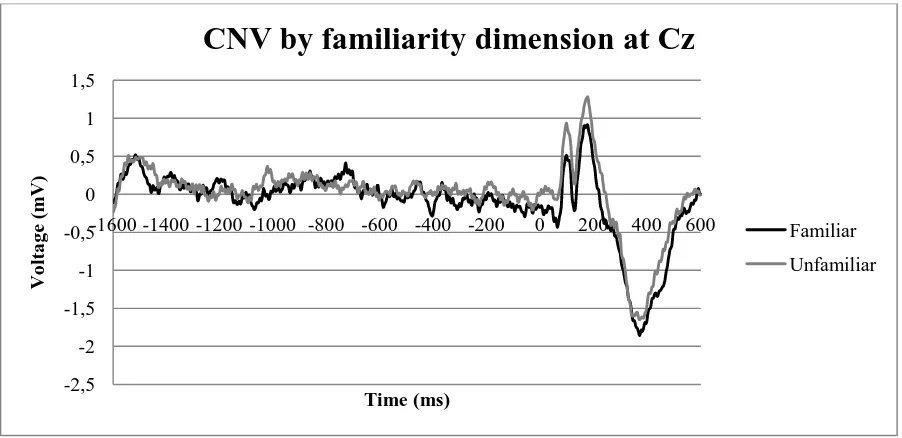
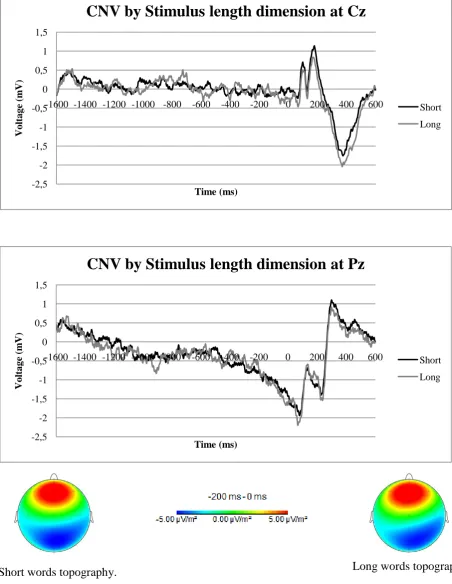
The CNV topography maps of the four conditions as seen in Fig.3 and 4 were based on the
averaged activity during the interval of 200 ms before the go/nogo signal. It particularly
shows negativity at parietal and temporal sites. This can also be seen in the ERP plots of Cz
and Pz shown in Fig. 3 and 4. The CNV is maximal in negativity at Pz while Cz reveals a
hardly any negative tendency. Also, there is no overall distinct divergence between the
dimensions Familiarity and Length for both Cz ad Pz. Further statistical analyses on the
1000-0 ms interval relative to the go/nogo signal confirm this. No significant differences were
found for Familiarity F(1,14)=1.183, p = 0.295 and for Length F(1,14)=0.463, p=0.507, also
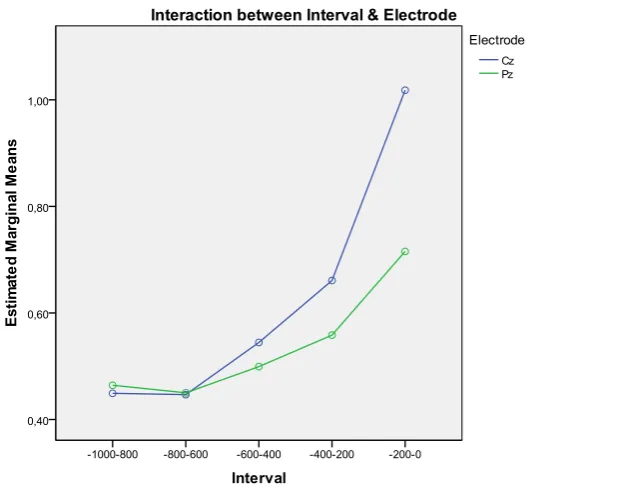
18
found on Interval F(4,56) = 35.297, p <0.001 and a marginal significant effect on Electrode
F(1,14) = 3.455, p = 0.084, indicating a stronger negativity at Pz compared to Cz.
Furthermore, an interaction effect was found on Electrode and Interval F(4,56) = 5.863, p =
0.012 which can be seen in Fig. 5.
Because an interaction effect between Electrode and Interval was found, additional
analysis was performed on the -200-0 interval relative to the go/nogo signal for Pz because
effects were expected to be maximal at this interval and electrode. An effect was found on
Familiarity F(1,14) = 5.009, p = 0.042. On average, activity for the unfamiliar words showed
more negativity. No effect of Length F(1,14) = 1.944, p = 0.185, or interaction F(1,14) =
19
Fig. 3 Top: Two ERP plots of the CNV by task familiarity dimension for the Cz and Pz electrode. Bottom:
Topography maps of the familiar words (left) and unfamiliar words (right), based on averaged values of the last
200 ms interval before the go/nogo signal. -2,5 -2 -1,5 -1 -0,5 0 0,5 1 1,5
-1600 -1400 -1200 -1000 -800 -600 -400 -200 0 200 400 600
Vo lt a g e (m V) Time (ms)
CNV by familiarity dimension at Cz
Familiar Unfamiliar -2,5 -2 -1,5 -1 -0,5 0 0,5 1 1,5
-1600 -1400 -1200 -1000 -800 -600 -400 -200 0 200 400 600
Vo lt a g e (m V) Time (ms)
CNV by familiarity dimension at Pz
Familiar
Unfamiliar
-5.00 µV/m² 0.00 µV/m² 5.00 µV/m²
-200 ms - 0 ms
-5.00 µV/m² 0.00 µV/m² 5.00 µV/m²
-200 ms - 0 ms
[image:19.595.72.523.69.288.2]20 -2,5 -2 -1,5 -1 -0,5 0 0,5 1 1,5
-1600 -1400 -1200 -1000 -800 -600 -400 -200 0 200 400 600
Vo lt a g e (m V) Time (ms)
CNV by Stimulus length dimension at Cz
Short
Long
-5.00 µV/m² 0.00 µV/m² 5.00 µV/m²
-200 ms - 0 ms
-5.00 µV/m² 0.00 µV/m² 5.00 µV/m²
-200 ms - 0 ms
-2,5 -2 -1,5 -1 -0,5 0 0,5 1 1,5
-1600 -1400 -1200 -1000 -800 -600 -400 -200 0 200 400 600
Vo lt a g e (m V) Time (ms)
CNV by Stimulus length dimension at Pz
Short
Long
[image:20.595.72.525.77.662.2]Short words topography. Long words topography.
Fig. 4 Top: Two ERP plots of the CNV by the stimulus length dimension for the Cz and Pz electrode. Bottom:
Topography maps of the short words (left) and long words (right), based on averaged values of the last 200 ms
21
[image:21.595.153.463.103.347.2]22
Discussion
The goal of the present study was to investigate how task complexity influences the cognitive
processes of motor preparation. More specifically, two types of task complexity were looked
into, namely task familiarity and stimulus length. Additionally, the experiment was designed
to reflect a natural, everyday life typewriting task to maximize generalisability of the
measured effects. Participants were asked to perform a variant on a go/nogo DSP task, in
which they had to copy type words displayed on the screen if the go-signal was given. Words
varied from short-Dutch words to Dutch words, short-nonsense words and
long-nonsense words. EEGs were recorded in order to derive the CNV, which was used as a
measure for cognitive processes of motor preparation. In the task familiarity dimension, it was
predicted that the familiar words (represented by the Dutch words), would be executed faster
and compared to the unfamiliar words (represented by the nonsense words). Also, in the
stimulus length dimension, it was predicted that short words would be executed faster
compared to the unfamiliar words. Furthermore, an interaction effect between the dimensions
of task familiarity and stimulus length was predicted. The effect of task familiarity on
execution speed and accuracy was expected to be enhanced for long words compared to short
words. Regarding the cognitive processes of motor preparation, comparable hypotheses were
made. For the task familiarity conditions it was predicted that the amplitude of the CNV
would show increased negative activity for unfamiliar words compared to familiar words. In
the stimulus length condition, the amplitude of the CNV for long words was expected to show
increased negative activity compared to the short words.
As expected, it was found that familiar words were typed faster compared to the unfamiliar
words. This indicates that there was indeed a certain difference in either the cognitive motor
preparation or execution. However, no such effect was found for the words in the stimulus
23
dimension. This is not in line with the findings in previous studies (Schröter & Leuthold,
2009; Verwey, 2001). This unexpected find may be explained because this study relies
heavily on typewriting, a skill which the participants had highly developed. The before
mentioned studies did not. A study with skilled typists (Salthouse, 1986) has shown that IKI’s
for skilled typist are shorter, it may therefore be more difficult to discern the averages from
the short and long word conditions. Moreover, the difference of two letters between the small
and long word conditions may simply be too small to reveal clear effects. The hypothesis on
an interaction effect between the task familiarity and stimulus length dimensions was not
confirmed in the RT results, as well as in the EEG data. Though no interaction was found, we
cannot fully abandon this hypothesis. It may be that such an effect is present, but was not
uncovered in our results. Because no clear effect on the stimulus length dimension was found,
it could be that the interaction effect was also obscured.
The main effect on the task familiarity dimension in the behavioral response data may be
further explained by the EEG data. Indeed, a significant difference in CNV amplitude was
found at the Pz electrode during the 200 ms interval before the go/nogo signal, showing a
stronger negativity for unfamiliar words compared to familiar words. This may indicate that
some form of chunking occurs at the parietal sites. However, no such difference was found at
Cz. In fact, the ERP plots for Cz reveal no outspoken tendency towards the negative at all.
The maximal amplitude does not exceed the -0.5µV mark. These are not the characteristics of
a typical CNV as found in previous studies (van Boxtel & Brunia, 1994; Caldara et al., 2004;
Wild-Wall, Sangals, Sommer, & Leuthold, 2003). It can therefore be argued that no central
CNV was present in this study. This may explain why no difference in amplitude was found
24
The fact that a difference in the task familiarity dimension was found at parietal sites, but
no CNV was recorded at central sites, may not be compatible with the initial hypothesis on
the task familiarity dimension. The initial hypothesis was based on the idea that participants
would be able to use motor chunks (Verwey, 2001) for familiar words and thus decrease the
cognitive load and the CNV amplitude (De Kleine & Van der Lubbe, 2011). This explanation
has pitted motor chunking as a key component in the reduction of cognitive load and thus a
CNV effect was predicted over central motor areas (Jankelowitz & Colebatch, 2002; Leynes
et al., 1998). Because this is not confirmed in the present results and the effect was only found
at parietal sites, the effect may not be solely attributed to motor chunking. The parietal CNV
has been known to reflect more than motor preparation alone (Leuthold & Jentzsch, 2002;
Verleger, Wauschkuhn, R. van der Lubbe, Jaśkowski, & Trillenberg, 2000). Alternative
explanations may therefore be necessary to explain the present findings. In order to shed light
on this question, three possible approaches are given. It should be noted that these
explanations do not necessarily oppose one another, but can be seen as different points of
view.
One possible explanation (1) for the parietal CNV is suggested by Verleger et al. (2000).
The authors propose that the parietal negativity may reflect the binding of stimulus and
response as described by Milner and Goodale (1998). Milner and Goodale elaborated on the
concept of two visual pathways, first introduced by Ungerleider, Mishkin and Macko (1983)
and describes a dorsal and ventral visual pathway. The dorsal pathway is said to be connected
with the question of “where” an object is located in space, or spatial characteristics of the
world around us. The ventral pathway is believed to be associated with the question of “what”
an object is, identifying and assigning semantic significances to the objects in view. So, in
line with this theory, the parietal and temporal negativity found in the present study may be
25
and not motor preparation. The lower CNV amplitude for familiar words may be evidence for
a word chunking effect (Mewhort, 1972; Sakai, Hikosaka, & Nakamura, 2004) or a visual
chunking effect, thus decreasing the load on the working memory (Leuthold, Sommer, &
Ulrich, 2004; McCollough, Machizawa, & Vogel, 2007).
Another explanation (2) may be given by the concept of parieto-frontal connections
(Rizzolatti, Luppino, & Matelli, 1998). The authors suggest that the motor system consists
mainly of a network of connection between parietal cortical structures (superior parietal
lobule, inferior parietal lobule) and frontal areas (motor areas, supplementary motor areas).
Although connections exist between all parietal and frontal areas, some connections are more
predominant compared to other, additional connections. These predominant reciprocal
connections indicate that the involved areas work closely together and can be seen as a single
motor unit. This may explain the parietal distribution of the CNV found in the present study.
If the observed parietal negativity is indeed associated with this parieto-frontal connection,
then this activity may be closely related to motor activity. The main effect on the task
familiarity dimension found in the parietal area may then be interpreted as an early, more
abstract form of motor chunking. It could be interpreted as a precursor of the motor chunking
effect as described by De Kleine & Van der Lubbe (2011).
However, the two before mentioned explanations should be interpreted with caution.
Although both the approach of the two visual pathways (Milner & Goodale, 1998) and the
idea of the parieto-frontal connections (Rizzolatti et al., 1998) explain to some degree the
parietal findings, both approaches still rely on central motor cortex activation to execute the
movement. The absence of the central CNV found in this study is therefore not explained by
26
A third approach may be given to tackle this problem. The distribution of the CNV may
change if the type of the task is altered (Leynes et al., 1998). Because the task in this
experiment consisted of typewriting, a different CNV topography may be expected compared
to classical DSP studies using meaningless sequences. A previous typewriting study also
found a parietal effect and have suggested that parietal areas may also be involved in the
production of movement sequences (Gordon et al., 1998). Furthermore, a functional magnetic
resonance imaging study on skilled piano players also found parietal activation in regions
such as the posterior parietal cortex (Itoh, Fujii, Suzuki, & Nakada, 2001). The results from
the before mentioned studies seem to indicate that the parietal areas are of particular
importance when a task involves highly developed finger motor tasks. It could be that the
parietal areas relieve the central areas by taking over some of the highly trained and
developed motor skills. Although further research on this statement is still necessary, there is
some evidence that the parietal regions are capable of taking over the production of sequential
movement (Pineiro, Pendlebury, Johansen-Berg, & Matthews, 2001). This may explain why
no distinct CNV was found over central sites, but more clearly over parietal sites. The
difference in CNV amplitude that was found in the task familiarity condition can in that case
be attributed to a form of motor chunking because participants would be able to use motor
chunks for familiar words, thus reducing the cognitive load.
The most likely interpretation of the three before mentioned approaches seems to be the
third, which has suggested that the parietal areas may take over some of the more highly
developed finger movements. This explains both the parietal difference in the task familiarity
dimension and the absence of a central CNV.
One of the more exploratory goals was to investigate whether a more natural task
comparable to an everyday life task influences the characteristics of the CNV. It can be
27
used more stripped down tasks. These differences can be due to the fact that the typewriting
task used in this study uses higher cognitive functions compared to the classical DSP task. It
is likely that other meaningful everyday life tasks also use more higher cognitive functions.
The present results are encouraging to further investigate the effects of natural tasks on the
CNV as it may jeopardize the generalizability of studies who use controlled, stripped down
tasks.
While interpreting the results of this study, it should be noted that the study was subjected
to one important limitation. Although all participants had a certain degree in typewriting skill,
there were still differences in typing speed. If cortical activity is indeed altered by the degree
of skill (Pulvermüller et al., 2005) as suggested earlier in this discussion, then the difference
in typewriting skill may have contaminated the averaged EEG values . A suggestion for
further research would be that it is desirable to make a more precise distinction in the degree
of skill of the participants. Also, it should be noted that the stimuli in the typewriting task
were words and thus relied on linguistic cognitive processes. Little is known about the effects
of linguistic components on the CNV, as most recent research on motor tasks employ
visual-spatial stimuli for their experiments. It may therefore be problematic to compare results from
these studies with the results from the present study.
In conclusion can be said that the most interesting findings in this study have been the
absence of a central CNV, but a more pronounced CNV at parietal sites which contained a
main effect on the task familiarity dimension. Although further research is necessary before a
definite explanation can be given for the absence of the central CNV, the parietal effect on the
task familiarity dimension may indicate that the parietal cortex plays an important part in the
production of sequential movement. This means that the concept of motor chunking as
described by De Kleine and Van der Lubbe (2011) may occur even earlier in the cognitive
28
References
Caldara, R., Deiber, M.-P., Andrey, C., Michel, C. M., Thut, G., & Hauert, C.-A. (2004). Actual and mental motor preparation and execution: a spatiotemporal ERP study.
Experimental brain research. 159(3), 389-99.
Cui, R. Q., Egkher, a, Huter, D., Lang, W., Lindinger, G., & Deecke, L. (2000). High resolution spatiotemporal analysis of the contingent negative variation in simple or complex motor tasks and a non-motor task. Clinical neurophysiology : official journal of
the International Federation of Clinical Neurophysiology, 111(10), 1847-1859.
Dirnberger, G., Reumann, M., Endl, W., Lindinger, G., Lang, W., & Rothwell, J. C. (2000). Dissociation of motor preparation from memory and attentional processes using
movement-related cortical potentials. Experimental Brain Research, 135(2), 231-240.
Doyon, J., & Benali, H. (2005). Reorganization and plasticity in the adult brain during learning of motor skills. Current opinion in neurobiology, 15(2), 161-167.
Gerloff, C., Corwell, B., Chen, R., Hallett, M., & Cohen, L. G. (1997). Stimulation over the human supplementary motor area interferes with the organization of future elements in complex motor sequences. Brain : a journal of neurology, 120(9), 1587-602.
Gibson, E. J., Pick, A., Osser, H., & Hammond, M. (1962). The role of grapheme-phoneme correspondence in the perception of words. The American Journal of Psychology, 75(4), 554–570.
Gordon, a M., Lee, J. H., Flament, D., Ugurbil, K., & Ebner, T. J. (1998). Functional magnetic resonance imaging of motor, sensory, and posterior parietal cortical areas during performance of sequential typing movements. Experimental brain research. 121(2), 153-166.
Gratton, G., Coles, M. G. H., & Donchin, E. (1983). Nouvelle méthode d’élimination off-line des artéfacts oculaires. Electroencephalography and Clinical Neurophysiology, 55(4), 468-484.
Gómez, C. M., Flores, A., & Ledesma, A. (2007). Fronto-parietal networks activation during the contingent negative variation period. Brain research bulletin, 73(1-3), 40-7.
Hauk, O., Johnsrude, I., & Pulvermüller, F. (2004). Somatotopic representation of action words in human motor and premotor cortex. Neuron, 41(2), 301-7.
Itoh, K., Fujii, Y., Suzuki, K., & Nakada, T. (2001). Asymmetry of parietal lobe activation during piano performance: a high field functional magnetic resonance imaging study.
Neuroscience letters, 309(1), 41-4.
29
Jenkins, I. H., Brooks, D. J., Frackowiak, R. S. J., & Passingham, F. E. (1994). Motor Sequence Tomography Learning : A Study with Positron. Learning, 14(6), 3775-3790.
De Kleine, E., & Van der Lubbe, R. H. J. (2011). Decreased load on general motor preparation and visual-working memory while preparing familiar as compared to unfamiliar movement sequences. Brain and cognition, 75(2), 126-134.
Koch, I. (2007). Anticipatory response control in motor sequence learning: evidence from stimulus-response compatibility. Human movement science, 26(2), 257-274.
de Lange, F. P., Hagoort, P., & Toni, I. (2005). Neural topography and content of movement representations. Journal of cognitive neuroscience, 17(1), 97-112.
Leuthold, H., & Jentzsch, I. (2002). Spatiotemporal source localisation reveals involvement of medial premotor areas in movement reprogramming. Experimental brain research,
144(2), 178-188.
Leuthold, H., & Schröter, H. (2011). Motor programming of finger sequences of different complexity. Biological psychology, 86(1), 57-64.
Leuthold, H., Sommer, W., & Ulrich, R. (2004). Preparing for Action: Inferences from CNV and LRP. Journal of Psychophysiology, 18(2-3), 77-88.
Leynes, P. a, Allen, J. D., & Marsh, R. L. (1998). Topographic differences in CNV amplitude reflect different preparatory processes. International journal of psychophysiology :
official journal of the International Organization of Psychophysiology, 31(1), 33-44.
Liang, H.-W., Hwang, Y.-H., & Chang, F.-H. (2008). Temporal change in bimanual
interkeypress intervals and self-reported symptoms during continuous typing. Journal of occupational rehabilitation, 18(4), 319-325.
McCollough, A. W., Machizawa, M. G., & Vogel, E. K. (2007). Electrophysiological
Measures of Maintaining Representations in Visual Working Memory. Cortex, 43(1), 77-83
Mewhort, D. J. (1972). Scanning chunking, and the familiarity effect in tachistoscopic recognition. Journal of experimental psychology, 93(1), 69-71.
Milner, A. D., & Goodale, M. A. (1998). The Visual Brain in Action. Brain (Oxford Psy., pp. 4-11). Ontario: Oxford University Press.
Mishkin, M., Ungerleider, L. G., & Macko, K. a. (1983). Object vision and spatial vision: two cortical pathways. Trends in Neurosciences, 6, 414-417.
Nattkemper, D., & Ziessler, M. (2004). Cognitive control of action: the role of action effects.
Psychological research, 68(2-3), 71-73.
30
local adaptive reorganization? Stroke; a journal of cerebral circulation, 32(5), 1134-1139.
Pulvermüller, F., Hauk, O., Nikulin, V. V., & Ilmoniemi, R. J. (2005). Functional links between motor and language systems. The European journal of neuroscience, 21(3), 793-807.
Rizzolatti, G., Luppino, G., & Matelli, M. (1998). The organization of the cortical motor system: new concepts. Electroencephalography and clinical neurophysiology, 106(4), 283-296.
Sakai, K., Hikosaka, O., & Nakamura, K. (2004). Emergence of rhythm during motor learning.
Trends in cognitive sciences, 8(12), 547-553.
Salthouse, T. a. (1986). Perceptual, cognitive, and motoric aspects of transcription typing.
Psychological bulletin, 99(3), 303-319.
Schröter, H., & Leuthold, H. (2009). Motor programming of rapid finger sequences:
inferences from movement-related brain potentials. Psychophysiology, 46(2), 388-401.
Van Boxtel, G. J., & Brunia, C. H. (1994). Motor and non-motor aspects of slow brain potentials. Biological psychology, 38(1), 37-51.
Verleger, R., Wauschkuhn, B., van der Lubbe, R., Jaśkowski, P., & Trillenberg, P. (2000). Posterior and Anterior Contribution of Hand-Movement Preparation to Late CNV.
Journal of Psychophysiology, 14(2), 69-86.
Verwey, W. B. (2001). Concatenating familiar movement sequences: the versatile cognitive processor. Acta psychologica, 106(1-2), 69-95.
Wiggs, C. L., & Martin, a. (1994). Aging and feature-specific priming of familiar and novel stimuli. Psychology and aging, 9(4), 578-588.
Wild-Wall, N., Sangals, J., Sommer, W., & Leuthold, H. (2003). Are fingers special? Evidence about movement preparation from event-related brain potentials.