J. exp. Biol. 130, 275-293 (1987) 2 7 5 Printed in Great Britain © The Company of Biologists Limited 1987
BODY ACCELERATIONS DURING THE WINGBEAT IN SIX
BAT SPECIES: THE FUNCTION OF THE UPSTROKE IN
THRUST GENERATION
BY H. D. J. N. ALDRIDGE*
Department of Zoology, University of Bristol, Woodland Road, Bristol, BS8 1UG, UK
Accepted 25 March 1987
SUMMARY
The kinematics and aerodynamics of Rhinolophus ferrumequinum, R. hippos-ideros, Mvotis nattereri, M. mystacinus, Plecotus auritus and Eptesicus serotinus in horizontal flight at various flight speeds are described. Three kinematic patterns can be recognized. At low speeds M. nattereri, M. mystacinus and P. auritus use a 'tip-reversal' upstroke in which thrust is generated during the backward 'flick' of the chiropatagium. R. hipposideros also uses this kinematic pattern, but does not appear to generate thrust during the upstroke. Both R. ferrumequinum flying at 3-12ms~' and E. serotinus flying at 3-44ms~' accelerate during the 'vertical' upstroke (in which the wings move perpendicularly to the flight path), indicating that their wings are active. When flying at 4-16 ms~', E. serotinus also uses a 'vertical' upstroke, but in this case it decelerates, which suggests that thrust is not being generated. At minimum power speed (4-8ms"1), R.ferrumequinum uses a 'reduced-span' upstroke, thrust is not generated during the upstroke and the animal decelerates.
INTRODUCTION
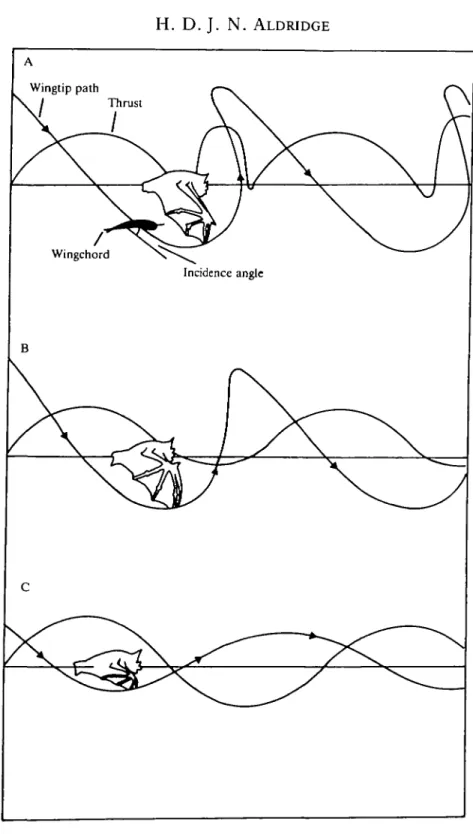
Flying animals flap their wings in order to generate thrust while maintaining weight support, and by altering the configuration of the wings during the upstroke they ensure net positive thrust. As the flight speed of the greater horseshoe bat, Rhinolophus ferrumequinum, increases, there is a gradual change in the way in which it moves its wings during the upstroke (Aldridge, 1986). At low speeds it uses a tip-reversal upstroke, in which the chiropatagium is accelerated backwards and upwards (Fig. 1A). This upstroke has also been described in the pigeon, Columba livia (Brown, 1948), and in a number of bat species (Eisentraut, 1936; Norberg, 1976; Altenbach, 1979; Aldridge, 1986). Several authors have suggested that the backward and upward flick of the wing at the end of the upstroke generates thrust, but Rayner (1987) thinks this unlikely since large transverse vortices are likely to be developed
•Present address: Department of Pure and Applied Zoology, University of Leeds, Leeds, LS2 9JT.
Wingtip path
Wingchord
Incidence angle
Upstroke function in bats 211
and induced drag increased. The hypothesis that the wings are unloaded during the upstroke in the slow forward flight of birds and bats is supported by the results of Kokshaysky (1979), Spedding, Rayner & Pennycuick (1984), Rayner, Jones & Thomas (1986) and Spedding (1986). The wake in these animals takes the form of small-cored vortex rings shed at the end of the downstroke. It is, however, possible that even if small air movements were generated during the upstroke these might be obscured by the larger air movements generated during the downstroke (Rayner etal. 1986).
At 3-12ms~', R. ferrumequinum moves its wings vertically (perpendicular to the flight path) during the upstroke, the so-called vertical upstroke (Aldridge, 1986; Fig. IB). Incidence angles tend to be low, suggesting that no lift is being generated (Aldridge, 1986). At minimum power speed (Vmp), R.ferrumequinum, uses a reduced-span upstroke, which has been shown to generate weight support and negative thrust (Spedding, 1987; Rayner et al. 1986). The bat ensures net positive thrust by reducing its effective wing span during the upstroke, thereby reducing the magnitude of upstroke lift (Rayner, 1986; Aldridge, 1986).
Possible independent measures of upstroke function are the accelerations and decelerations of the bat during the wingbeat. The lift generated by a wing is dependent upon the speed at which it moves through the air; therefore, when the wing decelerates at the end of the downstroke, the magnitude of lift (and therefore thrust) will fall and the bat will decelerate. Each wingbeat should, therefore, be characterized by accelerations and decelerations following the accelerations and decelerations of the wings. If the wings are unloaded during the upstroke then this deceleration should continue until the beginning of the downstroke. Alternatively, if the upstroke generates thrust the upstroke deceleration should either be absent or be replaced by an acceleration. I predict therefore that during the tip-reversal upstroke, the bats will accelerate or maintain a constant speed, while during the vertical and reduced-span upstrokes they will decelerate. This deceleration should be higher during the reduced-span upstroke due to the generation of negative thrust. The presence of accelerations and/or decelerations during the upstroke does not, however, unequivocally indicate that thrust is or is not being generated, because the effects of wing inertia and gravity may also be important.
downwards. This effect is likely to be most noticeable at low speeds when strokeplane angles tend to be small. If this horizontal force is large, then the accelerations of the body caused by it should be detectable.
The aim of this study was to measure the changes in body speed during the wingbeat for bats using all three of the kinematic patterns described above (Fig. 1) and, after accounting for the accelerations due to wing inertia and gravity, to test the hypotheses that (1) the tip-reversal upstroke generates thrust, (2) the vertical upstroke is inactive and (3) the reduced-span upstroke is active, generating weight support and negative thrust.
MATERIALS AND METHODS
Husbandry
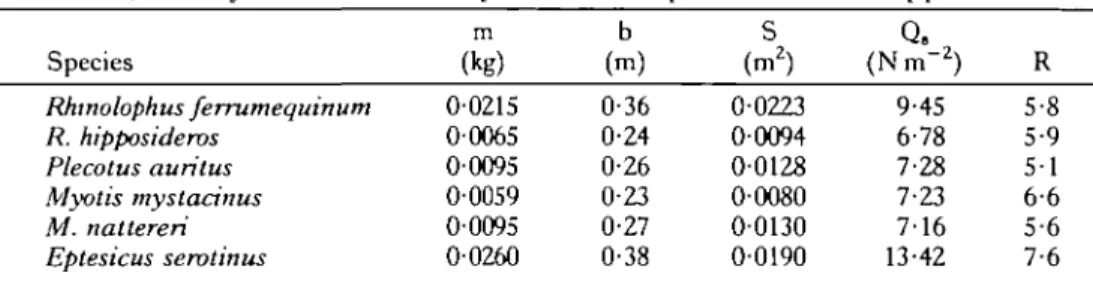
Six microchiropteran bat species were used in this study, Rhinolophus ferrum-equinum (Schreber), R. hipposideros (Bechstein), Plecotus auritus (L.), Myotis mystacinus (Kuhl), M. naitereri (Kuhl) and Eptesicus serotinus Schreber (Table 1). The bats were housed in plywood boxes similar in design to those described by Racey (1976) and Aldridge (1986). Food consisted primarily of the larvae of Tenebrio molitor (plus a vitamin supplement). Water was available ad libitum in Petri dishes placed in the boxes. The bats were fed by hand every day during their training sessions, during which they were allowed to fly unimpeded about the experiment room for up to 4h. The basic training schedule has already been described for R. ferrumequinum (Aldridge, 1986), and the same methods were used for the other species.
Photography
The bats were photographed as they flew through a flight tunnel, illuminated by a stroboscope (Rayner & Aldridge, 1985; Aldridge, 1986). Two stroboscope flashing
Table 1. Morphological parameters for Plecotus auritus, Eptesicus serotinus, Myotis nattereri, M. mystacinus, Rhinolophus ferrumequinum and R. hipposideros
m b S Q.
Species (kg) (m) (m2) (Nm~2) R
Rhinolophus ferrumequinum 00215 0 3 6 0-0223 9-45 5-8 R. hipposideros
Plecotus auritus Myotis mystacinus M. nalleren Eptesicus serotinus
m, body mass; b, wing span; S, wing area; Q,, wing loading; R, aspect ratio.
Upstroke function in bats 279
frequencies were used; 100Hz and 200Hz. For each flight, two photographs were obtained showing dorsal and lateral views of the bat as it flew through the cage. Only those photographs in which the upstroke occurred at the middle of the recorded time sequence were used for further analysis.
Analysis
The method of analysis has been described in detail elsewhere (Rayner & Aldridge, 1985; Aldridge, 1986), suffice it to say that from these photographs the positions of the bat and various parts of it (e.g. wrist and wingtip) were calculated in three dimensions at regular time intervals. These data were then used to calculate the velocities and accelerations of the body (denned by a point midway between the humeral joints horizontally and in the middle of the thorax vertically), the wrist, the wingtip and the tips of the second, fourth and fifth digits. From these data, I estimated the angles made by wingchords with the horizontal (a vvingchord is defined as a straight line drawn between the leading and trailing edges of an aerofoil). The angle of incidence of a wingchord is defined as the angle between the wingchord and the resultant airflow (Fig. 1). I calculated angles of incidence by determining the local velocity vectors of the two ends of the wingchord and finding the angle between the chord and the resultant of a line parallel to these velocities and induced velocity. Induced velocity was estimated using Pennycuick's (1975) equation.
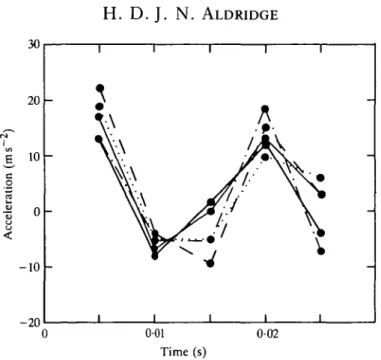
Accuracy and errors
10
-Fig. 2. Change in the acceleration of the centre of mass of Rhinolophus ferrumequinum over a 0025 s time interval calculated from five separate estimates of the animal's position.
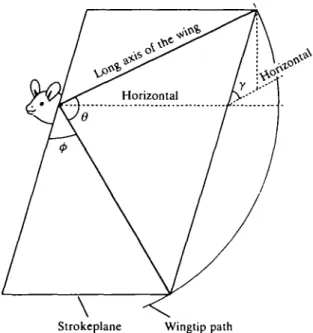
Accelerations due to inertial and gravitational forces The angular velocity of a wing during a wingbeat is,
d 0 / d t , (1)
where (p is the positional angle (Fig. 3). The wing's angular acceleration is, therefore,
d2<£/dt2. (2)
The acceleration of the wing's centre of mass is, therefore,
aw = r(d2tf>/dt2), (3)
where r is the distance of the centre of mass from the humeral joint. I assumed that r was 1/6 wing length. The total force acting at the centre of mass is,
W ^ " ^ W (4)
where mw is the mass of the wing. I did not measure the masses of the wings of the bats in this study, but measurements of individuals of six other microchiropteran species (Myotis lucifugus, Eptesicus fuscus, Antrozous pallidus, Megaderma lyra and Macrotus californicus) showed that there was a significant positive correlation ( r = 0-96, P < 0-0 1 ) between total wing area and wing mass,
Upstroke function in bats
281
where S is wing area, and I used this to estimate wing mass. The horizontal component of Fw is,
Fwh = Fwcosy, (6)
where y is strokeplane angle. Therefore the total horizontal force experienced by the bat due to the acceleration of the wings is,
Fbh = 2(Fwcosy). (7)
The horizontal acceleration experienced by the bat is therefore,
abh = 2(Fwcosy)/mb, (8)
where mb is the bat's total body mass.
If the animal is climbing or descending, gravity will have a horizontal component defined by:
gh = #cos(90 + a-), (9)
where aris the angle between the horizontal and the animal's flight path, and g is the acceleration due to gravity.
Some of the flights of R. ferrumequinum which I used in a previous paper (Aldridge, 1986) were used again in this study. The slow horizontal flight of P. auritus was described in detail by Norberg (1976), while the flights of E. serotinus, R. hipposideros, M. mystacinus and M. nattereri are described here for the first time.
Strokeplane Wingtip path
RESULTS
The tip-reversal upstroke: the slow forward flight of P. auritus, M. nattereri, M. mystacinus and R. hipposideros
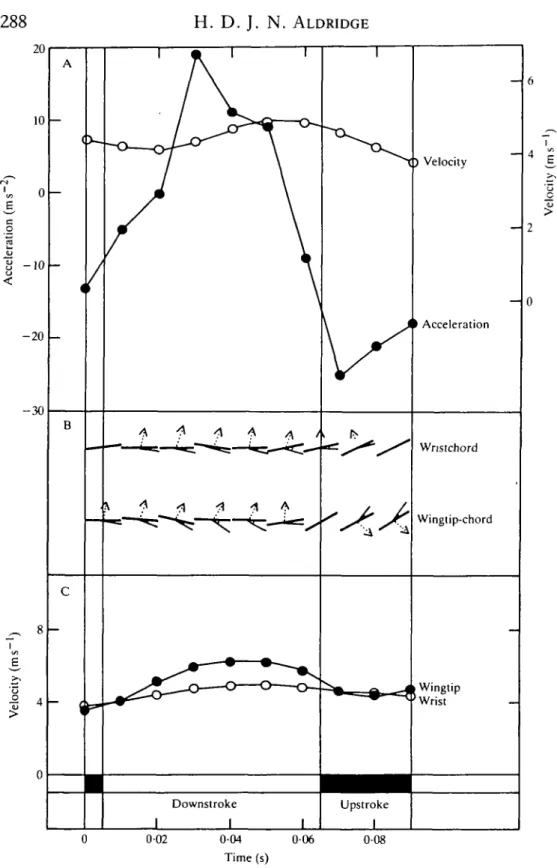
I examined four flights for P. auritus, two flights each for M. mystacinus and R. hipposideros and one flight for M. nattereri (Table 2). Kinematically these flights were similar (Table 2; Figs 4, 5, 6), but two patterns of body acceleration were recorded. The first pattern was recorded in two of the four flights of P. auritus and the flights of R. hipposideros. The bats decelerate during the upstroke and accelerate during the downstroke, suggesting that thrust is being generated during the downstroke, but not during the upstroke. In both bats, incidence angles during the upstroke are positive and therefore if lift is being generated it will be directed backwards and upwards. In both cases, the wings decelerate during the upstroke, suggesting that they are unloaded. The absence of upstroke thrust in R. hipposideros may be the explanation for the bats' overall deceleration and loss of height (Fig. 5).
The remaining flights of P. auritus and the flights of M. mystacinus and M. nattereri were characterized either by an increase in the acceleration of the body during the upstroke, or by the maintenance of the acceleration observed during the downstroke (Figs 4, 6). In P. auritus, the body's acceleration is associated with an acceleration of the wing backwards and upwards during the upstroke, at the end of which the wingchords are perpendicular to the flight path. Two upstrokes are illustrated in Fig. 4. In the first of these, the backward flick of the wing results in incidence angles approaching 90°: the bat is generating propulsion by means of a forward-directed drag force. In the second upstroke smaller negative incidence angles are produced, and thrust is probably generated as a consequence of the generation of a negative upstroke circulation.
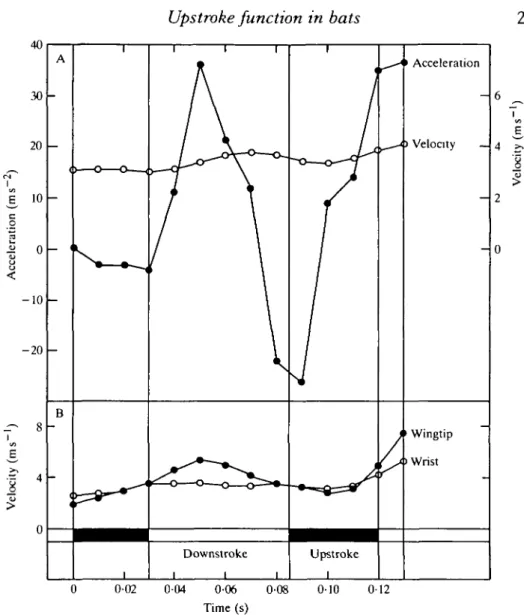
The vertical upstroke: the flight ofR. ferrumequinum and E. serotinus I examined seven flights of R. ferrumequinum and three of E. serotinus, in which the vertical upstroke was used (Table 2; Figs 7, 8, 9). The wingbeat kinematics of these bats is similar to those already described, except that there is a decrease in the backward movement of the wing during the upstroke and an increase in strokeplane angles. In both species and all flights, the downstroke is initiated by an acceleration of the wing, an increase in incidence angles and a deceleration of the body. Assuming that the wing is acting in a quasi-steady fashion, weight support and thrust are generated during the downstroke, and as the wings' speed increases there is an increase in thrust production and the bats accelerate (Figs 7, 8, 9). This acceleration reaches a maximum at the middle of the downstroke as the wing reaches maximum velocity and thrust reaches a maximum. As the wing decelerates towards the end of
Upstroke function in bats
Upstroke Downstroke
I I 1 I
0.02 04!4 0.M 0.08 Time (s)
2.15 ms-I 1.97ms-I '
2.15ms-I
2.15ms-I Wristchord
Wingtip-chord
1.97msC1 Wristchord
Wingtip-chord
Table 2. Kinematic parameters for representative flights of Rhinolophus ferrumequinum, Plecotus auritus, Myotis nattereri, M. mystacinus and Eptesicus serotinus and the nature of the change in body horizontal velocity for each flight
Upstroke type
Tip-reversal
P. auritus
Deceleration (Fig. 4) Deceleration (Fig. 4) Acceleration (Fig. 4) Acceleration (Fig. 4)
R. hipposideros
Deceleration (Fig. 5) Deceleration (Fig. 5)
M. nallereri
Acceleration (Fig. 6)
M. mystacinus
Acceleration (Fig. 6) Acceleration (Fig. 6) Vertical
R. ferrumequinum
Acceleration (Fig. 7) (from Aldridge, 1986) Acceleration Acceleration Acceleration Acceleration Acceleration Acceleration E. serotinus
Deceleration (Fig. 8) Acceleration (Fig. 9) Acceleration (Fig. 9) Reduced-span
R. ferrumequinum
Deceleration (Fig. 10) (from Aldridge, 1986)
Speed (ms-1)
2-15 2-03 1-97 211 2-65 2-58 1-81 1-57 1-83 3-12 312 3-85 3-52 4-00 3-55 3-48
4 1 6 3-44 3-90 4-84 Frequency (Hz) 14-28 14-28 14-28 14-28 16-67 16-67 11-81 14-28 14-29 1111 1111 12-50 1111 1111 12-50 12-50 8-33 12-50 910
9 0 9
Amplitude (degrees) 50-0 50-3 57-0 62-1 59-5 51-9 42-7
4 0 1 74-8
65-8
50-1 9 8 0 59-0 71-6 58-0 76-0 51-0 41-2 86-3 64-0 Strokeplane angle Wrist (degrees) 78-0 73-0 8 1 0 73-7 74-0 79-0 63-0 77-0 89-0 89-0
8 1 0 8 9 0 70-0 90-0 86-0 83-0 90-0 90-0 88-0
9 0 0
Wingtip (degrees)
70-0 6 9 0 6 1 0 65-0 61-0 70-0 490 72-0 79-0 65-0 660 83-0 66-5 80-0 82-0 78-0 76-0 81-6 77-0 850
20
10
I 0
- 1 0
Upstroke function in bats
T
rv
Wingtip ) Wnst
Acceleration
Wnstchord
Wingtip-chord
0-02 0-04 0-06
Time (s)
285
10
6 «
4 1
T
002 004 006
Time (s)
0-08
Upstroke function in bats
0-02 004 006
Time (s)
008 010
287
4
20
10
- 1 0
- 2 0
- 3 0
2
Wingtip Wrist
Acceleration
Wristchord
Wingtip-chord
Upstroke function in bats
289
Fig. 9. Kinematics and aerodynamics of Eptesicus semtinus in flight at 4-16ms '. (A) The velocity and acceleration of the body centre of mass and (B) wingtip and wrist speed changes during a wingbeat.
the second upstroke, however, the bat accelerates suggesting thrust generation, possibly associated with the acceleration of the wing (Fig. 8).
10 ms 2, and this continues for 20 ms. Towards the end of the upstroke, the wing accelerates and a small thrust may be produced, and cause a small upstroke acceleration.
DISCUSSION
The results seem to support the three hypotheses I postulated in the Introduction. In some flights in which the tip-reversal upstroke is used, a body acceleration occurs
0 002 004 006 008 010
>
Upstroke function in bats 291
during the upstroke, suggesting thrust generation. In P. auritus I recorded two upstrokes; during the first of these, thrust is generated as a consequence of a forward-directed drag force (Altenbach, 1979), while in the second the wings are acting more conventionally, thrust being generated in a manner similar to that described for this species by Norberg (1976). In her study, Norberg (1976) showed that most of the required thrust was generated during the upstroke, while weight support was produced during the downstroke. The pattern of body accelerations observed in P. auritus, M. mystacinus and M. nattereri suggests a similar pattern of lift generation. The wake in this wing stroke should take the form of a series of linked vortex rings of opposite circulation in the up- and downstrokes. This kinematic pattern, or 'gait', is similar to that postulated by Alexander (1986) for hovering hummingbirds and represents a possible intermediate stage between hovering and slow forward flight using an unloaded upstroke. This conclusion does not, however, agree with the findings of Rayner et al. (1986), who found that the wake of slow-flying P. auritus (and N. noctula) consists of discrete vortex rings similar to those described in the pigeon, Columba livia (Spedding et al. 1984), and the jackdaw, Corvus monedula (Spedding, 1986), which indicates that the upstroke is unloaded. There are two possible explanations for this discrepancy. First, it is possible that the flight of P. auritus reported by Rayner et al. (1986) was similar to the first flight of P. auritus and the flights of R. hipposideros, in which the wings are unloaded during the upstroke. Alternatively, as pointed out by Rayner et al. (1986), the circulation generated during the upstroke will be relatively weak and might be obscured by the more dominant vortices produced during the downstroke. It is significant that as P. auritus increases its flight speed from l-97ms~1 to 2-15ms~', the upstroke apparently becomes unloaded. Presumably the wake in this case takes the form of discrete vortex rings as described by Rayner et al. (1986).
The development of a negative circulation is only possible if the wing is accelerated backwards during the upstroke. Increases in forward velocity make this more difficult, incidence angles become positive and therefore the upstroke generates weight support and negative thrust, even though the animal's kinematics remain the same. Further increases in speed will increase the magnitude of this negative thrust up to a speed at which it exceeds the thrust generated during the downstroke. By reducing upstroke wing velocity, eliminating the backward flick and/or reducing incidence angles, the bat ensures that the wings are unloaded when this speed is reached.
would take the form of a series of discrete circular vortices shed at the end of the downstroke. The flight of R. ferrumequinum and that of E. serotinus at J ^ m s '1 would appear to be intermediate between the tip-reversal upstroke with negative circulation and the vertical upstroke with no circulation. The wake is probably similar to that described above for the active tip-reversal upstroke, except that the air movements generated during the upstroke are much smaller. At this stage it appears that the downward force generated during the upstroke is balanced by weight support generated during the downstroke. It is significant that as the flight speed of E. serotinus increases from 3-44ras"' to 4-16ms"1 the upstroke becomes inactive. As flight speed increases, it is probable that this downward force plus the animal's weight exceed the upward force generated during the downstroke and the upstroke has to become inactive.
At minimum power speed R. ferrumequinum uses a reduced-span upstroke similar to that described for birds in cruising flight (Brown, 1952; Scholey, 1983; Spedding, 1987) and bats (Rayner et al. 1986; Aldridge, 1986). This wingbeat is characterized by a vertical strokeplane, up- and downstrokes of equal duration, and small changes in incidence. As noted in the kestrel, Falco tinnunculus (Spedding, 1987), the large accelerations and decelerations associated with the wingbeat at lower flight speeds are absent and, thus, it is likely that lift is generated throughout the stroke. Because of wing supination during the upstroke, lift is directed backwards and upwards, although my results suggest that the negative thrust generated is relatively small. The bat ensures that net thrust is positive by reducing its effective wingspan and the magnitude of upstroke lift. The advantages of lift generation in the upstroke in this gait are quite clear; by generating weight support throughout the stroke the animal may reduce wing angular velocity and therefore power output. Also, upstroke lift will tend to raise the wing during the upstroke thus further reducing the need for muscular work (Aldridge, 1986). More importantly perhaps, by keeping the sense of the circulation constant the bat eliminates transverse vortices and reduces induced drag (Rayner, 1986).
Rayner (1986) has suggested four distinct gaits for flying animals of which three appear to apply to most birds and bats.
(1) Rigid wing flapping with negative upstroke circulation, generating thrust. This gait has been demonstrated in the bats, P. auritus and R. ferrumequinum (Norberg, 1976; Aldridge, 1986). The wake of this gait probably takes the form of linked vortices of opposite sense. An extreme form of this gait is thought to be used by hovering animals (Alexander, 1986).
(2) Wing flapping with little or no upstroke circulation. The wake is a series of separate vortex rings shed during the downstroke, and there is no upstroke lift generation (Kokshaysky, 1979; Spedding et al. 1984; Rayner et al. 1986).
(3) Wing flapping with constant circulation, net positive thrust being ensured by flexed, swept wings or unloaded wingtips. The wake takes the form of a pair of distorted trailing vortices (Rayner et al. 1986; Spedding, 1987).
Upstroke function in bats 293
patterns may exist between them, confirming the idea of a gradual change in upstroke function with increasing flight speed (Rayner, 1986; Aldridge, 1986; Scholey, 1983).
I am grateful to the following people for their help during the course of this work: Dr C. J. Pennycuick, Dr R. E. Stebbings and particularly Dr J. M. V. Rayner, without whose help the analysis could not have been done. Drs U. M. Norberg, R. A. Norberg and C. J. Pennycuick read the manuscript and I am grateful for their helpful comments. The author was a Natural Environment Research Council postgraduate student.
REFERENCES
ALDRIDGE, H. D. J. N. (1986). Kinematics and aerodynamics of the greater horseshoe bat,
Rhinolophus ferrumequinum, in horizontal flight at various flight speeds. J. exp. Biol. 126,
479-497.
ALEXANDER, R. M C N . (1986). Three kinds of flying in animals. Nature, Land. 321, 113-114. ALTENBACH, J. S. (1979). Locomotor morphology of the vampire bat, Desmodus rotundus. Spec.
Publs. Am. Soc. Mammal. 6, 1-75.
BROWN, R. H. J. (1948). The flight of birds. J. exp. Biol. 25, 322-333.
BROWN, R. H. J. (1952). The flight of birds. II. Wing function in relation to flight speed. J . exp.
Biol. 30, 90-103.
EISENTRAUT, M. (1936). Beitrag zur Mechanik des Fledermausfluges. Z. wiss. Zool. 24, 95-104. KOKSHAYSKY, N. V. (1979). Tracing the wake of a flying bird. Nature, Land. ZT), 146-148. LANCZOS, C. (1957). Applied Analysis. London: Isaac Pitman & Sons.
NORBERG, U. M. (1976). Aerodynamics, kinematics and energetics of horizontal flight in the long-eared bat Plecotus auritus.J. exp. Biol. 65, 179-212.
PENNYCUICK, C. J. (1975). Mechanics of flight. inAvian Biology, vol. 5 (ed. D. S. Farner, J. R. King & K. C. Parkes). London: Academic Press.
RACEY, P. A. (1976). Bats. In UFAW Handbook on the Care and Management of Laboratory
Animals, 5th edn. Edinburgh: Churchill Livingstone.
RAYNER, J. M. V. (1986). Vertebrate flapping flight mechanics and aerodynamics and the evolution of flight in bats. In Biona Report, 5, Fledermausflug (ed. W. Nachtigall). Heidelberg: Gustav Fischer-Verlag.
RAYNER, J. M. V. (1987). The mechanics of flapping flight in bats. In Recent Advances in the
Study of Bats (ed. M. B. Fenton, P. A. Racey & J. M. V. Rayner). Cambridge: Cambridge
University Press (in press).
RAYNER, J. M. V. & ALDRIDGE, H. D. J. N. (1985). Three-dimensional reconstruction of animal flight paths and the turning flight of microchiropteran bats. J. exp. Biol. 118, 247-265. RAYNER, J. M. V., JONES, G. & THOMAS, A. (1986). Vortex flow visualizations reveal change in
upstroke function with flight speed in bats. Nature, Land. 321, 113-114.
SCHOLEY, K. D. (1983). Developments in vertebrate flight: climbing and gliding of mammals and reptiles, and the flapping flight of birds. Ph.D. thesis, University of Bristol.
SPEDDING, G. R. (1986). The wake of a jackdaw (Corvus moneduld) in slow flight. J . exp. Biol.
125, 287-307.
SPEDDING, G. R. (1987). The wake of a kestrel (Falco tinnunculus) in flapping flight. J . exp. Biol.
127, 59-78.