1
What makes a difference in family therapy? Exploring
the links between theory and practice using qualitative
interviews and interpersonal process recall.
HARRIET SMITH
AUGUST 2015
Thesis submitted in partial completion of the requirements of the award
of Professional Doctorate in Counselling Psychology
Department of Psychology
2
Contents
Page No.
Acknowledgements
3
Research Paper
4
Abstract
24
Literature review
26
Methodology
52
Design and rationale
52-62
Method
62-72
Reflexivity
72
Analysis
75
Discussion
98
Implications for counselling psychology
114
Strengths and Limitations of the research
116
Suggestions for further research
117
Conclusions
118
References
119
3
ACKNOWLEDGEMENTS
I would like to thank Avon and Wiltshire Mental Health Partnership (AWP) and the Nelson Trust who allowed me to advertise my study to participant pools and (in the case of AWP) to put fliers for my study in their family therapy services.
I would also like to thank my research supervisors Naomi Moller, Chris Pawson and Christine Ramsey-Wade for their support and encouragement. You have challenged and motivated me as well as being generous with your time and unfailingly
supportive- it has been much appreciated.
My thanks also goes to all the participants in this study who gave so generously of their time. I am grateful for their involvement and for being so thoughtful and honest in sharing their opinions.
4
RESEARCH PAPER
The following paper is intended for submission in the Journal of Marital and Family Therapy. The journal publishes articles on research, theory, clinical practice and training. It was chosen because it is committed to moving the field of family and martial therapy forward through disseminating the best in family therapy research, theory and practice. It was also targeted because it has the largest circulation of any family therapy journal in the world.
5
6 Abstract
This article describes how Interpersonal Process Recall (IPR), a qualitative process-orientated methodology, can be applied to change process research in family
therapy. To date, this approach has mostly been used to study individual therapies. The paper examines the theoretical evidence base and rationale for this approach and demonstrates the process of using IPR with families, using a case example. Methodological and conceptual issues are also addressed, and opportunities for further research are discussed.
Introduction
In the last 40 years, family therapy research has generated substantial evidence that supports the efficacy of systemic treatment approaches for a wide range of problems (Carr, 2014a, 2014b). However, in recent reviews family therapy researchers have called for a greater focus on change process research (Heatherington, Friedlander, & Greenberg, 2005; Sexton & Datchi, 2014). Change process research examines particular processes in therapy and attempts to link them to theories of change (Heatherington et al., 2005; Llewelyn & Hardy, 2001). It attempts to uncover what is significant, for whom and when, in order to examine how change occurs. Change process research is increasingly recognised as essential for several reasons. It helps us understand what works for whom and in which setting, so that we can match clients to interventions and programmes (Kazdin, 2009). It helps bridge the gap between academic researchers and practitioners, in that an understanding of the detail of change processes allows clinicians to improve or modify therapy models and determine core competencies (Dattilio, Piercy, & Davis, 2014; Sexton & Datchi, 2014). It also strengthens the overall evidence base for psychotherapy, because without a plausible explanation that links cause and effect, the case for therapy is reduced (Kazdin, 2009).
7
is there limited research into the change process in family therapy, but what research there is focuses on manualised, empirically supported treatments for specific
presenting problems (Sexton & Datchi, 2014). For example; Multisystemic Therapy (Deković, Asscher, Manders, Prins, & van der Laan, 2012; Schoenwald, Carter, Chapman, & Sheidow, 2008), Functional Family Therapy (Sexton, 2011) and Emotionally Focused Therapy (Greenberg, Ford, Alden, & Johnson, 1993; McRae, Dalgleish, Johnson, Burgess-Moser, & Killian, 2014; Stavrianopoulos, Faller, & Furrow, 2014). However, in real-world family therapy practice there is a move towards integration and using skills and techniques in a flexible manner (Dickerson, 2010; Lebow, 2013). This would suggest that the current limited literature on change process research does not reflect family therapy as practised on the ground.
One suggested reason given for the lack of focus on change process research in family therapy is the difficulty of studying complex and multifactorial processes (Sexton, Kinser, & Hanes, 2008). A proposed solution to this problem is that family therapy researchers have access to a range of appropriate methodological
approaches (Sexton et al., 2008). This article presents an adapted version of Interpersonal Process Research (IPR) (Larsen, Flesaker, & Stege, 2008). IPR is a methodological approach which has considerable potential to provide finely grained descriptions of change process in family therapy. As such, IPR is a valuable tool for family therapy researchers interested in investigating how change occurs. The methodology will be described in detail using a case example from the authors’ own research. The relative advantages and disadvantages will also be examined. Prior to this, a brief review of family therapy change process research and a history of IPR is presented.
Change process research
In a recent review, Sexton et al (2014) highlighted how little of the family therapy research literature focused on researching change processes. This is despite a previous review by Heatherington et al (2005) which explicitly challenged
researchers in the field of family therapy to move beyond research which looks at the overall efficacy of family therapy and into a more detailed exploration of the
8
how overall change might happen to defined therapy tasks/therapeutic interventions to specific moments in therapy. These links between theory, process and outcome are important in order to build a complete, evidence and practice-based model of family therapy (Heatherington et al., 2005). They are also key in determining what should be taught in family therapy training programmes and what the stated
competencies of a family therapist practitioner should be (Nelson et al., 2007; Northey Jr, 2011; Stratton, Reibstein, Lask, Singh, & Asen, 2011).
Existing methodological approaches have contributed to our understanding of the change process of family therapy at several levels. Several recent reviews
summarise the depth and breadth of these findings (Heatherington et al., 2005; Sexton & Datchi, 2014). Much of the research falls within three specific areas: 1. Research into the therapeutic relationship, 2. Micro-analysis of specific moments in therapy, and 3. Studies which ask questions about the helpful factors of therapy. The following summary is intended to illustrate the most common methodologies used and is not intended as an exhaustive overview of change process research.
There is a long history of exploring the therapeutic relationship as a factor in
therapeutic change (Norcross, 2011). Within family therapy, it has been investigated using a number of questionnaires and psychometric measures, such as theWorking Alliance Inventory-Observer (Pereira, 2006) and the Vanderbilt Therapeutic Alliance Scale (Hogue, 2006). The literature has consistently shown that this is an important factor in therapeutic outcomes (Friedlander, Escudero, Heatherington & Diamond, 2011). Moreover, the extensive work of Freidlander et al on the development and validation of the of the System for Observing Family Therapy Alliances or SOFTA (Friedlander, Escudero, Heatherington, & Diamond, 2011; Friedlander, Escudero, & Heatherington, 2006b) means that there is now an empirically validated research tool designed to explore the complex nature of therapeutic alliances in family therapy.
Another approach to change process research is to focus on the micro-analysis of specific moments in therapy. This approach looks in detail (turn by turn) at
9
an impact on outcomes (Greenman & Johnson, 2013). Attachment-based family therapy, a well-articulated approach for treating depressed adolescents (Diamond, Siqueland, & Diamond, 2003; Diamond, 2014) has also been the focus of micro-analytic methods. A series of studies by Diamond et al (2003) looked at how
therapists have used relational reframes to encourage disclosure and non-defensive acknowledgement between parents and adolescents (Diamond et al., 2003;
Diamond, Diamond, & Hogue, 2007). The methodological approach most commonly used in these studies was task analysis: a detailed analytic process which focuses on turn by turn speech acts between therapist and clients (Greenberg, 2007; Greenberg & Foerster, 1996). Task analysis is a useful methodology to look at the fine-grained detail of moments in therapy. However, it requires a well conceptualised model of change as a starting point for exploration (Greenberg, 2007). Thus, it is most suited as a methodological tool for the examination of clearly defined models of therapy.
The third approach most often employed in family process research is what might be termed a helpful factors approach (Elliott, 2010). Much of this research uses semi-structured interview approaches, often asking families to comment on their therapy after sessions have ended (Allen, Burbach, & Reibstein, 2013; Bischoff & McBride, 1996; Bowman & Fine, 2000; Campbell, 2004; Sheridan, Peterson, & Rosen, 2010). The helpful factors approach has yielded a great deal of qualitative data as to what clients find helpful. This includes reformulating and giving feedback, a collaborative relationship, gaining insight, being treated as an expert on their experiences,
developing new perspectives and problem solving, and therapist empathy and warmth (Laszloffy, 2000; O'Connor, Meakes, Pickering, & Schuman, 1997;
Stanbridge, Burbach, Lucas, & Carter, 2003; Sundet, 2011). As a methodological approach, it has limited utility for investigating detailed processes. Asking broad questions about overall process cannot determine exactly how therapists promote insight, what are the important factors in reformulating and how best might a
10 Overview of IPR
Interpersonal Process Recall is a video elicitation research method designed to access participants’ thought processes and subjective experiences of a specified interpersonal interaction (Elliott & Shapiro, 1988; Hill et al., 1994; Larsen et al., 2008). It is a flexible methodology that can utilise “a number of different strategies ... depending on the interests and methodological predispositions of the researcher” (Elliott, personal communication, August 2012). The method involves videotaping a complete therapy session. The participants are then interviewed shortly after the therapy session and asked specific cuing questions about the pre-recorded therapy session whilst being able to watch and control the video tape. The recording acts as a cue to memory and also slows down the interview process, giving time for
participants to reflect on and differentiate their experience (Elliott, 1986). IPR has been shown to have the potential to both identify significant events and explore conscious yet unspoken experiences, so that participants can recall their perceptions and subjective impressions of therapy at a detailed level (Larsen et al., 2008).
11
IPR was considered as a useful methodological approach to change process research because of its open ended nature. By allowing participants to pause the recording when they wish, it privileges the participant’s subjective understanding. It allows the participants to dictate when they are having a salient thought or feeling related to the research question. The current approach for using IPR with families came from research which was designed to begin to build a description of the change process in family therapy as practised on the ground - an account of what factors contribute to change, how they interact and how they unfold. It was thought that obtaining this description would be best achieved through an exploratory approach. Open-ended qualitative research interviews were considered, but it was felt that they might not provide enough salient detail. Research strategies that relied on pre-prescribed quantified tools (surveys, psychometric measures, etc.) were also considered. They appeared to have limited usefulness in investigating processes that were not yet clearly operationalised. IPR allowed the possibility of moving from a description of what might be helpful to a more finely grained description that begins to unveil the how and why of change processes.
A case example: Using IPR with families and family therapy teams
In the current research study, IPR was employed to investigate families’ and family therapy teams’ experiences of important moments in a therapy session. Prior research seems to suggest that these in session processes have an impact on the overall process of change for families (Heatherington et al., 2005). Since the research was interested in investigating what family therapists do (or don’t do) that might be contributing to change in families at the level of an individual session, IPR seemed a plausible methodology, as it allowed the ability to look in detail at
12
group interviews would encourage greater interaction between participants. Joint interviews also have the ability for participants to stimulate one another into discussing issues that might not otherwise be recalled or salient. Morgan (2010) suggests that the interactional advantage of group interviewing is due to the process of sharing and comparing. Kitzinger (1994) also discusses the importance of
interaction in focus groups and illustrates how this can be utilised when interviewing natural groups (for example family groups, work groups) as a way of highlighting implicit knowledge.
Preparing for IPR with families
Deciding on the scope of the data collection and determining what/whom to sample is the first step in implementing an IPR methodology. Whom to interview, when, and why will depend on the research question. It is important to be clear about the rationale for your sampling strategy. The demands of the IPR interview should be considered as they are often longer and more involved than other interview techniques. So, for example, a method that involved multiple IPR interviews of a single participant might be considered very taxing. In the research used as the current case example it was decided to take a comparative stance, which meant interviewing pairings of families and family therapy teams sequentially about a therapy session that they had both taken part in. Selective and snowball sampling, was used in which qualified or part-qualified family therapist from local clinics were initially contacted and then recruiting families from the caseload of those therapists.
Researcher preparation is key to the success of IPR. It is recommended that researchers are familiar with the IPR methodology and have experience in
13
literature on IPR and conducting a trial simulated interview prior to interviewing participants (Larsen et al., 2008).
A simulated interview also gives the benefit of allowing familiarity with the necessary equipment. To prepare for the recording and interviews Researcher One filmed a dummy interaction with the equipment and set up a playback session. This allowed changes to be made to the technology selection. There are several details to take into account when considering the equipment needed for IPR with families. To capture the full range of verbal and non-verbal communication during a session, all participants must be both audible and visible on the recording. As families and their family therapy teams can vary in number, this requires a camera that has a wide angle lens setting and either a high quality omni-directional microphone or the ability to have multiple audio inputs and a suitable number of external microphones. The camera must also be able to be mounted onto a tripod which fits easily into a therapy room. There are a number of semi-professional video cameras that meet this
requirement. The camera selected for the current project provided adequate coverage and had the additional benefit of recording to a HDMI memory card allowing the direct transfer of material to the playback screen.
The complexities of establishing trust and gaining informed consent bring additional demands in IPR interviews. In the current research, therapist’s consent was sought before any of their clients were approached. Potential families were informed of the research via a poster and information sheet. If families expressed an interest in taking part, the researcher would arrange a telephone call with each member of the family individually to explain the study and obtain verbal consent to schedule a filming session. This individual contact was maintained to minimise the risk of
14 Conducting the interview
Consideration should be given to the timings of recordings and interviews. In the current research, the focus was on the content of one session. Choosing which session to film was dictated partly by pragmatics and partly by research question. As the study was not looking at the establishment of the therapeutic relationship, it was decided to exclude the first three sessions of therapy. After this, families had to be accommodated and this required liaison with family therapy teams and researcher schedules. Sessions for video recording were scheduled so that IPR interviews with both families and therapists could be conducted as soon after the session as
possible (as recommended in the literature (Larsen et al., 2008)). It is common to stipulate a forty-eight hour window between session and interview (Larsen et al., 2008), but in practice, this is not always possible, and some therapist interviews were conducted up to five days later. It would be advisable not to conduct an IPR interview on the same day as a therapy session, as IPR interviews can be quite demanding on participants. Both sets of participants (families and family therapists) were informed that interviews would be between an hour and an hour and a half. In practice, several of the interviews were slightly longer than this.
Staging the IPR interview is important. Interviews should take place somewhere where the participants feel comfortable and that is quiet and private. In the current study, families were given the option of coming back into the clinic or being
interviewed at home. All the families interviewed opted to be interviewed at home. The system for playback of the video should ensure that both the interviewer and all the participants can see the screen. If using a laptop as a playback device, the screen should be of sufficient size and an external speaker should be used to
maximise the sound quality. The playback machine should have the capacity to play, pause, forward and rewind with ease and the participants should have the ability to control this.
15
take an observer position with regard to the material (Elliot, 1986; Kagan, 1984). In order for IPR interviews to have a successful focus on process, it is suggested that researchers discuss the detail of the observer role prior to the interview (Larsen et al., 2008). For example, it might be helpful to remind participants that they are not being asked to comment on how they feel now looking back at the session, but that it would be helpful to recall their thoughts, experiences and emotions that occurred in the session itself. In the case of the current study, the focus of the interview was the moments identified as important. So, the families were asked to stop the video at any point when they felt there was something significant or important that occurred. They then had the opportunity to playback this section of the video, rewinding it and
playing it back again if necessary. Most participants required little prompting to locate significant moments, but it is important to regularly check if the video needs to be paused to encourage any participants whom may be less forthcoming.
Although each IPR interview may have a different foci (according to the research question), all IPR interviews share a common process. To facilitate high quality IPR interviews, researchers need to use skills that enable this process. In addition to standard qualitative interviewing skills, interviewees must be able to keep
participants focused on the contents of the video playback. As participants may wish to discuss how they feel in the present moment, it is the job of the interviewer to help them focus on their thoughts, feelings and emotions at the time of the recording. This can be helped by framing questions in the past tense and using particular prompts. For example, Larsen et al suggest the following phrases may be helpful:
“As you reflect on that moment in therapy”, “taking a step back from that moment”, (Larsen et al., 2008).
Table 1 displays some examples of questions that the researcher found helpful in maintaining the process focus of the interview.
Table One: Example Questions
What was that like for you in the session?
What do you remember thinking at that point in the session?
16 Can you tell me what you felt at this point?
What was important about what your therapist said or did?
What’s the most important thought or feeling that occurred to you at this moment?
What makes this moment important for you?
Although it is helpful to have process-orientated questions noted down prior to the interview, it is important to note that IPR requires a degree of flexibility in framing questions. For example, our study was focused on what might be important in facilitating change. This meant that questions had to incorporate a reference to the moment being discussed, a focus on process and on possible impact. This can be seen in the following example taken from an interview transcript:
“Was there anything in particular about, when you say ‘talk about it like that’, was there anything significant or important about the way in which you were talking about it? Or the way that the situation was set up?
Managing the interview session also requires attending to the emotional and
interactional processes that are likely to occur. Qualitative interviews with couples or families can be challenging, as one member of the group may try to dominate the interview (Hertz, 1995). The interviewer also needs to acknowledge that issues of power, family stories (for example about gender or intelligence) and patterns of family interaction may affect the interview. Care must be taken to ensure that all participants’ opinions are sought. Researcher One found following the principles of good focus group interviewing useful in establishing an interview style for families and family therapist groups (Krueger & Casey, 2009; Morgan, 1993). The researcher must be able to guide participants away from using the IPR interview as a
continuation of the family therapy session. Likewise in interviewing family therapy teams it is important to keep the focus of the interview on the process of therapy rather than allowing the family therapy team to use the interview as an opportunity to reflect on the family and ‘re-therapize’ them. Whilst it is helpful to acknowledge families or family therapists feelings, it is also important to redirect them to what they remember about how they felt in the session. In addition, because of the focus on process, IPR interview may lead to heightened emotions in interviewees.
17
that they have a planned response should participants become distressed. In the current study interviews were closed with a short debrief to ascertain if there were any issues that needed addressing. Participants were also offered the option of a separate debrief with the research team as well as access to a senior family therapist (not a member of their existing family therapy team) should the interview raise any issues that they wanted to discuss further.
Advantages and Disadvantages
The main advantage IPR has over other qualitative interviewing techniques is that participants can focus on the process, not recall, of events. This gives the researcher an opportunity to access rich and detailed accounts of therapeutic processes. Some examples of the process focused qualitative data are given below:
From Families (being interviewed about the change process in family therapy):
Male interviewee: But in each of those three moments what she is really doing is just tying back what you’re saying to a previous moment and what you felt and thought then. And then saying, ‘so right is there change, or if there is what sort of change?’
So that is kind of the common thread that she is stitching back through time, and
then you can compare and contrast things in a way in which you might not otherwise do. It’s kind of, while they are my experiences why do I need to compare what I am now with what I was then, and I’m not good at doing that anyway, so that’s the common thread. It’s sort of what she’s getting asked to do, or that’s the bit that was
useful for us.
Interviewer: And what in particular is useful about that compare and contrast?
Woman interviewee: well it makes you realise what you can do now that you couldn’t
do before you started to therapy. And it gives you a measure of how you are progressing and what’s good about now what was really bad about then.
From Family Therapists:
Family therapist (discussing the intention behind an intervention): It’s all about trying
18
that she wants to say in the face of him going ‘What?’, ‘I didn’t know, it looks different from where I sit’.
Family therapist (describing the process behind a moment in the session): That was me being transparent with attention that I felt from me. But also very aware the more
I say, am I missing anything or is there anything else? They will always come up with something. I always want to check that I’m not cutting off …
As well as being reflected in the data resulting from our study this has also been reported by other researchers using IPR (Gale, 1995). The complex, interpersonal processes that often occur in therapy can be slowed down and explored in a far more focused way than in a post-hoc qualitative interview. This means that very specific aspects of therapy can be explored, giving new perspectives and
information. In fact, in one study, Gale, Odell, and Nagireddy (1995) reported that participants found the IPR interview to be actively therapeutic.
The disadvantages are mainly practical in nature. IPR can be time consuming, and technically demanding. For example, transcribing the recall audio-interviews is even more time consuming than transcribing similar qualitative interviews, as the
transcriber has to differentiate between multiple participants, both in the here and now of the interview and in the audio of the videoed therapy session. The nature of the interviews requires several different skills from researcher (technical
competence, group interviewing skills and an ability to focus on and mange process). There are some limitations to video recall procedures that may be seen as
19 Summary and future directions:
The IPR methodology is a unique research approach which lends itself to accessing complex interactions such as those between family therapists and families. It
provides an opportunity to study aspects of therapy that are difficult to investigate via other research methods (for example, previously undisclosed thoughts, feelings, perceptions, intentions and reactions). It has been a somewhat overlooked
methodology in family therapy process research, yet it holds considerable promise as methodological tool.
Within the field of family therapy process research, it has particular relevance in two main areas. Firstly, it is an approach that can examine detailed therapist client interactions or sequences of interactions. Secondly, it is a tool for scrutinising specific therapist behaviours or interventions during sessions. Because of its
flexibility, IPR can be used on its own or in conjunction with other methodologies (for example, rating scales or outcomes measures), so that both therapist-client
interactions and therapist interventions can be tracked to micro and macro therapy outcomes.
IPR offers the opportunity to explore the complex interactional patterns of family therapy. Its use as a research tool could help family therapy researchers determine what exactly works for whom and why, thus strengthening the case for family therapies effectiveness.
References
Allen, J., Burbach, F., & Reibstein, J. (2013). ‘A Different World’ Individuals’ experience of an integrated family intervention for psychosis and its
contribution to recovery. Psychology and Psychotherapy: Theory, Research and Practice, 86(2), 212-228. doi: 10.1111/j.2044-8341.2011.02057.x
Bachelor, A. (1991). Comparison and relationship to outcome of diverse dimensions of the helping alliance as seen by client and therapist. Psychotherapy, 28(4), 534-549. doi: 10.1037/0033-3204.28.4.534
Balmforth, J., & Elliott, R. (2011). ‘I never talked about, ever’: A comprehensive process analysis of a significant client disclosure event in therapy.
20
Bischoff, R. J., & McBride, A. (1996). Client perceptions of couples and family therapy. American Journal of Family Therapy, 24(2), 117-128.
Bowen, C., Madill, A., & Stratton, P. (2002). Parental accounts of blaming within the family: a dialectical model for understanding blame in systemic therapy.
Journal of Marital and Family Therapy, 28(2), 129-144. doi: 10.1111/j.1752-0606.2002.tb00351.x
Bowman, L., & Fine, M. (2000). Client Perceptions of Couples Therapy: Helpful and Unhelpful Aspects. The American Journal of Family Therapy, 28(4), 295-310. doi: 10.1080/019261800437874
Campbell, A. S. (2004). How was it for you? Families’ experiences of receiving Behavioural Family Therapy. J Psychiatr Ment Health Nurs, 11(3), 261-267. doi: 10.1111/j.1365-2850.2003.00696.x
Carr, A. (2014a). The evidence base for couple therapy, family therapy and systemic interventions for adult-focused problems. Journal of Family Therapy, 36(2), 158-194. doi: 10.1111/1467-6427.12033
Carr, A. (2014b). The evidence base for family therapy and systemic interventions for child-focused problems. Journal of Family Therapy, 36(2), 107-157. doi: 10.1111/1467-6427.12032
Dattilio, F. M., Piercy, F. P., & Davis, S. D. (2014). The Divide Between “Evidenced-Based” Approaches and Practitioners of Traditional Theories of Family Therapy. Journal of Marital and Family Therapy, 40(1), 5-16. doi: 10.1111/jmft.12032
Deković, M., Asscher, J. J., Manders, W. A., Prins, P. J. M., & van der Laan, P. (2012). Within-intervention change: Mediators of intervention effects during multisystemic therapy. Journal of Consulting and Clinical Psychology, 80(4), 574-587. doi: 10.1037/a0028482
Diamond, G., Siqueland, L., & Diamond, G. M. (2003). Attachment-based family therapy for depressed adolescents: programmatic treatment development.
Clin Child Fam Psychol Rev, 6(2), 107-127.
Diamond, G. M. (2014). Attachment-based family therapy interventions.
Psychotherapy (Chic), 51(1), 15-19. doi: 10.1037/a0032689
Diamond, G. M., Diamond, G. S., & Hogue, A. (2007). Attachment-based family therapy: adherence and differentiation. J Marital Fam Ther, 33(2), 177-191. doi: 10.1111/j.1752-0606.2007.00015.x
Dickerson, V. C. (2010). Positioning Oneself Within an Epistemology: Refining Our Thinking About Integrative Approaches. Family Process, 49(3), 349-368. doi: 10.1111/j.1545-5300.2010.01327.x
Elliott, R. (1985). Helpful and nonhelpful events in brief counseling interviews: An empirical taxonomy. Journal of Counseling Psychology, 32(3), 307-322. doi: 10.1037/0022-0167.32.3.307
Elliott, R. (1986). Interpersonal Process Recall (IPR) as a process research method. In L. G. a. W. Pinsof (Ed.), The Psychotherapeutic Process (pp. 503-527). New York: Guilford Press.
Elliott, R. (2010). Psychotherapy change process research: Realizing the promise.
Psychotherapy Research, 20(2), 123-135. doi: 10.1080/10503300903470743
Elliott, R., & Shapiro, D. A. (1988). Brief Structured Recall: A more efficient method for studying significant therapy events. British Journal of Medical Psychology, 61(2), 141-153. doi: 10.1111/j.2044-8341.1988.tb02773.x
21
events in cognitive-behavioral and psychodynamic-interpersonal
psychotherapies. Journal of Counseling Psychology, 41(4), 449-463. doi: 10.1037/0022-0167.41.4.449
Friedlander, M. L., Escudero, V., Heatherington, L., & Diamond, G. M. (2011).
Alliance in couple and family therapy. Psychotherapy (Chic), 48(1), 25-33. doi: 10.1037/a0022060
Friedlander, M. L., Escudero, V. n., & Heatherington, L. (2006). Therapeutic alliances in couple and family therapy : an empirically informed guide to practice (1st ed.). Washington, DC: American Psychological Association.
Friedlander, M. L., Escudero, V., Heatherington, L., Diamond, G. M. (2011). Alliance in Couple and Family Therapy. Psychotherapy, 48(1), 25-33. doi:
10.1037/a0022060
Gale, J., Odell, M., & Nagireddy, C. (1995). Marital therapy and self-reflexive research: Research as intervention. In G.H. Morris & R. Chenail (Eds.), The talk of the clinic, 105–130.
Greenberg, L. S. (2007). A guide to conducting a task analysis of psychotherapeutic change. Psychotherapy Research, 17(1), 15-30. doi:
10.1080/10503300600720390
Greenberg, L. S., & Foerster, F. S. (1996). Task analysis exemplified: The process of resolving unfinished business. Journal of Consulting and Clinical Psychology, 64(3), 439-446. doi: 10.1037/0022-006X.64.3.439
Greenberg, L. S., Ford, C. L., Alden, L. S., & Johnson, S. M. (1993). In-session change in emotionally focused therapy. Journal of Consulting and Clinical Psychology, 61(1), 78-84. doi: 10.1037/0022-006x.61.1.78
Greenman, P. S., & Johnson, S. M. (2013). Process Research on Emotionally Focused Therapy (EFT) for Couples: Linking Theory to Practice. Family Process, 52(1), 46-61. doi: http://dx.doi.org/10.1111/famp.12015
Hardy, G., Rees, A., Barkham, M., Field, S., Elliott, R., & Shapiro, D. (1998). Whingeing Versus Working: Comprehensive Process Analysis of A “Vague Awareness” Event in Psychodynamic-Interpersonal Therapy. Psychotherapy
Research, 8(3), 334-353. doi: 10.1080/10503309812331332427
Heatherington, L., Friedlander, M. L., & Greenberg, L. (2005). Change Process Research in Couple and Family Therapy: Methodological Challenges and Opportunities. Journal of Family Psychology;Journal of Family Psychology, 19(1), 18-27. doi: 10.1037/0893-3200.19.1.18
Hertz, R. (1995). Separate But Simultaneous Interviewing of Husbands and Wives: Making Sense of Their Stories. Qualitative Inquiry, 1(4), 429-451. doi:
10.1177/107780049500100404
Hill, C. E., Ogrady, K. E., Balenger, V., Busse, W., Falk, D. R., Hill, M., . . . Taffe, R. (1994). Methodological examination of videotape-assisted reviews in brief therapy - helplessness ratings, therapist intentions, client reactions, mood, and session evaluation. Journal of Counseling Psychology, 41(2), 236-247. doi: 10.1037//0022-0167.41.2.236
Kagan, N., Krathwohl, D. R., & Miller, R. (1963). Stimulated recall in therapy using video tape: A case study. Journal of Counseling Psychology, 10(3), 237-243. doi: 10.1037/h0045497
Kazdin, A. E. (2009). Understanding how and why psychotherapy leads to change.
22
Krueger, R. A., & Casey, M. A. (2009). Focus groups : a practical guide for applied research (4th ed.). Los Angeles: SAGE.
Larsen, D., Flesaker, K., & Stege, R. (2008). Qualitative Interviewing Using Interpersonal Process Recall: Investigating Internal Experiences during Professional-Client Conversations. International Journal of Qualitative Methods, 7(1).
Laszloffy, T. A. (2000). The implications of client satisfaction feedback for beginning family therapists: back to the basics. Journal of Marital and Family Therapy, 26(3), 391-397. doi: 10.1111/j.1752-0606.2000.tb00308.x
Lebow, J. (2013). Couple and family therapy : an integrative map of the territory: American Psychological Association.
Llewelyn, S., & Hardy, G. (2001). Process research in understanding and applying psychological therapies. British Journal of Clinical Psychology, 40(1), 1-21. doi: 10.1348/014466501163436
Lloyd, H., & Dallos, R. (2008). First session solution-focused brief therapy with families who have a child with severe intellectual disabilities: mothers' experiences and views. Journal of Family Therapy, 30(1), 5-28.
McRae, T. R., Dalgleish, T. L., Johnson, S. M., Burgess-Moser, M., & Killian, K. D. (2014). Emotion Regulation and Key Change Events in Emotionally Focused Couple Therapy. Journal of Couple & Relationship Therapy, 13(1), 1-24. doi: 10.1080/15332691.2013.836046
Morgan, D. L. (1993). Successful focus groups : advancing the state of the art. Newbury Park, Calif.: Sage Publications.
Morgan, D. L. (2010). Reconsidering the Role of Interaction in Analyzing and Reporting Focus Groups. Qualitative health research, 20(5), 718-722. doi: 10.1177/1049732310364627
Nelson, T. S., Chenail, R. J., Alexander, J. F., Crane, D. R., Johnson, S. M., &
Schwallie, L. (2007). The Development of Core Competencies for the Practice of Marriage and Family Therapy. Journal of Marital and Family Therapy, 33(4), 417-438. doi: 10.1111/j.1752-0606.2007.00042.x
Norcross, J. C. (2011). Psychotherapy relationships that work : evidence-based responsiveness (2nd ed.). New York: Oxford University Press.
Northey Jr, W. F. (2011). Competency, common ground, and challenges: response to the development of systemic therapy competencies for the UK. Journal of
Family Therapy, 33(2), 144-152. doi: 10.1111/j.1467-6427.2011.00546.x
O'Connor, T. S. J., Meakes, E., Pickering, M. R., & Schuman, M. (1997). On the Right Track: Client Experience of Narrative Therapy. Contemporary Family
Therapy, 19(4), 479-495. doi: 10.1023/a:1026126903912
Pekarik, G., & Guidry, L. L. (1999). Relationship of satisfaction to symptom change, follow-up adjustment, and clinical significance in private practice. Professional
Psychology-Research and Practice, 30(5), 474-478. doi:
10.1037/0735-7028.30.5.474
Rosenblatt, A., & Rosenblatt, J. A. (2002). Assessing the effectiveness of care for youth with severe emotional disturbances: Is there agreement between popular outcome measures? Journal of Behavioral Health Services &
Research, 29(3), 259-273. doi: 10.1007/bf02287367
Schoenwald, S., Carter, R., Chapman, J., & Sheidow, A. (2008). Therapist Adherence and Organizational Effects on Change in Youth Behavior
23
Mental Health and Mental Health Services Research, 35(5), 379-394. doi: 10.1007/s10488-008-0181-z
Sexton, T. L. (2011). Functional family therapy in clinical practice : an
evidence-based treatment model for working with troubled adolescents. New York, NY:
Routledge.
Sexton, T. L., & Datchi, C. (2014). The Development and Evolution of Family Therapy Research: Its Impact on Practice, Current Status, and Future Directions. Family Process, 53(3), 415-433. doi: 10.1111/famp.12084
Sexton, T. L., Kinser, J. C., & Hanes, C. W. (2008). Beyond a single standard: levels of evidence approach for evaluating marriage and family therapy research and practice. Journal of Family Therapy, 30(4), 386-398. doi: 10.1111/j.1467-6427.2008.00444.x
Sheridan, M., Peterson, B. D., & Rosen, K. H. (2010). The experiences of parents of adolescents in family therapy: a qualitative investigation. J Marital Fam Ther, 36(2), 144-157. doi: 10.1111/j.1752-0606.2010.00193.x
Stanbridge, R. I., Burbach, F. R., Lucas, A. S., & Carter, K. (2003). A study of families' satisfaction with a family interventions in psychosis service in Somerset. Journal of Family Therapy, 25(2), 181-204. doi: 10.1111/1467-6427.00243
Stavrianopoulos, K., Faller, G., & Furrow, J. L. (2014). Emotionally Focused Family Therapy: Facilitating Change Within a Family System. Journal of Couple &
Relationship Therapy, 13(1), 25-43. doi: 10.1080/15332691.2014.865976
Stratton, P., Reibstein, J., Lask, J., Singh, R., & Asen, E. (2011). Competences and occupational standards for systemic family and couples therapy. Journal of
Family Therapy, 33(2), 123-143. doi: 10.1111/j.1467-6427.2011.00544.x
Strickland-Clark, L., Campbell, D., & Dallos, R. (2000). Children's and Adolescent's Views on Family Therapy. Journal of Family Therapy, 22(3), 324-341. doi: 10.1111/1467-6427.00155
Sundet, R. (2011). Collaboration: Family and therapist perspectives of helpful therapy. Journal of Marital and Family Therapy, 37(2), 236-249. doi: 10.1111/j.1752-0606.2009.00157.x
Thompson, B. J., & Hill, C. E. (1991). Therapist Perceptions of Client Reactions.
Journal of Counseling & Development, 69(3), 261.
Timulak, L. (2007). Identifying core categories of client-identified impact of helpful events in psychotherapy: A qualitative meta-analysis. Psychotherapy
Research, 17(3), 310-320. doi: 10.1080/10503300600608116
24
ABSTRACT
There is now good evidence to show that family therapy is effective in helping families with a wide range of presenting problems (Carr, 2014a; Shadish & Baldwin, 2003; Stratton, 2011). Although family therapy has a strong evidence base, much of the focus in the research literature has been on outcomes; far fewer studies have attempted to investigate the process of change in family therapy, and there has been a call for greater research in this area (Heatherington et al., 2005; Sexton & Datchi, 2014; Vilaça, Margarida, & Ana Paula, 2014). The inability to evidence how the process of family therapy works leaves it open to criticisms concerning credibility. Since family therapy is one of the few alternatives to one-to-one talking therapies (such as cognitive behavioural therapy) (Stratton & Lask, 2013), its devaluing would limit client choice. In order to justify its position as an alternative to one-to-one ways of working, family therapy needs to be able to evidence the link between theories of change, the process of change and outcomes.
The present study attempts to address some of the above concerns by exploring how family therapists in the U.K understand the change process in family therapy both in theory, and in their practice. In addition, it explores how the rationale that therapists’ provide for their interventions in specific therapy sessions relates to how families conceptualise and experience change in the same sessions. A multi-modal triangulation methodology was used, whereby eight family therapists were
interviewed in prospective qualitative interviews, and then two families and two family therapy teams were interviewed while they reviewed therapy sessions using the process methodology of Inter-personal process recall (IPR). The two
methodologies revealed several themes. Three super-ordinate themes emerged from the prospective interviews: ‘safe-space’, ‘perspective taking’ and ‘privileging the change’. The IPR interviews yielded four super-ordinate themes: two from family therapy teams; ‘expressing a clear rationale’ and ‘linking theory and process is
25
26
LITERATURE REVIEW
The following literature review gives an overview of the theoretical underpinnings and approaches of family therapy, and its evidence base, with particular attention paid to what we understand about the process of change in family therapy as it is practised in the UK today. The review starts with an introduction to family therapy, including an overview of its history with a focus on how change has been conceptualised in differing family therapy approaches. The current practice of family therapy is then reviewed, followed by an account of the evidence base of outcome studies for family therapy. The literature review concludes with a more detailed review of research which explores the process of change within family therapy. The presentation and critique of this research concludes with the rationale for the current study.
Definitions: what is family therapy? Historical overview
Family therapy as practised in the UK today is an integration of theory and research encompassing many different therapeutic perspectives and traditions from the last 60 years. In order to understand the theoretical underpinnings of how change is conceptualised in family therapy, and how the process of change is encouraged, it is necessary to explore a little of the history of how family therapy came into being. A number of authors have explored the history of family therapy, each taking a slightly different focus and approach. The author is guided by the accounts of Carr (2006) and Dallos and Draper (2010), who conceptualise the development of family therapy in three distinct phases. What follows is a brief outline of those phases with an emphasis on their associated theories of change.
The first phase (1950s–1970s): emerging ideas and research
27
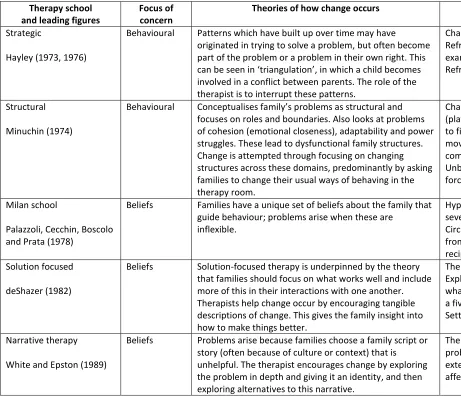
development of early family therapy theory (e.g. Gregory Bateson, Jay Hayley and Salvador Minuchin), but all shared a common perspective in which problems were seen as interactional and resulting from interpersonal processes. Individuals within a family were seen as interdependent and engaged in repetitive (or circular) patterns with one another. Treatment focused on understanding the function of patterns of behaviour in the family and working on disrupting these unhelpful patterns and changing dysfunctional styles of communicating (Asen, 2002; Dallos & Draper, 2010). Different clinicians began to write about these approaches, and as theories and clinical experience were disseminated, the discipline of ‘family therapy’ emerged. ‘structural’ and ‘strategic’ approaches were the first named approaches, with distinct ideas about how change could be promoted (see Table 1. The differing approaches to family therapy).
The second phase (1960s–1980s): the development of distinct schools
28
The third phase (1980s to present day)
In the last 30 years there have been several key developments in systemic family therapy, the first being the influence of social constructionist theories and the second a move towards integration and an acceptance of plurality (Dallos & Draper, 2010). At its heart, social constructionist theory posits that a family’s perceived reality is in fact constructed and influenced by wider societal factors. Families are influenced by the culture in which they live and construct meaning from this, but this meaning is not ‘reality’. Thus, the wider culture and context shape family life, from the structure of a family to the language it uses, as well as roles, responsibilities, beliefs and behaviour (Anderson, 1997; Anderson & Goolishian, 1992). Practising family therapy in a way that incorporates these ideas has become known as post-modern practice (Boston, 2000). Post-modern therapy approaches consider how culture and dominant narratives (for example about class or gender) may be influencing the family. Therapists pay attention to the use of language and the assumptions that they may bring as therapists (because of their own cultural influences), and the therapy is co-constructed with the family. Change is promoted by inviting the family to uncover meanings and encourage new ways of seeing problems (for example via reflecting teams, or by focusing on solutions not problems).
29
30
Table 1. The differing approaches to family therapy Therapy school
and leading figures
Focus of concern
Theories of how change occurs Techniques used to encourage change
Strategic
Hayley (1973, 1976)
Behavioural Patterns which have built up over time may have
originated in trying to solve a problem, but often become part of the problem or a problem in their own right. This can be seen in ‘triangulation’, in which a child becomes involved in a conflict between parents. The role of the therapist is to interrupt these patterns.
Changing parental roles. Disrupting patterns of behaviours. Reframing, the use of paradox (a contradictory statement, for example predicting the problem will get worse).
Reframing through asking questions that pose alternatives.
Structural Minuchin (1974)
Behavioural Conceptualises family’s problems as structural and focuses on roles and boundaries. Also looks at problems of cohesion (emotional closeness), adaptability and power struggles. These lead to dysfunctional family structures. Change is attempted through focusing on changing structures across these domains, predominantly by asking families to change their usual ways of behaving in the therapy room.
Change is focused on altering family structure. Enactment (playing out a typical interaction in the therapy room, but trying to find an alternative solution). Active techniques, such as moving between family members to block certain types of communication or altering where family members sit.
Unbalancing: taking the side of one family member in order to force change. Also uses reframing.
Milan school
Palazzoli, Cecchin, Boscolo and Prata (1978)
Beliefs Families have a unique set of beliefs about the family that guide behaviour; problems arise when these are
inflexible.
Hypothesising and neutrality (not taking sides and having several ideas as to what might be the problem patterns). Circularity: circular questions designed to shift families away from linear thinking into thinking about interdependence and reciprocity. Reframing.
Solution focused deShazer (1982)
Beliefs Solution-focused therapy is underpinned by the theory that families should focus on what works well and include more of this in their interactions with one another. Therapists help change occur by encouraging tangible descriptions of change. This gives the family insight into how to make things better.
The miracle question.
Exploring exceptions to the problem (perhaps using scaling: what was different between the time when the problem scored a five and the time it scored a two).
Setting modest positive goals to move towards an overall goal. Narrative therapy
White and Epston (1989)
Beliefs Problems arise because families choose a family script or story (often because of culture or context) that is unhelpful. The therapist encourages change by exploring the problem in depth and giving it an identity, and then exploring alternatives to this narrative.
31
Attachment-based therapies
Johnson (emotionally focused therapy, 1988), Dallos (attachment narrative therapy, 2004)
Contextual Families come to their current positions within a family with a series of unconscious constraints (based on their own family of origin and attachment patterns). Change is focused on freeing families from these constraints so that family members can be individuated and in relationship.
Listening and exploring patterns (in particular across
generations). Using circular questions to explore not just beliefs, but underlying feelings. Exploring emotional reactions and their possible context. Offering interpretations.
Multi-systemic therapy (MST)
Henggeler (1990)
Contextual MST posits that anti-social adolescents are often unsupported and poorly parented and form unhelpful peer relationships. Interventions are focused at changing interactions at every level of the system (family, school, peers, etc.).
33
Current definitions of practice and process
The above review has outlined how various schools of family therapy have conceptualised the change process. However, it is important to note that family therapy as practised in the UK today incorporates elements of many of those schools and developments. In fact, the issue of integration is made explicit in the Association for Family Therapy’s (AFT) framework for accreditation of family therapy training courses. In their requirements for qualification-level training, they state that courses should be able to demonstrate the following learning outcomes: “an ability to compare and contrast different approaches in systemic therapy and their relationship with other therapies and theories of change … an ability to use a range of techniques
to help clients to make changes in their lives” (AFT, 2011 p.8). Yet, whilst AFT
makes integration an explicit goal, no further details of exactly what models of change might be presented and which techniques might relate to this change are provided. Nor is there any rationale or meta-model for integration. So whilst it is increasingly accepted that family therapy as it is practised on the ground is not model-specific but in fact a synthesis of ideas and techniques from several schools (Rivett, 2008), there has been very little research that operationalises how family therapy is integrated and practised by family therapists in the UK.
There are two major exceptions to this. The first was a project to ‘manualise’ family therapy, undertaken by a team of researchers and family therapists at the University of Leeds (Pote, Stratton, Cottrell, Shapiro, & Boston, 2003). The aims of the research were to generate a manual that reflected current practice and that incorporated both traditional and post-modern systemic frameworks (Pote et al., 2003). The research involved interviewing therapists, videotaping family therapy sessions and making explicit the links between family activating events, therapists’ interventions and therapists’ intentions and theoretical rationale. The resulting manual offers a clear exposition of an integrated model of therapeutic change which centres on co-creating an understanding of patterns of “behaviour, beliefs or stories that have developed in family systems, and the wider context in which they live”
34
circular questioning. These alternative and new patterns are then posited to interact with the family system to create change. Pote et al. (2003) also make it clear that it is important to highlight any occurring change so that families understand “how the change was possible” (Pote et al., 2003 p.12).
The second project has been the development of a competence framework for the delivery of systemic therapies. This work was commissioned by the Department for Health and carried out by a team of researchers at University College London (UCL) (Stratton et al., 2011) . The detailed explication of the skills and knowledge required to deliver systemic therapy was drawn from existing evidence-based effective systemic therapy research manuals and key texts on family therapy. The team conducted a thematic analysis of these texts to extract competencies. These were then discussed with an expert reference panel consisting of 14 practising clinicians (who were selected on the basis that they were involved in outcomes studies and developing treatments). The expert group took the themes from the thematic analysis and adapted them somewhat so that the competencies were in line with family therapy as it was practised (Stratton et al., 2011). The competency framework makes clear that understanding the change process is key in terms of both knowledge (being able to understand patterns in a family and how they relate to a presenting problem, and understanding the therapist’s role in changing those patterns) and skills (being competent in a range of techniques that are thought to promote change, e.g. circular questioning, externalising, reframing and the use of experiential techniques) (Stratton et al., 2011).
35
A review of the evidence base for family therapy
Part one: a review of outcome research
Family therapy offers one of the few evidence-based alternatives to one-to-one therapies such as cognitive behavioural therapy (CBT) (AFT, 2011). The evidence for family therapy’s effectiveness in treating a range of problems appears strong. In a recent review of the research base, Carr (2014) highlights numerous clinical conditions for which there is good evidence of family therapy’s effectiveness and efficacy. These include mood and anxiety disorders, alcohol problems, schizophrenia, relationship distress, conduct disorder, eating disorders and psychosis (Carr, 2014a, 2014b). Similarly, a review of 20 meta-analyses concluded that “marriage and family therapy [the term used for family therapy in the United States of America] is now an empirically supported therapy in the plain English sense of the phrase – it clearly works, both in general and for a variety of specific
problems” (Shadish & Baldwin, 2003, p. 567). Another recent review – a
meta-content analysis which reviewed randomised control trials of systemic therapies in treating adult mental health – found that systemic therapy was an effective treatment for a variety of mental health problems and in addition that treatment effects were stable for up to five years post treatment (Von Sydow, Beher, Schweitzer, & Retzlaff, 2010).
36
defined systemic model (e.g. structural, strategic, solution-focused). Whilst both reached a similar conclusion regarding the efficacy of family therapy, it is clear that their definitions of what constituted family therapy differed widely. This definitional uncertainty is also reflected in the fact that there are very few protocols or treatment manuals used in family therapy outcome research (Diamond et al., 2003), and as Davey et al. recently commented, “many of the founding principles of family therapy … have not yet been operationalised clearly enough to translate easily into clinical
practice and evidence-based research” (Davey et al., 2012).
The issue of outcome measures forms another area of concern. A recent empirical examination of outcome measures in family therapy which reviewed 274 outcome studies highlighted several issues with the most commonly used instruments. Firstly, it was found that in the majority of cases (86%) the instruments were individual self-report measures, and in addition less than a third of the studies focused on the family (or couple) as the unit of analysis (Sanderson et al., 2009). This is problematic given the focus in family therapy on family-level (versus individual) change. Secondly, the review revealed that the field of outcome research lacks any accepted or standardised battery of measures, with a total of 480 different outcome measures being used in the 274 studies and 80% of these measures being used only once. Multiple measures mean that comparative analyses of outcomes (for example in a meta-analysis attempting to generate an effect size) are difficult, and the prevalence of instruments designed to be used with individuals means that many outcome measures could be accused of having poor construct validity. It could be argued that some of these issues are a result of the dominance of therapies with an individual focus (Barnes, Hall & Evans, 2008) and family therapy’s resultant need to prove itself within this therapeutic milieu. This is perhaps reflected in the prevalence of the use of the Beck Depression Index in family therapy outcome studies (Sanderson et al., 2009), as it is often the instrument of choice in efficacy studies of cognitive behavioural therapy (Beckham & Watkins, 1989).
37
overall efficacy of family therapy, the literature also suggests that family therapy offers specific benefits over individual therapies. There is some suggestion for example that in certain diagnostic criteria and with certain populations (e.g. anorexia nervosa in young people (Lock et al., 2010)), family therapy can be more effective than individual therapy (Von Sydow et al., 2010). In a recent review, Stratton (2011) pointed to the growing body of evidence that suggests that family therapy is well liked and well tolerated (with lower dropout rates). Furthermore, a recent and comprehensive quantitative study (Hamilton, Moore, Crane, & Payne, 2011) showed that marriage and family therapists (in the US) had the lowest rates of dropout of all mental health professionals. A number of qualitative studies equally report that patients’ experiences of family therapy are positive. For example, Sheridan et al. (2010) reported parents’ experiences of family therapy as supportive and positive, and Stanbridge and colleagues found that families found therapy both helpful and preferable to other services they had experienced (Stanbridge et al., 2003). Additionally, there is evidence that family therapists are more cost effective, with better outcomes and lower dropout rates than therapists delivering individual therapy (Hamilton et al., 2011; Russell Crane & Payne, 2011). Family therapy is already a NICE recommended treatment for a number of mental health issues (e.g. anorexia for adolescents) (AFT, 2011). The above research would suggest that a case can be made for widening access to family therapy in the NHS. It is the argument of this dissertation that this case would be further strengthened if more rigour was applied to outcome research and if the research base was expanded to include more change process research which explored the links between moments in therapy and overall outcomes.
Part two: a review of research into the process of family therapy
38
as multi-systemic family therapy and functional family therapy) (Sexton & Datchi, 2014).
What is known about the process of change in family therapy has been determined by a wide range of studies that have focused on a variety of different aspects of the therapeutic process. Broadly, the change process research in family therapy has been investigated in five main ways:
1. Research which focuses on micro-analytic processes such as speech acts or specific micro-processes associated with well-articulated accounts of therapy. 2. Research which is conducted qualitatively and asks broad questions about
families’ experiences.
3. Research which specifically focuses on the therapeutic relationship.
4. Qualitative research focusing on helpful factors (this approach has focused on asking therapists and families both separately and together).
5. Research which focuses on significant moments in therapy.
What follows is a review of some of the most pertinent studies along with a critical appraisal of the key points relevant to the current study.
Micro-analytic process design
39
their significant other to help them meet their attachment needs (Johnson & Johnson, 2004). They found that therapists facilitated change by giving clients a clear picture of what secure attachment in their relationship would look like, acknowledging fears and promoting the processing of emotions and engagement between the blamer and the withdrawer.
Micro-process studies have also been used to study the impact of particular therapist interventions, such as reframing and reflection in functional family therapy (e.g. (Robbins, Alexander, Newell, & Turner, 1996). The process of change in narrative therapy has also been investigated. For example, Coulehan, Friedlander, and Heatherington (1998) conducted a detailed analysis of videotaped sessions in which they focused on the process of transforming problems from an individual conception to an interpersonal, systemic one. Their research highlighted the importance of emotional change as well as confirming some of the theoretical models of change as proposed by Sluzki in her theoretical model of narrative therapy (Coulehan et al., 1998).
Micro-analytic process studies have given detailed evidence of particular change processes in certain detailed therapeutic approaches. The strength of these studies is that the researchers give very detailed and rigorous accounts of their research process. However, they have been used to investigate highly specified mechanisms of change that proponents of particular models believe are key to encouraging change in that model. Hence, they are looking for evidence to support the theoretical view of change provided by the model. This makes it difficult to generalise findings from these studies to the more general practice of family therapy.
Qualitatively asking about experiences
40
time lag between therapy ending and the interviews taking place (an average of 5.5 months), the implications of these results for the current study should be interpreted cautiously as such a gap between therapy and interviews would privilege recall of content (what happened) over process (how it happened) (Rhodes, 2011).
With regard to family therapy conducted with couples, the researchers Bowman and Fine (2000) looked at client perceptions of couples therapy, interviewing five couples who were receiving (or who had just finished) couples therapy. They reported several factors which clients found helpful, such as a safe therapeutic atmosphere, gaining understanding about the relationship and seeing things in a different light. Couples also reported that they found unequal treatment, in which the therapist focused on one partner over another, unhelpful. Metcalf, Thomas, Duncan, Miller and Hubble (1996) looked at couples who had successfully completed solution-focused therapy. The study asked both couples and therapists about their experiences of the therapy. With regard to change, this study suggested that the therapeutic relationship was more important than particular techniques of solution-focused therapy.
In one of the few studies to ask about children’s experience of therapy, Stith, Rosen, McCollum, Coleman, and Herman (1996) interviewed 16 children about their impressions of family therapy. One theme which described participants’ sense of what had changed following family therapy suggested that children felt their families were more able to talk about their problems. In their ethnographic research into narrative therapy, O'Connor et al. (1997) found that clients recounted what was helpful about therapy. In particular, if therapists “respected their perceptions” and
made them feel “listened to, acknowledged and not blamed” (O'Connor et al., 1997,
p. 489), clients reported this was helpful.
41
studies make this an explicit concern), several themes emerged about change during family therapy. Chenail et al. (2011) call these “changing the viewing” (changes in
how family members viewed themselves and their family) and “changing the doing”
(how the family’s behaviour and communication changed). Both of these types of change were described as interrelated, but they were not explicitly linked to therapist characteristics or interventions (which were conceptualised as positive or negative). There was also in the study findings an inference that clients’ positive experiences of therapists would facilitate change; however, the study was not able to make a clear link between therapists’ actions and how change occurred.
With regard to the process of change, the main findings from these qualitative studies that focused on clients’ experience of family therapy are rather limited (given that they focus on experience). However, it appears that defining problems as interactional, feeling heard, and having a good relationship with the therapist(s) were seen as helpful (Kuehl et al., 1990; Lobatto, 2002; O'Connor et al., 1997; Sheridan et al., 2010). These findings are in line with the literature on individual therapy clients’ experience of therapy and suggest that a key component which contributes to change is the relationship with the therapist (Norcross, 2011) .
Therapeutic alliance
The quality of the therapeutic alliance in facilitating change has received a great deal of attention in the research literature on therapy and is broadly recognised as a robust predictor of a successful outcome in therapy (Norcross, 2002; Norcross, 2011a). In the context of family therapy specifically, this is also true (Flaskas & Perlesz, 1996; Friedlander, Escudero & Heatherington, 2006). An early handbook of family therapy confirms that, “the ability of the therapist to establish a positive relationship … receives the most consistent support as an important outcome-related
therapist factor in marital and family therapy” (Gurman & Knirskern, 1978 p. 875).
42
difference of having more than one person in the room has not been overlooked (Johnson & Wright, 2002). However, there is much less known about both what contributes to a good alliance in family therapy and the relationship between the process of change and the therapeutic alliance (Friedlander et al., 2006).
Various factors have been investigated with regard to the systemic alliance (the therapeutic alliance between family therapist and family) and, much as in individual therapies, there is no universally accepted definition of this construct. There is however agreement that it is important to form an alliance with all family members a