Constructive Language in News Comments
Varada Kolhatkar Discourse Processing Lab
Simon Fraser University Burnaby, Canada
Maite Taboada Discourse Processing Lab
Simon Fraser University Burnaby, Canada
Abstract
We discuss the characteristics of construc-tive news comments, and present meth-ods to identify them. First, we define the notion of constructiveness. Second, we annotate a corpus for constructive-ness. Third, we explore whether avail-able argumentation corpora can be useful to identify constructiveness in news com-ments. Our model trained on argumen-tation corpora achieves a top accuracy of 72.59% (baseline=49.44%) on our crowd-annotated test data. Finally, we exam-ine the relation between constructiveness and toxicity. In our crowd-annotated data, 21.42% of the non-constructive comments and 17.89% of the constructive comments are toxic, suggesting that non-constructive comments are not much more toxic than constructive comments.
1 Introduction
The goal of online news comments is to provide constructive, intelligent and informed remarks that are relevant to the article, often in the form of an exchange with other readers. Many comments, however, do not contribute to achieving this goal. Online comments have a broad range: they can be vacuous, dismissive, abusive, hateful, but also constructive. Below we show two comments on an article about Hillary Clinton’s loss in the presi-dential election in 2016.1
(1) I have 3 daughters, and I told them that Mrs. Clinton lost because she did not have a platform. The only message that I got from her was that Mr. Trump is not fit to be in office and that she wanted to be the
1http://www.theglobeandmail.com/
opinion/thank-you-hillary-women-now-know-retreat-is-not-an-option/ article32803341/
first female President. I honestly believe that she lost because she offered no hope, or direction, to the aver-age American. Mr. Trump, with all his shortcomings, at least offered change and some hope.
(2) This article was a big disappointment. Thank you Ms Henein. Now women know that wasting their time reading your emotion-based opinion is not an option. Both comments disagree with the author, but one does it constructively and the other dismis-sively. Comment (1) treats the article as a genuine starting point for discussion and presents disagree-ment without denigrating, with reasons for the dis-agreement. On the other hand, comment (2) is dis-missive and probably sarcastic.
Our goal is to understand constructiveness in news comments, which may help in filtering and organizing many kinds of online comments. News comments may be filtered according to different criteria, for example, based on their toxicity and/or constructiveness. Toxic comments may be fil-tered negatively, i.e., they can be blocked, deleted, or demoted. Constructive comments may be fil-tered positively, i.e., they can be promoted, as it is done manually for the New York Times Picks (Diakopoulos, 2015). A number of approaches have been proposed for toxicity (e.g., Kwok and Wang,2013;Waseem and Hovy, 2016;Wulczyn et al.,2016;Nobata et al.,2016;Davidson et al.,
2017). A recent example is the effort by Google to identify abusive or toxic comments through the Perspective API.2 There is, however, not as
much research on the constructiveness of individ-ual comments. Niculae and Danescu-Niculescu-Mizil(2016) andNapoles et al.(2017) study con-structiveness at the comment thread-level, but not at the comment level.
In this paper, we focus on the constructiveness of individual news comments. First, we define the notion of constructiveness. Second, we
de-2https://www.perspectiveapi.com/
scribe our annotated corpus of online comments labelled for constructiveness. Third, we explore deep learning approaches for identifying construc-tive comments. Fourth, we discuss the association between constructiveness and a number of argu-mentation features. Finally, we examine the rela-tionship between toxicity and constructiveness.
2 Constructiveness: Definition and corpus
We are interested in comments that contribute to the conversation, which construct, build and pro-mote a dialogue. Napoles et al. (2017) define constructive conversations in terms of ERICs— Engaging, Respectful, and/or Informative Conver-sations. Rather than relying on our intuitions, we posted a survey asking what a constructive com-ment is. We opened a survey on SurveyMonkey3,
requesting 100 answers. A composite of the an-swers is: Constructive comments intend to create a civil dialogue through remarks that are relevant to the article and not intended to merely provoke an emotional response. They are typically targeted to specific points and supported by appropriate ev-idence.
In order to study constructiveness in news com-ments, we crawled 1,121 comments from 10 ar-ticles of the Globe and Mail news website4
cover-ing a variety of subjects: technology, immigration, terrorism, politics, budget, social issues, religion, property, and refugees. We used CrowdFlower5
as our crowdsourcing annotation platform and an-notated the comments for constructiveness. We asked the annotators to first read the relevant arti-cle, and then to tell us whether the displayed com-ment was constructive or not. For quality control, 100 units were marked as gold: Annotators were allowed to continue with the annotation task only when their answers agreed with our answers to the gold questions. As we were interested in the ver-dict of native speakers of English, we limited the allowed demographic region to English-speaking countries. We asked for three judgments per in-stance and paid 5 cents per annotation unit. Per-centage agreement for the constructiveness ques-tion was 87.88%, suggesting that constructiveness can be reliably annotated. Agreement numbers are provided by CrowdFlower, and are calculated
3https://www.surveymonkey.com/ 4http://www.theglobeandmail.com/ 5https://www.crowdflower.com/
on a random sample of 100 annotations. Other measures of agreement, such as kappa, are not easily computed with CrowdFlower data, because many different annotators are involved. Construc-tiveness seemed to be equally distributed in our dataset: Out of the 1,121 comments, 603 com-ments (53.79%) were classified as constructive, 517 (46.12%) as non-constructive, and the annota-tors were not sure in only one case. We use this an-notated corpus as the test data in our experiments. We have also made the corpus publicly available.6
3 Identifying constructive comments We take the view that constructiveness is closely related to argumentation. Argumentative texts usually establish a position on a topic and pro-vide reasoning for that particular position. Simi-larly, a constructive comment provides reasoning for the commenter’s point of view. We exploit argumentation-related datasets to train a bidirec-tional Long Short-Term Memory (biLSTM) model (Hochreiter and Schmidhuber, 1997; Graves and Schmidhuber,2005) to identify constructive com-ments. We also explore the association between constructiveness and argumentation features.
3.1 Building a constructiveness classifier
Constructiveness is an interplay between differ-ent kinds of linguistic knowledge: lexical, syn-tactic, semantic and pragmatic knowledge. Lex-ical and syntactic features, such as use of hedges and modals, sentence structure, readability or text complexity; semantic features, such as the use of personal and emotion words or the sentiment score for the comment; and discourse features, such as cohesion, discourse relations, the com-ment’s topic, or the topic distance from the ar-ticle, have shown to help in identifying similar phenomena, such as quality of student essays or constructiveness of a comment thread (Pitler and Nenkova,2008;Brand and Van Der Merwe,2014;
Diakopoulos, 2015; Momeni et al., 2015; Nicu-lae and Danescu-Niculescu-Mizil,2016). The pri-mary challenge in developing a computational sys-tem for constructiveness is the lack of training data from which we can learn about these different as-pects of constructiveness.
Training data Since there is no training data available for constructiveness at the comment
6
level, we gathered annotated data from similar tasks. In particular, we exploit two annotated cor-pora. The first corpus is the Yahoo News An-notated Corpus (YNC)7 (Napoles et al., 2017),
which contains thread-level constructiveness an-notations for Yahoo News comment threads. We are interested in comment-level annotations, and thus assume that a comment from a construc-tive thread is construcconstruc-tive and vice versa for non-constructive threads. We extracted 33,957 com-ments from constructive conversations and 26,821 comments from non-constructive conversations from this dataset. Other than constructiveness an-notations, the YNC corpus also contains annota-tions for sub-dialogue type (argumentative, flame-war, off topic, personal stories, positive, respect-ful, snarky or humorous). We concatenate these annotations to the comments when training.
The second corpus is the Argument Extraction Corpus (AEC)8 (Swanson et al.,2015). The
cor-pus includes annotations for argument quality on sentences extracted from the topics of gun con-trol, gay marriage, evolution, and death penalty. Our intuition is that sentences with high argument quality are constructive and low argument qual-ity are non-constructive. We extract 2,613 exam-ples with high argumentation quality and 2,761 examples with low argumentation quality. In to-tal, we had 36,570 constructive and 29,582 non-constructive training examples.
Test data Our test data is our crowd-sourced constructiveness corpus containing 1,121 in-stances marked for constructiveness. As news comments are not always well written, we carried out some preprocessing of the data, such as word segmentation and spelling correction. For exam-ple, inClimate change has always been ahoax,as
. . ., our preprocessing will add a space between hoax,andas.
Model and results We carry out preliminary ex-periments to assess whether argumentative com-ment representations are useful to identify con-structive comments. We train biLSTM models with the annotated argumentation corpora. These models are usually used for sequential predictions. The models havememoryin the sense that the re-sults from the previous predictions can inform fu-ture predictions. The model learns what kind of
7https://webscope.sandbox.yahoo.com 8https://nlds.soe.ucsc.edu/node/29
Aggregate Softmax Label
concat
concat concat
LSTM LSTM LSTM
LSTM LSTM LSTM
word1
Great
word2
article
word3
!
[image:3.595.315.521.60.291.2]Embeddings
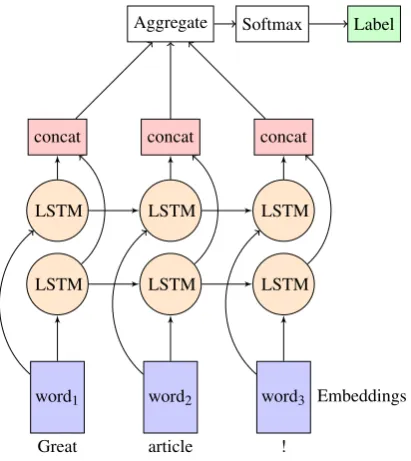
Figure 1: Bidirectional LSTM architecture. Label values: constructive, non-constructive.
memories are important in predicting the output. Although our task isnota sequential prediction task, the primary reason for using biLSTMs is that these models can utilize the expanded paragraph-level contexts and learn paragraph representations directly. In our case, the memory is used not to re-member the previous comments’ predictions, but to remember the long-distance context within the same comment. Moreover, biLSTMs have been shown to learn better representations of sequences by processing them from left to right and from right to left. They have recently been used in diverse tasks, such as stance detection ( Augen-stein et al.,2016), sentiment analysis (Teng et al.,
2016), and medical event detection (Jagannatha and Yu,2016).
acti-Training Validation Test
accuracy(%) accuracy (%)
YNC + AEC 68.43 68.45
YNC 72.76 72.59
[image:4.595.321.514.62.169.2]AEC 69.30 52.54
Table 1: Constructiveness prediction results using argumentation corpora. The test data was our an-notated constructiveness data in all cases. Random baseline accuracy = 49.44%.
vation function, which produces a probability-like output for each label type, in our case for the labels constructive and non-constructive.
The network is trained with backpropagation. The embedding vectors are also updated based on the backpropagated errors. We use bidirec-tional LSTMs as implemented in TensorFlow9.
We trained with the ADAM stochastic gradient de-scent for 10 epochs. The important parameter set-tings are: batch size=512, embedding size=200, drop out=0.5, and learning rate=0.001.
We wanted to examine which argumentation dataset is more effective in identifying construc-tiveness. So we carried out experiments with dif-ferent train and test combinations. In each experi-ment, 1% of the training data was used as the val-idation set.
Table 1 shows the average validation and test accuracies for three runs with the same parame-ter settings. Below we note a few observations. First, we achieved the best result when YNC was included in the training set. Second, AEC seems not to have much effect on the test accuracy but YNC does; when we do not have YNC in the train-ing data, the results drop markedly. This might be because the size of the AEC corpus is relatively small and the model was not able to learn any rele-vant patterns from this data. Finally, the validation and test accuracy is more or less same for the first two rows, when YNC is included in the training data.
3.2 Association with argumentation features
In addition to the classifier described above, we also examine the association between construc-tiveness and a number of linguistic and discourse features typically found in argumentative texts, based on the extensive literature on argumentation
9https://www.tensorflow.org/
Feature OR
Argumentative discourse relations 3.49
Stance adverbials 2.52
Reasoning verbs & modals 2.02
Root clauses 1.37
Conjunctions & connectives 0.82
[image:4.595.74.289.64.142.2]Abstract nouns 0.51
Table 2: Association of constructiveness with lin-guistic features in terms of OR (odds ratio).
(Biber, 1988; van Eemeren et al., 2007; Moens et al., 2007;Tseronis, 2011;Becker et al., 2016;
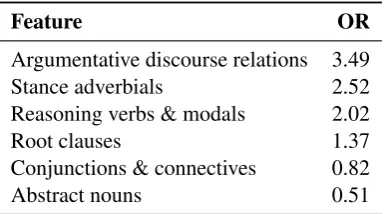
Habernal and Gurevych,2017;Azar,1999; Peld-szus and Stede,2016). We calculate association in terms of odds ratio (Horwitz,1979), which tells us the odds of a comment being constructive in the presence of a feature. Results are shown in Table
2. We observed a strong association between con-structiveness and occurrence of argumentative dis-course relations (Cause, Comparison, Condition, Contrast, Evaluation and Explanation).10 The
odds ratio for argumentative discourse relations is 3.49, which means that constructive texts are 3.49 times more likely to have this feature than non-constructive texts. Other features with strong asso-ciation with constructiveness are stance adverbials (e.g., undoubtedly, paradoxically, of course), and reasoning verbs (e.g., cause, lead) and modals. Root clauses (clauses with a matrix verb and an embedded clause, such asI think that . . .) show a medium association with constructiveness. On the other hand, abstract nouns (e.g., issue, rea-son) and, surprisingly, conjunctions and connec-tives are not associated with constructive texts. The latter is surprising because many discourse re-lations contain a connnective.
4 Toxicity in news comments
In the context of filtering news comments, we are also interested in the relationship between con-structiveness and toxicity. We propose the label toxicityfor a range of phenomena, including ver-bal abuse, offensive comments and hate speech. To better understand the nature of toxicity and its relationship with constructiveness, we extended our CrowdFlower annotation. For the 1,121 com-ments described in Section2, we also asked
anno-10For this analysis we used the discourse relations given by
tators to identify toxicity. The question posed was: How toxic is the comment? We established four classes: Very toxic, Toxic, Mildly toxic and Not toxic. The definition for Very toxic included com-ments which use harsh, offensive or abusive lan-guage; comments which include personal attacks or insults; or which are derogatory or demean-ing. Toxic comments were sarcastic, containing ridicule or aggressive disagreement. Mildly toxic comments were described as those which may be considered toxic only by some people, or which express anger and frustration.
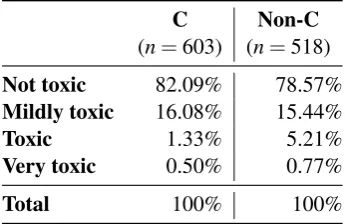
The distribution of toxicity levels by construc-tiveness label is shown in Table3. The percent-age agreement provided by CrowdFlower for this task was 81.82%. The most important result of this annotation experiment is that there were no significant differences in toxicity levels between constructive and non-constructive comments, i.e., constructive comments were as likely to be toxic (in its three categories) as non-constructive com-ments. For instance, consider Example (3) be-low. It was labelled as constructive by two out of three annotators, and toxic by all three (two as Toxic, and one as Very toxic). It could be the case, in some situations, that a moderator may allow a somewhat toxic comment if it contributes to the conversation, i.e., if it is constructive.
(3) If it’s wrong to vote AGAINST someone based on their gender,Then surely it is also wrong to vote FOR someone based on their gender.Yet there were many people advocating openly for people to to do just that.I wonder how many votes Clinton got just be-cause she was a woman.
We conclude, then, that constructiveness and toxicity are orthogonal categories. The results also suggest that it is important to consider construc-tiveness of comments along with toxicity when filtering comments, as aggressive constructive de-bate might be a good feature of online discussion. Given these results, the classification of construc-tiveness and toxicity should probably be treated as separate problems.
5 Discussion and conclusion
We have proposed a definition of constructiveness that hinges on argumentative aspects of news com-ments. We have shown that well-known linguis-tic indicators of argumentation, such as adverbials and rhetorical relations show an association with constructive comments. Our definition of con-structiveness is at the comment level, because it
C
(n=603) (nNon-C=518)
Not toxic 82.09% 78.57%
Mildly toxic 16.08% 15.44%
Toxic 1.33% 5.21%
Very toxic 0.50% 0.77%
[image:5.595.330.503.63.175.2]Total 100% 100%
Table 3: Percent distribution of constructive and toxic comments in CrowdFlower annotation. C = Constructive.
is important to identify comments as they come in, rather than waiting for a thread to degenerate (Wulczyn et al., 2016), and because many com-ments are top-level, i.e., not part of a thread.
We assume that constructive comments con-tain good argumentation and explored argumen-tation datasets to train a bidirectional LSTM to identify constructive comments. The high-est accuracy of our model was 72.59% (random baseline=49.44%).
Through an annotation experiment, we studied the relationship between constructiveness and tox-icity, and found that constructive comments are just as likely to be toxic (or not toxic) as non-constructive comments. In terms of filtering, this poses an interesting question, since some of our toxic comments were also deemed to be construc-tive by the annotators.
As for future work, our long-term goal is to build a robust system for identifying construc-tive news comments. We also plan to investigate the relation between toxicity and constructiveness more deeply. We plan to train on more relevant and directly related training data, such as the New York Times Picks, and systematically explore dif-ferent argumentation features for constructiveness (e.g., readability, cohesion, coherence).
Acknowledgments
References
Isabelle Augenstein, Tim Rockt¨aschel, Andreas Vla-chos, and Kalina Bontcheva. 2016. Stance detec-tion with bidirecdetec-tional condidetec-tional encoding. In Pro-ceedings of the 2016 Conference on Empirical Meth-ods in Natural Language Processing. Austin, TX, pages 876–885.
Moshe Azar. 1999. Argumentative text as rhetorical structure: An application of Rhetorical Structure Theory. Argumentation13(1):97–144.
Maria Becker, Alexis Palmer, and Anette Frank. 2016. Clause types and modality in argumentative micro-texts. In Proceedings of the Workshop on Founda-tions of the Language of Argumentation (in conjunc-tion with COMMA 2016). Postdam, pages 1–9. Douglas Biber. 1988. Variation across Speech and
Writing. Cambridge University Press, Cambridge. Dirk Brand and Brink Van Der Merwe. 2014.
Com-ment classification for an online news domain. In
Proceedings of the First International Conference on the use of Mobile Informations and Communi-cation Technology in Africa UMICTA. Stellenbosch, South Africa, pages 50–56.
Thomas Davidson, Dana Warmsley, Michael Macy, and Ingmar Weber. 2017. Automated hate speech detection and the problem of offensive language. In
Proceedings of the 11th International Conference on Web and Social Media. Montr´eal.
Nicholas Diakopoulos. 2015. Picking the NYT Picks: Editorial criteria and automation in the curation of online news comments. ISOJ Journal6(1):147–166. Alex Graves and J¨urgen Schmidhuber. 2005. Frame-wise phoneme classification with bidirectional LSTM networks. In Proceedings of the IEEE In-ternational Joint Conference on Neural Networks, IJCNN. volume 4, pages 2047–2052.
Ivan Habernal and Iryna Gurevych. 2017. Argumenta-tion mining in user-generated web discourse. Com-putational Linguistics43(1):125–179.
Sepp Hochreiter and J¨urgen Schmidhuber. 1997. Long Short-Term Memory. Neural Computation
9(8):1735–1780.
Ralph I. Horwitz. 1979. A method of estimating com-parative rates from clinical data: Applications to cancer of the lung, breast, and cervix: Cornfield J: J Nat Cancer Inst 11: 12691275, 1951. Journal of Chronic Diseases32(1-2):i.
Abhyuday N. Jagannatha and Hong Yu. 2016. Bidi-rectional RNN for medical event detection in elec-tronic health records. In Proceedings of the 2016 Conference of the North American Chapter of the Association for Computational Linguistics: Human Language Technologies. San Diego, CA, pages 473– 482.
Shafiq Joty, Giuseppe Carenini, and Raymond Ng. 2015. CODRA: A novel discriminative framework for rhetorical analysis. Computational Linguistics
41(3):385–435.
Irene Kwok and Yuzhou Wang. 2013. Locate the hate: Detecting tweets against blacks. InProceedings of the Twenty-Seventh AAAI Conference on Artificial Intelligence. AAAI’13, pages 1621–1622.
Marie-Francine Moens, Erik Boiy, Raquel Mochales Palau, and Chris Reed. 2007. Automatic detection of arguments in legal texts. In Proceedings of the 11th international conference on Artificial intelli-gence and law. ACM, Stanford, California, pages 225–230.
Elaheh Momeni, Claire Cardie, and Nicholas Di-akopoulos. 2015. A survey on assessment and rank-ing methodologies for user-generated content on the web.ACM Computing Surveys48(3):1–49.
Courtney Napoles, Joel Tetreault, Aasish Pappu, En-rica Rosato, and Brian Provenzale. 2017. Finding good conversations online: The Yahoo News An-notated Comments Corpus. In Proceedings of the 11th Linguistic Annotation Workshop, EACL. Valen-cia, pages 13–23.
Vlad Niculae and Cristian Danescu-Niculescu-Mizil. 2016. Conversational markers of constructive dis-cussions. InProceedings of the 2016 Conference of the North American Chapter of the Association for Computational Linguistics: Human Language Tech-nologies. San Diego, pages 568–578.
Chikashi Nobata, Joel Tetreault, Achint Thomas, Yashar Mehdad, and Yi Chang. 2016. Abusive lan-guage detection in online user content. In Proceed-ings of the 25th International World Wide Web Con-ference. Montr´eal, pages 145–153.
Andreas Peldszus and Manfred Stede. 2016. Rhetori-cal structure and argumentation structure in mono-logue text. InProceedings of the 3rd Workshop on Argument Mining, ACL. Berlin, pages 103–112. Jeffrey Pennington, Richard Socher, and
Christo-pher D. Manning. 2014. GloVe: Global vectors for word representation. In Proceedings of the Con-ference on Empirical Methods in Natural Language Processing. Doha, Qatar, pages 1532–1543. Emily Pitler and Ani Nenkova. 2008. Revisiting
read-ability: A unified framework for predicting text quality. InProceedings of the Conference on Empir-ical Methods in Natural Language Processing. Hon-olulu, HI, pages 186–195.
Zhiyang Teng, Duy Tin Vo, and Yue Zhang. 2016. Context-sensitive lexicon features for neural senti-ment analysis. In Proceedings of the 2016 Con-ference on Empirical Methods in Natural Language Processing. Association for Computational Linguis-tics, Austin, Texas, pages 1629–1638.
Assimakis Tseronis. 2011. From connectives to argu-mentative markers: A quest for markers of argumen-tative moves and of related aspects of argumenargumen-tative discourse. Argumentation25(4):427–447.
Frans H. van Eemeren, Peter Houtlosser, and A. Fran-cisca Snoeck Henkemans. 2007. Argumentative In-dicators in Discourse: A pragma-dialectical study. Springer, Berlin.
Zeerak Waseem and Dirk Hovy. 2016. Hateful sym-bols or hateful people? Predictive features for hate speech detection on Twitter. In Proceedings of the 2016 Conference of the North American Chapter of the Association for Computational Linguistics: Hu-man Language Technologies. San Diego, CA, pages 88–93.
Ellery Wulczyn, Nithum Thain, and Lucas Dixon. 2016. Ex machina: Personal attacks seen at scale.