Representations of Time Expressions for Temporal Relation Extraction
with Convolutional Neural Networks
Chen Lin1, Timothy Miller1, Dmitriy Dligach2, Steven Bethard3and Guergana Savova1
1Boston Children’s Hospital and Harvard Medical School 2Loyola University Chicago
3University of Arizona
1{first.last}@childrens.harvard.edu 2[email protected]
Abstract
Token sequences are often used as the in-put for Convolutional Neural Networks (CNNs) in natural language processing. However, they might not be an ideal repre-sentation for time expressions, which are long, highly varied, and semantically com-plex. We describe a method for represent-ing time expressions with srepresent-ingle pseudo-tokens for CNNs. With this method, we establish a new state-of-the-art result for a clinical temporal relation extraction task.
1 Introduction
Convolutional Neural Networks (CNNs) utilize convolving filters and pooling layers for explor-ing and subsamplexplor-ing a feature space, and show excellent results in tasks such as semantic pars-ing (Yih et al.,2014), search query retrieval (Shen et al., 2014), sentence modeling (Kalchbrenner et al.,2014), and many other natural language pro-cessing (NLP) tasks (Collobert et al.,2011).
Token sequences are often used as the input for a CNN model in NLP. Each token is represented as a vector. Such vectors could be either word embed-dings trained on the fly (Kalchbrenner et al.,2014), pre-trained on a corpus (Pennington et al.,2014;
Mikolov et al.,2013), or one-hot vectors that index the token into a vocabulary (Johnson and Zhang,
2014). CNN filters then act as n-grams over contin-uous representations. Subsequent network layers learn to combine these n-gram filters to detect pat-terns in the input sequence.
This token vector sequence representation has worked for many NLP tasks, but has not been well-studied for temporal relation extraction. Time ex-pressions are complex linguistic exex-pressions that are challenging to represent because of their length and variety. For example, for the time expressions in the THYME (Styler IV et al.,2014) colon can-cer training corpus, there are 3,833 occurrences of
Figure 1: CNN with encoded timex
2,014 unique expressions of which 1,624 (80.6%) are multi-token, 1,104 span three or more tokens, and some span as many as 10 tokens. CNNs, which represent meaning through fragments of word se-quences, might struggle to compose these frag-ments to represent the meaning of time expressions. For example, can a CNN properly generalize that
May 7 as a date is closer to April 30 than May 20? Can it embed years like2012and2040to rec-ognize that the former was in the past, while the latter is in the future? Time normalization systems can handle such phenomena, but they are complex and language-specific, and often require signifi-cant manual effort to re-engineer for a new domain (Str¨otgen and Gertz,2013;Bethard,2013).
Fortunately, not all tasks require full time nor-malization, so if the CNN can at least embed a meaningful subset of the time expression seman-tics, it may still be helpful in such tasks. An open question then, is how to best feed time expressions to the CNN so that it can usefully generalize over them as part of its solution to a larger task.
over-A
EVENT
surgery is scheduled on
TIME
Mar 11 .
⇓
1: aheisurgeryh/eiis scheduled onhtimar 11h/ti. 2: aheisurgeryh/eiis scheduled onhti htimexi h/ti. 3: aheisurgeryh/eiis scheduled onhti hdatei h/ti. 4: aheisurgeryh/eiis scheduled onhti hnn cdi h/ti. 5: aheisurgeryh/eiis scheduled onhti hdate nn cdi h/ti. 6: aheisurgeryh/eiis scheduled onhti hindex 721i h/ti. 7: aheisurgeryh/eiis scheduled onhtimar 11hdatei h/ti. 8:hoi hoi hoi hoi hoi hbi hii hoi hoi
9:hoi hoi hoi hoi hoi hb datei hi datei hoi hoi
10: ahe1isurgeryh/e1iishe2ischeduledh/e2ion .
Figure 2: Representations of an input sequence
head and high accuracy (Miller et al.,2015). 2) CNN filters are more effective because they oper-ate over the time expression as one unit. The filter process can thus focus on the informative surround-ing context to catch generalizable patterns instead of being trapped within lengthy time expressions.
We explored a variety of one-tag representations for time expressions, from very specific to very general. We also experimented with other ways to inject temporal information into the CNN models and compared them with our one-tag representa-tions. We picked a challenging learning task where time expressions are critical cues for evaluating our proposed representation: clinical temporal relation extraction. The identification of temporal relations in medical text has been drawing growing attention because of its potential to dramatically increase the understanding of many medical phenomena such as disease progression, longitudinal effects of med-ications, a patient’s clinical course, and its many clinical applications such as question answering (Das and Musen,1995;Kahn et al.,1990), clinical outcomes prediction (Schmidt et al., 2005), and the recognition of temporal patterns and timelines (Zhou and Hripcsak,2007;Lin et al.,2014).
Through experiments, we not only demonstrate the usefulness of one-tag representations for time expressions, but also establish a new state-of-the-art result for clinical temporal relation extraction.
2 Methods
We trained two CNN-based classifiers for recog-nizing two types of within-sentence temporal re-lations, event-event and event-time rere-lations, as they usually call for different temporal cues (Lin et al., 2016a). The input to our classifiers was manually annotated (gold) events and time expres-sions during both training and testing stages. That
way we isolated the task of time expression rep-resentation for temporal relation extraction from the tasks of event and time expression recognition. We adopted the same xml-tag marked-up token se-quence representation and model setup as (Dligach et al.,2017). Figure2(1) illustrates the marked-up token sequence for an event-time instance, in which the event is marked byheiandh/eiand the time expression is marked byhtiandh/ti. Event-event instances are handled similarly, e.g.ahe1isurgery h/e1iishe2ischeduledh/e2ion march 11.
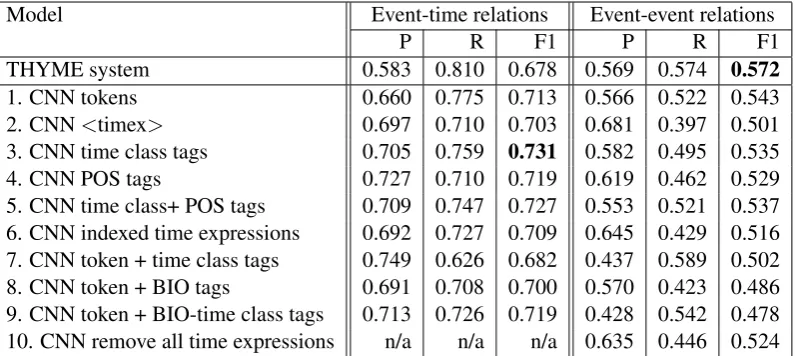
We tried different ways of representing a time ex-pression as a one-token tag. The most coarse option would be to represent all time expressions with one universal tag,htimexi, as in Figure2(2). For more granular options, we experimented with these addi-tional representations: 1) The time class1of a time expression, as in Figure2(3), where the time ex-pression,Mar 11, is represented by its class,hdatei. 2) The Penn Treebank POS tags of the tokens in a time expression, as in Figure2(4), where the time expression,Mar 11, is represented by concatenat-ing two POS tags,hnn cdi. 3) The combination of time class and POS tags, as in Figure2(5), where the time expression is represented byhdate nn cdi. 4) A fine-grained representation that assigns an index to each unique time expression, as in Fig-ure2(6), where the time expression is represented byhindex 721i, the index used every time the time expressionMar 11appears. For event-event rela-tions, where time expressions are not part of the relational arguments, we tried removing the time expressions altogether, as in Figure2(10), where
Mar 11has been removed.
To show the contribution of one-tag represen-tations versus adding new information to the sys-tem, we explored incorporating temporal informa-tion by adding time-class tags to the original to-ken sequences (Figure2(7)) and adding BIO tags with/without time classes for time expression (Fig-ure2(8,9)) alongside the original token sequences. We used the same CNN architecture as the CNN used in (Dligach et al., 2017), and fo-cused on extracting the contains relation. The word embeddings were randomly initialized2and
1We used the standard clinical domain classification
(Styler IV et al.,2014), where the classes are date (e.g.,next Friday,this month), time (e.g.3:00 pm), duration (e.g.,five years), quantifier (e.g. twice,four times), prepostexp (e.g., preoperative,post-surgery), and set (e.g.,twice monthly).
2Our preliminary experiments showed better results for
Model Event-time relations Event-event relations
P R F1 P R F1
THYME system 0.583 0.810 0.678 0.569 0.574 0.572
1. CNN tokens 0.660 0.775 0.713 0.566 0.522 0.543
2. CNN<timex> 0.697 0.710 0.703 0.681 0.397 0.501
3. CNN time class tags 0.705 0.759 0.731 0.582 0.495 0.535
4. CNN POS tags 0.727 0.710 0.719 0.619 0.462 0.529
5. CNN time class+ POS tags 0.709 0.747 0.727 0.553 0.521 0.537
6. CNN indexed time expressions 0.692 0.727 0.709 0.645 0.429 0.516
7. CNN token + time class tags 0.749 0.626 0.682 0.437 0.589 0.502
8. CNN token + BIO tags 0.691 0.708 0.700 0.570 0.423 0.486
9. CNN token + BIO-time class tags 0.713 0.726 0.719 0.428 0.542 0.478
[image:3.595.102.500.62.240.2]10. CNN remove all time expressions n/a n/a n/a 0.635 0.446 0.524
Table 1: Event-time and event-eventcontainsrelation on the dev set (all notes included)
learned through training. For the combined to-ken and BIO sequence input, we used two em-bedding/convolutional branches: one for the token sequence, and one for the BIO sequence; the result-ing vectors were concatenated into the same dense, dropout and final softmax layers. All models were implemented in Keras 1.0.4 (Chollet,2015) with Theano (Theano Development Team,2016) back-end. Models were trained with a batch size of 50, a dropout rate of 0.25, RMSprop optimizer, and a learning rate of 0.0001, on a GTX Titan X GPU. Our code will be made publicly available.
3 Evaluation Methodology and Results
We tested our new representations of time expres-sions on the THYME corpus (Styler IV et al.,2014). We followed the evaluation setup of Clinical Temp-Eval 2016 (Bethard et al., 2016). The THYME corpus contains a colon cancer set and a brain can-cer set. The colon cancan-cer set was our main focus. Models were trained on the colon cancer training set, hyper-parameters were tuned on the colon can-cer development set. Finally, the best models were re-trained using the best hyper-parameters on the combined training and development sets, tested and compared on the colon cancer test set.
As a secondary validation set, we also consid-ered the brain cancer portion of the THYME corpus. The models were re-trained on the brain cancer training and development sets (using the best hyper-parameters found for colon cancer) and tested on the brain cancer test set.
For results on the test sets, we used the official Clinical TempEval evaluation scripts (with closure-enhanced precision, recall, and F1-score).
Table1shows performance on the colon devel-opment set for the THYME system and the various methods of representing time expressions to CNN models. The order of representation settings is iden-tical to that in Figure2. For event-time relations, all our neural models outperformed the state-of-the-art THYME system’s F1. Three one-tag tempo-ral representations with moderate granularity, time class (Table1(3)), POS tags (Table1(4)), and time class plus POS tags (Table1(5)), performed better than the token sequence CNN baseline (Table1(1)), with the time class tag representation achieving the highest score (Table1(3)). CNNs were better able to leverage time class information in our tag-based representation (Table1(3)), than adding time class information to the original token sequence (Table1(7)) or adding a separate time-class neural embedding (Table1(9)).
Corpus Model containsrelations
P R F1 p-value
Colon cancer Top Clinical TempEval 2016 system 0.588 0.559 0.573
THYME system 0.669 0.534 0.594
CNN (tokens) event-time + THYME event-event 0.654 0.576 0.612
CNN (encode) event-time + THYME event-event 0.662 0.585 0.621 0.03
Brain cancer CNN (tokens) event-time 0.765 0.371 0.500
[image:4.595.75.525.62.172.2]CNN (encode) event-time 0.726 0.429 0.539 0.0002
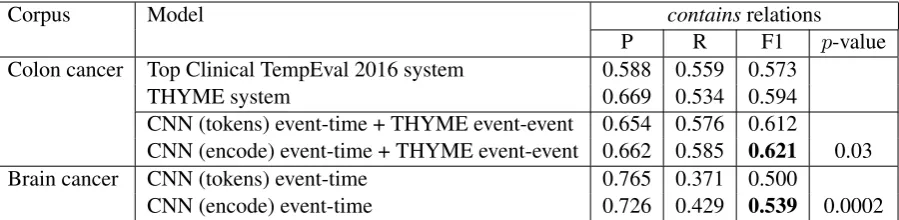
Table 2: Performance on both Colon and Brain test sets with the Clinical TempEval evaluation.
only evaluated on the event-time CNN models, so that we could directly assess the contribution of encoding time expressions as time class tags.
The top 4 rows of Table2show performance on the colon cancer test set for the best model from Clinical TempEval 2016, the THYME system, our CNN model with tokens only, and our CNN model where time expressions are encoded with time class tags. (To allow comparison with prior work, the event-time relation predictions made by our CNN models were coupled with the event-event relation predictions from the THYME system.) The bottom two rows of Table2show performance on the brain cancer test set. On both colon and brain corpora, the encoded CNN model outperformed the regu-lar CNN model significantly, based on a Wilcoxon signed-rank test over document-by-document com-parisons, as in (Cherry et al.,2013).
4 Discussion
The CNN filters in the first layers are designed to detect the presence of highly discriminative pat-terns. For the event-time relation extraction task, one such pattern signaling a containsrelation is “on Mar 11, 2014” as in Figure1. However, a more generalizable pattern should be – “on DATE”. Our time-class tag representation provided such infor-mation and contributed towards generalizability. A size-two filter can easily capture such a useful pattern, instead of picking up less generalizable pat-terns like “on March” or “11 ,” (shown in Figure1). For a time-sensitive learning task, especially the event-time relation extraction, our time encoding technique has been proved effective on two corpora. We hypothesize the contribution is from generaliz-ability and efficient filter computation.
Our method did not work for event-event rela-tions because time expressions are not critical cues for such relations. CNN models as a whole did not outperform the conventional THYME
event-event system, as confirmed byDligach et al.(2017). Event-event relations have lower inter-annotator agreement and usually leverage more of the syn-tactic information and event properties (Xu et al.,
2013), which are not perfectly captured by token sequences. The class imbalance issues are more severe for event-event relations than for event-time relations as well (Dligach et al.,2017). These likely lead to a lower performance for event-event CNNs. In the future, we will investigate methods to im-prove the event-event model including incorporat-ing syntactic information and event properties into a deep neural framework, and positive instance augmentationYu and Jiang(2016).
Word embeddings trained by conventional meth-ods such as word2vec and GloVe did not prove to be useful in our preliminary experiments. This is likely due to (1) lack of sufficiently large publicly available domain-specific corpora, and (2) inability of the conventional methods to capture the seman-tic properties of events that are key for the relation extraction task (such as event durations).
Currently, when we combined our encoded CNN-based event-time model with the THYME event-event model, we achieved the state-of-the-art performance (0.621F) on the colon cancer data. The best 2016 Clinical TempEval system achieved 0.573F (Bethard et al.(2016); row 1 of Table2), the result of the THYME system was 0.594F (Lin et al.
(2016b); row 2 of Table2), while our best com-bined model reached 0.621F, significantly higher (p=0.03) than the 0.612F of the combination of a regular CNN event-time model and the THYME event-event model. Note that the number of gold event-time containsrelation instances is similar to the number of gold event-eventcontains rela-tions (Lin et al.,2016a). Having a better event-time model indeed made the difference.
new deep learning world has called for minimal-istic pre-processing as input to powerful learners. We propose a new direction to combine the best of both worlds – infusing some knowledge into the learner input. For CNN models, multi-word time expressions are imperfectly represented in the to-ken sequence representation. With a little engineer-ing, we can encapsulate the time expressions in one tag with different granularities. Our experiments show that this small change still takes minimum linguistic preprocessing but delivers a significant performance boost for a temporal relation extrac-tion task. There are other multi-token named enti-ties (locations, organizations, etc.) where it may be hard to generalize over their multiple tokens. We believe our encoding strategy is likely to benefit tasks where critical linguistic information resides in phrases or multi-word units.
Acknowledgments
The study was funded by R01LM10090 (THYME), R01GM103859 (iPGx), and U24CA184407 (Deep-Phe). The content is solely the responsibility of the authors and does not necessarily represent the offi-cial views of the National Institutes of Health. The Titan X GPU used for this research was donated by the NVIDIA Corporation.
References
Steven Bethard. 2013. A synchronous context free grammar for time normalization. InProceedings of the 2013 Conference on Empirical Methods in Natu-ral Language Processing. Association for Computa-tional Linguistics, Seattle, Washington, USA, pages 821–826. http://www.aclweb.org/anthology/D13-1078.
Steven Bethard, Guergana Savova, Wei-Te Chen, Leon Derczynski, James Pustejovsky, and Marc Verhagen. 2016. Semeval-2016 task 12: Clinical tempeval.
Proceedings of SemEvalpages 1052–1062.
Colin Cherry, Xiaodan Zhu, Joel Martin, and Berry de Bruijn. 2013. la recherche du temps perdu: extracting temporal relations from medical text in the 2012 i2b2 nlp challenge. Journal of the Ameri-can Medical Informatics Association20(5):843–848. https://doi.org/10.1136/amiajnl-2013-001624.
Franc¸ois Chollet. 2015. Keras. https://github. com/fchollet/keras.
Ronan Collobert, Jason Weston, L´eon Bottou, Michael Karlen, Koray Kavukcuoglu, and Pavel Kuksa. 2011. Natural language processing (almost) from scratch. Journal of Machine Learning Research
12(Aug):2493–2537.
Amar K Das and Mark A Musen. 1995. A compari-son of the temporal expressiveness of three database query methods. InProceedings of the Annual Sym-posium on Computer Application in Medical Care. American Medical Informatics Association, page 331.
Dmitriy Dligach, Timothy Miller, Chen Lin, Steven Bethard, and Guergana Savova. 2017. Neural tem-poral relation extraction. EACL 2017page 746.
Rie Johnson and Tong Zhang. 2014. Effective use of word order for text categorization with convolutional neural networks. arXiv preprint arXiv:1412.1058.
Michael G Kahn, Larry M Fagan, and Samson Tu. 1990. Extensions to the time-oriented database model to support temporal reasoning in medical ex-pert systems. Methods of information in medicine
30(1):4–14.
Nal Kalchbrenner, Edward Grefenstette, and Phil Blun-som. 2014. A convolutional neural network for mod-elling sentences.arXiv preprint arXiv:1404.2188.
Chen Lin, Dmitriy Dligach, Timothy A Miller, Steven Bethard, and Guergana K Savova. 2016a. Multi-layered temporal modeling for the clinical domain.
Journal of the American Medical Informatics Asso-ciation23(2):387–395.
Chen Lin, Elizabeth W Karlson, Dmitriy Dligach, Monica P Ramirez, Timothy A Miller, Huan Mo, Natalie S Braggs, Andrew Cagan, Vivian Gainer, Joshua C Denny, and Guergana K Savova. 2014. Automatic identification of methotrexate-induced liver toxicity in patients with rheumatoid arthri-tis from the electronic medical record. Journal of the American Medical Informatics Association
https://doi.org/10.1136/amiajnl-2014-002642.
Chen Lin, Timothy Miller, Dmitriy Dligach, Steven Bethard, and Guergana Savova. 2016b. Improving temporal relation extraction with training instance augmentation. InProceedings of the 15th Workshop on Biomedical Natural Language Processing. Asso-ciation for Computational Linguistics, pages 108– 113.
Tomas Mikolov, Ilya Sutskever, Kai Chen, Greg S Cor-rado, and Jeff Dean. 2013. Distributed representa-tions of words and phrases and their compositional-ity. InAdvances in neural information processing systems. pages 3111–3119.
Timothy A Miller, Steven Bethard, Dmitriy Dligach, Chen Lin, and Guergana K Savova. 2015. Extract-ing time expressions from clinical text. In Proceed-ings of the 2015 Workshop on Biomedical Natural Language Processing (BioNLP 2015). Association for Computational Linguistics, pages 81–91.
Reinhold Schmidt, Stefan Ropele, Christian Enzinger, Katja Petrovic, Stephen Smith, Helena Schmidt, Paul M Matthews, and Franz Fazekas. 2005. White matter lesion progression, brain atrophy, and cog-nitive decline: the austrian stroke prevention study.
Annals of neurology58(4):610–616.
Yelong Shen, Xiaodong He, Jianfeng Gao, Li Deng, and Gr´egoire Mesnil. 2014. Learning semantic rep-resentations using convolutional neural networks for web search. In Proceedings of the 23rd Interna-tional Conference on World Wide Web. ACM, pages 373–374.
Jannik Str¨otgen and Michael Gertz. 2013. Multi-lingual and cross-domain temporal tagging. Lan-guage Resources and Evaluation 47(2):269–298. https://doi.org/10.1007/s10579-012-9179-y.
William F Styler IV, Steven Bethard, Sean Finan, Martha Palmer, Sameer Pradhan, Piet C de Groen, Brad Erickson, Timothy Miller, Chen Lin, Guergana Savova, et al. 2014. Temporal annotation in the clin-ical domain. Transactions of the Association for Computational Linguistics2:143–154.
Theano Development Team. 2016. Theano: A
Python framework for fast computation of mathe-matical expressions. arXiv e-printsabs/1605.02688. http://arxiv.org/abs/1605.02688.
Yan Xu, Yining Wang, Tianren Liu, Junichi Tsujii, I Eric, and Chao Chang. 2013. An end-to-end sys-tem to identify sys-temporal relation in discharge sum-maries: 2012 i2b2 challenge. Journal of the Amer-ican Medical Informatics Association 20(5):849– 858.
Wen-tau Yih, Xiaodong He, and Christopher Meek. 2014. Semantic parsing for single-relation question answering. InACL (2). Citeseer, pages 643–648.
Jianfei Yu and Jing Jiang. 2016. Pairwise relation clas-sification with mirror instances and a combined con-volutional neural network.Proceedings of COLING 2016.