Integrated sentence generation with charts
Alexander Koller and Nikos Engonopoulos Saarland University, Saarbr¨ucken, Germany
{koller|nikos}@coli.uni-saarland.de
Abstract
Integrating surface realization and the gen-eration of referring expressions (REs) into a single algorithm can improve the quality of the generated sentences. Existing algorithms for doing this, such as SPUD and CRISP, are search-based and can be slow or incom-plete. We offer a chart-based algorithm for integrated sentence generation which supports efficient search through chart pruning.
1 Introduction
It has long been argued (Stone et al., 2003) that the strict distinction between surface realization and sentence planning in the classical NLG pipeline (Re-iter and Dale, 2000) can cause difficulties for an NLG system. Generation decisions that look good to the sentence planner may be hard or impossible for the realizer to express in natural language. Further-more, a standalone sentence planner must compute each RE separately, thus missing out on opportuni-ties for succinct REs that are ambiguous in isolation but correct in context (Stone and Webber, 1998).
Algorithms such as SPUD (Stone et al., 2003) and CRISP (Koller and Stone, 2007) perform surface re-alization and parts of sentence planning, including RE generation, in an integrated fashion. Such inte-grated algorithms for sentence generation can bal-ance the needs of the realizer and the sentence plan-ner and take advantage of opportunities for succinct realizations. However, integrated sentence planning multiplies the complexities of two hard combinato-rial problems, and thus existing, search-based algo-rithms can be inefficient or fail to find a good
solu-tion; SPUD’s greedy search strategy may even find no solution at all, even when one exists.
By contrast, chart-based algorithms have been shown in parsing to remain efficient and accurate even for large inputs because they support structure sharing and very effective pruning techniques. Chart algorithms have been successfully applied to surface realization (White, 2004; Gardent and Kow, 2005; Carroll and Oepen, 2005; Schwenger et al., 2016), but in RE generation, most algorithms are not chart-based, see e.g. (Dale and Reiter, 1995; Krahmer et al., 2003). One exception is the chart-based RE gen-eration of Engonopoulos and Koller (2014).
In this paper, we present a chart-based algorithm for integrated surface realization and RE generation. This makes it possible – to our knowledge, for the first time – to apply chart-based pruning techniques to integrated sentence generation. Our algorithm ex-tends the chart-based RE generation algorithm of Engonopoulos and Koller (2014) by keeping track of the semantic content that has been expressed by each chart item. Because it is modular on the string side, the same algorithm can be used to generate with context-free grammars or TAGs, with or without fea-ture strucfea-tures, at no expense in runtime efficiency. An open-source implementation of our algorithm, based on the Alto system (Gontrum et al., 2017), can
be found atbitbucket.org/tclup/alto.
2 Chart-based integrated generation
We first describe the grammar formalism we use. Then we explain the sentence generation algorithm and discuss its runtime performance.
(a) (b) (c) {e}←−−−−−−IR sleepe,r2
defr2
rabbitr2
whiter2
IN
−−−→ {sleep(e, r2),rabbit(r2),white(r2)} [∩2]1
uniqr2
∩1
white rabbit sleep
]
]
white(r2) rabbit(r2) sleep(e, r2)
[image:2.612.77.295.57.154.2](d) IS:•(•(the,•(white,rabbit)),sleeps) =”the white rabbit sleeps”
Figure 1:A derivation tree (b) with its interpretations (a, c, d).
2.1 Semantically interpreted grammars
We describe the integrated sentence generation problem in terms ofsemantically interpreted
gram-mars (SIGs) (Engonopoulos and Koller, 2014), a
special case of Interpreted Regular Tree Grammars (Koller and Kuhlmann, 2011). We introduce SIGs by example, and refer to Engonopoulos and Koller (2014) for detailed definitions.
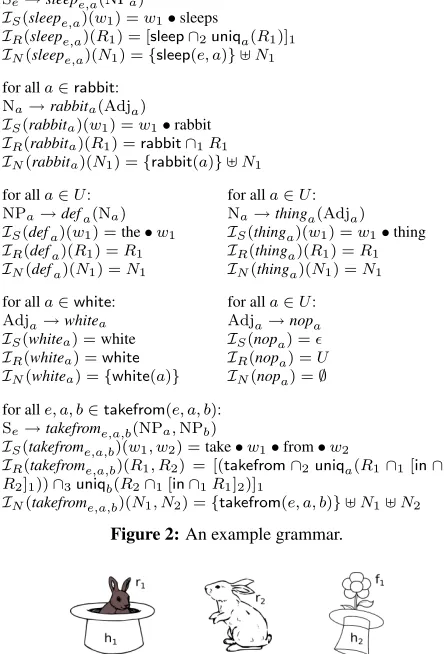
An example SIG grammar is shown in Fig. 2. At the core of each grammar rule is a rule of the form
Aa → f(Bb, . . . ,Zz). The symbols A, . . . ,Z are
nonterminals such as S, NP, VP, anda, . . . , zare se-mantic indices, i.e. constants for individuals indicat-ing to which object in the model a natural-language expression is intended to refer. These core rules al-low us to recursively derive aderivation tree, such as the one shown in Fig. 1b, representing the abstract syntactic structure of a natural-language expression. Each derivation tree t is mapped to a string through a functionIS. This function is defined
re-cursively for each rule of the grammar. In the ex-ample grammar of Fig. 2, we haveIS(whiter2) =
white, i.e. the word “white”. Given a string w1, we have IS(rabbitr2)(w1) = w1 • rabbit, where
“•” is string concatenation. This means that given a subtree t0 which evaluates to the string w1, a string for the treerabbitr2(t0)is constructed by
ap-pending the word “rabbit” afterw1. For the com-plete derivation treetin Fig. 1, we obtainIS(t) =
“the white rabbit sleeps”.
At the same time and in the same way, the deriva-tion tree is also evaluated to a set of referents through a functionIR. Constants, such as rabbitandsleep,
are interpreted as subsets of and relations between the individuals in a given model. For instance, in the model of Fig. 3,rabbitdenotes the set{r1, r2}, whereasindenotes the relation{(r1, h1),(f1, h2)}.
for alle, a∈sleep: Se→sleepe,a(NPa)
IS(sleepe,a)(w1) =w1•sleeps
IR(sleepe,a)(R1) = [sleep∩2uniqa(R1)]1
IN(sleepe,a)(N1) ={sleep(e, a)} ]N1
for alla∈rabbit: Na→rabbita(Adja)
IS(rabbita)(w1) =w1•rabbit
IR(rabbita)(R1) =rabbit∩1R1
IN(rabbita)(N1) ={rabbit(a)} ]N1
for alla∈U: NPa→defa(Na)
IS(defa)(w1) =the•w1
IR(defa)(R1) =R1
IN(defa)(N1) =N1
for alla∈U: Na→thinga(Adja)
IS(thinga)(w1) =w1•thing
IR(thinga)(R1) =R1
IN(thinga)(N1) =N1
for alla∈white: Adja→whitea
IS(whitea) =white
IR(whitea) =white
IN(whitea) ={white(a)}
for alla∈U: Adja→nopa IS(nopa) =
IR(nopa) =U
IN(nopa) =∅
for alle, a, b∈takefrom(e, a, b): Se→takefrome,a,b(NPa,NPb)
IS(takefrome,a,b)(w1, w2) =take•w1•from•w2
IR(takefrome,a,b)(R1, R2) = [(takefrom∩2uniqa(R1∩1[in∩2
R2]1))∩3uniqb(R2∩1[in∩1R1]2)]1
[image:2.612.312.534.71.398.2]IN(takefrome,a,b)(N1, N2) ={takefrom(e, a, b)} ]N1]N2 Figure 2:An example grammar.
Figure 3:An example model.
These relations are then combined using intersec-tion R1 ∩i R2 (yielding the subset of elements of
R1 whose i-th component is an element of the set R2), projection[R]i(yielding the set ofi-th
compo-nents of the tuples inR), and the uniqueness checker
uniqa(R)(yieldingRifR ={a}and∅otherwise).
Under this interpretation, the derivation tree in Fig. 1 maps to the set{e}, given the model in Fig. 3.
Observe, finally, that each rule is annotated with a “for all” clause, which creates instances of the rule for each tuple of individuals that satisfies the con-dition. We also mention that although we only use unary attributes such as “rabbit” and “white” in this example grammar, SIGs deal easily with relational attributes such as “in” or “next to”; see Engonopou-los and Koller (2014).
[image:2.612.351.505.359.400.2][B1, R1, N1] . . . [Bk, Rk, Nk] A→r(B1, ..., Bk)inG
[A,IR(r)(R1, . . . , Rk),IN(r)(N1, . . . , Nk)]
Figure 4:The chart computation algorithm.
of target referents, will compute a chart describing all derivationstofGwithIR(t) = R – that is, all
semantically valid REs forR.
Here we extend both SIGs and this algorithm to include surface realization. We assume that the generation algorithm is given a set N of
seman-tic atomsin addition to the grammar Gand
refer-ent set R, and should return only derivations that refer to R while expressing at least all the atoms in N. We achieve this by adding an interpreta-tion IN to SIGs, such that IN(t) will return a set
of semantic atoms expressed by the derivation tree t. We have added such IN clauses to the
gram-mar in Fig. 2. For example, the rule for whiter2
expresses the set {white(r2)} of semantic atoms. The rule forrabbitr2 evaluates to the disjoint union
of{rabbit(r2)}with whatever its “Adj” subtree
ex-pressed. Thus, theIN interpretation keeps track of
the semantic atoms expressed by each subtree of a derivation tree; in the example of Fig. 1, we see that the derivation tree as a whole expresses the semantic atoms{sleep(e, r2),rabbit(r2),white(r2)}.
Given a grammarG, target referent setR, and tar-get semantic contentN, we can now compute a chart that describes all derivation trees t of G such that
IR(t) = R and IN(t) ⊇ N; thus this algorithm
performs surface realization and RE generation at the same time. The algorithm, shown in Fig. 4 in the form of a parsing schema (Shieber et al., 1995), computeschart items[A, R, N]in a bottom-up fash-ion. Such an item states that there is a treetsuch that tcan be derived fromA, and we haveIR(t) = R
andIN(t) =N. Givenkitems for subtrees derived
from the nonterminalsB1, . . . , Bkas premises and a
ruler that can combine these into a nonterminalA, the algorithm creates a new item forAin which the
IRandIN functions for that rule were applied to the
referent sets and semantic contents of the subtrees. Given the inputsR and N, we define a goal item
to be an item[S, R, N0]whereSis the start symbol of the grammar andN0 ⊇ N. Each goal item the algorithm discovers thus represents a sentence that achieves the given communicative goals.
An example run of the algorithm, for the inputs
1 [Adjr2,{r2},{whiter2}] (whiter2)
2 [Adjr2, U,∅] (nopr2)
3 [Nr2,{r2},{whiter2,rabbitr2}] (rabbitr2, 1)
4 [Nr2,{r2},{whiter2}] (thingr2, 1)
5 [Nr2,{r1, r2},{rabbitr2}] (rabbitr2, 2)
6 [NPr2,{r2},{whiter2,rabbitr2}] (ther2, 3)
7 [NPr2,{r2},{whiter2}] (ther2, 4)
8 [NPr2,{r1, r2},{rabbitr2}] (ther2, 5)
9 [Se,{e},{whiter2,rabbitr2,sleepe,r2}] (sleepe, 6)
10 [Se,{e},{whiter2,sleepe,r2}] (sleepe, 7)
11 [Se,∅,{rabbitr2,sleepe,r2}] (sleepe, 8)
Figure 5:Excerpt from the chart for “The white rabbit sleeps.”
R={e}andN ={rabbit(r2)}, is shown in Fig. 5.
Each row in the chart corresponds to one application of the rule in Fig. 4. The grammar rule that was used, along with any premises, is given in brackets to the right. Observe that the only goal item, (9), corre-sponds to the derivation in Fig. 1, and hence the out-put string “the white rabbit sleeps”; the derivation can be reconstructed by following the backpointers to the premise items recursively. Observe also that (10) – for “the white thing sleeps” – is not a goal item because its semantic content is not a superset of N. The item (11) – for “the rabbit sleeps” – is not a goal item either: Its referent set is empty be-cause (8) is not a unique RE forr2, and thus the term
uniqr2(R1)in the “sleep” rule evaluates to the empty
set. Thus, the algorithm performs both surface real-ization and RE generation.
2.3 Generating succinct REs in context
One advantage of integrating surface realization with RE generation is that REs can be more succinct in the context of a larger grammatical construction than in isolation. The shortest standalone RE forr1 in Fig. 3 is “the brown rabbit”, but it is perfectly fe-licitous to say “takethe rabbitfrom the hat”. Stone and Webber (1998) explain this in terms of the pre-suppositions of the verb “take X from Y”, which say that X must be in Y, and thus the REs X and Y can mutually constrain each other. They also show how the SPUD algorithm can generate such succinct REs in the context of the verb, by global reasoning over the referent sets of all REs in the sentence.
Our algorithm can generate such REs as well, and can do it in an efficient, chart-based way.
As-sume R = {e2}and N = {takefrom(e2, r1, h1)}
and the grammar in Fig. 2. The chart
sub-derivation-trees t1 = defr1(rabbitr1(nopr1)) (“the rabbit”)
and t2 = defh1(hath1(noph1)) (“the hat”), with
R1 = IR(t1) = {r1, r2} and R2 = IR(t2) =
{h1, h2}; thus, these REs are not by themselves unique. These trees are then combined with the rule takefrome2,r1,h1. This rule intersects R1 with
the set of things that are “in” an element ofR2, en-coding the presupposition of “take X from Y”. Thus R1∩1 [in∩2R2]1 evaluates to {r1}, satisfying the uniqueness condition. Thus, the algorithm returns t=takefrome2,r1,h1(t1, t2)as a valid realization.
Note that we achieved the ability to let REs mutu-ally constrain each other by moving the requirement for semantic uniqueness to the verb that subcatego-rizes for the RE. This is in contrast to the standard assumption that it is the definite article that requires uniqueness, but permits us a purely grammar-based treatment of mutually constraining REs which re-quires no further reasoning capabilities.
2.4 Chart generation with heuristics
Our algorithm can enumerate all subsetsN of the true semantic atoms in the model, and thus has worst-case exponential runtime. This is probably unavoidable, given that surface realization and the generation of shortest REs are both NP-complete (Koller and Striegnitz, 2002; Dale and Reiter, 1995). However, because it is a chart-based algorithm, we can use heuristics to avoid computing the whole chart, and thus speed up the search for the best so-lution. To get an impression of this, assume that we are looking for ashortsentence; other optimization criteria are also possible. We first compute the full chart CR for the IR part of the input alone, using
essentially the same algorithm as Engonopoulos and Koller (2014). FromCR we compute the distance
of each chart item to a goal item, i.e. the minimal number of rules that must be applied to the item to produce a goal item. We then refine the items of CR by adding the IN parts to each chart item.
Unprocessed chart items[A, R, N]are organized on an agenda which is ordered lexicographically by the number of atoms in the target semantic content that are not yet realized in N and then the distance of
[A, R]to a goal item inCR. We stop the chart com-putation once the first goal item has been found.
Using this pruning strategy, we measured runtimes with problems from the GIVE
Chal-lenge (Koller et al., 2010) on an 2.9 GHz Intel Core i5 CPU.1We compared the performance of our system against CRISP, which uses the FF planner (Hoffmann and Nebel, 2001) to perform the search. For CRISP, we only measured the time spent in run-ning the planner. On the most complex scene from GIVE that we tried, our system took 13 ms to gen-erate the sentence “Push the button to the left of the flower”, outperforming CRISP which generated the same sentence in 50 ms. Note that it is possible to construct (not entirely realistic) inputs for the gener-ator on which FF’s much more sophisticated search strategy outperforms the heuristic described above. By incorporating such a heuristic into chart genera-tion, e.g. as in Schwenger et al. (2016), our system could be accelerated further.
3 Conclusion
We have presented a chart-based algorithm for inte-grated surface realization and RE generation. Com-pared to earlier approaches to integrated sentence generation, our algorithm can exploit the capabil-ities of charts for structure-sharing and pruning to achieve higher runtime performance in practice. We have only presented a simple pruning strategy here, but it would be astraightforward extension to in-corporate pruning strategies from surface realization (White, 2004; Schwenger et al., 2016).
One advantage of our algorithm is that it is ag-nostic of the grammar formalism that is used on the string side. We have used context-free rules for reading off string representations from the gener-ated derivation trees, but because SIGs are special case of IRTGs, we could instead use a tree-adjoining grammar to construct strings instead (Koller and Kuhlmann, 2012). In fact, the runtime experiments in Section 2.4 were based on a TAG grammar to al-low direct comparison with CRISP.
With the algorithm presented here, it may be-come feasible for the first time to perform integrated sentence generation in the context of practical ap-plications. So far, grammars that support this lag far behind grammars for surface realization in size and complexity. It would thus be interesting to ei-ther convert existing surface realization grammars to SIGs, or to learn such grammars from data.
References
John Carroll and Stephan Oepen. 2005. High efficiency realization for a wide-coverage unification grammar. InProceedings of the 2nd IJCNLP.
Robert Dale and Ehud Reiter. 1995. Computational interpretations of the Gricean Maxims in the gener-ation of referring expressions. Cognitive Science, 19(2):233–263.
Nikos Engonopoulos and Alexander Koller. 2014. Gen-erating effective referring expressions using charts. In
Proceedings of the 8th International Conference on Natural Language Generation (INLG), Philadelphia. Claire Gardent and Eric Kow. 2005. Generating and
se-lecting grammatical paraphrases. In Proceedings of ENLG.
Johannes Gontrum, Jonas Groschwitz, Alexander Koller, and Christoph Teichmann. 2017. Alto: Rapid proto-typing for parsing and translation. InProceedings of the EACL Demo Session.
J¨org Hoffmann and Bernhard Nebel. 2001. The FF planning system: Fast plan generation through heuris-tic search. Journal of Artificial Intelligence Research, 14:253–302.
Alexander Koller and Marco Kuhlmann. 2011. A gener-alized view on parsing and translation. InProceedings of the 12th International Conference on Parsing Tech-nologies (IWPT).
Alexander Koller and Marco Kuhlmann. 2012. Decom-posing TAG algorithms using simple algebraizations. InProceedings of the 11th TAG+ Workshop.
Alexander Koller and Matthew Stone. 2007. Sentence generation as a planning problem. InProceedings of the 45th ACL.
Alexander Koller and Kristina Striegnitz. 2002. Genera-tion as dependency parsing. InProceedings of the 40th Annual Meeting of the Association for Computational Linguistics, pages 17–24, Philadelphia, PA, USA. Alexander Koller, Kristina Striegnitz, Donna Byron,
Jus-tine Cassell, Robert Dale, Johanna Moore, and Jon Oberlander. 2010. The First Challenge on Generating Instructions in Virtual Environments. In E. Krahmer and M. Theune, editors,Empirical Methods in Natural Language Generation, number 5790 in LNCS, pages 337–361. Springer.
Emiel Krahmer, Sebastiaan van Erk, and Andr´e Verleg. 2003. Graph-based generation of referring expres-sions.Computational Linguistics, 29(1):53–72. Ehud Reiter and Robert Dale. 2000. Building Natural
Language Generation Systems. Cambridge University Press, Cambridge, England.
Maximilian Schwenger, ´Alvaro Torralba, J¨org Hoffmann, David M. Howcroft, and Vera Demberg. 2016. From OpenCCG to AI planning: Detecting infeasible edges
in sentence generation. InProceedings of the 26th In-ternational Conference on Computational Linguistics (COLING).
Stuart Shieber, Yves Schabes, and Fernando Pereira. 1995. Principles and implementation of deductive parsing. Journal of Logic Programming, 24(1–2):3– 36.
Matthew Stone and Bonnie Webber. 1998. Textual econ-omy through close coupling of syntax and semantics. InProceedings of the 9th INLG.
Matthew Stone, Christine Doran, Bonnie Webber, Tonia Bleam, and Martha Palmer. 2003. Microplanning with communicative intentions: The SPUD system.
Computational Intelligence, 19(4):311–381.
Michael White. 2004. Reining in CCG chart realization. In Anja Belz, Roger Evans, and Paul Piwek, editors,