SeemGo: Conditional Random Fields Labeling and Maximum Entropy
Classification for Aspect Based Sentiment Analysis
Pengfei Liu and Helen Meng
Human-Computer Communications Laboratory
Department of Systems Engineering and Engineering Management The Chinese University of Hong Kong, Hong Kong SAR, China
{pfliu,hmmeng}@se.cuhk.edu.hk
Abstract
This paper describes our SeemGo sys-tem for the task of Aspect Based
Sen-timent Analysis in SemEval-2014. The
subtask of aspect term extraction is cast as a sequence labeling problem modeled with Conditional Random Fields that ob-tains the F-score of 0.683 for Laptops and 0.791 for Restaurants by exploiting both word-based features and context features. The other three subtasks are solved by the Maximum Entropy model, with the occur-rence counts of unigram and bigram words of each sentence as features. The sub-task of aspect category detection obtains the best result when applying the Boosting method on the Maximum Entropy model, with the precision of 0.869 for Restau-rants. The Maximum Entropy model also shows good performance in the subtasks of both aspect term and aspect category polarity classification.
1 Introduction
In this paper, we present the SeemGo system de-veloped for the task of Aspect Based Sentiment
Analysis in SemEval-2014. The task consists of
four subtasks: (1) aspect term extraction (iden-tify particular aspects of a given entity, e.g., lap-top, restaurant, etc.); (2) aspect category detection (detect the category of a given sentence, e.g., food, service for a restaurant, etc.), (3) aspect term larity, and (4) aspect category polarity. The po-larity of each aspect term or aspect category in-cludes positive, negative, neutral or conflict (i.e., both positive and negative).
This work is licenced under a Creative Commons Attribu-tion 4.0 InternaAttribu-tional License. Page numbers and proceed-ings footer are added by the organizers. License details: http://creativecommons.org/licenses/by/4.0/
In the SeemGo system, the subtask of aspect term extraction is implemented with the CRF model that shows good performance by integrat-ing both word-based features and context features. The other subtasks of aspect category detection, aspect term/category polarity classification are all developed with the MaxEnt model with the occur-rence counts of unigram and bigram words of each sentence as features. Experimental results show that MaxEnt obtains good performance in all the three subtasks. For the subtask of aspect cate-gory detection, MaxEnt obtains even better perfor-mance when combined with the Boosting method. The rest of this paper is organized as fol-lows: Section 2 discusses related work; Section 3 presents the architecture and the underlying mod-els of the SeemGo system as well as the experi-mental results. We summarize the paper and pro-pose future work in Section 4.
2 Related Work
The subtask of aspect term extraction is quite similar with Noun Phrase Chunking (NPC) (Sha and Pereira, 2003) and Named Entity Recognition (NER) (Finkel et al., 2005). NPC recognizes noun phrases from sentences, while NER extracts a set of entities such as Person, Place, and Organiza-tion. Both NPC and NER are sequential learn-ing problems and they are typically modelled by sequence models such as Hidden Markov Model (HMM) and CRF (Finkel et al., 2005).
For the task of aspect term extraction, some re-lated papers also model it with sequence models. Jin et al. (2009) proposed an HMM-based frame-work to extract product entities and associated opinion orientations by integrating linguistic fea-tures such as part-of-speech tag, lexical patterns and surrounding words/phrases. Choi et al. (2005) proposed a hybrid approach using both CRF and extraction patterns to identify sources of opinions in text. Jakob and Gurevych (2010) described a
CRF-based approach for the opinion target extrac-tion problem in both single- and cross-domain set-tings. Shariaty and Moghaddam (2011) used CRF for the task of identifying aspects, aspect usages and opinions in review sentences by making use of labeled dataset on aspects, opinions as well as background words in the sentences.
The task of aspect category detection is essen-tially a text classification problem, for which many techniques exist. Joachims (1998) explored the use of Support Vector Machines (SVM) for text categorization and obtained good performance due to their ability to generalize well in high-dimensional feature spaces. Nigam et al. (1999) proposed the MaxEnt model for document clas-sification by estimating the conditional distribu-tion of the class variable give the document, and showed that MaxEnt is significantly better that Naive Bayes on some datasets.
For polarity classification, Pang et al. (2002) conducted experiments on movie reviews and showed that standard machine learning techniques (e.g., Naive Bayes, SVM and MaxEnt) outperform human-produced baselines.
3 The SeemGo System
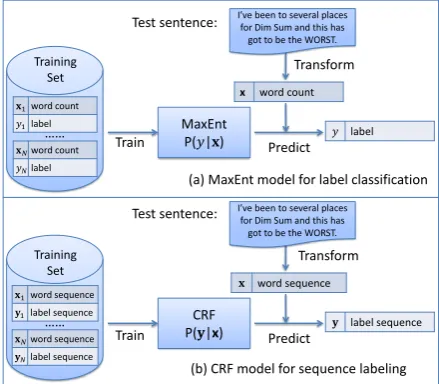
We use the CRF model (Lafferty et al., 2001) for the subtask of aspect term extraction, and adopt the MaxEnt model for the other three subtasks with the vectors ofword countas features. Each entry in the vector represents the occurrence count of each unigram or bigram words in the sentence. Figure 1 shows the architecture and the MaxEnt and CRF models of the SeemGo system. The la-belis denoted in lowercase (e.g. yfor sentiment), while word count, label sequence and word se-quenceare vectors, denoted in bold lowercase (e.g. yfor label sequence). We developed the SeemGo system in Java based on the MALLET Toolkit (McCallum, 2002) for MaxEnt and the Stanford CRFClassifier(Finkel et al., 2005) for CRF.
3.1 Background
3.1.1 Maximum Entropy Classifier
The MaxEnt model defines the conditional distri-bution of the class (y) given an observation vector xas the exponential form in Formula 1:
P(y|x) = 1Z(x)exp
K
X
k=1
θkfk(x, y)
!
(1)
……
𝐱1 word count
𝑦1 label MaxEnt
P(𝑦|𝐱) 𝑦 label
x word count
Train Predict
𝐱𝑁 word count
𝑦𝑁 label
Transform
(a) MaxEnt model for label classification I’ve been to several places
for Dim Sum and this has got to be the WORST. Test sentence:
Training Set
……
𝐱1 word sequence
𝐲1 label sequence CRF
P(𝐲|x) 𝐲 label sequence 𝐱 word sequence
Train Predict
𝐱𝑁 word sequence
𝐲𝑁 label sequence
Transform
(b) CRF model for sequence labeling I’ve been to several places
for Dim Sum and this has got to be the WORST. Test sentence:
[image:2.595.306.526.63.255.2]Training Set
Figure 1: The Architecture, the MaxEnt and CRF Models of the SeemGo System.
whereθkis a weight parameter to be estimated for the corresponding feature function fk(x, y), and
Z(x)is a normalizing factor over all classes to en-sure a proper probability.Kis the total number of feature functions.
3.1.2 Conditional Random Fields
CRF is an extension to the MaxEnt model for han-dling sequence data. The linear-chain CRF is a special case of CRF that obeys the Markov prop-erty between its neighbouring labels. Following McCallum and Li (2003), Formula 2 defines the linear-chain CRF:y ={yt}Tt=1,x ={xt}Tt=1are
label sequence and observation sequence respec-tively, and there areK arbitrary feature functions {fk}1≤k≤K and the corresponding weight param-eters {θk}1≤k≤K. Z(x) is a normalizing factor over all label sequences.
P(y|x) = 1Z(x)exp XT
t=1 K
X
k=1
θkfk(yt, yt−1,x, t) !
(2)
In the labeling phase, the Viterbi decoding algo-rithm is applied to find the best label sequencey∗ for the observation sequencex.
3.2 Subtask 1: Aspect Term Extraction
3.2.1 IOB Labeling
Since an aspect term can contain multiple words (e.g., hard disk), we define the label B-TERM
for the beginning of an aspect term, the label I-TERM for the subsequent inside words or end word of an aspect term and the labelOfor all other words. This definition follows the Inside,
Out-side, Beginning(IOB) labeling scheme (Ramshaw
and Marcus, 1999). The subtask 1 can be viewed as a sequence labeling problem by labeling each word either as B-TERM, I-TERM or O. Figure 2 shows two example sentences labeled with the IOB2 scheme1.
The hard disk is very noisy.
O B-TERM I-TERM O O O
I liked the service and the staff.
[image:3.595.307.523.132.272.2]O O O B-TERM O O B-TERM
Figure 2: Example Sentences with IOB2 Labels.
3.2.2 Features for the CRF Model
In CRF, features typically refer to feature func-tions {fk}, which can be arbitrary functions. In text applications, CRF features are typically bi-nary (Sutton and McCallum, 2012). As an exam-ple for “virus protection”, a binary feature func-tion may have value 1 if and only if the label for “virus” isB-TERMand the current word “protec-tion” has the suffix of ““protec-tion”, and otherwise 0. Similar to the features used in Finkel et al. (2005) for the NER task, Table 1 summarizes the features for the aspect term extraction task. We call the fea-tures derived from the current word word-based features such as wid, wcharacter, and the features from the surrounding words and the previous label thecontexfeatures (context).
We consider the sentence“I’ve been to several places for Dim Sum and this has got to be the
WORST.”as an example to explain why we choose
these features: (a) word-based features: the word “Sum” is located in the middle of the sentence, with the first character capitalized. (b) context fea-tures: the previous word “Dim” is also capitalized in the first character and the label of “Dim” is as-sumed to be “B-TERM”. By combining the word-based features and the context features, the Viterbi decoding algorithm will then label “Sum” as “I-TERM” with high degree of confidence, which is
1With IOB2, every aspect term begins with the B label.
[image:3.595.75.287.253.315.2]a part of the multi-word term “Dim Sum”, instead of a mathematical function in some other context.
Table 1: Features for the CRF Model. Feature Description
wid word identity
wcharacter whether the word characters are capital-ized, hyphenated, numeric, e.g., built-in camera, BIOS, Dim Sum, Windows 7
wlocation word index in the word sequencex
wngram
n-gram character sequences of each word with maximum length of 6, includ-ing prefixes and suffixes, e.g.,“tion”in specification, navigation
context current word(wt− wt, its neighbouring words 2,...,wt+2) and previous labelyt−1 wpos part-of-speech tag of each word
3.2.3 Experimental Results
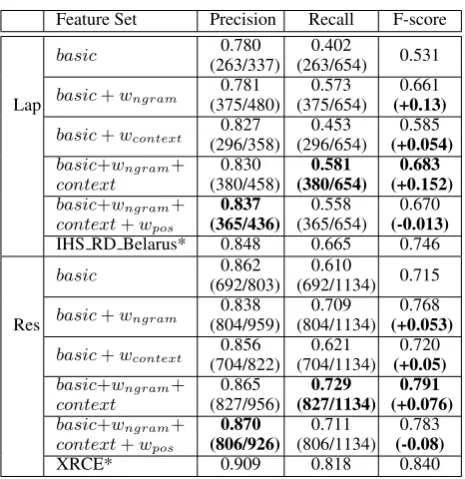
We trained the CRF model with different fea-ture set on the training set provided by the Se-mEval2014 organizers, and reported the experi-mental results on the testing set by the evaluation tooleval.jar. The detailed experimental results are listed in Table 2. Thebasicfeature set consists of
wid,wcharacterandwlocation. The results from one of the best systems on each dataset are also listed, marked with the star (*).
Table 2: Experimental Results on Different Fea-ture Set for Aspect Term Extraction.
Feature Set Precision Recall F-score
Lap
basic (263/337)0.780 (263/654)0.402 0.531
basic+wngram (375/480)0.781 (375/654)0.573 (+0.13)0.661 basic+wcontext (296/358)0.827 (296/654)0.453 (+0.054)0.585 basic+wngram+
context (380/458)0.830 (380/654)0.581 (+0.152)0.683
basic+wngram+
context+wpos (365/436)0.837 (365/654)0.558 (-0.013)0.670
IHS RD Belarus* 0.848 0.665 0.746
Res
basic (692/803)0.862 (692/1134)0.610 0.715
basic+wngram (804/959)0.838 (804/1134)0.709 (+0.053)0.768 basic+wcontext (704/822)0.856 (704/1134)0.621 (+0.05)0.720 basic+wngram+
context (827/956)0.865 (827/1134)0.729 (+0.076)0.791
basic+wngram+
context+wpos (806/926)0.870 (806/1134)0.711 (-0.08)0.783
XRCE* 0.909 0.818 0.840
We have the following observations:
[image:3.595.307.540.470.710.2]greatest performance improvement, with the absolute increase of F-score by 13% for Lap-tops and 5.3% for Restaurants; while adding the wcontext feature improves the F-score by around 5% for both datasets.
(2) Combining the word-based features (basic
and wngram) and the context-based features (wcontext) lead to the best performance for both datasets in terms of recall and F-score. (3) The POS tags lead to a decreasein both
re-call and F-score, with the absolute decrease of F-score by 1.3% for Laptops and 8% for Restaurants. The same observation is also re-ported by Tkachenko and Simanovsky (2012) for NER.
3.3 Subtask 3: Aspect Category Detection
We encode each sentence as a feature vector x with each entry representing occurrence count of each unigram word and bigram words (i.e.,word count). All words are lowercased, while keeping the stopwords as most sentences in the datasets are short. Using the provided training set, We trained a MaxEnt classifier (ME)P(y|x)with a Gaussian prior variance of 20 to prevent overfitting.
We also tried the Bagging (Breiman, 1996) on MaxEnt (BaggingME) and the Boosting (Freund and Schapire, 1996) on MaxEnt (BoostME). Table 3 shows the experimental results on the provided testing set. It shows that the Boosting method on MaxEnt improves both precision and recall as well as the F-score by 1.1%. The best evaluation result is by the NRC-Canada team.
Table 3: Performance of Different Classifiers for Aspect Category Detection.
Classifier Precision Recall F-score ME (686/800)0.858 (686/1025)0.669 0.752 BagME (674/800)0.843 (674/1025)0.658 0.739 BoostME (695/800)0.869 (695/1025)0.678 0.762
Best* 0.910 0.862 0.886
3.4 Subtask 2 & 4: Aspect Term & Category Polarity Classification
Similar to subtask-3, we also used MaxEnt for the subtasks of 2 and 4, with word count as features. For category polarity classification, we count the words from both the sentence and the category
name. For example, we count the sentence “The Dim Sum is delicious.” and its category “Food” as features. This improves performance compared with counting the sentence only.
[image:4.595.308.525.317.427.2]Table 4 shows the accuracy of each classifier for the subtasks of 2 and 4 on Laptops and Restau-rants, including the best results from NRC-Canada (a) and DCU (b). In both datasets, the distributions of aspect term/category polarities are very imbal-anced with very few sentences onconflictbut with most sentences onpositiveornegative. This leads to very low classification performance for the con-flictclass, with the F-score less than 0.2. In this case, the Boosting method does not necessarily improve the performance.
Table 4: Accuracy of Different Classifiers for As-pect Term & Category Polarity Classification.
Classifier Laptops TermRestaurants (Restaurants)Category
ME (424/654)0.648 (827/1134)0.729 (771/1025)0.752 BagME (415/654)0.635 (830/1134)0.732 (771/1025)0.752 BoostME (420/654)0.642 (828/1134)0.730 (766/1025)0.747
Best* 0.705 (a,b)(461/654) (918/1134)0.810 (b) (850/1025)0.829 (a)
3.5 Evaluation Ranks
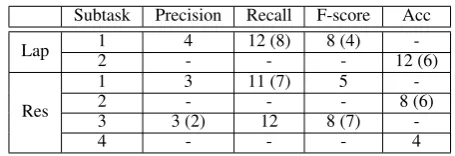
[image:4.595.303.531.596.674.2]Table 5 shows the official ranks (and the new ranks in braces of the revised version after evaluation) of the SeemGo system on the two datasets. The eval-uation metrics are Precision, Recall and F-score for the subtasks of 1 and 3, and Accuracy (Acc) for the subtasks of 2 and 4.
Table 5: Ranks of SeemGo on the Constrained Run (Using only the Provided Datasets).
Subtask Precision Recall F-score Acc Lap 12 4- 12 (8)- 8 (4)- 12 (6)
-Res
1 3 11 (7) 5
-2 - - - 8 (6)
3 3 (2) 12 8 (7)
-4 - - - 4
4 Conclusions
SemEval-2014. For the subtask of aspect term ex-traction, CRF is trained with both the word-based features and the context features. For the other three subtasks, MaxEnt is trained with the fea-tures of the occurrence counts of unigram and bi-gram words in the sentence. The subtask of aspect category detection obtains the best performance when applying the Boosting method on MaxEnt. MaxEnt also shows good average accuracy for po-larity classification, but obtains low performance for theconflictclass due to very few training sen-tences.This leaves us the future work to improve classification performance for imbalanced datasets (He and Garcia, 2009).
Acknowledgements
We thank the organizers for their hard work in or-ganizing this evaluation, and the two anonymous reviewers for their helpful comments.
References
Leo Breiman. 1996. Bagging predictors. Machine
learning, 24(2):123–140.
Yejin Choi, Claire Cardie, Ellen Riloff, and Siddharth Patwardhan. 2005. Identifying sources of opin-ions with conditional random fields and extraction
patterns. InProceedings of the Conference on
Hu-man Language Technology and Empirical Methods in Natural Language Processing, pages 355–362. Jenny Rose Finkel, Trond Grenager, and Christopher
Manning. 2005. Incorporating non-local informa-tion into informainforma-tion extracinforma-tion systems by gibbs
sampling. InProceedings of the 43rd Annual
Meet-ing on Association for Computational LMeet-inguistics, pages 363–370.
Yoav Freund and Robert E Schapire. 1996.
Experi-ments with a new boosting algorithm. In
Interna-tional Conference on Machine Learning, volume 96, pages 148–156.
Haibo He and Edwardo A Garcia. 2009. Learning
from imbalanced data. Knowledge and Data
Engi-neering, IEEE Transactions on, 21(9):1263–1284. Niklas Jakob and Iryna Gurevych. 2010. Extracting
opinion targets in a single-and cross-domain setting
with conditional random fields. InProceedings of
the Conference on Empirical Methods in Natural Language Processing, pages 1035–1045.
Wei Jin, Hung Hay Ho, and Rohini K Srihari. 2009. A novel lexicalized HMM-based learning framework
for web opinion mining. InProceedings of the
In-ternational Conference on Machine Learning, pages 465–472. Citeseer.
Thorsten Joachims. 1998. Text categorization with
support vector machines: Learning with many rel-evant features. Springer.
John Lafferty, Andrew McCallum, and Fernando CN Pereira. 2001. Conditional random fields: Prob-abilistic models for segmenting and labeling se-quence data.
Andrew McCallum and Wei Li. 2003. Early results for named entity recognition with conditional random fields, feature induction and web-enhanced lexicons. InProceedings of the seventh conference on Natural language learning at HLT-NAACL 2003-Volume 4, pages 188–191.
Andrew Kachites McCallum. 2002. MALLET: A Ma-chine Learning for Language Toolkit.
Kamal Nigam, John Lafferty, and Andrew McCallum. 1999. Using maximum entropy for text
classifica-tion. In IJCAI-99 workshop on machine learning
for information filtering, volume 1, pages 61–67. Bo Pang, Lillian Lee, and Shivakumar Vaithyanathan.
2002. Thumbs up?: sentiment classification using
machine learning techniques. InProceedings of the
Conference on Empirical Methods in Natural Lan-guage Processing, pages 79–86.
Lance A Ramshaw and Mitchell P Marcus. 1999. Text chunking using transformation-based learning. In
Natural language processing using very large cor-pora, pages 157–176. Springer.
Fei Sha and Fernando Pereira. 2003. Shallow
pars-ing with conditional random fields. InProceedings
of the Conference of the North American Chapter of the Association for Computational Linguistics on Human Language Technology, pages 134–141. Shabnam Shariaty and Samaneh Moghaddam. 2011.
Fine-grained opinion mining using conditional
ran-dom fields. InData Mining Workshops (ICDMW),
2011 IEEE 11th International Conference on, pages 109–114. IEEE.
Charles Sutton and Andrew McCallum. 2012. An
in-troduction to conditional random fields.
Founda-tions and Trends in Machine Learning, 4(4):267– 373.
Maksim Tkachenko and Andrey Simanovsky. 2012. Named entity recognition: Exploring features. In