ECNU: A Combination Method and Multiple Features for Aspect
Extraction and Sentiment Polarity Classification
Fangxi Zhang, Zhihua Zhang, Man Lan∗
Department of Computer Science and Technology East China Normal University
51111201041,[email protected]; [email protected]∗
Abstract
This paper reports our submissions to the four subtasks of Aspect Based Sentimen-t Analysis (ABSA) Sentimen-task (i.e., Sentimen-task 4) in SemEval 2014 including aspect term ex-traction and aspect sentiment polarity clas-sification (Aspect-level tasks), aspect cat-egory detection and aspect catcat-egory sen-timent polarity classification (Category-level tasks). For aspect term extraction, we present three methods, i.e., noun phrase (NP) extraction, Named Entity Recogni-tion (NER) and a combinaRecogni-tion of NP and NER method. For aspect sentiment classi-fication, we extracted several features, i.e., topic features, sentiment lexicon features, and adopted a Maximum Entropy classifi-er. Our submissions rank above average.
1 Introduction
Recently, sentiment analysis has attracted a lot of attention from researchers. Most previous work attempted to detect overall sentiment polarity on a text span, such as document, paragraph and sen-tence. Since sentiments expressed in text always adhere to objects, it is much meaningful to iden-tify the sentiment target and its orientation, which helps user gain precise sentiment insights on spe-cific sentiment target.
The aspect based sentiment analysis (ABSA) task (Task 4) (Pontiki et al., 2014) in SemEval 2014 is to extract aspect terms, determine its se-mantic category, and then to detect the sentimen-t oriensentimen-tasentimen-tion of sentimen-the exsentimen-tracsentimen-ted aspecsentimen-t sentimen-terms and isentimen-ts category. Specifically, it consists of 4 subtasks. The aspect term extraction (ATE) aims to extrac-t extrac-the aspecextrac-t extrac-terms from extrac-the senextrac-tences in extrac-two
giv-This work is licensed under a Creative Commons At-tribution 4.0 International Licence. Page numbers and pro-ceedings footer are added by the organisers. Licence details: http://creativecommons.org/licenses/by/4.0/
en domains (laptop and restaurant). The aspec-t caaspec-tegory deaspec-tecaspec-tion (ACD) is aspec-to idenaspec-tify aspec-the se-mantic category of aspects in a predefined set of aspect categories (e.g., food, price). The aspect term polarity (ATP) classification is to determine whether the sentiment polarity of each aspect is positive, negative, neutral or conflict (i.e., both positive and negative). The aspect category po-larity (ACP) classification is to determine the sen-timent polarity of each aspect category. We partic-ipated in these four subtasks.
Generally, there are three methods to extract as-pect terms: unsupervised learning method based on word frequency ((Ku et al., 2006), (Long et al., 2010)), supervised machine learning method (Kovelamudi et al., 2011) and semi-supervised learning method (Mukherjee and Liu, 2012) where only several user interested category seeds are given and used to extract more categorize aspect terms. Since sentiments always adhere to entities, several researchers worked on polarity classifica-tion of entity. For example, (Godbole et al., 2007) proposed a system that assigned scores represent-ing positive or negative opinion to each distinc-t endistinc-tidistinc-ty in distinc-the corpus. (Kim edistinc-t al., 2013) presendistinc-ted a hierarchical aspect sentiment model to classify the polarity of aspect terms from unlabeled online reviews. Moreover, some sentiment lexicons, such as SentiWordNet (Baccianella et al., 2010) and M-PQA Subjectivity Lexicon (Wilson et al., 2009), have been used to generate sentiment score fea-tures (Zhu et al., 2013).
The rest of this paper is organized as follows. From Section 2 to Section 5, we describe our ap-proaches to the Aspect Term Extraction task, the Aspect Category detection task, the Aspect Term Polarity task and the Aspect Category Polarity task respectively. Section 6 provides the conclusion.
2 Aspect Term Extraction System
For aspect terms extraction task, we first adopted two methods: a noun phrase (NP) based method and a Named Entity Recognition (NER) based method. In our preliminary experiments, we found that the NP-based method generates many noisy terms resulting in high recall and low precision, and the NER-based method performs inverse re-sults. In order to overcome their drawbacks and make use of their advantages, we proposed a third method which combines the two methods by using the results of NP-based method as an additional name list feature to the NER system.
2.1 Preprocessing
We used Stanford Parser Tools1 for POS tagging
and for parsing while the Natural Language Toolk-it2was used for removing stop words and
lemma-tization.
2.2 NP-based Method
(Liu, 2012) showed that the majority of aspec-t aspec-terms are noun phrases. Moreover, aspec-through aspec-the observation of the training set, we found that more than half of the aspects are pure noun phrases or nested noun phrases. So we considered these two types of noun phrases as aspect terms and adopt-ed a rule-basadopt-ed noun phrases extraction system to perform aspect term extraction. This extraction is performed on parsed sentences. For example, from parsed sentence:
“(CC but) (S
(NP (NN iwork)) (VP (VBZ is)
(ADJP (JJ cheap)) (PP (VBN compared)
(PP (TO to)
(NP (NN office))))))”
iwork and office with NN tag are extracted as as-pect terms. However, to make a more precise ex-traction, we first removed white lines from parsed sentences. Then we performed extraction only us-ing three continuous lines. Since the NPs we ex-tracted contain much noise which only appear in NPs rather than in gold aspect terms list, we built astopwords list containing these noisy terms espe-cially the numeric expressions. Table 1 shows the set of manually built rules used for NP extraction.
1http://nlp.stanford.edu/software/lex-parser.shtml 2http://www.nltk.org/
Based on the experimental results on training data, we found the NP-based method achieves high recall and low precision as shown in Table 2. This indicates that we extracted plenty of NPs which consist of a large proportion of aspect terms and much noise such as irrelevant NPs and over-lapping phrases. Thus the NP-based method alone has not produced good results.
2.3 NER-based Method
We also cast aspect term extraction task as a tradi-tional NER task (Liu, 2012). We adopted the com-monly used BIO tag format to represent the aspect terms in the given annotated training data (Toh et al., 2012), whereB indicates the beginning of an aspect term,I indicates the inside of an aspect ter-m andO indicates the outside of an aspect term. For example, given”the battery life is excellent”, wherebattery life is annotated as aspect term, we tagged the three wordsthe, is and excellent as O, battery as B and life as I.
We adopted several widely used features for the NER-based aspect term extraction system.
Word features: current word (word 0), previ-ous word (word -1) and next word (word 1) are used as word features.
POS feature: the POS tag of current word (POS 0), the POS tags of two words around cur-rent word (POS -2, POS -1, POS 1, POS 2), and the combinations of contextual POS tags (POS -1/POS 0, POS 0/POS 1, POS --1/POS 0/POS 1) are included as POS features.
Word shape: a tag sequence of characters in current word is recorded, i.e., the lowercase letter tagged asa, and the uppercase letter tagged as A.
Chunk:We extracted this feature from the POS tag sequence, which is defined as follows: the shortest phrase based on POS taggers, i.e., “(VP (VBD took) (NP (NN way)) (ADVP (RB too) (RB long))”, took labeled as O, way labeled as B-NP, too labeled as B-ADVP, long labeled as I-ADVP. We implemented a CRF++3based NER system
with the above feature types.
2.4 Combination of NP and NER Method
Based on our preliminary experiments, we con-sidered to combine the above two methods. To do so, we adopted the results of the NP system as additional name lists feature for the NER sys-tem. Through the observation on the results of the
if (NP in line 1) then select line 1 as candidate if (NP in line 1 and PP in line 2 and NP in line 3) then select line 1 + line 2 + line 3 as candidate else if (VB in line 1 and NN in line 2) then select line 1 + line 2 as candidate else if (NP in line 1 and NP in line 2) then select line 1 + line 2 as candidate else if (NP in line 1 and CC in line 2 and NN in line 3) then select line 3 as candidate else if (JJ in line 1 and NN in line 2) then select line 2 as candidate if (current term in candidate existing in stopwords) then remove current term
if (CD start candidate) then remove CD
if (DT or PRP start candidate) then remove DT or PRP
if (JJR in candidate) then remove JJR
[image:3.595.106.493.218.273.2]if (Punctuation in candidate) then remove Punctuation
Table 1: The rules in NP-based method.
method Precision(%) Recall(%)Laptop F-score(%) Precision(%) RestaurantRecall(%) F-score(%)
NP-based 44.35 74.43 55.59 45.99 70.50 56.17
NER-based 70.46 48.27 57.29 80.87 68.24 74.02
Combination 72.79 55.11 62.73 82.31 70.62 76.02
Table 2: The F-scores of three methods on training data.
NP-based method and the NER-based method, we built two types of name lists for our combination method as follows:
Gold Namelist: containing the gold aspec-t aspec-terms and aspec-the inaspec-tersecaspec-tion beaspec-tween aspec-the resulaspec-ts of the NP-based method and the NER-based method.
Stop Namelist: the words in original sentences but not in gold aspect terms set or not in NPs set we extracted before.
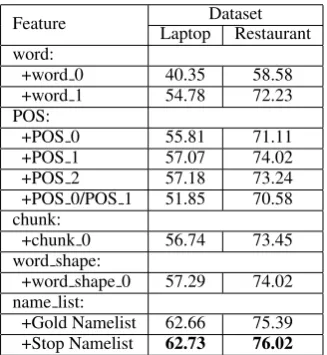
Table 3 shows the results of feature selection for the combination method on training data. The best performance was obtained by using all fea-tures. Thus, our final submission system adopted the combination method with all features.
Feature LaptopDatasetRestaurant word:
+word 0 40.35 58.58
+word 1 54.78 72.23
POS:
+POS 0 55.81 71.11
+POS 1 57.07 74.02
+POS 2 57.18 73.24
+POS 0/POS 1 51.85 70.58 chunk:
+chunk 0 56.74 73.45
word shape:
+word shape 0 57.29 74.02 name list:
+Gold Namelist 62.66 75.39 +Stop Namelist 62.73 76.02
Table 3: The F-scores of combination method of subtask 1 on training data based on 2 cross-validation
Table 2 shows the results of the above three systems on training data. Comparing with oth-er two methods, we easily find that the combina-tion method outperforms the other two systems in terms of precision, recall and F values on both do-mains.
2.5 Result and Discussion
In constrained run, we submitted the results us-ing the method in combination of NP and NER. Specifically, we adopted all features and the name lists listed in Table 3 and the CRF++ tool for the NER system. Table 4 lists the results of our fi-nal system and the top two systems officially re-leased by organizers. On both domains, our sys-tem ranks above the average under constrained model, which proves the effectiveness of the com-bination method by using NP extraction and NER. From Table 2 and Table 4 we find that the re-sults on restaurant data are much better than those on laptop data. Based on our further observation on training data, the possible reason is that the number of numeric descriptions in laptop dataset is much larger than those in restaurant dataset and the aspect terms containing numeric description are quite difficult to be extracted.
Dataset DLIREC NRC-Canada Our result
laptop 70.41 68.57 65.88
[image:3.595.100.264.534.712.2]restaurant 78.34 80.19 78.24
3 Aspect Category Classification System
Aspect category classification task tries to assign each aspect one or more semantic category labels. Thus, we regarded this task as a multi-class clas-sification problem. Following (Rennie, 2001), we built a binary model for each category, where bag-of-words is used as features.
3.1 Features
We adopted the bag-of-words schema to represent features as follows. Since not all training instances have annotated aspect terms, we extracted only an-notated aspect terms from sentence if the sentence contains annotated aspect terms, or extracted all words from sentence which does not contain any annotated aspect terms as features, which results in 5200 word features in total.
3.2 Classification Algorithm
We adopted the maximum entropy algorithm im-plemented in Mallet toolkit (McCallum, 2002) to build a binary classifier for each category. All pa-rameters are set as defaults. This subtask only pro-vides restaurant data and there are five predefined categories (i.e., food, price, service, ambience and anecdotes/miscellaneous), thus we build five bina-ry classifiers in total.
3.3 Results and Discussions
Table 5 lists the precision, recall and F-score of our final system along with the top two systems released by the organizers.
Precision(%) Recall(%) F-score(%)
our system 65.26 69.46 67.30
rank 1 system 91.04 86.24 88.58
rank 2 system 83.23 81.37 82.29
Table 5: The results of our system and the top two systems of subtask 3 on the test data.
From Table 5, we find that there are quite a large room to improve our system. One main reason is that our system only uses simple features (i.e., bag-of-words) and these simple features may have poor discriminating power. Another possible rea-son may be that in training data there are at least half sentences without annotated aspect terms. In this case, when we used all words in the sentences as features, it may bring much noise. In future work, we consider to generate more effective fea-tures from external resources to indicate the
re-lationships between aspects and categories to im-prove our system.
4 Aspect Term Sentiment Polarity Classification System
Once we extract aspect terms, this task aims at classifying the sentiment orientation of the anno-tated aspect terms. To address this task, we firstly extracted three types of features: sentiment lexi-con based features, topic model based features and other features. Then two machine learning algo-rithms, i.e., SVM and MaxEnt, were used to con-duct classification models.
4.1 Features
4.1.1 Sentiment Lexicon (SL) Features
We observed that the sentiment orientation of an aspect term is usually revealed by the surrounding terms. So in this feature we took four words before and four words after the current aspect term and then calculated their respective positive,negative and neutral scores. During the calculation we re-versed the sentiment orientation of the term if a negation occurs before it. We manually built a negative list: {no, nor, not, neither, none, no-body, nothing, hardly, seldom}. Eight sentimen-t lexicons are used: Bing Liu opinion lexicon4,
General Inquirer lexicon5, IMDB6, MPQA7,
Sen-tiWordNet8, NRC emotion lexicon9, NRC
Hash-tag Sentiment Lexicon10 and NRC Sentiment140
Lexicon11. With regard to the synonym selection
of SentiWordNet, we selected the first term in the synset as our lexicon. If the eight words surround-ing the aspect term do not exist in the eight cor-responding sentiment lexicons, we set their three sentiment scores as 0. Then we got 24 sentimen-t values for each word (3 polarisentimen-ties * 8 lexicons) and summed up the values of eight words for each sentiment polarity (i.e., positive, negative and neu-ral). Finally we got 24 sentiment lexicon features for each aspect.
4
http://www.cs.uic.edu/˜liub/FBS/sentiment-analysis.html#lexicon
5http://www.wjh.harvard.edu/˜inquirer/homecat.htm 6
http://anthology.aclweb.org//S/S13/S13-2.pdf#page=444
7http://mpqa.cs.pitt.edu/ 8http://sentiwordnet.isti.cnr.it/
9
http://mailman.uib.no/public/corpora/2012-June/015643.html
10
http://www.umiacs.umd.edu/˜saif/WebDocs/NRC-Hashtag-Sentiment-Lexicon-v0.1.zip
feature F-pos(%) F-neg(%) F-neu(%) Acc(%)
MaxEnt SVM MaxEnt SVM MaxEnt SVM MaxEnt SVM
[image:5.595.73.567.62.116.2]SL 72.50±1.91 70.99±5.91 65.10±1.99 65.66±3.48 25.54±5.68 24.02±9.28 62.28±2.59 61.61±4.68 +Other 72.92±2.12 72.70±1.44 65.93±3.89 65.09±3.67 31.14±5.77 34.00±7.31 62.88±3.22 62.54±3.17 +Topic 73.14±1.02 72.21±1.44 65.55±5.43 65.58±3.45 34.34±10.55 12.16±4.96 63.00±4.34 61.74±3.10
Table 6: The results of our system in subtask 2 on laptop training data based on 5-fold cross validation.
features F-pos(%) F-neg(%) F-neu(%) Acc(%)
MaxEnt SVM MaxEnt SVM MaxEnt SVM MaxEnt SVM
SL 79.78±1.37 79.85±1.35 49.37±3.54 47.96±4.52 26.02±3.62 31.67±2.84 65.61±2.59 65.45±1.98 +Other 80.48±2.18 79.09±1.42 53.17±2.70 50.51±3.34 29.25±3.60 33.13±6.89 66.80±2.33 65.21±2.35 +Topic 80.71±1.71 77.94±1.34 52.61±2.52 46.65±3.17 34.51±3.35 3.40±2.79 67.18±2.52 64.72±1.48
Table 7: The results of our system in subtask 2 on restaurant training data based on 5-fold cross valida-tion.
4.1.2 Topic Features
In this section we considered to use the topics feature to replace the traditional bag-of-words feature since the bag-of-bag-of-words feature are very sparse in the data set. To construct the cluster-s of topiccluster-s, we ucluster-sed the LDA12based topic model
to estimate the K topics (in our experiment, we set K to 50) from training data. Then we inferred the topic distribution from training and test data respectively as topic features.
4.1.3 Other Features
Besides, we also proposed the following other fea-tures in order to capture more useful information from the short texts.
Aspect distance This feature records the num-ber of words from the current aspect to the next aspect in the same sentence. If the current aspect term is the last term in the sentence, this value is calculated as the negative number of words from the current aspect to the former aspect. If only one aspect term exists in a sentence, then the value is set to zero.
Number of aspects This feature describes the number of aspect terms in the current sentence.
Negation flag featureWe set this feature as 1 if a negation word occurs in the current sentence, otherwise -1.
Number of negationsThis feature is the num-ber of negation words in the current sentence.
4.2 Classification Algorithms
The maximum entropy and SVM which are imple-mented in Mallet toolkit (McCallum, 2002) and LibSVM (Chang and Lin, 2011) respectively are
12http://www.cs.princeton.edu/ blei/lda-c/
used to construct the classification model from training data. Due to the limit of time, all parame-ters are set as defaults.
4.3 Results and Discussions 4.3.1 Results on Training Data
To compare the performance of different features and different algorithms, we performed a 5-fold cross validation on training data of two domain-s. Table 6 and Table 7 show the results of two domains in terms of F-scores and accuracy with mean and standard deviation. The best results are shown in bold.
no further deep analysis has been done so far.
Strategy F-pos(%) F-neg(%) F-neu(%) Acc(%)
Double 80.28 55.11 19.22 65.48
No double 80.71 52.61 34.51 67.18
Table 8: The results of controlled experiment on restaurant dataset (MaxEnt).
4.3.2 Results on Test Data
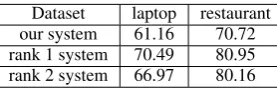
Based on above results on training data, our final system used all provided training data for both do-mains. The MaxEnt algorithm is used for our final system. Table 9 shows our results alone with the top two systems results released by organizers.
Our final results ranked the 12th on the lap-top dataset and the 14th on the restaurant dataset. On one hand, the accuracy in restaurant dataset is higher than laptop dataset for the possible reason that the data size of restaurant dataset is much big-ger than that of laptop dataset. On the other hand, our results ranked middle in both datasets. Since we utilized eight contextual words around aspect to extract features and it may bring some noise.
[image:6.595.111.250.395.439.2]Dataset laptop restaurant our system 61.16 70.72 rank 1 system 70.49 80.95 rank 2 system 66.97 80.16
Table 9: The Accuracy (%) of our system and the top two systems on test dataset in subtask 2.
5 Aspect Category Sentiment Polarity System
The aspect category sentiment polarity classifi-cation task is also only applicable to restauran-t domain. For restauran-this restauran-task, we adoprestauran-ted restauran-the bag-of-sentiment words representation, extracted sen-timent features and used the supervised machine learning algorithms to determine the sentimen-t oriensentimen-tasentimen-tion of each casentimen-tegory.
5.1 Features
To extract features, we firstly used eight sentiment lexicons mentioned in Section 4.1.1 to build a big sentiment words dictionary. Then we extracted al-l aspect words and aal-lal-l sentiment words in train-ing set as features. In the traintrain-ing and test data, we used the sentiment polarity score of sentiment word and the presence or absence of each aspect term as their feature values.
5.2 Classification Algorithms
The MaxEnt algorithm implemented in Mallet (M-cCallum, 2002) with default parameters is used to build a polarity classifier.
5.3 Experiment and Results
We used all features and the maximum entropy al-gorithm to conduct our final system. Table 10 list-s the final relist-sultlist-s of our list-submitted list-sylist-stem along with top two systems.
As shown in Table 10, the accuracy of our sys-tem is 0.63 while the best result is 0.83. The main reason is that the features we used are quite sim-ple. For the future work, more sufficient features are examined to help classification.
6 Conclusion
In this work we proposed a combination of NP and NER method and multiple features for aspec-t exaspec-tracaspec-tion. And we also used mulaspec-tiple feaaspec-tures including eight sentiment lexicons for aspect and category sentiment classification. Our final sys-tems rank above average in the four subtasks. In future work, we would expect to improve the re-call of aspect terms extraction by extending name lists using external data and seek other effective features such as discourse relation, syntactic struc-ture to improve the classification accuracy.
Systems our system rank 1 system rank 2 system
Acc(%) 63.41 82.93 78.15
Table 10: The accuracy of our system and the top two systems of subtask 4 on test dataset
Acknowledgements
The authors would like to thank the organizers and reviewers for this interesting task and their helpful suggestions and comments. This research is sup-ported by grants from National Natural Science Foundation of China (No.60903093) and Shang-hai Knowledge Service Platform Project (No. ZF1213).
References
Stefano Baccianella, Andrea Esuli, and Fabrizio Sebas-tiani. 2010. Sentiwordnet 3.0: An enhanced lexical resource for sentiment analysis and opinion mining.
Chih-Chung Chang and Chih-Jen Lin. 2011.
LIB-SVM: A library for support vector machines. ACM
Transactions on Intelligent Systems and
Technolo-gy, 2:27:1–27:27. Software available at http://
www.csie.ntu.edu.tw/˜cjlin/libsvm. Namrata Godbole, Manja Srinivasaiah, and Steven
Skiena. 2007. Large-scale sentiment analysis for news and blogs. ICWSM, 7.
Suin Kim, Jianwen Zhang, Zheng Chen, Alice Oh, and Shixia Liu. 2013. A hierarchical aspect-sentiment model for online reviews. InProceedings of AAAI. Sudheer Kovelamudi, Sethu Ramalingam, Arpit Sood,
and Vasudeva Varma. 2011. Domain independen-t model for producindependen-t aindependen-tindependen-tribuindependen-te exindependen-tracindependen-tion from user
reviews using wikipedia. InIJCNLP, pages 1408–
1412.
Lun-Wei Ku, Yu-Ting Liang, and Hsin-Hsi Chen. 2006. Opinion extraction, summarization and track-ing in news and blog corpora. InAAAI Spring Sym-posium: Computational Approaches to Analyzing Weblogs, volume 100107.
Bing Liu. 2012. Sentiment analysis and opinion min-ing. Synthesis Lectures on Human Language Tech-nologies, 5(1):1–167.
Chong Long, Jie Zhang, and Xiaoyan Zhut. 2010. A review selection approach for accurate feature rating estimation. InProceedings of the 23rd International Conference on Computational Linguistics: Posters, pages 766–774. Association for Computational Lin-guistics.
Andrew Kachites McCallum. 2002.
Mal-let: A machine learning for language toolkit. http://mallet.cs.umass.edu.
Arjun Mukherjee and Bing Liu. 2012. Aspect ex-traction through semi-supervised modeling. In Pro-ceedings of the 50th Annual Meeting of the Associ-ation for ComputAssoci-ational Linguistics: Long Papers-Volume 1, pages 339–348. Association for Compu-tational Linguistics.
Maria Pontiki, Dimitrios Galanis, John Pavlopou-los, Haris Papageorgiou, Ion AndroutsopouPavlopou-los, and Suresh Manandhar. 2014. Semeval-2014 task 4: Aspect based sentiment analysis. in proceedings of the 8th international workshop on semantic evalua-tion (semeval 2014).Dublin, Ireland.
Jason DM Rennie. 2001. Improving multi-class text
classification with naive Bayes. Ph.D. thesis, Mas-sachusetts Institute of Technology.
Zhiqiang Toh, Wenting Wang, Man Lan, and Xi-aoli Li. 2012. An ner-based product identifica-tion and lucene-based product linking approach to cprod1 challenge: Description of submission sys-tem to cprod1 challenge. InData Mining Workshop-s (ICDMW), 2012 IEEE 12th International Confer-ence on, pages 869–871. IEEE.
Theresa Wilson, Janyce Wiebe, and Paul Hoffmann. 2009. Recognizing contextual polarity: An explo-ration of features for phrase-level sentiment analy-sis.Computational linguistics, 35(3):399–433. Tian Tian Zhu, Fang Xi Zhang, and Man Lan. 2013.