End-to-End Information Extraction without Token-Level Supervision
Rasmus Berg PalmDTU Compute
Technical University of Denmark [email protected]
Dirk Hovy
Computer Science Dpeartment University of Copenhagen [email protected]
Florian Laws Tradeshift
Landemærket 10, 1119 Copenhagen [email protected]
Ole Winther DTU Compute
Technical University of Denmark [email protected]
Abstract
Most state-of-the-art information extrac-tion approaches rely on token-level labels to find the areas of interest in text. Unfor-tunately, these labels are time-consuming and costly to create, and consequently, not available for many real-life IE tasks. To make matters worse, token-level labels are usually not the desired output, but just an intermediary step. End-to-end (E2E) mod-els, which take raw text as input and pro-duce the desired output directly, need not depend on token-level labels. We propose an E2E model based on pointer networks, which can be trained directly on pairs of raw input and output text. We evaluate our model on the ATIS data set, MIT restau-rant corpus and the MIT movie corpus and compare to neural baselines that do use token-level labels. We achieve competi-tive results, within a few percentage points of the baselines, showing the feasibility of E2E information extraction without the need for token-level labels. This opens up new possibilities, as for many tasks cur-rently addressed by human extractors, raw input and output data are available, but not token-level labels.
1 Introduction
Humans spend countless hours extracting struc-tured machine readable information from unstruc-tured information in a multitude of domains. Promising to automate this, information extraction (IE) is one of the most sought-after industrial ap-plications of natural language processing. How-ever, despite substantial research efforts, in prac-tice, many applications still rely on manual effort to extract the relevant information.
One of the main bottlenecks is a shortage of the data required to train state-of-the-art IE mod-els, which rely on sequence tagging (Finkel et al.,
2005;Zhai et al.,2017). Such models require suf-ficient amounts of training data that is labeled at the token-level, i.e., with one label for each word. The reason token-level labels are in short supply is that they are not the intended output of human IE tasks. Creating token-level labels thus requires an additional effort, essentially doubling the work required to process each item. This additional ef-fort is expensive and infeasible for many produc-tion systems: estimates put the average cost for a sentence at about 3 dollars, and about half an hour annotator time (Alonso et al.,2016). Conse-quently, state-of-the-art IE approaches, relying on sequence taggers, cannot be applied to many real life IE tasks.
What is readily available in abundance and at no additional costs, is the raw, unstructured input and machine-readable output to a human IE task. Con-sider the transcription of receipts, checks, or busi-ness documents, where the input is an unstructured PDF and the output a row in a database (due date, payable amount, etc). Another example is flight bookings, where the input is a natural language request from the user, and the output a HTTP re-quest, sent to the airline booking API.
To better exploit such existing data sources, we propose an end-to-end (E2E) model based on pointer networks with attention, which can be trained end-to-end on the input/output pairs of hu-man IE tasks, without requiring token-level anno-tations.
We evaluate our model on three traditional IE data sets. Note that our model and the baselines are competing in two dimensions. The first is cost and applicability. The baselines require token-level labels, which are expensive and unavailable for many real life tasks. Our model doesnot
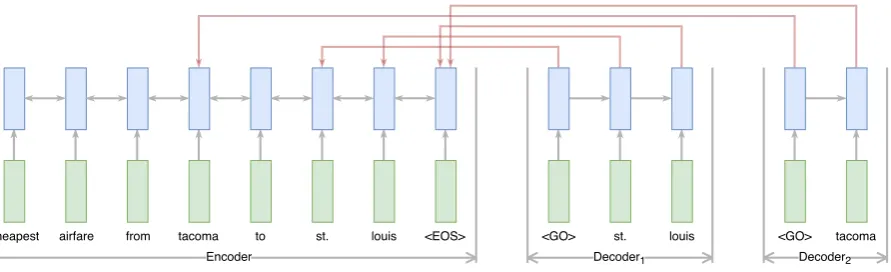
Figure 1: Our model based on pointer networks. The solid red lines are the attention weights. For clarity only two decoders are drawn and only the strongest attention weight for each output is drawn.
quire such token-level labels. Given the time and money required for these annotations, our model clearly improves over the baselines in this dimen-sion. The second dimension is the accuracy of the models. Here we show that our model is compet-itive with the baseline models on two of the data sets and only slightly worse on the last data set, all despite fewer available annotations.
Contributions We present an E2E IE model with attention that does not depend on costly token-level labels, yet performs competitively with neural baseline models that rely on token-level labels. By saving both time and money at comparable performance, our model presents a vi-able alternative for many real-life IE needs. Code is available at github.com/rasmusbergpalm/e2e-ie-release
2 Model
Our proposed model is based on pointer net-works (Vinyals et al., 2015). A pointer network is a sequence-to-sequence model with attention in which the output is a position in the input se-quence. The input position is ”pointed to” us-ing the attention mechanism. See figure1 for an overview. Our formulation of the pointer network is slightly different from the original: Our output is some content from the input rather than a posi-tion in the input.
An input sequence ofN wordsx =x1, ..., xN is encoded into another sequence of lengthN us-ing an Encoder.
ei =Encoder(xi, ei−1) (1)
We use a single shared encoder, andk= 1..K de-coders, one for each piece of information we wish
to extract. At each stepjeach decoder calculate an unnormalized scalar attention scoreakjiover each input positioni. Thek’th decoder output at stepj,
okj, is then the weighted sum of inputs, weighted with the normalized attention scoresattkji.
dkj =Decoderk(ok,j−1, dk,j−1) (2)
akji=Attentionk(dkj, ei)fori= 1..N (3)
attkji=softmax(akji)fori= 1..N (4)
okj = N
X
i=1
attkjixi. (5)
Since eachxi is a one-hot encoded word, and the
attkji sum to one overi,okj is a probability dis-tribution over words.
The loss function is the sum of the negative cross entropy for each of the expected outputsykj and decoder outputsokj.
L(x,y) =−XK k=1
1
Mk Mk
X
j=1
ykjlog (okj) , (6)
whereMkis the sequence length of expected out-putyk.
The specific architecture depends on the choice of Encoder, Decoder and Attention. For the en-coder, we use a Bi-LSTM with 128 hidden units and a word embedding of 96 dimensions. We use a separate decoder for each of the fields. Each de-coder has a word embedding of 96 dimensions, a LSTM with 128 units, with a learned first hidden state and its own attention mechanism. Our atten-tion mechanism followsBahdanau et al.(2014)
The attention parametersWe,Wdandv for each attention mechanism are all 128-dimensional.
During training we use teacher forcing for the decoders (Williams and Zipser, 1989), such that
ok,j−1 = yk,j−1. During testing we use argmax
to select the most probable output for each stepj
and run each decoder until the first end of sentence (EOS) symbol.
3 Experiments 3.1 Data sets
To compare our model to baselines relying on token-level labels we use existing data sets for which token level-labels are available. We mea-sure our performance on the ATIS data set (Price,
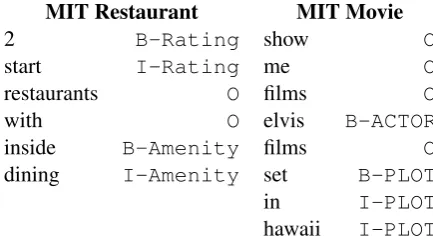
1990) (4978 training samples, 893 testing sam-ples) and the MIT restaurant (7660 train, 1521 test) and movie corpus (9775 train, 2443 test) (Liu et al.,2013). These data sets contains token-level labels in the Beginning-Inside-Out format (BIO).
The ATIS data set consists of natural language requests to a simulated airline booking system. Each word is labeled with one of several classes, e.g. departure city, arrival city, cost, etc. The MIT restaurant and movie corpus are similar, except for a restaurant and movie domain respectively. See table1for samples.
MIT Restaurant MIT Movie
2 B-Rating show O
start I-Rating me O
restaurants O films O
with O elvis B-ACTOR
inside B-Amenity films O dining I-Amenity set B-PLOT in I-PLOT hawaii I-PLOT
Table 1: Samples from the MIT restaurant and movie corpus. The transcription errors are part of the data.
Since our model does not need token-level la-bels, we create an E2E version of each data set without token-level labels by chunking the BIO-labeled words and using the labels as fields to ex-tract. If there are multiple outputs for a single field, e.g. multiple destination cities, we join them with a comma. For the ATIS data set, we choose the 10 most common labels, and we use all the labels for the movie and restaurant corpus. The movie data set has 12 fields and the restaurant has
8. See Table 2 for an example of the E2E ATIS data set.
Input
cheapest airfare from tacoma to st. louis and detroit
Output fromloc tacoma
toloc st. louis , detroit airline name
-cost relative cheapest period of day
-time
-time relative -day name -day number -month name
-Table 2: Sample from the E2E ATIS data set.
3.2 Baselines
For the baselines, we use a two layer neural net-work model. The first layer is a Bi-directional Long Short Term Memory network (Hochreiter and Schmidhuber,1997) (Bi-LSTM) and the sec-ond layer is a forward-only LSTM. Both layers have 128 hidden units. We use a trained word em-bedding of size 128. The baseline is trained with Adam (Kingma and Ba,2014) on the BIO labels and uses early stopping on a held out validation set.
This baseline architecture achieves a fairly strong F1 score of 0.9456 on the ATIS data set. For comparison, the published state-of-the-art is at 0.9586 (Zhai et al.,2017). These numbers are for the traditional BIO token level measure of per-formance using the publicly available conlleval script. They should not be confused with the E2E performance reported later. We present them here so that readers familiar with the ATIS data set can evaluate the strength of our baselines using a well-known measure.
[image:3.595.312.480.152.290.2] [image:3.595.76.293.444.566.2]Sundheim, 1993). We use bootstrap sampling to estimate the probability that the model with the best micro average F1 score on the entire test set is worse for a randomly sampled subset of the test data.
3.3 Our model
Since our decoders can only output values that are present in the input, we prepend a single comma to every input sequence. We optimize our model using Adam and use early stopping on a held-out validation set. The model quickly converges to op-timal performance, usually after around 5000 up-dates after which it starts overfitting.
For the restaurant data set, to increase perfor-mance, we double the sizes of all the parameters and use embedding and recurrent dropout follow-ing (Gal, 2015). Further, we add a summarizer LSTM to each decoder. The summarizer LSTM reads the entire encoded input. The last hidden state of the summarizer LSTM is then concate-nated to each input to the decoder.
3.4 Results
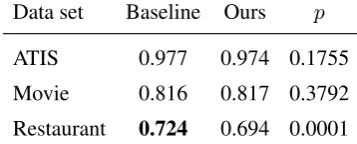
Data set Baseline Ours p
[image:4.595.89.268.395.467.2]ATIS 0.977 0.974 0.1755 Movie 0.816 0.817 0.3792 Restaurant 0.724 0.694 0.0001
Table 3: Micro average F1 scores on the E2E data sets. Results that are significantly better (p <
0.05) are highlighted in bold.
We see in Table 3 that our model is competi-tive with the baseline models in terms of micro-averaged F1 for two of the three data sets. This is a remarkable result given that the baselines are trained on token-level labels, whereas our model is trained end-to-end. For the restaurant data set, our model is slightly worse than the baseline.
4 Related work
Event extraction (EE) is similar to the E2E IE task we propose, except that it can have several event types and multiple events per input. In our E2E IE task, we only have a single event type and assume there is zero or one event mentioned in the input, which is an easier task. Recently, Nguyen et al.
(2016) achieved state of the art results on the ACE 2005 EE data set using a recurrent neural network to jointly model event triggers and argument roles.
Other approaches have addressed the need for token-level labels when only raw output values are available. Mintz et al. (2009) introduced dis-tant supervision, which heuristically generates the token-level labels from the output values. You do this by searching for input tokens that matches out-put values. The matching tokens are then assigned the labels for the matching outputs. One drawback is that the quality of the labels crucially depend on the search algorithm and how closely the tokens match the output values, which makes it brittle. Our method is trained end-to-end, thus not relying on brittle heuristics.
Sutskever et al.(2014) opened up the sequence-to-sequence paradigm. With the addition of at-tention (Bahdanau et al., 2014), these models achieved state-of-the-art results in machine trans-lation (Wu et al., 2016). We are broadly inspired by these results to investigate E2E models for IE.
The idea of copying words from the input to the output have been used in machine translation to overcome problems with out-of-vocabulary words (Gulcehre et al.,2016;Gu et al.,2016).
5 Discussion
We present an end-to-end IE model that does not require detailed token-level labels. Despite being trained end-to-end, it is competitive with baseline models relying on token-level labels. In contrast to them, our model can be used on many real life IE tasks where intermediate token-level labels are not available and creating them is not feasible.
In our experiments our model and the baselines had access to the same amount of training sam-ples. In a real life scenario it is likely that token-level labels only exist for a subset of all the data. It would be interesting to investigate the quanti-ty/quality trade-of of the labels, and a multi task extension to the model, which could make use of available token-level labels.
Our model is remarkably stable to hyper param-eter changes. On the restaurant dataset we tried several different architectures and hyper parame-ters before settling on the reported one. The differ-ence between the worst and the best was approxi-mately 2 percentage points.
the input and as ’17-01-2012’ in the machine readable output.
While it is clear that this model does not solve all the problems present in real-life IE tasks, we believe it is an important step towards applicable E2E IE systems.
In the future, we will experiment with adding character level models on top of the pointer net-work outputs so the model can focus on an input, and then normalize it to fit the normalized outputs.
Acknowledgments
We would like to thank the reviewers who helped make the paper more concise. Dirk Hovy was sup-ported by the Eurostars grant E10138 ReProsis. This research was supported by the NVIDIA Cor-poration with the donation of TITAN X GPUs.
References
H´ector Mart´ınez Alonso, Djam´e Seddah, and Benoˆıt Sagot. 2016. From Noisy Questions to Minecraft Texts: Annotation Challenges in Extreme Syntax Scenarios. WNUT 2016page 13.
Dzmitry Bahdanau, Kyunghyun Cho, and Yoshua Ben-gio. 2014. Neural machine translation by jointly learning to align and translate. arXiv preprint arXiv:1409.0473.
Nancy Chinchor and Beth Sundheim. 1993. MUC-5 Evaluation Metrics. InProceedings of the 5th Con-ference on Message Understanding. Association for Computational Linguistics, MUC5 ’93, pages 69– 78.https://doi.org/10.3115/1072017.1072026. Jenny Rose Finkel, Trond Grenager, and Christopher
Manning. 2005. Incorporating Non-local Informa-tion into InformaInforma-tion ExtracInforma-tion Systems by Gibbs Sampling. InProceedings of the 43rd Annual Meet-ing on Association for Computational LMeet-inguistics. Association for Computational Linguistics, Strouds-burg, PA, USA, ACL ’05, pages 363–370.
Yarin Gal. 2015. A Theoretically Grounded Appli-cation of Dropout in Recurrent Neural Networks.
arXiv:1512.05287 [stat] ArXiv: 1512.05287.
http://arxiv.org/abs/1512.05287.
Jiatao Gu, Zhengdong Lu, Hang Li, and Victor OK Li. 2016. Incorporating copying mechanism in sequence-to-sequence learning. arXiv preprint arXiv:1603.06393.
Caglar Gulcehre, Sungjin Ahn, Ramesh Nallap-ati, Bowen Zhou, and Yoshua Bengio. 2016. Pointing the unknown words. arXiv preprint arXiv:1603.08148.
Sepp Hochreiter and J¨urgen Schmidhuber. 1997. Long Short-Term Memory. Neural Comput. 9(8):1735– 1780.https://doi.org/10.1162/neco.1997.9.8.1735.
Diederik Kingma and Jimmy Ba. 2014. Adam:
A Method for Stochastic Optimization.
arXiv:1412.6980 [cs] ArXiv: 1412.6980.
http://arxiv.org/abs/1412.6980.
Jingjing Liu, Panupong Pasupat, Scott Cyphers, and Jim Glass. 2013. Asgard: A portable architecture for multilingual dialogue systems. InAcoustics, Speech and Signal Processing (ICASSP), 2013 IEEE Inter-national Conference on. IEEE, pages 8386–8390. Mike Mintz, Steven Bills, Rion Snow, and Dan
Ju-rafsky. 2009. Distant supervision for relation ex-traction without labeled data. In Proceedings of the Joint Conference of the 47th Annual Meeting of the ACL and the 4th International Joint Conference on Natural Language Processing of the AFNLP: Volume 2-Volume 2. Association for Computational Linguistics, pages 1003–1011.
Thien Huu Nguyen, Kyunghyun Cho, and Ralph Gr-ishman. 2016. Joint event extraction via recurrent neural networks. In Proceedings of NAACL-HLT. pages 300–309.
Patti Price. 1990. Evaluation of spoken language sys-tems: The ATIS domain. In Proceedings of the Third DARPA Speech and Natural Language Work-shop. Morgan Kaufmann, pages 91–95.
Ilya Sutskever, Oriol Vinyals, and Quoc V Le. 2014. Sequence to sequence learning with neural net-works. InAdvances in neural information process-ing systems. pages 3104–3112.
Oriol Vinyals, Meire Fortunato, and Navdeep Jaitly. 2015. Pointer networks. InAdvances in Neural In-formation Processing Systems. pages 2692–2700. Ronald J Williams and David Zipser. 1989. A
learn-ing algorithm for continually runnlearn-ing fully recurrent neural networks.Neural computation1(2):270–280. Yonghui Wu, Mike Schuster, Zhifeng Chen, Quoc V Le, Mohammad Norouzi, Wolfgang Macherey, Maxim Krikun, Yuan Cao, Qin Gao, Klaus Macherey, and others. 2016. Google’s Neural Ma-chine Translation System: Bridging the Gap be-tween Human and Machine Translation. arXiv preprint arXiv:1609.08144.