Using a Graph-based Coherence Model in
Document-Level Machine Translation
Leo Born†, Mohsen Mesgar‡ and Michael Strube‡
†Department of Computational Linguistics, Heidelberg University Heidelberg, Germany
‡Heidelberg Institute for Theoretical Studies gGmbH Heidelberg, Germany
(mohsen.mesgar|michael.strube)@h-its.org
Abstract
Although coherence is an important aspect of any text generation system, it has re-ceived little attention in the context of ma-chine translation (MT) so far. We hypo-thesize that the quality of document-level translation can be improved if MT mod-els take into account the semantic rela-tions among sentences during translation. We integrate the graph-based coherence model proposed by Mesgar and Strube
(2016) with Docent1 (Hardmeier et al.,
2012;Hardmeier,2014) a document-level
machine translation system. The applica-tion of this graph-based coherence mod-eling approach is novel in the context of machine translation. We evaluate the co-herence model and its effects on the qual-ity of the machine translation. The result of our experiments shows that our coher-ence model slightly improves the quality of translation in terms of the average Me-teor score.
1 Introduction
Coherence represents semantic connectivity of texts with regard to grammatical and lexical rela-tions between sentences. It is an essential part of natural texts and important in establishing struc-ture and meaning of documents as a whole.
It is crucial for any text generation system to generate coherent texts. For instance in real ma-chine translation systems, we desire to translate a document, which consists of several sentences, from a source language to a target language. Cur-rent machine translation systems (as an instance of text generation systems) mostly focus on the
1https://github.com/chardmeier/docent
sentence-level translation. Indeed, the state-of-the-art machine translation models perform well on sentence-level translation (Bahdanau et al.,
2015;Sennrich et al.,2017). However, it is
insuffi-cient to just sequentially and independently trans-late sentences of the source document and con-catenate them as the translated version. The trans-lated sentences should be coherently connected to each other in the target document as well.
From a linguistic point of view also the discourse-wide context must be taken into account to have a high-quality translation (Hatim and
Ma-son, 1990;Hardmeier et al., 2012). The current
paradigm of machine translation needs to be im-proved as it does not consider any discourse coher-ence phenomena that establish a text’s connected-ness (Sim Smith et al.,2015).
One of the active research topics in modeling coherence focuses on entity connections over sen-tences based on Centering Theory (Grosz et al.,
1995). Previous research on coherence model-ing shows its application mainly in readability as-sessment (Barzilay and Lapata, 2008; Pitler and
Nenkova, 2008). Recently, Parveen et al. (2016)
showed that the graph-based coherence model can be utilized to generate more coherent summaries of scientific articles.
The main goal of this paper is to integrate co-herence features with a statistical machine trans-lation system to improve the quality of the output translation. To achieve this goal, we combine the graph-based coherence representation by
Guin-audeau and Strube(2013) and its extensions (
Mes-gar and Strube, 2015, 2016) into the
document-level machine translation decoderDocent (
Hard-meier et al.,2012,2013).
Docent defines an initial translation of the source document and modifies the translation of sentences aiming to maximize an objective func-tion. This function measures the quality of the
S1:But the noise didn’t disappear.
S2: The mysterious noise that Penzias and Wilson were listening to turned out to be the oldest and most significant sound that anyone had ever heard.
S3: It was cosmic radiation left over from the very birth of the universe.
S4: This was the first experimental evidence that the Big Bang existed and the universe was born at a precise moment some 14.7 billion years ago.
S5:So our story ends at the beginning – the beginning of all things, the Big Bang.
Table 1: Excerpt of a TED talk (ID: 1177) from the DiscoMT 2015 training data.
translated document after each modification. We propose to update the objective function of Do-cent such that it takes into account the coherence of the translated document too. We quantify the coherence level of the translated document using graph-based coherence features. We show that in-tegrating coherence features improves the quality of the translation in terms of the Meteor score.
We start with the relevant background literature (Section 2). We then describe the graph-based co-herence model and how we integrate its coco-herence features with Docent (Section 3). Section 4 out-lines the datasets and the experimental setup. We discuss results in Section 5. Conclusions and pos-sible future work are in Section 6.
2 Related Work 2.1 Entity Graph
Guinaudeau and Strube (2013) present a
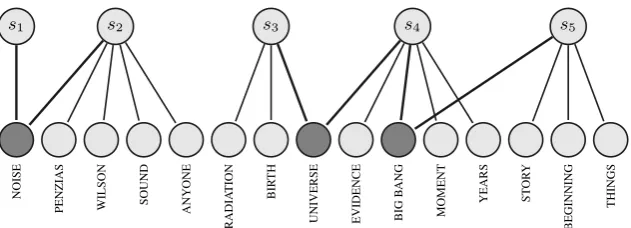
graph-based version of the entity grid (Barzilay and Lap-ata,2008). It models the interaction between enti-ties and sentences as a bipartite graph. In this rep-resentation, one set of nodes corresponds to sen-tences, whereas the other set of nodes corresponds to entities in a document. Table1shows a sample text from our training data and Figure1the bipar-tite entity-graph representation of it.
Coherence is measured over the one-mode pro-jection on sentence nodes. The one-mode projec-tion is the graph in which the sentence nodes are connected to each other if and only if they have at least one entity in common (see Figure 2). The coherence of a text T can then be measured by computing the average outdegree of the projection graph. Outdegree of a node is the number of edges that leave the node. The average outdegree is the sum of outdegree of all nodes in the one-mode
pro-jection graph divided by the number of sentences.
Mesgar and Strube (2015) evaluate this model
for readability assessment. They show that the av-erage outdegree is not the best choice for quanti-fying the coherence. They propose to encode co-herence as the connectivity structure of sentence nodes in a projection graph. So they represent the connections among sentences of each document in the corpus with its projection graph; then they mine all possible subgraphs of these graphs. These subgraphs resemble what the linguistic literature termsthematic progression(Daneˇs,1974) as sub-graphs represent connections between sentences following a certain pattern. Mesgar and Strube
(2015) call these subgraphs coherence patterns. The connectivity structure of a projection graph can be modeled by the frequency of subgraphs in each graph. These frequencies are called coher-ence features. Mesgar and Strube (2015) show that these coherence features, obtained from fre-quency of subgraphs of projection graphs of the entity graphs, can assess readability better. Fig-ure3illustrates four possible subgraphs with three nodes. The pool of possible subgraphs can be expanded to encompass any arbitrary number of nodes, so-calledk-node subgraphs.
Mesgar and Strube (2016) extend the entity
graph to the lexical graph: two sentences may be semantically connected because at least two words of them are semantically associated to each other. They compute semantic relatedness be-tween all content word pairs using GloVe word embeddings (Pennington et al., 2014). If there is a word pair whose word vectors have a cosine re-latedness greater than a threshold, two sentences are considered to be connected. They quantify the coherence of texts via frequency of subgraphs of the lexical graphs. It outperforms the entity graph coherence model on readability assessment.
Parveen et al.(2016) show that coherence
pat-terns can be mined from a corpus and those can get weighted based on their frequencies in the cor-pus. They use the extracted coherence patterns and their weights to generate a coherent summary from scientific documents. Using a human evaluation, they show that coherence patterns are more pow-erful than average outdegree to encode coherence for automatic summarization.
s1 s2 s3 s4 s5
NOISE
PENZIAS WILSON SOUND ANY
ONE
RADIA
TION BIRTH
UNIVERSE EVIDENCE BIG
BANG
MOMENT YEARS ST
OR
Y
BEGINNING
[image:3.595.142.458.59.173.2]THINGS
Figure 1: The entity graph representation of the text in Table1. Dark entities are shared by the sentences.
[image:3.595.77.286.318.376.2]s1 s2 s3 s4 s5
Figure 2: Unweighted projection graph of the en-tity graph in Figure 1. The nodes are connected based on whether sentences share an entity or not, whereas the edge direction follows sentence order.
s1 s2
s3
s1 s2
s3
s1 s3
s3
s1 s2
s3
sg1 sg2 sg3 sg4
Figure 3: All possible directed 3-node subgraphs. The edge directions indicate the order of sentences in the text.
document-level machine translation as another, and more difficult, text generation system. We can also evaluate which feature is more beneficial for machine translation.
2.2 Coherence in Machine Translation Coherence modeling in machine translation is an (almost) desideratum . To the best of our knowl-edge, there are only a handful of publications in this direction. The one relevant to our approach is the work by Lin et al. (2015) as it constitutes an application of a coherence model in the context of machine translation, as opposed to more theoret-ical papers on the state of coherence in machine translation (Sim Smith et al.,2016).
Lin et al. (2015) develop a sentence-level
Recurrent Neural Network Language Model (RNNLM) that takes a sentence as input and tries to predict the next one based on the sentence his-tory vector. By modeling sequences of sentences, the vector is able to model local coherence within RNNLM.2 Given the 10-best results of all sen-2They consider the “log probability of a given document as its coherence score” (Lin et al.,2015).
tences from the decoder, their system then selects the best translation for the first sentence. Given that translation, they score all translation candi-dates of the second sentence based on coherence and select the best one. They repeat this for all sentences in the document.
This approach, however, can be considered lin-guistically weak as it only measures coherence af-ter the translation and does not consider it as a part of the text generation process. As coherence, how-ever, is a fundamental need for any text generation system (Barzilay and Lapata,2008), this motivates us to go beyond a simple re-ranking approach and integrate the coherence measure directly into the decoding process of machine translation.
3 Method 3.1 Docent
We useDocent (Hardmeier et al.,2012,2013) as the baseline. It explicitly has no notion of coher-ence. Docent is a document-level decoder that treats a translation not as a bag of sentences but instead has a translation hypothesis for the whole document at each step. The initial hypothesis can either be generated randomly from the translation table or it can be initialized with the result of any standard sentence-level decoder such as Moses
(Koehn et al.,2007).
Docent first independently translates all sen-tences of the input document. Then it starts to modify the translation of sentences with respect to the other translated sentences. Three basic opera-tions modify the translation of sentences: change-phrase-translation,swap-phrases, andresegment.
The third operation,resegment, is able to generate from a number of phrases a new set of phrases cov-ering the same span. Docent checks the quality of the modified translation by an objective function that takes the modified translation of the document (the so-called state of the translated document) as its input and maps it to a real number. If the value of the objective function increases then Docent ac-cepts the applied operation.
The main advantage of Docent is that the objec-tive function can be defined over the whole docu-ment (Hardmeier et al.,2012). This allows us to integrate our new document-level coherence fea-tures with Docent. More formally, the overall doc-ument stateSis modeled as a sequence of sentence states:
S=S1S2...SN, (1)
whereN is the number of sentences andSi is the
translation (hypothesis) of theithsource sentence.
A scoring functionf(S)maps a state to a real num-ber. The scoring function can be further decom-posed into a linear combination ofKfeature func-tionshk(S), each with a constant weightλk, such
that
f(S) =
K X
k=1
λkhk(S). (2)
Docent uses simulated annealing, a stochastic variant of the hill climbing algorithm (
Khachatu-ryan et al.,1981), for either accepting or rejecting
operations for maximizing its objective function
(Hardmeier,2012) .
Docent already implements some sentence-local feature models that are similar to those found in traditional sentence-level decoders. These in-clude phrase translation scores provided by the phrase table (Koehn et al., 2003), n-gram lan-guage model scores implemented with KenLM
(Heafield,2011), a word penalty score, and an
un-lexicalised distortion cost model with geometric decay (Koehn et al.,2003).
Our idea is to add a new document-level co-herence function hcoh(S), namely a graph-based
coherence model to the objective function repre-sented in Equation. 2. In the next subsection, we describe this model in more detail.
3.2 Graph-based Coherence Model
Our coherence model is based on the lexical graph representation (Mesgar and Strube,2016). For any given document, we first filter out stop words us-ing the provided stop word list by Salton(1971).
Then, we calculate the cosine relatedness of all remaining word pairs of all sentence pairs using the 840 billion token pre-trained word embeddings of GloVe (Pennington et al., 2014). For every out-of-vocabulary word, we assign a random 300-dimensional vector that is memorized for its next occurrence. Based on this, we represent the lexical relations among sentences via graphs. If at least two words in the sentences are related, we choose the relation between those two words whose em-beddings have the maximum cosine value. In or-der to make the graph not too dense, we filter out those edges whose strengths are below a certain threshold.
However, in contrast to Mesgar and Strube
(2016), we use a different threshold for graph con-struction. They use a threshold of0.9, but we find this too strict on allowing the graph structure to change in the direction of more coherent texts. We choose a lower threshold, 0.85, to let the model consider more connections and more lexical vari-ations (i.e., synonyms) in the translation.
We encode coherence by frequency of coher-ence patterns in these graphs.
3.3 Integrating the Coherence Model With Docent
For extracting coherence patterns we use the tar-get documents3 of the training set of the Dis-coMT dataset. We extract all k-node subgraphs fork ∈ {3,4,5}. We limit the size of subgraphs to 3-, 4-, and 5-node asMesgar and Strube(2016) report declining results for subgraphs withk >5. We also calculate a respective weight for each pattern from lexical graph representations of Dis-coMT training target documents.
We base our coherence patterns on the charac-teristics of the target language as there is a theory within Translation Studies that “textual relations obtaining in the original are often modified [...] in favour of (more) habitual options offered by a tar-get culture” (Toury,1995).Toury(1995) calls this thelaw of growing standardizationwhich seeks to describe and explain the acceptability of the trans-lation in the receiving culture (Venuti,2004). This law seems suitable in the context of subgraph min-ing as it is also already reflected in the language model of any MT system (Lembersky et al.,2012). For computing the weights of subgraphs, we di-vide the count of eachk-node subgraph by the
tal counts of subgraphs for thatk. For eachk, this gives the following vector:
ϕ(sgk,G) = (w(sgk
1,G), ...,w(sgkm,G)), (3)
where formally
w(sgki,G) = P count(sgki,G) sgk
j∈(sgk1,...,sgkm)count(sg
k
j,G). (4)
These weights are then used as weights of coherence features in the coherence function,
hcoh(S), that quantifies the connectivity structure
of sentences of an intermediate state of the trans-lated document in Docent during evaluation on the test set of DiscoMT.
So, given the coherence graph representation of an intermediate state of the translated docu-ment (during the test phase), GS, and the set of
all extracted subgraphs of the training documents,
FSG = {sgk
1,sgk2, ...,sgkm} where k ∈ {3,4,5},
and their weights,hcoh(S)is defined as follow:
hcoh(S) = X
sgk i∈FSG
count(sgki, GS)·w(sgki). (5)
We use this score – which multiplies the frequency of each subgraph in each state (coherence feature) of the translated document with its weight accord-ing to its frequency in the trainaccord-ing documents and sums this up for all subgraphs – as our feature model score of our coherence model.
4 Experiments 4.1 Datasets
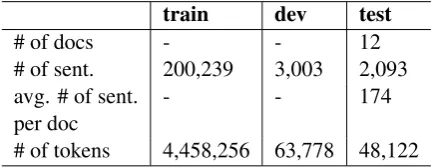
We use the WMT 2015 (Bojar et al.,2015) dataset for training and development of the sentence-level translation and language models4, and the Dis-coMT 2015 Shared Task (Hardmeier et al.,2015) dataset for mining subgraphs (coherence patterns) and as our test data (Table 2). We run experi-ments on the language pair French-English. Co-herence patterns are extracted from the 1551 Dis-coMTtrainingdocuments using GloVeword em-beddings. We extract all k-node subgraphs for
k ∈ {3,4,5}usingGASTON5 (Nijssen and Kok,
2004,2005).
4We use Moses to translate sentences independently and initialize the translation state in Docent.
5http://liacs.leidenuniv.nl/
˜nijssensgr/gaston/iccs.html.
We use the twelve test documents of DiscoMT as the test data because these are much longer, on the document level, than the WMT test data. The average number of sentences of the WMT test data is 20, whereas for DiscoMT it is 174 sentences. Thus it is a more difficult test set for our experi-ments.
train dev test
# of docs - - 12
# of sent. 200,239 3,003 2,093 avg. # of sent.
per doc - - 174
[image:5.595.308.527.171.255.2]# of tokens 4,458,256 63,778 48,122 Table 2: Statistics on the datasets used. trainis the news commentary v10 corpus,devis the 2012 newstest development data, and test is the Dis-coMT 2015 test data. The number (#) of tokens corresponds to the English (target) side.
4.2 Experimental Setup
We train our systems using the Moses decoder
(Koehn et al., 2007). After standard
prepro-cessing of the data, we train a 3-gram language model usingKenLM(Heafield,2011). We use the
MGIZA++ (Gao and Vogel, 2008) word aligner and employ standard grow-diag-fast-and sym-metrization. Tuning is done on the development data viaminimum error rate training(Och,2003). After training the language model and creating the phrase table with Moses, we use these to ini-tialize our translation systems. We use the lcurve-docentbinary of Docent, which outputs Docent’s learning curve, i.e., files for the intermediate de-coding states. This additionally allows us to in-vestigate the learning curves with regard to how our coherence feature behaves over time.
We prune the translation table by only retaining all phrase translations with a probability greater than 0.0001 during training. In our configura-tion file for Docent, we set to use the simulated annealing algorithm with a maximum number of 16,384 steps6 and the following features:
geo-metric distortion model,word penalty cost, OOV-penalty cost, phrase table, and the 3-gram lan-guage model.
4.3 Evaluation Metrics
We follow the standard machine translation pro-cedure of evaluation, measuringBLEU (Papineni
et al., 2002) for every system. BLEU is an n
-gram based co-occurrence metric that operates with modifiedn-gram precision scores. The doc-umentn-gram precision scores are averaged using the geometric mean of these scores withn-grams up to lengthN and positive weights summing to one. The result is multiplied by an exponential
brevity penalty factor that penalizes a translation if it does not match the reference translations in length, word choice, and word order.
We also calculate Meteor (Lavie et al., 2004;
Denkowski and Lavie,2014) as it is a widely used
evaluation metric as well. In contrast to BLEU, Meteor is a word-based metric that takes recall into account as well. Meteor creates a word align-ment between a pair of strings that is incremen-tally produced using a sequence of various word-mapping modules, including theexactmodule, the
Porter stem module, and the WordNet synonymy
module (Lavie and Agarwal,2007).
Because Meteor has been shown to have a higher correlation with human judgements than BLEU (Lavie et al.,2004), it is a useful alterna-tive evaluation metric for our purposes. As it also considers stemmed words and information from WordNet to determine synonymous words be-tween a candidate and a reference translation, the metric is interesting with regard to surface varia-tion with the same semantic content and how this affects the evaluation of our coherence model (as its graph construction is semantically grounded). 5 Results
5.1 Mined Coherence Patterns Analysis We represent each English document of the train-ing set of the DiscoMT dataset by a graph (as de-scribed in Section 3.2). As a result, instead of a set of documents we have a set of graphs. Then we extract all occurring subgraphs in these graphs as coherence patterns. We mine subgraphs with 3,4,5nodes.
All 3-node subgraphs exist in the graph repre-sentation of the training documents. It is because these subgraph are small and it is very likely that they occur in the graph representation of the large DiscoMT documents.
The mined 4-node subgraphs are shown in Fig-ure 4. Although the frequency of these patterns
sg5 sg6 sg7
s1
s2
s3
s4
s1
s2
s3
s4
s1
s2
s3
s4
sg8 sg9 sg10
s1
s2
s3
s4
s1
s2
s3
s4
s1
s2
s3
[image:6.595.318.516.65.210.2]s4
Figure 4: The mined 4-node subgraphs.
sg11 sg12 sg13
s1
s2
s3
s4
s5
s1
s2
s3
s4
s5
s1
s2
s3
s4
s5
Figure 5: The mined 5-node subgraphs.
encode coherence in our model, the existence of these patterns can be linguistically interpreted too. For example, sg10 models the smooth shift in
the topic of a sequence of sentences (Mesgar and
Strube,2015). The rest of the patterns have a
com-mon property: a sentence introduces some topic and the following sentences are about this topic. For instance, insg6, topics in the first sentence are
developed by the rest of the sentences.
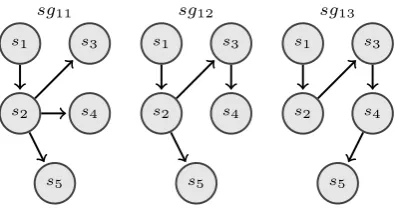
The mined 5-node subgraphs are shown in Fig-ure 5. The expansion of a topic is much clearer here insg11. The subgraphsg13is very similar to
sg10 following the notion of the topic shift. This
is somehow expected because the DiscoMT doc-uments are obtained from TED talks. These talks are mostly given by professional speakers. They have to move smoothly from one topic to the next topic in a short sequence of sentences. This con-firms the existence of the linear chain pattern in the 4-node and 5-node patterns.
We analyze the change of the frequencies of the subgraphs during the MT decoding phase. For ex-ample, on document 9 the subgraphsg1 of the
3-node subgraphs occurs one more time in the CM model. It is worthwhile to note that the increase of the frequency ofsg1is compatible with its positive
[image:6.595.318.516.245.351.2]Document ID BLEU (BL) BLEU (CM) Meteor (BL) Meteor (CM)
(#1) 1756 21.87 21.93 61.47 61.52
(#2) 1819 16.49 16.49 62.25 62.25
(#3) 1825 24.86 24.86 66.34 66.32
(#4) 1894 17.08 17.08 57.20 57.20
(#5) 1935 20.11 20.11 62.83 62.83
(#6) 1938 20.43 20.41 63.53 63.48
(#7) 1950 23.27 23.26 63.48 63.46
(#8) 1953 20.78 20.66 61.65 61.64
(#9) 1979 15.25 15.26 55.68 55.69
(#10) 2043 18.27 18.27 56.42 56.47
(#11) 2053 30.65 30.65 69.13 69.13
(#12) 205 13.79 13.79 52.68 52.68
[image:7.595.120.478.61.254.2]Average 20.24 20.23 61.01 61.06
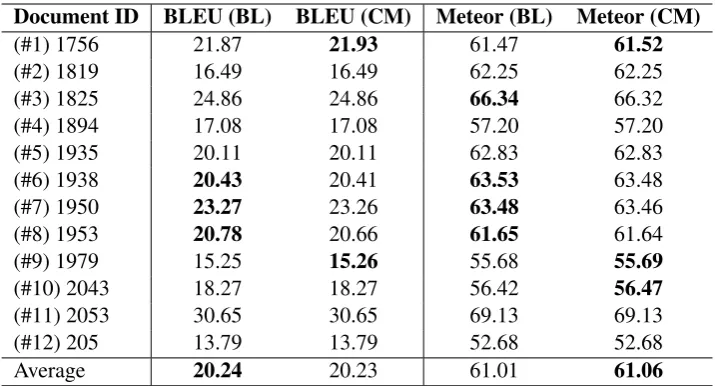
Table 3: Results of the coherence model (CM) compared to the baseline (BL) on the DiscoMT test set (highest values are marked in bold). The scores of the entity graph model using average outdegree as coherence feature are identical to the baseline model. The differences are not statistically significant (p= 0.05) using Student’st-test (Student,1908).
in the readability assessment experiment done by
Mesgar and Strube (2015). For the documents 1
and 10 the frequency of subgraphs are constant during decoding. It might be because the con-nectivity of sentences is already compatible with the training documents and our coherence features push the Docent model to reject operations that might disturb the structure. The decrease in the number of accepted operations for these two doc-uments by the CM model (represented in Table4) supports this.
5.2 Machine Translation Metrics Analysis We evaluate the model on the test set of the DiscoMT dataset. As the baseline, we use the coherence-blind Docent and compare it against a system with the additional document-level coher-ence features.
First we try the entity graph model with the average outdegree as the coherence feature. The BLEU and Meteor scores of this model are iden-tical to the baseline. This means that the average outdegree is not a good representative of coher-ence. That was also shown byMesgar and Strube
(2015) for the readability assessment task.
Next, we try the lexical graph representation of documents and frequency of coherence patterns as the coherence features.
The results of the baseline (BL) and our coher-ence model (CM) in terms of BLEU and Meteor scores are shown in Table3.
Compared to the baseline, results for about half of the documents do not change in terms of BLEU. For two documents, the coherence model improves the BLEU score, whereas for three doc-uments it diminishes. Overall, the average BLEU score of the coherence model is slightly lower than that of the baseline.
The Meteor score of the coherence model is better on three documents. The coherence model achieves the best overall result in terms of the av-eraged Meteor score. The coherence model does not improve the Meteor score on four documents.
We interpret these observations as follows: First, the coherence patterns can model the coher-ence property of texts better than average outde-gree. This is compatible with the reported results
by Mesgar and Strube (2015) and Parveen et al.
(2016) that, respectively, show that coherence pat-terns are more informative for readability assess-ment and multi-docuassess-ment summarization. How-ever, our results also indicate that they are not that powerful for a more difficult task like machine translation (Sim Smith et al.,2016).
in the context of sentence-level decoding. This means that these MT scores might not be that much appropriate to measure the global translation quality, especially with regard to discourse coher-ence. As a future work, we are going to do a hu-man evaluation on this.
Table 4 indicates the number of accepted
change-phrase-translation operations by Docent in a comparison between the baseline and the co-herence model. For both models, the number of accepted operations is very close.
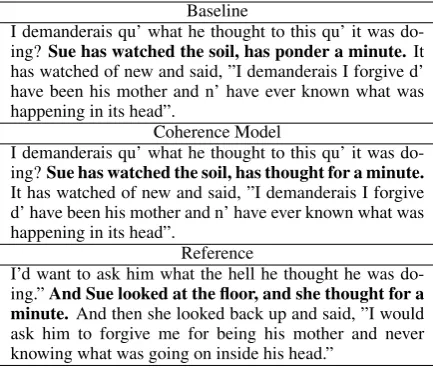
Document 1 is one of the documents where the coherence model outperforms the baseline and it is tempting to assume that the score difference stems from the one operation not accepted by the coher-ence model. Indeed, the only detectable differ-ence in the two translations is in one sentdiffer-ence only (see its output translations in Table5). The coher-ence features might prevent the translation model to change the translation of thought for, which is identical with the reference translation.
Similarly, for document 10 the CM model ac-cepts one less operation than the baseline model and it, again, helps the model to obtain a higher Meteor score. Interestingly, the BLEU score on these two documents remains the same, so the score difference is likely a result of a more seman-tic change in translation. For the document 9 the CM model improves the MT scores by accepting more operations than the baseline model. For doc-uments 3, 6 and 8 the accepted operations by the CM model reduce the MT scores.
Finally, supported operations in Docent seem
Document ID # of accepted operationsBL CM
(#1) 1756 22 21
(#2) 1819 18 18
(#3) 1825 22 21
(#4) 1894 25 25
(#5) 1935 21 21
(#6) 1938 30 33
(#7) 1950 59 59
(#8) 1953 29 32
(#9) 1979 25 26
(#10) 2043 9 8
(#11) 2053 12 12
[image:8.595.308.525.62.248.2](#12) 205 4 4
Table 4: Comparison of the number of accepted
change-phrase-translationoperations.
Baseline
I demanderais qu’ what he thought to this qu’ it was do-ing?Sue has watched the soil, has ponder a minute. It has watched of new and said, ”I demanderais I forgive d’ have been his mother and n’ have ever known what was happening in its head”.
Coherence Model
I demanderais qu’ what he thought to this qu’ it was do-ing?Sue has watched the soil, has thought for a minute. It has watched of new and said, ”I demanderais I forgive d’ have been his mother and n’ have ever known what was happening in its head”.
Reference
I’d want to ask him what the hell he thought he was do-ing.”And Sue looked at the floor, and she thought for a minute.And then she looked back up and said, ”I would ask him to forgive me for being his mother and never knowing what was going on inside his head.”
Table 5: Comparison of the baseline (BL), coher-ence model (CM), and reference (REF) transla-tions for document 1 (ID: 1756) for one differing sentence betweenBLandCM(marked in bold).
insufficient to change the structure of graphs. From the three basic operations Docent uses, the two operationsswap-phrasesandresegment may not change the graph structure. Change-phrase-translation, however, has the potential to actually change the graph structure by either choosing an alternative translation of a word that is either not connected to any other words anymore or that con-versely connects to another word within the text.
6 Conclusions
In this paper, we employed the graph-based repre-sentation of local coherence byMesgar and Strube
(2016) for the machine translation task by inte-grating the graph-based coherence features with the document-level MT decoder Docent (
Hard-meier et al., 2012, 2013). The usage of these
coherence features has been shown for readabil-ity assessment and multi-document summariza-tion (Parveen et al., 2016; Mesgar and Strube,
2016). We are the first who utilize these coher-ence features for document-level translation. Our coherence model using subgraph frequencies as coherence features improves the performance of Docent as a document-level MT decoder. For fu-ture work, we are going to check if the connectiv-ity structure of the source document can help the translation system to improve the translation qual-ity of each sentence. This idea is inspired from the application of topic-based coherence modeling in machine translation before (Xiong and Zhang,
[image:8.595.75.288.537.729.2]Acknowledgments
This work has been funded by the Klaus Tschira Foundation, Heidelberg, Germany. The second author has been supported by a HITS Ph.D. schol-arship. We are grateful to the anonymous review-ers for their insightful comments.
References
Dzmitry Bahdanau, Kyunghyun Cho, and Yoshua Ben-gio. 2015. Neural machine translation by jointly learning to align and translate. In Proceedings of the International Conference on Learning Represen-tations (ICLR).
Regina Barzilay and Mirella Lapata. 2008. Model-ing Local Coherence: An Entity-Based Approach.
Computational Linguistics34(1):1–34.
Ondrej Bojar, Rajen Chatterjee, Christian Federmann, Barry Haddow, Matthias Huck, Chris Hokamp, Philipp Koehn, Varvara Logacheva, Christof Monz, Matteo Negri, Matt Post, Carolina Scarton, Lucia Specia, and Marco Turchi. 2015. Findings of the 2015 Workshop on Statistical Machine Translation. InProceedings of the Tenth Workshop on Statistical Machine Translation. Lisbon, Portugal, pages 1–46. Frantiˇsek Daneˇs. 1974. Functional Sentence Perspec-tive and the Organization of the Text. In Frantiˇsek Daneˇs, editor, Papers on Functional Sentence Per-spective, Academia, Prague, pages 106–128. Michael Denkowski and Alon Lavie. 2014. Meteor
Universal: Language Specific Translation Evalua-tion for Any Target Language. InProceedings of the EACL 2014 Workshop on Statistical Machine Trans-lation. pages 376–380.
Qin Gao and Stephan Vogel. 2008. Parallel Implemen-tations of Word Alignment Tool. InProceedings of the ACL 2008 Software Engineering, Testing, and Quality Assurance Workshop. pages 49–57.
Barbara J. Grosz, Aravind Joshi, and Scott Weinstein. 1995. Centering: A Framework for Modeling the Local Coherence of Discourse. Computational Lin-guistics21(2):203–225.
Camille Guinaudeau and Michael Strube. 2013. Graph-based Local Coherence Modeling. In Pro-ceedings of the 51st Annual Meeting of the Associa-tion for ComputaAssocia-tional Linguistics. Sofia, Bulgaria, pages 93–103.
Christian Hardmeier. 2012. Discourse in Statistical Machine Translation: A Survey and a Case Study.
Discours11:3–30.
Christian Hardmeier. 2014. Discourse in Statistical Machine Translation. Ph.D. thesis, Uppsala Univer-sity.
Christian Hardmeier, Preslav Nakov, Sara Stymne, J¨org Tiedemann, Yannick Versley, and Mauro Cettolo. 2015. Pronoun-Focused MT and Cross-Lingual Pronoun Prediction: Findings of the 2015 Dis-coMT Shared Task on Pronoun Translation. In Pro-ceedings of the Second Workshop on Discourse in Machine Translation (DiscoMT). Lisbon, Portugal, pages 1–16.
Christian Hardmeier, Joakim Nivre, and J¨org Tiede-mann. 2012. Document-Wide Decoding for Phrase-Based Statistical Machine Translation. In Proceed-ings of the 2012 Joint Conference on Empirical Methods in Natural Language Processing and Com-putational Natural Language Learning. Jeju Island, Korea, pages 1179–1190.
Christian Hardmeier, Sara Stymne, J¨org Tiedemann, and Joakim Nivre. 2013. Docent: A Document-Level Decoder for Phrase-Based Statistical Machine Translation. In Proceedings of the 51st Annual Meeting of the Association for Computational Lin-guistics. Sofia, Bulgaria, pages 193–198.
Basil Hatim and Ian Mason. 1990. Discourse and the Translator. Language in Social Life Series. Long-man, London.
Kenneth Heafield. 2011. KenLM: Faster and Smaller Language Model Queries. In Proceedings of the Sixth Workshop on Statistical Machine Translation. pages 187–197.
A. Khachaturyan, S. Semenovsovskaya, and B. Vain-shtein. 1981. The thermodynamic approach to the structure analysis of crystals. Acta Crystallograph-ica Section A37(5):742–754.
Philipp Koehn, Hieu Hoang, Alexandra Birch, Chris Callison-Burch, Marcello Federico, Nicola Bertoldi, Brooke Cowan, Wade Shen, Christine Moran, Richard Zens, Chris Dyer, Ondrej Bojar, Alexandra Constantin, and Evan Herbst. 2007. Moses: Open Source Toolkit for Statistical Machine Translation. In Proceedings of the ACL 2007 Demo and Poster Sessions. Prague, Czech Republic, pages 177–180.
Philipp Koehn, Franz Josef Och, and Daniel Marcu. 2003. Statistical Phrase-Based Translation. In Pro-ceedings of HLT-NAACL 2003. pages 48–54.
Alon Lavie and Abhaya Agarwal. 2007. METEOR: An Automatic Metric for MT Evaluation with Improved Correlation with Human Judgments. In Proceed-ings of the Second Workshop on Statistical Machine Translation. Prague, Czech Republic, pages 228–23.
Gennadi Lembersky, Noam Ordan, and Shuly Wintner. 2012. Language Models for Machine Translation: Original vs. Translated Texts. Computational Lin-guistics38(4):799–825.
Rui Lin, Shujie Liu, Muyun Yang, Mu Li, Ming Zhou, and Sheng Li. 2015. Hierarchical Recurrent Neu-ral Network for Document Modeling. In Proceed-ings of the 2015 Conference on Empirical Methods in Natural Language Processing. Lisbon, Portugal, pages 899–907.
Mohsen Mesgar and Michael Strube. 2015. Graph-based Coherence Modeling For Assessing Readabil-ity. InProceedings of the Fourth Joint Conference on Lexical and Computational Semantics (*SEM 2015). Denver, Col., pages 309–318.
Mohsen Mesgar and Michael Strube. 2016. Lexical Coherence Graph Modeling Using Word Embed-dings. In Proceedings of the 2016 Conference of the North American Chapter of the Association for Computational Linguistics: Human Language Tech-nologies. San Diego, Cal., pages 1414–1423. Siegfried Nijssen and Joost N. Kok. 2004. A
Quick-start in Frequent Structure Mining Can Make a Dif-ference. In The Proceedings of the tenth ACM SIGKDD international conference on Knowledge discovery and data mining. pages 647–652.
Siegfried Nijssen and Joost N. Kok. 2005. The Gas-ton Tool for Frequent Subgraph Mining. Electronic Notes in Theoretical Computer Science127(1):77– 87.
Franz Josef Och. 2003. Minimum Error Rate Training in Statistical Machine Translation. InProceedings of the 41st Annual Meeting of the Association for Computational Linguistics. Sapporo, Japan, pages 160–167.
Kishore Papineni, Salim Roukos, Todd Ward, and Wei-Jing Zhu. 2002. BLEU: a Method for Automatic Evaluation of Machine Translation. In Proceed-ings of the 40th Annual Meeting of the Association for Computational Linguistics. Philadelphia, pages 311–318.
Daraksha Parveen, Mohsen Mesgar, and Michael Strube. 2016. Generating Coherent Summaries of Scientific Articles Using Coherence Patterns. In
Proceedings of the 2016 Conference on Empirical Methods in Natural Language Processing. Austin, Texas, pages 772–783.
Jeffrey Pennington, Richard Socher, and Christo-pher D. Manning. 2014. GloVe: Global Vectors for Word Representation. In Proceedings of the 2014 Conference on Empirical Methods in Natural Lan-guage Processing. Doha, Qatar, pages 1532–1543. Emily Pitler and Ani Nenkova. 2008. Revisiting
read-ability: A unified framework for predicting text quality. In Proceedings of the 2008 Conference on Empirical Methods in Natural Language Process-ing. Waikiki, Honolulu, Hawaii, pages 186–195.
Gerard Salton. 1971. The SMART Retrieval System— Experiments in Automatic Document Processing. Prentice-Hall, Inc., Upper Saddle River, NJ, USA. Rico Sennrich, Orhan Firat, Kyunghyun Cho,
Alexan-dra Birch, Barry Haddow, Julian Hitschler, Marcin Junczys-Dowmunt, Samuel L¨aubli, Antonio Valerio Miceli Barone, Jozef Mokry, and Maria Nadejde. 2017. Nematus: a toolkit for neural machine transla-tion. InProceedings of the Software Demonstrations of the 15th Conference of the European Chapter of the Association for Computational Linguistics. Va-lencia, Spain, pages 65–68.
Karin Sim Smith, Wilker Aziz, and Lucia Specia. 2015. A Proposal for a Coherence Corpus in Machine Translation. InProceedings of the Second Workshop on Discourse in Machine Translation (DiscoMT). Lisbon, Portugal, pages 52–58.
Karin Sim Smith, Wilker Aziz, and Lucia Specia. 2016. The Trouble with Machine Translation Coherence.
Baltic Journal of Modern Computing4(2):178–189. Student. 1908. The Probable Error of a Mean.
Biometrika6(1):1–25.
Gideon Toury. 1995.Descriptive Translation Studies – and beyond. John Benjamins Publishing.
Lawrence Venuti, editor. 2004.The Translation Studies Reader. Routledge, London, 2nd edition.