Improving Clinical Diagnosis Inference through Integration of Structured
and Unstructured Knowledge
Yuan Ling, Yuan An
College of Computing & Informatics Drexel University
Philadelphia, PA, USA
{yl638,ya45}@drexel.edu
Sadid A. Hasan
Artificial Intelligence Laboratory Philips Research North America
Cambridge, MA, USA
Abstract
This paper presents a novel approach to the task of automatically inferring the most probable diagnosis from a given clinical narrative. Structured Knowledge Bases (KBs) can be useful for such com-plex tasks but not sufficient. Hence, we leverage a vast amount of unstructured free text to integrate with structured KBs. The key innovative ideas include building a concept graph from both structured and unstructured knowledge sources and rank-ing the diagnosis concepts usrank-ing the en-hanced word embedding vectors learned from integrated sources. Experiments on the TREC CDS and HumanDx datasets showed that our methods improved the re-sults of clinical diagnosis inference. 1 Introduction and Related Work
Clinical diagnosis inference is the problem of au-tomatically inferring the most probable diagno-sis from a given clinical narrative. Many health-related information retrieval tasks can greatly ben-efit from the accurate results of clinical diagnosis inference. For example, in recent Text REtrieval Conference (TREC) Clinical Decision Support track (CDS1), diagnosis inference from medical
narratives has improved the accuracy of retriev-ing relevant biomedical articles (Roberts et al., 2015; Hasan et al., 2015; Goodwin and Harabagiu, 2016).
Solutions to the clinical diagnostic inferencing problem require a significant amount of inputs from domain experts and a variety of sources (Fer-rucci et al., 2013; Lally et al., 2014). To ad-dress such complex inference tasks, researchers (Yao and Van Durme, 2014; Bao et al., 2014; Dong et al., 2015) have utilized structured KBs
1http://www.trec-cds.org/
that store relevant information about various en-tity types and relation triples. Many large-scale KBs have been constructed over the years, such as WordNet (Miller, 1995), Yago (Suchanek et al., 2007), Freebase (Bollacker et al., 2008), DB-pedia (Auer et al., 2007), NELL (Carlson et al., 2010), UMLS Metathesaurus (Bodenreider, 2004) etc. However, using KBs alone for inference tasks (Bordes et al., 2014) has certain limitations such as incompleteness of knowledge, sparsity, and fixed schema (Socher et al., 2013; West et al., 2014).
On the other hand, unstructured textual re-sources such as free texts from Wikipedia gen-erally contain more information than structured KBs. As a supplementary knowledge to mitigate the limitations of structured KBs, unstructured text combined with structured KBs provides improved results for related tasks, for example, clinical ques-tion answering (Miller et al., 2016). For pro-cessing text, word embedding models (e.g. skip-gram model (Mikolov et al., 2013b; Mikolov et al., 2013a)) can efficiently discover and represent the underlying patterns of unstructured text. Word embedding models represent words and their rela-tionships as continuous vectors. To improve word embedding models, previous works have also suc-cessfully leveraged structured KBs (Bordes et al., 2011; Weston et al., 2013; Wang et al., 2014; Zhou et al., 2015; Liu et al., 2015).
Motivated by the superior power of the integra-tion of structured KBs and unstructured free text, we propose a novel approach to clinical diagno-sis inference. The novelty lies in the ways of in-tegrating structured KBs with unstructured text. Experiments showed that our methods improved clinical diagnosis inference from different aspects (Section 5.4). Previous work on diagnosis in-ference from clinical narratives either formulates the problem as a medical literature retrieval task (Zheng and Wan, 2016; Balaneshin-kordan and Kotov, 2016) or as a multiclass multilabel
fication problem in a supervised setting (Hasan et al., 2016; Prakash et al., 2016). To the best of our knowledge, there is no work on diagnoses infer-ence from clinical narratives conducted in an un-supervised way. Thus, we build such baselines for this task.
2 Overview of the Approach
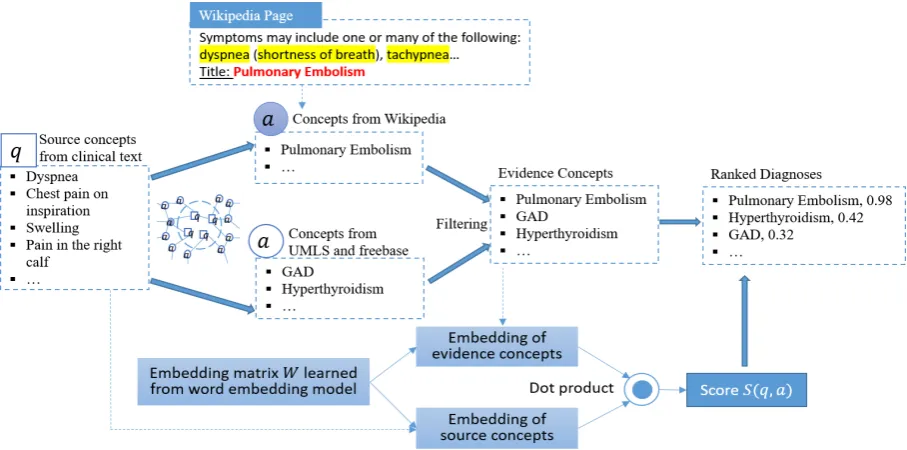
Our approach includes four steps in general: 1) extracting source concepts,q, from clinical narra-tives, 2) iteratively identifying corresponding ev-idence concepts, a, from KBs and unstructured text, 3) representing both source and evidence concepts in a weighted graph via a regularizer-enhanced skip-gram model, and 4) ranking the rel-evant evidence concepts (i.e. diagnoses) based on their association with the source concepts,S(q, a)
(computed by weighted dot product of two vec-tors), to generate the final output. Figure 1 shows the overview using an illustrative example.
Given source concepts as input, we build an edge-weighted graph representing the connections among all the concepts by iteratively retrieving evidence concepts from both KBs and unstruc-tured text. The weights of the edges represent the strengths of the relationships between concepts. Each concept is represented as a word embedding vector. We combine all the source concept vec-tors into a single vector representing a clinical sce-nario. Source concepts are differentiated accord-ing to the weightaccord-ing scheme in Section 4.2. Evi-dence concepts are also represented as vectors and ranked according to their relevance to the source concepts. For each clinical case, we find the most probable diagnoses from the top-ranked evidence concepts.
3 Knowledge Sources of Evidence Concepts
In this study, we use UMLS Metathesaurus (Bo-denreider, 2004) and Freebase (Bollacker et al., 2008) as the structured KBs. Both KBs pro-vide semantic relation triples in the following format: <concept1, relation, concept2>. We select UMLS relation types that are relevant to the problem of clinical diagnosis inference. These types include treatment, disease-prevention, disease-finding, sign or symptom, causes etc. Freebase contains a large number of triples from multiple domains. We select 61,243 triples from freebase that are classified as
medicine relation types. There are 19 such rela-tion types in total. Most of them fall under the “medicine.disease” category.
For unstructured text, we use articles from Wikipedia and MayoClinic corpus as the supple-mentary knowledge source. Important clinical concepts mentioned in a Wikipedia/MayoClinic page can serve as a critical clue to a clinical di-agnosis. For example, in Figure 1, we see that “dyspnea”, “shortness of breath”, “tachypnea” etc. are the related signs and symptoms of the “Pul-monary Embolism” diagnosis. We select 37,245 Wikipedia pages under the clinical diseases and medicine category in this study. Most of the page titles represent disease names. In addition, MayoClinic2disease corpus contains 1,117 pages,
which include sections of Symptoms, Causes, Risk Factors, Treatments and Drugs, Prevention, etc.
4 Methodology
4.1 Building Weighted Concept Graph
Both the source and the evidence concepts are represented as nodes in a graph. A clinical case is represented as a set of source concept nodes:
q = {q1, q2, . . .}. We build a weighted concept
graph from source concepts using Algorithm 1.
Algorithm 1:Build Concept Graph
Input :source concept nodesq
Output:graphG= (V, E)
1 S=qandV =q;
2 whileS6=∅do 3 foreachqiinSdo
4 ifdistance(qi, q)>2then
5 continue;
6 end
7 iftriple< qi, r, aj>in KBsthen
8 wij= 1;
9 e= (qi, aj)ande.value=wij;
10 insertajtoVandS;
11 insertetoE;
12 end
13 Useqias query, search in Unstructured Text Corpora, get
ResultR;
14 foreach page-similarity pair(p, sij)inRdo
15 e= (qi, title(p))ande.value=sij;
16 inserttitle(p)toVandS;
17 insertetoE;
18 end
19 removeqifromS;
20 end
21 end
Two kinds of evidence concept nodes are added to the graph: 1) the entities from KBs (UMLS and Freebase) (step 7-12 in Algorithm 1), and 2) the entities from unstructured text pages (step 13-18). If there exists a triple< qi, r, aj >in KBs, where
Figure 1: Overview of our system.
r refers to a relation, an edge is used to connect nodeqiand nodeaj.wij represents the weight for
that edge, and let wij = 1, if the corresponding
triple occurs at least once. Due to the incomplete-ness of the KBs, there may exist multiple missing connections between a potential evidence concept
aj and a source concept qi. Unstructured
knowl-edge from Wikipedia and MayoClinic can replen-ish these missing connections. For each page p, the page title represents an evidence concept aj.
We use each source concept qi as a query, and
pagepas a document, and then calculate a query-document similarity to measure the edge weight
wij between node aj and node qi. We only take
evidence concepts as all nodes connected to source concepts in a distance of at most2(step 4-6).
4.2 Representing Clinical Case
We combine the source conceptsq and get a sin-gle vector vq to represent the clinical case
narra-tive. The source concepts from narratives for clin-ical diagnosis inference should be differentiated. Some source concepts are major symptoms for a diagnosis, while others are less critical. These ma-jor source concepts should be identified and given higher weight values. We develop two kinds of weighting schema for the differential expression of the source concepts. The source concept is rep-resented as vq = N1 Pqi∈qγivqi. N is the total
number of source concepts. vqi is the vector
rep-resentation for one source conceptqi.
(1) A longer concept usually convey more infor-mation (e.g. malar rashvs. rash), so it should be given more weights. We define this weight value asγ1 = #W ords in Concept.
(2) For some commonly seen concepts (e.g.
fever), usually, there are more edges connected to them. Sometimes, a common concept is less im-portant for diagnosis inference, while some unique concepts are critical to infer a specific diagnosis. We define this weight value for each concept as
γ2 = #Connected Edges1 . A higher weight value
means the source concept is more unique.
4.3 Inferring Concepts for Diagnosis
Extracting Potential Evidence Concepts: From source concept nodes q, we find their con-nected concepts in the graph as evidence concepts. Traversing all edges in a graph is computation-ally expensive and often unnecessary for finding potential diagnoses. The solution is to use a sub-graph. We follow the idea proposed in Bordes et al. (2014). The evidence concepts are defined as all nodes connected to source concepts in a dis-tance of at most2.
Ranking Evidence Concepts: We rank each evidence concept a0 according to its matching
scoreS(q, a0)to the source concepts. The
match-ing score S(q, a0) is a dot product of embedding
representation of the evidence concepta0 and the
source concept q by taking the edge weights wij
into consideration. S(q, a0) = w
vqare embedding representations fora0andq. The
embedding E ∈ Rk×N for concepts are trained
using embedding models (Section 4.4). N is the total number of concepts and kis the predefined dimensions for the embedding vector. Each con-cept in the graph can find akdimensional vector representation in E. For a set of source concepts and evidence concepts A(q), the top-ranked evi-dence concept can be computed as:
a=argmax(a0∈A(q))S(q, a0) (1)
4.4 Word Embedding Models
We use the skip-gram model as the basic model. The skip-gram model predicts surrounding words
wt−c, . . . , wt−1, wt+1, . . . , wt+cgiven the current
center wordwt. We further enhance the skip-gram
model by adding a graph regularizer. Given a se-quence of training wordsw1, w2, . . . , wT, the
ob-jective function is:
J= max1 T
T X t=1
(1−λ) X
−c≤j≤c,j6=0
logp(wt+j|wt)−λ R X r=1
D(vt, vr),
(2) wherevtandvrare the representation vectors for
wordwtand wordwr.λis a parameter to leverage
the graph regularizer and original objective. Sup-pose, wordwtis mentioned having relations with a
set of other wordswr, r∈ {1, . . . , R}in KBs. The
graph regularizerλPRr=1D(vt, vr)integrates
ex-tra knowledge about semantic relationships among words within the graph structure.D(vt, vr)
repre-sents the distance betweenvt and vr. In our
ex-periments, the distance between two concepts is measured using KL-Divergence. D(vt, vr)can be
calculated using any other types of distance met-rics. By minimizing D(vt, vr), we expect if two
concepts have a close relation in KBs, their vector representations will also be close to each other.
5 Experiments
5.1 Datasets for Clinical Diagnosis Inference
Our first dataset is from the 2015 TREC CDS track (Roberts et al., 2015). It contains 30 top-ics, where each topic is a medical case narrative that describes a patient scenario. Each case is as-sociated with the ground truth diagnosis. We use MetaMap3 to extract the source concepts from a
narrative and then manually refine them to remove redundancy.
3https://metamap.nlm.nih.gov/
Our second dataset is curated from HumanDx4,
a project to foster integrating efforts to map health problems to their possible diagnoses. We curate diagnosis-findings relationships from HumanDx and create a dataset with 459 diagnosis-findings entries. Note that, the findings from this dataset are used as the given source concepts for a clinical scenario.
5.2 Training Data for Word Embeddings
We curate a biomedical corpus of around 5M sentences from two data sources: PubMed Cen-tral5 from the 2015 TREC CDS snapshot6 and
Wikipedia articles under the “Clinical Medicine” category7. After sentence splitting, word
tok-enization, and stop words removal, we train our word embedding models on this corpus. UMLS Metathesaurus and Freebase are used as KBs to train the graph regularizer. We use stochastic gra-dient descent (SGD) to maximize the objective function and set the parameters empirically.
5.3 Results
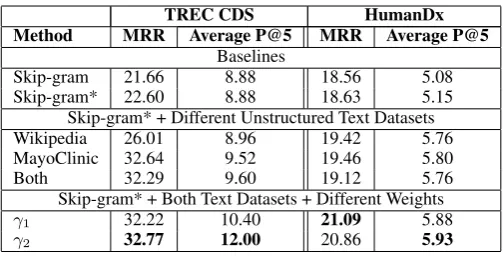
We use Mean Reciprocal Rank (MRR) and Aver-age Precision at 5 (P@5) to evaluate our models. MRR is a statistical measure to evaluate a process that generates a list of possible responses to a sam-ple of queries, ordered by probability of correct-ness. Average P@5 is calculated as precision at top 5 predicted results divided by the total number of topics. Since our dataset only has one correct diagnosis for each topic, all results have poor Av-erage P@5 scores.
Table 1 presents the results for our experi-ments. We report two baselines: Skip-gramrefers to the basic word embedding model, and Skip-gram* refers to the graph-regularized model us-ing KBs. We also show the results for usus-ing dif-ferent unstructured knowledge sources and differ-ent weighting schema. We can see that the best scores are obtained by the graph-regularized mod-els with both the unstructured knowledge sources with variable weighting schema (Section 4.2).
5.4 Discussion
Unstructured text is a critical supplement: We analyze the source concepts and the corresponding evidence concepts for CDS topics, and investigate
4https://www.humandx.org/ 5https://www.ncbi.nlm.nih.gov/pmc/
6http://www.trec-cds.org/2015.html#documents
TREC CDS HumanDx Method MRR Average P@5 MRR Average P@5
Baselines
Skip-gram 21.66 8.88 18.56 5.08
Skip-gram* 22.60 8.88 18.63 5.15
Skip-gram* + Different Unstructured Text Datasets
Wikipedia 26.01 8.96 19.42 5.76
MayoClinic 32.64 9.52 19.46 5.80
Both 32.29 9.60 19.12 5.76
Skip-gram* + Both Text Datasets + Different Weights
γ1 32.22 10.40 21.09 5.88
[image:5.595.173.425.60.188.2]γ2 32.77 12.00 20.86 5.93
Table 1: Evaluation results.
the origin of the correct diagnoses. 70% of the correct diagnoses can be inferred from Wikipedia, 60% of the correct diagnoses from MayoClinic, 56% of the correct diagnoses from Freebase, and only 7% are from UMLS. Hence, Wikipedia and MayoClinic are very important sources for finding the correct diagnoses.
Source concepts should be differentiated: In clinical narratives, some concepts are more critical than others for the clinical diagnosis inference. We developed two weighting schema to assign higher weight values to more important concepts. The re-sults in Table 1 show that differentiating the source concepts with different weight values has a large impact on the model performance.
Enhanced skip-gram is better: We propose the enhanced skip-gram model by using a graph regularizer to integrate the semantic relationships among concepts from KBs. Experimental results show that diagnosis inference is improved by us-ing word embeddus-ing representations from the en-hanced skip-gram model.
6 Conclusion
We proposed a novel approach to the task of clin-ical diagnosis inference from clinclin-ical narratives. Our method overcomes the limitations of tured KBs by making use of the integrated struc-tured and unstrucstruc-tured knowledge. Experimen-tal results showed that the enhanced skip-gram model with differential expression of source con-cepts improved the performance on two bench-mark datasets.
References
S¨oren Auer, Christian Bizer, Georgi Kobilarov, Jens Lehmann, Richard Cyganiak, and Zachary Ives. 2007. Dbpedia: A nucleus for a web of open data. InThe semantic web, pages 722–735. Springer.
Saeid Balaneshin-kordan and Alexander Kotov. 2016. Optimization method for weighting explicit and la-tent concepts in clinical decision support queries. In Proceedings of the 2016 ACM on International Conference on the Theory of Information Retrieval, pages 241–250. ACM.
Junwei Bao, Nan Duan, Ming Zhou, and Tiejun Zhao. 2014. Knowledge-based question answering as ma-chine translation. Cell, 2(6).
Olivier Bodenreider. 2004. The unified medical lan-guage system (umls): integrating biomedical termi-nology. Nucleic acids research, 32(suppl 1):D267– D270.
Kurt Bollacker, Colin Evans, Praveen Paritosh, Tim Sturge, and Jamie Taylor. 2008. Freebase: a col-laboratively created graph database for structuring human knowledge. InProceedings of the 2008 ACM SIGMOD international conference on Management of data, pages 1247–1250. ACM.
Antoine Bordes, Jason Weston, Ronan Collobert, and Yoshua Bengio. 2011. Learning structured embed-dings of knowledge bases. InConference on artifi-cial intelligence.
Antoine Bordes, Sumit Chopra, and Jason Weston. 2014. Question answering with subgraph embed-dings. arXiv preprint arXiv:1406.3676.
Andrew Carlson, Justin Betteridge, Bryan Kisiel, Burr Settles, Estevam R Hruschka Jr, and Tom M Mitchell. 2010. Toward an architecture for never-ending language learning. In AAAI, volume 5, page 3.
Li Dong, Furu Wei, Ming Zhou, and Ke Xu. 2015. Question answering over freebase with multi-column convolutional neural networks. In Proceed-ings of Association for Computational Linguistics, pages 260–269.
David Ferrucci, Anthony Levas, Sugato Bagchi, David Gondek, and Erik T Mueller. 2013. Watson: beyond jeopardy! Artificial Intelligence, 199:93–105. Travis R. Goodwin and Sanda M. Harabagiu. 2016.
support. In Proceedings of the 25th ACM Inter-national on Conference on Information and Knowl-edge Management, pages 297–306. ACM.
Sadid A. Hasan, Yuan Ling, Joey Liu, and Oladimeji Farri. 2015. Using neural embeddings for diag-nostic inferencing in clinical question answering. In
TREC.
Sadid A. Hasan, Siyuan Zhao, Vivek Datla, Joey Liu, Kathy Lee, Ashequl Qadir, Aaditya Prakash, and Oladimeji Farri. 2016. Clinical question answering using key-value memory networks and knowledge graph. InTREC.
Adam Lally, Sugato Bachi, Michael A. Barborak, David W. Buchanan, Jennifer Chu-Carroll, David A. Ferrucci, Michael R. Glass, Aditya Kalyanpur, Erik T. Mueller, J. William Murdock, et al. 2014. Watsonpaths: scenario-based question answering and inference over unstructured information. York-town Heights: IBM Research.
Quan Liu, Hui Jiang, Si Wei, Zhen-Hua Ling, and Yu Hu. 2015. Learning semantic word embeddings based on ordinal knowledge constraints. In Pro-ceedings of the 53rd Annual Meeting of the Associ-ation for ComputAssoci-ational Linguistics and the 7th In-ternational Joint Conference on Natural Language Processing (ACL-IJCNLP), pages 1501–1511. Tomas Mikolov, Kai Chen, Greg Corrado, and
Jef-frey Dean. 2013a. Efficient estimation of word representations in vector space. arXiv preprint arXiv:1301.3781.
Tomas Mikolov, Ilya Sutskever, Kai Chen, Greg S. Cor-rado, and Jeff Dean. 2013b. Distributed representa-tions of words and phrases and their compositional-ity. InAdvances in neural information processing systems, pages 3111–3119.
Alexander Miller, Adam Fisch, Jesse Dodge, Amir-Hossein Karimi, Antoine Bordes, and Jason We-ston. 2016. Key-value memory networks for di-rectly reading documents. CoRR, abs/1606.03126. George A. Miller. 1995. Wordnet: a lexical
database for english. Communications of the ACM, 38(11):39–41.
Aaditya Prakash, Siyuan Zhao, Sadid A. Hasan, Vivek Datla, Kathy Lee, Ashequl Qadir, Joey Liu, and Oladimeji Farri. 2016. Condensed memory net-works for clinical diagnostic inferencing. arXiv preprint arXiv:1612.01848.
Kirk Roberts, Matthew S. Simpson, Ellen Voorhees, and William R. Hersh. 2015. Overview of the trec 2015 clinical decision support track. InTREC. Richard Socher, Danqi Chen, Christopher D. Manning,
and Andrew Ng. 2013. Reasoning with neural ten-sor networks for knowledge base completion. In Ad-vances in Neural Information Processing Systems, pages 926–934.
Fabian M. Suchanek, Gjergji Kasneci, and Gerhard Weikum. 2007. Yago: a core of semantic knowl-edge. InProceedings of the 16th international con-ference on World Wide Web, pages 697–706. ACM. Zhen Wang, Jianwen Zhang, Jianlin Feng, and Zheng
Chen. 2014. Knowledge graph and text jointly em-bedding. InEMNLP, pages 1591–1601. Citeseer. Robert West, Evgeniy Gabrilovich, Kevin Murphy,
Shaohua Sun, Rahul Gupta, and Dekang Lin. 2014. Knowledge base completion via search-based ques-tion answering. In Proceedings of the 23rd inter-national conference on World wide web, pages 515– 526. ACM.
Jason Weston, Antoine Bordes, Oksana Yakhnenko, and Nicolas Usunier. 2013. Connecting language and knowledge bases with embedding models for re-lation extraction. arXiv preprint arXiv:1307.7973. Xuchen Yao and Benjamin Van Durme. 2014.
Infor-mation extraction over structured data: Question an-swering with freebase. InACL (1), pages 956–966. Citeseer.
Ziwei Zheng and Xiaojun Wan. 2016. Graph-based multi-modality learning for clinical decision sup-port. InProceedings of the 25th ACM International on Conference on Information and Knowledge Man-agement, pages 1945–1948. ACM.