A Generative Model for Punctuation in Dependency Trees
Xiang Lisa Li⇤and Dingquan Wang⇤ and Jason Eisner Department of Computer Science, Johns Hopkins University
[email protected], {wdd,jason}@cs.jhu.edu
Abstract
Treebanks traditionally treat punctuation marks as ordinary words, but linguists have suggested that a tree’s “true” punctuation marks are not observed (Nunberg, 1990). These latent “underlying” marks serve to delimit or separate constituents in the syn-tax tree. When the tree’s yield is rendered as a written sentence, a string rewriting mech-anism transduces the underlying marks into “surface” marks, which are part of the ob-served (surface) string but should not be re-garded as part of the tree. We formalize this idea in a generative model of punc-tuation that admits efficient dynamic pro-gramming. We train it without observing the underlying marks, by locally maximiz-ing the incomplete data likelihood (simi-larly to the EM algorithm). When we use the trained model to reconstruct the tree’s underlying punctuation, the results appear plausible across 5 languages, and in par-ticular are consistent with Nunberg’s anal-ysis of English. We show that our gener-ative model can be used to beat baselines on punctuation restoration. Also, our recon-struction of a sentence’s underlying punctu-ation lets us appropriately render the surface punctuation (via our trained underlying-to-surface mechanism) when we syntactically transform the sentence.
1 Introduction
Punctuation enriches the expressiveness of writ-ten language. When converting from spoken to written language, punctuation indicates pauses or pitches; expresses propositional attitude; and is conventionally associated with certain syntactic constructions such as apposition, parenthesis, quo-tation, and conjunction.
In this paper, we present a latent-variable model of punctuation usage, inspired by the rule-based approach to English punctuation of Nun-berg(1990). Training our model on English data
⇤Equal contribution.
learns rules that are consistent with Nunberg’s hand-crafted rules. Our system is automatic, so we use it to obtain rules for Arabic, Chinese, Spanish, and Hindi as well.
Moreover, our rules are stochastic, which al-lows us to reason probabilistically about ambigu-ous or missing punctuation. Across the 5 lan-guages, our model predicts surface punctuation better than baselines, as measured both by per-plexity (§4) and by accuracy on a punctuation restoration task (§ 6.1). We also use our model to correct the punctuation of non-native writers of English (§6.2), and to maintain natural punc-tuation style when syntactically transforming En-glish sentences (§ 6.3). In principle, our model could also be used within a generative parser, al-lowing the parser to evaluate whether a candidate tree truly explains the punctuation observed in the input sentence (§8).
Punctuation is interesting InThe Linguistics of Punctuation,Nunberg(1990) argues that punctu-ation (in English) is more than a visual counter-part of spoken-language prosody, but forms a lin-guistic system that involves “interactions of point indicators (i.e. commas, semicolons, colons, pe-riods and dashes).” He proposes that much as in phonology (Chomsky and Halle, 1968), a gram-mar generatesunderlyingpunctuation which then transforms into the observedsurfacepunctuation. Consider generating a sentence from a syntactic grammar as follows:
Hail the king [, Arthur Pendragon ,] [, who wields [ “ Excalibur ” ] ,] .
Although the full tree is not depicted here, some of the constituents are indicated with brackets. In this underlying generated tree, each appositive NP is surrounded by commas. On the surface, however, the two adjacent commas afterPendragon will now be collapsed into one, and the final comma will be absorbed into the adjacent period. Fur-thermore, in American English, the typographic
convention is to move the final punctuation inside the quotation marks. Thus a reader sees only this modified surface form of the sentence:
Hail the king, Arthur Pendragon, who wields “Excalibur.”
Note that these modifications are string transfor-mations that do not see or change the tree. The resulting surface punctuation marks may be clues to the parse tree, but (contrary to NLP convention) they should not be included as nodes in the parse tree. Only the underlying marks play that role. Punctuation is meaningful Pang et al. (2002) use question and exclamation marks as clues to sentiment. Similarly, quotation marks may be used to mark titles, quotations, reported speech, or dubious terminology (University of Chicago,
2010). Because of examples like this, methods for determining the similarity or meaning of syntax trees, such as a tree kernel (Agarwal et al.,2011) or a recursive neural network (Tai et al., 2015), should ideally be able to consider where the un-derlying punctuation marks attach.
Punctuation is helpful Surface punctuation re-mains correlated with syntactic phrase structure. NLP systems for generating or editing text must be able to deploy surface punctuation as human writ-ers do. Parswrit-ers and grammar induction systems benefit from the presence of surface punctuation marks (Jones,1994;Spitkovsky et al.,2011). It is plausible that they could do better with a linguisti-cally informed model that explains exactlywhythe surface punctuation appears where it does. Pat-terns of punctuation usage can also help identify the writer’s native language (Markov et al.,2018). Punctuation is neglected Work on syntax and parsing tends to treat punctuation as an af-terthought rather than a phenomenon governed by its own linguistic principles. Treebank annota-tion guidelines for punctuaannota-tion tend to adopt sim-ple heuristics like “attach to the highest possi-ble node that preserves projectivity” (Bies et al.,
1995; Nivre et al., 2018).1 Many dependency
parsing works exclude punctuation from evalua-tion (Nivre et al., 2007b;Koo and Collins,2010;
Chen and Manning,2014;Lei et al.,2014; Kiper-wasser and Goldberg,2016), although some others retain punctuation (Nivre et al., 2007a;Goldberg and Elhadad,2010;Dozat and Manning,2017).
1http://universaldependencies.org/u/ dep/punct.html
Unpunctuated Tree: T Dale means river valley
root nsubj dobj
ATTACH
tree: T0 Underlying sequence:u
sentence:u¯
Surface sentence:sequence:¯xx NOISYCHANNEL
u0 u1 u2 u3 u4
x0 x1 x2 x3 x4
“Dale” means“river valley” .
“Dale” means“river valley. ” root.
nsubj
[image:2.595.305.529.67.159.2]“ ” “dobj”
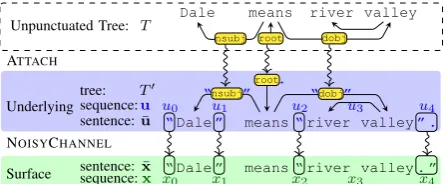
Figure 1: The generative story of a sentence. Given an unpunctuated tree T at top, at each node w 2 T, the ATTACH process stochastically attaches aleft puncteme l and a right puncteme r, which may be
empty. The resulting treeT0 has underlying punctua-tionu. Each slot’s punctuationui 2 uis rewritten to xi 2xby NOISYCHANNEL.
In tasks such as word embedding induction (Mikolov et al.,2013;Pennington et al.,2014) and machine translation (Zens et al., 2002), punctua-tion marks are usually either removed or treated as ordinary words (ˇReh˚uˇrek and Sojka,2010).
Yet to us, building a parse tree on a surface
sentence seems as inappropriate as morphologi-cally segmenting a surface word. In both cases, one should instead analyze the latent underlying
form, jointly with recovering that form. For exam-ple, the proper segmentation of Englishhoping is nothop-ingbuthope-ing(with underlying
e), and the proper segmentation of stopping
is neither stopp-ing nor stop-ping but
stop-ing (with only one underlying p).
Cot-terell et al.(2015,2016) get this right for morphol-ogy. We attempt to do the same for punctuation.
2 Formal Model
We propose a probabilistic generative model of sentences (Figure1):
p(¯x) =PT,T0psyn(T)·p✓(T0|T)·p (¯x|u¯(T0))
(1)
First, an unpunctuated dependency tree T is stochastically generated by some recursive pro-cesspsyn (e.g.,Eisner,1996, Model C).2 Second,
each constituent (i.e., dependency subtree) sprouts optional underlying punctuation at its left and right edges, according to a probability distribution p✓
that depends on the constituent’s syntactic role (e.g.,dobj for “direct object”). Thispunctuated
tree T0 yields the underlying stringu¯ = ¯u(T0),
which is edited by a finite-state noisy channelp to arrive at the surface sentencex¯.
2Our model could be easily adapted to work on
This third step may alter the sequence of punc-tuation tokens at eachslotbetween words—for ex-ample, in §1, collapsing the double comma , ,
betweenPendragonandwho. u andxdenote
just the punctuation at the slots ofu¯ andx¯
respec-tively, withui andxidenoting the punctuation to-ken sequences at theith slot. Thus, the transfor-mation at theithslot isui 7!xi.
Since this model is generative, we could train it without any supervision to explain the observed surface stringx: maximize the likelihood¯ p(¯x)in
(1), marginalizing out the possibleT, T0values. In the present paper, however, we exploit known T values (as observed in the “depunctuated” ver-sion of a treebank). BecauseTis observed, we can jointly train✓, to maximize just
p(x|T) =X
T0
p✓(T0 |T)·p (x|u(T0)) (2)
That is, the psyn model that generated T
be-comes irrelevant, but we still try to predict what surface punctuation will be added to T. We still marginalize over the underlying punctuation marksu. These arenever observed, but they must explain the surface punctuation marks x (§2.2), and they must be explained in turn by the syntax treeT (§2.1). The trained generative model then lets us restore or correct punctuation in new trees T (§6).
2.1 Generating Underlying Punctuation The ATTACH model characterizes the probability
of an underlying punctuated treeT0 given its cor-responding unpunctuated treeT, which is given by
p✓(T0 |T) = Y
w2T
p✓(lw, rw |w) (3)
wherelw, rw 2Vare the left and rightpunctemes thatT0attaches to the tree nodew. Each puncteme (Krahn,2014) in the finite setV is a string of 0 or more underlying punctuationtokens.3 The
proba-bilityp✓(l, r|w)is given by a log-linear model
3Multi-token punctemes are occasionally useful. For
ex-ample, the puncteme...might consist of either 1 or 3 to-kens, depending on how the tokenizer works; similarly, the puncteme?!might consist of 1 or 2 tokens. Also, if a sin-gle constituent ofT gets surrounded by both parentheses and
quotation marks, this gives rise to punctemes(“ and ”). (A better treatment would add the parentheses as a separate puncteme pair at a unary node above the quotation marks, but that would have requiredT0to introduce this extra node.)
1. Point Absorption 3. Period Absorption
„7!, ,.7!. -,7!- .?7!? .!7!! -;7!; ;.7!. abbv.7!abbv
2. Quote Transposition 4. Bracket Absorptions
[image:3.595.308.525.62.145.2]”,7!,” ”.7!.” ,)7!) -)7!) (,7!( ,”7!” “,7!“
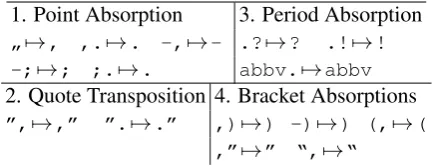
Table 1: Some of Nunberg’s punctuation interaction rules in English, in priority order. The absorption rules ensure that when there are two adjacent tokens, the “weaker” one is deleted (where the strength ordering is{?,!,(,),“,”} >. >{;,:} >- >,), except that bracketing tokens such as()and“”do not absorb tokensoutsidethe material they bracket.
p✓(l, r|w)/ (
exp✓>f(l, r, w) if(l, r)2Wd(w)
0 otherwise (4)
whereVis the finite set of possible punctemes and Wd ✓V2gives the possible puncteme pairs for a nodewthat has dependency relationd=d(w)to
its parent. V and Wd are estimated heuristically from the tokenized surface data (§4). f(l, r, w)is
a sparse binary feature vector, and ✓ is the
cor-responding parameter vector of feature weights. The feature templates inAppendix A4consider the
symmetry betweenlandr, and their compatibility with (a) the POS tag ofw’s head word, (b) the de-pendency paths connectingw to its children and the root ofT, (c) the POS tags of the words flank-ing the slots containflank-inglandr, (d) surface punc-tuation already added tow’s subconstituents.
2.2 From Underlying to Surface
From the tree T0, we can read off the sequence of underlying punctuation tokensui at each sloti between words. Namely,uiconcatenates the right punctemes of all constituents ending atiwith the left punctemes of all constituents starting ati(as illustrated by the examples in §1 and Figure 1). The NOISYCHANNELmodel then transducesuito a surface token sequencexi, for eachi= 0, . . . , n independently (wherenis the sentence length). Nunberg’s formalism Much likeChomsky and Halle’s (1968) phonological grammar of English,
Nunberg’s (1990) descriptive English punctuation grammar (Table1) can be viewed computationally as a priority string rewriting system, orMarkov algorithm (Markov, 1960; Caracciolo di Forino,
1968). The system begins with a token stringu.
abcde .ab7!ab abcde .bc7!b a bde .bd7!db a dbe .be7!e a d e
Figure 2: Editingabcde7!adewith a sliding win-dow. (When an absorption rule maps 2 tokens to 1, our diagram leaves blank space that is not part of the out-put string.) At each step, the left-to-right process has already committed to thegreentokens as output; has not yet looked at theblueinput tokens; and is currently considering how to (further) rewrite the black tokens. The right column shows the chosen edit.
At each step it selects the highest-priority local rewrite rule that can apply, and applies it as far left as possible. When no more rules can apply, the final state of the string is returned asx. Simplifying the formalism Markov algorithms are Turing complete. Fortunately,Johnson(1972) noted that in practice, phonologicalu 7! x maps described in this formalism can usually be imple-mented with finite-state transducers (FSTs).
For computational simplicity, we will formu-late our punctuation model as a probabilistic FST (PFST)—a locally normalized left-to-right rewrite model (Cotterell et al., 2014). The probabilities for each language must be learned, using gradient descent. Normally we expect most probabilities to be near 0 or 1, making the PFST nearly determin-istic (i.e., close to a subsequential FST). However, permitting low-probability choices remains useful to account for typographical errors, dialectal dif-ferences, and free variation in the training corpus. Our PFST generates a surface string, but the invertibility of FSTs will allow us to work back-wards whenanalyzinga surface string (§3). A sliding-window model Instead of having rule priorities, we apply Nunberg-style rules within a 2-token window that slides overuin a single left-to-right pass (Figure2). Conditioned on the cur-rent window contents ab, a single edit is selected stochastically: eitherab7!ab(no change),ab7!b (left absorption), ab 7! a (right absorption), or ab7!ba(transposition). Then the window slides rightward to cover the next input token, together with the token that is (now) to its left. aandbare always real tokens, never boundary symbols. specifies the conditional edit probabilities.5
5Rather than learn a separate edit probability distribution
for each bigramab, one could share parameters across bi-grams. For example, Table1’s caption says that “stronger” tokens tend to absorb “weaker” ones. A model that
incor-These specific edit rules (like Nunberg’s) can-not insert new symbols, nor can they deleteallof the underlying symbols. Thus, surfacexiis a good clue toui: all of its tokens must appear underly-ingly, and ifxi=✏(the empty string) thenui=✏.
The model can be directly implemented as a PFST (Appendix D4) using Cotterell et al.’s
(2014) more general PFST construction.
Our single-pass formalism is less expressive than Nunberg’s. It greedily makes decisions based on at most one token of right context (“label bias”). It cannot rewrite’”.7!.’”or”,.7!.” because the.is encountered too late to percolate leftward; luckily, though, we can handle such En-glish examples by sliding the window right-to-left instead of left-to-right. We treat the sliding direc-tion as a language-specific parameter.6
2.3 Training Objective
Building on equation (2), we train ✓, to lo-cally maximize the regularized conditional log-likelihood
⇣ X
x,T
logp(x|T) ⇠·E
T0[c(T
0)]2⌘ &· ||✓||2
(5) where the sum is over a training treebank.7
The expectation E[· · ·] is over T0 ⇠ p(· |
T,x). This generalized expectation term pro-videsposterior regularization(Mann and McCal-lum, 2010; Ganchev et al., 2010), by encourag-ing parameters that reconstruct trees T0 that use symmetric punctuation marks in a “typical” way. The functionc(T0) counts the nodes inT0 whose punctemes contain “unmatched” symmetric punc-tuation tokens: for example,)is “matched” only when it appears in a right puncteme with(at the comparable position in the same constituent’s left puncteme. The precise definition is given in Ap-pendix B.4
porated this insight would not have to learnO(|⌃|2)separate
absorption probabilities (two per bigramab), but onlyO(|⌃|)
strengths (one per unigrama, which may be regarded as a 1-dimensional embedding of the punctuation tokena). We
figured that the punctuation vocabulary⌃was small enough (Table2) that we could manage without the additional com-plexity of embeddings or other featurization, although this does presumably hurt our generalization to rare bigrams.
6We could have handled all languages uniformly by
mak-ing 2passes of the sliding window (via a composition of 2PFSTs), with at least one pass in each direction.
7In retrospect, there was no good reason to square the ET0[c(T0)]term. However, when we started redoing the
In our development experiments on English, the posterior regularization term was necessary to dis-cover an aesthetically appealing theory of under-lying punctuation. When we dropped this term (⇠ = 0) and simply maximized the ordinary
regu-larized likelihood, we found that the optimization problem was underconstrained: different training runs would arrive at different, rather arbitrary un-derlying punctemes. For example, one training run learned an ATTACH model that used underlying
“. to terminate sentences, along with a NOISY
-CHANNELmodel that absorbed the left quotation
mark into the period. By encouraging the under-lying punctuation to be symmetric, we broke the ties. We also tried making this a hard constraint (⇠ =1), but then the model was unable to explain
some of the training sentences at all, giving them probability of 0. For example,I went to the
“ special place ”cannot be explained,
be-causespecial placeis not a constituent.8
3 Inference
In principle, working with the model (1) is straightforward, thanks to the closure properties of formal languages. Provided thatpsyncan be
en-coded as a weighted CFG, it can be composed with the weighted tree transducerp✓ and the weighted
FSTp to yield a new weighted CFG (similarly to
Bar-Hillel et al.,1961;Nederhof and Satta,2003). Under this new grammar, one can recover the opti-malT, T0forx¯by dynamic programming, or sum
overT, T0by the inside algorithm to get the likeli-hoodp(¯x). A similar approach was used byLevy
(2008) with a different FST noisy channel. In this paper we assume thatT is observed, al-lowing us to work with equation (2). This cuts the computation time fromO(n3)toO(n).9 Whereas
the inside algorithm for (1) must consider O(n2)
possible constituents of¯xandO(n)ways of
build-ing each, our algorithm for (2) only needs to iterate over theO(n)true constituents ofTand the 1 true way of building each. However, it must still con-sider the|Wd|puncteme pairs for each constituent.
8Recall that the NOISYCHANNELmodel family (§2.2)
requires the surface “ before special to appear under-lyingly, and also requires the surface ✏afterspecial to be empty underlyingly. These hard constraints clash with the ⇠ = 1 hard constraint that the punctuation around
special must be balanced. The surface ”afterplace
causes a similar problem: no edge can generate the match-ing underlymatch-ing“.
9We doO(n)multiplications ofN
⇥N matrices where
Algorithm 1 The algorithm for scoring a given
(T,x)pair. The code inblueis used during
train-ing to get the posterior regularization term in (5). Input: T,x .Training pair (omitsT0,u) Output: p(x|T),E[c(T0)]
1: procedureTOTALSCORE(T,x)
2: fori= 1tondo
3: compute WFSA(Mi, i,⇢i)
4: E 0 .exp. count of unmatched punctemes
5: procedureIN(w) .w2T
6: i, k slots at left, right ofwconstit
7: j slot at right ofwheadword
8: Mleft (Qw02leftkids(w)IN(w0))⇢j 1
9: Mright >j (
Q
w02rightkids(w)IN(w0))
10: M0 Mleft·1·Mright.RNj⇥1,R1⇥Nj
11: M 0 .RNi⇥Nk
12: for(l, r)2Wd(w)do
13: p p✓(l, r|w)
14: M M+p·Mi(l)M0Mk(r)
15: E E+p· l,rhave unmatched punc
16: returnM .RNi⇥Nk
17: Mroot IN(root(T))
18: return >0Mroot⇢n,E .R,R
3.1 Algorithms
Given an input sentencex¯ of lengthn, our job is
to sum over possible trees T0 that are consistent with T and ¯x, or to find the best such T0. This is roughly a lattice parsing problem—made easier by knowing T. However, the possible u¯ values
are characterized not by a lattice but by a cyclic
WFSA (as|ui|is unbounded whenever|xi|>0).
For each slot 0 i n, transduce the sur-face punctuation string xi by the inverted PFST for p to obtain a weighted finite-state automa-ton (WFSA) that describes all possible underly-ing strunderly-ings ui.10 This WFSA accepts each
pos-sible ui with weight p (xi | ui). If it has Ni states, we can represent it (Berstel and Reutenauer,
1988) with a family of sparse weight matrices Mi( ) 2 RNi⇥Ni, whose element at row s and column tis the weight of the s ! tarc labeled with , or 0 if there is no such arc. Additional vectors i,⇢i 2 RNi specify the initial and final weights. ( i is one-hot if the PFST has a single
N=O(# of punc types·max # of punc tokens per slot).
10Constructively, compose theu-to-xPFST (from the end
initial state, of weight 1.)
For any puncteme l (or r) in V, we define Mi(l) = Mi(l1)Mi(l2)· · ·Mi(l|l|), a product
over the 0 or more tokens inl. This gives the total weight of alls!⇤ tWFSA paths labeled withl.
The subprocedure in Algorithm 1 essentially extends this to obtain a new matrix IN(w) 2
RNi⇥Nk, where the subtree rooted atw stretches
from slot i to slot k. Its element IN(w)st gives the total weight of all extended paths in the u¯
WFSA from statesat slotito statetat slotk. An extended path is defined by a choice of underly-ing punctemes atwand all its descendants. These punctemes determine ans-to-final path ati, then initial-to-final paths ati+ 1throughk 1, then an
initial-to-tpath atk. The weight of the extended path is the product of all the WFSA weights on these paths (which correspond to transition prob-abilities inp PFST) times the probability of the choice of punctemes (fromp✓).
This inside algorithm computes quantities needed for training (§ 2.3). Useful variants arise via well-known methods for weighted derivation forests (Berstel and Reutenauer,1988;Goodman,
1999;Li and Eisner,2009;Eisner,2016).
Specifically, to modify Algorithm1tomaximize
over T0 values (§§ 6.2–6.3) instead of summing over them, we switch to thederivation semiring (Goodman, 1999), as follows. Whereas IN(w)st used to store thetotalweight of all extended paths from statesat slotito statetat slotj, now it will store the weight of thebestsuch extended path. It will also store that extended path’s choice of un-derlying punctemes, in the form of a puncteme-annotated version of the subtree ofTthat is rooted atw. This is a potential subtree ofT0.
Thus, each element of IN(w) has the form (r, D) wherer 2 Rand Dis a tree. We define addition and multiplication over such pairs:
(r, D) + (r0, D0) = (
(r, D) ifr > r0
(r0, D0) otherwise (6)
(r, D)·(r0, D0) = (rr0, DD0) (7)
where DD0 denotes an ordered combination of two trees. Matrix productsUVand scalar-matrix productsp·Vare defined in terms of element ad-dition and multiplication as usual:
(UV)st =PrUsr·Vrt (8)
(p·V)st =p·Vst (9)
What isDD0? For presentational purposes, it is convenient to represent a punctuated dependency tree as a bracketed string. For example, the under-lying treeT0in Figure1would be[ [“ Dale ”] means [“ [ river ] valley ”] ] where
the words correspond to nodes ofT. In this case, we can represent every D as apartial bracketed string and define DD0 by string concatenation. This presentation ensures that multiplication (7) is a complete and associative (though not commutative) operation, as in any semiring. As base cases, each real-valued element of Mi(l) orMk(r) is now paired with the string[lor r] respectively,11 and the real number 1 at line10is
paired with the stringw. The real-valued elements of the iand⇢ivectors and the0matrix at line11 are paired with the empty string✏, as is the real
numberpat line13.
In practice, theDstrings that appear within the matrix M of Algorithm 1 will always represent complete punctuated trees. Thus, they can actu-ally be represented in memory as such, and differ-ent trees may share subtrees for efficiency (using pointers). The product in line10constructs a ma-trix of trees with rootw and differing sequences of left/right children, while the product in line14
annotates those trees with punctemesl, r.
To sample a possibleT0from the derivation for-est in proportion to its probability (§6.1), we use the same algorithm but replace equation (6) with
(r, D) + (r0, D0) = (
(r+r0, D) ifu < r+rr0
(r+r0, D0) otherwise
withu⇠Uniform(0,1)being a random number.
3.2 Optimization
Having computed the objective (5), we find the gradient via automatic differentiation, and opti-mize ✓, via Adam (Kingma and Ba, 2014)—a variant of stochastic gradient decent—with learn-ing rate 0.07, batchsize 5, sentence per epoch 400, and L2 regularization. (These hyperparam-eters, along with the regularization coefficients&
and⇠ from equation (5), were tuned on dev data
(§4) for each language respectively.) We train
11We still construct the real matrixM
the punctuation model for 30 epochs. The initial NOISYCHANNELparameters ( ) are drawn from
N(0,1), and the initial ATTACH parameters (✓)
are drawn from N(0,1) (with one minor excep-tion described inAppendix A).
4 Intrinsic Evaluation of the Model
Data. Throughout §§4–6, we will examine the punctuation model on a subset of the Univer-sal Dependencies (UD) version 1.4 (Nivre et al.,
2016)—a collection of dependency treebanks across 47 languages with unified POS-tag and de-pendency label sets. Each treebank has designated training, development, and test portions. We ex-periment on Arabic, English, Chinese, Hindi, and Spanish (Table 2)—languages with diverse punc-tuation vocabularies and puncpunc-tuation interaction rules, not to mention script directionality. For each treebank, we use the tokenization provided by UD, and take the punctuation tokens (which may be multi-character, such as...) to be the tokens with
the PUNCT tag. We replace each straight
dou-ble quotation mark"with either“or”as appro-priate, and similarly for single quotation marks.12
We split each non-punctuation token that ends in .(such asetc.) into a shorter non-punctuation token (etc) followed by a special punctuation to-ken called the “abbreviation dot” (which is distinct from a period). We prepend a special punctuation mark ˆ to every sentence x, which can serve to¯
absorb an initial comma, for example.13 We then
replace each token with the special symbolUNKif its type appeared fewer than5times in the training
portion. This gives the surface sentences.
To estimate the vocabulary V of underlying
punctemes, we simply collect allsurfacetoken se-quencesxi that appear at any slot in the training portion of the processed treebank. This is a gener-ous estimate. Similarly, we estimateWd(§2.1) as all pairs(l, r)2V2that flank anydconstituent.
Recall that our model generates surface punctu-ation given an unpunctuated dependency tree. We train it on each of the 5 languages independently. We evaluate on conditional perplexity, which will be low if the trained model successfully assigns a high probability to the actual surface punctuation in a held-out corpus of the same language.
12For en and en_esl, “ and ” are distinguished by
language-specific part-of-speech tags. For the other 4 lan-guages, we identify two"dependents of the same head word,
Language Treebank #Token %Punct #Omit #Type Arabic ar 282K 7.9 255 18 Chinese zh 123K 13.8 3 23 English en_eslen 97.7K255K 11.79.8 402 3516 Hindi hi 352K 6.7 21 15 Spanish es_ancora 560K 11.7 25 16
Table 2: Statistics of our datasets. “Treebank” is the UD treebank identifier, “#Token” is the number of kens, “%Punct” is the percentage of punctuation to-kens, “#Omit” is the small number of sentences con-taining non-leaf punctuation tokens (see footnote19), and “#Type” is the number of punctuation types after preprocessing. (Recall from§4that preprocessing dis-tinguishes between left and right quotation mark types, and between abbreviation dot and period dot types.)
Baselines. We compare our model against three baselines to show that its complexity is necessary. Our first baseline is an ablation study that does not use latent underlying punctuation, but generates the surface punctuation directly from the tree. (To implement this, we fix the parameters of the noisy channel so that the surface punctuation equals the underlying with probability 1.) If our full model performs significantly better, it will demonstrate the importance of a distinct underlying layer.
Our other two baselines ignore the tree struc-ture, so if our full model performs significantly better, it will demonstrate that conditioning on ex-plicit syntactic structure is useful. These baselines are based on previously published approaches that reduce the problem to tagging: Xu et al. (2016) use a BiLSTM-CRF tagger with bigram topology;
Tilk and Alumäe(2016) use a BiGRU tagger with attention. In both approaches, the model is trained to tag each slotiwith the correct stringxi 2 V⇤ (possibly✏orˆ). These are discriminative
proba-bilistic models (in contrast to our generative one). Each gives a probability distribution over the tag-gings (conditioned on the unpunctuated sentence), so we can evaluate their perplexity.14
Results. As shown in Table 3, our full model beats the baselines in perplexity in all 5 languages. Also, in 4 of 5 languages, allowing a trained NOISYCHANNEL (rather than the identity map)
replacing the left one with“and the right one with”.
13For symmetry, we should also have added a final mark. 14These methods learn word embeddings that optimize
Attn. CRF ATTACH +NC DIR
Arabic 1.4676 1.3016 1.2230 1.1526 L
Chinese 1.6850 1.4436 1.1921 1.1464 L
English 1.5737 1.5247 1.5636 1.4276 R
Hindi 1.1201 1.1032 1.0630 1.0598 L
[image:8.595.311.532.63.211.2]Spanish 1.4397 1.3198 1.2364 1.2103 R
Table 3: Results of the conditional perplexity experi-ment (§4), reported as perplexity per punctuation slot, where an unpunctuated sentence ofnwords hasn+ 1
slots. Column “Attn.” is the BiGRU tagger with atten-tion, and “CRF” stands for the BiLSTM-CRF tagger. “ATTACH” is the ablated version of our model where
surface punctuation is directly attached to the nodes. Our full model “+NC” adds NOISYCHANNELto
trans-duce the attached punctuation into surface punctuation. DIRis the learned direction (§2.2) of our full model’s
noisy channel PFST: Left-to-right or Right-to-left. Our models are given oracle parse treesT. The best per-plexity isboldfaced, along with all results that are not significantly worse (paired permutation test,p <0.05).
significantly improves the perplexity.
5 Analysis of the Learned Grammar
5.1 Rules Learned from the Noisy Channel We study our learned probability distribution over noisy channel rules (ab7! b, ab7!a, ab7! ab, ab7!ba) for English. The probability distributions corresponding to six of Nunberg’s English rules are shown in Figure3. By comparing the orange and blue bars, observe that the model trained on the en_cesl treebank learned different quotation rules from the one trained on theentreebank. This is becauseen_ceslfollows British style, whereas enhas American-style quote transposition.15
We now focus on the model learned from the en treebank. Nunberg’s rules are deterministic, and our noisy channel indeed learned low-entropy rules, in the sense that for an input ab with un-derlying count 25,16 at least one of the
possi-ble outputs (a,b,aborba) always has probability >0.75. The one exception is”.7!.”for which the argmax output has probability⇡0.5, because
writers do not apply this quote transposition rule consistently. As shown by the blue bars in Fig-ure 3, the high-probability transduction rules are
15American style places commas and periods inside the
quotation marks, even if they are not logically in the quote. British style (more sensibly) places unquoted periods and commas in their logical place, sometimes outside the quo-tation marks if they are not part of the quote.
16For rarer underlying pairsab, the estimated distributions
sometimes have higher entropy due to undertraining.
Figure 3: Rewrite probabilities learned for English, averaged over the last 4 epochs onentreebank (blue bars) or en_esl treebank (orange bars). The header above each figure is the underlying punctuation string (input to NOISYCHANNEL). The two counts in the
fig-ure headers are the number of occurrences of the under-lying punctuation strings in the 1-best reconstruction of underlying punctuation sequences (by Algorithm1) re-spectively in the en anden_esl treebank. Each bar represents one surface punctuation string (output of NOISYCHANNEL), its height giving the probability.
consistent with Nunberg’s hand-crafted determin-istic grammar in Table1.
Our system has high precision when we look at the confident rules. Of the 24 learned edits with conditional probability>0.75, Nunberg lists 20.
Our system also has good recall. Nunberg’s hand-crafted schemata consider 16 punctuation types and generate a total of 192 edit rules, in-cluding the specimens in Table1. That is, of the
162 = 256 possible underlying punctuation
bi-grams ab, 3
4 are supposed to undergo absorption
or transposition. Our method achieves fairly high recall, in the sense that when Nunberg proposes ab7! , our learnedp( |ab)usually ranks highly
among all probabilities of the formp( 0 |ab). 75
of Nunberg’s rules got rank 1, 48 got rank 2, and the remaining 69 got rank>2. The mean
recipro-cal rank was 0.621. Rerecipro-call is quite high when we restrict to those Nunberg rulesab7! for which our model is confident how to rewriteab, in the sense that some p( 0 | ab) > 0.5. (This tends
to eliminate rareab: see footnote5.) Of these 55 Nunberg rules, 38 rules got rank 1, 15 got rank 2, and only 2 got rank worse than 2. The mean recip-rocal rank was 0.836.
[image:8.595.71.289.63.144.2]for-malization, the English mark most analogous to¿
is(. Our learned noisy channel for Spanish (not
graphed here) includes the high-probability rules ,¿7!,¿and:¿7!:¿and¿,7!¿which match Nunberg’s treatment of(in English.
5.2 Attachment Model
What does our model learn about how dependency relations are marked by underlying punctuation?
ˆ,Earlier,Kerry said ,“...,in fact,answer the question”.
ˆEarlier,Kerry said ,“...,in fact,answer the question.”
root.
,advmod, ,“ccomp” ,nmod,
The above example17illustrates the use of specific
puncteme pairs to set off the advmod, ccomp,
and nmod relations. Notice that said takes
a complement (ccomp) that is symmetrically quoted but also left delimited by a comma, which is indeed how direct speech is punctuated in English. This example also illustrates quotation transposition. The top five relations that are most likely to generate symmetric punctemes and their top(l, r)pairs are shown in Table4.
Section 1 ,2, ,... 7,and 8 ... Section 1 ,2 ,... 7,and 8 ...
,conj, ,conj,
conj
cc
The above example18 shows how our model
han-dles commas in conjunctions of 2 or more phrases. UD format dictates that each conjunct after the first is attached by theconj relation. As shown above, each such conjunct is surrounded by under-lying commas (via the N.,.,.conj feature from
Appendix A), except for the one that bears the conjunctionand (via an even stronger weight on
the C.✏.✏.conj.cc! feature). Our learned feature
weights indeed yieldp(`=✏, r=✏)>0.5for the
final conjunct in this example. Some writers omit the “Oxford comma” before the conjunction: this style can be achieved simply by changing “sur-rounded” to “preceded” (that is, changing the N feature toN.,.✏.conj).
6 Performance on Extrinsic Tasks
We evaluate the trained punctuation model by us-ing it in the followus-ing three tasks.
17[en] Earlier, Kerry said, “Just because you
get an honorable discharge does not, in fact, answer that question.”
18[en] Sections 1, 2, 5, 6, 7, and 8 will
survive any termination of this License.
parataxis appos list advcl ccomp
2.38 2.29 1.33 0.77 0.53
, , 26.8 , , 18.8 ✏ ✏ 60.0 ✏ ✏ 73.8 ✏ ✏ 90.8
✏ ✏ 20.1 : ✏ 18.1 , , 22.3 , , 21.2 “ ” 2.4
( ) 13.0 - ✏ 15.9 , ✏ 5.3 ✏ , 3.1 , , 2.4
- ✏ 9.7 ✏ ✏ 14.4 < > 3.0 ( ) 0.74 :“ ” 0.9
[image:9.595.310.526.62.136.2]: ✏ 8.1 ( ) 13.1 ( ) 3.0 ✏ - 0.21 “ ,” 0.8
Table 4: The top 5 relations that are most likely to generate symmetric punctemes, the entropy of their puncteme pair (row 2), and their top 5 puncteme pairs (rows 3–7) with their probabilities shown as percent-ages. The symmetric punctemes are in boldface.
6.1 Punctuation Restoration
In this task, we are given a depunctuated sentence
¯
d19and must restore its (surface) punctuation. Our model supposes that the observed punctuated sen-tencex¯ would have arisen via the generative
pro-cess (1). Thus, we try to findT,T0, and¯xthat are consistent withd¯(a partial observation ofx).¯
The first step is to reconstructT fromd. This¯ initial parsing step is intended to choose theT that maximizespsyn(T |d¯).20 This step depends only
onpsynand not on our punctuation model (p✓,p ).
In practice, we chooseT via a dependency parser that has been trained on an unpunctuated treebank with examples of the form(¯d, T).21
Equation (2) now defines a distribution over
(T0,x)given thisT. To obtain a single prediction forx, we adopt the minimum Bayes risk (MBR) approach of choosing surface punctuation xˆ that
minimizes the expected loss with respect to the unknown truth x⇤. Our loss function is the total edit distance over all slots (where edits operate on punctuation tokens). Findingxˆ exactly would be
intractable, so we use a sampling-based
approx-imation and draw m = 1000 samples from the
posterior distribution over(T0,x). We then define
ˆ
x= argmin
x2S(T)
X
x⇤2S(T)
ˆ
p(x⇤|T)·loss(x,x⇤) (10)
where S(T) is the set of unique x values in the sample andpˆis the empirical distribution given by
the sample. This can be evaluated inO(m2)time.
19To depunctuate a treebank sentence, we remove all
to-kens with POS-tagPUNCTor dependency relationpunct. These are almost always leaves; else we omit the sentence.
20Ideally, rather than maximize, one would integrate over
possible treesT, in practice by sampling many values Tk frompsyn(· |u¯)and replacingS(T)in (10) withSkS(Tk).
21Specifically, the Yara parser (Rasooli and Tetreault,
We evaluate on Arabic, English, Chinese, Hindi, and Spanish. For each language, we train both the parser and the punctuation model on the training split of that UD treebank (§4), and evaluate on held-out data. We compare to the BiLSTM-CRF baseline in §4(Xu et al.,2016).22
We also compare to a “trivial” deterministic base-line, which merely places a period at the end of the sentence (or a "|" in the case of Hindi) and adds no other punctuation. Because most slots do not in fact have punctuation, the trivial baseline already does very well; to improve on it, we must fix its errors without introducing new ones.
Our final comparison on test data is shown in the table in Figure 4. On all 5 languages, our method beats (usually significantly) its 3 com-petitors: the trivial deterministic baseline, the BiLSTM-CRF, and the ablated version of our model (ATTACH) that omits the noisy channel.
Of course, the success of our method depends on the quality of the parse treesT (which is par-ticularly low for Chinese and Arabic). The graph in Figure4 explores this relationship, by evaluat-ing (on dev data) with noisier trees obtained from parsers that were variously trained on only the first 10%, 20%, . . . of the training data. On all 5 lan-guages, provided that the trees are at least 75% correct, our punctuation model beats both the triv-ial baseline and the BiLSTM-CRF (which do not use trees). It also beats the ATTACHablation
base-line at all levels of tree accuracy (these curves are omitted from the graph to avoid clutter). In all lan-guages, better parses give better performance, and gold trees yield the best results.
6.2 Punctuation Correction
Our next goal is to correct punctuation errors in a learner corpus. Each sentence is drawn from the Cambridge Learner Corpus treebanks, which provide original (en_esl) and corrected (en_cesl) sentences. All kinds of errors are corrected, such
22We copied their architecture exactly but re-tuned the
hy-perparameters on our data. We also tried tripling the amount of training data by adding unannotated sentences (provided along with the original annotated sentences byGinter et al.
(2017)), taking advantage of the fact that the BiLSTM-CRF does not require its training sentences to be annotated with trees. However, this actually hurt performance slightly, per-haps because the additional sentences were out-of-domain. We also tried the BiGRU-with-attention architecture ofTilk and Alumäe(2016), but it was also weaker than the BiLSTM-CRF (just as in Table3). We omit all these results from Fig-ure4to reduce clutter.
p 8 ATTACH a-- --a Arabic 0.064 0.064 0.063 0.0590.053
Chinese0.1100.109 0.104 0.1020.048
English 0.100 0.108 0.092 0.0900.079
[image:10.595.309.524.64.196.2]Hindi 0.025 0.023 0.019 0.0180.013 Spanish0.093 0.092 0.085 0.0780.068
Figure 4:Edit distance per slot (which we call average edit distance, or AED) for each of the 5 corpora. Lower is better. The table gives the final AED on thetestdata. Its first 3 columns show the baseline methods just as in Table3: the trivial deterministic method, the BiLSTM-CRF, and the ATTACH ablation baseline that attaches
the surface punctuation directly to the tree. Column 4 is our method that incorporates a noisy channel, and column 5 (in gray) is our method using oracle (gold) trees. We boldface the best non-oracle result as well as all that are not significantly worse (paired permutation test, p < 0.05). The curves show how our method’s AED (ondevdata) varies with the labeled attachment score (LAS) of the trees, where--aatx = 100uses the oracle (gold) trees,a-- atx <100uses trees from our parser trained on 100% of the training data, and the #-- points atx⌧100use increasingly worse parsers. Thepand8at the right of the graph show the AED of
the trivial deterministic baseline and the BiLSTM-CRF baseline, which do not use trees.
as syntax errors, but we use only the 30% of sen-tences whose depunctuated treesTare isomorphic
between en_esl and en_cesl. These en_cesl
trees may correct word and/or punctuation errors inen_esl, as we wish to do automatically.
We assume that an English learner can make mistakes in both the attachment and the noisy channel steps. A common attachment mistake is the failure to surround a non-restrictive relative clause with commas. In the noisy channel step, mistakes in quote transposition are common.
Correction model. Based on the assumption about the two error sources, we develop a dis-criminative model for this task. Let x¯e de-note the full input sentence, and let xe and xc denote the input (possibly errorful) and output (corrected) punctuation sequences. We model p(xc | ¯xe) = PT
P
In practice we use a 1-best pipeline rather than summing. Our first step is to reconstruct T from the error sentence x¯e. We choose T that max-imizes psyn(T | x¯e) from a dependency parser trained onen_esltreebank examples (xe,¯ T). The second step is to reconstructTe0based on our punc-tuation model trained on en_esl. We choose Te0 that maximizesp(Te0 |T,xe). We then reconstruct
Tc0by
p(Tc0|Te0) =Qwe2Te0 p(l, r|we) (11)
wherewe is the node in Te0, and p(l, r | we) is a
similar log-linear model to equation (4) with addi-tional features (Appendix C4) which look atwe.
Finally, we reconstruct xc based on the noisy channelp (xc |Tc0)in §2.2. During training, is regularized to be close to the noisy channel param-eters in the punctuation model trained onen_cesl. We use the same MBR decoder as in § 6.1 to choose the best action. We evaluate using AED as in §6.1. As a second metric, we use the script from the CoNLL 2014 Shared Task on Grammati-cal Error Correction (Ng et al.,2014): it computes the F0.5-measure of the set of edits found by the
system, relative to the true set of edits.
As shown in Table5, our method achieves bet-ter performance than the punctuation restoration baselines (which ignore input punctuation). On the other hand, it is soundly beaten by a new BiLSTM-CRF that we trained specifically for the task of punctuation correction. This is the same as the BiLSTM-CRF in the previous section, ex-cept that the BiLSTM now reads a punctuated
input sentence (with possibly erroneous punctua-tion). To be precise, at step0 i n, the BiL-STM reads a concatenation of the embedding of word i (orBOS ifi = 0) with an embedding of
the punctuation token sequencexi. The BiLSTM-CRF wins because it is a discriminative model tai-lored for this task: the BiLSTM can extract arbi-trary contextual features of slot i that are corre-lated with whetherxiis correct in context. 6.3 Sentential Rephrasing
We suspect that syntactic transformations on a sentence should often preserve the underlying punctuation attached to its tree. The surface punc-tuation can then be regenerated from the trans-formed tree. Such transformations include ed-its that are suggested by a writing assistance tool (Heidorn,2000), or subtree deletions in compres-sive summarization (Knight and Marcu,2002).
p 8 a-- parsed gold 8-corr
AED 0.052 0.051 0.047 0.034 0.033 0.005
F0.5 0.779 0.787 0.827 0.876 0.881 0.984
Table 5: AED and F0.5 results on the test split of English-ESL data. Lower AED is better; higher F0.5 is better. The first three columns (markers corre-spond to Figure4) are the punctuation restoration base-lines, which ignore the input punctuation. The fourth and fifth columns are our correction models, which use parsed and gold trees. The final column is the BiLSTM-CRF model tailored for the punctuation cor-rection task.
For our experiment, we evaluate an interesting case of syntactic transformation. Wang and Eis-ner (2016) consider a systematic rephrasing pro-cedure by rearranging the order of dependent sub-trees within a UD treebank, in order to synthesize new languages with different word order that can then be used to help train multi-lingual systems (i.e., data augmentation with synthetic data).
AsWang and Eisneracknowledge (2016, foot-note 9), their permutations treat surface punctua-tion tokens like ordinary words, which can result in synthetic sentences whose punctuation is quite unlike that of real languages.
In our experiment, we use Wang and Eisner’s (2016) “self-permutation” setting, where the de-pendents of each noun and verb are stochastically reordered, but according to a dependent ordering model that has been trained on the same language. For example, rephrasing a English sentence
SCONJ ADJ PUNCT DET NOUN VERB PUNCT
If true , the caper failed .
mark detpunct
advcl
nsubj punct root
under an English ordering model may yield
DET NOUN VERB PUNCT SCONJ ADJ PUNCT
the caper failed . If true ,
mark det
root
nsubj punctadvcl punct
which is still grammatical except that,and.are wrongly swapped (after all, they have the same POS tag and relation type). Worse, permutation may yield bizarre punctuation such as, , at the start of a sentence.
Our punctuation model gives a straightforward remedy—instead of permuting the tree directly, we first discover its most likely underlying tree
ˆ,If true, the caper faileddet nsubj . root.
mark ,advcl,
Punctuation All Base Half Full Base Half Full Arabic 156.0231.3 186.1 540.8590.3 553.4 Chinese 165.2 110.0 61.4 205.0 174.4 78.7
English 98.4 74.5 51.0 140.9 131.4 75.4
Hindi 10.8 11.0 9.7 118.4 118.8 91.8
[image:12.595.75.288.61.157.2]Spanish 266.2 259.2 194.5 346.3 343.4239.3
Table 6: Perplexity (evaluated on the train split to avoid evaluating generalization) of a trigram language model trained (with add-0.001 smoothing) on
differ-ent versions of rephrased training sentences. “Punc-tuation” only evaluates perplexity on the trigrams that have punctuation. “All” evaluates on all the tri-grams. “Base” permutes all surface dependents includ-ing punctuation (Wang and Eisner,2016). “Full” is our full approach: recover underlying punctuation, per-mute remaining dependents, regenerate surface punc-tuation. “Half” is like “Full” but it permutes the non-punctuation tokens identically to “Base.” The permu-tation model is trained on surface trees or recovered underlying treesT0, respectively. In each 3-way com-parison, we boldface the best result (always significant under a paired permutation test over per-sentence log-probabilities,p <0.05).
ˆthe caper failed ,If true,.
ˆthe caper failed ,If true .
det nsubjroot. mark ,advcl,
We
leave the handling of capitalization to future work. We test the naturalness of the permuted sen-tences by asking how well a word trigram lan-guage model trained on them could predict the original sentences.23As shown in Table6, our
per-mutation approach reduces the perplexity over the baseline on 4 of the 5 languages, often dramati-cally.
7 Related Work
Punctuation can aid syntactic analysis, since it signals phrase boundaries and sentence structure.
Briscoe (1994) and White and Rajkumar (2008) parse punctuated sentences using hand-crafted constraint-based grammars that implement Nun-berg’s approach in a declarative way. These gram-mars treat surface punctuation symbols as ordi-nary words, but annotate the nonterminal cate-gories so as to effectively keep track of the under-lyingpunctuation. This is tantamount to crafting a grammar for underlyingly punctuated sentences and composing it with a finite-state noisy channel.
23So the two approaches to permutation yield different
training data, but are compared fairly on the same test data.
The parser of Ma et al. (2014) takes a differ-ent approach and treats punctuation marks as fea-tures of their neighboring words. Zhang et al.
(2013) use a generative model for punctuated sen-tences, leting them restore punctuation marks dur-ing transition-based parsdur-ing of unpunctuated sen-tences. Li et al.(2005) use punctuation marks to segment a sentence: this "divide and rule" strat-egy reduces ambiguity in parsing of long Chinese sentences. Punctuation can similarly be used to constrain syntactic structure during grammar in-duction (Spitkovsky et al.,2011).
Punctuation restoration (§6.1) is useful for tran-scribing text from unpunctuated speech. The task is usually treated by tagging each slot with zero or more punctuation tokens, using a traditional sequence labeling method: conditional random fields (Lui and Wang,2013;Lu and Ng,2010), re-current neural networks (Tilk and Alumäe,2016), or transition-based systems (Ballesteros and Wan-ner,2016).
8 Conclusion and Future Work
We have provided a new computational approach to modeling punctuation. In our model, syntactic constituents stochastically generate latent under-lying left and right punctemes. Surface punctu-ation marks are not directly attached to the syn-tax tree, but are generated from sequences of adja-cent punctemes by a (stochastic) finite-state string rewriting process . Our model is inspired by Nun-berg’s (1990) formal grammar for English punctu-ation, but is probabilistic and trainable. We give exact algorithms for training and inference.
We trained Nunberg-like models for 5 lan-guages and L2 English. We compared the English model to Nunberg’s, and showed how the trained models can be used across languages for punctua-tion restorapunctua-tion, correcpunctua-tion, and adjustment.
scheme in equation (1). For example, the psyn
factor in equation (1) might be a standard re-current neural network grammar (RNNG) (Dyer et al.,2016); when a subtree ofT is completed by the REDUCE operation of psyn, the
punctuation-augmented RNNG (1) would stochastically attach subtree-external left and right punctemes withp✓
and transduce the subtree-internal slots withp . In the future, we are also interested in enriching the T0 representation and making it more differ-ent fromT, to underlyingly account for other phe-nomena inT such as capitalization, spacing, mor-phology, and non-projectivity (via reordering).
Acknowledgments
This material is based upon work supported by the National Science Foundation under Grant Nos. 1423276 and 1718846, including a REU supple-ment to the first author. We are grateful to the state of Maryland for the Maryland Advanced Research Computing Center, a crucial resource. We thank Xiaochen Li for early discussion, Argo lab mem-bers for further discussion, and the three reviewers for quality comments.
References
Apoorv Agarwal, Boyi Xie, Ilia Vovsha, Owen Rambow, and Rebecca Passonneau. 2011. Sen-timent analysis of Twitter data. InProceedings of the Workshop on Language in Social Media (LSM 2011), pages 30–38.
Miguel Ballesteros and Leo Wanner. 2016. A neu-ral network architecture for multilingual punc-tuation generation. InProceedings of the 2016 Conference on Empirical Methods in Natural Language Processing, pages 1048–1053.
Yehoshua Bar-Hillel, M. Perles, and E. Shamir.
1961. On formal properties of simple
phrase structure grammars. Zeitschrift für Phonetik, Sprachwissenschaft und Kommunika-tionsforschung, 14:143–172. Reprinted in Y. Bar-Hillel (1964), Language and Information: Selected Essays on their Theory and Applica-tion, Addison-Wesley 1964, pages 116–150.
Jean Berstel and Christophe Reutenauer. 1988.
Rational Series and their Languages. Springer-Verlag.
Ann Bies, Mark Ferguson, Karen Katz, Robert MacIntyre, Victoria Tredinnick, Grace Kim, Mary Ann Marcinkiewicz, and Britta Schas-berger. 1995. Bracketing guidelines for Tree-bank II style: Penn TreeTree-bank project. Technical Report MS-CIS-95-06, University of Pennsyl-vania.
Ted Briscoe. 1994. Parsing (with) punctuation, etc. Technical report, Xerox European Re-search Laboratory.
Danqi Chen and Christopher Manning. 2014. A fast and accurate dependency parser using neu-ral networks. InProceedings of the 2014 Con-ference on Empirical Methods in Natural Lan-guage Processing (EMNLP), pages 740–750.
Noam Chomsky and Morris Halle. 1968. The
Sound Pattern of English. Harper and Row, New York.
Ryan Cotterell, Nanyun Peng, and Jason Eisner. 2014. Stochastic contextual edit distance and probabilistic FSTs. InProceedings of the 52nd Annual Meeting of the Association for Compu-tational Linguistics (Volume 2: Short Papers), pages 625–630.
Ryan Cotterell, Nanyun Peng, and Jason Eisner. 2015. Modeling word forms using latent under-lying morphs and phonology. Transactions of the Association for Computational Linguistics (TACL), 3:433–447.
Ryan Cotterell, Tim Vieira, and Hinrich Schütze. 2016. A joint model of orthography and mor-phological segmentation. In Proceedings of the 2016 Conference of the North American Chapter of the Association for Computational Linguistics: Human Language Technologies (NAACL-HLT), pages 664–669.
Brooke Cowan, Ivona Kuˇcerová, and Michael Collins. 2006. A discriminative model for tree-to-tree translation. InProceedings of the 2006 Conference on Empirical Methods in Natural Language Processing (EMNLP), pages 232– 241.
Timothy Dozat and Christopher Manning. 2017.
Efficient third-order dependency parsers. In
Proceedings of the 5th International Confer-ence on Learning Representations (ICLR).
Chris Dyer, Adhiguna Kuncoro, Miguel Balles-teros, and Noah A. Smith. 2016. Recurrent neural network grammars. In Proceedings of the 2016 Conference of the North American Chapter of the Association for Computational Linguistics: Human Language Technologies (NAACL-HLT), pages 199–209.
Jason Eisner. 1996. Three new probabilistic mod-els for dependency parsing: An exploration. In
Proceedings of the 16th International Confer-ence on Computational Linguistics (COLING), pages 340–345.
Jason Eisner. 2016. Inside-outside and forward-backward algorithms are just backprop. In Pro-ceedings of the EMNLP Workshop on Struc-tured Prediction for NLP.
A. Caracciolo di Forino. 1968. String process-ing languages and generalized Markov algo-rithms. In D. G. Bobrow, editor,Symbol Manip-ulation Languages and Techniques, pages 191– 206. North-Holland Publishing Company, Am-sterdam.
Kuzman Ganchev, Jennifer Gillenwater, and Ben Taskar. 2010. Posterior regularization for struc-tured latent variable models. Journal of Ma-chine Learning Research, 11:2001–2049.
Filip Ginter, Jan Hajiˇc, Juhani Luotolahti, Milan Straka, and Daniel Zeman. 2017. CoNLL 2017 shared task - automatically annotated raw texts and word embeddings. LINDAT/CLARIN dig-ital library at the Institute of Formal and Ap-plied Linguistics (ÚFAL), Faculty of Mathe-matics and Physics, Charles University.
Yoav Goldberg and Michael Elhadad. 2010. An efficient algorithm for easy-first non-directional dependency parsing. In Human Language Technologies: The 2010 Annual Conference of the North American Chapter of the Association for Computational Linguistics (NAACL-HLT), pages 742–750.
Joshua Goodman. 1999. Semiring parsing. Com-putational Linguistics, 25(4):573–605.
George Heidorn. 2000. Intelligent writing assis-tance. In Robert Dale, Herman Moisl, and Harold Somers, editors, Handbook of Natural Language Processing, pages 181–207. Marcel Dekker, New York.
C. Douglas Johnson. 1972. Formal Aspects of Phonological Description. Mouton.
Bernard E. M. Jones. 1994. Exploring the role of punctuation in parsing natural text. InCOLING 1994 Volume 1: The 15th International Confer-ence on Computational Linguistics.
Diederik Kingma and Jimmy Ba. 2014. Adam: A method for stochastic optimization. In Proceed-ings of the International Conference on Learn-ing Representations (ICLR).
Eliyahu Kiperwasser and Yoav Goldberg. 2016.
Simple and accurate dependency parsing us-ing bidirectional LSTM feature representations.
Transactions of the Association for Computa-tional Linguistics (TACL), 4:313–327.
Kevin Knight and Daniel Marcu. 2002. Summa-rization beyond sentence extraction: A proba-bilistic approach to sentence compression. Ar-tificial Intelligence, 139(1):91–107.
Fang Kong, Guodong Zhou, Longhua Qian, and
Qiaoming Zhu. 2010. Dependency-driven
anaphoricity determination for coreference res-olution. In Proceedings of the 23rd Interna-tional Conference on ComputaInterna-tional Linguis-tics (COLING), pages 599–607.
Terry Koo and Michael Collins. 2010. Efficient third-order dependency parsers. InProceedings of the 48th Annual Meeting of the Association for Computational Linguistics (ACL), pages 1– 11.
Albert E. Krahn. 2014. A New Paradigm for
Punctuation. Ph.D. thesis, The University of Wisconsin-Milwaukee.
Roger Levy. 2008. A noisy-channel model of human sentence comprehension under uncer-tain input. In Proceedings of the 2008 Con-ference on Empirical Methods in Natural Lan-guage Processing (EMNLP), pages 234–243.
Xing Li, Chengqing Zong, and Rile Hu. 2005. A hierarchical parsing approach with punctuation processing for long Chinese sentences. In Pro-ceedings of the International Joint Conference on Natural Language Processing (IJCNLP).
Zhifei Li and Jason Eisner. 2009. First- and second-order expectation semirings with appli-cations to minimum-risk training on translation forests. In Proceedings of the Conference on Empirical Methods in Natural Language Pro-cessing (EMNLP), pages 40–51.
Wei Lu and Hwee Tou Ng. 2010. Better punctu-ation prediction with dynamic conditional ran-dom fields. In Proceedings of the 2010 Con-ference on Empirical Methods in Natural Lan-guage Processing (EMNLP), pages 177–186.
Marco Lui and Li Wang. 2013. Recovering
casing and punctuation using conditional ran-dom fields. InProceedings of the Australasian Language Technology Association Workshop (ALTA), pages 137–141.
Ji Ma, Yue Zhang, and Jingbo Zhu. 2014. Punc-tuation processing for projective dependency parsing. In Proceedings of the 52nd Annual Meeting of the Association for Computational Linguistics (Volume 2: Short Papers), pages 791–796.
Gideon S. Mann and Andrew McCallum. 2010.
Generalized expectation criteria for semi-supervised learning with weakly labeled data. Journal of Machine Learning Research, 11:955–984.
Andrey Andreevich Markov. 1960. The theory of algorithms. American Mathematical Society Translations, series 2(15):1–14.
Ilia Markov, Vivi Nastase, and Carlo Strappar-ava. 2018. Punctuation as native language in-terference. In Proceedings of the 27th Inter-national Conference on Computational Linguis-tics (COLING), pages 3456–3466.
Tomas Mikolov, Kai Chen, Greg Corrado, and Jef-frey Dean. 2013. Efficient estimation of word representations in vector space. Computing Re-search Repository (CoRR), arXiv:1301.3781. Mark-Jan Nederhof and Giorgio Satta. 2003.
Probabilistic parsing as intersection. In8th In-ternational Workshop on Parsing Technologies (IWPT), pages 137–148.
Hwee Tou Ng, Siew Mei Wu, Ted Briscoe, Chris-tian Hadiwinoto, Raymond Hendy Susanto, and
Christopher Bryant. 2014. The CoNLL-2014
shared task on grammatical error correction. In Proceedings of the Eighteenth Conference on Computational Natural Language Learning: Shared Task, pages 1–14.
Muis-chnek, Nina Mustafina, Kaili Müürisep, Luong Nguy˜ên Thi., Huy`ên Nguy˜ên Thi. Minh, Vitaly Nikolaev, Hanna Nurmi, Petya Osenova, Robert Östling, Lilja Øvrelid, Valeria Paiva, Elena Pas-cual, Marco Passarotti, Cenel-Augusto Perez, Slav Petrov, Jussi Piitulainen, Barbara Plank, Martin Popel, Lauma Pretkalnin,a, Prokopis
Prokopidis, Tiina Puolakainen, Sampo Pyysalo, Alexandre Rademaker, Loganathan Ramasamy, Livy Real, Laura Rituma, Rudolf Rosa, Shadi Saleh, Baiba Saul¯ıte, Sebastian Schuster, Wolf-gang Seeker, Mojgan Seraji, Lena Shakurova, Mo Shen, Natalia Silveira, Maria Simi, Radu Simionescu, Katalin Simkó, Mária Šimková, Kiril Simov, Aaron Smith, Carolyn Spadine, Alane Suhr, Umut Sulubacak, Zsolt Szántó, Takaaki Tanaka, Reut Tsarfaty, Francis Ty-ers, Sumire Uematsu, Larraitz Uria, Gertjan van Noord, Viktor Varga, Veronika Vincze, Lars Wallin, Jing Xian Wang, Jonathan North Washington, Mats Wirén, Zdenˇek Ž abokrt-ský, Amir Zeldes, Daniel Zeman, and Hanzhi
Zhu. 2016. Universal Dependencies 1.4.
LINDAT/CLARIN digital library at the In-stitute of Formal and Applied Linguistics (ÚFAL), Faculty of Mathematics and Physics, Charles University. Data available at http: //universaldependencies.org. Joakim Nivre, Johan Hall, Sandra Kübler, Ryan
McDonald, Jens Nilsson, Sebastian Riedel, and Deniz Yuret. 2007a. The CoNLL 2007 shared task on dependency parsing. In Proceedings of the CoNLL Shared Task Session of EMNLP-CoNLL 2007, pages 915–932.
Joakim Nivre, Johan Hall, Jens Nilsson, Atanas Chanev, Gül¸sen Eryigit, Sandra Kübler, Sve-toslav Marinov, and Erwin Marsi. 2007b. Malt-parser: A language-independent system for data-driven dependency parsing. Natural Lan-guage Engineering, 13(2):95–135.
Joakim Nivre et al. 2018. Universal
depen-dencies annotation guidelines. Available at universaldependencies.org.
Geoffrey Nunberg. 1990. The Linguistics of Punc-tuation. Number 18 in CSLI Lecture Notes. Center for the Study of Language and Informa-tion.
Bo Pang, Lillian Lee, and Shivakumar
Vaithyanathan. 2002. Thumbs up?
Senti-ment classification using machine learning techniques. In Proceedings of the 2002 Conference on Empirical Methods in Natural Language Processing (EMNLP 2002).
Jeffrey Pennington, Richard Socher, and Christo-pher Manning. 2014. GloVe: Global vectors for word representation. In Proceedings of the 2014 Conference on Empirical Methods in Natural Language Processing (EMNLP), pages 1532–1543.
Fernando C. N. Pereira and Michael D. Riley. 1996. Speech recognition by composition of weighted finite automata. Computing Research Repository (CoRR), arXiv:cmp-lg/9603001.
Mohammad Sadegh Rasooli and Joel R. Tetreault. 2015. Yara parser: A fast and accurate depen-dency parser. Computing Research Repository, arXiv:1503.06733 (version 2).
Radim ˇReh˚uˇrek and Petr Sojka. 2010. Software framework for topic modelling with large cor-pora. In Proceedings of the LREC 2010 Work-shop on New Challenges for NLP Frameworks, pages 45–50.
Valentin I. Spitkovsky, Hiyan Alshawi, and Daniel Jurafsky. 2011. Punctuation: Making a point in unsupervised dependency parsing. In Proceed-ings of the Fifteenth Conference on Computa-tional Natural Language Learning, CoNLL ’11, pages 19–28.
Kai Sheng Tai, Richard Socher, and
Christo-pher D. Manning. 2015. Improved semantic
representations from tree-structured long short-term memory networks. InProceedings of the 53rd Annual Meeting of the Association for Computational Linguistics and the 7th Interna-tional Joint Conference on Natural Language Processing (ACL-COLING), pages 1556–1566.
Ottokar Tilk and Tanel Alumäe. 2016. Bidirec-tional recurrent neural network with attention mechanism for punctuation restoration. In In-terspeech, pages 3047–3051.
University of Chicago. 2010. The Chicago Man-ual of Style. University of Chicago Press.
Dingquan Wang and Jason Eisner. 2016. The
Galactic Dependencies treebanks: Getting more data by synthesizing new languages. Transac-tions of the Association for Computational Lin-guistics (TACL), 4:491–505.
Michael White and Rajakrishnan Rajkumar. 2008.
A more precise analysis of punctuation for broad-coverage surface realization with CCG. InProceedings of the COLING 2008 Workshop on Grammar Engineering Across Frameworks, pages 17–24.
K. Xu, L. Xie, and K. Yao. 2016. Investigat-ing LSTM for punctuation prediction. In 2016 10th International Symposium on Chinese Spo-ken Language Processing (ISCSLP), pages 1–5.
Richard Zens, Franz Josef Och, and Hermann Ney. 2002. Phrase-based statistical machine transla-tion. InAnnual Conference on Artificial Intelli-gence, pages 18–32.
Dongdong Zhang, Shuangzhi Wu, Nan Yang, and
Mu Li. 2013. Punctuation prediction with
transition-based parsing. In Proceedings of the 51st Annual Meeting of the Association for Computational Linguistics (ACL), pages 752– 760.