Original Article
Genetic associations between miR-146a/499
polymorphisms and tuberculosis: a meta-analysis
Yanjun Lu, Na Shen, Xiong Wang
Department of Laboratory Medicine, Tongji Hospital, Tongji Medical College, Huazhong University of Science and Technology, Wuhan 430030, China
Received November 13, 2015; Accepted February 2, 2016; Epub March 15, 2016; Published March 30, 2016
Abstract: Polymorphisms in miR-146a and -499 are associated with a number of diseases. An association between these miRNAs and tuberculosis (TB) susceptibility has been detected in some studies, but not others. To clarify whether miR-146a and -499 are related to TB, which is widespread and potentially fatal, we performed a meta-analysis of these studies. The effect sizes were estimated based on pooled odds ratios (OR) with 95% confidence intervals (CIs). Six studies involving 1260/1261 cases and 1833/1670 controls (miR-146a/499, respectively) were identified. Overall, no significant association between miR-146a/499 polymorphisms and TB susceptibility was found for any genetic model (i.e., allelic, dominant, recessive, and additive genetic models). Anethnicity-stratified analysis showed that there is no significant association between miR-146a/499 polymorphisms and TB risk in Asian populations. Based on this meta-analysis, current data does not support an association between miR-146a/499 polymorphisms and genetic susceptibility to TB. Due to the small sample size and limited number of studies of Caucasian populations, additional large-scale analyses that include a wider range of ethnicities, as well as well-designed studies are needed to confirm this conclusion.
Keywords: Polymorphism, miR-146a, miR-499, tuberculosis, susceptibility
Introduction
Tuberculosis (TB) is an infectious disease caused by several strains of mycobacteria, especially Mycobacterium tuberculosis (MTB), and ranks first in infectious disease mortality worldwide. According to a report from the World Health Organization, approximately one-third of the current global population is infected with MTB, but only 10% will progress to active TB during their lifetime [1, 2]. Several factors could modulate the outcome of MTB infection, includ-ing MTB strain, physical condition, smokinclud-ing his-tory, socio-economic factors, and host genetic components [3, 4]. Accumulating evidence con-firms that a number of genetic factors affect TB susceptibility [5-7].
MicroRNAs (miRNAs) are a family of endoge-nous, small, non-coding RNAs (~22 nucleotides in length) that negatively regulate gene expres-sion via inhibiting translation or inducing mRNA degradation [8]. They are essential regulators involved in a variety of biological processes. Numerous diseases, including TB, are associ-ated with the aberrant expression or
dysfunc-phisms (SNPs) in pre-miRNAs or miRNAs may affect miRNA properties, leading to phenotypic differences among individuals and influencing the risk of diseases [10]. Previous studies have revealed associations between miR-146a rs2910164 (G>C) and miR-499 rs3746444 (T>C) polymorphisms and various diseases, including rheumatoid arthritis, severe sepsis, and breast cancer [11-13]. Some studies have reported associations between miR-146a/499 polymorphisms and TB; however, the results of these studies are inconsistent [14-16]. Hence, we performed a meta-analysis to evaluate the association between miR-146a/499 polymor-phisms and TB risk.
Methods
Publication search
Inclusion and exclusion criteria
To be included, studies should meet the follow-ing criteria: (1) Case-control study in design, (2) Evaluation of miR-146a/499 polymorphisms and TB, (3) Detailed genotype data for calcula-tion of odds ratios (ORs) and 95% confidence intervals (CIs). Exclusion criteria: (1) Comment, review and editorial, (2) Study with no detailed genotype data, (3) Genotype of control group was not in accordance with Hardy-Weinberg equilibrium (HWE).
Data extraction
Two investigators (Yanjun Lu and Na Shen) independently screened initially identified arti-cles, and reviewed full text for eligibility. Conflict
499 polymorphisms and TB was examined by pooled OR and 95% CI. Pooled ORs were per-formed for allelic comparison (miR-146a: C vs. G; miR-499: C vs. T), dominant model (miR-146a: CC + GC vs. GG; miR-499: CC + TC vs. TT), recessive model (miR-146a: CC vs. GC + GG; miR-499: CC vs. TC + TT), additive model (miR-146a: CC vs. GG; miR-499: CC vs. TT), respectively. The significance of the pooled OR was determined by Z test, and P<0.05 was considered as statistically significant. Heterogeneity was evaluated using a χ2-based
Q statistic and I2 statistic tests. If P
Q>0.10 or I2<50%, the fixed-effect model was used for
pooled ORs; if PQ<0.10 or I2>50%, the
[image:2.629.98.531.95.199.2]random-effect model was applied. Sensitivity analysis was carried out by sequentially omitting indi-vidual study to estimate the stability of the Table 1. Characteristics of the 6 studies included in this meta-analysis
Author Year Country Ethnicity TB type Genotyping method Sample size Quality score Case Control
Zhang X 2015 China Asian (Uygur) PTB PCR-RFLP 301 361 7
Zhang X 2015 China Asian (Kazak) PTB PCR-RFLP 251 362 7
Zhang X 2015 China Asian (Han) PTB PCR-RFLP 354 300 7
Naderi M 2015 Iran Caucasian PTB T-ARMS-PCR 202 204 6
Li D 2011 China Asian (Tibetan) PTB PCR-RFLP 147 171 7
Li D 2011 China Asian (Han) PTB PCR-RFLP 190 567 7
[image:2.629.99.405.256.362.2]PTB: pulmonary tuberculosis.
Table 2. Genotype frequencies of miR-146a rs2910164 in the 6 stud-ies
Author Year Case Control MAF HWE
CC GC GG CC GC GG Case Control
Zhang X 2015 36 146 106 51 179 131 0.378 0.389 0.415 Zhang X 2015 53 92 65 55 174 124 0.471 0.402 0.639 Zhang X 2015 64 120 39 41 98 38 0.556 0.508 0.152 Naderi M 2015 16 70 116 15 80 109 0.252 0.270 0.951 Li D 2011 39 72 36 62 85 24 0.510 0.611 0.549 Li D 2011 76 93 21 141 297 129 0.645 0.511 0.252
Table 3. Genotype frequencies of miR-499 rs3746444 in the 6 studies
Author Year CC CaseTC TT CC TCControlTT Case ControlMAF HWE
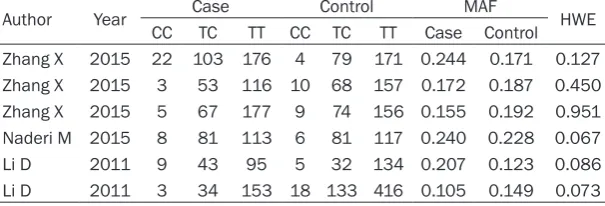
Zhang X 2015 22 103 176 4 79 171 0.244 0.171 0.127 Zhang X 2015 3 53 116 10 68 157 0.172 0.187 0.450 Zhang X 2015 5 67 177 9 74 156 0.155 0.192 0.951 Naderi M 2015 8 81 113 6 81 117 0.240 0.228 0.067 Li D 2011 9 43 95 5 32 134 0.207 0.123 0.086 Li D 2011 3 34 153 18 133 416 0.105 0.149 0.073
was dissolved by discus-sion to reach consensus. If the dissent still exis- ted, the third investigator (Xiong Wang) would be involved to adjudicate the disagreements. We extracted the following contents from original publications: name of the first author, publication year, country, ethnicity, genotyping method, sam-ple size, genotype infor-mation in cases and controls.
Statistics analysis
[image:2.629.100.403.401.504.2]result. Publication bias was assessed by Begg’s and Egger’s tests. All data were analysed with Stata 12.0 software (StataCorp, College Station, TX, USA).
Results
Study characteristics
In total, 48 studies were identified in the PubMed, Web of Science, Medline, and Embase
databases using the general search terms (PubMed: 6, Web of Science: 10, Medline: 10, Embase: 22). After an independent review based on the exclusion criteria, a total of 6 studies in 3 publications that evaluated the asso-ciation between miR-146a/499 poly-morphisms and TB risk between 2011 and 2015, comprising 1260/1261 TB cases and 1833/1670 controls (miR-146a and -499, respectively), were included in the meta-analysis [14-16]. Zhang et al. examined 3 cohorts from Chinese Uygur, Kazak, and Southern Han populations, and these results were treated as 3 independent studies [14]. A publication by Li et al. included 2 cohorts’ from Chinese Tibetan and Han populations, which were divided into 2 independent studies [16]. The study characteristics and patient geno-types included in the current meta-analysis are listed in Tables 1-3.
Meta-analysis of miR-146a/499 poly-morphisms and TB
[image:5.629.99.346.105.414.2]For the 4 genetic models, the esti-mates of heterogeneity among studies Table 4. Meta-analysis of miR-146a/499 polymorphisms
and TB
Genetic model PQ I2 (%) 95% CI P Z miR-146a rs2910164
Overall
Allelic model 0.000 82.8 1.09 (0.84, 1.42) 0.502 Dominant model 0.002 74.0 1.08 (0.77, 1.52) 0.650 Recessive model 0.001 75.5 1.22 (0.83, 1.79) 0.303 Additive model 0.000 82.3 1.25 (0.71, 2.18) 0.437 Asian
Allelic model 0.000 85.5 1.13 (0.84, 1.53) 0.425 Dominant model 0.002 77.2 1.14 (0.76, 1.71) 0.533 Recessive model 0.000 80.1 1.24 (0.81, 1.91) 0.326 Additive model 0.000 85.5 1.29 (0.68, 2.46) 0.433 miR-499 rs3746444
Overall
Allelic model 0.000 78.9 1.06 (0.78, 1.44) 0.714 Dominant model 0.004 71.3 1.06 (0.78, 1.44) 0.705 Recessive model 0.012 65.9 1.10 (0.50, 2.46) 0.808 Additive model 0.005 69.8 1.12 (0.48, 2.65) 0.789 Asian
Allelic model 0.000 83.1 1.06 (0.72, 1.56) 0.773 Dominant model 0.002 77.0 1.06 (0.73, 1.55) 0.748 Recessive model 0.006 72.6 1.05 (0.39, 2.83) 0.925 Additive model 0.002 75.7 1.07 (0.37, 3.09) 0.901
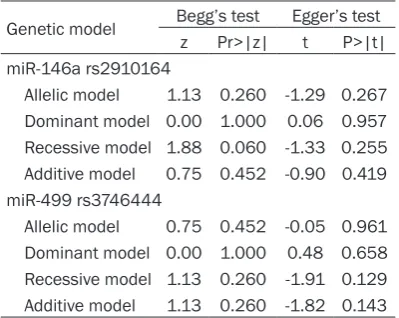
Table 5. Publication bias
Genetic model Begg’s test Egger’s test z Pr>|z| t P>|t| miR-146a rs2910164
Allelic model 1.13 0.260 -1.29 0.267 Dominant model 0.00 1.000 0.06 0.957 Recessive model 1.88 0.060 -1.33 0.255 Additive model 0.75 0.452 -0.90 0.419 miR-499 rs3746444
Allelic model 0.75 0.452 -0.05 0.961 Dominant model 0.00 1.000 0.48 0.658 Recessive model 1.13 0.260 -1.91 0.129 Additive model 1.13 0.260 -1.82 0.143
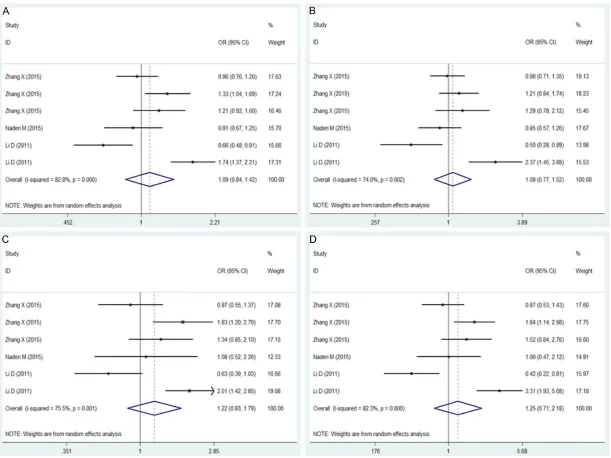
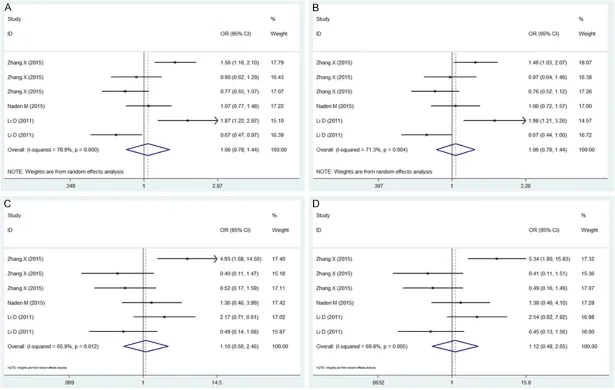
were PQ<0.10 and I2>50%. Thus, a
random-effect model was used to calculate the pooled OR (Figures 1, 2). Overall, the combined results showed that miR-146a/499 was not significant-ly associated with TB risk for any genetic model (miR-146a: allele model: OR = 1.09, 95% CI 0.84-1.42, P = 0.502; dominant model: OR = 1.08, 95% CI 0.77-1.52, P = 0.650; recessive mode: OR = 1.22, 95% CI 0.83-1.79, P = 0.303; additive model: OR = 1.25, 95% CI 0.71-2.18, P = 0.437. miR-499: allele model: OR = 1.06, 95% CI 0.78-1.44, P = 0.714; dominant model: OR = 1.06, 95% CI 0.78-1.44, P = 0.705; reces-sive mode: OR = 1.10, 95% CI 0.50-2.46, P = 0.808; additive model: OR = 1.12, 95% CI 0.48-2.65, P = 0.789). An ethnicity-stratified analysis showed that there was no significant associa-tion between miR-146a/499 polymorphisms and TB susceptibility in Asian populations (Table 4).
[image:5.629.98.298.448.607.2]Based on the results of Begg’s and Egger’s tests, no publication bias was observed for any genetic model (Table 5).
Discussion
The pathogenesis of TB includes a complex interaction between environmental and genetic factors. Therefore, the identification of the genetic basis for susceptibility to TB would facil-itate the development of effective and preven-tive interventions to decrease the incidence of TB [17]. This meta-analysis clarified the associ-ations between miR-146a/499 polymorphisms and TB, and the results suggest that miR-146a/499 polymorphisms are not associated with TB susceptibility based on data obtained from published studies.
Gene expression regulation via miRNAs is involved in various biological processes, and increasing evidence suggests that miRNAs play essential roles in the control of infectious dis-eases [18-20]. SNPs within pre-miRNAs or miR-NAs could change miRNA characteristics and result in functional or phenotypic changes, and have been implicated in the pathogenesis of multiple disorders. Among these miRNAs, miR-146a/499 polymorphisms have been widely investigated in several diseases. miR-146a rs2910164 involves a G>C nucleotide replace-ment, leading to the replacement of G:U pair by a C:U mismatch in the stem structure of pre-miR-146a [5]. The miR-499 rs374644 T>C poly-morphism occurred within the stem region of the miR-499 gene, resulting in an A:U to G:U mismatch in the stem structure of pre-miR-499 [6]. Epidemiological research has shown that miR-146a/499 polymorphisms are associated with a number of diseases, such as ankylosing spondylitis, breast cancer, and inflammatory bowel disease [7]. In ankylosing spondylitis, miR-146a regulates many target genes involved in inflammatory signalling, including TRAF-6, IRAK-1, and IRAK-2. Additionally, miR-499 tar-gets a variety of genes, including IL-2, IL-6, IL-21, IL-23a [3].
Li et al. first reported associations between miR-146a/499 polymorphisms and TB in the Chinese Tibetan and Han populations. Subsequently, Zhang et al. and Naderi et al. investigated these associations and reported inconsistent results. In this meta-analysis, 6 studies including a total of 1260/1261 TB
cases and 1833/1670 controls (miR-146a and -499 respectively) were analysed. Based on the observed heterogeneity among studies, the random-effect model was used to calculate the pooled OR.
The pooled OR showed that miR-146a rs2910164 is not associated with TB for any genetic model. The genotype distribution of the control group for all studies conformed to the HWE. A sensitivity analysis showed that our pooled OR was robust and stable. Furthermore, based on a subgroup analysis considering eth-nicity, there was no significant association between miR-146a rs2910164 polymorphism and TB risk in Asians. No publication bias was observed. In the allelic genetic model, the Chinese Kazak population and the Chinese Han population showed associations between the rs2910164 C allele and an increased TB risk, while the Chinese Tibetan population showed an association between the rs2910164 C allele and a decreased TB risk. For the domi-nant genetic model, Li et al. showed that the Chinese Tibetan and Han populations showed different associations between miRNA and TB risk. In the recessive and additive genetic mod-els, studies of the Chinese Kazak population and the Chinese Han population have shown that the rs2910164 C allele is associated with an increased TB risk. In the additive genetic model, the opposite pattern was observed for the Chinese Tibetan population and the Han population. Naderi et al. examined a population in Iran and did not detect any association for any genetic model. These results indicated that different genetic backgrounds in the Chinese Han, Kazak, and Tibetan populations influence the genetic associations. However, larger sam-ple sizes and additional ethnicities should be examined.
associ-ation was found in the remaining populassoci-ations for any genetic models. Collectively, these results suggest that miR-146a/499 polymor-phisms are not associated with TB, though sig-nificant associations have been detected in some studies.
In addition to the effects of ethnicity on poly-morphisms, there may be various other con-founding factors, including the TB inclusion cri-teria, male/female ratio, and age of study participants. Both Zhang et al. and Li et al. recruited TB patients according to the diagnos-tic criteria for pulmonary tuberculosis pub-lished by the Ministry of Health of China. Accordingly, the inclusion criteria were consis-tent between the studies. Zhang et al. reported that the male/female ratios of Uygur, Kazak, and Han TB patients and the corresponding controls were 1.09:1.53, 1.59:1.43, and 1.15:1.19, respectively. In the studies of Li et al, the male/female ratios of Tibetan and Han TB patients and the corresponding controls were 2:1.44 and 1.24:0.96, respectively. In the study of Naderi et al, the male/female ratio between TB patients and controls was 0.55: 0.85. In the Chinese Han population, the sex ratio for TB patients and controls was different between the studies of Zhang et al. and Li et al. (1.15:1.19 and 1.24:0.96). For the allelic and dominant models, Li et al. detected a signifi-cant association between TB patients and con-trols in the Chinese Han population, while Zhang et al. did not detect a significant associ-ation. These data suggest that sex-specific effects may contribute to the observed associ-ation. Some studies support this inference. Salie found a sex bias when analysing the asso-ciation between TLR8 polymorphism and TB susceptibility [17]. Similar results have been reported by Lee et al. in an investigation of the association between rs4331426 and suscepti-bility to TB among female Han Taiwanese [18]. Moreover, age was not consistent among groups. Therefore, a well-designed study in- cluding paired sex ratios and balanced ages may limit the effects of confounding variables. Jazdzewski et al. reported that the C allele of rs2910164 might reduce the level of mature miR-146a and the inhibition of its target genes [19]. Liu et al. showed that miR-146a is decreased in alveolar macrophages of TB patients, and is negatively correlated with the degree of positive smears. They found that
overexpression of miR-146a decreased PTGS2 levels and promoted the ability of THP-1 cells to kill Mycobacterium bovis BCG. Additionally, miR-146a negatively regulated TNF-α release in a feedback manner, indicating an essential role of miR-146a in BCG infection in the regula-tion of the inflammaregula-tion response of MTB infec-tions [20]. The roles of gene-environment inter-actions, gene-gene interinter-actions, and the detailed functions of miR-146a in TB require further studies.
This meta-analysis has several limitations. First, it was limited by the relatively small num-ber of available studies. We included 6 studies from 3 publications, for a total of fewer than 500 cases. Second, as only a single publication included a Caucasian population, we were not able to perform a subgroup analysis for this group. Third, the studies were limited to those published in English, and this restriction might result in a language bias. Thus, additional stud-ies are needed to further examine the associa-tion between miR-146a/499 and TB risk, espe-cially those that include different ethnic populations.
In summary, the results of the meta-analysis suggest that miR-146a/miR-499 polymor-phisms are not associated with TB susceptibili-ty, despite previous reports indicating associa-tions. Additional studies with larger sample sizes and appropriate designs are needed to accurately characterize the relationship bet- ween miR-146a/499 polymorphisms and sus-ceptibility to TB.
Disclosure of conflict of interest
None.
Address correspondence to: Xiong Wang, Depart- ment of Laboratory Medicine, Tongji Hospital, Tongji Medical College, Huazhong University of Science and Technology, Wuhan 430030, China. E-mail: [email protected]; [email protected]
References
[1] Zumla A, George A, Sharma V, Herbert N; Bar-oness Masham of Ilton. WHO’s 2013 global report on tuberculosis: successes, threats, and opportunities. Lancet 2013; 382: 1765-1767.
[3] Comstock GW. Tuberculosis in twins: a re-anal-ysis of the Prophit survey. Am Rev Respir Dis 1978; 117: 621-624.
[4] Moller M and Hoal EG. Current findings, chal-lenges and novel approaches in human genet-ic susceptibility to tuberculosis. Tuberculosis (Edinb) 2010; 90: 71-83.
[5] Stead WW, Senner JW, Reddick WT and Lof-gren JP. Racial differences in susceptibility to infection by Mycobacterium tuberculosis. N Engl J Med 1990; 322: 422-427.
[6] Curtis J, Luo Y, Zenner HL, Cuchet-Lourenco D, Wu C, Lo K, Maes M, Alisaac A, Stebbings E, Liu JZ, Kopanitsa L, Ignatyeva O, Balabanova Y, Nikolayevskyy V, Baessmann I, Thye T, Meyer CG, Nurnberg P, Horstmann RD, Drobniewski F, Plagnol V, Barrett JC and Nejentsev S. Suscep-tibility to tuberculosis is associated with vari-ants in the ASAP1 gene encoding a regulator of dendritic cell migration. Nat Genet 2015; 47: 523-527.
[7] Moller M, Flachsbart F, Till A, Thye T, Horst-mann RD, Meyer CG, Osei I, van Helden PD, Hoal EG, Schreiber S, Nebel A and Franke A. A functional haplotype in the 3’untranslated re-gion of TNFRSF1B is associated with tubercu-losis in two African populations. Am J Respir Crit Care Med 2010; 181: 388-393.
[8] Mao A, Liu Y, Zhang H, Di C and Sun C. microR-NA expression and biogenesis in cellular re-sponse to ionizing radiation. DNA Cell Biol 2014; 33: 667-679.
[9] Ma C, Li Y, Li M, Deng G, Wu X, Zeng J, Hao X, Wang X, Liu J, Cho WC, Liu X and Wang Y. mi-croRNA-124 negatively regulates TLR signaling in alveolar macrophages in response to myco-bacterial infection. Mol Immunol 2014; 62: 150-158.
[10] Rah H, Kim HS, Cha SH, Kim YR, Lee WS, Ko JJ and Kim NK. Association of breast cancer-re-lated microRNA polymorphisms with idiopathic primary ovarian insufficiency. Menopause 2015; 22: 437-443.
[11] Li K, Tie H, Hu N, Chen H, Yin X, Peng C, Wan J and Huang W. Association of two polymor-phisms rs2910164 in miRNA-146a and rs3746444 in miRNA-499 with rheumatoid ar-thritis: a meta-analysis. Hum Immunol 2014; 75: 602-608.
[12] Shao Y, Li J, Cai Y, Xie Y, Ma G, Li Y, Chen Y, Liu G, Zhao B, Cui L and Li K. The functional poly-morphisms of miR-146a are associated with susceptibility to severe sepsis in the Chinese population. Mediators Inflamm 2014; 2014: 916202.
[13] He B, Pan Y, Xu Y, Deng Q, Sun H, Gao T and Wang S. Associations of polymorphisms in mi-croRNAs with female breast cancer risk in Chi-nese population. Tumour Biol 2015; 36: 4575-82.
[14] Zhang X, Li Y, Li X, Zhang W, Pan Z, Wu F, Wang C, Chen Z, Jiang T, Xu D, Ping Z, Liu J, Liu C, Li Z and Li JC. Association of the 146a, miR-149, miR-196a2 and miR-499 polymorphisms with susceptibility to pulmonary tuberculosis in the Chinese Uygur, Kazak and Southern Han populations. BMC Infect Dis 2015; 15: 41. [15] Naderi M, Hashemi M, Khorgami P, Koshki M,
Ebrahimi M, Amininia S, Sharifi-Mood B and Taheri M. Lack of Association between miRNA-146a rs2910164 and miRNA-499 rs3746444 Gene Polymorphisms and Susceptibility to Pul-monary Tuberculosis. Int J Mol Cell Med 2015; 4: 40-45.
[16] Li D, Wang T, Song X, Qucuo M, Yang B, Zhang J, Wang J, Ying B, Tao C and Wang L. Genetic study of two single nucleotide polymorphisms within corresponding microRNAs and suscepti-bility to tuberculosis in a Chinese Tibetan and Han population. Hum Immunol 2011; 72: 598-602.
[17] Salie M, Daya M, Lucas LA, Warren RM, van der Spuy GD, van Helden PD, Hoal EG and Moller M. Association of toll-like receptors with susceptibility to tuberculosis suggests sex-spe-cific effects of TLR8 polymorphisms. Infect Genet Evol 2015; 34: 221-229.
[18] Lee SW, Lin CY, Chuang TY, Huang HH, Kao YH and Wu LS. SNP rs4331426 in 18q11.2 is as-sociated with susceptibility to tuberculosis among female Han Taiwanese. J Microbiol Im-munol Infect 2014; [Epub ahead of print]. [19] Jazdzewski K, Murray EL, Franssila K, Jarzab B,
Schoenberg DR and de la Chapelle A. Common SNP in pre-miR-146a decreases mature miR expression and predisposes to papillary thy-roid carcinoma. Proc Natl Acad Sci U S A 2008; 105: 7269-7274.