Original Article
Effect of coffee and green tea on executive ability and
plasma levels of inflammatory factors in soldiers
with 48-hour total sleep deprivation
Tao Zhang, Ling Li, Yuhui Liu, Daiqu Zhong, Yuan Tao, Xiaojiang Jiang, Zhiqiang Xu
Department of Neurology and Center for Clinical Neuroscience, Daping Hospital, The Third Military Medical University, Chongqing, China
Received March 30, 2016; Accepted July 3, 2016; Epub October 15, 2016; Published October 30, 2016
Abstract: Objectives: To compare the effect of coffee and green tea on executive ability and plasma levels of inflam-matory factors in soldiers with 48-hour total sleep deprivation (SD). Methods: Forty-five male soldiers were randomly divided into control group, coffee group and green tea group. All subjects underwent 48-hour total SD, and received gun disassembly and assembly test and venous blood collection before SD, 24 hours and 48 hours after SD and 24 hours after sleep recovery (SR). Plasma IL-6 and NF-κb levels were detected. Results: There was no significant differ-ence in baseline characteristics among groups. Two-way ANOVA results indicated significant differdiffer-ences in the time of gun assembly and plasma levels of IL-6 and NF-κb between the coffee group or green tea group and the control group. No indicators were significantly different between the green tea group and the coffee group. Spearman cor-relation analysis indicated that the plasma levels of IL-6 and NF-κb were not significantly correlated with the time of gun disassembly and assembly before SD and after SR; plasma levels of IL-6 and NF-κb were significantly positively correlated with the time of gun disassembly and assembly at 48 hours after SD. Conclusions: Coffee and green tea have similar effects with regard to attenuating decreased performance and increased plasma levels of inflammatory factors caused by SD, but green tea has a better advantage in terms of maintaining the effect; Lowering plasma lev-els of inflammatory factors maybe the mechanism for improving executive ability of coffee and green tea during SD.
Keywords: Sleep deprivation, coffee, green tea, interleukin-6, nuclear transcription factor-κb
Introduction
Sleep deprivation (SD) is a state in which the human body is partially or completely deprived of a normal amount of sleep because of envi-ronmental factors or the body itself [1]. Long-term or complete SD, an endogenous source of stress, can cause the central nervous system and immune system to be generally suppressed [2] and result in endocrine and metabolic disor-ders [3]. Humans or animals with SD can have symptoms of emotional lability aggravated emotion, diminished learning and memory, decreased alertness and impaired judgment, difficulty concentrating and decreased perfor-mance, but they can also incur body weight changes, blood glucose and blood pressure fluctuations, decreased immunity, and opportu-nistic pathogen infections; sepsis can occur in the late stages of SD [4-6]. Quick responses and a strong body are very important in rescue
Gun disassembly and assembly operations are regular training activities for Chinese soldiers, which can reflect the storage and retrieval of sets of memory in the brain and can also reflect performance and reaction time. This study used gun disassembly and assembly as the detection index for soldier executive function. Studies had found that nuclear transcription factor-κb (NF-κb) was likely activated in SD [9]. NF-κb is a critical transcription factor and exists in almost all cell types because it can regulate multiple molecules in the early stages of the immune response and inflammation, similar to the function of tumor necrosis factor-α (TNF-α), IL-1β, IL-2, IL-6, chemokines, adhesion mole-cules and colony-stimulating factor. Hence, NF-κb is also thought to be an important inflam-matory cytokine [10]. Previous studies have shown that complete SD can cause increased plasma concentrations of interleukin-6 (IL-6), the most common inflammatory factor. There-fore, this study will discuss the effect of 48-hour SD on Chinese soldier performance and the lev-els of plasma inflammatory cytokines IL-6 and NF-κb. The effects of green tea and coffee on the executive ability and plasma levels of in- flammatory factors in soldiers with 48-hour total sleep deprivation (SD) with regard to attenuating SD-induced negative effects were compared and their possible mechanisms of
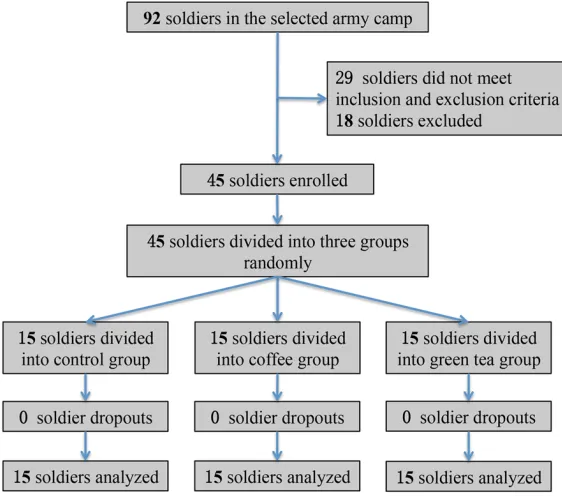
day), alcohol and gambling; (5) history of sus-tained central excitatory and inhibitory drug use; (6) inability to tolerate coffee or tea because of cardiac disease or other diseases; and (7) unwillingness or inability to participate the study. Ultimately, 45 soldiers were select-ed, and they were randomly divided into a con-trol group, coffee group and green tea group, with 15 soldiers in each group. All subjects signed an informed consent agreement. This study was approved by the ethics committee of Daping Hospital of the Third Military Medical University (Figure 1).
Preparation before the study
[image:2.612.91.372.74.323.2]One week before the study, all subjects were mobilized and informed about the steps and requirements of the trial. Fifteen soldiers in each group and 8 platoon leaders were as- signed various tasks. During the 48-hour SD period, all 45 soldiers were monitored 3 differ-ent times to ensure full wakefulness. The 8 pla-toon leaders were recommended by the battal-ion commander, two of whom were responsible for organizing gun disassembly and assembly training and assessments, and 6 of whom were responsible for arranging routine military train-ing activities and the remainder of the soldiers’ schedules during SD.
Figure 1.Flowchart of study subject selection.
performance improvement were explored, with the goal of selecting a more suitable refreshing drink for Chinese army soldiers.
Subjects and methods
Subjects
One week before the study, the subjects were prohibited from drinking coffee and caffeinated beverages, tea and tea-containing beverages and alcoholic beverages, as well as other bev-erages with central nervous system effects. Meanwhile, each subject finished his daily sleep records on his own, including bedtimes and wake times, estimated total sleep times, sleep quality and daytime mental state. Three days prior to the study, each subject was advised to get proper rest and avoid strenuous exercise, and the subjects underwent 1 hour of daily gun disassembly and assembly training (81-1 automatic rifle) to proficiently master the disassembly and assembly procedures. Additionally, subject data regarding age (years), body mass index, smoking and drinking history, educational background, average sleep time at 1 week before the study, and past medical his-tory and family hishis-tory were obtained.
Sleep deprivation and intervention
In this study, all subjects were deprived of sleep for 48 hours, from 6:30 am on the day that the subjects began the study to 6:30 am of the third day. During the 48-hour sleep deprivation period, all subjects underwent daily military training, avoided strenuous exercise, and par-ticipated in light physical and mental activities, such as doing housework, taking queue train-ing, playing chess and card games, watching video news, learning regulations and ordinance, talking, and reading. All subjects participated in the same activities and the entire process was monitored to ensure that they remained awake. The soldiers in each group received their cor-responding interventions during the SD period. Fifteen soldiers in the control group were re- ceived water (tap water), which was drunk vol-untarily; 15 soldiers in the coffee group were given five bags of instant coffee (daily usage was approximately 300 mg) and required to drink within 24 hours; and 15 soldiers in the green tea group were given 12 g green tea, which was made with boiling water at a tem-perature > 90°C within 24 hours. The amount of tea for each brewing was decided by the sol-diers themselves. The duration of each tea brewing was 15 minutes, and each tea brewing was repeated at least three times. Meanwhile, the soldiers in the coffee and tea groups could also drink water.
Observation indicators
Automatic rifle gun disassembly and assembly
time: The soldiers received 1-hour gun disas-sembly and asdisas-sembly training 3 days before the study. Gun disassembly and assembly as- sessments were conducted at 7:00 am on the first SD day, 7:00 am on the second SD day and 7:00 am on the third SD day, and the perfor-mance quality and duration were recorded by an appointed platoon leader. Re-examination was required if the soldiers failed to reach the appropriate quality standards, and the time to reach these quality standards was used as the examination result.
Detection of serum IL-6 and NF-κb concentra -tions: 4 mL of venous blood was drawn before SD (6:30 am), 24 hours after SD (6:30 am on the second day), 48 hours after SD (6:30 am on the third day), and 24 hours after SD (6:30 am on the fourth day). Samples were placed at room temperature for 3-6 hours and centri-fuged for 5 min at 3000 × g/min, and then the plasma was separated and stored at -70°C. The concentrations of serum IL-6 and NF-κb were determined by enzyme-linked immunosor-bent assay (ELISA), and all procedures were performed according to kit instructions.
Statistical analysis
In univariate analysis, continuous variables were tested with the Kolmogorov-Smirnov test. Differences in demographic characteristics, plasma IL-6 levels, plasma NF-κb levels, and duration of gun disassembly and assembly between groups were assessed using one-way or two-way analysis of variance (ANOVA), Kruskal-Wallis tests, and Chi square tests, where appropriate. Spearman correlation anal-ysis was used to examine the correlations between variables. The data are expressed as the mean ± SD, and significance was achieved when P<0.05. All statistical analyses were per-formed with the statistical analysis software SPSS 18.0.
Results
Baseline characteristics
Table 1.Basic characteristics of the subjects
Control group
(n=15) Coffee group(n=15) Green tea group(n=15) (ANOVA)P value
Age, years, mean ± SD 19.47±0.83 19.67±1.05 19.33±1.05 0.648
Educational background, years, mean ± SD 9.73±1.44 9.67±1.88 10.13±2.45 0.782
Body mass index, kg/m2, mean ± SD 20.12±1.35 20.28±1.81 20.34±1.62 0.932
Drinking, n (%) 6 (40%) 6 (40%) 5 (33.33%) 0.910
Current smoking, n (%) 4 (26.67%) 3 (20%) 5 (33.33%) 0.711
Average sleep duration in the past week, hours/day, mean ± SD 7.45±0.49 7.48±0.54 7.45±0.47 0.982
Time of gun disassembly before SD, second(s), mean ± SD 26.20±7.47 27.73±7.05 26.07±6.47 0.771
Time of gun assembly, second(s) before SD, mean ± SD 49.13±12.06 46.87±9.13 46.60±9.39 0.761
Plasma IL-6 level before SD, pg/ml, mean ± SD 1.63±0.35 1.60±0.40 1.69±0.32 0.791
Plasma NF-κb level, ng/ml, mean ± SD 10.04±0.91 10.20±1.15 10.41±1.12 0.647
group and green tea group according to the intervention that they received. The baseline characteristics of the three groups are shown in Table 1, including age, educational back-ground, body mass index, smoking and drink-ing history, average daily duration of sleep during the past week, gun disassembly and assembly times, and plasma IL-6 and NF-κb levels before SD. No significant differences were observed in baseline characteristics am- ong the three groups.
Effect of SD on executive ability and inflamma -tory cytokine levels in the three groups
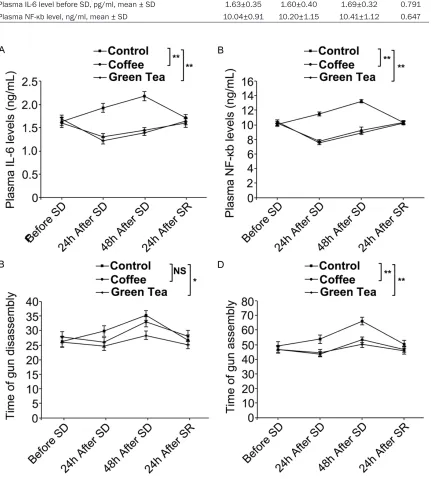
Two-way ANOVA was used to analyze the chang-es in gun disassembly and assembly time and plasma IL-6 and NF-κb levels before SD, 24 hours after SD, 48 hours after SD and 24 hours after sleep recovery to compare the effect of coffee and tea with regard to attenuating the negative effects caused by SD. Figure 2 in- dicates significant differences between the changes in plasma IL-6 and NF-κb levels and the times of gun disassembly and assembly between the coffee group and the control group and between the green tea group and the control group (P<0.01). There was a
[image:5.612.92.525.72.329.2]signifi-cant difference in the time of gun disassembly and assembly between the green tea group and the control group (P<0.05), but not between the coffee group and the control group. No sig-nificant difference was observed in these vari-ables between the coffee and green tea groups. Figure 2 shows that in the control group, the time for gun disassembly and assembly was gradually extended and that the plasma levels of IL-6 and NF-κb were gradually increased dur-ing SD and did not fully recover after sleep recovery. In the tea and coffee groups, the times for gun disassembly and assembly were slightly decreased 24 hours after SD but returned to baseline levels 48 hours after SD; the green tea group exhibited improved recov-ery compared with the coffee group. Addi- tionally, plasma levels of IL-6 and NF-κb first decreased and then increased after SD in the green tea and coffee groups. This indicates that coffee and green tea have similar effects with regard to attenuating the decreased exec-utive ability and increased levels of inflamma-tory factors caused by SD. However, compared with coffee, green tea can improve the time for gun disassembly to a greater extent, but the time was not significantly increased 48 hours after SD, indicating that green tea may have
better effects with regard to sustaining execu-tive ability after SD.
Correlation analysis of executive ability and
inflammatory factors
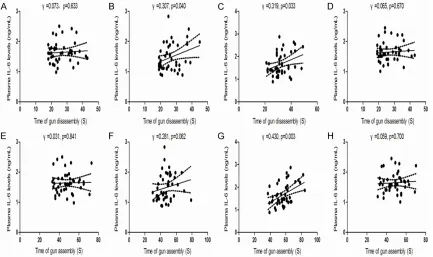
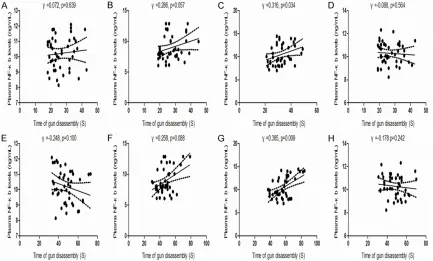
Spearman correlation analysis was used to determine the relationship between the times for gun disassembly and assembly and the lev-els of inflammatory cytokines IL-6 and NF-κb and to explore the possible mechanisms under-lying the improvements in executive ability facil-itated by green tea and coffee. Figures 3 and 4 indicate that there was no noticeable associa-tion between the plasma levels of IL-6 and NF-κb and the times for gun disassembly and assembly before SD and after sleep recovery and that there was a significantly positive rela-tionship between the plasma levels of IL-6 and NF-κb and the times required for gun disassem-bly and assemdisassem-bly 48 hours after SD, whereas at 24 hours after SD, only plasma IL-6 levels was positively correlated with the time for gun disassembly, and NF-κb levels were not signifi-cantly related to executive ability. Thus, coffee and green tea can improve executive ability in SD by decreasing plasma inflammatory factor levels.
Discussion
[image:6.612.91.524.73.334.2]Approximately one-third of one’s life is spent sleeping as the human body and brain can obtain complete rest and recovery only during sleep to maintain homeostasis, metabolism, physiological function and central nervous sys-tem related functions [11, 12]. Sleep consists of non-rapid eye movement sleep (NREM) and rapid eye movement sleep (REM), and the two phases alternately occur throughout sleep. NREM sleep (deep sleep especially) mainly pro-motes mental recovery, and REM sleep mainly promotes physical recovery [13]. Total SD refers to the complete deprivation of NREM and REM sleep, which can lead to physical and mental un-recovery and ultimately cause disorders of body function and decreased memory ability, cognition and learning [2]. Moreover, long-term SD can lead to death [14]. Total SD is a source of stress for the body itself [15], which can pro-duce stress responses through pathways such as the hypothalamic-pituitary-adrenal system, increasing inflammation and promoting stress-related gene expression to maintain a steady state [16, 17]. A unique population, army sol-diers inevitably undergo complete sleep depri-vation during war, natural disasters, accidents,
emergency rescues, military exercises and other tasks. If we do not take measures to cope with total SD, it will inevitably decrease sol-diers’ abilities in implementation, alertness, visual tracking and logical reasoning, ultimately resulting in decreased ability during military operations [18, 19]. Therefore, it is particularly important to develop effective measures for military soldiers to cope with total SD.
This study used Chinese army soldiers as study subjects, applied coffee or green tea as mea-sures to address total SD and explored the effect of coffee and green tea with regard to attenuating the negative effects caused by total SD. In this study, the authors obtained the following results: (1) without interventions, total SD can gradually decrease soldiers’ implemen-tation capacity and increase the inflammatory response; (2) drinking 300 mg coffee/day and 12 g green tea/day can greatly improve execu-tive ability and attenuate the inflammatory response in soldiers with 48-hour total SD with-out having a significant effect on late sleep recovery; (3) compared with coffee, green tea can better maintain soldiers’ executive ability, especially in the latter stage of SD; (4) plasma levels of inflammatory factors were not signifi-cantly correlated with executive ability in the non-SD stage but were both significantly corre-lated with executive ability during SD. Hence, coffee and tea can maintain soldiers’ executive ability by reducing the levels of inflammatory cytokines.
Previous studies about US soldiers indicated that 200 mg and 300 mg of caffeine can main-tain a soldier’s visual reaction ability, memory, emotional state, and shooting accuracy [8], which is consistent with the results of this study. This indicates that coffee is effective at maintaining alertness and operability in mili-tary activities in SD. We chose to compare green tea and coffee to select a more suitable refreshing drink for army soldiers for the follow-ing reasons: (1) Green tea is widely produced and is inexpensive. (2) Green tea not only con-tains caffeine but also concon-tains ingredients such as tea polyphenols, amino acids and vita-mins, which promote human health. It has been regarded as an excellent refreshing drink nationwide in China. (3) Several studies have confirmed that green tea has anti-inflammato-ry, anti-cancer and lipid-lowering effects [20-22]. Combined with the results from this study,
the body’s susceptibility to inflammation. Chronic SD can even lead to septicemia and death. Our results suggest that plasma IL-6 and NF-κb levels were gradually increased and that implementation capacity was significantly reduced in soldiers who did not receive inter-vention during SD, which was consistent with previous findings. Although plasma IL-6 and NF-κb levels were decreased and implementa-tion capacity was not significantly decreased in the coffee and green tea groups, we believe that the mechanism underlying the improve-ments facilitated by coffee and green tea with regard to the decreases in implementation abil-ity caused by SD is mediated through suppres-sion of the inflammatory response.
This study mainly aimed to investigate a more effective and suitable drink for Chinese military soldiers with SD; thus, the study subjects were a unique population that mainly comprised young males that experienced SD. Hence, our findings may not be applicable to the general population. Additionally, the 48-hour SD dura-tion is not long. In a future study, we will select a healthy population to conduct a longer total SD duration and selective NREM or REM sleep deprivation and further compare the effects of green tea and coffee to more comprehensively assess the efficiency and safety of coffee and green tea in coping with SD. This study did not investigate the mechanisms of action of coffee and tea with regard to attenuating the negative effects of SD, which further study to demon-strate the roles of these beverages in anti- inflammation.
Acknowledgements
The authors appreciate the generous participa-tion of all soldiers enrolled in the study. The principal investigator (Tao Zhang) had full access to all of the data in the study and took responsibility for the integrity of the data and the accuracy of the data analysis.
Disclosure of conflict of interest
None.
Address correspondence to: Drs. Zhiqiang Xu and Xiaojiang Jiang, Department of Neurology and Center for Clinical Neuroscience, Daping Hospital, The Third Military Medical University 10 Changjiang Branch Road, Daping, Chongqing 400042, China.
Tel: 0086-23-68757861; Fax: 0086-23-68757861; E-mail: [email protected]
References
[1] Abrams RM. Sleep Deprivation. Obstet Gynecol Clin North Am 2015; 42: 493-96.
[2] Orzel-Gryglewska J. Consequences of sleep de-privation. Int J Occup Med Environ Health 2010; 23: 95-114.
[3] Chamorro RA, Duran SA, Reyes SC, Ponce R, Algarin CR, Peirano PD. Sleep deprivation as a risk factor for obesity. Rev Med Chile 2011; 139: 932-40.
[4] Benedetti F, Colombo C. Sleep deprivation in mood disorders. Neuropsychobiology 2011; 64: 141-51.
[5] Maski KP, Kothare SV. Sleep deprivation and neurobehavioral functioning in children. Int J Psychophysiol 2013; 89: 259-64.
[6] Lu Y, Ren Q, Zong L, Wu Y, Zhang Q, Ma X, Pu J, Dong H, Liu Q, Tang Y, Song L, Chen X, Pan X, Cui Y. Effects of sleep deprivation on polysom-nography and executive function in patients with depression. Chin Med J (Engl) 2014; 127: 3229-32.
[7] Tharion WJ, Shukitt-Hale B, Lieberman HR. Caffeine effects on marksmanship during high-stress military training with 72 hour sleep deprivation. Aviat Space Environ Med 2003; 74: 309-14.
[8] Lieberman HR, Tharion WJ, Shukitt-Hale B, Speckman KL, Tulley R. Effects of caffeine, sleep loss, and stress on cognitive perfor-mance and mood during U.S. Navy SEAL train-ing. Sea-Air-Land. Psychopharmacology 2002; 164: 250-61.
[9] Ramesh V, Thatte HS, McCarley RW, Basheer R. Adenosine and sleep deprivation promote NF-kappaB nuclear translocation in choliner-gic basal forebrain. J Neurochem 2007; 100: 1351-63.
[10] Williams AJ, Dave JR, Tortella FC. Neuropro- tection with the proteasome inhibitor MLN519 in focal ischemic brain injury: relation to nucle-ar factor kappaB (NF-kappaB), inflammatory gene expression, and leukocyte infiltration. Neurochem Int 2006; 49: 106-12.
[11] Copinschi G, Leproult R, Spiegel K. The impor-tant role of sleep in metabolism. Front Horm Res 2014; 42: 59-72.
[13] McCarley RW. Neurobiology of REM and NREM sleep. Sleep Med 2007; 8: 302-30.
[14] Everson CA. Functional consequences of sus-tained sleep deprivation in the rat. Behav Brain Res 1995; 69: 43-54.
[15] Villafuerte G, Miguel-Puga A, Rodriguez EM, Machado S, Manjarrez E, Arias-Carrion O. Sleep deprivation and oxidative stress in ani-mal models: a systematic review. Oxid Med Cell Longev 2015; 2015: 234952.
[16] da Costa Souza A, Ribeiro S. Sleep deprivation and gene expression. Curr Top Behav Neurosci 2015; 25: 65-90.
[17] Maggio M, Colizzi E, Fisichella A, Valenti G, Ceresini G, Dall’Aglio E, Ruffini L, Lauretani F, Parrino L, Ceda GP. Stress hormones, sleep de-privation and cognition in older adults. Ma- turitas 2013; 76: 22-44.
[18] Heaton KJ, Maule AL, Maruta J, Kryskow EM, Ghajar J. Attention and visual tracking degra-dation during acute sleep deprivation in a mili-tary sample. Aviat Space Environ Med 2014; 85: 497-503.
[19] Olsen OK, Pallesen S, Eid J. The impact of par-tial sleep deprivation on moral reasoning in military officers. Sleep 2010; 33: 1086-90. [20] Butt MS, Ahmad RS, Sultan MT, Qayyum MM,
Naz A. Green tea and anticancer perspectives: updates from last decade. Crit Rev Food Sci Nutr 2015; 55: 792-805.
[21] Huang J, Wang Y, Xie Z, Zhou Y, Zhang Y, Wan X. The anti-obesity effects of green tea in hu-man intervention and basic molecular studies. Eur J Clin Nutr 2014; 68: 1075-87.
[22] Tipoe GL, Leung TM, Hung MW, Fung ML. Green tea polyphenols as an anti-oxidant and anti-inflammatory agent for cardiovascular protection. Cardiovasc Hematol Disord Drug Targets 2007; 7: 135-44.
[23] Goldstein ER, Ziegenfuss T, Kalman D, Kreider R, Campbell B, Wilborn C, Taylor L, Willoughby D, Stout J, Graves BS, Wildman R, Ivy JL, Spano M,Smith AE, Antonio J. International society of sports nutrition position stand: caffeine and performance. J Int Soc Sports Nutr 2010; 7: 5. [24] Dirks-Naylor AJ. The benefits of coffee on
skel-etal muscle. Life Sci 2015; 143: 182-6. [25] Butt MS, Sultan MT. Coffee and its
consump-tion: benefits and risks. Crit Rev Food Sci Nutr 2011; 51: 363-73.
[26] Byrne EM, Johnson J, McRae AF, Nyholt DR, Medland SE, Gehrman PR, Heath AC, Madden PA, Montgomery GW, Chenevix-Trench G, Martin NG. A genome-wide association study of caffeine-related sleep disturbance: confir-mation of a role for a common variant in the adenosine receptor. Sleep 2012; 35: 967-75.
[27] Popat RA, Van Den Eeden SK, Tanner CM, Kamel F, Umbach DM, Marder K, Mayeux R, Ritz B, Ross GW, Petrovitch H, Topol B, McGuire V, Costello S, Manthripragada AD, Southwick A, Myers RM, Nelson LM. Coffee, ADORA2A, and CYP1A2: the caffeine connection in Parkinson’s disease. Eur J Neurol 2011; 18: 756-65. [28] Tan EK, Lu ZY, Fook-Chong SM, Tan E, Shen H,
Chua E, Yih Y, Teo YY, Zhao Y. Exploring an in-teraction of adenosine A2A receptor variability with coffee and tea intake in Parkinson’s dis-ease. Am J Med Genet B Neuropsychiatr Genet 2006; 141b: 634-6.
[29] Antonioli L, Blandizzi C, Pacher P, Hasko G. Immunity, inflammation and cancer: a leading role for adenosine. Nature reviews. Cancer 2013; 13: 842-57.
[30] Feoktistov I, Biaggioni I. Role of adenosine A(2B) receptors in inflammation. Adv Phar- macol 2011; 61: 115-44.
[31] Koloverou E, Panagiotakos DB, Pitsavos C, Chrysohoou C, Georgousopoulou EN, Laskaris A, Stefanadis C; ATTICA Study group. The evalu-ation of inflammatory and oxidative stress bio-markers on coffee-diabetes association: re-sults from the 10-year follow-up of the ATTICA Study (2002-2012). Eur J Clin Nutr 2015; 69: 1220-5.
[32] Shen T, Park YC, Kim SH, Lee J, Cho JY. Nuclear factor-kappaB/signal transducers and activa-tors of transcription-1-mediated inflammato- ry responses in lipopolysaccharide-activated macrophages are a major inhibitory target of kahweol, a coffee diterpene. Biol Pharm Bull 2010; 33: 1159-64.
[33] Mota MA, Landim JS, Targino TS, Silva SF, Silva SL, Pereira MR. Evaluation of the anti-inflam-matory and analgesic effects of green tea (Camellia sinensis) in mice. Acta Cir Bras 2015; 30: 242-6.
[34] Molina N, Bolin AP, Otton R. Green tea polyphe-nols change the profile of inflammatory cyto-kine release from lymphocytes of obese and lean rats and protect against oxidative dam-age. Int Immunopharmacol 2015; 28: 985-96. [35] Ravindranath NH, Ravindranath MH. Green
tea catechins suppress NF-kappaB-mediated inflammatory responses: relevance to nutri-tional management of inflammation. Br J Nutr 2011; 105: 1715-7.
[36] Rohleder N, Aringer M, Boentert M. Role of in-terleukin-6 in stress, sleep, and fatigue. Ann N Y Acad Sci 2012; 1261: 88-96.