Original Article
Polymorphic variants of FGFR-4 associated with clinical
characteristics in urothelial cell carcinoma
Wei-Chun Weng
1,2, Yu-Hui Huang
3,4, Ying-Erh Chou
3,5, Shian-Shiang Wang
1,6, Ming-Ju Hsieh
1,7, Shun-Fa
Yang
1,51Institute of Medicine, Chung Shan Medical University, Taichung, Taiwan; 2Division of Urology, Department of
Surgery, Tungs’ Taichung MetroHarbor Hospital, Taichung, Taiwan; 3School of Medicine, Chung Shan Medical
University, Taichung, Taiwan; 4Department of Physical Medicine & Rehabilitation, Chung Shan Medical University
Hospital, Taichung, Taiwan; 5Department of Medical Research, Chung Shan Medical University Hospital, Taichung,
Taiwan; 6Division of Urology, Department of Surgery, Taichung Veterans General Hospital, Taichung, Taiwan; 7
Can-cer Research Center, Changhua Christian Hospital, Changhua, Taiwan
Received December 9, 2015; Accepted March 19, 2016; Epub June 15, 2016; Published June 30, 2016
Abstract: Background: Fibroblast growth factor receptor-4 (FGFR-4) polymorphic variants have an important role on the development of various cancers. However, the association between FGFR-4 polymorphic variants and the risk of urothelial cell carcinoma (UCC) has not been determined. In this study, we studied the associations of FGFR-4 polymorphic variants with UCC susceptibility and its clinicopathological features. Materials and methods: Four SNPs in FGFR-4 were analyzed among 558 participants comprising 279 controls and 279 patients with UCC by performing a real-time genotype PCR assay. Results: Our results showed that UCC patients who carried at least one A genotype at rs1966265 exhibited a higher risk of invasive tumor stage compared with those carrying the wild-type genotype (P < 0.05). Patients with UCC who carried at least one G genotype (AG and GG) at rs2011077 also exhibited a higher risk of invasive tumor stage. Conclusion: Our findings suggest that polymorphic variants in FGFR-4 rs1966265 and rs2011077 may be associated with the risk of invasive tumor stage in Taiwanese patients with UCC. This is the first study to determine the association between FGFR-4 polymorphic variants and UCC tumor stage progression.
Keywords: Polymorphic variants, fibroblast growth factor receptor 4, urothelial cell carcinoma
Introduction
Urothelial cell carcinoma (UCC) is the most
common malignancy of the urinary tract. In
Taiwan, UCC is the ninth leading malignancy
among men and the 16th leading malignancy
among women. The most widely known risk
fac-tors for UCC are tobacco consumption and
exposure to aromatic amines [1-3]. Increasingly
more evidence regarding the impact of genetic
factors in the risk of UCC has been published
[4-6].
Fibroblast growth factors (FGFs) are effective
regulators of cell proliferation, and cell
differen-tiation. The function are critical in normal
devel-opment, tissue maintenance angiogenesis,
embryonic development, and wound repair [7].
At least 20 FGF members exist, designated
FGF-1 through FGF-20, but acidic FGF and basic
FGF are names commonly used for FGF-1 and
FGF-2, and keratinocyte growth factor (KGF) is
the name generally used for FGF-7. FGFs
repre-sent a large family of secreted molecules [8].
The FGF receptor (FGFR) family comprises 4
family members, is a subsequent formation of
various complexes to initiate downstream
sig-nal transduction [9-11]. Aberrant FGFR sigsig-nal-
signal-ing is mainly contributed to several
mecha-nisms involving genetic variants, gene
amplifi-cation and chromosomal transloamplifi-cation [12-14].
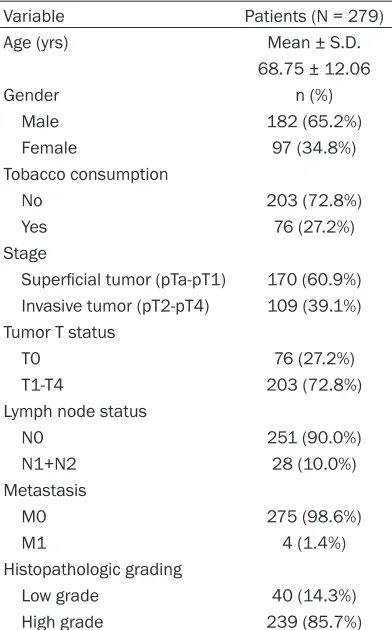
Table 1.
The distributions of demographical
characteristics in 279 patients with UCC
Variable Patients (N = 279) Age (yrs) Mean ± S.D.
68.75 ± 12.06
Gender n (%)
Male 182 (65.2%) Female 97 (34.8%) Tobacco consumption
No 203 (72.8%) Yes 76 (27.2%) Stage
Superficial tumor (pTa-pT1) 170 (60.9%) Invasive tumor (pT2-pT4) 109 (39.1%) Tumor T status
T0 76 (27.2%) T1-T4 203 (72.8%) Lymph node status
N0 251 (90.0%) N1+N2 28 (10.0%) Metastasis
M0 275 (98.6%) M1 4 (1.4%) Histopathologic grading
Low grade 40 (14.3%) High grade 239 (85.7%)
in rs351855 (Gly388Arg) may alters protein
expression [16-18]. Additionally, these
polymor-phic variants have a pathophysiological impact
on tumor development in prostate or breast
cancers [19, 20]. However, no report has been
published on the relationship between FGFR-4
polymorphic variants and UCC risks. Thus, this
study explored the associations among these 4
polymorphic variants of FGFR-4 and the risk of
UCC, and evaluated the impact of these
poly-morphic variants on the clinicopathological
fea-tures of UCC.
Materials and methods
Subjects and specimen collection
279 patients (182 men and 97 women, with
a mean age of 68.75 years) were recruited
in 2010-213 at Taichung Veterans General
Hospital (TVGH) in Taichung, Taiwan. All 279
patients have pathology proved as urothe-
lial cell carcinoma of bladder or upper urinary
tract. The control group was enrolled from the
physical examination during the hospital. The
approval was obtained from the Institutional
Review Board of TVGH, and informed written
consent to patients was obtained from each
person before commencement of this study.
FGFR-4 polymorphic variants genotyping
Genomic DNA was extracted using AxyPrep
Blood Genomic DNA Miniprep Kit (Axygen Bio-
sciences, Union City, CA, USA). The FGFR-4
rs351855, rs1966265, rs7708357 and rs20-
11077 polymorphic variants were assessed by
using the TaqMan assay with an ABI Step-
OnePlus™ Real-Time PCR System as previously
described [21].
Statistical analysis
The AOR and 95% CIs of the association
between genotype frequencies and risk or
clinicopathological features were estimated
using multiple logistic regression models,
after controlling for age, gender and tobacco.
Differences between the 2 groups were sig-
nificant if
p
values were < 0.05. We analyzed
all data with SPSS software (version 17.0,
SPSS Inc., Chicago, IL, USA).
Results
The distributions of demographics of 279
patients with UCC are shown in
Table 1
. Com-
pared with the control group, no significant
differences were found in age (68.8 ± 12.1 vs
67.9 ± 10.8 y, P = 0.375), sex, and tobacco
consumption. The frequencies of FGFR-4
genes were all in the Hardy-Weinberg equi-
librium among the control group. The
distribu-tion of FGFR-4 genotypes is shown in
Table 2
.
The most frequent alleles were heterozygous
G/A, C/T, and A/G for rs1966265, rs351855,
and rs2011077, respectively, and homozy-
gous G/G for rs7708357. After adjusting for
age, sex, and tobacco consumption, no
differ-ence in genotype frequencies for rs1966265,
rs351855, rs2011077, and rs7708357 of the
FGFR-4 gene was observed between the case
and control groups (
Table 2
).
Table 2.
Distribution frequency of FGFR-4 genotypes in 279 controls and 279 UCC patients
Variable Controls (N = 279) n (%) Patients (N = 279) n (%) OR (95% CI) AOR (95% CI) rs1966265
GG 73 (26.2%) 75 (26.9%) 1.00 1.00 GA 143 (51.2%) 140 (50.2%) 0.953 (0.640-1.418) 0.893 (0.568-1.404) AA 63 (22.6%) 64 (22.9%) 0.989 (0.615-1.589) 0.766 (0.443-1.324) GA+AA 206 (73.8%) 204 (73.1%) 0.964 (0.662-1.404) 0.853 (0.555-1.309) rs351855
CC (Gly/Gly) 76 (27.2%) 84 (30.1%) 1.00 1.00 CT (Gly/Arg) 149 (53.4%) 136 (48.7%) 0.826 (0.560-1.217) 0.789 (0.508-1.226) TT (Arg/Arg) 54 (19.4%) 59 (21.2%) 0.989 (0.610-1.601) 0.773 (0.455-1.342) CT+TT 203 (72.8%) 195 (69.9%) 0.869 (0.602-1.255) 0.784 (0.516-1.192) rs2011077
AA 72 (25.8%) 76 (27.2%) 1.00 1.00 AG 143 (51.3%) 139 (49.9%) 0.921 (0.619-1.371) 0.868 (0.552-1.364) GG 64 (22.9%) 64 (22.9%) 0.947 (0.590-1.521) 0.727 (0.421-1.256) AG+GG 207 (74.2%) 203 (72.8%) 0.929 (0.638-1.353) 0.823 (0.536-1.263) rs7708357
GG 269 (96.4%) 272 (97.5%) 1.00 1.00 GA 10 (3.6%) 7 (2.5%) 0.692 (0.260-1.845) 0.749 (0.246-2.282)
AA 0 (0%) 0 (0%) ---
GA+AA 10 (3.6%) 7 (2.5%) 0.692 (0.260-1.845) 0.749 (0.246-2.282)
Table 3.
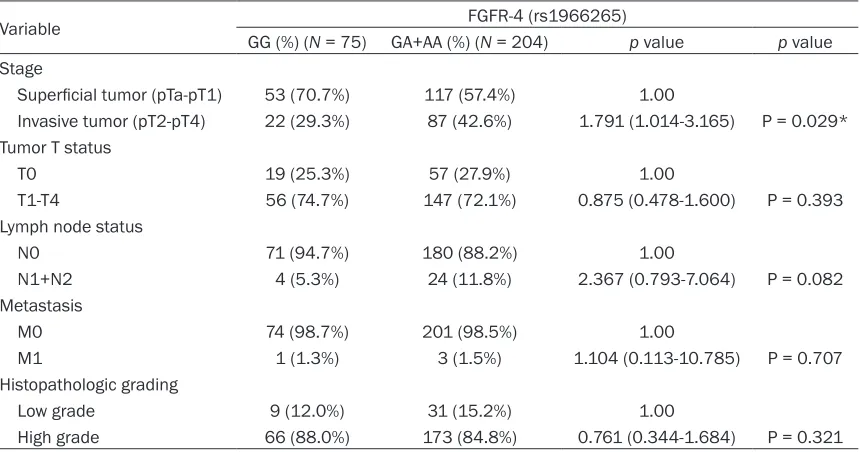
Distribution frequency of the clinical status and
FGFR-4
rs1966265
genotype frequencies in
279 patients with UCC
Variable FGFR-4 (rs1966265)
GG (%) (N = 75) GA+AA (%) (N = 204) p value p value Stage
Superficial tumor (pTa-pT1) 53 (70.7%) 117 (57.4%) 1.00
Invasive tumor (pT2-pT4) 22 (29.3%) 87 (42.6%) 1.791 (1.014-3.165) P = 0.029* Tumor T status
T0 19 (25.3%) 57 (27.9%) 1.00
T1-T4 56 (74.7%) 147 (72.1%) 0.875 (0.478-1.600) P = 0.393 Lymph node status
N0 71 (94.7%) 180 (88.2%) 1.00
N1+N2 4 (5.3%) 24 (11.8%) 2.367 (0.793-7.064) P = 0.082 Metastasis
M0 74 (98.7%) 201 (98.5%) 1.00
M1 1 (1.3%) 3 (1.5%) 1.104 (0.113-10.785) P = 0.707 Histopathologic grading
Low grade 9 (12.0%) 31 (15.2%) 1.00
High grade 66 (88.0%) 173 (84.8%) 0.761 (0.344-1.684) P = 0.321
*p value < 0.05 as statistically significant.
assessments included the stage, tumor size
and lymph node statuses, as well as meta-
stasis and histopathologic grading. No
signifi-cant differences were observed between other
[image:3.612.93.523.419.645.2]het-Table 4.
Distribution frequency of the clinical status and
FGFR-4
rs2011077 genotype frequencies in
279 patients with UCC
Variable FGFR-4 (rs2011077)
AA (%) (N = 76) AG+GG (%) (N = 203) p value p value Stage
Superficial tumor (pTa-pT1) 54 (71.1%) 116 (57.1%) 1.00
Invasive tumor (pT2-pT4) 22 (28.9%) 87 (42.9%) 1.841 (1.043-3.250) P = 0.023* Tumor T status
T0 19 (25.0%) 57 (28.1%) 1.00
T1-T4 57 (75.0%) 146 (71.9%) 0.854 (0.467-1.560) P = 0.362 Lymph node status
N0 72 (94.7%) 179 (88.2%) 1.00
N1+N2 4 (5.3%) 24 (11.8%) 2.413 (0.809-7.202) P = 0.076 Metastasis
M0 75 (98.7%) 200 (98.5%) 1.00
M1 1 (1.3%) 3 (1.5%) 1.125 (0.115-10.984) P = 0.701 Histopathologic grading
Low grade 9 (11.8%) 31 (15.3%) 1.00
High grade 67 (88.2%) 172 (84.7%) 0.745 (0.337-1.649) P = 0.302
*p value < 0.05 as statistically significant.
erozygous G/A or A/A genotype exhibited a high
risk of UCC with invasive tumor stage (
P
< 0.05)
compared with those with the homozygous G/G
genotype, as shown in
Table 3
. In addition,
patients with the heterozygous A/G or G/G
gen-otype also exhibited a high risk of UCC with
invasive tumor stage (
P
< 0.05) compared with
those with the homozygous A/A genotype for
FGFR-4 rs2011077 (
Table 4
). No significant
dif-ferences were observed between FGFR-4
rs351855 and rs7708357 genotypic and
inva-sive tumor clinical status. The relationship of
FGFR-4 haplotypes with the risk of developing
UCC was also evaluated. The frequency
distri-butions of three common FGFR-4 rs1966265,
rs351855, rs2011077, and rs7708357
haplo-types are shown in
Table 5
, with the most
fre-quent haplotype in the controls (GCAG) being
chosen as the reference. We found that all
these common FGFR-4 haplotypes exhibit no
significant associations with increased
suscep-tibility to UCC (
Table 5
).
Discussion
This is the first study to determine a significant
association between FGFR-4 polymorphic
vari-ants and UCC risk. The results showed that
patients carrying the G/A or A/A genotype of
the FGFR-4 rs1966265 polymorphic variant
exhibited a significantly increased risk of UCC
invasive tumor stage. Compared with the A/A
genotype of the FGFR-4 rs2011077, the A/G +
G/G genotype also exhibited a higher risk of
UCC invasive tumor stage.
[image:4.612.93.523.96.323.2]FGFRs consist of 4 closely related genes
(FGFR1-4) associated with the development
Table 5.
The estimated haplotype frequencies of four examined polymorphic variants in
FGFR-4
gene
and the corresponding risk for UCC
Variable Controls (N = 558)
n (%)
Patients (N = 558)
n (%) OR (95% CI) p value rs1966265
G/A rs351855 T/A rs2011077 A/G rs7708357 G/T
G C A G 279 (50.0%) 286 (51.3%) Reference
A T G G 247 (44.2%) 248 (44.3%) 0.979 (0.769-1.247) 0.866 A C G G 16 (2.9%) 12 (2.2%) 0.732 (0.340-1.575) 0.423 Others# 16 (2.9%) 12 (2.2%) 0.732 (0.340-1.575) 0.423
[image:4.612.89.526.380.472.2]of several types of human cancers, for exam-
ple breast cancers, ovarian cancer, bladder
cancer, lung cancer, and gastric cancers [22,
23]. Bang et al reported that the FGFR-4
rs351855 polymorphic variant was associated
with metastasis in prostate and breast can-
cer patients [24]. Moreover, Sugiyama et al.,
also reported the FGFR-4-R388 allele could
increase tumor invasion by decreasing
MT1-MMP degradation, thus exerts to poor cancer
prognosis [25]. Aberrant expression and
poly-morphic variant of fibroblast growth factor
receptor 4 (FGFR-4) has been linked to tu-
mor progression and anticancer drug
resis-tance. Knockdown of FGFR-4-R388 or
MT1-MMP through RNA interference blocked tu-
mor cell invasion and growth in collagen. This
was coupled with impaired phosphorylation of
FGFR substrate 2 and Src, upregulation of
E-cadherin, and suppression of cadherin-11
and N-cadherin [26]. However, few studies
have reported the expression of FGFR-4 and
its associated polymorphic variants with UCC.
However, no significant differences were ob-
served between FGFR-4 rs351855 genotypic
and invasive tumor clinical status in our study.
We observed that polymorphic variants in
FGFR-4 rs1966265 and FGFR-4 rs2011077
were associated with a high risk of invasive
tumor stage in patients with UCC. FGFR-4
poly-morphic variant rs1966265 exhibited an
asso-ciation with both respiratory distress and
bron-chopulmonary dysplasia [16]. FGFR-4 G alleles
of the rs2011077 polymorphic variant have a
significant impact on the development of
pros-tate cancer and benign prospros-tate hyperplasia
[17]. Although the rs2011077 polymorphic
variant is located in the intron, it may affect
mRNA splicing or transcription activity. It is
sug-gested that the rs2011077 SNP may increase
the activity or expression of FGFR-4 at the UCC
progressive stage. These findings may explain
the relationship between the G alleles of the
rs2011077 of FGFR-4 and the increased
inva-sive tumor status of UCC observed in the
pres-ent study. However, the mechanism by which
this SNP modulates the tumor development of
UCC should be further investigated in future
studies.
In conclusion, our results show that an as-
sociation between FGFR-4 rs1966265 and
rs2011077 was detected with a high risk of
invasive tumor in patients with UCC. These
find-ings indicate a novel genetic predisposition to
urothelial cell tumorigenesis.
Acknowledgements
This study was supported by a research
grant from Chung Shan Medical University
and Tungs’ Taichung Metro Harbor Hospital
(CSMU-TTM-104-01).
Disclosure of conflict of interest
None.
Address correspondence to: Drs. Shun-Fa Yang and Ming-Ju Hsieh, Institute of Medicine, Chung Shan Medical University, Taichung 402, Taiwan. Tel: +886-4-24739595 Ext. 34253; Fax: +886-4-24723229; E-mail: [email protected] (SFY); [email protected] (MJH)
References
[1] Colin P, Koenig P, Ouzzane A, Berthon N, Villers A, Biserte J, Roupret M. Environmental factors involved in carcinogenesis of urothelial cell carcinomas of the upper urinary tract. BJU Int 2009; 104: 1436-1440.
[2] Stern MC, Lin J, Figueroa JD, Kelsey KT, Kiltie AE, Yuan JM, Matullo G, Fletcher T, Benhamou S, Taylor JA, Placidi D, Zhang ZF, Steineck G, Rothman N, Kogevinas M, Silverman D, Malats N, Chanock S, Wu X, Karagas MR, Andrew AS, Nelson HH, Bishop DT, Sak SC, Choudhury A, Barrett JH, Elliot F, Corral R, Joshi AD, Gago-Dominguez M, Cortessis VK, Xiang YB, Gao YT, Vineis P, Sacerdote C, Guarrera S, Polidoro S, Allione A, Gurzau E, Koppova K, Kumar R, Rudnai P, Porru S, Carta A, Campagna M, Arici C, Park SS, Garcia-Closas M; International Consortium of Bladder Cancer. Polymorphisms in DNA repair genes, smoking, and bladder cancer risk: Findings from the international consortium of bladder cancer. Cancer Res 2009; 69: 6857-6864.
[3] Rouissi K, Stambouli N, Marrakchi R, Slama MR, Cherif M, Sfaxi M, Chebil M, Elgaaied AB, Ouerhani S. Smoking and polymorphisms in folate metabolizing genes and their effects on the histological stage and grade for bladder tumors. Bull Cancer 2011; 98: E1-10.
[4] Wang L, Wang G, Lu C, Feng B, Kang J. Contribution of the -160c/a polymorphism in the e-cadherin promoter to cancer risk: A me-ta-analysis of 47 case-control studies. PLoS One 2012; 7: e40219.
sur-vivin gene promoter -31 c/g polymorphism and urothelial carcinoma risk in taiwanese popula-tion. Urology 2009; 73: 670-674.
[6] Wang SS, Liu YF, Ou YC, Chen CS, Li JR, Yang SF. Impacts of ca9 gene polymorphisms on urothelial cell carcinoma susceptibility and clinicopathologic characteristics in taiwan. PLoS One 2013; 8: e82804.
[7] Galzie Z, Kinsella AR, Smith JA. Fibroblast growth factors and their receptors. Biochem Cell Biol 1997; 75: 669-685.
[8] Thisse B, Thisse C. Functions and regulations of fibroblast growth factor signaling during em-bryonic development. Dev Biol 2005; 287: 390-402.
[9] Turner N, Lambros MB, Horlings HM, Pearson A, Sharpe R, Natrajan R, Geyer FC, van Kouwenhove M, Kreike B, Mackay A, Ashworth A, van de Vijver MJ, Reis-Filho JS. Integrative molecular profiling of triple negative breast cancers identifies amplicon drivers and poten-tial therapeutic targets. Oncogene 2010; 29: 2013-2023.
[10] Su WC, Kitagawa M, Xue N, Xie B, Garofalo S, Cho J, Deng C, Horton WA, Fu XY. Activation of stat1 by mutant fibroblast growth-factor recep-tor in thanatophoric dysplasia type ii dwarfism. Nature 1997; 386: 288-292.
[11] Hart KC, Robertson SC, Kanemitsu MY, Meyer AN, Tynan JA, Donoghue DJ. Transformation and stat activation by derivatives of fgfr1, fgfr3, and fgfr4. Oncogene 2000; 19: 3309-3320.
[12] Wong A, Lamothe B, Lee A, Schlessinger J, Lax I. Frs2 alpha attenuates fgf receptor signaling by grb2-mediated recruitment of the ubiquitin ligase cbl. Proc Natl Acad Sci U S A 2002; 99: 6684-6689.
[13] Jean S, Mikryukov A, Tremblay MG, Baril J, Guillou F, Bellenfant S, Moss T. Extended-synaptotagmin-2 mediates fgf receptor endo-cytosis and erk activation in vivo. Dev Cell 2010; 19: 426-439.
[14] Yusoff P, Lao DH, Ong SH, Wong ES, Lim J, Lo TL, Leong HF, Fong CW, Guy GR. Sprouty2 in-hibits the ras/map kinase pathway by inhibit-ing the activation of raf. J Biol Chem 2002; 277: 3195-3201.
[15] Tiong KH, Mah LY, Leong CO. Functional roles of fibroblast growth factor receptors (fgfrs) sig-naling in human cancers. Apoptosis 2013; 18: 1447-1468.
[16] Rezvani M, Wilde J, Vitt P, Mailaparambil B, Grychtol R, Krueger M, Heinzmann A. Association of a fgfr-4 gene polymorphism with bronchopulmonary dysplasia and neonatal re-spiratory distress. Dis Markers 2013; 35: 633-640.
[17] Ma Z, Tsuchiya N, Yuasa T, Inoue T, Kumazawa T, Narita S, Horikawa Y, Tsuruta H, Obara T,
Saito M, Satoh S, Ogawa O, Habuchi T. Polymorphisms of fibroblast growth factor re-ceptor 4 have association with the develop-ment of prostate cancer and benign prostatic hyperplasia and the progression of prostate cancer in a japanese population. Int J Cancer 2008; 123: 2574-2579.
[18] Xu W, Li Y, Wang X, Chen B, Wang Y, Liu S, Xu J, Zhao W, Wu J. Fgfr4 transmembrane domain polymorphism and cancer risk: A meta-analy-sis including 8555 subjects. Eur J Cancer 2010; 46: 3332-3338.
[19] FitzGerald LM, Karlins E, Karyadi DM, Kwon EM, Koopmeiners JS, Stanford JL, Ostrander EA. Association of fgfr4 genetic polymorphisms with prostate cancer risk and prognosis. Prostate Cancer Prostatic Dis 2009; 12: 192-197.
JD, Czene K, Eriksson M, Humphreys K, Darabi H, Hooning MJ, Kriege M, Collée JM, Tilanus-Linthorst M, Li J, Jakubowska A, Lubinski J, Jaworska-Bieniek K, Durda K, Nevanlinna H, Muranen TA, Aittomäki K, Blomqvist C, Bogdanova N, Dörk T, Hall P, Chenevix-Trench G, Easton DF, Pharroah PD, Arias-Perez JI, Zamora P, Benítez J, Milne RL. Fgf receptor genes and breast cancer susceptibility: re- sults from the Breast Cancer Association Consortium. Br J Cancer 2014; 110: 1088-1100.
[21] Sheu MJ, Hsieh MJ, Chiang WL, Yang SF, Lee HL, Lee LM, Yeh CB. Fibroblast growth factor receptor 4 polymorphism is associated with liver cirrhosis in hepatocarcinoma. PLoS One 2015; 10: e0122961.
[22] Jacquemier J, Adelaide J, Parc P, Penault-Llorca F, Planche J, deLapeyriere O, Birnbaum D. Expression of the fgfr1 gene in human breast-carcinoma cells. Int J Cancer 1994; 59: 373-378.
[23] Jaakkola S, Salmikangas P, Nylund S, Partanen J, Armstrong E, Pyrhonen S, Lehtovirta P, Nevanlinna H. Amplification of fgfr4 gene in human breast and gynecological cancers. Int J Cancer 1993; 54: 378-382.
[24] Bange J, Prechtl D, Cheburkin Y, Specht K, Harbeck N, Schmitt M, Knyazeva T, Muller S, Gartner S, Sures I, Wang H, Imyanitov E, Haring HU, Knayzev P, Iacobelli S, Hofler H, Ullrich A. Cancer progression and tumor cell motility are associated with the fgfr4 arg (388) allele. Cancer Res 2002; 62: 840-847.
[25] Sugiyama N, Varjosalo M, Meller P, Lohi J, Chan KM, Zhou Z, Alitalo K, Taipale J, Keski-Oja J, Lehti K. Fgf receptor-4 (fgfr4) polymorphism acts as an activity switch of a membrane type 1 matrix metalloproteinase-fgfr4 complex. Proc Natl Acad Sci U S A 2010; 107: 15786-15791.