Proceedings of Knowledge Resources for the Socio-Economic Sciences and Humanities associated with RANLP-17, pages 19–25,
GRaSP: Grounded Representation and Source Perspective
Antske Fokkens♣, Piek Vossen♣, Marco Rospocher♦, Rinke Hoekstra♥♣and Willem R. van Hage♠
♣CLTL and Computer Science, Vrije Universiteit, Amsterdam, The Netherlands
♦Fondazione Bruno Kessler, Trento, Italy
♥Elsevier BV, Amsterdam, The Netherlands
♠Netherlands eScience Center, Amsterdam, The Netherlands
{antske.fokkens,piek.vossen}@vu.nl,[email protected] [email protected],[email protected]
Abstract
When people or organizations provide in-formation, they make choices regarding what they include and how they repre-sent it. These two aspects combined (the content and the stance) represent a per-spective. Investigating perspectives can provide useful insights into the reliabil-ity of information, changes in viewpoints over time, shared beliefs among social or political groups and contrasts with other groups, etc. This paper introduces GRaSP, a generic framework for modeling per-spectives and their sources.
1 Introduction
Structured data and knowledge resources typically provide what is seen as factual information. They contain definitions of concepts, ontologies, infor-mation about origins, dates, locations, etc. Meth-ods have been developed to automatically extract such information from text (Hearst, 1992; Buite-laar et al.,2004;Wu and Weld,2010, among oth-ers). However, knowledge consists of much more than ontological classifications and basic verifi-able properties of objects and people. It involves information about various entities, events and con-cepts, connecting this information and judging its validity. For social science and humanities, these aspects of knowledge are particularly interesting, i.e. how information is connected, how people judge validity, how knowledge changes, what un-certainty and sentiment that accompanies it.
When people or organizations provide informa-tion, they make choices regarding what they in-clude and how they present information. These two aspects together (the content and stance pro-vided by the source) represent a perspective, an element of interest for many disciplines.
Commu-nication scientists and social psychologists study (e.g.) how common opinions or existing stereo-types are displayed in the media. Political scien-tists can investigate how various sources present hot topics. Historians may look into how perspec-tives on historic events change over time. Outside of academia, perspectives can be of interest to in-formation professionals, decision makers, adver-tisers, journalists and any citizen interested in crit-ical thinking and finding balanced information.
Natural language processing (NLP) can offer support in identifying the topic of text, classify-ing stances, identifyclassify-ing sentiment and opinions, determining factuality values of events, etc. To our knowledge, these technologies are generally investigated in isolation and have, up to date, not been connected in order to obtain a more full-fledged representation of perspectives. In this paper, we take the first step towards such a representation by introducing a framework that formally represents perspectives: the Grounded Representation and Source Perspective framework (GRaSP). GRaSP is a unique and generic flexible framework that combines the formal representa-tion of the content and of the source perspective in one single model. It is compatible with exist-ing models, but can also model subtleties that can be expressed in natural language but remain chal-lenging for RDF representations.
The rest of this paper is structured as follows. We provide background on GRaSP in Section 2. We then introduce the framework itself in Sec-tion 3. We describe an automatically generated dataset represented in GRaSP in Section4. After discussing related work, we conclude.
2 Background
The origins of GRaSP lie in the projects News-Reader (Vossen et al., 2016) and BiographyNet
(Fokkens et al.,2014). NewsReader aimed at ex-tracting what happened to whom, when and where from large amounts of (financial) news, creating structured data to support decision making. In BiographyNet, we aimed to extract information about individuals in biographical dictionaries for historians. We investigated in connections be-tween people and how the same person or event was depicted in different biographical dictionar-ies. An essential step for addressing these chal-lenges is to indicate which documents talk about the same entity or event. In addition, the prove-nance of information is essential in both projects, i.e. end-users need insight into the source of spe-cific information. NewsReader and BiographyNet also shared the vision of comparing differences in information from various sources.
More recent projects dive deeper in perspec-tives. Understanding Language By Machines in-vestigates the relations between events, uncer-tainty, sentiment and opinons and how this infor-mation results into storylines and world views. In
Reading between the lines, we look at more subtle cues of perspectives addressing questions such as “which background information given when talk-ing about people from different ethnic groups?” or “when do we chose to generalize (e.g. by calling someone a thief rather than a suspect of having stolen something)?”. QuPiD2 addresses (among others) what evidence is discussed and how sources build their argumentation around it.
With GRaSP, we aim to design a framework that can support the research questions central to these projects following six requirements. First, we want to represent various perspectives on the same entity, proposition or topic next to each other. Second, it should represent the source of each per-spective, so that users can e.g. select all perspec-tives of a specific source; group sources according to shared or conflicting views on a given content; find all sources that have a perspective on the same content or share a perspective; and, find available background information about the source. Third, we want to provide the means to semantically compare the (propositional) content across state-ments and represent whether sources mention the same, similar or related content (e.g. more or less specific), or a different framing of content (e.g.
murdered, which is intentional, or killed which may be accidental). Fourth, it should be possi-ble to represent a wide range of perspective-related
phenomena, including: sentiment, emotion, judg-ment, negation, certainty, speculation, reporting, framing and salience. Fifth, we want to make al-ternativeinterpretationsof the same statement ex-plicit, since statements might be (deliberately) am-biguous, not well formulated or difficult to process with Natural Language Processing (NLP) technol-ogy. Finally, users should be able to gain insight in the full provenance of any information provided by GRaSP. Next to the source, it should provide information about how this perspective was ana-lyzed (e.g. expert analysis of a text, crowd annota-tions, text mining).
The first three requirements allow users to place various perspectives next to each other allowing them to compare, among others, which sources agree or disagree on what, which sources change their mind, which sources speculate and whether their predictions were accurate. In addition, they would allow identifying all content and stances given on a specific topic by a source and, for ex-ample, display this on a timeline. Researchers can thus investigate what information is important to sources who hold a specific opinion. The fourth and fifth requirement ensure that the model is flex-ible enough to support various needs of end-users as well as to accommodate the variation of infor-mation provided by different systems or datasets. Tools used to gather and interpret information can introduce biases end-users should be aware of (Lin, 2012;Rieder and R¨ohle, 2012). Provid-ing clear provenance of information (includProvid-ing in-volved processes) is a necessary component for creating such awareness (sixth requirement).
There are several ontologies that can be used to model perspective-related information. We will outline the most influential ones and explain which part of the requirements they fulfill in Section5.
3 The GRaSP Framework
in how information is presented (e.g. using neutral or marked words, certainty, confirming or deny-ing somethdeny-ing). We therefore see a perspective as the combination of thecontentof one or more statements (which information is included) and the stancesources take on this content.
GRaSP makes the link between the content and stance of a statement as well as to their source explicit. The framework achieves this through a triple layered representation consisting of a men-tion layer, aninstance layer and anattribution layer. The mention layeris the central layer of the model. Mentions are physical objects, such as a (piece of) text, (part of) an image or a sound, that signal information and can be embedded in a larger physical object. Mentions can be com-bined and form a statement that displays a per-spective on some propositional content by some source. Propositions are abstract meaning repre-sentations that make reference to events and par-ticipating entities. Both events and entities are rep-resented as instances in some (presumed) world in theinstance layer. Finally, the stance expressed by the statement is represented in theattribution layer. This layer models attitudinal information such as beliefs, judgments, certainty and sentiment of the source towards the propositional content. This section introduces these layers and illustrate how they are used to model perspectives.1
3.1 Grounding
An essential part of representing perspectives is making explicit what the perspective is about, i.e. representing the described (real-world) situation. This is captured by the two top layers of our frame-work; the instance layer and the mention layer. These two layers, as well as their connecting rela-tion are based on the architecture proposed in the Grounded Annotation Framework (Fokkens et al., 2013, GAF), which is incorporated in GRaSP. Consider the following examples:
1. During 2000-2014, measles vaccination pre-vent an estimated 17.1 million deaths 2. The search result contained 108 deaths over
this period, resulting from four different measles vaccines
3. There have been no measles death reported in the U.S. since 2003
1The ontology and examples can be found at:
https://github.com/cltl/GRaSP
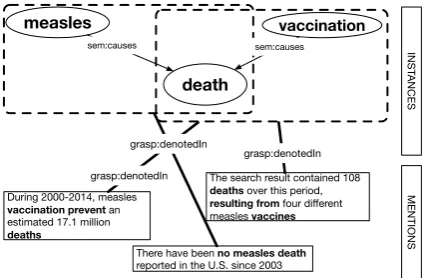
These sentences above make statements about whether measles or vaccinations cause death. Fig-ure1illustrates how this is represented in the top two layers of GRaSP.
During 2000-2014, measles
vaccination prevent an estimated 17.1 million
deaths
There have been nomeasles death
reported in the U.S. since 2003
The search result contained 108
deaths over this period,
resultingfrom four different measles vaccines
measles
death
vaccination
sem:causes INST
ANCES
sem:causes
grasp:denotedIn
grasp:denotedIn
grasp:denotedIn
[image:3.595.310.524.127.266.2]MENTIONS
Figure 1: Instance and mention layers
The content of statements is represented in the instance layer. This layer can represent informa-tion about events, their participants, their locainforma-tions or their time, but also information about (generic) concepts or ideas. Typically, propositions are ex-pressed in terms of the Simple Event Model (SEM, (van Hage et al., 2011)), but information in this layer can be represented using other vocabularies as well. SEM is a generic RDF vocabulary for event-participant relations that allows for reason-ing over the propositional content of statements. Event-event relations can be represented as well in the instance layer: the example in Figure 1 includes a causal relation between measles and death, and one between vaccination and death.
Entities, events and statements in the instance layer can be linked to expressions in the men-tion layer by the relamen-tions grasp:denotedBy
pointing out the exact words or linguistic struc-ture that expresses the event or statement, or
bygrasp:denotedInwhich indicates that the
statement is made somewhere in a sentence, para-graph or document. In our example the causal re-lation between ‘vaccination’ and ‘death’ is linked to Sentences 1. and 2. The relation between ‘measles’ and ‘death’ is linked to Sentence 3. Through these links, researchers interested in how various sources talk about the risks of measles or vaccinations can find snippets of text that talk about these issues. However, the source and the stance taken are not made explicit yet. The next subsection introduces the attribution layer, which allows us to add this information.
3.2 Source Perspective
Grounding (modeled by the link between in-stances and mentions) establishes what a specific message is about. Two components need to be added to complete a framework that can capture perspectives from various sources. First, men-tions should be linked to the source that expresses the perspective. Second, we want to represent the stance the source takes on the content of the message. The stance typically includes informa-tion on factuality (e.g. does the source confirm or deny, is it certain or hesitant, is it talking about the future?), judgment, sentiment and emotion (e.g. does the source consider the content ethical, is the source scared by the content?).
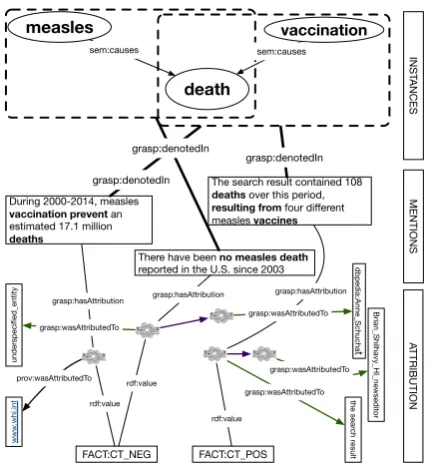
The third layer, theattributionlayer, adds these components to GRaSP. Figure2adds the attribu-tion layer to our example. Each of the menattribu-tions is linked to an attribution node. These nodes are in turn linked to the source that published them and, if applicable, the source reported in the text. We use the PROV-DM (Moreau et al.,2013) to model the source of publication and a specified variant of the wasAttributedTo relation introduced by GRaSP for quoted sources. Attribution nodes also receive values that make the stance taken by the source explicit. In this case, the statements expressing opposing views to vaccines leading to deaths or measles leading to death are connected to a factuality value indicating that the source de-nied this relation without expressing doubt.
Through the addition of this layer, end-users can
During 2000-2014, measles vaccination prevent an estimated 17.1 million deaths
There have been no measles death reported in the U.S. since 2003
The search result contained 108 deaths over this period, resulting from four different measles vaccines
measles
death
vaccination
sem:causes INST
ANCES
sem:causes
grasp:denotedIn
grasp:denotedIn
grasp:denotedIn
MENTIONS
ATTRIBUTION
FACT:CT_POS FACT:CT_NEG
www
.whi.int
dbpedia:Anne_Schucha
t
underspecified_entity
Brian_Shilhavy_HI_newseditor
the sear
ch r
esult
grasp:wasAttributedTo
grasp:wasAttributedTo grasp:wasAttributedTo prov:wasAttributedTo
grasp:wasAttributedTo
grasp:hasAttribution grasp:hasAttribution grasp:hasAttribution
rdf:value rdf:value
[image:4.595.309.523.59.293.2]rdf:value
Figure 2: Instance, mention and attribution layers
explore opposing views on the same topic or state-ment. This allows users to compare sources re-ported on both viewpoints, identifying what other opinions these sources express and investigating the overall argumentation (the statement that there were no measles death can both been used by peo-ple opposing to vaccination, because “measles are not deadly”, or by people supporting it, stating that “measles deaths are avoided thanks to vaccina-tion”). Additional information about sources can be gathered leading to investigations on, among others, how reports on specific topics evaluate over time, the difference in certainty expressed by politicians or scientists or how different countries report on the same event.
4 GRaSP illustrated
One of the main challenges involved in represent-ing perspectives in GRaSP is the question of how to obtain this information accurately. In principle, GRaSP can be used in combination with close-reading manual methods, where researchers use it to meticulously record the information they base their conclusions on. It becomes more interest-ing when we can represent massive amounts of data and help researchers find information auto-matically. Sentiment analysis, factuality classifi-cation, opinion mining, event extraction and ar-gumentation mining are challenging tasks. Auto-matically creating highly accurate representations of perspectives in GRaSP is a challenge for the future. Nevertheless, current methods can pro-vide output that we believe to be useful for re-searchers interested in perspectives. In this sec-tion, we illustrate what information can currently be generated by NLP tools through a dataset that the GRaSP framework for representation made available through an interface providing an open source visualization (van der Zwaan et al.,2016; van Meersbergen et al.,2017).
The GRaSP dataset consists of WikiNews texts2 by the Open Source pipeline of NewsReader (Vossen et al.,2016). The pipeline includes soft-ware for identifying events, relations between events, factuality of events and opinions. The in-terpretation program turning the linguistic repre-sentations of the NLP tools into RDF representa-tion in GRaSP specifically targets Source Intro-ducing Predicates (e.g. say, believe), identifying who said what according to the text. All content not in the scope of these predicates is attributed to the author of the text.
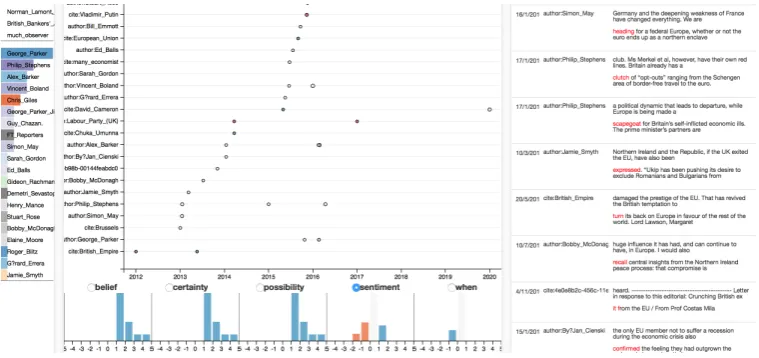
The interactive visualization showing perspec-tives on immigration and external EU borders in WikiNews.3 is available on github and can be ex-plored for better understanding of the following passage.4 Figure3 provides a partial screenshot. On the left hand side, the sources are provided. There are two lists of sources, the bottom list pro-vides the authors or publishers of news articles. The top list provides sources quoted in the article. The events mentioned by the sources are displayed in the central image, with actual text on the right. Statistics on sentiment and factuality are provided
2https://en.wikinews.org/wiki/Main Page 3http://wikinews.org/
4http://nlesc.github.io/UncertaintyVisualization/
by the diagrams at the bottom of the visualization. The visualization is interactive: sources and events can be selected leading to updates of perspective information and text.
5 Related Work
GRaSP offers ways to connect statements (in texts, video, images, etc.) to their source, the entities and events they mention and the stance they dis-play. Arguably, this connection can be seen as a form of annotation. The Web Annotation Data Model (OA)5 of the W3C represents annotations as therelatedcombination of a body (the annota-tion) and a target (the annotated source). The rela-tion isdirected, the body says something about the target, but not vice versa. Directionality of OA, and the annotation view in general, is not com-patible with the goals of GRaSP. A traditional an-notation would just say that the link between an instance and its mention is a form of semantic en-richment of the text containing mention. The real question is: does the semantic representation of an instance determine how mentions should be un-derstood, or do the combined mentions of an in-stance collectively determine its semantics? This nuance is of central importance when e.g. study-ing concept drift across historical sources, and it is the reason that GRaSP commits to the neutral de-notationrelation between instances and mentions. Secondly, the OA specification forces annotation targets to bedereferencable, which is problematic for sources that are not owned by the agent pro-ducing the annotations. License and other con-straints may prohibit republication, and on a tech-nical level dereferenceability cannot be guaran-teed for sources hosted at an external location.
Marl6 provides a model to represent subjective opinions in text. Marl is used by the Onyx ontol-ogy7 for representing emotions expressed in text. It has also been combined with lexical information on sentiment from Lemon (Buitelaar et al.,2013).8 GRaSP shares this flexibility of being compati-ble with various models that express aspects of perspectives. Unlike GRaSP, Marl is restricted to text. It furthermore confounds the layers that GRaSP carefully separates: the opinion (attribu-tion in GRaSP) is a central node, that refers to
Figure 3: Screenshot of visualized perspective information
an object/feature (instance in GRaSP) and the lit-eral text that reflects the opinion (mentions). This has two consequences. First, Marl only relates the opinion to the source (text or url) in which it was found without making the opinion holder explicit. GRaSP links mentions to their provenance and at-tributions of stances to the source that expressed the opinion. Marl thus does not seem to provide the means to collect all perspectives from a spe-cific source. Second, GRaSP’s separation of these layers makes it more flexible in dealing with alter-native interpretations of mentions, both at the at-tribution and instance layer. Finally, GRaSP is not limited to explicitly subjective opinions, but can connect all stances taken by a source (including factual statements).
GRaSP can be combined with various existing models. We use PROV (Moreau et al., 2013) to model the provenance of mentions and interpreta-tions made on them (i.e. to model the NLP pro-cess followingOckeloen et al.(2013)). The NLP Interchange Format (NIF, Hellmann et al. 2013) is an RDF/OWL vocabulary for representing NLP annotations in a common way, to foster interop-erability between NLP tools, language resources and annotations. The core of NIF consists of a vocabulary and a URI design that permit describ-ing strdescrib-ings and substrdescrib-ings, to which arbitrary an-notations can be attached using vocabularies exter-nal to NIF. NIF itself does not specifically address the representation of source or attribution infor-mation, but can be combined with GRaSP. GRaSP bases the format of IRIs of mentions on NIF and uses it to represent some mention layer attributes (e.g. char offset in the text). Finally, GRaSP uses
the grounding relations provided by GAF, as men-tioned above. GRaSP’s main contribution com-pared to GAF is that GRaSP adds an attribution layer tying sources and their stances to mentions. 6 Conclusion and Discussion
This paper introduces GRaSP, a formal framework to represent perspectives on content. The GRaSP framework was designed out of need from various NLP projects that deal with automatically iden-tifying perspectives. We explained how GRaSP provides the structure to study perspectives from various view points (starting with a topic, source, sentiment, or stance). We provide a dataset ac-tively using GRaSP that allows users to study the perspective various sources express on events in WikiNews.
The way perspectives are expressed in natural language is highly complex. Space limitations prevented us to illustrate how phenomena such as scope, alternative interpretations and framing can be represented in GRaSP. The wide range of pos-sibilities for applying this and how researchers can deal with (lack of) accuracy of NLP tools also re-quires more space than available in a short paper. We plan to address these issues in future work. Acknowledgement
References
Paul Buitelaar, Mihael Arcan, Carlos A Iglesias, J Fer-nando S´anchez-Rada, and Carlo Strapparava. 2013. Linguistic linked data for sentiment analysis. In2nd Workshop on Linked Data in Linguistics. page 1. Paul Buitelaar, Daniel Olejnik, and Michael Sintek.
2004. A prot´eg´e plug-in for ontology extraction from text based on linguistic analysis. InEuropean Semantic Web Symposium. Springer, pages 31–44. Antske Fokkens, Serge Ter Braake, Niels Ockeloen,
Piek Vossen, Susan Legˆene, and Guus Schreiber. 2014. Biographynet: Methodological issues when nlp supports historical research. In LREC. pages 3728–3735.
Antske Fokkens, Marieke van Erp, Piek Vossen, Sara Tonelli, Willem Robert van Hage, Luciano Serafini, Rachele Sprugnoli, and Jesper Hoeksema. 2013. GAF: A grounded annotation framework for events. InThe 1st Workshop on Events. Atlanta, USA. Marti A Hearst. 1992. Automatic acquisition of
hy-ponyms from large text corpora. InProceedings of the 14th conference on Computational linguistics-Volume 2. Association for Computational Linguis-tics, pages 539–545.
Sebastian Hellmann, Jens Lehmann, Sren Auer, and Martin Brmmer. 2013. Integrating NLP using Linked Data. InProc. of ISWC. pages 98–113. See
also http://persistence.uni-leipzig.
org/nlp2rdf/.
Yu-wei Lin. 2012. Transdisciplinarity and digital hu-manities: Lessons learned from developing text-mining tools for textual analysis. InUnderstanding digital humanities, Springer, pages 295–314. Luc Moreau, Paolo Missier, Khalid Belhajjame, Reza
B’Far, James Cheney, Sam Coppens, Stephen Cress-well, Yolanda Gil, Paul Groth, Graham Klyne, et al. 2013. Prov-dm: The prov data model. Retrieved July30:2013.
Niels Ockeloen, Antske Fokkens, Serge Ter Braake, Piek Vossen, Victor De Boer, Guus Schreiber, and Susan Legˆene. 2013. Biographynet: Managing provenance at multiple levels and from different per-spectives. In LiSc-Volume 1116. CEUR-WS. org, pages 59–71.
Bernhard Rieder and Theo R¨ohle. 2012. Digital meth-ods: Five challenges. InUnderstanding digital hu-manities, Springer, pages 67–84.
Janneke van der Zwaan, Maarten van Meersbergen, Antske Fokkens, Serge ter Braake, Inger Leemans, Erika Kuijpers, Piek Vossen, and Isa Maks. 2016. Storyteller: Visualizing perspectives in digital hu-manities projects. In Computational History and Data-Driven Humanities: Second IFIP WG 12.7 In-ternational Workshop, CHDDH 2016, Dublin, Ire-land, May 25, 2016, Revised Selected Papers 2. Springer, pages 78–90.
Willem Robert van Hage, V´eronique Malais´e, Roxane Segers, Laura Hollink, and Guus Schreiber. 2011. Design and use of the Simple Event Model (SEM).
Journal of Web Semantics9(2):128–136.
Maarten van Meersbergen, Piek Vossen, Janneke van der Zwaan, Antske Fokkens, Willem van Hage, Inger Leemans, and Isa Maks. 2017. Storyteller: Vi-sual analytics of perspectives on rich text interpreta-tions. InProceedings of Natural Language Process-ing meets Journalism. Copenhagen, Denmark. Piek Vossen, Rodrigo Agerri, Itziar Aldabe, Agata
Cy-bulska, Marieke van Erp, Antske Fokkens, Egoitz Laparra, Anne-Lyse Minard, Alessio Palmero Apro-sio, German Rigau, Marco Rospocher, and Roxane Segers. 2016. Newsreader: Using knowledge re-sources in a cross-lingual reading machine to gener-ate more knowledge from massive streams of news.
Knowledge-Based Systems110:60–85.