Improving Neural Machine Translation with Conditional Sequence
Generative Adversarial Nets
Zhen Yang1,2, Wei Chen1∗, Feng Wang1,2, Bo Xu1 1Institute of Automation, Chinese Academy of Sciences
2University of Chinese Academy of Sciences
{yangzhen2014, wei.chen.media, feng.wang, xubo}@ia.ac.cn
Abstract
This paper proposes an approach for apply-ing GANs to NMT. We build a condition-al sequence generative adversaricondition-al net which comprises of two adversarial sub models, a generator and a discriminator. The generator aims to generate sentences which are hard to be discriminated from human-translated sen-tences ( i.e., the golden target sensen-tences); And the discriminator makes efforts to discriminate the machine-generated sentences from human-translated ones. The two sub models play a mini-max game and achieve the win-win situation when they reach a Nash Equilibri-um. Additionally, the static sentence-level BLEU is utilized as the reinforced objective for the generator, which biases the generation towards high BLEU points. During training, both the dynamic discriminator and the stat-ic BLEU objective are employed to evaluate the generated sentences and feedback the eval-uations to guide the learning of the generator. Experimental results show that the proposed model consistently outperforms the traditional RNNSearch and the newly emerged state-of-the-art Transformer on English-German and Chinese-English translation tasks.
1 Introduction
Neural machine translation (Kalchbrenner and Blunsom,2013;Sutskever et al.,2014;Cho et al.,
2014;Bahdanau et al.,2014) which directly lever-ages a single neural network to transform the source sentence into the target sentence, has drawn more and more attention in both academia and in-dustry (Shen et al.,2015;Wu et al.,2016;Johnson et al., 2016;Gehring et al., 2017;Vaswani et al.,
2017). This end-to-end NMT typically consists of two sub neural networks. The encoder network reads and encodes the source sentence into the context vector representation; and the decoder net-work generates the target sentence word by word
based on the context vector. To dynamically erate a context vector for a target word being gen-erated, the attention mechanism which enables the model to focus on the relevant words in the source-side sentence is usually deployed. Under the encoder-decoder framework, many variants of the model structure, such as convolutional neural net-work (CNN) and recurrent neural netnet-work (RN-N) are proposed (Bahdanau et al.,2014;Gehring et al., 2017). Recently, (Gehring et al., 2017) propose the Transformer, the first sequence trans-duction model based entirely on attention, achiev-ing state-of-the-art performance on the English-German and English-French translation tasks. De-spite its success, the Transformer, similar to tradi-tional NMT models, is still optimized to maximize the likelihood estimation of the ground word (M-LE) at each time step. Such an objective poses a hidden danger to NMT models. That is, the model may generate the best candidate word for the cur-rent time step yet a bad component of the whole sentence in the long run. Minimum risk training (MRT) (Shen et al.,2015) is proposed to alleviate such a limitation by adopting the sequence level objective, i.e., the sentence-level BLEU, for tra-ditional NMT models. Yet somewhat improved, this objective still does not guarantee the transla-tion results to be natural and sufficient. Since the BLEU point is computed as the geometric mean of the modified n-gram precisions (Papineni et al.,
2002), almost all of the existing objectives es-sentially train NMT models to generate sentences with n-gram precisions as high as possible (MLE can be viewed to generate sentences with high 1-gram precisions). While n-1-gram precisions largely tell the good sentence apart from the bad one, it is widely acknowledged that higher n-gram preci-sions do not guarantee better sentences ( Callison-Burch and Osborne,2006;Chatterjee et al.,2007). Additionally, the manually defined objective, i.e.,
the n-gram precision, is unable to cover all crucial aspects of the data distribution and NMT models may be trained to generate suboptimal sentences (Luc et al.,2016).
In this paper, to address the limitation men-tioned above, we borrow the idea of generative ad-versarial training from computer vision ( Goodfel-low et al., 2014; Denton et al., 2015) to directly train the NMT model generating sentences which are hard to be discriminated from human transla-tions. The motivation behind is that while we can not manually define the data distribution of gold-en sgold-entgold-ences comprehgold-ensively, we are able to uti-lize a discriminative network to learn automatical-ly what the golden sentences look like. Following this motivation, we build a conditional sequence generative adversarial net where we jointly train two sub adversarial models: A generator gener-ates the target-language sentence based on the in-put source-language sentence; And a discrimina-tor, conditioned on the source-language sentence, predicts the probability of the target-language sen-tence being a human-generated one. During the training process, the generator aims to fool the discriminator into believing that its output is a human-generated sentence, and the discriminator makes efforts not to be fooled by improving its ability to distinguish the machine-generated sen-tence from the human-generated one. This kind of adversarial training achieves a win-win situa-tion when the generator and discriminator reach a Nash Equilibrium (Zhao et al.,2016;Arora et al.,
2017;Guimaraes et al., 2017). Besides generat-ing the desired distribution, we also want to di-rectly guide the generator with a static and spe-cific objective, such as generating sentences with high BLEU points. To this end, the smoothed sentence-level BLEU (Nakov et al.,2012) is uti-lized as the reinforced objective for the generator. During training, we employ both the dynamic dis-criminator and the static BLEU objective to evalu-ate the generevalu-ated sentences and feedback the eval-uations to guide the learning of the generator. In summary, we mainly make the following contribu-tions:
• To the best of our knowledge, this work is a-mong the first endeavors to introduce the gen-erative adversarial training into NMT. We di-rectly train the NMT model to generate sen-tences which are hard to be discriminated from human translations. The proposed
mod-el can be applied to any end-to-end NMT sys-tems.
• We conduct extensive experiments on
English-German and Chinese-English trans-lation tasks and we test two different NMT models, the traditional RNNSearch ( Bah-danau et al., 2014) and the state-of-the-art Transformer. Experimental results show that the proposed approach consistently achieves great success.
• Last but not least, we propose the smoothed sentence-level BLEU as the static and spe-cific objective for the generator which biases the generation towards achieving high BLEU points. We show that the proposed approach is a weighted combination of the naive GAN and MRT.
2 Background and Related Work
2.1 RNNSearch and Transformer
The RNNSearch is the traditional NMT model which has been widely explored. We follow the de facto standard implementation by (Bahdanau et al., 2014). The encoder is a bidirectional gat-ed recurrent units that encodes the input sequence
x = (x1, . . . , xm)and calculates the forward
se-quence of hidden states(−→h1, . . . ,−→hm), and a
back-ward sequence of hidden states(←h−1, . . . ,←−hm). The
final annotation vector hj is calculated by
con-catenating−→hj and←h−j. The decoder is a
recurren-t neural nerecurren-twork recurren-tharecurren-t predicrecurren-ts a recurren-targerecurren-t sequence
y = (y1, . . . , yn). Each word yi is predicted on
a recurrent hidden statesi, the previously
predict-ed word yi−1 and a context vector ci. The ci is
computed as a weighted sum of the encoded anno-tationshj. The weightaij of each annotationhj
is computed by the attention mechanism, which models the alignment betweenyiandxj.
sub-layer, which performs multi-head attention over the output of the encoder stack. The Trans-former can be trained significantly faster than architectures based on recurrent or convolutional layers since it allows for significantly more parallelization.
2.2 Generative adversarial nets
Generative adversarial network, has enjoyed great success in computer vision and has been wide-ly applied to image generation (Zhu et al.,2017;
Radford et al., 2015). The conditional generative adversarial nets (Gauthier, 2014) apply an exten-sion of generative adversarial network to a con-ditional setting, which enables the networks to condition on some arbitrary external data. Some recent works have begun to apply the genera-tive adversarial training into the NLP area: (Chen et al.,2016) apply the idea of generative adversar-ial training to sentiment analysis and (Zhang et al.,
2017) use the idea to domain adaptation tasks. For sequence generation problem, (Yu et al., 2016) leverage policy gradient reinforcement learning to back-propagate the reward from the discrimina-tor, showing presentable results for poem gener-ation, speech language generation and music gen-eration. Similarly, (Zhang et al., 2016) generate the text from random noise via adversarial train-ing. A striking difference from the works men-tioned above is that, our work is in the conditional setting where the target-language sentence is gen-erated conditioned on the source-language one. In parallel to our work, (Li et al., 2017) propose a similar conditional sequence generative adversar-ial training for dadversar-ialogue generation. They use a hierarchical long-short term memory (LSTM) ar-chitecture for the discriminator. In contrast to their approach, we apply the CNN-based discriminator for the machine translation task. Furthermore, we propose to utilize the sentence-level BLEU as the specific objective for the generator. Detailed train-ing strategies for the proposed model and exten-sive quantitative results are reported. We noticed that (Wu et al.,2017) is exploring the potential of GAN in NMT too. There are some differences in training strategies and experimental settings be-tween (Wu et al., 2017) and this work. And the most significant difference is that we propose a novel BLEU-reinforced GAN for NMT1.
1The previous presentation of this work can be found at
https://arxiv.org/abs/1703.04887
3 The Approach
3.1 Model overview
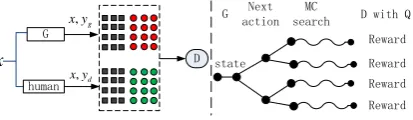
In this section, we describe the architecture of the proposed BLEU reinforced conditional se-quence generative adversarial net (referred to as BR-CSGAN) in detail. The sentence generation process is viewed as a sequence of actions that are taken according to a policy regulated by the gen-erator. In this work, we take the policy gradient training strategies following (Yu et al.,2016). The whole architecture of the proposed model is de-picted in figure1. The model mainly consists of three sub modules:
GeneratorBased on the source-language sen-tences, the generator G aims to generate target-language sentences indistinguishable from human translations.
Discriminator The discriminator D,
condi-tioned on the source-language sentences, tries to distinguish the machine-generated sentences from human translations. Dcan be viewed as a dynam-ic objective since it is updated synchronously with G.
BLEU objective The sentence-level BLEU Q
serves as the reinforced objective, guiding the gen-eration towards high BLEU points. Qis a static function which will not be updated during train-ing.
3.2 Generator
Resembling NMT models, the generatorGdefines the policy that generates the target sentencey
giv-en the source sgiv-entgiv-ence x. The generator takes
exactly the same architecture with NMT models. Note that we do not assume the specific architec-ture of the generator. To verify the effectiveness of the proposed method, we take two different archi-tectures for the generator, the RNNSearch 2 and
Transformer3.
3.3 Discriminator
Recently, the deep discriminative models such as the CNN and RNN have shown a high per-formance in complicated sequence classification tasks. Here, the discriminator is implemented based on the CNN architecture.
Since sentences generated by the generator have variable lengths, the CNN padding is used to trans-form the sentences to sequences with fixed length
G
x
, g
x y
human x y, d
D
G Next action
MC search
Reward D with Q
state Reward
Reward
[image:4.595.80.287.64.124.2]Reward
Figure 1: The Illustration of the proposed BR-CSGAN. Left: D is trained over the real sentence pairs translated by the human and the generated sentence pairs by G. Note that D is a conditional discriminator. Right: G is trained by police gradient where the final reward is provided by D and Q.
T, which is the maximum length set for the output
of the generator. Given the source-language se-quence x1, . . . , xT and target-language sequence
y1, . . . , yT, we build the source matrix X1:T and
target matrixY1:T respectively as:
X1:T =x1;x2;. . .;xT (1)
and
Y1:T =y1;y2;. . .;yT (2)
wherext,yt ∈Rkis thek-dimensional word
em-bedding and the semicolon is the concatenation operator. For the source matrix X1:T, a kernel
wj ∈ Rl×k applies a convolutional operation to
a window size of l words to produce a series of feature maps:
cji=ρ(BN(wj⊗Xi:i+l−1+b)) (3)
where ⊗ operator is the summation of
element-wise production andbis a bias term. ρ is a
non-linear activation function which is implemented as ReLu in this paper. Note that the batch normaliza-tion (Ioffe and Szegedy, 2015) which accelerates the training significantly, is applied to the input of the activation function (BN in equation3). To get
the final feature with respect to kernelwj, a
max-over-time pooling operation is leveraged over the feature maps:
e
cj =max{cj1, . . . , cjT−l+1} (4)
We use various numbers of kernels with different window sizes to extract different features, which are then concatenated to form the source-language sentence representationcx. Identically, the
target-language sentence representation cy can be
ex-tracted from the target matrixY1:T. Finally, given
the source-language sentence, the probability that
the target-language sentence is being real can be computed as:
p=σ(V[cx;cy]) (5)
whereV is the transform matrix which transforms
the concatenation ofcxandcy into a 2-dimension
embedding andσis the logistic function.
3.4 BLEU objective
We apply the smoothed sentence-level BLEU as the specific objective for the generator. Given the generated sentenceygand the the ground true
sentence yd, the objective Q calculates a reward
Q(yg, yd), which measures the n-gram precisions
of the generated sentenceyg. Identical to the
out-put of the discriminator, theQ(yg, yd)also ranges
from zero to one, which makes it easier to fuseQ
andD.
3.5 Policy Gradient Training
Following (Yu et al., 2016), the objective of the generatorG is defined as to generate a sequence
from the start state to maximize its expected end reward. Formally, the objective function is com-puted as:
J(θ) = P Y1:T
Gθ(Y1:T|X)·RD,QGθ (Y1:T−1, X, yT, Y∗)
where θ represents the parameters in G, Y1:T =
y1, . . . , yT indicates the generated target
se-quence, X is the source-language sentence, Y∗
represents the ground true target sentence. RGθ
D,Q
is the action-value function of a target-language sentence given the source sentenceX, i.e. the
ex-pected accumulative reward starting from the state
(Y1:T−1, X), taking action yT, and following the
policyGθ. To estimate the action-value function,
we consider the estimated probability of being re-al by the discriminator D and the output of the
BLEU objectiveQas the reward:
RGθ
D,Q(Y1:T−1, X, yT, Y∗) =
λ(D(X, Y1:T)−b(X, Y1:T)) + (1−λ)Q(Y1:T, Y∗)
where b(X,Y) denotes the baseline value to reduce the variance of the reward. Practically, we take b(X,Y) as a constant, 0.5 for simplicity. And the
λis a hyper-parameter. The question is that,
giv-en the source sequgiv-ence,Donly provides a reward
value for a finished target sequence. IfY1:T is not a
finished target sequence, the value ofD(X, Y1:T)
action-value for an intermediate state directly. To evaluate the action-value for an intermediate state, the Monte Carlo search under the policy of Gθ
is applied to sample the unknown tokens. Each search ends until the end of sentence token is sam-pled or the samsam-pled sentence reaches the maxi-mum length. To obtain more stable reward and re-duce the variance, we represent an N-time Monte Carlo search as:
{Y1
1:T1, . . . , Y
N
1:TN}=M C Gθ((Y
1:t, X), N)
where Ti represents the length of the
sen-tence sampled by the i’th Monte Carlo search. (Y1:t, X) = (y1, . . . , yt, X) is the current state
and YN
t+1:TN is sampled based on the policyGθ.
The discriminator provides N rewards for the
sampled N sentences respectively. The final
re-ward for the intermediate state is calculated as the average of theN rewards. Hence, for the target
sentence with the length T, we compute the
re-ward forytin the sentence level as:
RGθ
D,Q(Y1:t−1, X, yT, Y∗) =
1
N N
P
n=1
λ(D(X, Yn
1:Tn)−b(X, Y n
1:Tn)) + (1−λ)Q(Y1:Tn, Y∗) t < T
λ(D(X, Y1:t)−b(X, Y1:t)) + (1−λ)Q(Y1:t, Y∗) t=T
Using the discriminator as a reward function can further improve the generator iteratively by dy-namically updating the discriminator. Once we get more realistic generated sequences, we re-train the discriminator as:
min−EX,Y∈Pdata[logD(X, Y)]−EX,Y∈G[log(1−D(X, Y))]
After updating the discriminator, we are ready to re-train the generator. The gradient of the objec-tive functionJ(θ) w.r.t the generator’s parameter
θis calculated as:
∇J(θ) =T1
T
P
t=1
P
yt
RGθ
D,Q(Y1:t−1, X, yT, Y∗)· ∇θ(Gθ(yt|Y1:t−1, X))
=1 T
T
P
t=1Eyt∈Gθ
[RGθ
D,Q(Y1:t−1, X, yT, Y∗)· ∇θlogp(yt|Y1:t−1, X)]
3.6 Training strategies
GANs are widely criticized for its unstable train-ing since the generator and discriminator need to be carefully synchronized. To make this work eas-ier to reproduce, this paper gives detailed strate-gies for training the proposed model.
Firstly, we use the maximum likelihood estima-tion to pre-train the generator on the parallel train-ing set until the best translation performance is achieved. Then, generate the machine-generated
sentences by using the generator to decode the training data. We simply use the greedy sam-pling method instead of the beam search method for decoding. Next, pre-train the discriminator on the combination of the true parallel data and the machine-generated data until the classification accuracy achieves at ξ. Finally, we jointly train
the generator and discriminator. The generator is trained with the policy gradient training method. However, in our practice, we find that updating the generator only with the simple policy gradient training leads to unstableness. To alleviate this is-sue, we adopt the teacher forcing approach which is similar to (Lamb et al., 2016; Li et al., 2017). We directly make the discriminator to automati-cally assign a reward of 1 to the golden target-language sentence and the generator uses this re-ward to update itself on the true parallel example. We run the teacher forcing training for one time once the generator is updated by the policy gra-dient training. After the generator gets updated, we use the new stronger generator to generate η
more realistic sentences, which are then used to train the discriminator. Following (Arjovsky et al.,
2017), we clamp the weights of the discriminator to a fixed box ( [−,] ) after each gradient update. We perform one optimization step for the discrim-inator for each step of the generator. In our prac-tice, we setξ as 0.82,η as 5000,as 1.0 and the
N for Monte Carlo search as 20.
4 Experiments and Results
We evaluate our BR-CSGAN on English-German and Chinese-English translation tasks and we test two different architectures for the generator, the traditional RNNSearch and the newly emerged state-of-the-art Transformer.
4.1 Data sets and preprocessing
English-German: For English-German translation, we conduct our experiments on the publicly avail-able corpora used extensively as benchmark for N-MT systems, WN-MT’14 En-De. This data set con-tains 4.5M sentence pairs 4. Sentences are
en-coded using byte-pair encoding (Sennrich et al.,
2015), which has a shared source-target vocabu-lary of about 37000 tokens. We report results on newstest2014. The newstest2013 is used as vali-dation.
Model NIST03 NIST04 NIST05 averageChinese-English English-Germannewstest2014
RNNSearch (Bahdanau et al.,2014) 33.93 35.67 32.24 33.94 21.2
Transformer (Vaswani et al.,2017) 42.23 42.17 41.02 41.80 27.30
RNNSearch+BR-CSGAN(λ= 1.0) 35.21 36.51 33.45 35.05 22.1
RNNSearch+BR-CSGAN(λ= 0.7) 35.97 37.32 34.03 35.77 22.89
RNNSearch+BR-CSGAN(λ= 0) 34.57 35.93 33.07 34.52 21.75
Transformer+BR-CSGAN(λ= 1.0) 42.67 42.79 41.54 42.30 27.75
Transformer+BR-CSGAN(λ= 0.8) 43.01 42.96 41.86 42.61 27.92
Transformer+BR-CSGAN(λ= 0) 42.41 42.74 41.29 42.14 27.49
Table 1: BLEU score on Chinese-English and English-German translation tasks. The hyper-parameterλis selected
according to the development set. For the Transformer, following (Vaswani et al.,2017), we report the result of a single model obtained by averaging the 5 checkpoints around the best model selected on the development set.
Chinese-English: For Chinese-English transla-tion, our training data consists of 1.6M sentence pairs randomly extracted from LDC corpora 5.
Both the source and target sentences are encod-ed with byte-pair encoding and the tokens in the source and target vocabulary is about 38000 and 34000 respectively 6. We choose the NIST02 as
the development set. For testing, we use NIST03, NIST04 and NIST05 data sets.
To speed up the training procedure, sentences of length over 50 words are removed when we con-duct experiments on the RNNSearch model. This is widely used by previous works (Ranzato et al.,
2015;Shen et al.,2015;Yang et al.,2016).
4.2 Model parameters and evaluation
For the Transformer, following the base model in (Vaswani et al., 2017), we set the dimension of word embedding as 512, dropout rate as 0.1 and the head number as 8. The encoder and decoder both have a stack of 6 layers. We use beam search with a beam size of 4 and length penaltyα= 0.6.
For the RNNSearch, following (Bahdanau et al.,
2014), We set the hidden units for both encoders and decoders as 512. The dimension of the word embedding is also set as 512. We do not apply dropout for training the RNNSearch. During test-ing, we use beam search with a beam size of 10 and length penalty is not applied.
All models are implemented in TensorFlow (Abadi et al.,2015) and trained on up to four K80 GPUs synchronously in a multi-GPU setup on a
5LDC2002L27, LDC2002T01, LDC2002E18,
LD-C2003E07, LDC2004T08, LDC2004E12, LDC2005T10
6When doing BPE for Chinese, we need to do word
seg-mentation first and the following steps are the same with BPE for English.
single machine7. We stop training when the
mod-el achieves no improvement for the tenth evalu-ation on the development set. BLEU (Papineni et al., 2002) is utilized as the evaluation metric. We apply the scriptmteval-v11b.plto evaluate the Chinese-English translation and utilize the script
multi-belu.plfor English-German translation8.
4.3 Main results
The model of RNNSearch is optimized with the mini-batch of 64 examples. It takes about 30 hours to pre-train the RNNSearch on the Chinese-English data set and 46 hours on the Chinese- English-German data set. During generative adversarial training, it takes about 35 hours on the Chinese-English data set and about 50 hours on the English-German data set. For the Transformer, each training batch contains a set of sentence pairs containing approximately 25000 source to-kens and 25000 target toto-kens. On the Chinese-English data set, it takes about 15 hours to do pre-training and 20 hours to do generative adversarial training. On the English-German data set, it takes about 35 hours for the pre-training and 40 hours for the generative adversarial training.
Table 1 shows the BLEU score on Chinese-English and Chinese-English-German test sets. On the RNNSearch model, the naive GAN (i.e., the line of RNNSearch+BR-CSGAN (λ=1) in table 1)
achieves improvement up to +1.11 BLEU points averagely on Chinese-English test sets and +0.9 BLEU points on English-German test set. Armed
7The code we used to train and evaluate our models can
be found at https://github.com/ZhenYangIACAS/NMT GAN
8
with the BLEU objective, the BR-CSGAN (the line of RNNSearch+BR-CSGAN (λ=0.7)) leads
to more significant improvements, +1.83 BLEU points averagely on Chinese-English translation and +1.69 BLEU points on English-German trans-lation. We also test the translation performance when the RNNSearch is only guided by the stat-ic BLEU objective (the line of RNNSearch+BR-CSGAN (λ=0)), and we only get +0.58 BLEU
points improvement on Chinese-English transla-tion and +0.55 BLEU points improvement on English-German. Experiments on the Transformer show the same trends. While the Transformer has achieved state-of-the-art translation performances, our approach still achieves +0.81 BLEU points improvement on Chinese-English translation and +0.62 BLEU points improvement on English-German.
These results indicate that the proposed BR-CSGAN consistently outperforms the baselines and it shows better translation performance than the naive GAN and the model guided only by the BLEU objective.
5 Analysis
5.1 Compared with MRT
We show that MRT (Shen et al., 2015) is an ex-treme case of our approach. Considering a sen-tence pair(x, y), the training objective of MRT is
calculated as
b
J(θ0) = X
ys∈S(x)
p(ys|x;θ0)∆(ys, y)
where ∆(ys, y) is a loss function (i.e., the
sentence-level BLEU used in this paper) that mea-sures the discrepancy between a predicted trans-lationys and the training exampley,S(x)
repre-sents the set which contains all of the predictions given the inputx, andθ0is the parameters of the
N-MT model. Unfortunately, this objective is usually intractable due to the exponential search space. To alleviate this problem, a subset of the search space is sampled to approximate this objective. In this paper, when we setλas zero, the objective for the proposed BR-CSGAN comes to
J(θ)λ=0 = X
Y1:T
Gθ(Y1:T|X)·Q(Y1:T, Y∗)
where theQ(Y1:T, Y∗)is also a loss function
be-tween the predicted translationY1:T and the
train-ing exampleY∗. It is easy to be found that, under
this condition (i.e., λ set as zero), the proposed BR-CSGAN optimizes almost the same objective with MRT. The only difference is that the rein-forcement learning procedure is utilized in BR-CSGAN to maximize the total reward and M-RT instead applies random sampling to approx-imate the risk. Actually, the BR-CSGAN is a weighted sum of the naive GAN (λ=1) and MRT
(λ=0), and it incorporates the advantages of the
t-wo approaches. Specifically, compared to naive GAN which is trained without specific objective guidance, BR-CSGAN utilizes the BLEU objec-tive to guide the generator to generate sentences with higher BLEU points. And compared to M-RT which is trained only with the static objective, the BR-CSGAN applies a dynamic discriminator which updates synchronously with the generator, to feedback the dynamic rewards for the genera-tor. Table2compares the translation performance between the MRT and BR-CSGAN on Chinese-English and Chinese-English-German translation tasks. We only conduct experiments on the RNNSearch be-cause we only get the open-source implementa-tion of MRT on the RNNSearch9. Results show
that the proposed BR-CSGAN consistently out-performs the MRT on the Chinese-English and English-German translations.
Model Chinese-English English-Germanaverage newstest2014
RNNSearch 33.94 21.2
MRT (Shen et al.,2015) 34.64 21.6 BR-CSGAN(λ= 0.7) 35.77 22.89
Table 2: BLEU score on Chinese-English and English-German translation tasks for MRT and BR-CSGAN.
5.2 When to stop pre-training
The initial accuracyξ of the discriminator which
is viewed as a hyper-parameter, can be set care-fully during the process of pre-training. A nat-ural question is that when shall we end the pre-training. Do we need to pre-train the discriminator with the highest accuracy? To answer this ques-tion, we test the impact of the initial accuracy of the discriminator. We pre-train five discriminators which have the accuracy as 0.6, 0.7, 0.8, 0.9 and 0.95 respectively. With the five discriminators, we train five different BR-CSGAN models (with the generator as RNNSearch andλset as 0.7) and test
9The open-source implementation can be found at:
0 2 4 6 8 10 12 14 16 18 Test step
5 10 15 20 25 30 35 40
BL
EU
[image:8.595.320.516.64.171.2]0.6-acc 0.7-acc 0.8-acc 0.9-acc 0.95-acc
Figure 2: BLEU score on the development set for the BR-CSGAN where the discriminators have differen-t inidifferen-tial accuracy. ”0.6-acc” means differen-the inidifferen-tial accura-cy is 0.6. We report the results on the Chinese-English translation tasks. RNNSearch is taken as the generator.
their translation performances on the development set at regular intervals. Figure2reports the results and we can find that the initial accuracy of the dis-criminator shows great impacts on the translation performance of the proposed BR-CSGAN. From figure 2, we show that the initial accuracy of the discriminator needs to be set carefully and either it is too high (0.9 and 0.95) or too low (0.6 and 0.7), the model performs badly 10. This suggests
that it is important for the generator and discrim-inator to keep a balanced relationship at the be-ginning of the generative adversarial training. If the discriminator is too strong, the generator is al-ways penalized for its bad predictions and gets no idea about right predictions. Hence, the generator is discouraged all the time and the performance gets worse and worse. On the other hand, if the discriminator is too weak, the discriminator is un-able to give right guidance for the generator, i.e. the gradient direction for updating the generator is random. Empirically, we pre-train the discrimina-tor until its accuracy reaches around 0.8.
5.3 Sample times for Monto Carol search
We are also curious about how the sample times
N for Monte Carlo search affects the translation
performance. Intuitively, if N is set as a
smal-l number, the intermediate reward for each word may be incorrect since there is a large variance for the Monto Carol search when the sample time is too small. And if otherwise, the computation
10To make the illustration simple and clear, we only depict
the results when the RNNSearch acts as the generator.
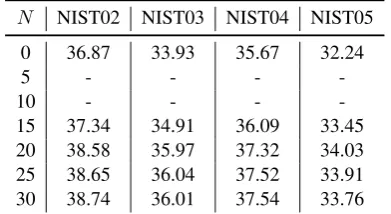
N NIST02 NIST03 NIST04 NIST05
0 36.87 33.93 35.67 32.24
5 - - -
-10 - - -
[image:8.595.90.271.73.217.2]-15 37.34 34.91 36.09 33.45 20 38.58 35.97 37.32 34.03 25 38.65 36.04 37.52 33.91 30 38.74 36.01 37.54 33.76
Table 3: The translation performance of the BR-CSGAN with differentN for Monte Carlo search. ”-”
means that the proposed model shows no improvement than the pre-trained generator or it can not be trained stably. With N set as 0, it is referred to as the
pre-trained generator. Similarly, we only report results on the RNNSearch andλis set as 0.7.
shall be very time consuming because we need to do much more sampling. Therefore, there is a trade-off between the accuracy and computa-tion complexity here. We investigate this prob-lem on the Chinese-English translation task. Table
3presents the translation performance of the BR-CSGAN on the test sets when theN are set from
5 to 30 with interval 5. From table3, the proposed model achieves no improvement than the baseline (i.e., the pre-trained generator) when N are set
less than 15 and the BLEU scores are not reported on the table. As a matter of fact, the translation performance of the model gets worse and worse. We conjecture that the approximated reward is far from the expected reward due to the large variance when N is set too small, and gives wrong gradi-ent directions for model updating. Since the train-ing for GAN is not stable, the wrong gradient di-rection exacerbates the unstableness and results in the BLEU getting worse and worse. With the in-creasing ofN, the translation performance of the
model gets improved. However, withN set larger than 20, we get little improvement than the model withN set as 20 and the training time exceeds our
expectation.
6 Conclusion and Future Work
Extensive experiments on Chinese-English and English-German translation tasks show that our approach consistently achieves significant im-provements. In the future, we would like to try multi-adversarial framework which consists of multi discriminators and generators for GAN.
Acknowledgements
This work is supported by the National Key Re-search and Development Program of China un-der Grant No. 2017YFB1002102, and Beijing Engineering Research Center under Grant No. Z171100002217015. We would like to thank X-u ShX-uang for her preparing data X-used in this work. Additionally, we also want to thank Chen Zhineng, Wang Wenfu and Zhao Yuanyuan for their invalu-able discussions on this work.
References
Mart´ın Abadi, Ashish Agarwal, Paul Barham, Eugene Brevdo, Zhifeng Chen, Craig Citro, Greg S. Cor-rado, Andy Davis, Jeffrey Dean, Matthieu Devin, Sanjay Ghemawat, Ian Goodfellow, Andrew Harp, Geoffrey Irving, Michael Isard, Yangqing Jia, Rafal Jozefowicz, Lukasz Kaiser, Manjunath Kudlur, Josh Levenberg, Dan Man´e, Rajat Monga, Sherry Moore, Derek Murray, Chris Olah, Mike Schuster, Jonathon Shlens, Benoit Steiner, Ilya Sutskever, Kunal Tal-war, Paul Tucker, Vincent Vanhoucke, Vijay Vasude-van, Fernanda Vi´egas, Oriol Vinyals, Pete Warden, Martin Wattenberg, Martin Wicke, Yuan Yu, and Xi-aoqiang Zheng. 2015. TensorFlow: Large-scale ma-chine learning on heterogeneous systems .
Martin Arjovsky, Soumith Chintala, and L´eon Bot-tou. 2017. Wasserstein gan. arXiv preprint arX-iv:1701.07875.
Sanjeev Arora, Rong Ge, Yingyu Liang, Tengyu Ma, and Yi Zhang. 2017. Generalization and equilibrium in generative adversarial nets.ICML.
Dzmitry Bahdanau, Kyunghyun Cho, and Yoshua Ben-gio. 2014. Neural machine translation by jointly learning to align and translate. arXiv preprint arX-iv:1409.0473.
Chris Callison-Burch and Miles Osborne. 2006. Re-evaluating the role of bleu in machine translation re-search .
Niladri Chatterjee, Anish Johnson, and Madhav Krish-na. 2007. Some improvements over the bleu metric for measuring translation quality for hindi. In Com-puting: Theory and Applications, 2007. ICCTA’07. International Conference on. IEEE, pages 485–490.
Xilun Chen, Yu Sun, Ben Athiwaratkun, Claire Cardie, and Kilian Weinberger. 2016. Adversarial deep av-eraging networks for cross-lingual sentiment classi-fication.arXiv preprint arXiv:1606.01614.
Kyunghyun Cho, Bart Van Merri¨enboer, Caglar Gul-cehre, Dzmitry Bahdanau, Fethi Bougares, Holger Schwenk, and Yoshua Bengio. 2014. Learning phrase representations using rnn encoder-decoder for statistical machine translation. arXiv preprint arXiv:1406.1078.
Emily L Denton, Soumith Chintala, Rob Fergus, et al. 2015. Deep generative image models using a? laplacian pyramid of adversarial networks. In Ad-vances in neural information processing systems. pages 1486–1494.
Jon Gauthier. 2014. Conditional generative adversar-ial nets for convolutional face generation. Class Project for Stanford CS231N: Convolutional Neural Networks for Visual Recognition, Winter semester
2014(5):2.
Jonas Gehring, Michael Auli, David Grangier, Denis Yarats, and Yann N Dauphin. 2017. Convolutional sequence to sequence learning .
Ian Goodfellow, Jean Pouget-Abadie, Mehdi Mirza, Bing Xu, David Warde-Farley, Sherjil Ozair, Aaron Courville, and Yoshua Bengio. 2014. Generative ad-versarial nets. In Advances in neural information processing systems. pages 2672–2680.
Gabriel Lima Guimaraes, Benjamin Sanchez-Lengeling, Pedro Luis Cunha Farias, and Al´an Aspuru-Guzik. 2017. Objective-reinforced genera-tive adversarial networks (organ) for sequence gen-eration models. arXiv preprint arXiv:1705.10843
.
Sergey Ioffe and Christian Szegedy. 2015. Batch nor-malization: Accelerating deep network training by reducing internal covariate shift. arXiv preprint arXiv:1502.03167.
Melvin Johnson, Mike Schuster, Quoc V Le, Maxim Krikun, Yonghui Wu, Zhifeng Chen, Nikhil Thorat, Fernanda Vi´egas, Martin Wattenberg, Greg Corrado, et al. 2016. Google’s multilingual neural machine translation system: Enabling zero-shot translation.
arXiv preprint arXiv:1611.04558.
Nal Kalchbrenner and Phil Blunsom. 2013. Recur-rent continuous translation models. EMNLPpages 1700–1709.
Alex Lamb, Anirudh Goyal, Ying Zhang, Saizheng Zhang, Aaron Courville, and Yoshua Bengio. 2016. Professor forcing: A new algorithm for training re-current networks. Advances In Neural Information Processing Systemspages 4601–4609.
Pauline Luc, Camille Couprie, Soumith Chintala, and Jakob Verbeek. 2016. Semantic segmentation us-ing adversarial networks. arXiv preprint arX-iv:1611.08408.
Preslav Nakov, Francisco Guzman, and Stephan Vogel. 2012. Optimizing for sentence-level bleu+ 1 yields short translations. In COLING. volume 12, pages 1979–1994.
Kishore Papineni, Salim Roukos, Todd Ward, and Wei-Jing Zhu. 2002. Bleu: a method for automatic eval-uation of machine translation. Association for Com-putational Linguisticspages 311–318.
Alec Radford, Luke Metz, and Soumith Chintala. 2015. Unsupervised representation learning with deep convolutional generative adversarial network-s.arXiv preprint arXiv:1511.06434.
Marc’Aurelio Ranzato, Sumit Chopra, Michael Auli, and Wojciech Zaremba. 2015. Sequence level train-ing with recurrent neural networks. arXiv preprint arXiv:1511.06732.
Rico Sennrich, Barry Haddow, and Alexandra Birch. 2015. Neural machine translation of rare words with subword units. Computer Science.
Shiqi Shen, Yong Cheng, Zhongjun He, Wei He, Hua Wu, Maosong Sun, and Yang Liu. 2015. Minimum risk training for neural machine translation. arXiv preprint arXiv:1512.02433.
Ilya Sutskever, Oriol Vinyals, and Quoc VV Le. 2014. Sequence to sequence learning with neural network-s. Advances in neural information processing sys-temspages 3104–3112.
Ashish Vaswani, Noam Shazeer, Niki Parmar, Jakob Uszkoreit, Llion Jones, Aidan N Gomez, Lukasz Kaiser, and Illia Polosukhin. 2017. Attention is all you need .
Lijun Wu, Yingce Xia, Li Zhao, Fei Tian, Tao Qin, Jianhuang Lai, and Tie-Yan Liu. 2017. Adversari-al neurAdversari-al machine translation. arXiv preprint arX-iv:1704.06933.
Yonghui Wu, Mike Schuster, Zhifeng Chen, Quoc V Le, Mohammad Norouzi, Wolfgang Macherey, Maxim Krikun, Yuan Cao, Qin Gao, Klaus Macherey, et al. 2016. Google’s neural machine translation system: Bridging the gap between hu-man and machine translation. arXiv preprint arX-iv:1609.08144.
Zhen Yang, Wei Chen, Feng Wang, and Bo Xu. 2016. A character-aware encoder for neural machine trans-lation. InCOLING.
Lantao Yu, Weinan Zhang, Jun Wang, and Yong Yu. 2016. Seqgan: Sequence generative adversarial nets with policy gradient. The Association for the Ad-vancement of Artificial Intelligence 2017.
Yizhe Zhang, Zhe Gan, and Lawrence Carin. 2016. Generating text via adversarial training. NIPS.
Yuan Zhang, Regina Barzilay, and Tommi Jaakko-la. 2017. Aspect-augmented adversarial network-s for domain adaptation. arXiv preprint arX-iv:1701.00188.
Junbo Zhao, Michael Mathieu, and Yann LeCun. 2016. Energy-based generative adversarial network. arXiv preprint arXiv:1609.03126.