Proceedings of NAACL-HLT 2018, pages 745–755
Accurate Text-Enhanced Knowledge Graph Representation Learning
Bo An1,2, Bo Chen1,2, Xianpei Han1, Le Sun1 1State Key Laboratory of Computer Science
Institute of Software, Chinese Academy of Sciences, Beijing, China 2University of Chinese Academy of Sciences, Beijing, China
{anbo, chenbo, xianpei, sunle}@iscas.ac.cn
Abstract
Previous representation learning techniques for knowledge graph representation usually represent the same entity or relation in differ-ent triples with the same represdiffer-entation, with-out considering the ambiguity of relations and entities. To appropriately handle the semantic variety of entities/relations in distinct triples, we propose an accurate text-enhanced knowl-edge graph representation learning method, which can represent a relation/entity with dif-ferent representations in difdif-ferent triples by ex-ploiting additional textual information. Specif-ically, our method enhances representations by exploiting the entity descriptions and triple-specific relation mention. And a mutual atten-tion mechanism between relaatten-tion menatten-tion and entity description is proposed to learn more accurate textual representations for further improving knowledge graph representation. Experimental results show that our method achieves the state-of-the-art performance on both link prediction and triple classification tasks, and significantly outperforms previous text-enhanced knowledge representation mod-els.
1 Introduction
Knowledge graphs such as Freebase (Bollacker et al., 2008), YAGO (Suchanek et al., 2007) and WordNet (Miller,1995) are among the most widely used resources in NLP applications. Typi-cally, a knowledge graph consists of a set of triples {(h, r, t)}, where h, r, t stand for head entity,
rela-tion and tail entity respectively.
[image:1.595.308.528.223.365.2]Learning distributional representation of knowl-edge graph has attracted many research attentions in recent years. By projecting all elements in a knowledge graph into a dense vector space, the se-mantic distance between all elements can be eas-ily calculated, and thus enables many applications
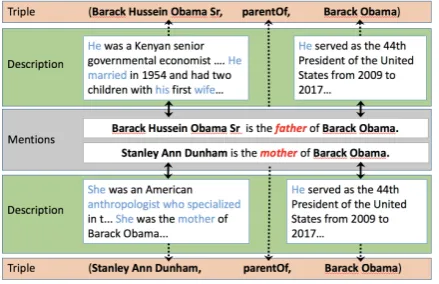
Figure 1: A demonstration of our accurate text-enhanced model. The meanings of relationparentOf in different triples are distinguished by their entity descriptions, and the relationparentOfemphasizes words which describe its social relationship in entity descriptions.
such as link prediction and triple classification (Socher et al.,2013).
Recently, translation-based models, including TransE (Bordes et al.,2013), TransH (Wang et al.,
2014), TransD (Ji et al., 2015) and TransR (Lin et al., 2015b), have achieved promising results in distributional representation learning of knowl-edge graph. ComplEx (Trouillon et al., 2016) has achieved the state-of-the-art performance on multiple tasks, such as triple classification and link prediction. Unfortunately, all of these meth-ods only utilize the structure information of knowledge graph, which inevitably suffer from the sparseness and incompleteness of knowledge graph. Even worse, structure information usually cannot distinguish the different meanings of rela-tions and entities in different triples.
To address the above problem, additional in-formation is introduced to enrich the knowledge representations, including entity types and logic rules. However, most researches of this line are limited by manually constructed logic rules, which
are knowledge graph sensitive and require the ex-pert knowledge. Another type of widely used re-sources is textual information, such as entity de-scriptions and words co-occurrence with entities (Socher et al., 2013; Wang et al., 2014; Zhong et al.,2015).
The main drawback of the above methods is that they represent the same entity/relation in dif-ferent triples with a unique representation. Un-fortunately, by detailed analyzing the triples in knowledge graph, we find two problems of the unique representation: (1) Relations are ambigu-ous, i.e., the accurate semantic meaning of a re-lation in a specific triple is related to the en-tities in the same triple. For example, the re-lation “parentOf” may refer to two different meanings of (i.e., “father” and “mother”), depend-ing on the entities in triples. (2) Because differ-ent relations may concern differdiffer-ent attributes of an entity, the same entity may express different aspects in different triples. For example, differ-ent words in the description of “Barack Obama” should be emphasized by relations “parentOf” and “professionOf”. The ambiguity of en-tity/relation has been considered as one of the pri-mary reasons why translation-based models can-not handle 1-to-N, N-to-1 and N-to-N categories of relations (Wang et al.,2014).Wang et al.(2016) tried to solve the two issues using words co-occurrence with the entities in the same sentences. Despite its apparent success, there remains a ma-jor drawback: this method suffers from noisy text, which reduces the value of textual information.
To solve above problems, this paper proposes an accurate text-enhanced knowledge representa-tion model, which can enhance the representarepresenta-tions of entities and relations by incorporating accurate textual information for each triple. To learn the representation of a given triple, we first extract its accurate relation mentions from text corpus, which reflect the specific relationship between its head entity and tail entity. Then a mutual attention mechanism between relation mention and entity descriptions (extracted from knowledge graph), is introduced to enhance the representations of en-tities and relations. For example, the two triples in Figure 1 have the same “parentOf” relation-ship, but have different underlying semantics “was the father of” and “was the mother of” respec-tively. Besides, our mutual attention mechanism enables knowledge representation focusing more
on related information from text information. For example, the “parentOf” relation will concern more about the social relations and gender at-tributes of a person, rather than his/her jobs, which are also contained in its descriptions. And such a relation-specific entity description will make an entity has more appropriate, relation-specific rep-resentations in different triples.
Concretely, we employ BiLSTM model ( Schus-ter and Paliwal, 1997; Graves and Schmidhuber,
2005) with mutual attention mechanism (Zhou et al., 2016) to learn representations for relation mentions and entity descriptions. Specifically, in order to generate triple-specific textual represen-tation of entities and relation, a mutual attention mechanism is proposed to model relation between entity descriptions and relation mention of one triple. Then the learned textual representations are incorporated with previous traditional transition-based representations, which are, learned from structural information of knowledge graph, di-rectly to obtain enhanced triple specific represen-tations of elements.
We evaluate our method on both link pre-diction task and triple classification task, using benchmark datasets from Freebase1and WordNet2
with the text corpus. Experimental results show that, our model achieves the state-of-the-art per-formance, and significantly outperforms previous text-enhanced models.
The main contributions are threefold: (i) To the best of our knowledge, this is the first work which simultaneously exploits both relation mention and entity description to handle the ambiguity of re-lations and entities (Section 3). (ii) We propose a mutual attention mechanism which exploits the textual representations of relation and entity to enhance each other (Section 3.2). (iii) This pa-per achieves new state-of-the-art pa-performances on triple classification tasks over two most widely used benchmarks (Section 4).
2 Related Work
Currently, a lot of structural-based knowledge rep-resentation learning methods have been proposed for knowledge graph completion, including Bi-linear Model (Sutskever, 2009), Distance Model (Bordes et al., 2011), Unstructured Model ( Bor-des et al.,2012), Neural Tensor Network (Socher
et al., 2013), Single Layer Model (Socher et al.,
2013). And many translation-based methods are introduced, including TransE (Bordes et al.,2013) and its extensions like TransH (Wang et al.,2014), TransD (Ji et al.,2015), TransR (Lin et al.,2015b).
Xiao et al. (2016a) proposed a manifold-based embedding principle to deal with the overstrict geometric form of translation-based assumption.
Trouillon et al. (2016) employed complex value embeddings to understand the structural informa-tion.
In recent years, many methods improve the knowledge representation by exploiting additional information. For example, both the path informa-tion and logic rules have been proved to be ben-eficial for knowledge representation (Lin et al.,
2015a;Toutanova et al.,2016;Xiong et al.,2017;
Xie et al.,2016;Xu et al.,2016).
One other direction to enhance knowledge representation is to utilize entity descriptions of entities and relations. Socher et al. (2013) proposed a neural tensor network model which enhances an entity’s representation using the av-erage of the word embeddings in its name.Wang et al. (2014) proposed a model which combines entity embeddings with word embeddings using its names and Wikipedia anchors. Zhong et al.
(2015) further improved the model ofWang et al.
(2014) by aligning entity and text using entity descriptions. Zhang et al. (2015) proposed to model entities with word embeddings of entity names or entity descriptions. Xie et al. (2016) proposed a model to learn the embeddings of a knowledge graph by modelling both knowl-edge triples and entity descriptions. Xu et al.
(2016) learns different representations for entities based on the attention from relation. The textual mentions of relations are also explored by Fan et al.(2014). The universal schema based models (Riedel et al., 2013; Toutanova et al., 2015) en-hance knowledge representation by incorporating textual triples, which assume that all the extracted triples express a relationship between the entities and they treat each pattern as a separate relation. The main drawback of these methods is that they assume all the relation mentions will express relationship between entity pairs, which inevitably introduces a lot of noisy information. For ex-ample, the sentence “Miami Dolphins in 1966 and the Cincinnati Bengals in 1968” does not express any
relation-ship between “miami dolphins” and “cincinnati bengals”. Even worse, the diversity of language often leads to the data sparsity problem.
To resolve the ambiguity of entities and rela-tions in different triples (i.e., a relation/entity may have different meanings in different triples),Xiao et al.(2016b) proposed a generative model to han-dle the ambiguous relations. Wang et al. (2016) extended the translation-based models by textual information, which assigns a relation with differ-ent represdiffer-entations for differdiffer-ent differ-entity pairs, using words co-occurred with both entities in a triple. However, the words co-occur with an entity pair nay also not express the meanings of the relation between them, which will inevitably introduce noisy information for the specific triple. Compared with these methods the main advantages of our methods are: (i) We filters out noisy textual infor-mation for accurate enrich knowledge representa-tion. (ii) We simultaneously take the ambiguity of entities and relations in various triples into consid-eration.
3 Accurate Text-enhanced Knowledge Graph Representation
This section presents our accurate text-enhanced knowledge graph representation learning frame-work. We first describe how to extract accurate textual information for a given triple, and then we propose a textual representation learning model, which generates textual representations for both entities and relation in a specific triple. Finally, we describe how to enhance knowledge represen-tations based on the textual represenrepresen-tations.
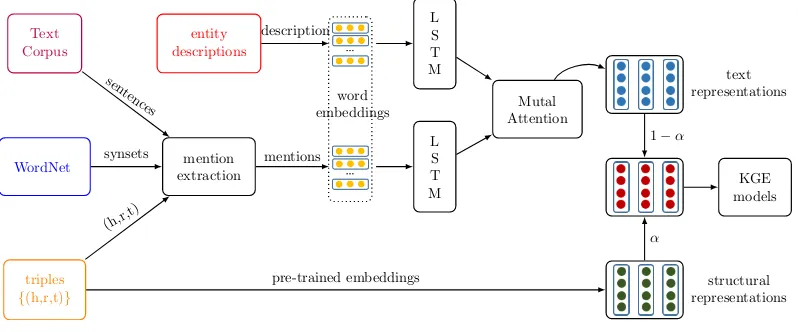
The framework of the proposed approach is il-lustrated in Figure 2.
3.1 Text Information Extraction
triples
{(h,r,t)} WordNet Text Corpus
mention extraction
entity descriptions
L S T M
L S T M
Mutal Attention
KGE models word
embeddings
text representations
structural representations synsets
sen tences
(h,r,t)
description
mentions
pre-trained embeddings
1−α
[image:4.595.101.500.64.230.2]α
Figure 2: Framework of the proposed approach.
Entity Linking. Given a sentence D =
(w1, w2, ..., wn), and an entity set E =
(e1, e2, ..., em), we first recognize entities of
E in D to construct a new sentence D0 = (w1, ..., e1, ..., em, ..., wn), where wi represents theith word inDandej corresponds to thejth entity inE. There are many general entity linking
tools can be used for this purpose. The proposed method employs a simple and precise method to link entities of Freebase and WordNet as Wang et al. (2016). Concretely, we link a Wikipedia inner-link as an entity of Freebase if they have the same titles, and link a word in the corpus as a WordNet entity if the word belongs to one of its synsets.
Relation Mention Extraction. To extract
ac-curate relation text mentions for a specific triple, we first collect all sentences containing both en-tities of the triple as candidate text mentions. And then, we calculate the similarity between a text mention and the relation based on WordNet. For example, for the triple of (Steve Jobs, /peo-ple/person/parents, Paul Jobs), we treat a sentence as its accurate relation mention only if the sen-tence contains both of its entities and at least one hyponym/synonyms word of the relation. We col-lect accurate relation mentions for triples in Word-Net in a similar way.
In this way, we can extract accurate rela-tion menrela-tions for triples with high precision. However, if a relation mention doesn’t contain any hyponym/synonym words of the relation, our method would be unable to identify it. For example, the sentence “In 1961 Obama was born in Hawaii, US” expresses the meanings of /people/person/nationality
in the triple (Barack
Obama,/people/person/nationality, USA ) but without any words belonging to the hyponym or synonyms of “nationality”. For this, we further employ word embeddings to compute the similarity. Concretely, we represent a relation by averaging the pre-trained word embeddings of its last two words. Then we extract a sentence as an accurate relation mention of a given triple if the similarity between a word in the sentence and the relation representation is above a threshold, with the similarity between a word and a relation is calculated by the cosine similarity of their representations.
3.2 Learning Textual Representation
As mentioned above, the underlying semantics of entities and relations vary from different triples, and different attributes of an entity are concerned by different relations. In this section, we first uti-lize BiLSTM to encode relation mentions and en-tity descriptions. And then, we propose a mu-tual attention mechanism to learn more accurate text representations of relations and entities. Our model contains four layers including Embedding layer, BiLSTM layer and Mutual Attention Layer, and the details of these layers are described as fol-lows.
ma-trix. We use the same pre-trained word embed-dings as input for the BiLSTM networks of rela-tion menrela-tions and entity descriprela-tions.
BiLSTM Layer. To learn the representation
of text mentions, we utilize a BiLSTM (Long Short-Term Memory) (Hochreiter and Schmidhu-ber, 1997; Le and Zuidema, 2015; Zhou et al.,
2016) model to compose the words in a sequence into the distributional representation. Concretely, we employ a two layer Bidirectional LSTM net-work to generate text representations. The detailed description of LSTM is presented in (Hochreiter and Schmidhuber, 1997). Two different BiLSTM networks are employed to encode relation men-tions and entity descripmen-tions respectively.
Mutual Attention Layer.Attention based neu-ral networks have recently achieved success in a wide range of tasks, including machine transla-tion, speech recognition and paraphrase detection (Luong et al., 2015;Yang et al.,2016;Yin et al.,
2016;Vaswani et al.,2017). In this paper, we in-troduce a mutual attention to improve text repre-sentations. Given a triple, the goal of our mutual attention mechanism is two-fold. On one hand, our model wants to identify words in relation mention associated with the entity descriptions in the same triple. On the other hand, our model wants to rec-ognize words in entity descriptions which are em-phasized by its relation. To achieve the above goal, we first infer the representations of entity descrip-tions using relation representation as attention:
ai(e) = exp(score(
~ hi, ~r0)) P
i0exp(score(h~i0, ~r0))
(1)
score(h~i, ~r0) =h~i T
Wer~0 (2)
where r~0 ∈ dw is the representation of the
rela-tion menrela-tion by averaging all the hidden vectors of BiLSTM,h~iis the hidden representation ofwi,
andWe ∈ dw×2×h is a trained parameter matrix. The relation-sensitive representation of the entity description is generated as follows:
~
e∗ =tanh(~aT
eHe) (3)
where a~e ∈ dm is the relation-specific attention vector over the words in the entity description,
dm is the length of the description, He ∈ dm×h is the hidden representation matrix generated by BiLSTM, ande~∗ ∈ dh is the representation of the description. In this way, we learn the representa-tions of entity descriprepresenta-tions of head entitye~∗
h ∈dh
and tail entitye~∗
t ∈ dh with the attention from re-lation representation.
The above two entity description representa-tions are utilized as the attention for learning the triple-sensitive relation mention representation as follows:
~e=e~∗
h+e~∗t (4)
ai(r) =
exp(score(h~i, ~e)) P
i0exp(score(h~i0, ~e))
(5)
score(h~i, ~e) =h~i T
Wr~e (6) where e~∗
h and e~∗t are representations of head en-tity description and tail enen-tity description respec-tively,h~i is the hidden vector ofwi for each word
in the text mention, andWr∈dw×2×his a trained parameter matrix. The representation of the triple-sensitive relation mention is generated as Formula (7):
~
r∗ =tanh(a~rTH
r) (7)
where a~rT ∈ dn is the triple-sensitive attention vector over the words in the relation mention,dn
is the length of the relation mention,Hr ∈ dn×h is the hidden representation matrix generated by BiLSTM, andr~∗ ∈dh is the representation of the mention. In this way, we learn the triple-attention representation of all text mentions.
3.3 Text-Enhanced Representation Learning
In this section, we introduce how to incorporate the learned textual representations with represen-tations learned from knowledge graph structure using previous methods.
For each given triple and its accurate textual in-formation, we enhance the representations of the relation and entities based on the text representa-tions of entities e~∗
h ∈ dh, e~∗t ∈ dh and relation
~
r∗ ∈dh. Specifically, we enhance the relation and entity representations as follows:
Re(~rate) =α·Re(r~kg) + (1−α)·r~∗,0≤α≤1 (8)
Re(~hate) =α·Re(h~kg) + (1−α)·e~∗h,0≤α≤1 (9)
Re(~tate) =α·Re(t~kg) + (1−α)·e~∗t,0≤α≤1 (10) whereαrepresents the weight factor for the
struc-tural representations, r~kg ∈ dh, h~kg ∈ dh and
~
learned from structural information of knowledge graph,r~∗ ∈dh,e~∗
h ∈dhande~∗t ∈dhrepresent the vectors of the text mention, head and tail entity de-scriptions for the triple,~rate ∈dh,~hateand~tateare the accurate text-enhanced representations of rela-tion, head and tail entity, respectively. Note that, we enhance the real part vector of an entity with the textual representation of the entity as Formula (9) and (10), and treat the matrix representation of a relation as a vector with each element the same as the element in diagonal matrix, and then en-hance its real part as Formula (8). In this way, we enhance the representation of knowledge graph, and calculate the plausibility of a triple based on their score functions.
If there is no accurate relation mention ex-tracted for a triple, we only utilize the knowledge embeddings to estimate the plausibility of the triple, and the weight factor α is set to 1 in
this case. For example, if there is no accu-rate relation mention extracted for triple (Su Shi, /people/person/profession, Artist), then only its structural representations will be utilized to compute the plausibility of the triple. And α is set to 1 for the triples if none of
the entities in it is linked.
3.4 Model Training
In the training process, the(h, r, t,ht,rt,tt)tuples are used as supervision, where ht, rt and tt are the description of head entity, relation text men-tion and the descripmen-tion of tail entity, respectively. Since there are only correct triples in the knowl-edge graph, followingLin et al.(2015a), we con-struct the corrupted tuples (h0, r, t0, ht, rt, tt) ∈
KG0 for a(h, r, t, ht, rt, tt) ∈ KGby randomly replacing head/tail entity with entities from knowl-edge graph using Bernoulli Sampling Method (Wang et al., 2014). Furthermore, to train the model of text representation model, we construct the corrupted tuples(h, r, t, h0t, r0t, t0t) ∈ KG0 for
a (h, r, t, ht, rt, tt) ∈ KG by random replacing the text information. We use the following margin-based ranking loss:
L= X
q∈KG X
q0∈KG0
max(0, γ+f(q)−f(q0)) (11)
where f is the score function of our model, and γ > 0 is the margin between golden tuples and
negative tuples, KG is the set of tuples in
train-ing dataset, and KG0 is the corrupted set of
tu-ples. The parameters of our model are optimized
using the stochastic gradient descent (SGD) algo-rithm. To accelerate the training process and avoid overfitting, we initialize the representations of en-tities and relations using base models and initial-ize word representations with the pre-trained word embeddings, and all these embeddings are fine-tuned during training.
4 Experiments
In this section, we first describe the settings in our experiments, and then we conduct experiments of link prediction and triple classification tasks and compare our method with base models and the state-of-the-art baselines.
4.1 Experiment Settings
In this paper, we evaluate our model on four benchmark datasets: WN11, WN18, FB13 and FB15k (Bordes et al., 2013;Socher et al., 2013;
Wang et al.,2014). For the text corpus, we use a snapshot of the English Wikipedia (Wiki) (Shaoul and Westbury, 2010)3dump in April 2016, which
contains more than1.2billion tokens. We link
en-tities in the text corpus to enen-tities in Freebase and synsets in WordNet as described above, and re-place entities with HEAD TAG and TAIL TAG. The text descriptions of entities are freely avail-able4. In addition, we pre-process the word-entity
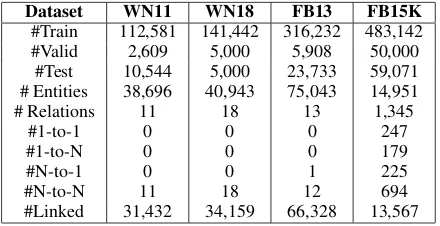
corpus, including stemming, lowercasing and re-moving words with fewer than 5 occurrences. The statistics of the datasets and linked-entities in text corpus are shown in Table 1.
Dataset WN11 WN18 FB13 FB15K
#Train 112,581 141,442 316,232 483,142 #Valid 2,609 5,000 5,908 50,000
#Test 10,544 5,000 23,733 59,071 # Entities 38,696 40,943 75,043 14,951
# Relations 11 18 13 1,345
#1-to-1 0 0 0 247
#1-to-N 0 0 0 179
#N-to-1 0 0 1 225
#N-to-N 11 18 12 694
[image:6.595.307.527.510.623.2]#Linked 31,432 34,159 66,328 13,567
Table 1: Statistics of different datasets and the number of entities linked in Wikipedia,#Linkedrepresents the number of entities linked in the text corpus.#N-to-1is the number of N-to-1 type of relations.
As introduced above, we implement our frame-work using TransE, TransH, TransR and Com-plEx as base models, and evaluate on two
cal tasks: link prediction and triple classification. We referAAT E Eas the proposed model which
enhances TransE with accurate textual informa-tions and mutual attention mechanism, and refer
AT E Eas the proposed model without mutual
at-tention mechanism to reveal the effect of our atten-tion mechanism.
To speed up training and reduce overfitting, we employ the SkipGram model of word2vec (Mikolov et al., 2013) to pre-train the word em-beddings with the dimension of word emem-beddings isdw = 200, the windows size is 5, the number of
iterations is 5, and the number of negative sam-ples is 10. And we pre-train the representations of entities and relations of knowledge graph us-ing the mentioned base models, and the parame-ters are empirically tuned as follows: the dimen-sion of vectors isdkg= 200, the number of epochs
is2000and the margin is1.0. We implement our
model based on the OpenKE5framework.
In our experiments, the hyper-parameters of BiLSTM are empirically set as follows: the num-ber of hidden units is dh = 200, the learning rates for SGD are among {0.1,0.001,0.0001}, the margin λ values are among {0.5,1.0,2.0} and the batch sizes are among {100,500,2000}.
We employ two different BiLSTM networks with the same hyper-parameters to learn the represen-tations of text mentions and entity descriptions. And all the parameters are learned jointly, includ-ing BiLSTM networks and knowledge representa-tions.
4.2 Link Prediction
Link prediction aims to predict missing head or tail entity of a triple, which is a widely employed evaluation task for knowledge graph completion models (Bordes et al., 2011; Wang et al., 2016). Concretely, given a head entity h (or tail entity t) and a relationr, the system will return a rank list of candidate entities for tail entity. Following (Bordes et al., 2013; Lin et al., 2015b), we con-duct the link prediction task on WN18 and FB15k datasets.
In the testing phase, for each triple (h, r, t), we replace its head/tail entity with all entities to construct candidate triples, and extract text men-tions from the text corpus for each candidate triple. Then we rank all these entities in descending or-der of the scores, which are calculated by our
5http://openke.thunlp.org/
score function. Based on the entity ranking list, we employ two evaluation metrics from ( Bor-des et al., 2013): (1) mean rank of correct en-tities (MR); and (2) proportion of correct enti-ties in top-10 rank entienti-ties Hit@10 (Hit10). A
good link predictor should achieve low MR and highHit@10. We tuned model parameters using
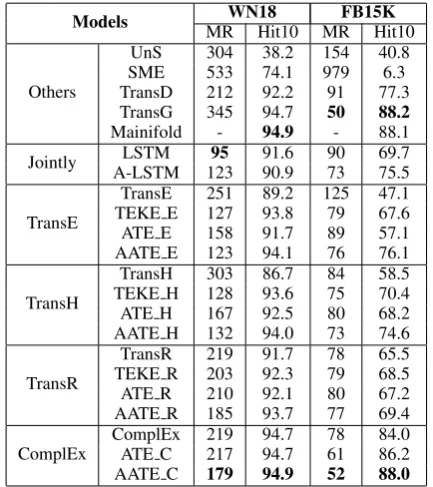
validate datasets. We implement our framework using TransE, TransH, TransR and ComplEx as base models, and treat these base models as base-lines. Furthermore, we also compare our method with the state-of-the-art results from Unstructured, SME, TransD, TEKE , Jointly (Xu et al., 2016), TransG and Mainifold, and we report the results from their original papers. The overall results are presented in Table 2.
Models MRWN18Hit10 MRFB15KHit10
Others
UnS 304 38.2 154 40.8
SME 533 74.1 979 6.3
TransD 212 92.2 91 77.3 TransG 345 94.7 50 88.2
Mainifold - 94.9 - 88.1 Jointly A-LSTMLSTM 12395 91.690.9 9073 69.775.5
TransE
TransE 251 89.2 125 47.1 TEKE E 127 93.8 79 67.6
ATE E 158 91.7 89 57.1
AATE E 123 94.1 76 76.1
TransH
TransH 303 86.7 84 58.5 TEKE H 128 93.6 75 70.4
ATE H 167 92.5 80 68.2
AATE H 132 94.0 73 74.6
TransR
TransR 219 91.7 78 65.5 TEKE R 203 92.3 79 68.5
ATE R 210 92.1 80 67.2
[image:7.595.308.525.292.536.2]AATE R 185 93.7 77 69.4 ComplEx ComplExATE C 219217 94.794.7 7861 84.086.2 AATE C 179 94.9 52 88.0
Table 2: Evaluation results of link prediction.
From Table 2, we can see that both ATE and AATE models surpass all base models (TransE, TransH, TransR and ComplEx) on all metrics. This result verifies that the textual information is beneficial for structure-based knowledge graph representation learning models. Compared with the ATE models, the AATE models achieve bet-ter results on link prediction task, which verifies that the mutual attention between entity descrip-tion and reladescrip-tion mendescrip-tion is effect for selecting meaningful words and enhancing the learning of knowledge graph representation.
This is probably because TransH and TransR have tried to project the entity embeddings into the space of relation space, which may lead to the fact that the text information could not en-hance the entity representation directly. In addi-tion, our method implemented based on Com-plEx has achieve better performances w.r.t TEKE (Wang et al.,2016) on all metrics, that verifies the importance of filtering out the noisy information.
4.2.1 Analysis on 1-to-N, N-to-1 and N-to-N Relations
To better analyse the effect of textual information for knowledge graph representation learning, this section presents the results of our model on dif-ferent categories of relations including 1-N, N-1 and N-N on link prediction task. We present the results of our models based on TransE and of all baselines.
From Table 3, we can see that, both of our pro-posed methods have achieved higher performance over the base model on all types of relations (1-to-N, N-to-1 and N-to-N). In addition, our AATE model achieves better results than the JointlyLSTM) model. Since both of AATE and Joint (A-LSTM) are implemented based on TransE, we ver-ify that the triple-specific relation mention is valu-able to improving the knowledge representation. Another reason why our proposed model achieves better results is that the attention from textual rep-resentation of relation and entity is more effective than the attention using structural representation for textual representation.
4.2.2 Fault Analysis
To gain more insight, we present a failure analysis to explore possible limitations and weaknesses of our model. In particular, several illustrative triples from the test set of FB15K are listed in Table 4. The tail entities of those triples are failed to be ranked in the top-10 candidates.
It can be seen from Table 4 that, the fail-ures are mostly caused by the data sparsity problem, which results in relatively limited occurrences of entities and relations. All of “Elementary school”, “Abugida”, “interests/collection category /sub categories” and “martial arts/ martial artist/martial art” appear less than 4 times in training data. It must also be mentioned that the triple “(Abugida, language /language writing system/
languages, Khmer language)” is in-cluded in the training data. Therefore, we can infer the first triple in Table 4 based on the above triple due to the general logic that “language/human language/writing
system” and “/language/language writing system/languages” are a pair of inverse relations. Consequently, we believe it is important to incorporate the logic rules into knowledge embeddings, especially for the entities and relations with limited occurrences.
4.3 Triple Classification
In this section, we assess different models on the triple classification task. Triple classification aims to judge whether a given triple(h, r, t)is true fact
or not, and it is usually modeled as a binary clas-sification task (Socher et al., 2013;Bordes et al.,
2013;Wang et al.,2016). FollowingSocher et al.
(2013) we evaluate different systems on WN11 and FB13 datasets.
Given a triple (h, r, t)and all its accurate
rela-tion menrela-tions and entity descriprela-tions of this triple, In our experiments, a triple will be classified as a true fact if the score obtained by functionf is
be-low the relation-specific thresholdδr, otherwise it
will be classified as a false fact. The δr and the weight factor of α are optimized by maximizing
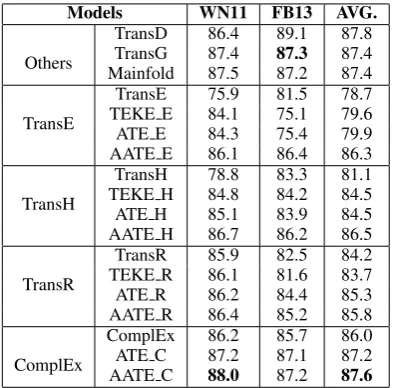
classification accuracy on validation dataset, and different values ofδrwill be set for different rela-tions. We use the same settings as link prediction task, all parameters are optimized on the validation datasets to obtain the best accuracies. We compare our method with all base models and the state-of-the-art performances from TransD, TEKE (Wang et al.,2016), TransG, Mainfold, and we report the best results from their original papers. The results are listed in Table 5.
Prediction Head (Hits@10) Prediction Tail (Hits@10)
Relation Category 1-to-N N-to-1 N-to-N 1-to-N N-to-1 N-to-N #Triples in Test 2,078 6,084 109,526 2,078 6,084 109,526 Jointly(A-LSTM) 95.1 21.1 47.9 30.8 94.7 53.1
TransE 65.7 18.2 47.2 19.7 66.7 50.0
ATE E 80.2 22.1 47.6 20.3 67.7 60.0
[image:9.595.143.456.62.134.2]AATE E 96.1 35.2 49.1 32.2 98.3 60.3
Table 3: Hit@10 of link prediction on different type of relations on FB15k dataset.
No Head Entity (#) Relation (#) Tail Entity (#)
1 Upper Canada College (16) education/educational institution/school type (728) Elementary school (1) 2 Khmer language (9) language/human language/writing system (41) Abugida (1) 3 Film (255) interests/collection category/sub categories (3) Star Wars (31) 4 Jean-Claude Van Damme (28) martial arts/martial artist/martial art (1) Taekwondo (155)
Table 4: The triples whose tail entities were failed to be ranked in top 10 candidates, # is the number of occurrences of the entity/relation in the training data.
Models WN11 FB13 AVG.
Others
TransD 86.4 89.1 87.8 TransG 87.4 87.3 87.4 Mainfold 87.5 87.2 87.4
TransE
TransE 75.9 81.5 78.7 TEKE E 84.1 75.1 79.6 ATE E 84.3 75.4 79.9 AATE E 86.1 86.4 86.3
TransH
TransH 78.8 83.3 81.1 TEKE H 84.8 84.2 84.5 ATE H 85.1 83.9 84.5 AATE H 86.7 86.2 86.5
TransR
TransR 85.9 82.5 84.2 TEKE R 86.1 81.6 83.7 ATE R 86.2 84.4 85.3 AATE R 86.4 85.2 85.8
ComplEx
ComplEx 86.2 85.7 86.0 ATE C 87.2 87.1 87.2 AATE C 88.0 87.2 87.6
Table 5: Evaluation results of triple classification.
model improves the accuracies on all the datasets. We believe this is because mutual attention mech-anism can better identify the relation-sensitive words from entity descriptions and extract entity-sensitive words from relation mention.
The results demonstrate that, our method has achieved the best performances on the triple clas-sification task, which verifies that it is critical to filter out noisy text information to determine whether a triple should be added into knowledge graph or not.
5 Conclusions
In this paper, we propose an accurate text-enhanced knowledge graph representation frame-work, which can utilize accurate textual infor-mation enhance the knowledge representations of a triple, and can effectively handle the
ambigu-ity of relations and entities through a mutual at-tention model between relation mentions and en-tity descriptions. Experiment results show that our method can achieve the state-of-the-art per-formance, and significantly outperforms previous text-enhanced knowledge representation models. And the mutual attention between relation men-tions and entity descripmen-tions can significantly im-prove the performance of knowledge representa-tion. For future work, we want to further exploit entity types and logic rules as constraints to fur-ther improve knowledge representations.
Acknowledgments
This work is supported by the National Natu-ral Science Foundation of China under Grants no. 61433015, 61772505 and 61572477, and the Young Elite Scientists Sponsorship Program no. YESS20160177. Moreover, we sincerely thank the reviewers for their valuable comments.
References
Kurt Bollacker, Colin Evans, Praveen Paritosh, Tim Sturge, and Jamie Taylor. 2008. Freebase:a col-laboratively created graph database for structuring human knowledge. In ACM SIGMOD Interna-tional Conference on Management of Data, SIG-MOD 2008, Vancouver, Bc, Canada, June. pages 1247–1250.
Antoine Bordes, Xavier Glorot, and Jason Weston. 2012. Joint learning of words and meaning repre-sentations for open-text semantic parsing. In In-ternational Conference on Artificial Intelligence & Statistics.
[image:9.595.83.281.279.473.2]2013. Translating embeddings for modeling multi-relational data. NIPSpages 2787–2795.
Antoine Bordes, Jason Weston, Ronan Collobert, and Yoshua Bengio. 2011. Learning structured embed-dings of knowledge bases. InAAAI Conference on Artificial Intelligence, AAAI 2011, San Francisco, California, Usa, August.
Miao Fan, Qiang Zhou, Emily Chang, and Thomas Fang Zheng. 2014. Transition-based knowledge graph embedding with relational mapping properties. InPACLIC. pages 328–337.
A Graves and J Schmidhuber. 2005. Framewise phoneme classification with bidirectional lstm and other neural network architectures. Neural Net-works18(56):602–610.
Sepp Hochreiter and J¨urgen Schmidhuber. 1997. Long short-term memory. Neural computation
9(8):1735–1780.
Guoliang Ji, Shizhu He, Liheng Xu, Kang Liu, and Jun Zhao. 2015. Knowledge graph embedding via dy-namic mapping matrix. InMeeting of the Associa-tion for ComputaAssocia-tional Linguistics and the Interna-tional Joint Conference on Natural Language Pro-cessing. pages 687–696.
Bhushan Kotnis and Vivi Nastase. 2017. Learning knowledge graph embeddings with type regularizer.
arXiv preprint arXiv:1706.09278.
Phong Le and Willem Zuidema. 2015. Compositional distributional semantics with long short term mem-ory.arXiv preprint arXiv:1503.02510.
Yankai Lin, Zhiyuan Liu, Huanbo Luan, Maosong Sun, Siwei Rao, and Song Liu. 2015a. Modeling rela-tion paths for representarela-tion learning of knowledge bases. arXiv preprint arXiv:1506.00379.
Yankai Lin, Zhiyuan Liu, Maosong Sun, Yang Liu, and Xuan Zhu. 2015b. Learning entity and relation em-beddings for knowledge graph completion. InAAAI. pages 2181–2187.
Minh Thang Luong, Hieu Pham, and Christopher D. Manning. 2015. Effective approaches to attention-based neural machine translation. Computer Sci-ence.
Tomas Mikolov, Ilya Sutskever, Kai Chen, Greg S Cor-rado, and Jeff Dean. 2013. Distributed representa-tions of words and phrases and their compositional-ity. InAdvances in neural information processing systems. pages 3111–3119.
George A Miller. 1995. Wordnet: a lexical database for english. Communications of the Acm38(11):39–41.
Sebastian Riedel, Limin Yao, Andrew McCallum, and Benjamin M Marlin. 2013. Relation extraction with matrix factorization and universal schemas. In HLT-NAACL. pages 74–84.
Mike Schuster and Kuldip K Paliwal. 1997. Bidirec-tional recurrent neural networks. IEEE Transactions on Signal Processing45(11):2673–2681.
R. Socher, D. Chen, C. D. Manning, and A. Y. Ng. 2013. Reasoning with neural tensor networks for knowledge base completion. InInternational Con-ference on Intelligent Control & Information Pro-cessing. pages 464–469.
Fabian M. Suchanek, Gjergji Kasneci, and Gerhard Weikum. 2007. Yago:a core of semantic knowledge. In International Conference on World Wide Web, WWW 2007, Banff, Alberta, Canada, May. pages 697–706.
Ilya Sutskever. 2009. Modelling relational data us-ing bayesian clustered tensor factorization. Ad-vances in Neural Information Processing Systems
pages 1821–1828.
Kristina Toutanova, Danqi Chen, Patrick Pantel, Hoi-fung Poon, Pallavi Choudhury, and Michael Gamon. 2015. Representing text for joint embedding of text and knowledge bases. InEMNLP. volume 15, pages 1499–1509.
Kristina Toutanova, Xi Victoria Lin, Wen-tau Yih, Hoi-fung Poon, and Chris Quirk. 2016. Compositional learning of embeddings for relation paths in knowl-edge bases and text. InACL2016. volume 1, pages 1434–1444.
Th´eo Trouillon, Johannes Welbl, Sebastian Riedel, ´Eric Gaussier, and Guillaume Bouchard. 2016. Com-plex embeddings for simple link prediction. In In-ternational Conference on Machine Learning. pages 2071–2080.
Ashish Vaswani, Noam Shazeer, Niki Parmar, Jakob Uszkoreit, Llion Jones, Aidan N Gomez, Lukasz Kaiser, and Illia Polosukhin. 2017. Attention is all you need. arXiv preprint arXiv:1706.03762.
Zhen Wang, Jianwen Zhang, Jianlin Feng, and Zheng Chen. 2014. Knowledge graph embedding by trans-lating on hyperplanes. InAAAI. pages 1112–1119.
Zhigang Wang, Juanzi Li, Zhiyuan LIU, and Jie TANG. 2016. Text-enhanced representation learning for knowledge graph.To appear in IJCAI2016:04–17.
Han Xiao, Minlie Huang, and Xiaoyan Zhu. 2016a. From one point to a manifold: knowledge graph em-bedding for precise link prediction. InProceedings of the Twenty-Fifth International Joint Conference on Artificial Intelligence. AAAI Press, pages 1315– 1321.
Ruobing Xie, Zhiyuan Liu, Jia Jia, Huanbo Luan, and Maosong Sun. 2016. Representation learning of knowledge graphs with entity descriptions. InAAAI. pages 2659–2665.
Wenhan Xiong, Thien Hoang, and William Yang Wang. 2017. Deeppath: A reinforcement learning method for knowledge graph reasoning. arXiv preprint arXiv:1707.0669.
Jiacheng Xu, Kan Chen, Xipeng Qiu, and Xuanjing Huang. 2016. Knowledge graph representation with jointly structural and textual encoding. arXiv preprint arXiv:1611.08661.
Zichao Yang, Xiaodong He, Jianfeng Gao, Li Deng, and Alex Smola. 2016. Stacked attention networks for image question answering. InIEEE Conference on Computer Vision and Pattern Recognition. pages 21–29.
Wenpeng Yin, Hinrich Schtze, Bing Xiang, and Bowen Zhou. 2016. Abcnn: Attention-based convolutional neural network for modeling sentence pairs. Com-puter Science.
Huaping Zhong, Jianwen Zhang, Zhen Wang, Hai Wan, and Zheng Chen. 2015. Aligning knowledge and text embeddings by entity descriptions. InEMNLP. pages 267–272.