Bootstrapping Generators from Noisy Data
Laura Perez-Beltrachini and Mirella Lapata
Institute for Language, Cognition and Computation School of Informatics, University of Edinburgh
10 Crichton Street, Edinburgh EH8 9AB
{lperez,mlap}@inf.ed.ac.uk
Abstract
A core step in statistical data-to-text gen-eration concerns learning correspondences between structured data representations (e.g., facts in a database) and associated texts. In this paper we aim to bootstrap generators from large scale datasets where the data (e.g., DBPedia facts) and related texts (e.g., Wikipedia abstracts) are loosely aligned. We tackle this challenging task by in-troducing a special-purpose content selection mechanism.1 We use multi-instance learning
to automatically discover correspondences between data and text pairs and show how these can be used to enhance the content signal while training an encoder-decoder architec-ture. Experimental results demonstrate that models trained with content-specific objec-tives improve upon a vanilla encoder-decoder which solely relies on soft attention.
1 Introduction
A core step in statistical data-to-text genera-tion concerns learning correspondences between structured data representations (e.g., facts in a database) and paired texts (Barzilay and Lapata,
2005;Kim and Mooney,2010;Liang et al.,2009). These correspondences describe how data repre-sentations are expressed in natural language ( con-tent realisation) but also indicate which subset of the data is verbalised in the text (content selec-tion).
Although content selection is traditionally per-formed by domain experts, recent advances in generation using neural networks (Bahdanau et al.,
2015; Ranzato et al., 2016) have led to the use of large scale datasets containing loosely related data and text pairs. A prime example are on-line data sources like DBPedia (Auer et al.,2007) and Wikipedia and their associated texts which
1Our code and data are available at https://github.com/EdinburghNLP/wikigen.
are often independently edited. Another example are sports databases and related textual resources. Wiseman et al. (2017) recently define a generation task relating statistics of basketball games with commentaries and a blog written by fans.
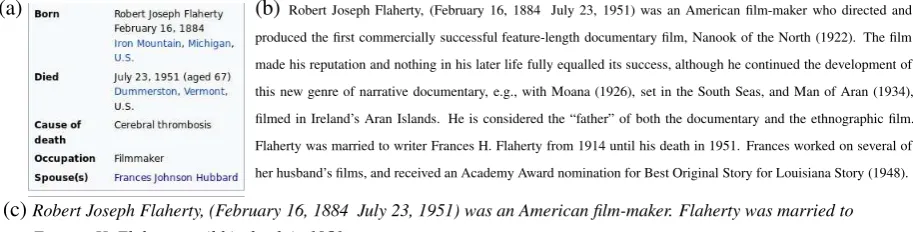
In this paper, we focus on short text generation from such loosely aligned data-text resources. We work with the biographical subset of the DBPe-dia and WikipeDBPe-dia resources where the data cor-responds to DBPedia facts and texts are Wikipedia abstracts about people. Figure1shows an example for the film-makerRobert Flaherty, the Wikipedia infobox, and the corresponding abstract. We wish to bootstrap a data-to-text generator that learns to verbalise properties about an entity from a loosely related example text. Given the set of properties in Figure (1a) and the related text in Figure (1b), we want to learn verbalisations for those proper-ties that are mentioned in the text and produce a short description like the one in Figure (1c).
In common with previous work (Mei et al.,
2016; Lebret et al., 2016; Wiseman et al., 2017) our model draws on insights from neural machine translation (Bahdanau et al., 2015;
Sutskever et al., 2014) using an encoder-decoder architecture as its backbone. Lebret et al. (2016) introduce the task of generating biographies from Wikipedia data, however they focus on single sentence generation. We generalize the task to multi-sentence text, and highlight the limitations of the standard attention mechanism which is often used as a proxy for content selection. When exposed to sub-sequences that do not correspond to any facts in the input, the soft attention mechanism will still try to justify the sequence and somehow distribute the attention weights over the input representation (Ghader and Monz,
2017). The decoder will still memorise high frequency sub-sequences in spite of these not being supported by any facts in the input.
We propose to alleviate these
(a) (b) Robert Joseph Flaherty, (February 16, 1884 July 23, 1951) was an American film-maker who directed and produced the first commercially successful feature-length documentary film, Nanook of the North (1922). The film made his reputation and nothing in his later life fully equalled its success, although he continued the development of this new genre of narrative documentary, e.g., with Moana (1926), set in the South Seas, and Man of Aran (1934), filmed in Ireland’s Aran Islands. He is considered the “father” of both the documentary and the ethnographic film. Flaherty was married to writer Frances H. Flaherty from 1914 until his death in 1951. Frances worked on several of her husband’s films, and received an Academy Award nomination for Best Original Story for Louisiana Story (1948).
[image:2.595.72.529.65.181.2](c)Robert Joseph Flaherty, (February 16, 1884 July 23, 1951) was an American film-maker. Flaherty was married to Frances H. Flaherty until his death in 1951.
Figure 1: Property-value pairs (a), related biographic abstract (b) for the Wikipedia entityRobert Flaherty, and model verbalisation in italics (c).
ings via a specific content selection mecha-nism based on multi-instance learning (MIL;
Keeler and Rumelhart,1992) which automatically discovers correspondences, namely alignments, between data and text pairs. These alignments are then used to modify the generation function dur-ing traindur-ing. We experiment with two frameworks that allow to incorporate alignment information, namely multi-task learning (MTL;Caruana,1993) and reinforcement learning (RL;Williams,1992). In both cases we define novel objective functions using the learnt alignments. Experimental results using automatic and human-based evaluation show that models trained with content-specific objec-tives improve upon vanilla encoder-decoder archi-tectures which rely solely on soft attention.
The remainder of this paper is organised as fol-lows. We discuss related work in Section2and de-scribe the MIL-based content selection approach in Section 3. We explain how the generator is trained in Section4and present evaluation experi-ments in Section5. Section7concludes the paper.
2 Related Work
Previous attempts to exploit loosely aligned data and text corpora have mostly focused on extract-ing verbalisation spans for data units. Most approaches work in two stages: initially, data units are aligned with sentences from related cor-pora using some heuristics and subsequently ex-tra content is discarded in order to retain only text spans verbalising the data. Belz and Kow
(2010) obtain verbalisation spans using a measure of strength of association between data units and words,Walter et al.(2013) extract textual patterns from paths in dependency trees whileMrabet et al.
(2016) rely on crowd-sourcing. Perez-Beltrachini and Gardent (2016) learn shared representations for data units and sentences reduced to
subject-predicate-object triples with the aim of extracting verbalisations for knowledge base properties. Our work takes a step further, we not only induce data-to-text alignments but also learn generators that produce short texts verbalising a set of facts.
Our work is closest to recent neural network models which learn generators from indepen-dently edited data and text resources. Most pre-vious work (Lebret et al., 2016; Chisholm et al.,
2017; Sha et al., 2017; Liu et al., 2017) targets the generation of single sentence biographies from Wikipedia infoboxes, while Wiseman et al.
(2017) generate game summary documents from a database of basketball games where the input is always the same set of table fields. In contrast, in our scenario, the input data varies from one entity (e.g., athlete) to another (e.g., scientist) and properties might be present or not due to data incompleteness. Moreover, our generator is enhanced with a content selection mechanism based on multi-instance learning. MIL-based techniques have been previously applied to a variety of problems including image retrieval (Maron and Ratan, 1998; Zhang et al., 2002), ob-ject detection (Carbonetto et al.,2008;Cour et al.,
2011), text classification (Andrews and Hofmann,
2004), image captioning (Wu et al., 2015;
Karpathy and Fei-Fei, 2015), paraphrase detec-tion (Xu et al.,2014), and information extraction (Hoffmann et al., 2011). The application of MIL to content selection is novel to our knowledge.
focus-ing mostly on morphosyntax. Examples in-clude chunking, tagging (Collobert et al., 2011;
Søgaard and Goldberg, 2016; Bjerva et al., 2016;
Plank, 2016), name error detection (Cheng et al.,
2015), and machine translation (Luong et al.,
2016). Reinforcement learning (Williams, 1992) has also seen popularity as a means of train-ing neural networks to directly optimize a task-specific metric (Ranzato et al., 2016) or to in-ject task-specific knowledge (Zhang and Lapata,
2017). We are not aware of any work that com-pares the two training methods directly. Further-more, our reinforcement learning-based algorithm differs from previous text generation approaches (Ranzato et al.,2016;Zhang and Lapata,2017) in that it is applied to documents rather than individ-ual sentences.
3 Bidirectional Content Selection
We consider loosely coupled data and text pairs where the data component is a set
P
of property-values {p1 : v1,···,p|P| :v|P|} and the related textT
is a sequence of sentences (s1,···,s|T|).We define a mention span τ as a (possibly dis-continuous) subsequence of
T
containing one or several words that verbalise one or more property-value fromP
. For instance, in Figure1, the mention span “married to Frances H. Fla-herty” verbalises the property-value {Spouse(s): Frances Johnson Hubbard}.In traditional supervised data to text generation tasks, data units (e.g., pi:vi in our particular set-ting) are either covered by some mention spanτj or do not have any mention span at all in
T
. The latter is a case of content selection where the gen-erator will learn which properties to ignore when generating text from such data. In this work, we consider text components which are independently edited, and will unavoidably contain unaligned spans, i.e., text segments which do not correspond to any property-value inP
. The phrase “from 1914” in the text in Figure (1b) is such an example. Similarly, the last sentence, talks about Frances’ awards and nominations and this information is not supported by the properties either.Our model checks content in both directions; it identifies which properties have a correspond-ing text span (data selection) and also foregrounds (un)aligned text spans (text selection). This knowl-edge is then used to discourage the generator from producing text not supported by facts in the
prop-married spouse:FrancesJohnsonFlaherty to spouse:FrancesJohnsonFlaherty Frances spouse:FrancesJohnsonFlaherty Flaherty spouse:FrancesJohnsonFlaherty death died:july23,1951
in died:july23,1951 1951 died:july23,1951
Table 1: Example of word-property alignments for the Wikipedia abstract and facts in Figure1.
erty set
P
. We view a property setP
and its loosely coupled textT
as a coarse level, imperfect align-ment. From this alignment signal, we want to dis-cover a set of finer grained alignments indicating which mention spans inT
align to which proper-ties inP
. For each pair(P
,T
), we learn an align-ment setA
(P
,T
) which contains property-value word pairs. For example, for the propertiesspouse and diedin Figure 1, we would like to derive the alignments in Table1.We formulate the task of discovering finer-grained word alignments as a multi-instance learn-ing problem (Keeler and Rumelhart, 1992). We assume that words from the text are positive la-bels for some property-values but we do not know which ones. For each data-text pair (
P
,T
), wederive |
T
| pairs of the form (P
,s) where |T
| is the number of sentences inT
. We encode prop-erty setsP
and sentences sinto a common multi-modalh-dimensional embedding space. While do-ing this, we discover finer grained alignments be-tween words and property-values. The intuition is that by learning a high similarity score for a prop-erty setP
and sentence pairs, we will also learn the contribution of individual elements (i.e., words and property-values) to the overall similarity score. We will then use this individual contribution as a measure of word and property-value alignment. More concretely, we assume the pair is aligned (or unaligned) if this individual score is above (or below) a given threshold. Across examples like the one shown in Figure (1a-b), we expect the model to learn an alignment between the text span “married to Frances H. Flaherty” and theproperty-value{spouse:Frances Johnson Hubbard}. In what follows we describe how we encode (
P
,s)pairs and define the similarity function.therefore consider property-value pairs as concate-nated sequences pvand use a bidirectional Long Short-Term Memory Network (LSTM; Hochreiter and Schmidhuber, 1997) network for their encod-ing. Note that the same network is used for all pairs. Each property-value pair is encoded into a vector representation:
pi=biLSTMdenc(pvi) (1)
which is the output of the recurrent network at the final time step. We use addition to combine the for-ward and backfor-ward outputs and generate encoding
{p1,···,p|P|}for
P
.Sentence Encoder We also use a biLSTM to obtain a representation for the sentence s = w1,···,w|s|. Each word wt is represented by the output of the forward and backward networks at time step t. A word at position t is represented by the concatenation of the forward and backward outputs of the networks at time stept:
wt =biLSTMsenc(wt) (2) and each sentence is encoded as a sequence of vec-tors(w1,···,w|s|).
Alignment Objective Our learning objec-tive seeks to maximise the similarity score between property set
P
and a sentence s (Karpathy and Fei-Fei, 2015). This similarity score is in turn defined on top of the similarity scores among property-values inP
and words ins. Equation (3) defines this similarity function using the dot product. The function seeks to align each word to the best scoring property-value:SPs= |s|
∑
t=1maxi∈{1,...,|P|}pi•wt (3)
Equation (4) defines our objective which encour-ages related properties
P
and sentencess to have higher similarity than otherP
′6=P
ands′6=s:L
CA=max(0,SPs−SPs′+1)+max(0,SPs−SP′s+1) (4)
4 Generator Training
In this section we describe the base generation architecture and explain two alternative ways of using the alignments to guide the training of the model. One approach follows multi-task training where the generator learns to output a sequence of words but also to predict alignment labels for
each word. The second approach relies on rein-forcement learning for adjusting the probability distribution of word sequences learnt by a standard word prediction training algorithm.
4.1 Encoder-Decoder Base Generator
We follow a standard attention based encoder-decoder architecture for our generator (Bahdanau et al., 2015; Luong et al., 2015). Given a set of properties X as input, the model learns to predict an output word sequence Y which is a verbalisation of (part of) the input. More precisely, the generation of sequence Y is conditioned on inputX:
P(Y|X) = |Y|
∏
t=1P(yt|y1:t−1,X) (5)
The encoder module constitutes an intermediate representation of the input. For this, we use the property-set encoder described in Section3which outputs vector representations {p1,···,p|X|} for a set of property-value pairs. The decoder uses an LSTM and a soft attention mechanism (Luong et al.,2015) to generate one word yt at a time conditioned on the previous output words and a context vectorct dynamically created:
P(yt+1|y1:t,X) =so ftmax(g(ht,ct)) (6) where g(·) is a neural network with one hidden layer parametrised byWo∈R|V|×d,|V|is the out-put vocabulary size andd the hidden unit dimen-sion, overht andct composed as follows:
g(ht,ct) =Wotanh(Wc[ct;ht]) (7) whereWc ∈Rd×2d. ht is the hidden state of the LSTM decoder which summarisesy1:t:
ht =LSTM(yt,ht−1) (8) The dynamic context vectorctis the weighted sum of the hidden states of the input property set (Equa-tion (9)); and the weightsαti are determined by a dot product attention mechanism:
ct = |X|
∑
i=1αtipi (9)
αti= exp(ht
•pi)
∑i′exp(ht •pi′) (10)
We initialise the decoder with the aver-aged sum of the encoded input representations (Vinyals et al.,2016). The model is trained to op-timize negative log likelihood:
L
wNLL=− |Y|∑
t=1We extend this architecture to multi-sentence texts in a way similar to Wiseman et al. (2017). We view the abstract as a single sequence, i.e., all sentences are concatenated. When training, we cut the abstracts in blocks of equal size and per-form forward backward iterations for each block (this includes the back-propagation through the en-coder). From one block iteration to the next, we initialise the decoder with the last state of the pre-vious block. The block size is a hyperparameter tuned experimentally on the development set.
4.2 Predicting Alignment Labels
The generation of the output sequence is condi-tioned on the previous words and the input. How-ever, when certain sequences are very common, the language modelling conditional probability will prevail over the input conditioning. For in-stance, the phrase from 1914 in our running ex-ample is very common in contexts that talk about periods of marriage or club membership, and as a result, the language model will output this phrase often, even in cases where there are no supporting facts in the input. The intuition behind multi-task training (Caruana,1993) is that it will smooth the probabilities of frequent sequences when trying to simultaneously predict alignment labels.
Using the set of alignments obtained by our con-tent selection model, we associate each word in the training data with a binary labelat indicating whether it aligns with some property in the input set. Our auxiliary task is to predict at given the sequence of previously predicted words and input X:
P(at+1|y1:t,X) =sigmoid(g′(ht,ct)) (12)
g′(ht,ct) =va•tanh(Wc[ct;ht]) (13) whereva ∈Rd and the other operands are as de-fined in Equation (7). We optimise the following auxiliary objective function:
L
aln=− |Y|∑
t=1logP(at|y1:t−1,X) (14)
and the combined multi-task objective is the weighted sum of both word prediction and align-ment prediction losses:
L
MT L=λL
wNLL+ (1−λ)L
aln (15) whereλcontrols how much model training will fo-cus on each task. As we will explain in Section5, we can anneal this value during training in favour of one objective or the other.4.3 Reinforcement Learning Training
Although the multi-task approach aims to smooth the target distribution, the training process is still driven by the imperfect target text. In other words, at each time step t the algorithm feeds the previ-ous wordwt−1of the target text and evaluates the prediction against the targetwt.
Alternatively, we propose a training approach based on reinforcement learning (Williams 1992) which allows us to define an objective function that does not fully rely on the target text but rather on a revised version of it. In our case, the set of alignments obtained by our content selection model provides a revision for the target text. The advantages of reinforcement learning are twofold: (a) it allows to exploit additional task-specific knowledge (Zhang and Lapata,2017) during train-ing, and (b) enables the exploration of other word sequences through sampling. Our setting differs from previous applications of RL (Ranzato et al.,
2016;Zhang and Lapata,2017) in that the reward function is not computed on the target text but rather on its alignments with the input.
The encoder-decoder model is viewed as an agent whose action space is defined by the set of words in the target vocabulary. At each time step, the encoder-decoder takes action ˆyt with policy Pπ(yˆt|y1:ˆ t−1,X)defined by the probability in Equa-tion (6). The agent terminates when it emits the End Of Sequence (EOS) token, at which point the sequence of all actions taken yields the output se-quence ˆY = (y1ˆ ,···,yˆ|Yˆ|). This sequence in our task is a short text describing the properties of a given entity. After producing the sequence of ac-tions ˆY, the agent receives a rewardr(Yˆ) and the policy is updated according to this reward.
Reward Function We define the reward func-tionr(Yˆ)on the alignment set
A
(X,Y). If theout-put action sequence ˆY is precise with respect to the set of alignments
A
(X,Y), the agent willre-ceive a high reward. Concretely, we definer(Yˆ)as follows:
r(Yˆ) =γprrpr(Yˆ) (16) whereγpradjusts the reward valuerprwhich is the unigram precision of the predicted sequence ˆY and the set of words in
A
(X,Y).is defined as the negative expected reward:
L
RL=−E(yˆ1,···,yˆ|Yˆ|)∼Pπ(·|X)[r(y1ˆ ,···,yˆ|Yˆ|)]wherePπ is the agent’s policy, i.e., the word dis-tribution produced by the encoder-decoder model (Equation (6)) and r(·) is the reward function as defined in Equation (16). The gradient of
L
RL is given by:∇
L
RL≈ |Yˆ|∑
t=1∇logPπ(yˆt|y1:ˆ t−1,X)[r(yˆ1:|Yˆ|)−bt]
wherebtis a baseline linear regression model used to reduce the variance of the gradients during train-ing. bt predicts the future reward and is trained by minimizing mean squared error. The input to this predictor is the agent hidden stateht, however we do not back-propagate the error toht. We re-fer the interested reader to Williams (1992) and
Ranzato et al.(2016) for more details.
Document Level Curriculum Learning Rather than starting from a state given by a random policy, we initialise the agent with a policy learnt by pre-training with the negative log-likelihood objective (Ranzato et al., 2016; Zhang and Lapata, 2017). The reinforcement learning objective is applied gradually in combination with the log-likelihood objective on each target block subsequence. Re-call from Section 4.1 that our document is seg-mented into blocks of equal size during training which we denote as MAXBLOCK. When training
begins, only the last ℧ tokens are predicted by the agent while for the first (MAXBLOCK−℧) we
still use the negative log-likelihood objective. The number of tokens℧predicted by the agent is incre-mented by℧units every 2 epochs. We set℧=3 and the training ends when(MAXBLOCK−℧) =0.
Since we evaluate the model’s predictions at the block level, the reward function is also evaluated at the block level.
5 Experimental Setup
Data We evaluated our model on a dataset col-lated from WIKIBIO (Lebret et al., 2016), a cor-pus of 728,321 biography articles (their first para-graph) and their infoboxes sampled from the En-glish Wikipedia. We adapted the original dataset in three ways. Firstly, we make use of the entire abstract rather than first sentence. Secondly, we reduced the dataset to examples with a rich set of properties and multi-sentential text. We elimi-nated examples with less than six property-value
pairs and abstracts consisting of one sentence. We also placed a minimum restriction of 23 words in the length of the abstract. We considered abstracts up to a maximum of 12 sentences and property sets with a maximum of 50 property-value pairs. Finally, we associated each abstract with the set of DBPedia properties p:v corresponding to the abstract’s main entity. As entity classification is available in DBPedia for most entities, we concate-nate class informationc(whenever available) with the property value, i.e., p:vc. In Figure 1, the property valuespouse:FrancesH.Flahertyis
ex-tended with class information from the DBPedia ontology tospouse:FrancesH.FlahertyPerson.
Pre-processing Numeric date formats were con-verted to a surface form with month names. Numerical expressions were delexicalised us-ing different tokens created with the property name and position of the delexicalised token on the value sequence. For instance, given the property-value for birth date in Figure (1a), the first sentence in the abstract (Figure (1b)) becomes “ Robert Joseph Flaherty, (February DLX birth date 2, DLX birth date 4 – July . . . ”. Years and numbers in the text not found in the val-ues of the property set were replaced with tokens YEAR and NUMERIC.2In a second phase, when
creating the input and output vocabularies,
V
IandV
Orespectively, we delexicalised wordswwhich were absent from the output vocabulary but were attested in the input vocabulary. Again, we cre-ated tokens based on the property name and the position of the word in the value sequence. Words not inV
O orV
I were replaced with the symbol UNK. Vocabulary sizes were limited to |VI|= 50k and|VO|=50k for the alignment model and|
V
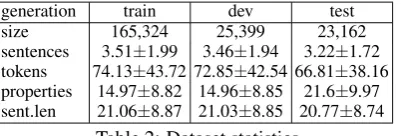
O|=20k for the generator. We discarded ex-amples where the text contained more than three UNKs (for the content aligner) and five UNKs (for the generator); or more than two UNKs in the property-value (for generation). Finally, we added the empty relation to the property sets.Table2summarises the dataset statistics for the generator. We report the number of abstracts in the dataset (size), the average number of sentences and tokens in the abstracts, and the average num-ber of properties and sentence length in tokens
generation train dev test
size 165,324 25,399 23,162
sentences 3.51±1.99 3.46±1.94 3.22±1.72 tokens 74.13±43.72 72.85±42.54 66.81±38.16 properties 14.97±8.82 14.96±8.85 21.6±9.97 sent.len 21.06±8.87 21.03±8.85 20.77±8.74
Table 2: Dataset statistics.
(sent.len). For the content aligner (cf. Section3), each sentence constitutes a training instance, and as a result the sizes of the train and development sets are 796,446 and 153,096, respectively.
Training Configuration We adjusted all mod-els’ hyperparameters according to their perfor-mance on the development set. The encoders for both content selection and generation mod-els were initialised with GloVe (Pennington et al.,
2014) pre-trained vectors. The input and hidden unit dimension was set to 200 for content selec-tion and 100 for generaselec-tion. In all models, we used encoder biLSTMs and decoder LSTM (reg-ularised with a dropout rate of 0.3 (Zaremba et al.,
2014)) with one layer. Content selection and gen-eration models (base encoder-decoder and MTL) were trained for 20 epochs with the ADAM opti-miser (Kingma and Ba,2014) using a learning rate of 0.001. The reinforcement learning model was initialised with the base encoder-decoder model and trained for 35 additional epochs with stochas-tic gradient descent and a fixed learning rate of 0.001. Block sizes were set to 40 (base), 60 (MTL) and 50 (RL). Weights for the MTL objec-tive were also tuned experimentally; we set λ= 0.1 for the first four epochs (training focuses on
alignment prediction) and switched toλ=0.9 for
the remaining epochs.
Content Alignment We optimized content alignment on the development set against man-ual alignments. Specifically, two annotators aligned 132 sentences to their infoboxes. We used the Yawat annotation tool (Germann, 2008) and followed the alignment guidelines (and eval-uation metrics) used in Cohn et al. (2008). The inter-annotator agreement using macro-averaged f-score was 0.72 (we treated one annotator as the reference and the other one as hypothetical system output).
Alignment sets were extracted from the model’s output (cf. Section 3) by optimizing the thresh-old avg(sim) +a∗std(sim) where sim denotes the similarity between the set of property values and words, and a is empirically set to 0.75; avg
and std are the mean and standard deviation of simscores across the development set. Each word was aligned to a property-value if their similarity exceeded a threshold of 0.22. Our best content alignment model (Content-Aligner) obtained an f-score of 0.36 on the development set.
We also compared our Content-Aligner against a baseline based on pre-trained word embeddings (EmbeddingsBL). For each pair (
P
,s) we com-puted the dot product between words insand prop-erties inP
(properties were represented by the the averaged sum of their words’ vectors). Words were aligned to property-values if their similarity exceeded a threshold of 0.4. EmbeddingsBL ob-tained an f-score of 0.057 against the manual align-ments. Finally, we compared the performance of the Content-Aligner at the level of property setP
and sentence s similarity by comparing the aver-age ranking position of correct pairs among 14 dis-tractors, namely rank@15. The Content-Aligner obtained a rank of 1.31, while the EmbeddingsBL model had a rank of 7.99 (lower is better).
6 Results
We compared the performance of an encoder-decoder model trained with the standard nega-tive log-likelihood method (ED), against a model trained with multi-task learning (EDMTL) and re-inforcement learning (EDRL). We also included a template baseline system (Templ) in our evalua-tion experiments.
The template generator used hand-written rules to realise property-value pairs. As an approxima-tion for content selecapproxima-tion, we obtained the 50 more frequent property names from the training set and manually defined content ordering rules with the following criteria. We ordered personal life properties (e.g., birth date oroccupation) based on their most common order of mention in the Wikipedia abstracts. Profession dependent prop-erties (e.g., position orgenre), were assigned an equal ordering but posterior to the personal prop-erties. We manually lexicalised properties into sin-gle sentence templates to be concatenated to pro-duce the final text. The template for the prop-erty position and example verbalisation for the property-value position:de f ender of the entity zanetti are “[NAME] played as [POSITION].” and “Zanetti played as defender.” respectively.
[image:7.595.81.282.62.130.2]Model Abstract RevAbs
Templ 5.47 6.43
ED 13.46 35.89
[image:8.595.114.242.61.117.2]EDMTL 13.57 37.18 EDRL 12.97 35.74
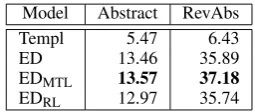
Table 3: BLEU-4 results using the original Wikipedia abstract (Abstract) as reference and crowd-sourced re-vised abstracts (RevAbs) for template baseline (Templ), standard encoder-decoder model (ED), and our content-based models trained with multi-task learning (EDMTL)
and reinforcement learning (EDRL).
(Papineni et al.,2002) against the noisy Wikipedia abstracts. Considering these as a gold standard is, however, not entirely satisfactory for two rea-sons. Firstly, our models generate considerably shorter text and will be penalized for not gener-ating text they were not supposed to generate in the first place. Secondly, the model might try to re-produce what is in the imperfect reference but not supported by the input properties and as a result will be rewarded when it should not. To alleviate this, we crowd-sourced using AMT a revised ver-sion of 200 randomly selected abstracts from the test set.
Crowdworkers were shown a Wikipedia in-fobox with the accompanying abstract and were asked to adjust the text to the content present in the infobox. Annotators were instructed to delete spans which did not have supporting facts and rewrite the remaining parts into a well-formed text. We collected three revised versions for each abstract. Inter-annotator agreement was 81.64 measured as the mean pairwise BLEU-4 amongst AMT workers.
Automatic evaluation results against the re-vised abstracts are also shown in Table 3. As can be seen, all encoder-decoder based models have a significant advantage over Templ when evaluating against both types of abstracts. The model enabled with the multi-task learning con-tent selection mechanism brings an improvement of 1.29 BLEU-4 over a vanilla encoder-decoder model. Performance of the RL trained model is inferior and close to the ED model. We discuss the reasons for this discrepancy shortly.
To provide a rough comparison with the results reported inLebret et al.(2016), we also computed BLEU-4 on the first sentence of the text generated by our system.3 Recall that their model generates
the first sentence of the abstract, whereas we
out-3We post-processed system output with Stanford CoreNLP (Manning et al.,2014) to extract the first sentence.
[image:8.595.308.525.62.128.2]System 1st 2nd 3rd 4th 5th Rank Templ 12.17 14.33 10.17 15.50 47.83 3.72 ED 12.83 24.17 24.67 25.17 13.17 3.02 EDMTL 14.83 26.17 26.17 19.17 13.67 2.90 EDRL 14.67 25.00 25.50 24.00 10.83 2.91 RevAbs 47.00 14.00 12.67 16.17 9.17 2.27 Table 4: Rankings shown as proportions and mean ranks given to systems by human subjects.
put multi-sentence text. Using the first sentence in the Wikipedia abstract as reference, we obtained a score of 37.29% (ED), 38.42% (EDMTL) and 38.1% (EDRL) which compare favourably with their best performing model (34.7%±0.36).
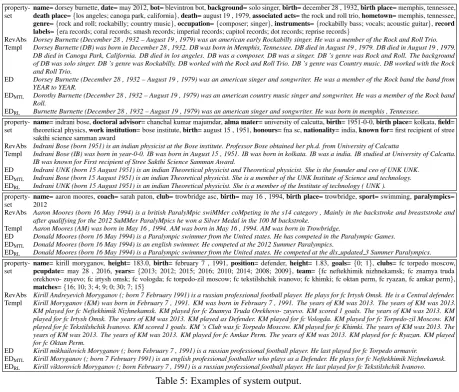
Human-Based Evaluation We further exam-ined differences among systems in a human-based evaluation study. Using AMT, we elicited 3 judge-ments for the same 200 infobox-abstract pairs we used in the abstract revision study. We compared the output of the templates, the three neural gen-erators and also included one of the human edited abstracts as a gold standard (reference). For each test case, we showed crowdworkers the Wikipedia infobox and five short texts in random order. The annotators were asked to rank each of the texts ac-cording to the following criteria: (1) Is the text faithful to the content of the table? and (2) Is the text overall comprehensible and fluent? Ties were allowed only when texts were identical strings. Ta-ble 5 presents examples of the texts (and proper-ties) crowdworkers saw.
Table4shows, proportionally, how often crowd-workers ranked each system, first, second, and so on. Unsurprisingly, the human authored gold text is considered best (and ranked first 47% of the time). EDMTL is mostly ranked second and third best, followed closely by EDRL. The vanilla encoder-decoder system ED is mostly forth and Templ is fifth. As shown in the last column of the table (Rank), the ranking of EDMTL is over-all slightly better than EDRL. We further con-verted the ranks to ratings on a scale of 1 to 5 (assigning ratings 5. . .1 to rank placements 1. . .5).
This allowed us to perform Analysis of Variance (ANOVA) which revealed a reliable effect of sys-tem type. Post-hoc Tukey tests showed that all systems were significantly worse than RevAbs and significantly better than Templ (p<0.05). EDMTL is not significantly better than EDRLbut is signifi-cantly (p<0.05) different from ED.
property-set namedeath place= dorsey burnette,={los angeles; canoga park, californiadate= may 2012,bot= blevintron bot,},death= august 19 , 1979,background= solo singer,associated actsbirth= the rock and roll trio,= december 28 , 1932,birth placehometown= memphis, tennessee,= memphis, tennessee,
genre={rock and roll; rockabilly; country music},occupation={composer; singer},instruments={rockabilly bass; vocals; acoustic guitar},record labels={era records; coral records; smash records; imperial records; capitol records; dot records; reprise records}
RevAbs Dorsey Burnette (December 28 , 1932 – August 19 , 1979) was an american early Rockabilly singer. He was a member of the Rock and Roll Trio. Templ Dorsey Burnette (DB) was born in December 28 , 1932. DB was born in Memphis, Tennessee. DB died in August 19 , 1979. DB died in August 19 , 1979.
DB died in Canoga Park, California. DB died in los angeles. DB was a composer. DB was a singer. DB ’s genre was Rock and Roll. The background of DB was solo singer. DB ’s genre was Rockabilly. DB worked with the Rock and Roll Trio. DB ’s genre was Country music. DB worked with the Rock and Roll Trio.
ED Dorsey Burnette (December 28 , 1932 – August 19 , 1979) was an american singer and songwriter. He was a member of the Rock band the band from YEAR to YEAR.
EDMTL Dorothy Burnette (December 28 , 1932 – August 19 , 1979) was an american country music singer and songwriter. He was a member of the Rock band Roll.
EDRL Burnette Burnette (December 28 , 1932 – August 19 , 1979) was an american singer and songwriter. He was born in memphis , Tennessee.
property-set theoretical physics,name= indrani bose,work institutiondoctoral advisor= bose institute,= chanchal kumar majumdar,birth= august 15 , 1951,alma materhonours= university of calcutta,= fna sc,nationalitybirth= india,= 1951-0-0,known forbirth place= first recipient of stree= kolkata,field= sakthi science samman award
RevAbs Indrani Bose (born 1951) is an indian physicist at the Bose institute. Professor Bose obtained her ph.d. from University of Calcutta
Templ Indrani Bose (IB) was born in year-0-0. IB was born in August 15 , 1951. IB was born in kolkata. IB was a india. IB studied at University of Calcutta. IB was known for First recipient of Stree Sakthi Science Samman Award.
ED Indrani UNK (born 15 August 1951) is an indian Theoretical physicist and Theoretical physicist. She is the founder and ceo of UNK UNK. EDMTL Indrani Bose (born 15 August 1951) is an indian Theoretical physicist. She is a member of the UNK Institute of Science and technology.
EDRL Indrani UNK (born 15 August 1951) is an indian Theoretical physicist. She is a member of the Institute of technology ( UNK ).
property-set name2012= aaron moores,coach= sarah paton,club= trowbridge asc,birth= may 16 , 1994,birth place= trowbridge,sport= swimming,paralympics= RevAbs Aaron Moores (born 16 May 1994) is a british ParalyMpic swiMMer coMpeting in the s14 category , Mainly in the backstroke and breaststroke and
after qualifying for the 2012 SuMMer ParalyMpics he won a Silver Medal in the 100 M backstroke. Templ Aaron Moores (AM) was born in May 16 , 1994. AM was born in May 16 , 1994. AM was born in Trowbridge.
ED Donald Moores (born 16 May 1994) is a Paralympic swimmer from the United states. He has competed in the Paralympic Games. EDMTL Donald Moores (born 16 May 1994) is an english swimmer. He competed at the 2012 Summer Paralympics.
EDRL Donald Moores (born 16 May 1994) is a Paralympic swimmer from the United states. He competed at the dlx updated 3 Summer Paralympics.
property-set namepcupdate= kirill moryganov,= may 28 , 2016,heightyears= 183.0,={2013; 2012; 2015; 2016; 2010; 2014; 2008; 2009birth= february 7 , 1991,position= defender,}height,team= 1.83,={fc neftekhimik nizhnekamsk; fc znamya trudagoals={0; 1},clubs= fc torpedo moscow, orekhovo- zuyevo; fc irtysh omsk; fc vologda; fc torpedo-zil moscow; fc tekstilshchik ivanovo; fc khimki; fc oktan perm, fc ryazan, fc amkar perm},
matches={16; 10; 3; 4; 9; 0; 30; 7; 15}
RevAbs Kirill Andreyevich Moryganov (; born 7 February 1991) is a russian professional football player. He plays for fc Irtysh Omsk. He is a Central defender. Templ Kirill Moryganov (KM) was born in February 7 , 1991. KM was born in February 7 , 1991. The years of KM was 2013. The years of KM was 2013. KM played for fc Neftekhimik Nizhnekamsk. KM played for fc Znamya Truda Orekhovo- zuyevo. KM scored 1 goals. The years of KM was 2013. KM played for fc Irtysh Omsk. The years of KM was 2013. KM played as Defender. KM played for fc Vologda. KM played for fc Torpedo-zil Moscow. KM played for fc Tekstilshchik Ivanovo. KM scored 1 goals. KM ’s Club was fc Torpedo Moscow. KM played for fc Khimki. The years of KM was 2013. The years of KM was 2013. The years of KM was 2013. KM played for fc Amkar Perm. The years of KM was 2013. KM played for fc Ryazan. KM played for fc Oktan Perm.
ED Kirill mikhailovich Moryganov (; born February 7 , 1991) is a russian professional football player. He last played for fc Torpedo armavir. EDMTL Kirill Moryganov (; born 7 February 1991) is an english professional footballer who plays as a Defender. He plays for fc Neftekhimik Nizhnekamsk.
[image:9.595.70.530.59.451.2]EDRL Kirill viktorovich Moryganov (; born February 7 , 1991) is a russian professional football player. He last played for fc Tekstilshchik Ivanovo.
Table 5: Examples of system output.
which might affect BLEU-4 scores and also the ratings provided by the annotators. As shown in Table5 (entity dorsey burnette), EDRL drops in-formation pertaining to dates or chooses to just verbalise birth place information. In some cases, this is preferable to hallucinating incorrect facts; however, in other cases outputs with more infor-mation are rated more favourably. Overall, EDMTL seems to be more detail oriented and faithful to the facts included in the infobox (see dorsey burnette, aaron moores, or kirill moryganov). The template system manages in some specific configurations to verbalise appropriate facts (indrani bose), how-ever, it often fails to verbalise infrequent proper-ties (aaron moores) or focuses on properproper-ties which are very frequent in the knowledge base but are rarely found in the abstracts (kirill moryganov).
7 Conclusions
In this paper we focused on the task of bootstrap-ping generators from large-scale datasets consist-ing of DBPedia facts and related Wikipedia
biog-raphy abstracts. We proposed to equip standard encoder-decoder models with an additional con-tent selection mechanism based on multi-instance learning and developed two training regimes, one based on multi-task learning and the other on re-inforcement learning. Overall, we find that the proposed content selection mechanism improves the accuracy and fluency of the generated texts. In the future, it would be interesting to investi-gate a more sophisticated representation of the input (Vinyals et al., 2016). It would also make sense for the model to decode hierarchically, tak-ing sequences of wordsandsentences into account (Zhang and Lapata,2014;Lebret et al.,2015).
Acknowledgments
References
Stuart Andrews and Thomas Hofmann. 2004. Multi-ple instance learning via disjunctive programming boosting. InAdvances in Neural Information Pro-cessing Systems 16, Curran Associates, Inc., pages 65–72.
S¨oren Auer, Christian Bizer, Georgi Kobilarov, Jens Lehmann, Richard Cyganiak, and Zachary Ives. 2007. DBPedia: A nucleus for a web of open data.
The Semantic Webpages 722–735.
Dzmitry Bahdanau, Kyunghyun Cho, and Yoshua Ben-gio. 2015. Neural machine translation by jointly learning to align and translate. InProceedings of the International Conference on Learning Represet-nations. San Diego, CA.
Regina Barzilay and Mirella Lapata. 2005. Collective content selection for concept-to-text generation. In
Proceedings of Human Language Technology Con-ference and ConCon-ference on Empirical Methods in Natural Language Processing. Vancouver, British Columbia, Canada, pages 331–338.
Anja Belz and Eric Kow. 2010. Extracting parallel frag-ments from comparable corpora for data-to-text gen-eration. InProceedings of the 6th International Nat-ural Language Generation Conference. Association for Computational Linguistics, Ireland, pages 167– 171.
Johannes Bjerva, Barbara Plank, and Johan Bos. 2016. Semantic tagging with deep residual networks. In
Proceedings of COLING 2016, the 26th Interna-tional Conference on ComputaInterna-tional Linguistics: Technical Papers. Osaka, Japan, pages 3531–3541. Peter Carbonetto, Gyuri Dork´o, Cordelia Schmid,
Hen-drik K¨uck, and Nando De Freitas. 2008. Learning to recognize objects with little supervision. Interna-tional Journal of Computer Vision77(1):219–237. Richard Caruana. 1993. Multitask learning: A
knowledge-based source of inductive bias. In Pro-ceedings of the 10th International Conference on Machine Learning. Morgan Kaufmann, pages 41– 48.
Hao Cheng, Hao Fang, and Mari Ostendorf. 2015. Open-domain name error detection using a multi-task RNN. InProceedings of the 2015 Conference on Empirical Methods in Natural Language Process-ing. Lisbon, Portugal, pages 737–746.
Andrew Chisholm, Will Radford, and Ben Hachey. 2017. Learning to generate one-sentence biogra-phies from Wikidata. In Proceedings of the 15th Conference of the European Chapter of the Associa-tion for ComputaAssocia-tional Linguistics: Volume 1, Long Papers. Valencia, Spain, pages 633–642.
Trevor Cohn, Chris Callison-Burch, and Mirella La-pata. 2008. Constructing corpora for the develop-ment and evaluation of paraphrase systems. Compu-tational Linguistics34(4):597–614.
Ronan Ronan Collobert, Jason Weston, Michael Karlen L´eon Bottou, Koray Kavukcuoglu, and Pavel Kuksa. 2011. Natural language processing (almost) from scratch. Journal of Machine Learning Research
12(Aug):2493–2537.
Timothee Cour, Ben Sapp, and Ben Taskar. 2011. Learning from partial labels. Journal of Machine Learning Research12(May):1501–1536.
Ulrich Germann. 2008. Yawat: yet another word align-ment tool. InProceedings of the 46th Annual Meet-ing of the Association for Computational LMeet-inguistics on Human Language Technologies: Demo Session. Columbus, Ohio, pages 20–23.
Hamidreza Ghader and Christof Monz. 2017. What does attention in neural machine translation pay at-tention to? InProceedings of the 8th International Joint Conference on Natural Language Processing (Volume 1: Long Papers). Asian Federation of Natu-ral Language Processing, Taipei, Taiwan, pages 30– 39.
Raphael Hoffmann, Congle Zhang, Xiao Ling, Luke Zettlemoyer, and Daniel S Weld. 2011. Knowledge-based weak supervision for information extraction of overlapping relations. InProceedings of the 49th Annual Meeting of the Association for
Computa-tional Linguistics: Human Language Technologies-Volume 1. Portland, Oregon, USA, pages 541–550.
Andrej Karpathy and Li Fei-Fei. 2015. Deep visual-semantic alignments for generating image descrip-tions. InProceedings of the IEEE Conference on Computer Vision and Pattern Recognition. pages 3128–3137.
Jim Keeler and David E Rumelhart. 1992. A self-organizing integrated segmentation and recognition neural net. InAdvances in Neural Information Pro-cessing Systems 5. Curran Associates, Inc., pages 496–503.
Joohyun Kim and Raymond J. Mooney. 2010. Gen-erative alignment and semantic parsing for learn-ing from ambiguous supervision. InProceedings of the 23rd International Conference on Computa-tional Linguistics. Beijing, China, pages 543–551.
Diederik P Kingma and Jimmy Ba. 2014. Adam: A method for stochastic optimization. arXiv preprint arXiv:1412.6980.
R´emi Lebret, David Grangier, and Michael Auli. 2016. Neural text generation from structured data with ap-plication to the biography domain. InProceedings of the 2016 Conference on Empirical Methods in Natural Language Processing. Austin, Texas, pages 1203–1213.
Percy Liang, Michael Jordan, and Dan Klein. 2009. Learning semantic correspondences with less super-vision. In Proceedings of the Joint Conference of the 47th Annual Meeting of the ACL and the 4th In-ternational Joint Conference on Natural Language Processing of the AFNLP. Suntec, Singapore, pages 91–99.
Tianyu Liu, Kexiang Wang, Lei Sha, Baobao Chang, and Zhifang Sui. 2017. Table-to-text generation by structure-aware seq2seq learning. arXiv preprint arXiv:1711.09724.
Minh-Thang Luong, Quoc V. Le, Ilya Sutskever, Oriol Vinyals, and Lukasz Kaiser. 2016. Multi-task se-quence to sese-quence learning. InProceedings of the International Conference on Learning Representa-tions. San Juan, Puerto Rico.
Thang Luong, Hieu Pham, and Christopher D. Man-ning. 2015. Effective approaches to attention-based neural machine translation. InProceedings of the 2015 Conference on Empirical Methods in Natu-ral Language Processing. Lisbon, Portugal, pages 1412–1421.
Christopher Manning, Mihai Surdeanu, John Bauer, Jenny Finkel, Steven Bethard, and David McClosky. 2014. The Stanford CoreNLP natural language pro-cessing toolkit. InProceedings of the 52nd Annual Meeting of the Association for Computational Lin-guistics: System Demonstrations. Baltimore, Mary-land, pages 55–60.
Oded Maron and Aparna Lakshmi Ratan. 1998. Multiple-instance learning for natural scene classi-fication. InProceedings of the 15th International Conference on Machine Learning. San Francisco, California, USA, volume 98, pages 341–349.
Hongyuan Mei, Mohit Bansal, and Matthew R. Walter. 2016. What to talk about and how? selective gen-eration using LSTMs with coarse-to-fine alignment. InProceedings of the 2016 Conference of the North American Chapter of the Association for Computa-tional Linguistics: Human Language Technologies. San Diego, California, pages 720–730.
Yassine Mrabet, Pavlos Vougiouklis, Halil Kilicoglu, Claire Gardent, Dina Demner-Fushman, Jonathon Hare, and Elena Simperl. 2016. Proceedings of the 2nd International Workshop on Natural Language Generation and the Semantic Web, Association for Computational Linguistics, chapter Aligning Texts and Knowledge Bases with Semantic Sentence Sim-plification, pages 29–36.
Kishore Papineni, Salim Roukos, Todd Ward, and Wei-Jing Zhu. 2002. Bleu: a method for automatic eval-uation of machine translation. In Proceedings of 40th Annual Meeting of the Association for Com-putational Linguistics. Philadelphia, Pennsylvania, USA, pages 311–318.
Jeffrey Pennington, Richard Socher, and Christopher Manning. 2014. Glove: Global vectors for word rep-resentation. InProceedings of the 2014 Conference on Empirical Methods in Natural Language Process-ing. Doha, Qatar, pages 1532–1543.
Laura Perez-Beltrachini and Claire Gardent. 2016. Learning embeddings to lexicalise RDF properties. InProceedings of the 5th Joint Conference on Lexi-cal and Computational Semantics. Berlin, Germany, pages 219–228.
Barbara Plank. 2016. Keystroke dynamics as signal for shallow syntactic parsing. In Proceedings of the 26th International Conference on Computational Linguistics: Technical Papers. Osaka, Japan, pages 609–619.
Marc’Aurelio Ranzato, Summit Chopra, Michael Auli, and Wojciech Zaremba. 2016. Sequence level train-ing with recurrent neural networks. InProceedings of the International Conference on Learning Repre-sentations. San Juan, Puerto Rico.
Lei Sha, Lili Mou, Tianyu Liu, Pascal Poupart, Sujian Li, Baobao Chang, and Zhifang Sui. 2017. Order-planning neural text generation from structured data.
arXiv preprint arXiv:1709.00155.
Anders Søgaard and Yoav Goldberg. 2016. Deep multi-task learning with low level multi-tasks supervised at lower layers. In Proceedings of the 54th Annual Meet-ing of the Association for Computational LMeet-inguistics (Volume 2: Short Papers). Berlin, Germany, pages
231–235.
Ilya Sutskever, Oriol Vinyals, and Quoc V Le. 2014. Sequence to sequence learning with neural networks. InAdvances in Neural Information Processing Sys-tems 27. Curran Associates, Inc., pages 3104–3112.
Oriol Vinyals, Samy Bengio, and Manjunath Kudlur. 2016. Order matters: Sequence to sequence for sets. InProceedings of the International Conference on Learning Representations. San Juan, Puerto Rico.
Sebastian Walter, Christina Unger, and Philipp Cimi-ano. 2013. A corpus-based approach for the induc-tion of ontology lexica. InInternational Conference on Application of Natural Language to Information Systems. Springer, pages 102–113.
Ronald J Williams. 1992. Simple statistical gradient-following algorithms for connectionist reinforce-ment learning.Machine learning8(3-4):229–256.
Sam Wiseman, Stuart Shieber, and Alexander Rush. 2017. Challenges in data-to-document generation. InProceedings of the 2017 Conference on Empirical Methods in Natural Language Processing. Copen-hagen, Denmark, pages 2243–2253.
Recognition. Boston, Massachusetts, USA, pages 3460–3469.
Wei Xu, Alan Ritter, Chris Callison-Burch, William B Dolan, and Yangfeng Ji. 2014. Extracting lexi-cally divergent paraphrases from Twitter. Transac-tions of the Association for Computational Linguis-tics2:435–448.
Wojciech Zaremba, Ilya Sutskever, and Oriol Vinyals. 2014. Recurrent neural network regularization.
CoRRabs/1409.2329.
Qi Zhang, Sally A Goldman, Wei Yu, and Jason E Fritts. 2002. Content-based image retrieval using multiple-instance learning. InProceedings of the 19th Inter-national Conference on Machine Learning. Sydney, Australia, volume 2, pages 682–689.
Xingxing Zhang and Mirella Lapata. 2014. Chinese poetry generation with recurrent neural networks. InProceedings of the 2014 Conference on Empiri-cal Methods in Natural Language Processing. Doha, Qatar, pages 670–680.
Xingxing Zhang and Mirella Lapata. 2017. Sentence simplification with deep reinforcement learning. In