639
INGEOTEC at SemEval-2019 Task 5 and Task 6:
A Genetic Programming Approach for Text Classification
Mario Graff and Sabino Miranda-Jim´enez and Eric S. Tellez CONACyT - INFOTEC, Aguascalientes, M´exico
{mario.graff,sabino.miranda,eric.tellez}@infotec.mx
Daniela Moctezuma
CONACyT - CentroGEO, Aguascalientes, M´exico
Abstract
This paper describes our participation in HatEval and OffensEval challenges for
En-glish and Spanish languages. We used
several approaches, B4MSA, FastText, and EvoMSA. Best results were achieved with EvoMSA, which is a multilingual and domain-independent architecture that combines the prediction from different knowledge sources to solve text classification problems.
1 Introduction
Social media platforms, like Twitter and Face-book, are spaces where people interact with oth-ers and express themselves; while these plat-forms encourage free speech, other issues could emerge such as the usage of offensive language that could mock or insult individuals or groups of people. Thus, detecting offenses and misbehav-ior expressed in text form is interesting to measure the people’s feelings and warn them about pos-sible attacks on others such as abusive language, hate speech, cyberbullying, trolling, among others (Waseem et al.,2017).
In order to tackle these text classifications prob-lems, SemEval-2019 proposed two tasks: mul-tilingual detection of hate speech against immi-grants and women in Twitter HatEval, task 5 (Basile et al., 2019), and identification and cate-gorization of offensive language in social media OffensEval, task 6 (Zampieri et al.,2019b). In this paper, we present the results from our participating in these two tasks.
The HatEval challenge consists in detecting hate speech for two targets, immigrants and women, in Twitter for Spanish and English lan-guages. There are two subtasks, subtask A is a bi-nary classification where systems have to predict whether a tweet with a given target (immigrants or women) is hateful or not hateful; subtask B is
about aggressive behavior and target classification, systems are asked to classify hateful tweets as ag-gressive or not agag-gressive, and identify the target harassed (individual or group).
On the other hand, OffensEval challenge con-sists in determining if a given message has offen-sive content. It is divided into three subtasks. Sub-task A is dedicated to identifying the offensive lan-guage, i.e., determine if a message is offensive or not offensive. Subtask B is about categorizing of-fense types; that is, a tweet containing an insult or threat to someone, or a tweet containing non-targeted profanity and swearing. Finally, subtask C focus on identifying the target, i.e., whether the offensive post is about an individual, a group, or others.
Both HatEval and OffensEval are related tasks to abusive language,Waseem et al.(Waseem et al.,
2017) describe tasks on this theme; authors focus their analysis on two primary factors that could guide the modeling of systems: i) language is di-rected towards a specific individual, entity, or gen-eralized group; ii) the abusive content may be ex-plicit or imex-plicit.
For instance, Schmidt and Wiegand (Schmidt
of speech and syntactic information; knowledge information such as ontologies and taxonomies (ConcepNet, WordNet, etc.).
For both tasks, we use the same approach for fi-nal runs. Our approach takes into account several features mentioned above. For example, the ef-fects of character-level n-grams are broadly stud-ied for related tasks in (Tellez et al., 2017b). In particular, text modeling is a crucial factor in our approach; therefore we used the approach pre-sented in (Tellez et al.,2018) that selects the best configuration on the datasets concerned. We also use external knowledge to the given training set to support the classification task; in this sense, our approach named EvoMSA (§2.1) is a stacking sys-tem based on genetic programming, and particu-larly on the use of semantic genetic operators, that focus on sentiment analysis, and, in general, on text classification.
2 System Description
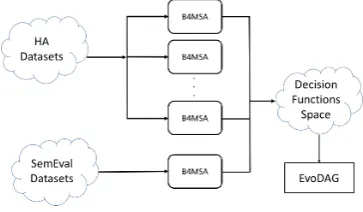
We used our framework based on genetic pro-gramming named EvoMSA to evaluate HatEval and OffensEval tasks. EvoMSA is composed of a stack of B4MSA classifiers to produce predic-tions, and EvoDAG combines the predictions into the final one.
2.1 EvoMSA
EvoMSA1(Graff et al.,2018a,b) is a Generic Sen-timent Analysis System based on B4MSA and EvoDAG. It is an architecture of two phases to
solve classification tasks, see Figure1. EvoMSA
improves the performance of a global classifier combining the predictions of a set of classifiers with different models on the same text to be clas-sified. Roughly speaking, in the first stage, a set of B4MSA classifiers (see Sec. 2.1.1) are trained from several views of the same datasets; datasets provided by SemEval. It creates a decision func-tions space with mixtures of values coming from different views of knowledge, one coming from B4MSA trained with the training set of the com-petition (it is used as generic classifier), a lexicon-based model (it only counts affective words: pos-itive and negative, based on several lexicons (Liu,
2017;Albornoz et al.,2012;Sidorov et al.,2013;
Perez-Rosas et al., 2012)), an emoji-based space (the sixty-four most probable emoticons for the message) (Graff et al.,2018b), and the output of
1https://github.com/INGEOTEC/EvoMSA
FastText (Grave et al., 2018) (word embeddings
of dimension of 100) trained with the training set. Finally, EvoDAG’s inputs are the concatenation of all the decision functions predicted, and EvoDAG
produces a final value or prediction. The
[image:2.595.325.507.184.290.2]fol-lowing subsections describe the internal parts of EvoMSA. The precise configuration of our bench-marked system is described in Sec.4.
Figure 1: EvoMSA Architecture
2.1.1 B4MSA
B4MSA2 focus on multilingual sentiment
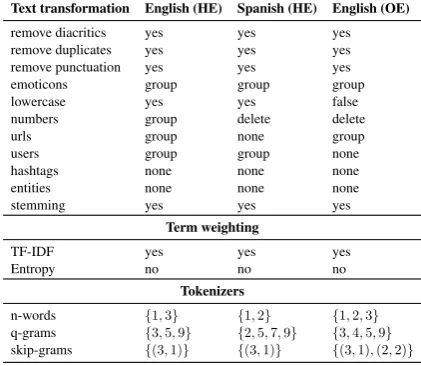
analy-sis. For complete details of the model see (Tellez et al.,2017a,b). The core idea behind B4MSA is to tackle the sentiment analysis problem as a model selection problem, using a different view of the underlying combinatorial problem, i.e., B4MSA combines a bunch of different text tokenization, text transformations, weighting methods, and in-ternally uses an SVM with a linear kernel to classify. Also, B4MSA takes advantage of sev-eral domain-specific particularities like emojis and emoticons and makes explicit handling of nega-tion statements expressed in texts. Nonetheless, EvoMSA avoids the sophisticated use of B4MSA fixing the model for each language in favor of per-forming an optimization process at the level of the decision functions of several models ( Miranda-Jim´enez et al.,2017). Table1shows text transfor-mation parameters used in our system for English and Spanish languages.
2.1.2 EvoDAG
EvoDAG3 (Graff et al.,2016,2017) is a Genetic Programming system specifically tailored to tackle classification and regression problems on very high dimensional vector spaces and large datasets. In particular, EvoDAG uses the principles of Dar-winian evolution to create models represented as a directed acyclic graph (DAG). An EvoDAG model
2
https://github.com/INGEOTEC/b4msa
has three distinct node’s types; the inputs nodes, that as expected received the independent vari-ables, the output node that corresponds to the la-bel, and the inner nodes are the different numerical functions such as sum, product, sin, cos, max, and min, among others. Due to lack of space, we refer the reader to (Graff et al.,2016) where EvoDAG is broadly described.
3 Experimental Settings
As we mentioned, to determine the best configura-tion of parameters for text modeling, B4MSA in-tegrates a hyper-parameter optimization phase that ensures the performance of the classifier based on the training data. The text modeling parameters for B4MSA were set for all process as we show in
Table1for English and Spanish languages. A text
transformation feature could be binary (yes/no) or ternary (group/delete/none) option. Tokenizers denote how texts must be split after applying the process of each text transformation to texts. Tok-enizers generate text chunks in a range of lengths, all tokens generated are part of the text representa-tion. B4MSA allows selecting tokenizers based on
n-words, q−grams, and skip-grams, in any
com-bination. We calln-words to the popular wordn -grams; in particular, we allow to use any combi-nation of unigrams, bigrams, and trigrams. Also, the configuration space allows selecting any
com-bination of character, q-grams, for q = 1 to 9.
Finally, we allow skip-grams such as (3,1) and
(2,2), three words separated by one word (gap), and two words separated by two gaps.
We use two baselines B4MSA and the Fast-Text’s classifier (Bojanowski et al.,2016) for both
contests. FastText represents sentences with a
weighted bag of words, and each word is repre-sented as a bag of character n-gram to create text vectors based on word embeddings. Our custom FastText searches automatically the best param-eters, e.g., for OffensEval with parameters such
as window size = 9, learning rate = 0.01,
epochs = 10, size of wordvectors = 10, min-imum and maxmin-imum length of character n-grams, 2 and 5, respectively; and some other preprocess-ing steps such as group numbers and reduce dupli-cated characters.
3.1 Datasets
SemEval contests provide datasets to train systems for each task. Table2 presents the data
distribu-Text transformation English (HE) Spanish (HE) English (OE)
remove diacritics yes yes yes remove duplicates yes yes yes remove punctuation yes yes yes emoticons group group group lowercase yes yes false numbers group delete delete urls group none group users group group none hashtags none none none entities none none none stemming yes yes yes
Term weighting
TF-IDF yes yes yes
Entropy no no no
Tokenizers
n-words {1,3} {1,2} {1,2,3}
q-grams {3,5,9} {2,5,7,9} {3,4,5,9}
[image:3.595.310.521.65.248.2]skip-grams {(3,1)} {(3,1)} {(3,1),(2,2)}
Table 1: Example of set of configurations for text modeling, HatEval (HE), and OffensEval (OE)
tion of the HatEval dataset.Hateclass (HATE) de-fines tweets that convey hate against immigrants or women; its complement correspond to these mes-sages not having hate content (NO-H), aggressive (AGGR) and no aggressive (NO-A), and target ha-rassed (TARG) as individual and group.
Table3shows the OffensEval data distribution. In Task A, class OFF defines tweets that have offenses or insults; while class NOT describes tweets with no offensive content. Messages with labeled as TIN contain an insult or threat to an en-tity; UNT defines the opposite. Group (GRP), in-dividual (IND), and others (OTH) classes contain the target of the offensive messages. The Offen-sEval collection is described in detail inZampieri et al.(2019a).
DataSet NO-H HATE NO-A AGGR NO-T TARG
training (English) 5,217 3,783 7,441 1,559 7,659 1,341 development (English) 573 427 796 204 781 219 training (Spanish) 2,643 1,857 2,998 1,502 3,371 1,129 development (Spanish) 278 222 324 176 363 137
Table 2: Statistics of HatEval datasets.
DataSet Task A Task B Task C
NOT OFF TIN UNT GRP IND OTH training 8,840 4,400 3,876 524 1,074 2,407 395 development 243 77 34 39 4 30 2
Table 3: Statistics of OffensEval datasets for English lan-guage.
4 Results
We present the results of our approaches for
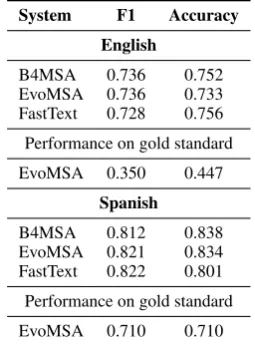
HatE-val contest in Table4and Table5. We performed
provided by HateEval. Table 4shows the results of task A, given a tweet is hateful or not hateful for English and Spanish languages. In the case of task A, the macro-F1 score is used to measure the
performance. Table5shows the results of task B,
classify tweets as aggressive or not aggressive and the target harassed.
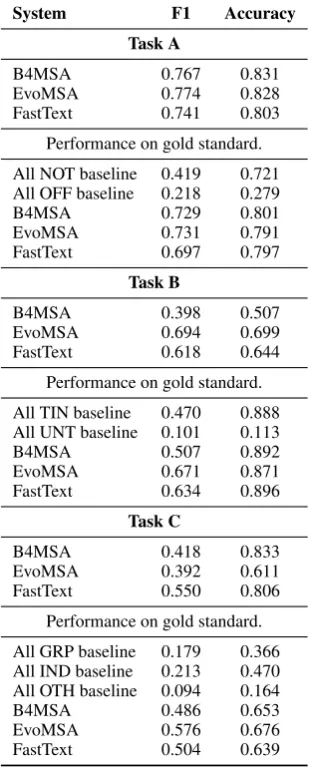
In the case of OffenseEval, Table 6 shows the
results for the three task proposed offensive lan-guage identification (Task A), categorization of of-fense types (Task B), and ofof-fense target identifica-tion (Task C).
We present three system configurations for both tasks. B4MSA uses only the training data pro-vided by the contest as the knowledge base to classify texts, i.e., B4MSA is our baseline, but it is also its outcome is an additional input for our more sophisticated classifier (EvoMSA). Fast-Text generates word embeddings from the pro-vided dataset. We do not use pre-training vectors, using pre-trained vectors did not provide any sig-nificant improvement in this case, but increased the complexity of the models and the processing pipeline. EvoMSA (Graff et al.,2018a) combines, using EvoDAG, the output of different text models such as B4MSA, a lexicon-based model, an emoji-space model, and FastText.
As we can see the performance in all results Tables, EvoMSA is systematically better than our other systems; under these circumstances, we de-cided to use EvoMSA firstly in the evaluation
phase. Following the rules of HatEval, only
the last run would be valid; therefore we used EvoMSA for this chance. In the case of Offen-sEval, up to three predictions were allowed on the test dataset, but only the best one was com-pared with other systems. As we can see, Table
6shows the performance of our three systems on
gold standards; EvoMSA stays ahead in all tasks including the baselines from the contest. The table also shows the performance of two baselines, “All NOT” and “ALL OFF”, that correspond to label-ing all tweets as NOT or OFF, respectively; simi-larly, the rest of the tasks have baselines for “All TIN”, “All UNT”, “All GRP”, “ALL IND”, and “ALL OTH” labeling strategies.
5 Conclusions
In this paper was presented our solution for Hat-Eval and OffensHat-Eval, two campaigns of SemHat-Eval 2019. We show the competitiveness of our
ap-System F1 Accuracy
English
B4MSA 0.736 0.752 EvoMSA 0.736 0.733 FastText 0.728 0.756
Performance on gold standard
EvoMSA 0.350 0.447
Spanish
B4MSA 0.812 0.838 EvoMSA 0.821 0.834 FastText 0.822 0.801
Performance on gold standard
[image:4.595.352.480.63.236.2]EvoMSA 0.710 0.710
Table 4: Results of HateEval: Task A
proach in both training and test phases. EvoMSA and B4MSA are designed to be multilingual and language and domain independent as much as pos-sible. For the training step, we used extra knowl-edge from datasets out of any specific emotion of the contests, but categories or emotions related to sentiment-analysis information. Our solution per-forms well in Spanish and some task for English languages; however, there is room for further im-provements in performance for tasks in English language using another sort of knowledge for spe-cific domains.
References
Jorge Carrillo De Albornoz, Laura Plaza, and Pablo Gerv. 2012. Language Resources and Evaluation SentiSense : an affective lexicon for sentiment anal-ysis SentiSense : An easily scalable concept-based affective lexicon for sentiment analysis. In Interna-tional Conference on Language Resources and
Eval-uation, pages 3562–3567, Istanbul, Turkey.
Euro-pean Language Resources Association (ELRA).
Valerio Basile, Cristina Bosco, Elisabetta Fersini, Deb-ora Nozza, Viviana Patti, Francisco Rangel, Paolo Rosso, and Manuela Sanguinetti. 2019. Semeval-2019 task 5: Multilingual detection of hate speech against immigrants and women in twitter. In Pro-ceedings of the 13th International Workshop on
Se-mantic Evaluation (SemEval-2019). Association for
Computational Linguistics.
Piotr Bojanowski, Edouard Grave, Armand Joulin, and Tomas Mikolov. 2016. Enriching word vec-tors with subword information. arXiv preprint
arXiv:1607.04606.
Interna-System Aggressiveness Hate Target Avg-F1 F1 Accuracy F1 Accuracy F1 Accuracy
English
B4MSA 0.495 0.814 0.736 0.752 0.659 0.858 0.630 EvoMSA 0.556 0.746 0.736 0.733 0.711 0.851 0.668 FastText 0.536 0.806 0.729 0.752 0.710 0.866 0.658
Performance on gold standard
EvoMSA 0.515 0.542 0.348 0.445 0.653 0.699 0.506
Spanish
B4MSA 0.820 0.726 0.785 0.810 0.767 0.880 0.791 EvoMSA 0.755 0.818 0.821 0.834 0.810 0.890 0.795 FastText 0.744 0.818 0.796 0.824 0.791 0.888 0.777
Performance on gold standard
[image:5.595.142.456.63.246.2]EvoMSA 0.737 0.765 0.71 0.71 0.816 0.862 0.754
Table 5: Results of HateEval: Task B
System F1 Accuracy
Task A
B4MSA 0.767 0.831
EvoMSA 0.774 0.828
FastText 0.741 0.803
Performance on gold standard.
All NOT baseline 0.419 0.721 All OFF baseline 0.218 0.279
B4MSA 0.729 0.801
EvoMSA 0.731 0.791
FastText 0.697 0.797
Task B
B4MSA 0.398 0.507
EvoMSA 0.694 0.699
FastText 0.618 0.644
Performance on gold standard.
All TIN baseline 0.470 0.888 All UNT baseline 0.101 0.113
B4MSA 0.507 0.892
EvoMSA 0.671 0.871
FastText 0.634 0.896
Task C
B4MSA 0.418 0.833
EvoMSA 0.392 0.611
FastText 0.550 0.806
Performance on gold standard.
All GRP baseline 0.179 0.366 All IND baseline 0.213 0.470 All OTH baseline 0.094 0.164
B4MSA 0.486 0.653
EvoMSA 0.576 0.676
FastText 0.504 0.639
Table 6: Results of OffensEval: Offensive language identifi-cation (Task A), categorization of offense types (Task B), and offense target identification (Task C).
tional Autumn Meeting on Power, Electronics and
Computing (ROPEC), pages 1–6.
Mario Graff, Sabino Miranda-Jim´enez, Eric S Tellez, and Daniela Moctezuma. 2018a. Evomsa: A mul-tilingual evolutionary approach for sentiment analy-sis.arXiv preprint arXiv:1812.02307.
Mario Graff, Sabino Miranda-Jim´enez, Eric Sadit Tellez, and Daniela Moctezuma. 2018b. Evomsa: A multilingual evolutionary approach for sentiment analysis. CoRR, abs/1812.02307.
Mario Graff, Eric S. Tellez, Hugo Jair Escalante, and Sabino Miranda-Jim´enez. 2017. Semantic Genetic Programming for Sentiment Analysis. In Oliver Schtze, Leonardo Trujillo, Pierrick Legrand, and Yazmin Maldonado, editors, NEO 2015, number 663 in Studies in Computational Intelligence, pages 43–65. Springer International Publishing. DOI: 10.1007/978-3-319-44003-3 2.
Edouard Grave, Piotr Bojanowski, Prakhar Gupta, Ar-mand Joulin, and Tomas Mikolov. 2018. Learn-ing Word Vectors for 157 Languages. In Proceed-ings of the 11th Language Resources and
Evalua-tion Conference, pages 3483–3487. Proceedings of
the Eleventh International Conference on Language Resources and Evaluation (LREC-2018).
Bing Liu. 2017.English Opinion Lexicon.
Tomas Mikolov, Ilya Sutskever, Kai Chen, Greg S Cor-rado, and Jeff Dean. 2013. Distributed representa-tions of words and phrases and their compositional-ity. InAdvances in neural information processing systems, pages 3111–3119.
Sabino Miranda-Jim´enez, Mario Graff, Eric S Tellez, and Daniela Moctezuma. 2017. INGEOTEC at Se-mEval 2017 Task 4: A B4MSA Ensemble based on Genetic Programming for Twitter Sentiment Analy-sis. InProceedings of the 11th International
Work-shop on Semantic Evaluations (SemEval-2017),
[image:5.595.104.259.286.672.2]Veronica Perez-Rosas, Carmen Banea, and Rada Mi-halcea. 2012. Learning Sentiment Lexicons in
Span-ish. In Proceedings of the Eighth International
Conference on Language Resources and Evaluation
(LREC-2012), pages 3077–3081.
Anna Schmidt and Michael Wiegand. 2017. A Sur-vey on Hate Speech Detection Using Natural Lan-guage Processing. InProceedings of the Fifth Inter-national Workshop on Natural Language Process-ing for Social Media. Association for Computational Linguistics, pages 1–10, Valencia, Spain.
Grigori Sidorov, Sabino Miranda-Jim´enez, Francisco Viveros-Jim´enez, Alexander Gelbukh, No Castro-S´anchez, Francisco Vel´asquez, Ismael D´ıaz-Rangel, Sergio Su´arez-Guerra, Alejandro Trevi˜no, and Juan Gordon. 2013. Empirical Study of Machine Learn-ing Based Approach for Opinion MinLearn-ing in Tweets.
In Proceedings of the 11th Mexican International
Conference on Advances in Artificial Intelligence
-Volume Part I, MICAI’12, pages 1–14, Berlin,
Hei-delberg. Springer-Verlag.
Eric S. Tellez, Sabino Miranda-Jim´enez, Mario Graff, Daniela Moctezuma, Ranyart R. Su´arez, and Os-car S. Siordia. 2017a. A simple approach to mul-tilingual polarity classification in Twitter. Pattern Recognition Letters, 94:68–74.
Eric S. Tellez, Sabino Miranda-Jimnez, Mario Graff, Daniela Moctezuma, Oscar S. Siordia, and Elio A. Villaseor. 2017b. A case study of spanish text trans-formations for twitter sentiment analysis. Expert Systems with Applications, 81:457 – 471.
Eric S. Tellez, Daniela Moctezuma, Sabino Miranda-Jim´enez, and Mario Graff. 2018. An automated text categorization framework based on hyperparameter optimization. Knowledge-Based Systems, 149:110– 123.
Zeerak Waseem, Thomas Davidson, Dana Warmsley, and Ingmar Weber. 2017. Understanding Abuse: A Typology of Abusive Language Detection Subtasks.
In Proceedings of the First Workshop on Abusive
Langauge Online.
Marcos Zampieri, Shervin Malmasi, Preslav Nakov, Sara Rosenthal, Noura Farra, and Ritesh Kumar. 2019a. Predicting the Type and Target of Offensive Posts in Social Media. InProceedings of NAACL.
Marcos Zampieri, Shervin Malmasi, Preslav Nakov, Sara Rosenthal, Noura Farra, and Ritesh Kumar. 2019b. SemEval-2019 Task 6: Identifying and Cat-egorizing Offensive Language in Social Media (Of-fensEval). InProceedings of The 13th International