Proceedings of the 12th International Workshop on Semantic Evaluation (SemEval-2018), pages 57–64
SemEval 2018 Task 4: Character Identification on Multiparty Dialogues
Jinho D. Choi Computer Science
Emory University Atlanta, GA 30322 [email protected]
Henry Y. Chen Information Security
Snap Inc.
Santa Monica, CA 90405 [email protected]
Abstract
Character identification is a task of entity link-ing that finds the global entity of each personal mention in multiparty dialogue. For this task, the first two seasons of the popular TV show Friendsare annotated, comprising a total of 448 dialogues, 15,709 mentions, and 401 entities. The personal mentions are detected from nomi-nals referring to certain characters in the show, and the entities are collected from the list of all characters in those two seasons of the show. This task is challenging because it requires the identification of characters that are mentioned but may not be active during the conversation. Among 90+ participants, four of them submit-ted their system outputs and showed strengths in different aspects about the task. Thorough analyses of the distributed datasets, system out-puts, and comparative studies are also provided. To facilitate the momentum, we create an open-source project for this task and publicly release a larger and cleaner dataset, hoping to support researchers for more enhanced modeling.
1 Introduction
Most of the earlier works in natural language pro-cessing (NLP) had focused on formal writing such as newswires, whereas many recent works have tar-geted at colloquial writing such as text messages or social media. Since the evolution of Web 2.0, the amount of user-generated contents involving col-loquial writing has exceeded the one with formal writing. NLP tasks are relatively well-explored at this point for certain types of colloquial writing i.e., microblogs and reviews (Ritter et al.,2011;Kong et al., 2014; Ranganath et al., 2016;Shin et al., 2017). However, the genre of multiparty dialogue is still under-explored, even though digital contents in dialogue forms keep increasing at a faster rate than any other types of writing.1 This inspires us 1
https://medium.com/hijiffy/10-graphs-that-show-the-immense-power-of-messaging-apps-4a41385b24d6
to create a new task called character identification that aims to link personal mentions (e.g,she,mom) to their global entities across multiple dialogues, where the entities indicate the specific characters referred by those mentions (e.g.,Judy).
Due to the nature of multiparty dialogue where several speakers take turns to complete a context, character identification is a crucial step for adapting higher-end NLP tasks (e.g., summarization, ques-tion answering, machine translaques-tion) to this genre. It can also bring another level of sophistication to intelligent personal assistants or tutoring systems. This task is challenging because it needs to process through colloquialism that includes slangs, gram-mar mistakes, and/or rhetorical questions, as well as to handle cross-document resolution for the iden-tification of entities that are mentioned but may not be actively participating during the conversation. Nonetheless, we believe that models produced by this task will remarkably enhance inference on di-alogue contexts (e.g., business meetings, doctor-patient conversations) by providing finer-grained information about individual characters.
Section2illustrates the task of character identi-fication and explains the key differences between it and other types of entity linking tasks. Section3 describes the corpus, based on TV show transcripts, used for this task with annotation details. Section4 gives brief overviews of the systems participated in this shared task. Section5explains the evaluation metrics and the results produced by those systems. Finally, Section6gives thorough analysis and com-parative studies between these systems. This task was originally conducted at CodaLab.2The latest
dataset and the system outputs can be found from our open source project, Emory NLP.3
2https://competitions.codalab.org/ competitions/17310
3https://github.com/emorynlp/ semeval-2018-task4
Ross I told mom and dad last night, they seemed to take it pretty well.
Monica never have grandchildren, I'll never have grandchildren." was what? A wrong number?Oh really, so that hysterical phone call I got from a woman at sobbing 3:00 A.M., "I'll
Ross Sorry.
Joey Alright Ross, look. You're feeling a lot of pain right now. You're angry. You're hurting.Can I tell you what the answer is? Monica
Jack Judy
[image:2.595.94.508.59.361.2]Ross Joey
Figure 1: An example of character identification, excerpted from the Season 1 Episode 1 ofFriends, where mentions are indicated in red boxes and entities are linked by arrows.
2 Task Description
Let a mention be a nominal that refers to a singular or a collective entity (e.g.,she,mom,Judy), and an entity be the actual person that the mention refers to. Given a dialogue transcribed in text where all mentions are detected, the objective is to find the entity for each mention, who can be either active or passive in the dialogue. In Figure1, entities such asRoss,Monica, andJoeyare the active speakers of the dialogue, whereas Jack and Judy are not although they are passively mentioned asmomand dadin this context. Linking such mentions to their global entities demands inferred knowledge about the kinship from other dialogues, challenging cross-document resolution. Thus, character identification can be viewed as an entity linking task that aims for holistic understanding in multiparty dialogue.
Most of previous works on entity linking have focused on Wikification, which links named entity mentions to their relevant Wikipedia articles ( Mi-halcea and Csomai,2007;Ratinov et al.,2011;Guo et al.,2013). Unlike Wikification where most enti-ties come with structured information from knowl-edge bases (e.g., Infobox, Freebase, DBPedia), enti-ties in character identification have no such
precom-piled information, which makes this task even more challenging. It is similar to coreference resolution in a sense that it groups mentions into entities, but distinguished because this task requires to identify each mention group as a known person. In Figure1, coreference resolution would give a cluster of the four mentions, {mom,woman,I,I}; however, it would not identify that cluster to be the entityJudy, which in this case is not possible to identify without getting contexts from other dialogues.
3 Corpus
The character identification corpus was first created by collecting transcripts from the popular TV show, Friends(Chen and Choi,2016). These transcripts were voluntarily provided by fans who made them publicly available.4 Dialogues in this corpus mimic
daily conversations that are more natural and vari-ous in topics than other dialogue corpora (Janin et al., 2003; Danescu-Niculescu-Mizil and Lee, 2011;Hu et al.,2013;Kim et al.,2015;Lowe et al., 2015). Although they are scripted, the interpreta-tion of these dialogues is no easier than unscripted
4http://www.livesinabox.com/friends/ scripts.shtml
Episodes Scenes Speakers Utterances Sentences Tokens
Season 1 24 229 105 4,725 8,680 66,355
Season 2 23 219 101 4,501 7,380 65,675
[image:3.595.142.461.63.114.2]Total 47 448 171 9,226 16,060 132,030
Table 1: Distributions from the subset of the character identification corpus used for this shared task.
dialogues; they not only involve as much disfluency and context switching as real dialogues do, but also include more humor, sarcasm, or metaphor. Thus, models evaluated on this corpus should give a gen-eral sense about the state of character identification on multiparty dialogue.
The original transcripts collected from the fan site were formatted in HTML; we converted them into JSON so that they could be easily processed. This structured data were then manually checked for potential errors. Table1shows the distributions from the subset of the character identification cor-pus used for this shared task. The provided dataset is divided into two seasons, each season is divided into episodes, each episode is divided into scenes, each scene contains utterances, where each utter-ance indicates a turn of speech.
3.1 Mention Annotation
For mention annotation, a heuristic-based mention detector was developed, which utilized dependency relations (Choi and McCallum,2013), named en-tity tags (Choi,2016), and personal noun gazetteers, then automatically detected mentions for the entire corpus. In this heuristic, a noun phrase was consid-ered a personal mention if it was either:
1. APERSONnamed entity, or
2. A pronoun or a possessive pronoun excluding the pronounsitandthey, or
3. One of the personal noun gazetteers that are 603 common and singular personal nouns selected from Freebase and DBPedia.
Specific mentions such asitandtheywere excluded because they often referred to the ambiguous entity types,collective,general, andother(Section3.2). For the quality assurance, about 10% of this pseudo annotation were randomly sampled and manually evaluated, showing a precision, a recall, and the F1-score of 97.58%, 94.34%, and 95.93%, respectively. Finally, the annotation was manually checked again while it was systematically corrected for routinely produced errors. Although mention detection was
the foundational step, including it as a part of this shared task could over-complicate the evaluation. Thus, gold mentions were provided for this year’s shared task such that participants could purely con-centrate on the task of entity linking.
3.2 Entity Annotation
All mentions were double-annotated with their ref-erent entities, and adjudicated upon disagreements. Annotation and adjudication tasks were conducted on Amazon Mechanical Turk. Each mention was annotated with either a primary character, that are Ross,Chandler,Joey,Rachel,Monica, andPheobe, a secondary character (other frequently recurring characters across the show), or one of the following ambiguous types suggested byChen et al.(2017):
• Generic: indicates actual characters in the show whose identities are unknown (e.g., Thatwaitress is really cute, I am going to askherout). Generic entities are annotated with their group names and optional numberings (e.g.,Man 1,Woman 1).
• Collective: indicates the plural use of the pro-nounyou, which cannot be deterministically dis-tinguished from the singular use.
• General: indicates mentions used in reference to a general case rather than an specific entity (e.g., The idealguyyou look for doesn’t exist).
• Other: indicates all the other kinds of entities.
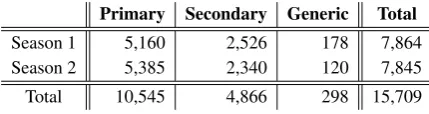
For this year’s shared task, mentions annotated with the last three ambiguous types,collective,general, andother, were excluded from the dataset to reduce the high complexity of this task (Table2).
Primary Secondary Generic Total
Season 1 5,160 2,526 178 7,864
Season 2 5,385 2,340 120 7,845
Total 10,545 4,866 298 15,709
[image:3.595.309.524.671.728.2]Speaker Utterance
Joey Yeah, right! ...You1serious?
Rachel Everythingyou2need to know is in that first kiss.
Chandler Yeah. Forus3, it’s like the stand-upcomedian4you5have to sit through before the maindude6starts.
Ross It’s not thatwe7don’t like thecomedian8, it’s that ... that’s not whywe9bought the ticket.
[image:4.595.78.519.171.224.2]{You1} →Rachel,{us3,we7,9} →Collective,{you2,5} →General,{comedian4,8} →Generic,{dude6} →Other
Table 3: Examples of the entity annotation described in Section3.2.
Episodes Scenes Entities Mentions ClustersE ClustersS SingletonE SingletonS
Training 47 374 372 13,280 893 2,051 209 472
Evaluation 7 74 106 2,429 304 370 54 83
Total 47 448 401 15,709 1,197 2,421 263 555
Table 4: Distributions of the training and the evaluation sets in Section3.3.
Table3shows examples of these ambiguous types. About 83% were assigned to the primary and sec-ondary characters, 1.4% were assigned togeneric, and the rest were assigned to the other ambiguous types,collective,general, andother. To evaluate the annotation quality, the annotation agreement scores as well as Cohen’s kappa scores were mea-sured, showing 82.83% and 79.96%, respectively.
3.3 Data Split
The corpus was split into training and evaluation sets for this shared task (Table4). No dedicated development set was provided; participants were encouraged to use sub-parts of the training set to create their own development sets or perform cross-validation for the optimization of statistical models. Two types of datasets are provided for both training and evaluation sets, one treating each episode as an individual dialogue and the other treating each scene as an independent dialogue.5
Processing a larger dialogue makes coreference resolution harder because it needs to link referential mentions that are farther apart; on the other hand, each cluster comprises a greater number of men-tions which can help identifying the global entity of that cluster. The numbers of clusters grouped in each dataset are shown as ClustersEand ClustersS,
implying episode-level and scene-level clusters, re-spectively. Our corpus includes singleton mentions, which take about 22% of all mentions.
3.4 Data Format
To help participants adapting their existing coref-erence resolution systems to this task, the original dataset in JSON was converted into the CoNLL’12
5Each episode consists of about 10 scenes on average.
shared task format (Pradhan et al.,2012), where each column is delimited by white spaces and rep-resents the following:
1. Season and episode ID. 2. Document ID.
3. Token ID. 4. Word form.
5. Part-of-speech tag (auto-generated). 6. Phrase structure tag (auto-generated). 7. Lemma (auto-generated).
8. Predicate sense (not provided). 9. Word sense (not provided). 10. Speaker.
11. Named entity tag (auto-generated). 12. Entity ID.
The part-of-speech tags, lemmas, and named en-tity tags were automatically generated by NLP4J,6
and the phrase structure tags were produced by the Stanford parser.7Table5shows the example of the
first utterance in Figure1in the CoNLL’12 format.
4 System Description
This section describes the top-2 scoring systems of this shared task. The AMORE-UPF is a group of researchers from the Universitat Pompeu Fabra in Spain (Section4.1). The KNU CI is a group of researchers from Kangwon National University in South Korea (Section4.2).
6https://emorynlp.github.io/nlp4j 7https://nlp.stanford.edu/software/
lex-parser.shtml
s1e1u38 0 0 I PRP (TOP(S(S(NP*) I - - Ross * (7)
s1e1u38 0 1 told VBD (VP* tell - - Ross *
-s1e1u38 0 2 mom NN (NP* mom - - Ross * (9)
s1e1u38 0 3 and CC * and - - Ross *
-s1e1u38 0 4 dad NN *) dad - - Ross * (10)
s1e1u38 0 5 last JJ (NP-TMP* last - - Ross (TIME*
-s1e1u38 0 6 night NN *))) night - - Ross *)
-s1e1u38 0 7 , , * , - - Ross *
-s1e1u38 0 8 they PRP (NP*) they - - Ross *
-s1e1u38 0 9 seemed VBD (VP* seem - - Ross *
-s1e1u38 0 10 to TO (S(VP* to - - Ross *
-s1e1u38 0 11 take VB (VP* take - - Ross *
-s1e1u38 0 12 it PRP (NP*) it - - Ross *
-s1e1u38 0 13 pretty RB (ADVP* pretty - - Ross *
-s1e1u38 0 14 well RB *))))) well - - Ross *
-s1e1u38 0 15 . . *)) . - - Ross *
-Table 5: Example of the first utterance in Figure1annotated in the CoNLL’12 format.
4.1 AMORE-UPF System
The AMORE-UPF system approaches this task as a multi-class classification. It uses a bidirectional Long Short-Term Memory (LSTM) that processes the input dialogue and resolves mentions, by means of a comparison between the LSTM’s hidden state, for each mention, to vectors in an entity library. In this model, learned representations of each entity are stored in the entity library, that is a matrix where each row represents an entity and whose values are learned during training (Figure2).
lution (e.g., the aforementioned approaches, as well as Wiseman et al. 2016; Lee et al. 2017,
Francis-Landau et al. 2016). For instance, we avoid feature engineering, focusing instead on the model’s ability to learn meaningful entity repre-sentations from the dialogue itself. Moreover, we deviate from the common strategy to entity linking of incorporating a specialized coreference resolu-tion module (e.g.,Chen et al. 2017).
3 Model description
We approach the task of character identification as one of multi-class classification. Our model is depicted in Figure1, with inputs in the top left and outputs at the bottom. In a nutshell, our model is a bidirectional LSTM (long short-term memory,
Hochreiter and Schmidhuber 1997) that processes the dialogue text and resolves mentions, by means of a comparison between the LSTM’s hidden state (for each mention) to vectors in a learned entity library.
The model is given chunks of dialogue, which it processes token by token. Theithtokenti and
its speakersSi(typically a singleton set) are
repre-sented as one-hot vectors, embedded via two dis-tinct embedding matrices (Wt and Ws,
respec-tively) and finally concatenated (Eq.1; see alsoxi
in Figure1). In caseSicontains multiple speakers,
their embeddings are summed.
xi =Wttik X
s2Si
Wss (1)
The resulting embedding xi of a token with its
speakers is passed on to a bidirectional LSTM. The hidden state!hi of aunidirectional LSTM for the ithinput is recursively defined as a combination of
that input with the LSTM’s previous hidden state !
hi 1. For abidirectional LSTM, the hidden state hiis a concatenation of the hidden states!hiand hi of two unidirectional LSTMs which process
the data in opposite directions (Eq.2; see also Fig-ure 1). In principle, this enables a bidirectional LSTM to represent the entire dialogue with a focus on the current input, including for instance its rele-vant dependencies on the context (e.g., coreference, agreement).
hi=BiLSTM(xi,!hi 1,hi+1) (2)
In the model, learned representations of each
en-Ross Rachel guy + tanh ... softmax Ws Wt Ws Ross & Rachel: the
Ross & Rachel: guy Ross & Rachel: was
{
E
Entity library: ...
(fictional example)
... ... Inputs: Class scores:
e
o
BiLSTM:
h
i-1h
ih
i+1i i xi Wo cos ... ...
Figure 1: The AMORE-UPF model.
This is a matrix where each row vector represents an entity, and whose values are updated (only) dur-ing traindur-ing. For tokenstithat are tagged as
men-tions, we map the hidden state to a representation that has the same dimensionality as the vectors in the entity library.3 Its similarity to each entity
rep-resentation is computed using cosine. Softmax is then applied to the resulting similarity profile to obtain a probability distribution oi over entities
(‘class scores’ in Figure1):
oi=softmax(cosine(E,(Wohi+b) | {z }
ei
) (3)
We train the model with backpropagation, using negative log-likelihood as loss function. Besides the BiLSTM parameters, we optimize Wt, Ws, Wo,Eandb. At testing time, the model’s
predic-tioncˆi for theith token is the entity with highest
probability:
ˆ
ci=argmax(oi) (4)
In order for this architecture to be successful, ei
needs to be as similar as possible to the entity vector of the entity to which mentionirefers. We refer
to this model asAMORE-UPF, our team name in the SemEval competition.
In order to assess the contribution of the entity library, we compare our model to a similar architec-ture which does not include it (NoEntLib). This model obtains scores by directly applying softmax
[image:5.595.93.503.59.221.2]3For multi-word mentions this is done only for the last
Figure 2: The overview of AMORE-UPF system.
4.2 KNU-CI System
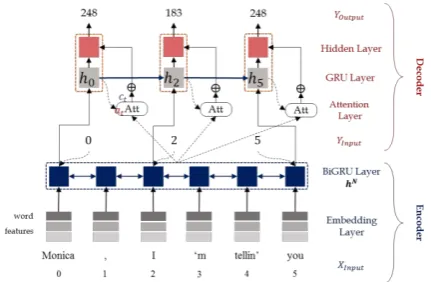
The KNU-CI system tackles this task as a sequence-labeling problem. It uses an attention-based recur-rent neural network (RNN) encoder-decoder model. The input dialogue of character identification con-sists of several conversations, resulting a long se-quence of text. The RNN encoder-decoder model
suffers from poor performance when the length of the input sequence is long. To overcome this issue, this system applies an attention, position encoding, and the self-matching network to the original RNN encoder-decoder model. As a result, the best per-formance is achieved by the attention-based RNN depicted in Figure3.
NAACL-HLT 2018 Submission ***. Confidential review Copy. DO NOT DISTRIBUTE.
2 100 101 102 103 104 105 106 107 108 109 110 111 112 113 114 115 116 117 118 119 120 121 122 123 124 125 126 127 128 129 130 131 132 133 134 135 136 137 138 139 140 141 142 143 144 145 146 147 148 149 150 151 152 153 154 155 156 157 158 159 160 161 162 163 164 165 166 167 168 169 170 171 172 173 174 175 176 177 178 179 180 181 182 183 184 185 186 187 188 189 190 191 192 193 194 195 196 197 198 199
the decoder and the hidden state of the encoder when performing decoding.
2.1 Model 1: Attention-based Enc–Dec model
The first model proposed in this paper is a general attention mechanism-based Enc–Dec model, as shown in Figure 1.
The input of the encoder is one document that contains 𝑆 sentences (multiparty dialogue). Each sentence 𝑆consists of 𝑛𝑆 words, and the input se-quence 𝑋𝑖𝑛𝑝𝑢𝑡 is 𝑋𝑖𝑛𝑝𝑢𝑡= {𝑥1, 𝑥2, … , 𝑥𝑛𝑆}. The input to the decoder is 𝑌𝑖𝑛𝑝𝑢𝑡= {𝑦𝑖0, 𝑦𝑖1, … , 𝑦𝑖𝑚} consisting of the positions of the words given in the gold mentions, and the output sequence
ac-cordingly becomes 𝑌𝑜𝑢𝑡𝑝𝑢𝑡= {𝑦𝑜0, 𝑦𝑜1, … , 𝑦𝑜𝑚} consisting of the character number, which is cor-responded with the decoder’s input mentions.
We use word embedding and adopt the K-dimensional word embedding 𝑒𝑖𝑘, 𝑘 ∈ [1, 𝐾] for all input words, where 𝑖 is the word index in the input sequence. We perform feature embedding for three features — speaker, named entity recog-nition (NER) tags, and capitalization — and con-catenate them to make 𝑥̃𝑖. The uppercase feature is a binary feature (1 or 0) that verifies whether the uppercase is included in the word. 10-dimensional speaker embedding for a total of 205 different types of speakers included by “un-known”. 19-dimensional NER embedding for a total of 19 different types of NER tags.
We use bidirectional gated recurrent unit (BiGRU) (Cho et al., 2014) for the encoder. The hidden state of the encoder for the input (word) sequence is defined as ℎ𝑖𝑁.
𝑒𝑖= 𝑊𝑒𝑥𝑖 (1)
𝑥̃𝑖= [𝑒𝑖; 𝑢𝑐𝑖; 𝑠𝑝𝑘𝑖; 𝑁𝐸𝑅𝑖] (2)
ℎ𝑖= 𝑏𝑖𝐺𝑅𝑈(𝑥̃𝑖, ℎ𝑖−1) (3) where ℎ⃗ 𝑖 and ℎ⃖⃗𝑖 are forward and backward net-works, respectively, and ℎ𝑖𝑁 concatenates ℎ⃗ 𝑖 and ℎ⃖⃗𝑖.
The decoder of our model uses the GRU as fol-lows.
ℎ𝑡= 𝐺𝑅𝑈(ℎ𝑦𝑖𝑁𝑡, ℎ𝑡−1) (4) The input of the decoder is the hidden state ℎ𝑖𝑁 generated by the encoder corresponding to each position of 𝑌𝑖𝑛𝑝𝑢𝑡 which is the gold mention se-quence. The hidden state ℎ𝑡 of the current decoder receives the hidden state ℎ𝑖𝑁 of the encoder corre-sponding to the output position of the previous de-coder and the previous hidden state of the dede-coder.
𝛼𝑖𝑡=
exp(𝑠𝑐𝑜𝑟𝑒𝑎(ℎ𝑡,ℎ𝑦𝑖𝑖𝑁))
∑ exp(𝑠𝑐𝑜𝑟𝑒𝑗 𝑎(ℎ𝑡,ℎ𝑦𝑖𝑗𝑁 ))
(5)
𝑠𝑐𝑜𝑟𝑒𝑎(ℎ𝑡, ℎ𝑦𝑖𝑁
𝑖) = vt
𝑇tanh(𝑊
𝑎[ℎ𝑡; ℎ𝑦𝑖𝑁𝑖; ℎ𝑦𝑖𝑡
𝑁 ]) (6)
𝑦𝑡= argmax𝑖(𝑎𝑖𝑡) (7)
𝑐𝑡= ℎ𝑦𝑁𝑡,ℎ𝑎𝑟𝑑𝑎𝑡𝑡𝑒𝑛𝑡𝑖𝑜𝑛 (8) At the attention layer of the decoder, we use the attention weight 𝛼𝑖𝑡 to compute the alignment score for the gold mention input into the decoder and the encoder hidden state ℎ𝑖𝑁 input. The atten-tion layer acts as a coreference resoluatten-tion for each gold mention and input sequence. After calculat-ing the attention weights, we create the context vector 𝑐𝑡. We use hard attention in Eq. (8). Hard attention 𝑐𝑡 = ℎ𝑦𝑡
𝑁 is an attention-pooling vector,
which is based on the argmax function Eq. (7) for attention weight 𝛼𝑖𝑡 to choose the position with high score for the decoder input as the gold men-tion.
𝑠𝑐𝑜𝑟𝑒𝑧(ℎ𝑡, 𝑐𝑡, ℎ𝑦𝑖𝑁𝑡) = 𝑊𝑧2𝑇ReLU(𝑊𝑧[ℎ𝑡; 𝑐𝑡; ℎ𝑦𝑖𝑁𝑡]) (9)
[image:5.595.312.528.368.509.2]𝑦𝑜𝑡= argmax𝑡(𝑠𝑜𝑓𝑡𝑚𝑎𝑥 (𝑠𝑐𝑜𝑟𝑒𝑧(ℎ𝑡, 𝑐𝑡, ℎ𝑦𝑖𝑁𝑡))) (10) After calculating the context vector between the input of the encoder and the input of the decoder, we calculate 𝑠𝑐𝑜𝑟𝑒𝑧, using which the context vec-tor 𝑐𝑡, decode hidden state ℎ𝑡 and encoder hidden state ℎ𝑁 are concatenated in the decoder hidden layer. Next, the softmax function is used to calcu-late the alignment score for 𝑠𝑐𝑜𝑟𝑒𝑧, and then the character index (𝑌𝑜𝑢𝑡𝑝𝑢𝑡) for the CI task corre-sponding to the input of the decoder is obtained using the argmax function.
Figure 1: Attention-based Enc-Dec. Figure 3: The overview of KNU-CI system.
5 Evaluation
FollowingChen et al.(2017), the labeling accuracy (Acc) and the macro-average F1 score (F1) are used for the evaluation (C: the total number of
charac-ters,F1i: the F1-score for thei’th character):
Acc= # of corrected identified mentions
# of all mentions
F1 = 1
C C X
i=1 F1i
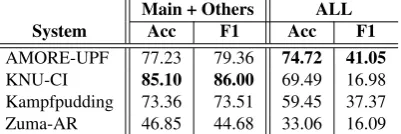
Table6shows the overall scores from all submitted systems. Two types of evaluation are performed for this task. The first one is based on seven characters where six of them compose the primary characters
[image:5.595.78.289.432.619.2](Section3.2) and every other character is grouped as one entity calledOthers(Main + Others). The other is based on 78 characters comprising all char-acters appeared in the dataset, except for the ones appear either in the training or the evaluation set but not both, which is grouped to theOthers(ALL).
Main + Others ALL System Acc F1 Acc F1
AMORE-UPF 77.23 79.36 74.72 41.05
[image:6.595.83.284.158.225.2]KNU-CI 85.10 86.00 69.49 16.98 Kampfpudding 73.36 73.51 59.45 37.37 Zuma-AR 46.85 44.68 33.06 16.09 Table 6: Overall scores from the submitted systems.
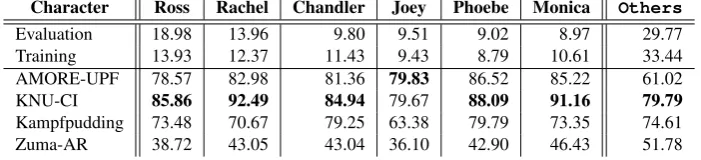
Table7shows the F1 scores for the primary charac-ters andOthers, illustrating detailed evaluation forMain + Others. Table8gives detailed evalua-tion forALL, showing the F1-scores for the top-12 most frequently appeared secondary characters and
Othersthat appear only in the training or the eval-uation set but not both. The 18 characters in these two tables comprise about 85% of all mentions.
6 Analysis
Based on the evaluation results, several interesting observations can be made for how different system architectures affect model performance on this task. The analysis in this section primarily focuses on the top-2 scoring systems, AMORE-UPF an KNU-CI, as their results vastly outperform the other two and the authors of those systems provide more detailed descriptions to the organizers.
6.1 Overall Performance
It is worth pointing out the significance of the two evaluation metrics proposed in Section5in terms of the model performance. The labeling accuracy indicates the raw predicative power of the model. This metric is biased towards more frequently ap-pearing characters such as the primary characters, a total of which compose 70+% of the evaluation set. Thus, it is possible to achieve a relatively high label-ing accuracy score without handllabel-ing referents for the secondary characters well. On the contrary, the macro-average F1 score neutralizes the imbalance between frequently and not so frequently appearing characters. It reveals the model performance on a per-entity basis, which tends to favor transient and extra characters more because every character is treated equally in this metric.
For the overall performance, KNU-CI outperforms forMain + Otherswith the labeling accuracy of 85.10% and the macro-average F1 score of 86.00%, whereas AMORE-UPF outperforms forALLwith the labeling accuracy of 74.72% and the macro-average F1 of 41.05% (Table6). All systems pro-duce better results forMain + OthersthanALL, which is expected due to the fewer number of enti-ties to classify (7 vs 78). It is possible that KNU-CI’s attention model is highly optimized for the identification of the primary characters, whereas AMORE-UPF’s LSTM model distributes weights for the secondary characters more evenly, but more detailed analysis needs to be made to see the com-parative strengths between these two systems.
6.2 Main + Other Identification
Table7depicts the strength of the KNU-CI system for the primary characters in comparisons to the others, which is attributed to its unique sequence labeling architecture and the attention mechanism. Their encoder-decoder architecture helps consoli-dating sequential information of the input dialogue along with the mentions. The hidden units in RNNs enable the network to aggregate character-related information and to disambiguate timeline shifts across utterances. The encoder takes the input dia-logue and provides the decoder with context-rich features. Coupled with the attention mechanism, this model focuses on the primary characters; thus, it results better performance on Main + Others. However, this architecture is not as well-adaptive as the number of characters increases for the identi-fication, which can be observed from the system’s low macro-average F1 score forAll.
6.3 All Character Identification
Table8describes the strength of the AMORE-UPF system for the secondary characters using the bidi-rectional LSTM model, leading it to outperform all the others forAll. Although both AMORE-UPF and KNU-CI utilize variations of RNNs as their un-derlying architectures, the performance downfall is not as prominent for AMORE-UPF as the number of characters increases, thanks to its entity library. The entity library is consumed and updated as nec-essary given the mention embeddings. It is used to regularize training each individual character, which helps avoiding the bias towards frequently appear-ing characters. As the result, AMORE-UPF yields better performance for All while accomplishing reasonable results forMain + Othersas well.
Character Ross Rachel Chandler Joey Phoebe Monica Others
Evaluation 18.98 13.96 9.80 9.51 9.02 8.97 29.77
Training 13.93 12.37 11.43 9.43 8.79 10.61 33.44
AMORE-UPF 78.57 82.98 81.36 79.83 86.52 85.22 61.02
KNU-CI 85.86 92.49 84.94 79.67 88.09 91.16 79.79
Kampfpudding 73.48 70.67 79.25 63.38 79.79 73.35 74.61
[image:7.595.124.475.64.144.2]Zuma-AR 38.72 43.05 43.04 36.10 42.90 46.43 51.78
Table 7: Detailed evaluation forMain + Othersin Table6. The Evaluation and Training rows show the percentages of individual characters appeared in the evaluation and the training set, respectively.
Character Be Ca Ed Pa Ju MB Ri Sc Ca Fr Ja OT
Evaluation 3.46 1.73 1.56 1.44 1.32 0.86 0.86 0.78 0.74 0.70 0.62 2.92 Training 1.41 1.46 1.06 0.71 1.15 0.60 1.83 0.21 0.13 0.51 0.43 13.51 AMORE-UPF 50.00 57.14 80.60 35.56 72.73 64.52 80.85 10.00 61.54 0.00 42.11 7.89
KNU-CI 38.46 62.79 73.02 15.38 42.55 0.00 66.67 38.46 0.00 18.18 16.00 0.00 Kampfpudding 31.86 33.33 68.85 33.33 60.32 50.00 61.22 10.00 0.00 0.00 23.53 0.00 Zuma-AR 0.00 12.24 44.44 0.00 27.91 15.38 77.78 0.00 38.46 0.00 12.50 0.00 Table 8: Detailed evaluation forALLin Table6. Be: Ben, Ca: Carol, Ed: Eddie, Pa: Paolo, Ju: Julie: MB: Mrs. Bing, Ri: Richard, Sc: Scott, Ca: Carl, Fr: Frank, Ja: Janice, OT:Others.
7 Conclusion
In this shared task, we propose a novel entity link-ing task called character identification that aims to find the global entities for all personal mentions, representing individual characters in the contexts of multiparty dialogue. Among 90+ participants signed up for this task at CodaLab, only four sub-mitted their system outputs, which is unfortunate. However, the top-2 scoring systems depict unique strengths, allowing us to make a good analysis for this task. It would be interesting to see if the se-quence labeling architecture from KNU-CI coupled with the entity library from AMORE-UPF could produce an even higher performing model for both theMain + OtherandAllevaluation.
To facilitate the momentum, we create an open-source project that will continuously support this task.8 It is worth mentioning thatCharacter
Identi-ficationis a part of a bigger project called Charac-ter Miningthat strives for machine comprehension on dialog.9 Currently, this project provides more
and cleaner annotation for character identification than the corpus described in Section3, hoping to engage more researchers to this task.
8https://github.com/emorynlp/ character-identification 9https://github.com/emorynlp/
character-mining
References
Henry Yu-Hsin Chen and Jinho D. Choi. 2016. Charac-ter Identification on Multiparty Conversation: Iden-tifying Mentions of Characters in TV Shows. In Proceedings of the 17th Annual Meeting of the Spe-cial Interest Group on Discourse and Dialogue. SIG-DIAL’16, pages 90–100.
Henry Yu-Hsin Chen, Ethan Zhou, and Jinho D. Choi. 2017. Robust Coreference Resolution and Entity Linking on Dialogues: Character Identification on TV Show Transcripts. InProceedings of the 21st Conference on Computational Natural Language Learning. Vancouver, Canada, CoNLL’17, pages 216– 225. http://www.conll.org/2017.
Jinho D. Choi. 2016. Dynamic Feature Induction: The Last Gist to the State-of-the-Art. InProceedings of the Conference of the North American Chapter of the Association for Computational Linguistics: Human Language Technologies. NAACL’16.
Jinho D. Choi and Andrew McCallum. 2013. Transition-based Dependency Parsing with Selectional Branch-ing. InProceedings of the 51st Annual Meeting of the Association for Computational Linguistics. ACL’13, pages 1052–1062.
Cristian Danescu-Niculescu-Mizil and Lillian Lee. 2011. Chameleons in Imagined Conversations: A New Ap-proach to Understanding Coordination of Linguistic Style in Dialogs. InProceedings of the 2nd Workshop on Cognitive Modeling and Computational Linguis-tics. CMCL’11, pages 76–87.
Association for Computational Linguistics on Human Language Technology. NAACL, pages 1020–1030. Zhichao Hu, Elahe Rahimtoroghi, Larissa Munishkina,
Reid Swanson, and Marilyn A. Walker. 2013. Unsu-pervised Induction of Contingent Event Pairs from Film Scenes. InProceedings of the 2013 Conference on Empirical Methods in Natural Language Process-ing. EMNLP’13, pages 369–379.
Adam Janin, Don Baron, Jane Edwards, Dan Ellis, David Gelbart, Nelson Morgan, Barbara Peskin, Thilo Pfau, Elizabeth Shriberg, Andreas Stolcke, and Chuck Wooters. 2003. The ICSI Meeting Cor-pus. InProceedings of IEEE International Confer-ence on Acoustics, Speech, and Signal Processing. ICASSP’03, pages 364–367.
Seokhwan Kim, Luis Fernando ´DHaro, Rafael E. Banchs, Jason D. Williams, and Matthew Henderson. 2015. The Fourth Dialog State Tracking Challenge. InProceedings of the 4th Dialog State Tracking Chal-lenge. DSTC4.
Lingpeng Kong, Nathan Schneider, Swabha Swayamdipta, Archna Bhatia, Chris Dyer, and Noah A. Smith. 2014. A Dependency Parser for Tweets. InProceedings of the 2014 Conference on Empirical Methods in Natural Language Processing. EMNLP, pages 1001–1012.
Ryan Lowe, Nissan Pow, Iulian Serban, and Joelle Pineau. 2015. The Ubuntu Dialogue Corpus: A Large Dataset for Research in Unstructured Multi-Turn Dialogue Systems. InProceedings of the 16th Annual Meeting of the Special Interest Group on Dis-course and Dialogue. SIGDIAL’15, pages 285–294. Rada Mihalcea and Andras Csomai. 2007. Wikify!: Linking Documents to Encyclopedic Knowledge. In Proceedings of the Sixteenth ACM Conference on Conference on Information and Knowledge Manage-ment. CIKM’07, pages 233–242.
Sameer Pradhan, Alessandro Moschitti, Nianwen Xue, Olga Uryupina, and Yuchen Zhang. 2012. CoNLL-2012 Shared Task: Modeling Multilingual Unre-stricted Coreference in OntoNotes. InProceedings of the Sixteenth Conference on Computational Natural Language Learning: Shared Task. CoNLL’12, pages 1–40.
Suhas Ranganath, Xia Hu, Jiliang Tang, Suhang Wang, and Huan Liu. 2016. Identifying Rhetorical Ques-tions in Social Media. InProceedings of the 10th International Conference on Web and Social Media. pages 667–670.
Lev Ratinov, Dan Roth, Doug Downey, and Mike An-derson. 2011. Local and Global Algorithms for Dis-ambiguation to Wikipedia. In Proceedings of the 49th Annual Meeting of the Association for Compu-tational Linguistics: Human Language Technologies. ACL’11, pages 1375–1384.
Alan Ritter, Sam Clark, Mausam, and Oren Etzioni. 2011. Named Entity Recognition in Tweets: An Ex-perimental Study. InProceedings of the Conference on Empirical Methods in Natural Language Process-ing. EMNLP, pages 1524–1534.
Bonggun Shin, Timothy Lee, and Jinho D. Choi. 2017.
Lexicon Integrated CNN Models with Attention for Sentiment Analysis. In Proceedings of the EMNLP Workshop on Computational Approaches to Subjectivity, Sentiment and Social Media Analysis. Copenhagen, Denmark, WASSA’17, pages 149–158.
http://optima.jrc.it/wassa2017/.