Proceedings of the Thirteenth Workshop on Innovative Use of NLP for Building Educational Applications, pages 184–194
CAMB at CWI Shared Task 2018:
Complex Word Identification with Ensemble-Based Voting
Sian Gooding
Dept of Computer Science and Technology University of Cambridge
Ekaterina Kochmar ALTA Institute University of Cambridge
Abstract
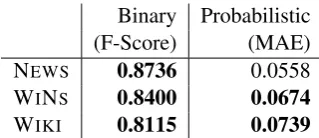
This paper presents the winning systems we submitted to the Complex Word Identifica-tion Shared Task 2018. We describe our best performing systems’ implementations and discuss our key findings from this research. Our best-performing systems achieve an F1
score of0.8736on the NEWS,0.8400on the WIKINEWS and 0.8115 on the WIKIPEDIA
test sets in the monolingual English binary classification track, and a mean absolute er-ror of 0.0558 on the NEWS, 0.0674 on the WIKINEWS and 0.0739 on the WIKIPEDIA
test sets in the probabilistic track. 1 Introduction
Poor reading comprehension often caused by the presence of complex technical terms can have se-rious practical consequences (Dubay,2004). Al-though proper text simplification requires a wide range of transformations, it has been shown that application of lexical simplification (LS) tech-niques alone improves reader understanding and information retention (Leroy et al., 2013). Com-plex Word Identification (CWI) is concerned with automated identification of words that might present challenge for the target readers and should thus be simplified (Shardlow,2013a). Early stud-ies on LS (Carroll et al., 1999; Devlin and Tait, 1998) do not consider CWI as part of the simplifi-cation pipeline, but recent studies argue that sim-plification systems benefit from applying CWI as the first step in the LS pipeline (Shardlow,2014; Paetzold and Specia,2016b). Inadequate identifi-cation of complex words in text might result in an overly difficult text if many potential candidates are missed, or in meaning distortion if many sim-ple words are falsely identified as comsim-plex.
CWI can not only be used as a component of LS systems, but also as a stand-alone applica-tion within intelligent tutoring systems for second
language learners or in reading devices for peo-ple with low literacy skills. For instance, Nation (2006) shows that at least 95% of text should be
familiar to the reader in order for them to under-stand the content. A CWI system can help iden-tify the unfamiliar words and provide readers with their definitions even when simpler alternatives are not available. This has the potential to help a wide variety of target reader groups, including general readers of technical texts (Feng,2008).
Following the SemEval 2016 shared task ( Paet-zold and Specia, 2016c), the Shared Task 2018 frames CWI as the process of identifying words that are difficult for a given target population (for example, non-native speakers of English) based on the annotation from a sample of that target popu-lation (Yimam et al.,2018). We overview the re-lated work in the field in Section2and discuss the CWI shared task framework in Section3. We have participated in the binary and probabilistic classifi-cation tasks in the monolingual English track, and scored first in the binary setting on all three data sources, as well as on two out of three data sources in the probabilistic setting. Section 4 presents the implementation details of our systems includ-ing features and methods used. In Section 5 we present the results obtained with our systems, and discuss the key findings. Finally, we outline future directions for this research in Section6.
2 Related Work
The earliest studies that address CWI as an in-dependent task are related to the medical do-main:Zeng et al.(2005) predict medical term fa-miliarity based on term occurrence, and show that individualised assessment is possible if the models consider readers’ demographics. Elhadad(2006), in addition to corpus frequency, consider using fa-miliarity features from the MRC Psycholinguistic
Database (Wilson,1988) and the number of senses from WordNet (Fellbaum, 2005). Zeng-Treitler et al.(2008) improve on the previous methods us-ing contextual information.
Some previous approaches to LS consider all words as potentially complex and try to simplify every word (Devlin and Tait, 1998; Thomas and Anderson, 2012; Bott et al., 2012). This has a number of undesirable effects, including radical changes in the original meaning and the depen-dence of the simplification process on the avail-ability of alternatives. For instance, the results ofHorn et al.(2014) show that such an approach is unable to find a simpler alternative for one third of the complex words in their dataset. Another type of approach introduces a threshold that is typ-ically based on the word frequency (Zeng et al., 2005;Elhadad,2006;Biran et al.,2011). Until re-cently (Shardlow,2013b), the lack of shared data to compare different approaches to CWI has been one of the bottlenecks for this task.
The CW corpus of Shardlow (2013b) is based on the edit histories in Simple Wikipedia, and in-cludes only the sentences where a single word is simplified.Paetzold and Specia(2016c) find that as much as 51.9% of the words in this corpus
are annotated as complex by at least one of their annotators and conclude that non-native speakers of English might still find the simplified version of Wikipedia challenging. The quality of Sim-ple Wikipedia and its usefulness for simplification research has been challenged before in Xu et al. (2015). Further experiments inShardlow (2013a) show that a more resource-intensive threshold-based approach does not perform significantly dif-ferently on this dataset to a more na¨ıve technique of simplifying everything, while an SVM classifier performs better in terms of precision but does so at the cost of a much lower recall. These findings inspired further research into classification-based approaches to CWI (Paetzold and Specia,2016c). The SemEval 2016 shared task on CWI com-bines the data from the CW corpus of Shard-low (2013b), the LexMTurk corpus of Horn et al. (2014) and the Simple Wikipedia corpus of Kauchak (2013), all of which rely on Simple Wikipedia data. A set of 400 non-native
speak-ers annotated the content words in the data as simple or complex. The information about anno-tator’s age, native language (L1), education and level of language proficiency has been collected,
but has not been used in the task. The final dataset has a bias towards annotation provided by the non-native speakers of upper levels of lan-guage proficiency and, potentially as a result of that, only about 11% of word types (and 3% of
word tokens) are annotated as complex (Paetzold and Specia, 2016c). The results of the shared task show that simpler features based on word fre-quency (Konkol, 2016; Wr´obel, 2016; Zampieri et al., 2016) and word presence in certain lexi-cons (Mukherjee et al.,2016;Wr´obel,2016), work best. A number of systems performing best in terms of G-score used various ensemble-based ap-proaches (Paetzold and Specia, 2016d; Ronzano et al., 2016; Mukherjee et al., 2016; Zampieri et al., 2016). The systems that performed best in terms of F-score used threshold-based ap-proaches (Wr´obel,2016;Malmasi et al.,2016) and frequency features (Malmasi and Zampieri,2016). In their analysis of the SemEval 2016 shared task,Zampieri et al.(2017), similarly toPaetzold and Specia(2016c), show that an ensemble of all systems does not outperform the best system or an ensemble of a few best-performing systems. The use of an oracle of the3best-performing systems
sets the upper bound at0.60F-score for the iden-tification of complex words and at 0.98 F-score
for the identification of simple words. They also show that the systems more reliably identify those complex words that are annotated as such by the majority of human annotators, arguing that lexi-cal complexity should be seen as a continuum on a spectrum rather than a binary value.
3 CWI Shared Task 2018 Setup
The CWI shared task uses the data fromYimam et al.(2017b), and approaches CWI from two per-spectives: under the binary (bin) view, a word can be either complex or simple, and in the prob-abilistic(prob) setting a word receives a score in the range of[0.0,1.0]reflecting the proportion of
annotators that consider the word complex. In this section, we briefly overview the CWI shared task 2018 framework, discuss the data and the annota-tion, and analyse the challenges the CWI systems are presented with in this task.
3.1 Data
different genres: professionally written news ar-ticles (NEWS), amateurishly written news
arti-cles (WIKINEWS), and WIKIPEDIA articles. The
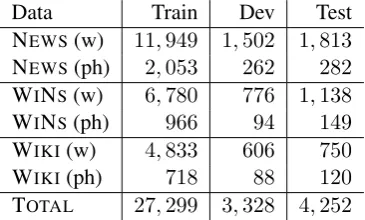
dataset includes annotation for content words as well as for phrases. The annotation for the English data is collected from both native and non-native speakers of English. Table 1 presents the statis-tics on the number of words (w) and phrases (ph) in the training (train), development (dev) andtest
subsets of the News (NEWS), WikiNews (WINS)
and Wikipedia (WIKI) datasets.
Data Train Dev Test
NEWS(w) 11,949 1,502 1,813
NEWS(ph) 2,053 262 282
WINS(w) 6,780 776 1,138
WINS(ph) 966 94 149
WIKI(w) 4,833 606 750
WIKI(ph) 718 88 120
[image:3.595.90.273.222.332.2]TOTAL 27,299 3,328 4,252
Table 1: Number of instances
3.2 Annotation
The annotation was performed using the Amazon Mechanical Turk platform. The set of annotators comprised 10 native and 10 non-native speakers
of English. They were presented with text para-graphs and were asked to select up to 10 lexical
items that they found complex. The lexical items included content words (e.g., nouns, verbs, adjec-tives and adverbs) and phrases up to50characters
in length. Additional information about the an-notators, such as their language proficiency, was collected but was not used in the task.
By allowing the annotators to select phrases as well as individual words, Yimam et al. (2017a) created a more practically useful dataset. By pre-senting the annotators with whole paragraphs, they replicated a realistic scenario in which words are interpreted in context. By not preselecting target lexical items, they avoided introducing the bias into the annotation, although it may be argued that the limit of10lexical items per paragraph
re-stricted the selection options. Finally, since the annotations are provided by both native and non-native speakers, this allowsYimam et al.(2017a) to explore to what extent the needs of non-native speakers can be estimated based on the needs of a wider target population. The analysis in Yimam et al. (2017a) shows that there are quantitative differences between the annotation provided by
the native and non-native speakers, and between the three genres. Further experiments show that the system trained on native speakers’ annotations performs better than the system trained on non-native speakers’ annotations, both on non-native and non-native data. Yimam et al.(2017a) also note that the inter-annotator agreement between native speakers is higher than between non-native speak-ers, which might be due to the fact that, unlike non-native annotators, native speakers share L1 and are of relatively similar language proficiency level. At the same time, these results suggest that the annotation provided by the native speakers can be used to predict the simplification needs of the non-native speakers as well.
The shared task relies on two types of annota-tion: under thebinsetting that words and phrases are annotated as complex (label1) if at least one of the20annotators annotated them as such, and
sim-ple (label0) otherwise; and under theprob set-ting that words and phrases receive a label in the range between [0.0, ...,1.0], with a step of 0.05,
reflecting the proportion of annotators who found the lexical item complex.
Table 2presents the distribution of simple and complex words in the dataset. We present the label break-down in terms of label percentages across the genres (NEWS, WINS, WIKI) and subsets of
data (tr for training, dev for development, andts
for test sets). Due to space limitations, for the
prob setting we present only the percentage of cases annotated as simple (0bin = 0.0prob), anno-tated as complex by a single annotator (0.05prob)
and by all20annotators (1.0prob).
Data 0bin 1bin 0.05prob 1.0prob NEWStr 60.41 39.59 13.52 0.39 NEWSdev 60.54 39.46 13.83 0.28 NEWSts 61.72 38.28 12.70 0.29 WINStr 58.48 41.52 16.25 0.17 WINSdev 59.43 40.57 14.25 0.11 WINSts 57.58 42.42 16.71 0.16 WIKItr 55.07 44.93 16.66 0.52 WIKIdev 51.15 48.85 19.31 0.14 WIKIts 49.54 50.46 18.62 0.23
Table 2: Annotation labels break-down (%)
These figures demonstrate that: (1) there is a quantitative difference in the annotation across the three genres, with NEWSbeing the easier to
com-plex words) and WIKI being the most complex
(44.93% to50.46% complex words), which
sug-gests that systems might perform better if trained and tested within the same genre; (2) the distri-bution of complex and simple words across train-ing, development and test subsets is consistent for NEWS and WINS with a difference in label
dis-tribution of no more than 2.5% – this suggests
that the systems for these two genres might gener-alise better than the one for WIKIPEDIA; (3) about
1/3 of the complex word annotation comes from
a single annotator finding a word complex, while the cases where all 20 annotators agree that the
word is complex comprise less than1%in all
sub-sets. Furthermore, we have identified the follow-ing challenges presented by the dataset:
Context-specific annotation: Since the lexical items were presented to the annotators in a vari-ety of contexts, the item might have received dif-ferent annotation depending on the context. Be-tween3%and10%of lexical items in the binary
setting received different annotation, and in the probabilistic setting a number of words received a wide range of labels: e.g. the labels for observa-toryrange from0.0to0.95, and fortragedyfrom 0.0to1.0. There are several possible reasons for
this effect:
• surrounding context might help or impede
understanding of a target word;
• the word might be used in a rare sense; • the data might show a sequential bias
ef-fect (Mathur et al.,2017).
Consider the following example from the WIKI
training set:
(1) Beethoven’s Symphony0.6 No.7, Bruckner’s Symphony0.1 No.6 and Mendelssohn’s Symphony0.0 No.4 comprise a nearly complete list of sym-phonies0.3 in this key in the Romantic era.
The first occurrence of the wordsymphony is an-notated as complex by12 annotators, the second
one by 2 while the third one is not considered
complex by any annotators. This might suggest that (1) by the third occurrence of the same word the annotators perceive the word as familiar, (2) some of them found it unnecessary to annotate a word multiple times, (3) given the restriction of
10 complex items per paragraph they prioritised
other words. The annotation ofsymphonies illus-trates that the annotators might find different mor-phological forms of the same word challenging.
Phrase annotation: The annotators were al-lowed to select phrases of up to 50 characters in
length. At the same time, the component words within the phrase might have been annotated as complex independently by other annotators. This results in cases like (2), where the phrase ity is a derivative of the component word complex-ities, as well as (3) where the phrase annotation is independent of the component words:
(2) future0.05∪generations0.25=future
gen-erations0.15
(3) traditional0.2 ∪ connection0.0 ∪
coun-try0.05 6= traditional connection to that
country0.0
Annotation of proper nouns : Proper nouns received a variety of labels: e.g., from0.0to0.45
forEurozone, 0.0 to0.05 forBarack,0.05 to0.3
forBrexit, and from0.0to0.05or0.1for a
num-ber of geographical locations like Copenhagen,
Estonia, Hungary, Warsaw, etc. The annotation in such cases depends more on world knowledge than on the properties of the wordsper se.
3.3 Evaluation
The systems in thebin setting are evaluated us-ing F-score. The systems in theprobsetting are evaluated usingmean absolute error(MAE) which estimates the average difference between the val-ues in the gold standard and valval-ues predicted by the system across all test instances.
4 CAMB systems
This section describes the implementation details of theCAMBmachine learning framework applied to the shared task data sets.
4.1 Features
(CALD),1and (4) the use of Google N-gram word
frequencies sourced using theDatamuseAPI.2 4.1.1 Word N-gram and POS
The target word and its syntactic class are repre-sented as matrices of token counts. For words, the token counts represent the whole vocabulary as well as character-based bi-grams contained within the words (N-gram). The part of speech tags
(POS) each correspond to a value within the ma-trix. The syntactic class of the word is obtained by performing part of speech tagging on all sen-tences containing target words using the NLPCore pipeline (Manning et al.,2014).
4.1.2 Lexical Features
These features are based on the lexical information about the target word and include:
• Word length (Len): the number of characters
in the word.
• Number of syllables (Syll): the syllable count for the target word, collected using the Data-museAPI.
• WordNet Features: number of senses (Syn), number of hypernyms (Hyper) and hy-ponyms (Hypo) for the word’s lemma from WordNet (Fellbaum,2005).
4.1.3 Dependency Parse Relations
The data was parsed using the NLPCore pipeline, and the number of dependency relations for the target word are extracted and used as a feature (DepNum).
4.1.4 Lexicon-Based Features
All but the the last in the following list of features are binary features indicating the presence of the word within a lexicon. CALD returns a CEFR level of the target word on the scale[1,6]:
• SubIMDB: a list produced using the
SubIMDB corpus (Paetzold and Specia, 2016a). The word frequency in the subtitles from the ’Movies and Series for Children’ section is calculated, and the top 1,000
words are included in this list.
• Simple Wikipedia (SimpWiki): a list of the
top 6,368 words contained in the Simple Wikipedia (Coster and Kauchak,2011).
1Publicly available through http://www.
englishprofile.org/wordlists
2https://www.datamuse.com/api/
• Ogden’s Basic English: a list of1,000words from Ogden’s Basic English list (Ogden, 1968).
• Cambridge Advanced Learners Dictionary (CALD): the entries contained in the Cam-bridge Advanced Learner’s Dictionary with their CEFR levels.
4.1.5 Word Frequency
The frequency of the target word (Freq) is esti-mated using the Google dataset of syntactic n-grams (Goldberg and Orwant,2013).
4.1.6 MCR Features
We extract the psycholinguistic features of the target words from the MCR Psycholinguistic Database (Wilson,1988). As the coverage of this database is relatively low, if a target word is not in the dataset we use anullvalue.
• Word familiarity rating (FAM)in the range of
[100,700]is based on a combination of3sets
of familiarity norms: Pavio (unpublished), Toglia and Battig (1978) and Gilhooly and Logie(1980).
• Number of phonemes (NPHN)
• Thorndike-Lorge written frequency (TLFRQ)
– the frequency of occurrence derived from Thorndike and Lorge(1944).
• Imageability rating (IMG), representing the ease of associating the word with an image, is derived from the same combination of sets as the familiarity rating.
• Concreteness rating (CNC)represents the
de-gree to which the concept denoted by a word refers to a perceivable entity based on the norms ofGilhooly and Logie(1980).
• Thenumber of categories (KFCAT),samples (KFSMP) and written frequency (KFFRQ)
are derived fromKuˇcera and Francis(1967).
• Age of acquisition (AOA) is based on the norms ofGilhooly and Logie(1980), multi-plied by100to produce a number in the range
of[100,700](min125, max697, mean405,
SD120).
4.2 Method
4.2.1 Binary Classification Approach
As a wide range of heterogeneous features are em-ployed by both the classification and regression systems, a feature union pipeline is applied. We use thesklearnmachine learning framework.3
The numerical features are normalized using a Standard Scaler, which subtracts the mean and scales the data to unit variance. Text-based fea-tures are represented as a matrix of token counts using a Count Vectorizer component.
Experiments on the development set confirm the findings of Paetzold and Specia (2016c) that the best performing classification algorithms for this task are ensemble-based techniques. Of these, the boosting classifier AdaBoost with
5000estimators achieves the highest results,
fol-lowed by the bootstrap aggregation classifier
Random Forest. For the WIKIPEDIA and
NEWS datasets, the best performance is attained
using AdaBoost. However for the WIKINEWS
an ensemble voting classifier that combines both the AdaBoost and Random Forest classifiers with equal weightings gives the highest F-Score.
4.2.2 Experimental Setup Feature Selection
The effectiveness of features varies according to the data set classified. For the WIKINEWS and
NEWS all aforementioned features are integrated
into the systems. The feature set for WIKIPEDIA
does not include MCR psycholinguistic features.
Training Data
The performance of the classifier also varies ac-cording to the genre of data used for training. The WIKIPEDIA and WIKINEWS are best
classi-fied when all available training data are used (i.e., NEWS, WIKINEWS and WIKIPEDIA combined),
whereas the best results are achieved on the NEWS
when the system is trained using the NEWSdataset
only.
4.2.3 Probabilistic Classification Approach
The probabilistic setting uses the same set of features as the binary classification algorithms. We use the Linear Regression algorithm, and the lowest MAE values are achieved with the following settings: we use all features and all training data for the NEWS, all but MRC
psycholinguistic features and all training data for the WIKINEWS, and a combination of the
3http://scikit-learn.org/stable/
WIKIPEDIA and WIKINEWS training data and
all but MRC psycholinguistic features for the WIKIPEDIA.
Since the gold standard labels for the probabilis-tic classification tasks lie in the range of[0.0,1.0]
with a step of0.05reflecting the proportion of
an-notators, we round the classifier’s prediction to the nearest value on this scale.
4.2.4 Phrase Complexity Prediction
Table 1 shows that there are a non-negligible amount of phrases in the data. We implement three binary classification approaches and one proba-bilistic classification approach to predict phrase complexity.
Binary Classification Techniques
• CW presence: Each word within the phrase
is first classified using our word-based CW classifier. If the total number of complex words is above a pre-defined threshold then the phrase is marked as complex.
• N-gram classifier: The frequency of n-grams
contained within phrases is obtained from the Corpus of Contemporary American En-glish (Davies,2009). An AdaBoost classifier is first trained using these frequencies as fea-tures, and then applied to classify new phrase instances.
• Greedy approach: The greedy baseline ap-proach simply labels all phrases as complex.
Probabilistic Classification Techniques
For the probabilistic setting, we first apply our word-based CW regression classifier, and then de-rive the phrase complexity label as the mean of the complexity values within the phrase. Note that this technique helps us correctly predict the phrase complexity for cases similar to example (2) from Section3, but not for cases similar to example (3).
5 Results
In this Section, we present and discuss the results obtained with the CAMB systems. The systems submitted to the shared task scored first in the bi-nary classification English track on all three text genres, first on the WIKINEWS and WIKIPEDIA
test sets and third on the NEWS test set in the
5.1 Test Set Results
Binary Probabilistic (F-Score) (MAE) NEWS 0.8736 0.0558
WINS 0.8400 0.0674
[image:7.595.100.260.88.157.2]WIKI 0.8115 0.0739 Table 3: Test set results
The final test files across all genres contain a to-tal of 3,701words and 551 phrases. Words are
classified using the tailored approaches according to the dataset genre. In the shared task submis-sion, phrases are independently classified using the greedy approach (see Section4).
5.2 Analysis
Per-Genre Performance
Classification performance as well as feature rel-evance varies across the datasets. In the binary setting, the highest performance is obtained on the NEWSdata when the system is trained on the
NEWS data only. In the probabilistic setting, the
system performs best on the NEWS data as well.
Table 2 suggests that NEWS contains the lowest
number of complex words, and Table 4 shows the total number of words, the number of unique words and the percentage of unique words within each genre.
NEWS WINS WIKI
Total 13,461 7,559 5,439
Unique 3,376 3,334 3,157 % 25.08 44.10 58.44
Table 4: Unique words distribution
Table 4 suggests that the NEWS dataset contains
the lowest number of unique words, which might be the effect of more restricted vocabulary used in professional news. As a result, the classifier is likely to have multiple exposure to the same word (albeit in different contexts) during training. At the same time, WIKIPEDIA with its58.44% has
the highest ratio of unique words, which might be due to the fact that it covers a very broad range of subjects. Note, that WIKIPEDIA is both more
challenging for human annotators (highest per-centage of complex words in Table2) and the clas-sifiers (lowest results in both settings in Table3). This might explain why the classifiers benefit from training on multiple data sources in this case.
Our CWI systems are context-independent, which means that a word or a phrase receives the same complexity label regardless of a particular context of use. E.g., all three occurrences of the word Symphony in the example (1) from Section 3 would receive the same complexity label from our system. This limitation is the biggest source of error for the NEWSdataset (88.94%of the
mis-classified words in the NEWS test set have
multi-ple labels in the data) and the WIKINEWSdataset
(61.31%), while the proportion of such cases in the
WIKIPEDIA data is lower (52.78%) which might
also be due to the higher ratio of unique words in the WIKIPEDIAdata.
Phrase Classification Results
The CAMB submission to the shared task applies a simple greedy approach to the phrase classifi-cation. We run experiments with more informed approaches overviewed in Section4 and evaluate whether these approaches improve performance. Table5presents the results obtained with the dif-ferent approaches to the phrase classification in the binary setting. The results of the system submitted to the shared task are marked in bold.
Data Acc P R F-Score
CW pres. 0.6987 0.8049 0.8231 0.8139
N-gram 0.8004 0.8015 0.9977 0.8889
[image:7.595.310.534.422.476.2]Greedy 0.8004 0.8004 1.000 0.8891
Table 5: Binary classification results for the phrase classification in the test set
The results suggest that the more linguistically in-formed n-gram classifier is capable of achieving results similar to the baseline greedy approach that simply labels all phrases as complex. To test how it would score in the shared task, we re-run the experiments using the n-gram based phrase classi-fier, and report the results in Table6.
Data Acc P R F-Score
NEWS 0.8535 0.7778 0.8641 0.8479
WINS 0.8423 0.8046 0.8297 0.8392
WIKI 0.8081 0.8254 0.7859 0.8080
Table 6: Test set results using n-gram phrase classifier
We note a drop of 3.13% for the F-score on the
NEWS dataset, although the difference in the
[image:7.595.99.263.477.531.2]Features NEWS WINS WIKI N-grams 0.792 0.789 0.754
POS 0.033 0.035 0.046
Freq 0.029 0.029 0.043
Syn 0.020 0.027 0.013
FAM 0.016 0.008 0.019
Syll 0.013 0.021 0.018
KFSMP 0.012 0.010 0.008
SimpWiki 0.010 0.011 0.005
TLFRQ 0.010 0.009 0.011
[image:8.595.94.267.61.211.2]CNC 0.009 0.010 0.009
Table 7: Gini coefficient for feature contribution
Individual Feature Contribution
We analyse the contribution of individual features to the classification framework. Table 7 reports the Gini coefficient for the top10informative
fea-tures across different datasets. The Gini coeffi-cient is defined as the total decrease in node im-purity, weighted by the probability of reaching that node, averaged over all trees of the ensemble (Breiman,2015).
We also note that the combination of all fea-tures achieves best results on the NEWS and
WIKINEWS data sets, but the results on the
WIKIPEDIA data decrease when the MCR
Psy-cholinguistic Database features are included. We have noted above that one of the reasons for lower performance on the WIKIPEDIAdata is due to the
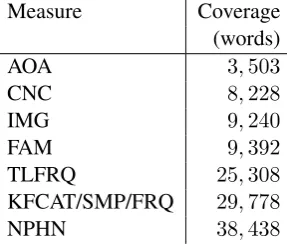
more diverse vocabulary. In addition to that, we note that the MCR Psycholinguistic Database con-tains values for 150,837 words, but some
mea-sures provide much lower coverage (see Table8).
Measure Coverage
(words)
AOA 3,503
CNC 8,228
IMG 9,240
FAM 9,392
TLFRQ 25,308
KFCAT/SMP/FRQ 29,778
[image:8.595.308.531.149.233.2]NPHN 38,438
Table 8: Number of feature instances covered by the MCR Database
As the WIKIPEDIAdataset has the largest
propor-tion of unique words, it is likely that these features do not improve the classification accuracy due to their sparsity.
Performance Across Parts of Speech
Table9reports the results achieved by the binary classification algorithm on the different parts of speech in the test files. We include only content words in our analysis.
Data Size Acc P R F
Total Test 3,701 0.86 0.82 0.79 0.85
Nouns 2,427 0.86 0.80 0.76 0.84
Verbs 718 0.84 0.83 0.81 0.84
Adjectives 435 0.88 0.86 0.86 0.87
Adverbs 111 0.91 0.89 0.92 0.91
Table 9: POS Classification Metrics
We note that nouns represent the largest proportion of all test items, while showing the lowest preci-sion and recall. We hypothesise that one of the reasons for that might be the dependence of the noun annotation on the context and the context-independent nature of our classifiers. In addition, as we note in Section3, the complexity of proper nouns largely depends on the world knowledge and is harder to model with a machine learning approach: 12.56% of misclassified instances in
the NEWS data, 22.02% in the WIKINEWS and
22.92%in the WIKPEDIAare proper nouns. 6 Conclusion
In this paper, we have presented the implementa-tion of the CAMB systems submitted to the CWI Shared Task 2018, and discussed the key chal-lenges for the systems. Our systems scored first on three text genres in the binary classification track, and on two out of three genres in the probabilistic track. Further analysis of the performance identi-fies future directions for this research.
First of all, our systems are implemented in a context-independent way, while the context of use clearly affects the perception of word complex-ity. Future research will look into the ways to in-clude contextual features into the machine learn-ing framework. In addition, future work should investigate how phrase complexity is derived from individual word complexity scores.
[image:8.595.109.253.536.658.2]Acknowledgments
We are grateful to Cambridge English for support-ing this research via the ALTA Institute.
References
Or Biran, Samuel Brody, and Noemie Elhadad. 2011. Putting it Simply: a Context-Aware Approach to Lexical Simplification. In Proceedings of the 49th Annual Meeting of the Association for Com-putational Linguistics:shortpapers, pages 496–501, Portland, Oregon. Association for Computational Linguistics.
Stefan Bott, Luz Rello, Biljana Drndarevic, and Hora-cio Saggion. 2012. Can Spanish Be Simpler? Lex-SiS: Lexical Simplification for Spanish. In Pro-ceedings of COLING 2012: Technical Papers, pages 357–374, Mumbai. COLING.
Leo Breiman. 2015. Random forests leo breiman and adele cutler. Random Forests-Classification De-scription.
John Carroll, Guido Minnen, Darren Pearce, Yvonne Canning, Siobhan Devlin, and John Tait. 1999. Sim-plifying Text for Language-Impaired Readers. In
Proceedings of the 9th Conference of the European Chapter of the ACL (EACL’99), pages 269–270, Bergen, Norway.
William Coster and David Kauchak. 2011. Simple en-glish wikipedia: a new text simplification task. In
Proceedings of the 49th Annual Meeting of the Asso-ciation for Computational Linguistics: Human Lan-guage Technologies: short papers-Volume 2, pages 665–669. Association for Computational Linguis-tics.
Mark Davies. 2009. The 385+ million word corpus of contemporary american english (1990–2008+): De-sign, architecture, and linguistic insights. Interna-tional journal of corpus linguistics, 14(2):159–190. Siobhan Devlin and John Tait. 1998. The use of a
psy-cholinguistic database in the simplification of text for aphasic readers. Linguistic Databases, pages 161–173.
William H. Dubay. 2004. The Principles of Readabil-ity.Costa Mesa, CA: Impact Information.
Noemie Elhadad. 2006. Comprehending Technical Texts: Predicting and Defining Unfamiliar Terms. In AMIA Annual Symposium Proceedings, pages 239–243.
The Council of Europe. 2011. Common European Framework of Reference for Languages: Learning, Teaching, Assessment.
Christiane Fellbaum. 2005. Encyclopedia of Language and Linguistics, Second Edition, chapter WordNet and wordnets. Oxford: Elsevier.
Lijun Feng. 2008. Text simplification: A survey. Tech-nical report, CUNY.
Ken J Gilhooly and Robert H Logie. 1980. Age-of-acquisition, imagery, concreteness, familiarity, and ambiguity measures for 1,944 words. Behavior re-search methods & instrumentation, 12(4):395–427.
Yoav Goldberg and Jon Orwant. 2013. A dataset of syntactic-ngrams over time from a very large corpus of english books. In Second Joint Conference on Lexical and Computational Semantics (* SEM), Vol-ume 1: Proceedings of the Main Conference and the Shared Task: Semantic Textual Similarity, volume 1, pages 241–247.
Colby Horn, Cathryn Manduca, and David Kauchak. 2014. Learning a lexical simplifier using Wikipedia. InProceedings of the 52nd ACL, pages 458–463.
David Kauchak. 2013. Improving text simplification language modeling using unsimplified text data. In
Proceedings of the 51st ACL, pages 1537–1546.
Michal Konkol. 2016. Uwb at semeval-2016 task 11: Exploring features for complex word identifi-cation. In Proceedings of the 10th International Workshop on Semantic Evaluation (SemEval-2016), pages 1038–1041, San Diego, California. Associa-tion for ComputaAssocia-tional Linguistics.
Henry Kuˇcera and Winthrop Nelson Francis. 1967.
Computational analysis of present-day American English. Dartmouth Publishing Group.
Gondy Leroy, James E. Endicott, David Kauchak, Obay Mouradi, and Melissa Just. 2013. User Evalu-ation of the Effects of a Text SimplificEvalu-ation Algo-rithm Using Term Familiarity on Perception, Un-derstanding, Learning, and Information Retention.
Journal of Medical Internet Research (JMIR), 7(15).
Shervin Malmasi, Mark Dras, and Marcos Zampieri. 2016. Ltg at semeval-2016 task 11: Complex word identification with classifier ensembles. In Proceed-ings of the 10th International Workshop on Semantic Evaluation (SemEval-2016), pages 996–1000, San Diego, California. Association for Computational Linguistics.
Shervin Malmasi and Marcos Zampieri. 2016. Maza at semeval-2016 task 11: Detecting lexical com-plexity using a decision stump meta-classifier. In
Proceedings of the 10th International Workshop on Semantic Evaluation (SemEval-2016), pages 991– 995, San Diego, California. Association for Com-putational Linguistics.
Nitika Mathur, Timothy Baldwin, and Trevor Cohn. 2017. Sequence Effects in Crowdsourced Annota-tions. In Proceedings of the 2017 Conference on Empirical Methods in Natural Language Processing (EMNLP), pages 2860–2865.
Niloy Mukherjee, Braja Gopal Patra, Dipankar Das, and Sivaji Bandyopadhyay. 2016. Ju nlp at semeval-2016 task 11: Identifying complex words in a sen-tence. In Proceedings of the 10th International Workshop on Semantic Evaluation (SemEval-2016), pages 986–990, San Diego, California. Association for Computational Linguistics.
I. S. Paul Nation. 2006. How Large a Vocabulary Is Needed For Reading and Listening? The Canadian Modern Language Review/La Revue canadienne des langues vivantes, 63(1):59–82.
Charles Kay Ogden. 1968. Basic English: interna-tional second language. Harcourt, Brace & World. Gustavo Paetzold and Lucia Specia. 2016a. Collecting
and exploring everyday language for predicting psy-cholinguistic properties of words. In Proceedings of COLING 2016, the 26th International Confer-ence on Computational Linguistics: Technical Pa-pers, pages 1669–1679.
Gustavo Paetzold and Lucia Specia. 2016b. Plumberr: An automatic error identification framework for lex-ical simplification. In Proceedings of the first in-ternational workshop on Quality Assessment for Text Simplification (QATS), pages 1–9, Portoroz, Slovenia. European Language Resources Associa-tion (ELRA).
Gustavo Paetzold and Lucia Specia. 2016c. SemEval 2016 Task 11: Complex Word Identification. In
Proceedings of the 10th International Workshop on Semantic Evaluation (SemEval-2016), pages 560– 569, San Diego, California. Association for Com-putational Linguistics.
Gustavo Paetzold and Lucia Specia. 2016d. Sv000gg at semeval-2016 task 11: Heavy gauge complex word identification with system voting. InProceedings of the 10th International Workshop on Semantic Eval-uation (SemEval-2016), pages 969–974, San Diego, California. Association for Computational Linguis-tics.
Francesco Ronzano, Ahmed Abura’ed, Luis Es-pinosa Anke, and Horacio Saggion. 2016. Taln at semeval-2016 task 11: Modelling complex words by contextual, lexical and semantic features. In
Proceedings of the 10th International Workshop on Semantic Evaluation (SemEval-2016), pages 1011– 1016, San Diego, California. Association for Com-putational Linguistics.
Matthew Shardlow. 2013a. A comparison of tech-niques to automatically identify complex words. In
Proceedings of the Student Research Workshop at the 51st Annual Meeting of the Association for Com-putational Linguistics (ACL), pages 103–109, Sofia,
Bulgaria. Association for Computational Linguistics (ACL).
Matthew Shardlow. 2013b. The cw corpus: A new re-source for evaluating the identification of complex words. InProceedings of the 2nd Workshop on Pre-dicting and Improving Text Readability for Target Reader Populations, pages 69–77, Sofia, Bulgaria. Association for Computational Linguistics (ACL).
Matthew Shardlow. 2014. Out in the open: Finding and categorising errors in the lexical simplification pipeline. InIn Proceedings of the 9th LREC, pages 1583–1590.
S. Rebecca Thomas and Sven Anderson. 2012. WordNet-Based Lexical Simplification of a Docu-ment. In Proceedings of KONVENS 2012 (Main track: oral presentations), Vienna.
Edward L Thorndike and Irving Lorge. 1944. The teacher’s wordbook of 30,000 words. new york: Columbia university, teachers college.
Michael P Toglia and William F Battig. 1978. Hand-book of semantic word norms. Lawrence Erlbaum.
Michael Wilson. 1988. The MRC Psycholinguistic Database: Machine Readable Dictionary, Version 2. Behavioural Research Methods, Instruments and Computers, pages 6–11.
Krzysztof Wr´obel. 2016. Plujagh at semeval-2016 task 11: Simple system for complex word identi-fication. In Proceedings of the 10th International Workshop on Semantic Evaluation (SemEval-2016), pages 953–957, San Diego, California. Association for Computational Linguistics.
Wei Xu, Chris Callison-Burch, and Courtney Napoles. 2015. Problems in Current Text Simplification Re-search: New Data Can Help. Transactions of the Association for Computational Linguistics (TACL), 3:283–297.
Seid Muhie Yimam, Chris Biemann, Shervin Mal-masi, Gustavo Paetzold, Lucia Specia, Sanja ˇStajner, Ana¨ıs Tack, and Marcos Zampieri. 2018. A Report on the Complex Word Identification Shared Task 2018. InProceedings of the 13th Workshop on In-novative Use of NLP for Building Educational Ap-plications, New Orleans, United States. Association for Computational Linguistics.
Seid Muhie Yimam, Sanja ˇStajner, Martin Riedl, and Chris Biemann. 2017b. Multilingual and Cross-Lingual Complex Word Identification. In Proceed-ings of the International Conference Recent Ad-vances in Natural Language Processing, RANLP 2017, pages 813–822, Varna, Bulgaria. INCOMA Ltd.
Marcos Zampieri, Shervin Malmasi, Gustavo Paetzold, and Lucia Specia. 2017. Complex Word Identifi-cation: Challenges in Data Annotation and System Performance. InProceedings of the 4th Workshop on Natural Language Processing Techniques for Ed-ucational Applications (NLPTEA 2017), pages 59– 63, Taipei, Taiwan. Asian Federation of Natural Language Processing.
Marcos Zampieri, Liling Tan, and Josef van Genabith. 2016. Macsaar at semeval-2016 task 11: Zip-fian and character features for complexword iden-tification. InProceedings of the 10th International Workshop on Semantic Evaluation (SemEval-2016), pages 1001–1005, San Diego, California. Associa-tion for ComputaAssocia-tional Linguistics.
Qing Zeng, Eunjung Kim, Jon Crowell, and Tony Tse. 2005. Biological and Medical Data Analy-sis. ISBMDA 2005. Lecture Notes in Computer Sci-ence, volume 3745 of ISBMDA 2005, chapter A Text Corpora-Based Estimation of the Familiarity of Health Terminology. Springer, Berlin, Heidelberg.