Proceedings of Discourse Relation Parsing and Treebanking (DISRPT2019), pages 97–104 97
The DISRPT 2019 Shared Task on Elementary Discourse Unit
Segmentation and Connective Detection
∗Amir Zeldes
Georgetown University [email protected]
Debopam Das
University of Potsdam [email protected]
Erick Galani Maziero
Federal University of Lavras [email protected]
Juliano Desiderato Antonio
Universidade Estadual de Maringa [email protected]
Mikel Iruskieta
University of the Basque Country [email protected]
Abstract
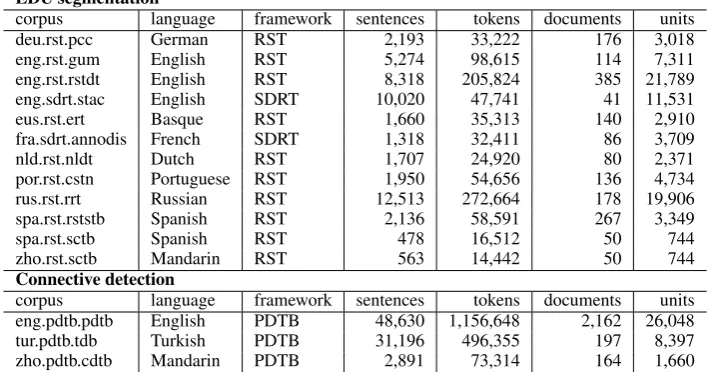
In 2019, we organized the first iteration of a shared task dedicated to the underlying units used in discourse parsing across formalisms: the DISRPT Shared Task on Elementary Dis-course Unit Segmentation and Connective De-tection. In this paper we review the data in-cluded in the task, which cover 2.6 million manually annotated tokens from 15 datasets in 10 languages, survey and compare submit-ted systems and report on system performance on each task for both annotated and plain-tokenized versions of the data.
1 Introduction
The past few years have seen substantial advances in both the development of new discourse anno-tated corpora for diverse languages (e.g. Iruski-eta et al. 2013, Zhou et al. 2014, Afantenos et al. 2012) and approaches to automatic discourse parsing relying on neural and other architectures (Braud et al. 2017, Wang and Lan 2015,Li et al. 2016, Perret et al. 2016). Across frameworks, most work producing substantial amounts of data in multiple languages has been developed within Rhetorical Structure Theory (Mann and Thomp-son,1988), the Penn Discourse Treebank’s frame-work (Prasad et al., 2014) and Segmented Dis-course Representation Theory (Asher,1993).
At the same time, there is reason to believe that performance on discourse parsing still has a substantial way to go (Morey et al., 2017), with scores on deep discourse parsing for well studied and homogeneous resources such as the English RST Discourse Treebank (Carlson et al., 2003) still well behind human annotators, and results
∗
Discourse Relation Parsing and Treebanking (DIS-RPT): 7th Workshop on Rhetorical Structure Theory and Related Formalisms (https://sites.google.com/ view/disrpt2019) was held in conjunction with Annual Conference of the NAACL 2019 in Minneapolis, MN.
for other datasets, especially in less studied and lower resource languages lagging much farther be-hind. To make matters worse, the vast majority of deep discourse parsing papers work with gold segmented discourse units, which allow for eas-ier comparisons of scores, but represent an unre-alistically easy scenario. In their recent survey of discourse parsing results, Morey et al. (2017, 1322) point out that “all the parsers in [their] sam-ple except [two] predict binary trees over manually segmented EDUs”,1 meaning that we have very limited information on the accuracy of discourse parsing in realistic settings. In order for discourse parsing to come closer to the reliability of syn-tactic parsing, a similarly reliable state of the art (SOA) for segmentation into terminal units must be reached.
The comparison with work on syntax parsing brings another point of interest into focus: the recent success of Universal Dependencies (Nivre et al., 2017) as a standard bringing together re-sources from different languages has been instru-mental in creating generic NLP tools that are flexi-ble and applicaflexi-ble to a variety of tasks. This is not only due to converging cross-linguistic annotation guidelines and the codification of a uniform for-mat based on the CoNLL shared task datasets, but also due to the community building afforded by the organization of joint workshops which bring together researchers from a range of domains.
Within this landscape, the first multilingual and cross-framework task on discourse unit segmen-tation and connective detection aims to promote the development of reliable tools for working with the basic building blocks of discourse annotation. Although it is clear that there are substantial
EDU segmentation
corpus language framework sentences tokens documents units
deu.rst.pcc German RST 2,193 33,222 176 3,018
eng.rst.gum English RST 5,274 98,615 114 7,311
eng.rst.rstdt English RST 8,318 205,824 385 21,789
eng.sdrt.stac English SDRT 10,020 47,741 41 11,531
eus.rst.ert Basque RST 1,660 35,313 140 2,910
fra.sdrt.annodis French SDRT 1,318 32,411 86 3,709
nld.rst.nldt Dutch RST 1,707 24,920 80 2,371
por.rst.cstn Portuguese RST 1,950 54,656 136 4,734
rus.rst.rrt Russian RST 12,513 272,664 178 19,906
spa.rst.rststb Spanish RST 2,136 58,591 267 3,349
spa.rst.sctb Spanish RST 478 16,512 50 744
zho.rst.sctb Mandarin RST 563 14,442 50 744
Connective detection
corpus language framework sentences tokens documents units eng.pdtb.pdtb English PDTB 48,630 1,156,648 2,162 26,048
tur.pdtb.tdb Turkish PDTB 31,196 496,355 197 8,397
[image:2.595.121.477.68.254.2]zho.pdtb.cdtb Mandarin PDTB 2,891 73,314 164 1,660
Table 1: Datasets in the DISRPT 2019 shared task.
ferences in guidelines and goals across different formalisms and datasets, we hope that the shared task will contribute to a broad discussion of dis-course annotation standards and goals, and put less studied resources in focus, next to more frequently addressed corpora such as PDTB (Prasad et al.,
2008) and RST-DT (Carlson et al.,2003). Addi-tionally, the release of the DISRPT 2019 shared task dataset2in a uniform format, modeled on the CoNLL-U format used by Universal Dependen-cies, is meant as a first step in creating a multi-lingual testing grounds for discourse parsing sys-tems, starting with the basic task of identifying the minimal locus at which discourse relations apply: discourse units and connectives.
2 Shared task data
The DISRPT 2019 shared task dataset comprises 15 datasets in 10 languages, 12 of which tar-get elementary discourse unit segmentation, and 3 dedicated to explicit connective annotation. Ta-ble 1 gives an overview of the datasets. Of the 15 datasets, 14 were released approximately 1.5 months before the shared task deadline, while the final one, connective annotations from the Turk-ish Discourse Bank, was released as a ‘surprise’ dataset/language together with dev and test sets just two weeks before the announced deadline. For four of the datasets, licensing constraints pre-vented online publication of the underlying texts (e.g. Wall Street Journal material), meaning that the public repository contains only annotations
2https://github.com/disrpt/sharedtask2019
.
for those corpora, with tokens replaced by under-scores. A script included in the shared task reposi-tory was provided in order to reconstruct the data, which requires users to have access to the original LDC releases of the underlying corpora.
The short names for every dataset begin with an ISO 639-3 three letter code for the language, a framework designation (RST/SDRT/PDTB) and an acronym for the corpus. The names correspond to the following included corpora:
− deu.rst.pcc - Potsdam Commentary Corpus (Stede and Neumann,2014).
− eng.pdtb.pdtb - Penn Discourse Treebank (Prasad et al.,2014).
− eng.rst.gum - Georgetown University Multi-layer corpus (Zeldes,2017).
− eng.rst.rstdt - RST Discourse Treebank ( Carl-son et al.,2003).
− eng.sdrt.stac - Strategic Conversations corpus (Asher et al.,2016).
− eus.rst.ert - Basque RST Treebank (Iruskieta et al.,2013).
− fra.sdrt.annodis - ANNOtation DIScursive (Afantenos et al.,2012).
− nld.rst.nldt - Dutch Discourse Treebank ( Re-deker et al.,2012).
− por.rst.cstn - Cross-document Structure The-ory News Corpus (Cardoso et al.,2011).
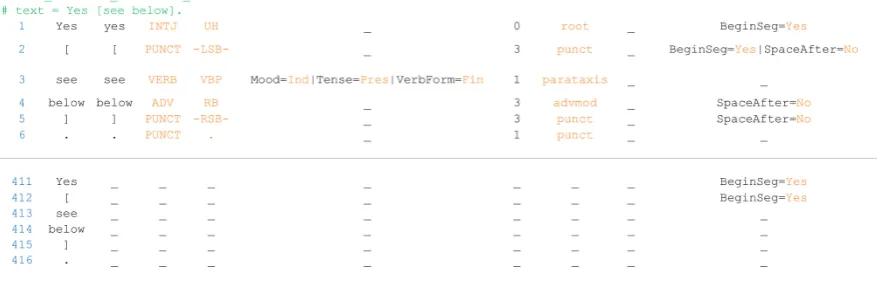
Figure 1: Data formats: treebanked (*.conll, top) and plain (*.tok, bottom)
− spa.rst.rststb - RST Spanish Treebank (da Cunha et al.,2011).
− spa.rst.sctb - RST Spanish-Chinese Treebank (Spanish) (Shuyuan et al.,2018).
− tur.pdtb.tdb - Turkish Discourse Bank (Zeyrek et al.,2010).
− zho.pdtb.cdtb - Chinese Discourse Treebank (Zhou et al.,2014).
− zho.rst.sctb - RST Spanish-Chinese Treebank (Chinese) (Shuyuan et al.,2018).
As Table 1 shows, these datasets range from small (under 15,000 tokens for the smallest cor-pus, zho.rst.sctb), to the larger RST corpora (over 200,000 tokens for RST-DT and the Russian RST Treebank), to the largest PDTB-style datasets (al-most half a million tokens for Turkish, and over a million for the English PDTB). The variability in sizes, languages, frameworks, and corpus-specific annotation guidelines were expected to challenge systems, but also promote architectures which can be extended to more languages in the future, and ideally stay robust for low resource settings.
Data was released for all corpora in two for-mats, corresponding to two scenarios: Treebanked data (*.conll), which included an (ideally gold)
dependency parse, including gold sentence splits and POS tags, and unannotated, plain tokens (*.tok). For datasets that had Universal POS
tags and/or UD dependencies, including these was preferred, though we followed the CoNLL-U for-mat’s convention of allowing two POS tag fields (UPOS for universal tags, XPOS for language specific tags), a morphology field with unlimited morphological annotations, and a secondary de-pendency field (only used in the Dutch dataset). The tenth column (MISC in CoNLL-U) was used
for gold standard labels and additional annota-tions (e.g. SpaceAfter to indicate whites-pace in underlying data), which all followed the CoNLL-U key=value format: BeginSeg=Yes
for EDU segmentation and BI tags for connec-tives,Seg=B-ConnandSeg=I-Conn, versus for unannotated tokens. The second scenario in-cluded no annotations except for tokenization and the same document boundary annotations found in the treebanked files. No sentence splits were pro-vided in this scenario. Figure1illustrates both for-mats.
The shared task repository also contained an evaluation script to score systems on each dataset. For both evaluations, we opted to compute preci-sion, recall and F1 score on discourse unit segmen-tation and connective detection, micro-averaged within each dataset, and macro-averaged results across all corpora for each system in each scenario (treebank/plain tokens). Similarly to evaluation of NER performance, scores reward only the positive classes, i.e. precision and recall of segmentation is judged purely based on identification of segmenta-tion points, with no reward for recognizing nega-tive cases.
For connective detection, the evaluation targets exact span retrieval, meaning that precision and re-call are calculated out of the total connective spans (not tokens) available in the gold data. This means that partial credit was not given: a system identify-ing the span in Example(1)is given one precision error and one recall error, since it misses the gold span and invents one not present in gold data.
Dataset ToNy GumDrop DFKI RF IXA Mean
(treebanked) P R F P R F P R F P R F
deu.rst.pcc 95.22 94.76 94.99 93.33 90.48 91.88 95.33 83.33 88.93 90.91 91.84 91.37 91.86
eng.rst.gum 95.84 90.74 93.21 96.47 90.77 93.53 97.96 83.71 90.27 95.52 88.61 91.94 92.38
eng.rst.rstdt 95.29 96.81 96.04 94.88 96.46 95.67 93.65 85.47 89.37 94.56 94.93 94.75 93.99
eng.sdrt.stac 94.34 96.22 95.27 95.26 95.39 95.32 97.65 91.94 94.71 92.51 90.71 91.60 94.24
eus.rst.ert 89.77 82.87 86.18 90.89 74.03 81.60 92.77 60.54 73.27 91.19 80.27 85.38 82.40
fra.sdrt.annodis 94.42 88.12 91.16 94.38 86.47 90.25 94.04 81.18 87.13 91.10 90.50 90.79 89.96
nld.rst.nldt 97.90 89.59 93.56 96.44 94.48 95.45 98.38 88.08 92.95 90.91 93.02 91.95 93.60
por.rst.cstn 92.78 93.06 92.92 91.77 89.92 90.84 93.18 77.36 84.54 93.01 92.38 92.69 90.37
rus.rst.rrt 86.65 79.49 82.91 83.47 75.52 79.30 82.79 67.51 74.37 73.22 74.11 73.67 77.75
spa.rst.rststb 92.03 89.52 90.74 89.02 81.80 85.26 93.01 76.54 83.99 85.68 87.94 86.80 86.86
spa.rst.sctb 91.43 76.19 83.12 89.76 67.86 77.29 95.28 60.12 73.72 93.22 65.48 76.92 79.20
zho.rst.sctb 87.07 76.19 81.27 80.95 80.95 80.95 88.81 75.60 81.67 90.37 73.57 81.11 81.54
[image:4.595.76.526.62.202.2]mean 92.73 87.80 90.11 91.38 85.34 88.11 93.57 77.61 84.58 90.18 85.28 87.41 87.84
Table 2: EDU segmentation results on treebanked data.
3 Results
We report precision, recall and F1 for systems in the two tasks, each consisting of two scenarios: EDU segmentation and connective detection, with treebanked and plain tokenized data. Four systems were submitted to the shared task, all of which attempted the EDU segmentation task, and three of which also approached the connective detec-tion task for at least some datasets. For teams that submitted multiple systems, we selected the sys-tem that achieved the best macro-averaged F-score across datasets as the representative submission.
3.1 EDU segmentation
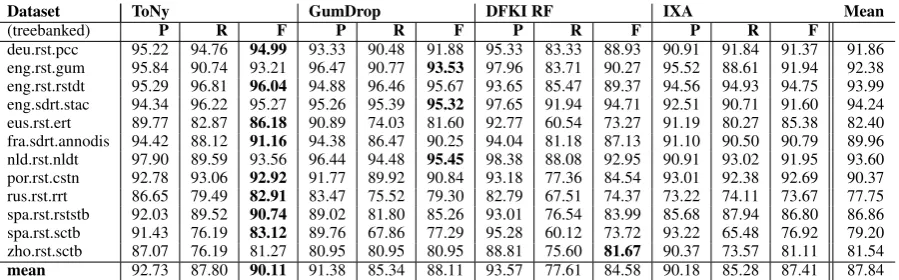
The main results for EDU segmentation on the test sets are given in Table2for treebanked data, and in Table 3 for plain tokenized data. No one sys-tem performs best on all corpora, suggesting that the different approaches have different merits in different settings. Overall, ToNy (Muller et al.,
2019) performs best on the most datasets, and on average has the highest F-scores (90.11, computed by averaging five runs of the system, since GPU training was not deterministic). The next best sys-tems by average F-score are GumDrop (Yu et al. 2019, 88.11 F1), IXA (Iruskieta et al. 2019, 87.18
F1) and DFKI RF (Bourgonje and Sch¨afer 2019,
84.56 F1).
For the treebanked scenario, the best configura-tion for ToNy (using contextualized Bert embed-dings,Devlin et al. 2018), receives the highest F-score on 8 datasets, the next best system, Gum-Drop, does so on 3 datasets, and DFKI’s system on one: the Chinese RST dataset, which is notably the smallest one in the shared task with around 14,000 tokens.
Results for all systems show clearly that
preci-sion is usually higher than recall across the board. This suggests that some ‘safe’ strategies, such as assuming segment boundaries at the beginnings of sentences (which are gold standard split in most cases), yield good results, with the challenge being much more the identification of non-obvious seg-mentation points within sentences. Another obvi-ous trend is the comparatively high performance on datasets that are large and gold-treebanked. The counterexample to the generalization that large corpora fare well is rus.rst.rrt, which can be explained by the lack of gold parses for this dataset, as well as some tricky conventions, such as handling segmentation differently within aca-demic abstracts and bibliographies.
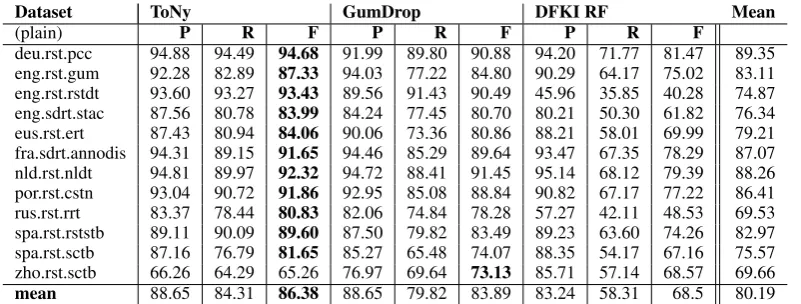
For the established RST benchmark dataset, RST-DT, two systems exceed the previous state of the art score (93.7,Bach et al. 2012), suggest-ing substantial progress (ToNy: 96.04; GumDrop: 95.67) compared to results previous to the shared task. For other languages, previous benchmark re-sults using different corpora include F-scores of 80 for Spanish (Da Cunha et al.,2010), 73 for French (Afantenos et al.,2010), 83 for Basque (Iruskieta and Zapirain, 2015) and between 88 and 93 for German (Sidarenka et al.,2015).
sys-Dataset ToNy GumDrop DFKI RF Mean
(plain) P R F P R F P R F
[image:5.595.101.502.61.213.2]deu.rst.pcc 94.88 94.49 94.68 91.99 89.80 90.88 94.20 71.77 81.47 89.35 eng.rst.gum 92.28 82.89 87.33 94.03 77.22 84.80 90.29 64.17 75.02 83.11 eng.rst.rstdt 93.60 93.27 93.43 89.56 91.43 90.49 45.96 35.85 40.28 74.87 eng.sdrt.stac 87.56 80.78 83.99 84.24 77.45 80.70 80.21 50.30 61.82 76.34 eus.rst.ert 87.43 80.94 84.06 90.06 73.36 80.86 88.21 58.01 69.99 79.21 fra.sdrt.annodis 94.31 89.15 91.65 94.46 85.29 89.64 93.47 67.35 78.29 87.07 nld.rst.nldt 94.81 89.97 92.32 94.72 88.41 91.45 95.14 68.12 79.39 88.26 por.rst.cstn 93.04 90.72 91.86 92.95 85.08 88.84 90.82 67.17 77.22 86.41 rus.rst.rrt 83.37 78.44 80.83 82.06 74.84 78.28 57.27 42.11 48.53 69.53 spa.rst.rststb 89.11 90.09 89.60 87.50 79.82 83.49 89.23 63.60 74.26 82.97 spa.rst.sctb 87.16 76.79 81.65 85.27 65.48 74.07 88.35 54.17 67.16 75.57 zho.rst.sctb 66.26 64.29 65.26 76.97 69.64 73.13 85.71 57.14 68.57 69.66 mean 88.65 84.31 86.38 88.65 79.82 83.89 83.24 58.31 68.5 80.19
Table 3: EDU segmentation results on plain tokenized data.
tems exceed the previous SOA of 89.5 on unparsed RST-DT: Georgetown’s system GumDrop reaches 90.49, and ToNy achieves a remarkable 93.43, al-most as high as previous results on gold parsed data. GumDrop performs better by a wide margin on the small Chinese dataset, but is overall well behind on many of the larger datasets, and about 2.5 F-score points lower on average than the best system, ToNy.
3.2 Connective detection
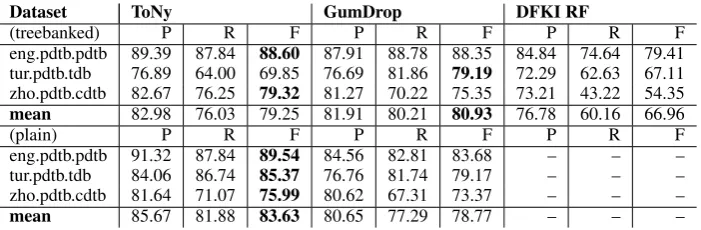
The main results for connective detection are given in Table 4. Three systems approached this task, though the DFKI system was not adapted substantially from the segmentation sce-nario, leading to low performance (Bourgonje and Sch¨afer,2019), and did not report results on auto-matically parsed data.
ToNy again has the highest scores for the most datasets, obtaining the highest mean F-score for the plain tokenized scenario, and coming second to GumDrop only on the Turkish dataset in the gold syntax scenario. The margin for this partic-ular result is however very wide, with GumDrop leading by almost 10 points, resulting in GumDrop obtaining the highest average F-score on gold syn-tax connective detection (though this score is in fact below the best plain tokenized result). This surprising result remained robust across 5 runs of the ToNy system (GumDrop was deterministically seeded and therefore reproducible in a single run). Overall the connective detection results demon-strate that syntax is not central to the task (tree-banked and plain results are close) and that ac-curacy is correlated with dataset size, presumably because the inventory of possible explicit con-nectives and their disambiguating environments is
more exhaustively attested as the dataset grows.
4 Analysis of systems
The four systems submitted to the task all use ei-ther RNNs with word embeddings (ToNy, IXA), decision tree ensembles on linguistic features (DFKI’s best system) or both (GumDrop). For two of the systems approaching both shared tasks, the same architecture is used for both connective detection and EDU segmentation, whereas Gum-Drop uses a slightly different architecture in each case. The high performance of ToNy on both tasks is remarkable in that a generic sequence labeling approach achieves excellent results despite not us-ing engineered features or a tailored learnus-ing ap-proach.
Looking at the internal distribution of scores for each system, we can observe that ToNy performs well on some of the less consistent resources, in particular for the automatically parsed and seg-mented Russian data, which all other systems de-grade on, and on corpora with automatic parses but gold or very high quality sentence splits, such as the Spanish datasets and German. For some of the corpora with gold parses in the gold sce-nario, GumDrop takes the lead, perhaps thanks to the use of a large number of linguistic features next to character and word embeddings (notably for GUM, which has manually produced depen-dencies, rather than conversion from constituents in RST-DT).
reli-Dataset ToNy GumDrop DFKI RF
(treebanked) P R F P R F P R F
eng.pdtb.pdtb 89.39 87.84 88.60 87.91 88.78 88.35 84.84 74.64 79.41 tur.pdtb.tdb 76.89 64.00 69.85 76.69 81.86 79.19 72.29 62.63 67.11 zho.pdtb.cdtb 82.67 76.25 79.32 81.27 70.22 75.35 73.21 43.22 54.35 mean 82.98 76.03 79.25 81.91 80.21 80.93 76.78 60.16 66.96
(plain) P R F P R F P R F
eng.pdtb.pdtb 91.32 87.84 89.54 84.56 82.81 83.68 – – – tur.pdtb.tdb 84.06 86.74 85.37 76.76 81.74 79.17 – – – zho.pdtb.cdtb 81.64 71.07 75.99 80.62 67.31 73.37 – – –
[image:6.595.125.476.61.176.2]mean 85.67 81.88 83.63 80.65 77.29 78.77 – – –
Table 4: Connective detection results.
able sentence splitting less crucial. At the same time, the performance advantage of the system is not found for the smallest corpus, zho.rst.sctb. DFKI was able to perform substantially better than ToNy for the gold scenario, while the next best system, GumDrop, takes the lead for Chinese on plain data, perhaps thanks to a high accuracy en-semble sentence splitter included in the system. The higher scores on this corpus for both DFKI and GumDrop, which employ Gradient Boosting and/or Random Forests, may suggest that the ro-bustness of tree ensembles against overfitting al-lows for better generalization to the test data in the lowest resource scenario.
For connective detection, the best DFKI system using Random Forests does not attain good scores, probably due to the need to memorize sequences of vocabulary items. For English PDTB, ToNy and GumDrop are very close, suggesting that both systems can memorize the inventory of connec-tives and disambiguate ambiguous cases with sim-ilar success. For the smaller datasets, with the ex-ception of the unexpectedly low performance on gold Turkish, ToNy has a more substantial lead. It is also worth noting that in 4/6 scenarios (all but Chinese), GumDrop has higher recall than preci-sion, while ToNy has higher precision than recall in 5/6 scenarios, perhaps pointing to imbalanced learning issues for the latter versus weaker disam-biguation capacity for the former.
5 Conclusion
By organizing the first shared task on EDU seg-mentation and connective detection, we hope to have pushed the field further in terms of bring-ing together resources and researchers from re-lated fields, and making systems available that are flexible enough to tackle different datatset guide-lines, but accurate enough to form the basis for
deeper discourse parsing tasks in the future. One particular point of progress has been mak-ing an official scorer and providmak-ing data in a uni-form uni-format based on the popular CoNLL-U spec-ification used by Universal Dependencies. We ex-pect this will make it easier to provide discourse annotations together with manually treebanked or automatically parsed data, as well as to compare future results with scores from this shared task. We also plan to maintain the DISRPT dataset and possibly extend it for future editions of the work-shop.
References
Stergos Afantenos, Nicholas Asher, Farah Bena-mara, Myriam Bras, Ccile Fabre, Mai Ho-dac, Anne Le Draoulec, Philippe Muller, Marie-Paule Pry-Woodley, Laurent Prvot, Josette Rebeyrolle, Lu-dovic Tanguy, Marianne Vergez-Couret, and Laure Vieu. 2012. An empirical resource for discovering cognitive principles of discourse organisation: The ANNODIS corpus. InProceedings of LREC 2012, pages 2727–2734, Istanbul, Turkey.
Stergos Afantenos, Pascal Denis, Philippe Muller, and Laurence Danlos. 2010. Learning recursive segments for discourse parsing. arXiv preprint arXiv:1003.5372.
Nicholas Asher. 1993. Reference to Abstract Objects in Discourse. Kluwer, Dordrecht.
Nicholas Asher, Julie Hunter, Mathieu Morey, Farah Benamara, and Stergos D. Afantenos. 2016. Dis-course structure and dialogue acts in multiparty di-alogue: the STAC corpus. InProceedings of LREC 2016, pages 2721–2727, Portoroˇz, Slovenia.
Ngo Xuan Bach, Nguyen Le Minh, and Akira Shimazu. 2012. A reranking model for discourse segmenta-tion using subtree features. InProceedings of SIG-Dial 2012, pages 160–168, Seoul, South Korea.
In Proceedings of Discourse Relation Treebanking and Parsing (DISRPT 2019), Minneapolis, MN.
Chlo´e Braud, Maximin Coavoux, and Anders Søgaard. 2017. Cross-lingual RST Discourse Parsing. In Proceedings of EACL 2017, pages 292–304, Valen-cia, Spain.
Paula Christina Figueira Cardoso, Erick Galani Maziero, Maria Luc´ıa del Rosario Castro Jorge, M. Eloize, R. Kibar Aji Seno, Ariani Di Felippo, Lucia Helena Machado Rino, Maria das Grac¸as Volpe Nunes, and Thiago Alexandre Salgueiro Pardo. 2011. CSTNews - a discourse-annotated cor-pus for single and multi-document summarization of news texts in Brazilian Portuguese. InProceedings of the 3rd RST Brazilian Meeting, pages 88–105, Cuiab´a, Brazil.
Lynn Carlson, Daniel Marcu, and Mary Ellen Okurowski. 2003. Building a discourse-tagged cor-pus in the framework of Rhetorical Structure Theory. InCurrent and New Directions in Discourse and Di-alogue, Text, Speech and Language Technology 22, pages 85–112. Kluwer, Dordrecht.
Iria da Cunha, Juan-Manuel Torres-Moreno, and Ger-ardo Sierra. 2011. On the development of the RST Spanish Treebank. InProceedings of the Fifth Lin-guistic Annotation Workshop (LAW V), pages 1–10, Portland, OR.
Iria Da Cunha, Eric SanJuan, Juan-Manuel Torres-Moreno, Marina Lloberes, and Irene Castell´on. 2010. Discourse segmentation for Spanish based on shallow parsing. In Mexican International Conference on Artificial Intelligence, pages 13–23. Springer.
Jacob Devlin, Ming-Wei Chang, Kenton Lee, and Kristina Toutanova. 2018. BERT: Pre-training of deep bidirectional transformers for language under-standing.
Mikel Iruskieta, Mar´ıa Jes´us Aranzabe, Arantza Diaz de Ilarraza, Itziar Gonzalez-Dios, Mikel Lersundi, and Oier Lopez de Lacalle. 2013. The RST Basque TreeBank: An online search interface to check rhetorical relations. In 4th Workshop on RST and Discourse Studies, pages 40–49, Fortaleza, Brasil.
Mikel Iruskieta, Kepa Bengoetxea, Aitziber Atutxa, and Arantza Diaz de Ilarraza. 2019. Multilingual segmentation based on neural networks and pre-trained word embeddings. In Proceedings of Dis-course Relation Treebanking and Parsing (DISRPT 2019), Minneapolis, MN.
Mikel Iruskieta and Benat Zapirain. 2015. Euseduseg: A dependency-based EDU segmentation for Basque. Procesamiento del Lenguaje Natural, 55:41–48.
Qi Li, Tianshi Li, and Baobao Chang. 2016. Discourse parsing with attention-based hierarchical neural net-works. InProceedings of EMNLP 2016, pages 362– 371, Austin, TX.
William C. Mann and Sandra A. Thompson. 1988. Rhetorical Structure Theory: Toward a functional theory of text organization. Text, 8(3):243–281.
Mathieu Morey, Philippe Muller, and Nicholas Asher. 2017. How much progress have we made on RST discourse parsing? A replication study of recent re-sults on the RST-DT. In Proceedings of EMNLP 2017, pages 1319–1324, Copenhagen, Denmark.
Philippe Muller, Chlo´e Braud, and Mathieu Morey. 2019. ToNy: Contextual embeddings for accurate multilingual discourse segmentation of full docu-ments. InProceedings of Discourse Relation Tree-banking and Parsing (DISRPT 2019), Minneapolis, MN.
Ue-matsu, Larraitz Uria, Gertjan van Noord, Viktor Varga, Veronika Vincze, Jonathan North Washing-ton, Zdenˇek ˇZabokrtsk´y, Amir Zeldes, Daniel Ze-man, and Hanzhi Zhu. 2017. Universal dependen-cies 2.0. Technical report, LINDAT/CLARIN dig-ital library at the Institute of Formal and Applied Linguistics ( ´UFAL), Faculty of Mathematics and Physics, Charles University.
Jer´emy Perret, Stergos Afantenos, Nicholas Asher, and Mathieu Morey. 2016. Integer linear programming for discourse parsing. In Proceedings of NAACL 2016, pages 99–109, San Diego, CA.
Rashmi Prasad, Nikhil Dinesh, Alan Lee, Eleni Milt-sakaki, Livio Robaldo, Aravind Joshi, and Bon-nie Webber. 2008. The Penn Discourse Treebank 2.0. InProceedings of the 6th International Confer-ence on Language Resources and Evaluation (LREC 2008), pages 2961–2968, Marrakesh, Morocco.
Rashmi Prasad, Bonnie Webber, and Aravind Joshi. 2014. Reflections on the Penn Discourse TreeBank, comparable corpora, and complementary annota-tion. Computational Linguistics, 40(4):921–950.
Gisela Redeker, Ildik´o Berzl´anovich, Nynke van der Vliet, Gosse Bouma, and Markus Egg. 2012. Multi-layer discourse annotation of a Dutch text corpus. In Proceedings of LREC 2012, pages 2820–2825, Is-tanbul, Turkey.
Cao Shuyuan, Iria da Cunha, and Mikel Iruskieta. 2018. The RST Spanish-Chinese Treebank. In Pro-ceedings of the Joint Workshop of Linguistic An-notation, Multiword Expression and Constructions (LAW-MWE-CxG-2018), pages 156–166, Santa Fe, NM.
Uladzimir Sidarenka, Andreas Peldszus, and Manfred Stede. 2015. Discourse segmentation of German texts.JLCL, 30(1):71–98.
Manfred Stede and Arne Neumann. 2014. Potsdam Commentary Corpus 2.0: Annotation for discourse research. InProceedings of the Language Resources and Evaluation Conference (LREC ’14), pages 925– 929, Reykjavik.
Svetlana Toldova, Dina Pisarevskaya, Margarita Ananyeva, Maria Kobozeva, Alexander Nasedkin, Sofia Nikiforova, Irina Pavlova, and Alexey Shele-pov. 2017. Rhetorical relation markers in Russian RST Treebank. InProceedings of the 6th Workshop Recent Advances in RST and Related Formalisms, pages 29–33, Santiago de Compostela, Spain.
Jianxiang Wang and Man Lan. 2015. A refined end-to-end discourse parser. In Proceedings of CoNLL 2015, pages 17–24, Beijing.
Yue Yu, Yilun Zhu, Yang Liu, Yan Liu, Siyao Peng, Mackenzie Gong, and Amir Zeldes. 2019. Gum-Drop at the DISRPT2019 shared task: A model stacking approach to discourse unit segmentation
and connective detection. In Proceedings of Dis-course Relation Treebanking and Parsing (DISRPT 2019), Minneapolis, MN.
Amir Zeldes. 2017. The GUM corpus: Creating mul-tilayer resources in the classroom. Language Re-sources and Evaluation, 51(3):581–612.
Deniz Zeyrek, Is¸ın Demirs¸ahin, Ayıs¸ıˇgı B. Sevdik C¸ allı, and Ruket C¸ akıcı. 2010. The first question generation shared task evaluation challenge. Dia-logue and Discourse, 3:75–99.