Proceedings of the 6th Joint Conference on Lexical and Computational Semantics (*SEM 2017), pages 135–148, Vancouver, Canada, August 3-4, 2017. c2017 Association for Computational Linguistics
The (Too Many) Problems of Analogical Reasoning with Word Vectors
Anna Rogers
Dept. of Computer Science University of Massachusetts Lowell
Lowell, MA, USA
Aleksandr Drozd
Global Scient. Inf. and Comput. Center Tokyo Institute of Technology
Tokyo, Japan
Bofang Li
School of Information Renmin University of China
Beijing, China
Abstract
This paper explores the possibilities of analogical reasoning with vector space models. Given two pairs of words with the same relation (e.g. man:woman ::
king:queen), it was proposed that the
off-set between one pair of the corresponding word vectors can be used to identify the unknown member of the other pair (−−→king
− −−→man + −−−−−→woman = ?−−−→queen). We
ar-gue against such “linguistic regularities” as a model for linguistic relations in vector space models and as a benchmark, and we show that the vector offset (as well as two other, better-performing methods) suffers from dependence on vector similarity. 1 Introduction
This paper considers the phenomenon of “vector-oriented reasoning” via linear vector offset in vector space models (VSMs) (Mikolov et al., 2013c,a). Given two pairs of words with the same linguistic relation (woman:man :: king:queen), it has been proposed that the offset between one pair of word vectors can be used to identify the un-known member of a different pair of words via solving proportional analogy problems (−−→king − −−→
man+−−−−−→woman= ?−−−→queen), as shown in Fig. 1.
We will refer to this method as 3CosAdd.
This approach attracted a lot of attention, both as the “poster child” of word embeddings, and for its potential practical utility. Given the vi-tal role that analogical reasoning plays in human cognition for discovering new knowledge and un-derstanding new concepts, automated analogical reasoning could become a game-changer in many fields, providing a universal mechanism for detect-ing ldetect-inguistic relations (Turney, 2008) and word sense disambiguation (Federici et al.,1997). It is
[image:1.595.311.522.294.369.2]already used in many downstream NLP tasks, such as splitting compounds (Daiber et al., 2015), se-mantic search (Cohen et al.,2015), cross-language relational search (Duc et al.,2012), to name a few.
Figure 2: Left panel shows vector offsets for three word pairs illustrating the gender relation. Right panel shows a different projection, and the singular/plural relation for two words. In high-dimensional space, multiple relations can be embedded for a single word.
provided. We have explored several related meth-ods and found that the proposed method performs well for both syntactic and semantic relations. We note that this measure is qualitatively similar to rela-tional similarity model of (Turney, 2012), which pre-dicts similarity between members of the word pairs
(xb, xd),(xc, xd)and dis-similarity for(xa, xd).
6 Experimental Results
To evaluate the vector offset method, we used vectors generated by the RNN toolkit of Mikolov (2012). Vectors of dimensionality 80, 320, and 640 were generated, along with a composite of several systems, with total dimensionality 1600. The sys-tems were trained with 320M words of Broadcast News data as described in (Mikolov et al., 2011a), and had an 82k vocabulary. Table 2 shows results for both RNNLM and LSA vectors on the syntactic task. LSA was trained on the same data as the RNN. We see that the RNN vectors capture significantly more syntactic regularity than the LSA vectors, and do remarkably well in an absolute sense, answering
more than one in three questions correctly.2
In Table 3 we compare the RNN vectors with those based on the methods of Collobert and We-ston (2008) and Mnih and Hinton (2009), as imple-mented by (Turian et al., 2010) and available online
3Since different words are present in these datasets,
we computed the intersection of the vocabularies of the RNN vectors and the new vectors, and restricted the test set and word vectors to those. This resulted in a 36k word vocabulary, and a test set with 6632
Method Adjectives Nouns Verbs All
LSA-80 9.2 11.1 17.4 12.8
LSA-320 11.3 18.1 20.7 16.5
LSA-640 9.6 10.1 13.8 11.3
RNN-80 9.3 5.2 30.4 16.2
RNN-320 18.2 19.0 45.0 28.5
RNN-640 21.0 25.2 54.8 34.7
RNN-1600 23.9 29.2 62.2 39.6
Table 2: Results for identifying syntactic regularities for different word representations. Percent correct.
Method Adjectives Nouns Verbs All
RNN-80 10.1 8.1 30.4 19.0
CW-50 1.1 2.4 8.1 4.5
CW-100 1.3 4.1 8.6 5.0
HLBL-50 4.4 5.4 23.1 13.0
HLBL-100 7.6 13.2 30.2 18.7
Table 3: Comparison of RNN vectors with Turian’s Col-lobert and Weston based vectors and the Hierarchical Log-Bilinear model of Mnih and Hinton. Percent correct.
questions. Turian’s Collobert and Weston based vec-tors do poorly on this task, whereas the Hierarchical Log-Bilinear Model vectors of (Mnih and Hinton, 2009) do essentially as well as the RNN vectors. These representations were trained on 37M words of data and this may indicate a greater robustness of the HLBL method.
We conducted similar experiments with the se-mantic test set. For each target word pair in a rela-tion category, the model measures its relarela-tional sim-ilarity to each of the prototypical word pairs, and then uses the average as the final score. The results are evaluated using the two standard metrics defined in the task, Spearman’s rank correlation coefficient
ρand MaxDiff accuracy. In both cases, larger
val-ues are better. To compare to previous systems, we report the average over all 69 relations in the test set. From Table 4, we see that as with the syntac-tic regularity study, the RNN-based representations perform best. In this case, however, Turian’s CW vectors are comparable in performance to the HLBL vectors. With the RNN vectors, the performance
im-Figure 1: Linguistic relations modeled by linear vector offset (Mikolov et al.,2013c)
The idea that linguistic relations are mirrored in neat geometrical relations (as shown in Fig. 1) is also intuitively appealing, and 3CosAdd has be-come a popular benchmark. Roughly, the current VSMs score between 40% (Lai et al., 2016) and 75% (Pennington et al.,2014) on the Google test set (Mikolov et al.,2013a). However, in fact per-formance varies widely for different types of re-lations (Levy and Goldberg, 2014; K¨oper et al., 2015;Gladkova et al.,2016).
One way to explain the current limitations is to attribute them to the imperfections of the current models and/or corpora with which they are built: with this view, in a perfect VSM, any linguistic relation should be recoverable via vector offset.
The alternative to be explored in this paper is that perhaps natural language semantics is more complex than suggested by Fig. 1, and there may be both theoretical and mathematical issues with analogical reasoning with word vectors and its 3CosAdd implementation.
We present a series of experiments with two popular VSMs (GloVe and Word2Vec) to show that the accuracy of 3CosAdd depends on the proximity of the target vector to its source (i.e.
−−−→
queen should be quite similar to −−→king). Since not all linguistic relations can be expected to result in high word vector proximity, the method is lim-ited to those that happen to be so in a given VSM. Furthermore, its accuracy also varies because the “linguistic regularities” are actually not so regu-lar, and should not be expected to be so. We also compare 3CosAdd to two alternative methods to investigate whether better algorithms can improve on these and other accounts.
2 Background: “Relational Similarity” vs “Word Analogies”
The most fundamental term for what 3CosAdd is supposed to capture is actually not analogy, but ratherrelational similarity, i.e. the idea that pairs of words may hold similar relations to those be-tween other pairs of words. For example, the re-lation betweencat andfeline is similar to the re-lation between dog and canine. Notably, this is
similarityrather than identity: “instances of a
sin-gle relation may still have significant variability in how characteristic they are of that class” (Jurgens et al.,2012).
Analogyas it is known in philosophy and logic
is something quite different. The “classical” ana-logical reasoning follows roughly this template: objectsXandY share propertiesa,b, andc; there-fore, they may also share the propertyd. For ex-ample, both Earth and Mars orbit the Sun, have at least one moon, revolve on axis, and are subject to gravity; therefore, if Earth supports life, so could Mars (Bartha,2016).
The NLP move from relational similarity to analogy follows the use of the term by P. Turney, who distinguishes between attributional similarity between two words and relational similarity be-tween two pairs of words. On this interpretation,
two word pairs that have a high degree of
rela-tional similarity are analogous(Turney,2006).
In terms of practical NLP tasks, Turney et al. (2003) introduced the task of solving SAT1
anal-ogy problems by choosing from several provided options. These problems were formulated as
pro-portional analogies, written in the forma : a0 ::
b:b0(ais toa0asbis tob0)
It is this use of the term “analogy” thatMikolov et al.(2013c) followed in proposing the 3CosAdd method. They formulated the task as selecting a single best fitting vector out of the whole
vocabu-1Scholastic Aptitude Test.
lary of the VSM. It became known asword
anal-ogy task, but in its core it is still basically
esti-mation of relational similarity, and could be for-mulated as such: given a pair of wordsaanda0, find how they are related and then find word b0, such that it has a similar relation with the wordb. A crucial difference is that the graded, non-binary nature of relational similarity is now not in focus: the goal is to find a single correct answer.
The dataset that came to be known as the Google analogy test set (Mikolov et al., 2013a), included 14 linguistic relations with 19544 ques-tions in total. It has become one of the most popular benchmarks for VSMs. This evaluation paradigm assumes that:
(1) Words in similar linguistic relations should in principle be recoverable via relational similar-ity to known word pairs.
(2) 3CosAdd score reflects the extent to which a given VSM encodes linguistic relations.
(1) became dubious when it was shown that ac-curacy of 3CosAdd varies widely between cate-gories (Levy and Goldberg, 2014), and even the best-performing GloVe model scores under 30% on the more challenging Bigger Analogy Test Set (BATS) (Gladkova et al., 2016). It appears that not all relations can be identified in this way, with lexical semantic relations such as synonymy and antonymy being particularly difficult (K¨oper et al., 2015;Vylomova et al.,2016). The assumption of a single best-fitting candidate answer is also being targeted (Newman-Griffis et al.,2017).
(2) was refuted when Drozd et al. (2016) demonstrated that some relations missed by 3CosAdd could be recovered with a supervised method, and therefore the information was present in the VSM – just not recoverable with 3CosAdd.
Let us consider why both (1) and (2) failed.
3 What Does 3CosAdd Really Do?
3.1 Methodology
We present a series of experiments performed with BATS dataset. Although there are more results on analogy task published with Google test than with BATS, Google test only contains 15 types of lin-guistic relations, and these happen to be the easier ones (Gladkova et al.,2016).
Inflectional Nouns regular plurals(student:students), plurals with orthographic changes(wife:wives)
morphology Adjectives comparative degree(strong:stronger), superlative degree(strong:strongest)
Verbs infinitive: 3Ps.Sg(follow:follows), infinitive: participle(follow:following), infinitive: past(follow:followed), participle: 3Ps.Sg(following:follows), participle: past (follow-ing:followed), 3Ps.Sg : past(follows:followed)
Derivational
morphology Stemchange verb+erverb+ment(bake:baker)(argue:argument), verb+able (edit:editable), verb+ation(continue:continuation),
No stem
change re+verbun+adj.(able:unable)(create:recreate), adj.+ly, noun+less(usual:usually)(home:homeless), over+adj., adj.+ness(used:overused)(mad:madness),
Lexicographic Hypernyms animals(turtle:reptile), miscellaneous(peach:fruit)
semantics Hyponyms miscellaneous(color:white)
Meronyms part-whole(car:engine), substance(sea:water), member(player:team), Antonyms opposites(up:down), gradable(clean:dirty)
Synonyms exact(sofa:couch), intensity(cry:scream)
Encyclopedic Animals the young(cat:kitten), sounds(dog:bark), shelterfox:den
semantics Geography capitals(Athens:Greece), languages(Peru:Spanish), UK city:countyYork:Yorkshire
People occupation(Lincoln:president), nationalities(Lincoln:American)
Other thing:color(blood:red), male:female(actor:actress)
Table 1: The Bigger Analogy Test Set: categories and examples
relations (98,000 questions in total). BATS covers most relations in the Google set, but it adds many new and more difficult relations, balanced across derivational and inflectional morphology, lexico-graphic and encyclopedic semantics (10 relations of each type). Thus BATS provides a less flatter-ing, but more accurate estimate of the capacity for analogical reasoning in the current VSMs.
We use pre-trained GloVe vectors by Penning-ton et al. (2014), released by the authors2 and
trained on Gigaword 5 + Wikipedia 2014 (300 di-mensions, window size 10). We also experiment with Word2Vec vectors (Mikolov et al.,2013b) re-leased by the authors3, trained on a subcorpus of
Google news (also with 300 dimensions).
The evaluation with 3CosAdd and LRCos meth-ods was conducted with the Python script that ac-companies BATS. We also added an implementa-tion of 3CosMul, a multiplicative objective pro-posed by Levy and Goldberg (2014), now avail-able in the same script4. Since 3CosMul requires
normalization, we used normalized GloVe and Word2Vec vectors in all experiments.
Questions with words not in the model vocab-ulary were excluded (0.01% BATS questions for GloVe and 0.016% for Word2Vec).
3.2 The “Honest” 3CosAdd
Let us remember that 3CosAdd as initially formu-lated byMikolov et al.(2013c) excludes the three
2https://nlp.stanford.edu/projects/
glove/
3https://code.google.com/archive/p/
word2vec/
4http://vsm.blackbird.pw/tools/
source vectorsa,a0 andbfrom the pool of possi-ble answers. Linzen (2016) showed that if that is not done, the accuracy drops dramatically, hitting zero for 9 out of 15 Google test categories.
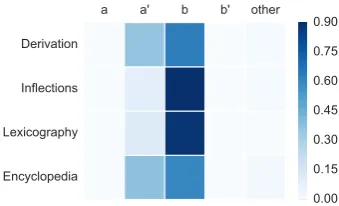
Let us investigate what happens on BATS data, split by 4 relation types. The rows of Fig. 2 represent all questions of a given category, with darker color indicating higher percentage of pre-dicted vectors being the closest to a, a0, b, b0, or any other vector.
a a' b b' other
Encyclopedia Lexicography Inflections Derivation
[image:3.595.331.501.435.538.2]0.00 0.15 0.30 0.45 0.60 0.75 0.90
Figure 2: The result ofa−a0+bcalculation on BATS: source vectorsa,a0, andbare not excluded.
Fig. 2 shows that if we do not exclude the source vectors,bis the most likely to be predicted; in derivational and encyclopedic categories a0 is also possible in under 30% of cases. b0 is as un-likely to be predicted asa, or any other vector.
This experiment suggests that the addition of the offset between a and a0 typically has a very small effect on thebvector – not sufficient to in-duce a shift to a different vector on its own. This would in effect limit the search space of 3CosAdd to the close neighborhood of thebvector.
0.0 0.1 0.2 0.3 0.4 0.5 0.6 0.7 0.8 0.9 0.0
0.2 0.4 0.6 0.8 1.0
share / accuracy
share of all questions accuracy (top 1) accuracy (top 3) accuracy (top 5)
(a) similarity between vectorsaanda0
0.0 0.1 0.2 0.3 0.4 0.5 0.6 0.7 0.8 0.9 0.0
0.2 0.4 0.6 0.8 1.0
(b) similarity between vectorsa0andb0
0.0 0.1 0.2 0.3 0.4 0.5 0.6 0.7 0.8 0.9 0.0
0.2 0.4 0.6 0.8 1.0
(c) similarity between vectorsbandb0
0.0 0.1 0.2 0.3 0.4 0.5 0.6 0.7 0.8 0.9 0.0
0.2 0.4 0.6 0.8 1.0
share / accuracy
share of all questions accuracy (top 1) accuracy (top 3) accuracy (top 5)
(d) similarity between vectorb0and
pre-dicted vector
0.0 0.1 0.2 0.3 0.4 0.5 0.6 0.7 0.8 0.9 0.0
0.2 0.4 0.6 0.8 1.0
(e) similarity between vectorb0anda
0 10 20 30 40 50 60 70 80 90 0.0
0.2 0.4 0.6 0.8 1.0
(f) rank ofbin the neighborhood ofb0
[image:4.595.78.520.60.305.2]*X-axis labels indicate lower boundary of the corresponding similarity/rank bins. The numerical values for all data can be found in the Appendix.
Figure 3: Accuracy of 3CosAdd method on GloVe vs characteristics of the vector space.
Google test set 70% accuracy was achieved by simply taking the closest neighbor of the vector b, while 3CosAdd improved the accuracy by only 10%. That would indeed be expected if most sin-gular (a) and plural (a0) forms of the same noun were so similar, that subtracting them would result in a nearly-null vector which would not change much when added tob.
3.3 Distance to the Target Vector
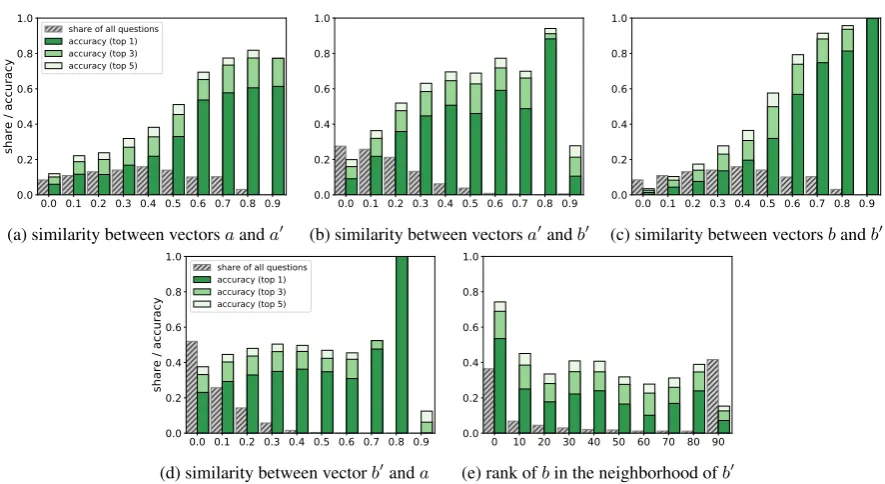
Levy and Goldberg (2014, p.173) suggested that 3CosAdd method is “mathematically equivalent to seeking a word (b0) which is similar tobanda0but is different froma.” We examined the similarity between all source vector pairs, looking not only at the actual, top-1 accuracy of the 3CosAdd (i.e. the vector the closest to the hypothetical vector), but also at whether the correct answer was found in the top-3 and top-5 neighbors of the predicted vector. For each similarity bin we also estimated how many questions of the whole BATS dataset there were. The results are presented in Fig.3.
Our data indicates that, indeed, for all combina-tions of source vectors, the accuracy of 3CosAdd decreases as their distance in vector space in-creases. It is the most successful when all three source vectors are relatively close to each other and the target vector. This is in line with the above
evidence from the “honest” 3CosAdd: if the offset is typically small, for it to lead to the target vector, that target vector should be close.
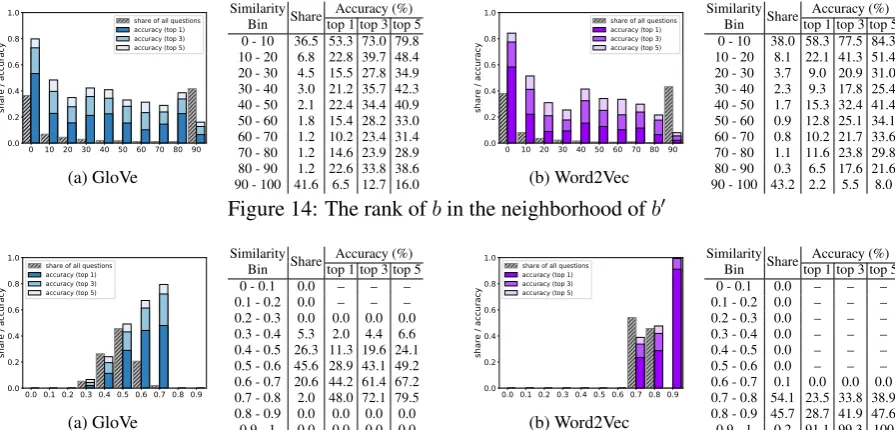
Consider also the ranks of the b vectors in the neighborhood ofb0, shown in Fig. 3f. For nearly 40% of the successful questionsb0 was within 10 neighbors of b – and over 40% of low-accuracy questions were over 90 neighbors away.
As predicted by Levy et al.,b0 andavectors do not exhibit the same clear trend for higher accu-racy with higher similarity that is observed in all other cases (Fig. 3f). However, in experiments with only 20 morphological categories we did ob-serve the same trend forb0 andaas for the other vector pairs (see Fig.4). This is counter-intuitive, and requires further examination.
0.0 0.1 0.2 0.3 0.4 0.5 0.6 0.7 0.8 0.9 0.0
0.2 0.4 0.6 0.8 1.0
share / accuracy
share of all questions accuracy (top 1) accuracy (top 3) accuracy (top 5)
[image:4.595.346.484.627.725.2]The observed correlation between the accuracy of 3CosAdd and the distance to the target vec-tor could explain in particular the overall lower performance on BATS derivational morphology questions (only 0.08% top-1 accuracy) as opposed to inflectional (0.59%) or encyclopedic seman-tics (0.26%). −−→man and −−−−−→woman could be ex-pected to be reasonably similar distributionally, as they combine with many of the same verbs: both men and women sit, sleep, drink etc. How-ever, the same could not be said of words derived with prefixes that change part of speech. Going from −−−→happy to −−−−−−−→happiness, or from −−−−→govern to
−−−−−−−−→
government, is likely to have to take us further in the vector space.
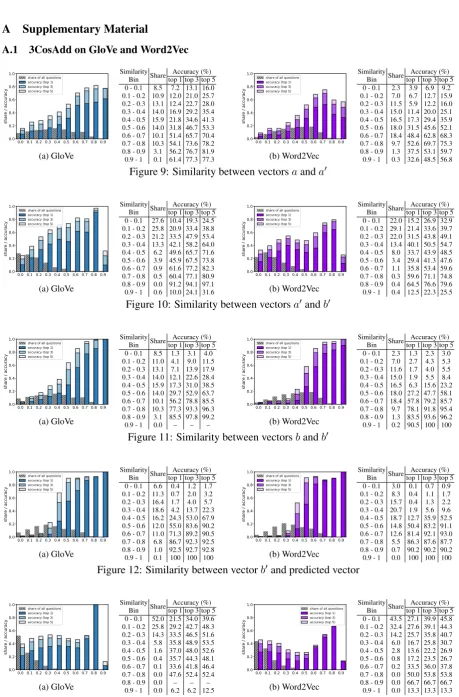
To make sure that the above trend is not spe-cific to GloVe, we repeated these experiments with Word2Vec, which exhibited the same trends. All data is presented in AppendixA.1.
3.4 Uniqueness of a Relation
Note that the dependence of 3CosAdd on similar-ity is not entirely straightforward: Fig. 3b shows that for the highest similarity (0.9 and more) there is actually a drop in accuracy. The same trend was observed with Word2Vec (Fig10in Appendix 1). Theoretically, it could be attributed to there not be-ing much data in the highest similarity range; but BATS has 98,000 questions, and even 0.1% of that is considerable.
The culprit is the “dishonesty” of 3CosAdd: as discussed above, it excludes the source vectorsa, a0, andbfrom the pool of possible answers. Not only does this mask the real extent of the differ-ence betweenaanda0, but it also creates a funda-mental difficulty with categories where the source vectors may be the correct answers.
This is what explains the unexpected drops in accuracy at the highest similarity between vec-tors b0 and a0. Consider the question −−−→blood:−→red
:: −−−→snow:−−−−→?white. The vector offset could
theoret-ically solve it, but if the question is −−−→snow:−−−→white :: −−−→sugar:−−−−→?white, the correct answer woulda pri-ori be excluded. In BATS data, this factor af-fects several semantic categories, including coun-try:language, thing:color, animal:young, and ani-mal:shelter.
3.5 Density of Vector Neighborhoods
If solving proportional analogies with word vec-tors is like shooting, the farther away the target
vector is, the more difficult it should be to hit. Also, we can hypothesize that the more crowded a particular region is, the more difficult it should be to hit a particular target.
However, density of vector neighborhoods is not as straightforward to measure as vector sim-ilarity. We could look at average similarity be-tween, e.g., top-10 ranking neighbors, but that could misrepresent the situation if some neighbors were very close and some were very far.
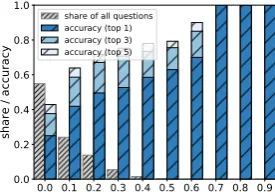
In this experiment we estimate density as the similarity to the 5th neighbor. The higher it is, the more highly similar neighbors a word vector has. This approach is shown in Fig.5.
0.0 0.1 0.2 0.3 0.4 0.5 0.6 0.7 0.8 0.9 0.0
0.2 0.4 0.6 0.8 1.0
share / accuracy
[image:5.595.347.487.267.364.2]share of all questions accuracy (top 1) accuracy (top 3) accuracy (top 5)
Figure 5: The similarity between b0 and its 5th neighbor
The results seem counter-intuitive: denser neighborhoods actually yield higher accuracy (al-though there are virtually no cases of very tight neighborhoods). One explanation could be its re-verse correlation with distance: if the neighbor-hood ofb0is sparse, the closest word is likely to be relatively far away. But that runs contrary to the above findings that closer source vectors improve the accuracy of 3CosAdd. Then we could expect lower accuracy in sparser neighborhoods.
In this respect, too, GloVe and Word2Vec be-have similarly (Fig.15).
4 Comparison with Other Methods We repeat the above experiments on GloVe with 3CosMul, a multiplication-based alternative to 3CosAdd proposed byLevy and Goldberg(2014):
argmaxb0∈V cos(b
0, b)cos(b0, a0) cos(b0, a) +ε
(ε= 0.001is used to prevent division by zero)
0.0 0.1 0.2 0.3 0.4 0.5 0.6 0.7 0.8 0.9 0.0
0.2 0.4 0.6 0.8 1.0
share / accuracy
share of all questions accuracy (top 1) accuracy (top 3) accuracy (top 5)
(a) similarity between vectorsaanda0
0.0 0.1 0.2 0.3 0.4 0.5 0.6 0.7 0.8 0.9 0.0
0.2 0.4 0.6 0.8 1.0
(b) similarity between vectorsa0andb0
0.0 0.1 0.2 0.3 0.4 0.5 0.6 0.7 0.8 0.9 0.0
0.2 0.4 0.6 0.8 1.0
(c) similarity between vectorsbandb0
0.0 0.1 0.2 0.3 0.4 0.5 0.6 0.7 0.8 0.9 0.0
0.2 0.4 0.6 0.8 1.0
share / accuracy
share of all questions accuracy (top 1) accuracy (top 3) accuracy (top 5)
(d) similarity between vectorb0anda
0 10 20 30 40 50 60 70 80 90 0.0
0.2 0.4 0.6 0.8 1.0
(e) rank ofbin the neighborhood ofb0
[image:6.595.77.520.58.300.2]*X-axis labels indicate lower boundary of the corresponding similarity/rank bins. The numerical values for all data can be found in the Appendix.
Figure 6: Accuracy of 3CosMul method on GloVe model vs characteristics of the vector space.
like 3CosAdd, has much higher chances of success where target vectors are close to the source.
We also consider LRCos, a method based on su-pervised learning from a set of word pairs (Drozd et al., 2016). LRCos reinterprets the analogy task as follows: given a set of word pairs (e.g.
brother:sister, husband:wife, man:woman, etc.),
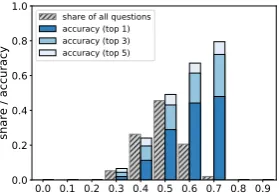
the available examples of the class of the target b0 vector (sister, wife, woman, etc.) and randomly selected negative examples are used to learn a rep-resentation of the target class with a supervised classifier. The question is this: what word is the closest to−−→king, but belongs to the “women” class? With LRCos it is only meaningful to look at the similarity of btob0 (Fig. 7). Once again, we see the same trend: closer targets are easier to hit.
0.0 0.1 0.2 0.3 0.4 0.5 0.6 0.7 0.8 0.9 0.0
0.2 0.4 0.6 0.8 1.0
share / accuracy
[image:6.595.112.249.627.724.2]share of all questions accuracy (top 1) accuracy (top 3) accuracy (top 5)
Figure 7: Accuracy of LRCos method vs similar-ity between vectorsbandb0
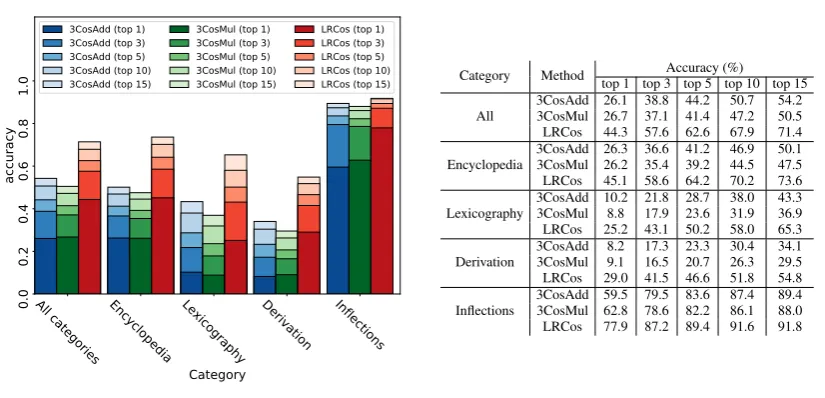
However, if we look at overall accuracy, there is a big difference between the three methods.
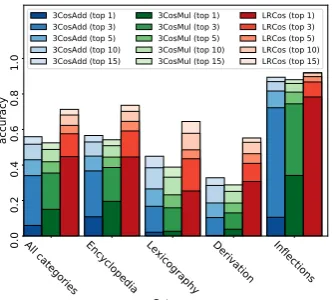
Fig. 8b shows that the accuracy of LRCos is much higher than the top-1 3CosAdd or 3Cos-Mul. Moreover, its “honest” version (Fig.8a) per-forms just as well as the “dishonest” one. These results are consistent with the results reported by Drozd et al.(2016). As for 3CosMul,Levy et al. (2015) show that 3CosMul outperforms 3CosAdd in PPMI, SGNS, GloVe and SVD models with the Google dataset, sometimes yielding 10-25% im-provement. Our BATS experiment confirms the overall superiority of 3CosMul to 3CosAdd, al-though the difference is less dramatic.
Thus LRCos considerably outdoes its competi-tors, although it does not manage to avoid the sim-ilarity problem. We attribute this to the set-based, supervised nature of LRCos that gives it an edge on a different problem that affects both 3CosAdd and 3CosMul: the assumption of “linguistic regu-larities” from which we started.
5 Discussion: What Should We Expect from the Word Analogy Task?
5.1 How Regular Are “Linguistic Regularities”?
All categories Encyclopedia Lexicography Derivation Inflections
Category
0.0
0.2
0.4
0.6
0.8
1.0
accuracy
3CosAdd (top 1) 3CosAdd (top 3) 3CosAdd (top 5) 3CosAdd (top 10) 3CosAdd (top 15)
3CosMul (top 1) 3CosMul (top 3) 3CosMul (top 5) 3CosMul (top 10) 3CosMul (top 15)
LRCos (top 1) LRCos (top 3) LRCos (top 5) LRCos (top 10) LRCos (top 15)
(a) 3CosAdd vs 3CosMul vs LRCos (“honest” versions)
All categories Encyclopedia Lexicography Derivation Inflections
Category
0.0
0.2
0.4
0.6
0.8
1.0
accuracy
3CosAdd (top 1) 3CosAdd (top 3) 3CosAdd (top 5) 3CosAdd (top 10) 3CosAdd (top 15)
3CosMul (top 1) 3CosMul (top 3) 3CosMul (top 5) 3CosMul (top 10) 3CosMul (top 15)
LRCos (top 1) LRCos (top 3) LRCos (top 5) LRCos (top 10) LRCos (top 15)
[image:7.595.99.266.63.213.2](b) CosAdd vs 3CosMul vs LRCos
Figure 8: LRCos performance on BATS
andaprovides access to certain features combin-able with vectorbto detectb0, and that such offset should be more or less constant for all words in a given linguistic relations.
Table2shows that this does not happen in a re-liable way (data: BATS category D06 “re+verb”).
Table 2: 3CosAdd: effect of variousa:a0 vector pairs with the sameb:b0pair (−−−−→marry:−−−−−−→remarry)
No a a0 b predicted
vector Sim.score correctb0score
1 acquire reacquire marry fianc´ee 0.54 <0.51 2 tell retell marry betrothed 0.51 0.49 3 engage reengage marry eloped 0.52 0.51 4 appear reappear marry marries 0.65 0.55 5 establish reestablish marry marries 0.58 0.52 6 invest reinvest marry marries 0.59 0.57 7 adjust readjust marry marrying 0.59 0.55 8 arrange rearrange marry marrying 0.52 0.43 9 discover rediscover marry marrying 0.54 0.49 10 apply reapply marry remarry 0.53 0.53
Both correct and incorrect answers lie in about the same similarity range, so we cannot attribute the failures to the reliance of 3CosAdd on close neighborhoods. The distance from −−−−→marry to
−−−−−−→
remarry is the same; thus it must be the case that the offset between different a and a0 is not the same, and leads to different answers – with a frustratingly small margin of error.
5.2 Can We Just Blame the Corpus?
Source corpora are noisy, and it is tempting to blame almost anything on that. It could be lit-eral text-processing noise (e.g. not quite cleaned HTML data and ad texts) or, more broadly, any kind of information in the VSM that is irrelevant to the question at hand. This includes polysemy: for a word-level VSM the difference between−−→king and−−−→queenis not exactly the same as the difference between−−→man and−−−−−→woman just for the existence of theQueenband (although that factor should not affect the “re-” prefix verbs in Table2).
In addition to irrelevant information, there is also missing information. Corpora of written texts
area priori not the same source of input as what
children get when they learn their language. Natu-ral language semantics relies on much data that the current VSMs do not have, including multimodal data and frequencies of events too commonplace to be mentioned in writing (Erk,2016, p.18).
This means that the distributional difference be-tween −→tell and −−−→retell (or −−−−→marry and −−−−−−→remarry, or both pairs) does not necessarily reflect the full range of the relevant difference, which could per-haps have helped to bring the vector offset calcula-tion closer to the desired outcome. On this view, in the ideal world all word vectors with the “re-” fea-ture would be nearly aligned. Some blame could also be passed to the condensed vectors such as SVD or neural word embeddings, which blend dis-tributional features in a non-transparent way, po-tentially obscuring the relevant ones.
The current source corpora and VSMs could certainly be improved. But both linguistics and philosophy suggest that there are also issues with the idea of linguistic relations being so regular. 5.3 Semantics is Messy
[image:7.595.97.264.63.401.2]In fact, such variation would make VSMs more like human mental lexicon, not less. A well-known problem in psychology is the asymmetry of similarity judgments, upon which relational simi-larity and analogical reasoning are based. Logi-cally a is like b is equivalent to b is like a, but humans do not necessarily agree with both state-ments to the same degree (Tversky,1977).
Consider the “re-” prefix examples above. We could expect 100% success by native English speakers on a “complete the verb paradigm” task, because they would be inevitably made aware of the “add re-” rule during its completion. Even so, processing time would vary due to such factors as frequencies and prototypicality. The psycho-logical evidence is piling for certain gradedness in mental representation of morphological rules: people can rate the same structure differently on complexity (“settlement” is reported more affixed that “government”), similarity judgments for se-mantically transparent and non-transparent bases are continuous, and there are graded priming ef-fects for both orthographic, semantic and phono-logical similarity between derived words and their roots (Hay and Baayen,2005).
There are several connectionist proposals to simulate asymmetry through biases, saliency features, or structural alignment (Thomas and Mareschal, 1997, p.758). The irregularities we observe in the VSMs could perhaps even be wel-comed as another way to model this phenomenon - although it remains to be seen to what extent the parallel we draw here is appropriate.
As a side note, let us remember that equations such as−−→king− −−→man+−−−−−→woman=−−−→queen should only be interpreted distributionally, although it is tempting to suppose that they reflect something like semantic features. That would be mislead-ing on several accounts. First of all, the 3CosAdd math is commutative, which would be dubious for semantic features5. Secondly, it would bring us
to the wall that componential analysis in linguistic semantics has hit a long time ago: semantic fea-tures defy definitions6, they only apply to a
por-tion of vocabulary, and they impose binary op-positions that are psycholinguistically unrealistic (Leech,1981, pp.117-119).
5((−−−−−−→remarry− −−−−→marry)+−−−→write) makes some sense, but
((−−−→write− −−−−→marry)+−−−−−−→remarry) does not.
6Is the−−→man− −−−−−→womanresult certainly “femaleness” – or
perhaps “maleness”, or some mysterious “malefemale gender change” semantic feature?
5.4 Analogy Is Not an Inference Rule
Let us now come back to the fact that the “linguis-tic regularities” are in fact relying on relational similarity (Section 2), and relational similarity is not something binary. That takes us straight to the most fundamental difficulty with analogy as it is known in philosophy and logic. Analogy is unde-niably fundamental to human reasoning as an in-strument for discovery and understanding the un-known from the un-known – but it is not, and has never been an inference rule.
Consider the example where Mars is similar to Earth in several ways, and therefore could be sup-porting life. This analogy does not guarantee the existence of Martians, and it could even be simi-larly applied to even less suitable planets.
Basically, the problem with analogy is that not all similarities warrant all conclusions, and estab-lishing valid analogies requires much case-by-case consideration. For this and some other reasons, analogy has long been rejected in generative lin-guistics as a mechanism for language acquisition through discovery, although now it is making a comeback (Itkonen,2005, p.67-75).
This general difficulty with analogical reason-ing – it does work in humans, but selectively, so to say, – is inherited by the so-called proportional analogies of thea : a0 :: b : b0 kind. A case in point is their use in schools as verbal reasoning tests. In 2005 analogies were removed from SAT, its criticisms including ambiguity, guesswork and puzzle-like nature (Pringle,2003). It is also telling that SAT analogy problems came with a set of po-tential answers to choose from, because otherwise students would supply a range of answers with varying degrees of incorrectness.
In case of the “re-” prefix above, once again, we could expect 100% success rate by humans who could see the “add re-” pattern; but semantic BATS questions would yield more variation. Consider the question “trout is to river as lion is to ”. Some would say den, thinking of the river as the trout’s “home”, but some could saysavannain the broader habitat terms; cageorzooorsafari park
or even circus would all be valid to various de-grees. BATS accepts several answer options, but it is hardly feasible to list them all for all cases.
6 Implications for Evaluation of VSMs The analogy task continues to enjoy immense pop-ularity in the NLP community as the standard eval-uation task for VSMs. We have already mentioned two problems with the task: the problem of the Google test scores being flattering to the VSMs (Gladkova et al.,2016), and also 3CosAdd disad-vantaging them, because the required semantic in-formation may be encoded in more complex ways (Drozd et al.,2016).
What the present work adds to the discussion is the demonstration of how strongly the accuracy on the analogy task depends on the target vector being relatively close to the source in the vector space model – not only for 3CosAdd, but also 3CosMul and LRCos. This is in fact a fundamental problem that is encountered in many other NLP tasks7.
That problem brings about the following ques-tion: what have we been evaluating with 3CosAdd all this time?
The answer seems to be this: analogy task scores indicate to what extent the semantic space of a given VSM was structured in a way that, for each word category, favored the linguistic relation that happened to be picked by the creators of the particular test dataset. BATS makes this clearer, because it is well balanced across different types of relations. Most models score well on morpho-logical inflections – because morphomorpho-logical forms of the same word are highly distributionally sim-ilar and are likely to be close. But we do not see equal success for synonyms, suffixes, colors and other categories – because it is hard to ex-pect of any one model to “guess” which words should have synonyms as closest neighbors and which words should be close to their antonyms.
As a matter of fact, for a general-purpose VSM we would not want that: every word can partic-ipate in hundreds of linguistic relations that we may be interested in, but we cannot expect them all to be close neighbors. We would want a VSM whose vector neighborhoods simply reflect what-ever distributional properties were observed in a corpus. The challenge is to find reasoning meth-ods that could reliably identify linguistic relations from vectors at any distance.
Given the irregularities discussed in section 5,
7E.g. in taxonomy construction it was found helpful to
narrow the semantic space with domains or clusters, essen-tially “zooming in” on certain relations (Fu et al.,2014; Es-pinosa Anke et al.,2016).
these methods would also have to rely on a more linguistically and cognitively realistic model of how meanings are reflected in distributional prop-erties of words.
LRCos made a step in the right direction, as it does not rely on unique and neatly aligned word pairs, but it can only work for relations between coherent word classes. That excludes many lexi-cographic relations like synonyms (caris to
auto-mobileassnakeis toserpent), frame-semantic or
encyclopedic relations (whiteis tosnowasredis torose).
7 Conclusion
While it would be highly desirable to have au-tomated reasoning about linguistic relations with VSMs as a powerful, all-purpose tool, it is so far a remote goal. We investigated the potential of the vector offset method in solving the so-called proportional analogies, which rely on one pair of words with a known linguistic relation to identify the missing member of another pair of words.
We have presented a series of experiments showing that the success of the linear vector off-set (as well as two better-performing methods) de-pends on the structure of the VSM: the targets that are further away in the vector space have worse chances of being recovered. This is a crucial lim-itation: no model could possibly hold all related words close in the vector space, as there are many thousands of linguistic relations, and many are context-dependent.
Furthermore, the offsets of different word vec-tor pairs appear to not be so regular, even for rel-atively straightforward linguistic relations. We ar-gue that the observed irregularities should not just be blamed on the corpus. There is a number of the-oretical issues with the very approach to linguistic relations as something neat and binary. We hope to drive attention to the graded nature of relational similarity that underlies analogical reasoning, and the need for automated reasoning algorithms to be-come more psychologically plausible in order to become more successful.
Acknowledgements
References
Paul Bartha. 2016. Analogy and analogical
reason-ing. In Edward N. Zalta, editor, The Stanford
Encyclopedia of Philosophy, Metaphysics Research Lab, Stanford University. Winter 2016 edition.
https://plato.stanford.edu/archives/win2016/entries/ reasoning-analogy/.
Trevor Cohen, Dominic Widdows, and Thomas
Rind-flesch. 2015. Expansion-by-analogy: a
vec-tor symbolic approach to semantic search. In
Quantum Interaction, Springer, pages 54–66.
https://doi.org/10.1007/978-3-319-15931-7 5. Joachim Daiber, Lautaro Quiroz, Roger Wechsler, and
Stella Frank. 2015. Splitting compounds by
seman-tic analogy. InProceedings of the 1st Deep Machine Translation Workshop. Charles University in Prague, Praha, Czech Republic, 3-4 September 2015, pages
20–28.
http://www.aclweb.org/anthology/W15-5703.
Aleksandr Drozd, Anna Gladkova, and Satoshi
Mat-suoka. 2016. Word embeddings, analogies, and
machine learning: beyond king - man + woman = queen. In Proceedings of COLING 2016, the 26th International Conference on Computational Linguistics: Technical Papers. pages 3519–3530.
https://www.aclweb.org/anthology/C/C16/C16-1332.pdf.
Nguyen Tuan Duc, Danushka Bollegala, and Mitsuru
Ishizuka. 2012. Cross-language latent relational
search between Japanese and English languages us-ing a Web corpus.ACM Transactions on Asian Lan-guage Information Processing (TALIP) 11(3):11.
http://dl.acm.org/citation.cfm?id=2334805.
Katrin Erk. 2016. What do you know about
an alligator when you know the company it keeps. Semantics and Pragmatics 9(17):1–63.
https://doi.org/10.3765/sp.9.17.
Luis Espinosa Anke, Jose Camacho-Collados,
Clau-dio Delli Bovi, and Horacio Saggion. 2016.
Su-pervised distributional hypernym discovery via do-main adaptation. In Proceedings of the 2016 Conference on Empirical Methods in Natural Language Processing. Association for Computa-tional Linguistics, Austin, Texas, pages 424–435.
https://aclweb.org/anthology/D16-1041.
Stefano Federici, Simonetta Montemagni, and Vito
Pir-relli. 1997. Inferring semantic similarity from
dis-tributional evidence: An analogy-based approach to word sense disambiguation. In Proceedings of the ACL/EACL Workshop on Automatic Infor-mation Extraction and Building of Lexical Se-mantic Resources for NLP Applications. pages
90–97.
http://aclweb.org/anthology/W/W97/W97-0813.pdf.
Ruiji Fu, Jiang Guo, Bing Qin, Wanxiang Che,
Haifeng Wang, and Ting Liu. 2014.
Learn-ing semantic hierarchies via word embeddLearn-ings.
In Proceedings of the 52nd Annual Meeting of the Association for Computational
Linguis-tics. Association for Computational Linguistics,
Baltimore, Maryland, USA, pages 1199–1209.
http://202.118.253.69/ rjfu/publications/acl2014.pdf.
Anna Gladkova, Aleksandr Drozd, and Satoshi
Mat-suoka. 2016. Analogy-based detection of
mor-phological and semantic relations with word em-beddings: What works and what doesn’t. In
Proceedings of the NAACL-HLT SRW. ACL, San Diego, California, June 12-17, 2016, pages 47–54.
https://doi.org/10.18653/v1/N16-2002.
Jennifer B. Hay and R. Harald Baayen. 2005.
Shift-ing paradigms: Gradient structure in morphol-ogy. Trends in cognitive sciences 9(7):342–348.
https://doi.org/10.1016/j.tics.2005.04.002.
Esa Itkonen. 2005. Analogy as Structure and
Pro-cess: Approaches in Linguistic, Cognitive Psy-chology, and Philosophy of Science. Num-ber 14 in Human cognitive processing. John Benjamins Pub. Co, Amsterdam ; Philadelphia.
https://doi.org/10.1075/hcp.14.
David A. Jurgens, Peter D. Turney, Saif M.
Mo-hammad, and Keith J. Holyoak. 2012.
Semeval-2012 task 2: measuring degrees of relational sim-ilarity. In Proceedings of the First Joint Con-ference on Lexical and Computational Semantics (*SEM). Association for Computational Linguistics, Montr´eal, Canada, June 7-8, 2012, pages 356–364.
http://dl.acm.org/citation.cfm?id=2387693.
Maximilian K¨oper, Christian Scheible, and
Sabine Schulte im Walde. 2015. Multilingual
reliability and “semantic” structure of continuous word spaces. InProceedings of the 11th Interna-tional Conference on ComputaInterna-tional Semantics. Association for Computational Linguistics, pages
40–45.
http://www.aclweb.org/anthology/W15-01#page=56.
Siwei Lai, Kang Liu, Liheng Xu, and Jun Zhao.
2016. How to generate a good word
embed-ding? IEEE Intelligent Systems 31(6):5–14.
https://doi.org/10.1109/MIS.2016.45.
Geoffrey Leech. 1981.Semantics: The Study of
Mean-ing. Harmondsworth: Penguin Books.
Omer Levy and Yoav Goldberg. 2014.Linguistic
regu-larities in sparse and explicit word representations. In Proceedings of the Eighteenth Conference on Computational Natural Language Learning. pages
171–180. https://doi.org/10.3115/v1/W14-1618.
Omer Levy, Yoav Goldberg, and Ido Dagan. 2015.
Im-proving distributional similarity with lessons learned from word embeddings. Transactions of the As-sociation for Computational Linguistics3:211–225.
Tal Linzen. 2016. Issues in evaluating semantic spaces using word analogies. InProceedings of the First Workshop on Evaluating Vector Space Representa-tions for NLP. Association for Computational
Lin-guistics. https://doi.org/10.18653/v1/W16-2503.
Tomas Mikolov, Kai Chen, Greg Corrado, and Jeffrey
Dean. 2013a. Efficient estimation of word
repre-sentations in vector space. Proceedings of Inter-national Conference on Learning Representations (ICLR)http://arxiv.org/abs/1301.3781.
Tomas Mikolov, Ilya Sutskever, Kai Chen, Greg S.
Corrado, and Jeff Dean. 2013b. Distributed
repre-sentations of words and phrases and their composi-tionality. InAdvances in Neural Information Pro-cessing Systems 26 (NIPS 2013). pages 3111–3119.
http://papers.nips.cc/paper/5021-di.
Tomas Mikolov, Wen-tau Yih, and Geoffrey Zweig.
2013c. Linguistic regularities in continuous space
word representations. In Proceedings of the 2013 Conference of the North American Chap-ter of the Association for Computational Linguis-tics: Human Language Technologies. Associa-tion for ComputaAssocia-tional Linguistics, pages 746–751.
http://aclweb.org/anthology/N13-1090.
Denis Newman-Griffis, Albert M. Lai, and Eric
Fosler-Lussier. 2017. Insights into analogy completion
from the biomedical domain. arXiv:1706.02241 [cs]http://arxiv.org/abs/1706.02241.
Jeffrey Pennington, Richard Socher, and
Christo-pher D. Manning. 2014. GloVe: global vectors
for word representation. In Proceedings of the 2014 Conference on Empirical Methods in Natural Language Processing (EMNLP). volume 12, pages
1532–1543. https://doi.org/10.3115/v1/D14-1162.
Paul Pringle. 2003. College board scores with
critics of SAT analogies. Los Angeles Times http://articles.latimes.com/2003/jul/27/local/me-sat27/2.
Michael SC Thomas and Denis Mareschal. 1997.
Con-nectionism and psychological notions of similar-ity. In The Proceedings of the 19th Annual Con-ference of the Cognitive Science Society. Mah-wah, NJ: Erlbaum, Stanford, USA, pages 757–762.
http://eprints.bbk.ac.uk/4611/.
Peter Turney, Michael L. Littman, Jeffrey Bigham,
and Victor Shnayder. 2003. Combining
inde-pendent modules to solve multiple-choice syn-onym and analogy problems. In Proceed-ings of the International Conference on Re-cent Advances in Natural Language
Process-ing. pages 482–489.
http://nparc.cisti-icist.nrc-cnrc.gc.ca/npsi/ctrl?action=rtdoc&an=8913366.
Peter D. Turney. 2006. Similarity of semantic
rela-tions. Computational Linguistics 32(3):379–416.
https://doi.org/10.1162/coli.2006.32.3.379.
Peter D. Turney. 2008. A uniform approach
to analogies, synonyms, antonyms, and associa-tions. In Proceedings of the 22nd International Conference on Computational Linguistics (Coling 2008). pages 905–912. http://nparc.cisti-icist.nrc-cnrc.gc.ca/npsi/ctrl?action=rtdoc&an=5764174.
Amos Tversky. 1977. Features of
similar-ity. Psychological Review 84(4):327–352.
https://doi.org/10.1037/0033-295X.84.4.327. Ekaterina Vylomova, Laura Rimmel, Trevor Cohn,
and Timothy Baldwin. 2016. Take andtook,
gag-gle andgoose,book andread: evaluating the util-ity of vector differences for lexical relation learn-ing. InProceedings of the 54th Annual Meeting of the Association for Computational Linguistics (Vol-ume 1: Long Papers). Association for Computa-tional Linguistics, Berlin, Germany, pages 1671–
A Supplementary Material
A.1 3CosAdd on GloVe and Word2Vec
0.0 0.1 0.2 0.3 0.4 0.5 0.6 0.7 0.8 0.9 0.0 0.2 0.4 0.6 0.8 1.0
share / accuracy
share of all questions accuracy (top 1) accuracy (top 3) accuracy (top 5)
(a) GloVe
Similarity Share Accuracy (%)Bin top 1 top 3 top 5
0 - 0.1 8.5 7.2 13.1 16.0
0.1 - 0.2 10.9 12.0 21.0 25.7 0.2 - 0.3 13.1 12.4 22.7 28.0 0.3 - 0.4 14.0 16.9 29.2 35.4 0.4 - 0.5 15.9 21.8 34.6 41.3 0.5 - 0.6 14.0 31.8 46.7 53.3 0.6 - 0.7 10.1 51.4 65.7 70.4 0.7 - 0.8 10.3 54.1 73.6 78.2 0.8 - 0.9 3.1 56.2 76.7 81.9
0.9 - 1 0.1 61.4 77.3 77.3
0.0 0.1 0.2 0.3 0.4 0.5 0.6 0.7 0.8 0.9 0.0 0.2 0.4 0.6 0.8 1.0
share / accuracy
share of all questions accuracy (top 1) accuracy (top 3) accuracy (top 5)
(b) Word2Vec
Similarity Share Accuracy (%)Bin top 1 top 3 top 5
0 - 0.1 2.3 3.9 6.9 9.2
0.1 - 0.2 7.0 6.7 12.7 15.9 0.2 - 0.3 11.5 5.9 12.2 16.0 0.3 - 0.4 15.0 11.4 20.0 25.1 0.4 - 0.5 16.5 17.3 29.4 35.9 0.5 - 0.6 18.0 31.5 45.6 52.1 0.6 - 0.7 18.4 48.4 62.8 68.3 0.7 - 0.8 9.7 52.6 69.7 75.3 0.8 - 0.9 1.3 37.5 53.1 59.7
0.9 - 1 0.3 32.6 48.5 56.8
Figure 9: Similarity between vectorsaanda0
0.0 0.1 0.2 0.3 0.4 0.5 0.6 0.7 0.8 0.9 0.0 0.2 0.4 0.6 0.8 1.0
share / accuracy
share of all questions accuracy (top 1) accuracy (top 3) accuracy (top 5)
(a) GloVe
Similarity Share Accuracy (%)Bin top 1 top 3 top 5
0 - 0.1 27.6 10.4 19.3 24.5
0.1 - 0.2 25.8 20.9 33.4 38.8 0.2 - 0.3 21.2 33.5 47.9 53.4 0.3 - 0.4 13.3 42.1 58.2 64.0 0.4 - 0.5 6.2 49.6 65.7 71.6 0.5 - 0.6 3.9 45.9 67.5 73.8 0.6 - 0.7 0.9 61.6 77.2 82.3 0.7 - 0.8 0.5 60.4 77.1 80.9 0.8 - 0.9 0.0 91.2 94.1 97.1
0.9 - 1 0.6 10.0 24.1 31.6
0.0 0.1 0.2 0.3 0.4 0.5 0.6 0.7 0.8 0.9 0.0 0.2 0.4 0.6 0.8 1.0
share / accuracy
share of all questions accuracy (top 1) accuracy (top 3) accuracy (top 5)
(b) Word2Vec
Similarity Share Accuracy (%)Bin top 1 top 3 top 5
0 - 0.1 22.0 15.2 26.9 32.9
0.1 - 0.2 29.1 21.4 33.6 39.7 0.2 - 0.3 22.0 31.5 43.8 49.1 0.3 - 0.4 13.4 40.1 50.5 54.7 0.4 - 0.5 8.0 33.7 43.9 48.5 0.5 - 0.6 3.4 29.4 41.3 47.6 0.6 - 0.7 1.1 35.8 53.4 59.6 0.7 - 0.8 0.3 59.6 71.1 74.8 0.8 - 0.9 0.4 64.5 76.6 79.6
0.9 - 1 0.4 12.5 22.3 25.5
Figure 10: Similarity between vectorsa0andb0
0.0 0.1 0.2 0.3 0.4 0.5 0.6 0.7 0.8 0.9 0.0 0.2 0.4 0.6 0.8 1.0
share / accuracy
share of all questions accuracy (top 1) accuracy (top 3) accuracy (top 5)
(a) GloVe
Similarity Share Accuracy (%)Bin top 1 top 3 top 5
0 - 0.1 8.5 1.3 3.1 4.0
0.1 - 0.2 11.0 4.1 9.0 11.5 0.2 - 0.3 13.1 7.1 13.9 17.9 0.3 - 0.4 14.0 12.1 22.6 28.4 0.4 - 0.5 15.9 17.3 31.0 38.5 0.5 - 0.6 14.0 29.7 52.9 63.7 0.6 - 0.7 10.1 56.2 78.8 85.5 0.7 - 0.8 10.3 77.3 93.3 96.3 0.8 - 0.9 3.1 85.5 97.8 99.2
0.9 - 1 0.0 – – –
0.0 0.1 0.2 0.3 0.4 0.5 0.6 0.7 0.8 0.9 0.0 0.2 0.4 0.6 0.8 1.0
share / accuracy
share of all questions accuracy (top 1) accuracy (top 3) accuracy (top 5)
(b) Word2Vec
Similarity Share Accuracy (%)Bin top 1 top 3 top 5
0 - 0.1 2.3 1.3 2.3 3.0
0.1 - 0.2 7.0 2.7 4.3 5.3 0.2 - 0.3 11.6 1.7 4.0 5.5 0.3 - 0.4 15.0 1.9 5.5 8.4 0.4 - 0.5 16.5 6.3 15.6 23.2 0.5 - 0.6 18.0 27.2 47.7 58.1 0.6 - 0.7 18.4 57.8 79.2 85.7 0.7 - 0.8 9.7 78.1 91.8 95.4 0.8 - 0.9 1.3 83.5 93.6 96.2
0.9 - 1 0.2 90.5 100 100
Figure 11: Similarity between vectorsbandb0
0.0 0.1 0.2 0.3 0.4 0.5 0.6 0.7 0.8 0.9 0.0 0.2 0.4 0.6 0.8 1.0
share / accuracy
share of all questions accuracy (top 1) accuracy (top 3) accuracy (top 5)
(a) GloVe
Similarity Share Accuracy (%)Bin top 1 top 3 top 5
0 - 0.1 6.6 0.4 1.2 1.7
0.1 - 0.2 11.3 0.7 2.0 3.2 0.2 - 0.3 16.4 1.7 4.0 5.7 0.3 - 0.4 18.6 4.2 13.7 22.3 0.4 - 0.5 16.2 24.3 53.0 67.9 0.5 - 0.6 12.0 55.0 83.6 90.2 0.6 - 0.7 11.0 71.3 89.2 90.5 0.7 - 0.8 6.8 86.7 92.3 92.5 0.8 - 0.9 1.0 92.5 92.7 92.8
0.9 - 1 0.1 100 100 100
0.0 0.1 0.2 0.3 0.4 0.5 0.6 0.7 0.8 0.9 0.0 0.2 0.4 0.6 0.8 1.0
share / accuracy
share of all questions accuracy (top 1) accuracy (top 3) accuracy (top 5)
(b) Word2Vec
Similarity Share Accuracy (%)Bin top 1 top 3 top 5
0 - 0.1 3.0 0.1 0.7 0.9
0.1 - 0.2 8.3 0.4 1.1 1.7 0.2 - 0.3 15.7 0.4 1.3 2.2 0.3 - 0.4 20.7 1.9 5.6 9.6 0.4 - 0.5 18.7 12.7 35.9 52.5 0.5 - 0.6 14.8 50.4 83.2 91.1 0.6 - 0.7 12.6 81.4 92.1 93.0 0.7 - 0.8 5.5 86.3 87.6 87.7 0.8 - 0.9 0.7 90.2 90.2 90.2
[image:12.595.70.530.41.739.2]0.9 - 1 0.0 100 100 100
Figure 12: Similarity between vectorb0and predicted vector
0.0 0.1 0.2 0.3 0.4 0.5 0.6 0.7 0.8 0.9 0.0 0.2 0.4 0.6 0.8 1.0
share / accuracy
share of all questions accuracy (top 1) accuracy (top 3) accuracy (top 5)
(a) GloVe
Similarity Share Accuracy (%)Bin top 1 top 3 top 5
0 - 0.1 52.0 21.5 34.0 39.6
0.1 - 0.2 25.8 29.2 42.7 48.3 0.2 - 0.3 14.3 33.5 46.5 51.6 0.3 - 0.4 5.8 35.8 48.9 53.5 0.4 - 0.5 1.6 37.0 48.0 52.6 0.5 - 0.6 0.4 35.7 44.3 48.1 0.6 - 0.7 0.1 33.6 41.8 46.4 0.7 - 0.8 0.0 47.6 52.4 52.4
0.8 - 0.9 0.0 – – –
0.9 - 1 0.0 6.2 6.2 12.5
0.0 0.1 0.2 0.3 0.4 0.5 0.6 0.7 0.8 0.9 0.0 0.2 0.4 0.6 0.8 1.0
share / accuracy
share of all questions accuracy (top 1) accuracy (top 3) accuracy (top 5)
(b) Word2Vec
Similarity Share Accuracy (%)Bin top 1 top 3 top 5
0 - 0.1 43.5 27.1 39.9 45.8
0.1 - 0.2 32.4 27.6 39.1 44.3 0.2 - 0.3 14.2 25.7 35.8 40.7 0.3 - 0.4 6.0 16.7 25.8 30.7 0.4 - 0.5 2.8 13.6 22.2 26.9 0.5 - 0.6 0.8 17.2 23.5 26.7 0.6 - 0.7 0.2 33.5 36.0 37.8 0.7 - 0.8 0.0 50.0 53.8 53.8 0.8 - 0.9 0.0 66.7 66.7 66.7
0.9 - 1 0.0 13.3 13.3 13.3
0 10 20 30 40 50 60 70 80 90 0.0 0.2 0.4 0.6 0.8 1.0
share / accuracy
share of all questions accuracy (top 1) accuracy (top 3) accuracy (top 5)
(a) GloVe
Similarity Share Accuracy (%)Bin top 1 top 3 top 5
0 - 10 36.5 53.3 73.0 79.8
10 - 20 6.8 22.8 39.7 48.4
20 - 30 4.5 15.5 27.8 34.9
30 - 40 3.0 21.2 35.7 42.3
40 - 50 2.1 22.4 34.4 40.9
50 - 60 1.8 15.4 28.2 33.0
60 - 70 1.2 10.2 23.4 31.4
70 - 80 1.2 14.6 23.9 28.9
80 - 90 1.2 22.6 33.8 38.6
90 - 100 41.6 6.5 12.7 16.0
0 10 20 30 40 50 60 70 80 90 0.0 0.2 0.4 0.6 0.8 1.0
share / accuracy
share of all questions accuracy (top 1) accuracy (top 3) accuracy (top 5)
(b) Word2Vec
Similarity Share Accuracy (%)Bin top 1 top 3 top 5
0 - 10 38.0 58.3 77.5 84.3
10 - 20 8.1 22.1 41.3 51.4
20 - 30 3.7 9.0 20.9 31.0
30 - 40 2.3 9.3 17.8 25.4
40 - 50 1.7 15.3 32.4 41.4
50 - 60 0.9 12.8 25.1 34.1
60 - 70 0.8 10.2 21.7 33.6
70 - 80 1.1 11.6 23.8 29.8
80 - 90 0.3 6.5 17.6 21.6
[image:13.595.67.522.4.842.2]90 - 100 43.2 2.2 5.5 8.0
Figure 14: The rank ofbin the neighborhood ofb0
0.0 0.1 0.2 0.3 0.4 0.5 0.6 0.7 0.8 0.9 0.0 0.2 0.4 0.6 0.8 1.0
share / accuracy
share of all questions accuracy (top 1) accuracy (top 3) accuracy (top 5)
(a) GloVe
Similarity Share Accuracy (%)Bin top 1 top 3 top 5
0 - 0.1 0.0 – – –
0.1 - 0.2 0.0 – – –
0.2 - 0.3 0.0 0.0 0.0 0.0 0.3 - 0.4 5.3 2.0 4.4 6.6 0.4 - 0.5 26.3 11.3 19.6 24.1 0.5 - 0.6 45.6 28.9 43.1 49.2 0.6 - 0.7 20.6 44.2 61.4 67.2 0.7 - 0.8 2.0 48.0 72.1 79.5 0.8 - 0.9 0.0 0.0 0.0 0.0
0.9 - 1 0.0 0.0 0.0 0.0
0.0 0.1 0.2 0.3 0.4 0.5 0.6 0.7 0.8 0.9 0.0 0.2 0.4 0.6 0.8 1.0
share / accuracy
share of all questions accuracy (top 1) accuracy (top 3) accuracy (top 5)
(b) Word2Vec
Similarity Share Accuracy (%)Bin top 1 top 3 top 5
0 - 0.1 0.0 – – –
0.1 - 0.2 0.0 – – –
0.2 - 0.3 0.0 – – –
0.3 - 0.4 0.0 – – –
0.4 - 0.5 0.0 – – –
0.5 - 0.6 0.0 – – –
0.6 - 0.7 0.1 0.0 0.0 0.0 0.7 - 0.8 54.1 23.5 33.8 38.9 0.8 - 0.9 45.7 28.7 41.9 47.6
[image:13.595.75.523.62.277.2]0.9 - 1 0.2 91.1 99.3 100
Figure 15: Similarity betweenb0and its 5th neighbor
A.2 3CosMul on GloVe
0.0 0.1 0.2 0.3 0.4 0.5 0.6 0.7 0.8 0.9 0.0 0.2 0.4 0.6 0.8 1.0
share / accuracy
share of all questions accuracy (top 1) accuracy (top 3) accuracy (top 5)
Similarity Share Accuracy (%)Bin top 1 top 3 top 5
0 - 0.1 8.5 6.0 10.1 12.0
0.1 - 0.2 10.9 11.7 18.8 22.1 0.2 - 0.3 13.1 11.5 20.0 23.8 0.3 - 0.4 14.0 16.8 26.9 31.9 0.4 - 0.5 15.9 21.9 32.8 38.2 0.5 - 0.6 14.0 33.0 45.5 51.1 0.6 - 0.7 10.1 53.7 65.2 69.4 0.7 - 0.8 10.3 57.7 73.4 77.4 0.8 - 0.9 3.1 60.5 77.4 81.8
[image:13.595.77.286.340.438.2]0.9 - 1 0.1 61.4 77.3 77.3
Figure 16: Similarity between vectorsaanda0
0.0 0.1 0.2 0.3 0.4 0.5 0.6 0.7 0.8 0.9 0.0 0.2 0.4 0.6 0.8 1.0
share / accuracy
share of all questions accuracy (top 1) accuracy (top 3) accuracy (top 5)
Similarity Share Accuracy (%)Bin top 1 top 3 top 5
0 - 0.1 27.6 9.1 16.0 19.9
0.1 - 0.2 25.8 21.8 31.9 36.3 0.2 - 0.3 21.2 35.8 47.6 51.9 0.3 - 0.4 13.3 44.7 58.4 63.1 0.4 - 0.5 6.2 50.7 64.6 69.6 0.5 - 0.6 3.9 46.0 62.7 68.9 0.6 - 0.7 0.9 59.1 71.8 77.3 0.7 - 0.8 0.5 48.7 66.1 69.9 0.8 - 0.9 0.0 88.2 91.2 94.1
[image:13.595.307.512.341.437.2]0.9 - 1 0.6 10.6 21.3 27.8
Figure 17: Similarity between vectorsa0 andb0
0.0 0.1 0.2 0.3 0.4 0.5 0.6 0.7 0.8 0.9 0.0 0.2 0.4 0.6 0.8 1.0
share / accuracy
share of all questions accuracy (top 1) accuracy (top 3) accuracy (top 5)
Similarity Share Accuracy (%)Bin top 1 top 3 top 5
0 - 0.1 8.5 1.4 2.6 3.5
0.1 - 0.2 11.0 4.3 8.3 10.3 0.2 - 0.3 13.1 7.6 13.9 17.4 0.3 - 0.4 14.0 13.6 23.0 27.7 0.4 - 0.5 15.9 19.6 30.8 36.4 0.5 - 0.6 14.0 31.9 49.9 57.6 0.6 - 0.7 10.1 56.9 73.9 79.3 0.7 - 0.8 10.3 74.8 88.2 91.4 0.8 - 0.9 3.1 81.3 93.7 95.7
0.9 - 1 0.0 – – –
Figure 18: Similarity between vectorsbandb0
0.0 0.1 0.2 0.3 0.4 0.5 0.6 0.7 0.8 0.9 0.0 0.2 0.4 0.6 0.8 1.0
share / accuracy
share of all questions accuracy (top 1) accuracy (top 3) accuracy (top 5)
Similarity Share Accuracy (%)Bin top 1 top 3 top 5
0 - 0.1 52.0 23.1 33.2 37.6
0.1 - 0.2 25.8 29.2 40.3 44.5 0.2 - 0.3 14.3 32.9 43.7 48.0 0.3 - 0.4 5.8 34.9 46.2 50.4 0.4 - 0.5 1.6 36.2 46.3 49.7 0.5 - 0.6 0.4 34.8 42.4 46.9 0.6 - 0.7 0.1 30.9 41.8 45.5 0.7 - 0.8 0.0 47.6 52.4 52.4
0.8 - 0.9 0.0 – – –
0.9 - 1 0.0 0.0 6.2 12.5
Figure 19: Similarity between vectorb0anda
0 10 20 30 40 50 60 70 80 90 0.0 0.2 0.4 0.6 0.8 1.0
share / accuracy
share of all questions accuracy (top 1) accuracy (top 3) accuracy (top 5)
Similarity Share Accuracy (%)Bin top 1 top 3 top 5
0 - 10 36.5 53.5 68.9 74.3
10 - 20 6.8 25.0 38.5 45.1
20 - 30 4.5 17.7 28.1 33.5
30 - 40 3.0 22.2 34.8 40.9
40 - 50 2.1 24.0 34.7 40.7
50 - 60 1.8 16.5 27.6 31.8
60 - 70 1.2 10.2 22.7 27.8
70 - 80 1.2 16.9 25.9 31.2
80 - 90 1.2 23.9 34.6 38.9
90 - 100 41.7 7.2 12.6 15.3
Figure 20: The rank ofbin the neighborhood ofb0
0.0 0.1 0.2 0.3 0.4 0.5 0.6 0.7 0.8 0.9 0.0 0.2 0.4 0.6 0.8 1.0
share / accuracy
share of all questions accuracy (top 1) accuracy (top 3) accuracy (top 5)
Similarity Share Accuracy (%)Bin top 1 top 3 top 5
0 - 0.1 0.0 – – –
0.1 - 0.2 0.0 – – –
0.2 - 0.3 0.0 – – –
0.3 - 0.4 0.0 – – –
0.4 - 0.5 0.0 – – –
0.5 - 0.6 0.0 – – –
0.6 - 0.7 5.3 1.7 3.9 5.7 0.7 - 0.8 71.9 23.3 33.1 37.4 0.8 - 0.9 22.7 44.8 59.4 64.5
0.9 - 1 0.1 0.0 0.0 2.1
[image:13.595.305.511.476.572.2] [image:13.595.77.285.480.572.2] [image:13.595.298.511.618.714.2] [image:13.595.78.292.628.720.2]A.3 LRCos on GloVe and Word2Vec
0.0 0.1 0.2 0.3 0.4 0.5 0.6 0.7 0.8 0.9 0.0
0.2 0.4 0.6 0.8 1.0
share / accuracy
share of all questions accuracy (top 1) accuracy (top 3) accuracy (top 5)
(a) GloVe
Similarity Share Accuracy (%)Bin top 1 top 3 top 5
0 - 0.1 8.6 1.8 4.1 5.3
0.1 - 0.2 11.0 7.4 15.2 17.5 0.2 - 0.3 13.1 20.8 35.1 44.4 0.3 - 0.4 14.1 36.7 56.5 65.8 0.4 - 0.5 15.9 47.9 66.0 71.7 0.5 - 0.6 14.0 63.5 81.2 85.6 0.6 - 0.7 10.1 76.4 87.9 92.0 0.7 - 0.8 10.2 85.6 93.6 95.5 0.8 - 0.9 3.1 88.5 96.7 96.7
0.9 - 1 0.0 – – –
0.0 0.1 0.2 0.3 0.4 0.5 0.6 0.7 0.8 0.9 0.0
0.2 0.4 0.6 0.8 1.0
share / accuracy
share of all questions accuracy (top 1) accuracy (top 3) accuracy (top 5)
(b) Word2Vec
Similarity Share Accuracy (%)Bin top 1 top 3 top 5 0.0 - 0.1 2.6 2.1 2.1 4.2 0.1 - 0.2 6.9 5.4 7.7 7.7 0.2 - 0.3 11.2 9.0 15.7 22.9 0.3 - 0.4 15.1 19.1 41.7 48.8 0.4 - 0.5 16.5 43.2 62.0 70.1 0.5 - 0.6 18.2 67.4 77.4 82.4 0.6 - 0.7 18.5 87.3 92.5 95.4 0.7 - 0.8 9.6 91.1 93.9 95.0 0.8 - 0.9 1.2 69.6 95.7 100
[image:14.595.81.513.74.685.2]0.9 - 1 0.2 33.3 100 100
Figure 22: Similarity between vectorsbandb0
A.4 Comparison between 3CosAdd, 3CosMul and LRCos on GloVe
All categories Encyclopedia Lexicography Derivation Inflections
Category
0.0
0.2
0.4
0.6
0.8
1.0
accuracy
3CosAdd (top 1) 3CosAdd (top 3) 3CosAdd (top 5) 3CosAdd (top 10) 3CosAdd (top 15)
3CosMul (top 1) 3CosMul (top 3) 3CosMul (top 5) 3CosMul (top 10) 3CosMul (top 15)
LRCos (top 1) LRCos (top 3) LRCos (top 5) LRCos (top 10)
LRCos (top 15) Category Method top 1 top 3 top 5 top 10 top 15Accuracy (%)
All 3CosAdd 26.1 38.8 44.23CosMul 26.7 37.1 41.4 50.747.2 54.250.5
LRCos 44.3 57.6 62.6 67.9 71.4
Encyclopedia 3CosAdd 26.3 36.6 41.23CosMul 26.2 35.4 39.2 46.944.5 50.147.5
LRCos 45.1 58.6 64.2 70.2 73.6
Lexicography 3CosAdd 10.2 21.8 28.73CosMul 8.8 17.9 23.6 38.031.9 43.336.9
LRCos 25.2 43.1 50.2 58.0 65.3
Derivation 3CosAdd3CosMul 8.29.1 17.3 23.316.5 20.7 30.426.3 34.129.5
LRCos 29.0 41.5 46.6 51.8 54.8
Inflections 3CosAdd 59.5 79.5 83.63CosMul 62.8 78.6 82.2 87.486.1 89.488.0
[image:14.595.91.504.248.447.2]LRCos 77.9 87.2 89.4 91.6 91.8
Figure 23: 3CosAdd vs 3CosMul vs LRCos
All categories Encyclopedia Lexicography Derivation Inflections
Category
0.0
0.2
0.4
0.6
0.8
1.0
accuracy
3CosAdd (top 1) 3CosAdd (top 3) 3CosAdd (top 5) 3CosAdd (top 10) 3CosAdd (top 15)
3CosMul (top 1) 3CosMul (top 3) 3CosMul (top 5) 3CosMul (top 10) 3CosMul (top 15)
LRCos (top 1) LRCos (top 3) LRCos (top 5) LRCos (top 10)
LRCos (top 15) Category Method top 1 top 3 top 5 top 10 top 15Accuracy (%)
All 3CosAdd3CosMul 15.0 35.5 41.86.0 34.0 43.0 51.748.8 56.052.5
LRCos 44.7 57.6 62.3 68.2 71.3
Encyclopedia 3CosAdd 10.8 36.7 45.03CosMul 19.5 38.6 44.4 53.050.9 56.654.2
LRCos 44.5 59.2 64.6 70.2 73.6
Lexicography 3CosAdd3CosMul 2.12.7 16.7 26.615.9 23.2 38.433.2 44.938.8
LRCos 25.4 43.5 48.6 57.8 64.5
Derivation 3CosAdd3CosMul 0.33.8 10.4 18.613.0 18.6 28.525.2 32.828.8
LRCos 30.7 40.9 46.4 52.8 55.2
Inflections 3CosAdd 10.5 72.2 81.63CosMul 34.1 74.5 81.0 86.985.9 89.488.0
LRCos 78.3 86.8 89.8 91.8 92.0
[image:14.595.99.499.495.675.2]