An Experimental Study on the Use of Temperature
for Effective Separation of Cracked Palm Nuts from
Their Shells
Patrick Ebunilo and Godspower Ojariafe
ABSTRACT - In this paper, a novel approach to the very knotty problem of separating cracked palm nuts from their cracked shell was studied. Heating of the Dura and Tenera Palm nuts at the relatively low temperatures of 180OC and
170oC respectively, deleteriously affected the cohesive
properties of their shells and significantly reduced the spread of their fragmented shell sizes after cracking by 42.53% and 36.37% respectively. Also, it was discovered that the average cracked shell thickness became 0.45cm and 0.33cm respectively for the heated Dura and Tenera palms nuts, whilst it was 0.7 and 0.6 for the unheated but cracked Dura and Tenera shells. Again, this shows an average reduction in shell thickness of 45% and 35.7% respectively for the Dura and Tenera shells. Given that the nominal sizes for the cracked Dura and Tenera nuts are 1.6cm and 1.16cm, it means that the reduction both in the range and size of shell thicknesses produced after cracking heated nuts of Dura and Tenera palm nuts can be efficiently and effectively combined to design a new generation of sieves which can use the physical sizes only of both the cracked nuts and shells to separate them, which was hitherto impossible.
Keywords: Cracked, Dura, Fragmented,Separating
I INTRODUCTION
Nigeria is a major producer of palm [1] using Elaesis guineensis from pro genetic variants of the palm tree namely: Dura and Tenera [2]. The Dura is a hard-shelled palm nut with an average shell thickness of 2-5mm. The shell constitutes about 30% of the weight of the fruit [3]; [4]. The Tenera is a hybrid of the cross between Dura and Pisifera. The shells are thinner than those of the Dura while the palm produces more fruits and bunches [5]; [6].
However, the palm oil extracted from the fruit is not the only important by product of the palm fruit. After the palm oil has been extracted, the chaff and the palm nut can further be processed to produce other valuable substances like palm kernel oil (P.K.O.) which is used in producing chemicals for the pharmaceutical, cosmetics and laundry industries, [7]; [8], the cracked shell can be used for road construction [9], brake
pads, and coarse aggregate in concrete for building [10], [11].
Department of Mechanical Engineering University of Benin Edo State Nigeria [email protected] [email protected]
The chaff and shell are used locally for the manufacture of candles, and as fuel for cooking [12]. Thus, every part of the palm fruit or its by products is economically useful.
In Nigeria, the post-harvest operations of boiling, pressing and extracting the palm oil from the nut have all been mechanized and various palm oil mills exist for this purpose in various rural communities and urban centres [13]. Also the mechanical cracking of the dried palm kernel even for industrial purposes has also been achieved but the successful separation of the palm kernel shell and palm nut have not been achieved because the size of the nut and the shell after cracking are about the same [14].
Various methods and media like water, clay, carpets fans, blowers and sieves [15]; [16] have been tried but nobody has reported any success rate above 60% for the separation of palm nut and shell. The use of such methods like clay and water further complicates the separation process as heat would be needed in order to dry the shell before they can be stored [17]. Conventionally, palm kernel cracking machines usually work on the principle of impact either using centrifugal means to deliver the energy or using the Hammermill. Measurements taken of the shells and nuts after cracking [18] show that the variation between the sizes of the nuts and shells are minimal. Thus it is not possible to separate them using sieves, inclined planes or fan/blowers.
The physical property of the shells that control their sizes after cracking is ductility, since; the palm kernel shell is totally organic both in its origin and composition [19] , the mechanical property of ductility and physical property of size could both be affected by heat [20].
It is hoped that heating would make the shells brittle and thus fracture in smaller sizes that would significantly make them easier to separate from the nuts.
The aim of this experimental study was to ascertain if the heating of a palm kernel nut would significantly affect the ductility and size of the palm kernel shells (as the size of the nuts remain relatively unaffected)s so that the physical property of size alone can be used to effectively separate the cracked shell from the nut.
rural communities where the palm tree plantations are usually locamted.
II MATERIALS AND METHOD
The materials used for this study were 150kg of dried Dura and 150kg of dried Tenera, a digital weighing machine, a digital oven capable of reaching 250oC and 25 small ceramic
plates capable of containing 3kg of palm nuts and a conventional centrifugal palm nut cracking machine.
First, 50kg of dried palm kernel nuts (Dura) was weighed out. The cracking machine was energized and the palm kernels were fed into it for about 10seconds. After cracking, the machine was stopped and some nuts and shells were randomly picked and measured using vernier callipers. This was repeated five times and the mean result of all the measurements are shown in Tables 1 and 2. The discharge end of the palm kernel cracking machine was then very carefully cleaned and cleared of all remnants of the cracked Dura nuts and shells until no visible evidence was left. Secondly, 50kg of dried Tenera palm kernel nuts was weighed out and fed into the energized palm nut cracking machine for about 10 seconds. The cracked nuts and shells were also randomly picked and measured. The results obtained are as shown in Tables 3 and 4.Subsequently, equal quantities (3kg) of Dura and Tenera palm nuts were weighed out and placed inside the ceramic plates. Twelve (12) samples of each were prepared, carefully labelled and put into the digital oven in different compartments. The oven was switched on and allowed to heat up normally. Samples of both the Dura and Tenera palm nuts were subsequently taken out of the oven with metal thongs and cracked in the conventional palm nut cracking machine. The palm nuts were taken out at temperatures of 75oC - 180oC and cracked, but after
measurement, with vernier callipers, were found to be the same as those cracked at normal room temperature in terms of shell thicknesses and range. At a temperature of 170oC for the
Tenera and 180oC for the Dura, the measurements for the
thickness and range of the cracked shells showed significant changes. The results are shown in Tables 5 and 6. Further increases in temperature resulted in the nuts being charred, and the experiment was terminated at 180oC as the shells were
also breaking into very tiny pieces.
III RESULTS
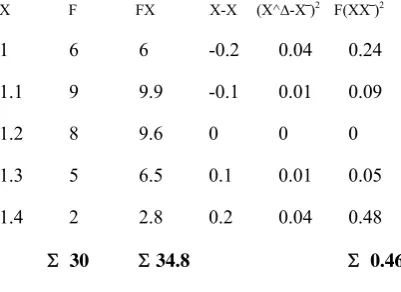
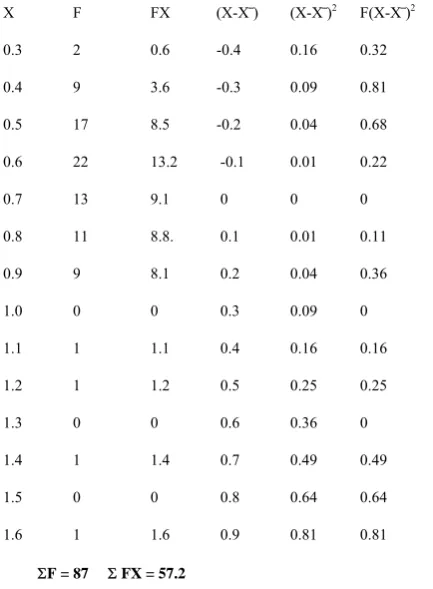
Tables 1 and 2 show the mean diameter of the nuts and shells of the Dura palm nut and shell after being cracked but not heated respectively
Measure for Cracked Dura Nuts (cm)
X = Nut thickness: F = Frequency
Mean thickness of nuts = = . = 1.6cm
Range = biggest size of nut – least size of nuts
= 1.4 – 1 = 0.4cmVariance = . = 0.015
Shell Thickness of Dura Kernel After Cracking
X = shell thickness
F = frequency
Mean =
= 0.7
Range = 1.6 – 0.3 = 1.3
Variance = = 0.06
Tables 3 and 4 show the mean diameters of the nuts and shells of the unheated Tenera palm nuts and shells after being cracked respectively.
Measurement of Cracked Tenera Nuts (After Cracking)
X = shell thickness
F = frequency
Mean = = . = 1.16
Range = 1.4 – 1.0 = 0.4
Variance = = 0.015
Measurement of Cracked Tenera Shells
Mean = 0.6
Range = 1.5
Variance = 0.07
Measurement of Cracked Dura Shells (After Heating) at 180oC
X = shell thickness F = frequency
Mean = = = 0.45cm
Range = 0.6 – 0.3 = 0.3
Variance =
= 0.0063
Measurement of Cracked Tenera Shells (After Heating) at 170oC
X = shell thickness F = frequency
Mean shell thickness =
Range = 0.5 – 0.2 = 0.3
Variance = = . = 0.0055
IV DISCUSSION
A look at Tables 1 and 2; Tables 3 and 4, show that when the unheated Dura palm nuts and Tenera palm nuts are cracked, it will be very difficult to separate their nuts from their shells because the thicknesses of the cracked palm nuts and shells are almost the same. Thus, it is nearly physically impossible to separate them effectively using a sieve. This is shown in the mathematical calculation of their range (1.3 - 1.5).
Table 1 shows that the cracked (unheated) Dura palm kernel has a nut thickness that ranges between 1cm – 1.4cm while shells range from 0.3cm – 1.6cm as shown in Table 2. The percentage of the shells that are of the same size as the Dura nut (making an allowance of 0.2cm) is about 25%. Thus theoretically, only about 75% separation efficiency is possible.
For the Tenera palm kernel, after cracking, the nut thickness ranges between 1cm – 1.4cm as shown in Table3, while the cracked shell thickness range between 0.1cm – 1.6cm (see Table 4). The percentage of the Tenera shells that are of the same nominal size as the nuts (making for an allowance of 0.2cm) is above 16%. Thus for cracked Tenera nuts and shells, the theoretical separation efficiency is about 84%.
However, after heating of the Dura palm kernel in an oven to 180oC and cracking them in a conventional palm nut cracking
machine, the range of the cracked shells produced reduce very dramatically to only 0.3cm – 0.6cm while the mean diameter is now 0.45cm as shown in Table 5 instead of 0.7cm (see Table 2). Given that the mean size of the cracked Dura nut is 1cm while the average size of the cracked shell is now 0.45cm, any sieve size of 0.65cm x 0.65cm (given an allowance of 0.2cm) will separate the nuts from the shells with a 100% efficiency (theoretically). Also, the Tenera nuts after being heated to 170 and cracked, produce shells that range from 0.2cm – 0.5cm. The reduction in the range of produced shells is 75% when compared with the unheated shell thicknesses, while the average shell thickness is now 0.33cm, instead of 0.6cm. See Table 6. This represents a reduction in size of 35.7%. Given that the least size of a Tenera (cracked) nut is about 1cm, it is easily seen that a sieve screen of 0.53cm x 0.53cm (given an allowance of 0.2cm) will separate the cracked Tenera nuts from their shells with 100% efficiency (theoretically). The thickness of the nuts and shells is the only relevant physical parameter as the length and width of the cracked nuts and shells will always be in the same range.
V CONCLUSION
Heating the Dura and Tenera species of palm kernel nuts at relatively low temperatures of 170oC and 180oC respectively
before cracking them seems to beneficially alter the friability of their shells and made them brittle. Consequently, the cracked shells produced are significantly different in terms of the range of sizes and actual thickness of the shells. This significantly marked reduction both in the range and size of the cracked shell thickness can be exploited by designers and engineers of mechanical sieves to achieve great improvements in the separation efficiency of cracked palm nuts and their shells of up to 100% (theoretically).
This maybe achieved by exploiting the physical and mechanical properties of the Dura and Tenera palm kernels without the use of water, clay or carpets.
Also, the heating of the nuts before cracking means that there is no need to further dry the nuts or shells before trying to extract their oil or store their shells. The heating of the palm nuts is not injurious to the quality of the produced palm kernel oil.
This work, if properly harnessed would remove the greatest bottleneck hampering the commercial and industrial operation of the oil palm industry in Nigeria.
[image:3.595.305.506.453.599.2]VI Tables
Table 1- Measure for Cracked Dura Nuts (cm)
X F FX X-X (X^∆-X ̅)2 F(XX ̅)2
1 6 6 -0.2 0.04 0.24
1.1 9 9.9 -0.1 0.01 0.09
1.2 8 9.6 0 0 0
1.3 5 6.5 0.1 0.01 0.05
1.4 2 2.8 0.2 0.04 0.48
Table 2: Shell Thickness of Dura Kernel After Cracking
X F FX (X-X ̅) (X-X ̅)2 F(X-X ̅)2
0.3 2 0.6 -0.4 0.16 0.32 0.4 9 3.6 -0.3 0.09 0.81 0.5 17 8.5 -0.2 0.04 0.68 0.6 22 13.2 -0.1 0.01 0.22 0.7 13 9.1 0 0 0 0.8 11 8.8. 0.1 0.01 0.11 0.9 9 8.1 0.2 0.04 0.36 1.0 0 0 0.3 0.09 0 1.1 1 1.1 0.4 0.16 0.16 1.2 1 1.2 0.5 0.25 0.25 1.3 0 0 0.6 0.36 0 1.4 1 1.4 0.7 0.49 0.49 1.5 0 0 0.8 0.64 0.64 1.6 1 1.6 0.9 0.81 0.81 F = 87 FX = 57.2
Tables 3 and 4 show the mean diameters of the nuts and shells of the unheated Tenera palm nuts and shells after being cracked respectively.
Table 3: Measurement of Cracked Tenera Nuts (After Cracking)
X F FX (X-X ̅ (X-X ̅)2 F(X-X ̅)2
1 6 6 -0.2 0.04 0.24
1.1 9 9.9 -0.1 0.01 0.09
1.2 8 9.6 0 0 0
1.3 5 6.5 0.1 0.01 0.05
1.4 2 2.8 0.2 0.04 0.48
F = 30 FX = 34.8
Table 4: Measurement of Cracked Tenera Shells
X F FX (X-X ̅) (X-X ̅)2 F(X-X ̅)2
0.1 1 0.1 -0.4 0.16 0.16
0.2 2 0.4 -0.3 0.09 0.18
0.3 8 2.4 -0.2 0.04 0.32
0.4 13 5.2 -0.1 0.01 0.13
0.5 27 13.5 0 0 0
0.6 14 8.4 0.1 0.01 0.14
0.7 2 1.4 0.2 0.04 0.08
0.8 2 1.6 0.3 0.09 0.18
0.9 1 0.9 0.4 0.16 0.16
1.0 0 0 0 0 0
1.1 4 4.4 0.6 0.36 1.44
1.2 1 1.2 0.7 0.49 0.49
1.3 1 0 0 0 0
1.4 1 1.4 0.9 0.81 0.81
1.5 0 0 0 0 0
1.6 1 1.6 1.1 1.21 0.21
F = 77 FX = 42.5 F(X-X ̅)2 =5.3
Table 5: Measurement of Cracked Dura Shells (After Heating) at 180oC
X F FX (X-X ̅) (X-X ̅)2 F(X-X ̅)2 0.3 0 0 -0.15 0.0225 0 0.4 1.6 6.4 -0.05 0.0025 0.04 0.5 5 2.5 0.05 0.0025 0.0125 0.6 5 3 0.15 0.0225 0.01125 F = 26 FX = 119 F(X-X ̅)2 =0.165
Table 6: Measurement of Cracked Tenera Shells (After Heating) at 170oC
X F FX (X-X ̅) (X-X ̅)2 F(X-X ̅)2 0.2 4 0.8 -0.15 0.0225 0.09 0.3 14 4.2 -0.05 0.0025 0.035 0.4 5 2 0.05 0.0025 0.0125 0.5 4 2 0.15 0.0225 0.01125
[image:4.595.44.261.104.399.2]ACKNOWLEDGMENT
The authors wish to acknowledge Messrs Aghfekokhian Lucky, Chukwuka Jude, Ezeala Chidiebere and Mafe Olusegun who assisted them very immensely during the fabrication and testing operations in the laboratory
REFERENCES
[1] C.W. Hartley; “The Oil Palm” Longman Publishers,London, 1- 85pp, 1977.
[2] NIFOR, “A Manual On Oil Palm Production” Nigerian Institute For Oil Palm Production, 2nd Edition, Benin, Nigeria, 5-36pp, 1981.
[3] D.K Salunkhe ; J.K Charen ; R.V Adsule and S.S Kadan, “World Oil Seeds: Chemistry, Technology and Utilization”. AVI Publishers N.Y. 198 – 250pp, 1992. [4] P.K Oke. : “Development and Performance Evaluation of
Indigenous Palm Kernel Dual Processing machine”. Journal of engineering and Applied Science 2(4): 701 – 705pp, 2007.
[5] P.D Turner and R.A Gillbanks : “Oil Palm Cultivation and Management”, Incorporated Society of Planters, Kuala Lumpur, 621 – 674pp, 1974.
[6] L.K Opeke. : “Tropical Tree Crops”, John Wiley and Sons, 1st Edition pp 231 – 271pp, 1997.
[7] NIFOR : “Oil Pam Products and Their Uses”; Information Bulletin No. 3, 1986.
[8] MPOB ; “Reviews of Malaysian Oil Palm Industry”, MPOB, Bangi, 17 – 19pp, 2004.
[9] http://www.iejt.academicdirect.org : “Performance of Palm Kernel Shells as a Partial Replacement for Coarse Aggregate in Asphalt Concrete” Assessed 18/5/11 [10] M.K Nuhu-Koko ; “The Use of Palm Kernel Shell as
Aggregate For Concrete” A paper presented at the 21st Annual Conference of material Testing, Control and Research, Federal Ministry of Works, Lagos, Nigeria, 18-21pp, 1990.
[11] H Mahmud. M.Z Jumaat. And U.J Alengaram. : “Influence of Sand/Cement ratio on Mechanical Properties of Palm Kernel Shell Concrete”; Journal of Applied Science, Vol. 9 Issue 9 1764 – 1769pp, 2009. [12] C.O Ilechie; U Omote; M.E Bafor; G.F Aibangbee; P.E
Amiolemhen and S.R Ogbiechi. : “Palm Waste Briquette Substituted For Fuel Wood”, Journal of Engineering, Science and Technology, 2(3):64 – 67pp, 2004.
[13] J.U Okoli. : “Optimum Drying Time for Palm Nut for Efficient But Cracking in Small Scale Oil Palm Producing Mills”, Global Journal of Engineering Research 2:7 – 10pp, 2003.
[14] L Aghafekokhian; J.C Chukwuka; M.C Ezeala and B.C Mafe : “The Fabrication of an Experimental Oven and Its Use to Ascertain The Effects of Temperature On the Separation of Cracked Palm Kernel and the Shell” Unpublished Final Year B.Eng Thesis, Dept. Of Mechanical Engineering, University Of Benin, 6 – 15pp, 2010.
[15] O.N Oguoma; C.C Onwuzurigbo and M Nnamadi. : “Design of Palm Kernel/Shell Separation for Developing Countries” Nig. J. Tech. Edu. 10: 1 – 5pp, 1993.
[16] S.I Obiakor . and O.O Babatunde. : “Development and Testing of the NCAM Centrifugal Palm Nutcracker”. AGRIMECH Research and Information Bulletin of the Nation Centre for Agricultural Mechanization (NCAM) 15 – 40pp, 1999.
[17] A.O Koya and M.O Faborode : “Separation Theory for Palm Kernel and Shell Mixture on a Spinning Disc”, Biosystem Engineering, 95: 405 – 413pp, 2006.
[18] O.A Koya ; A Idowu; and M.O Faborode : “Some Properties of Palm Kernel and Shell Relevant in Nut Cracking and Product Separation J. Agric. Eng. Technol. 12: 27 – 39pp, 2004.
[19] R.P Kachru; R.A Grupta and A Alan. : “Physico- Chemical Constituents and Engineering Properties of Food Crop” India Scientific Publishers 2nd Edition, 22 – 96pp, 1994.