Study of effectiveness of controlled traffic farming system
and wide span self-propelled gantry-type machine
Volodymir Bulgakov
1, Valerii Adamčuk
2, Ladislav Nozdrovický
3*,
Volodymir Kuvačov
41
Department of Mechanics and Resistance Materials, Mechanical and Technological
Faculty, National University of Life and Environmental Sciences of Ukraine, Kiev, Ukraine
2Institute of Agricultural Engineering and Electrification, National Scientific Centre,
National Academy of Agrarian Science of Ukraine, Kiev, Ukraine
3
Department of Machines and Production Biosystems, Faculty of Engineering, Slovak
University of Agriculture in Nitra, Nitra, Slovak Republic
4
Department of Utilization of Machines in Agriculture, Mechanical Engineering Faculty,
Tavria State Agrotechnological University of Ukraine, Melitopol, Ukraine
*Corresponding author: [email protected]
Abstract
Bulgakov V., Adamčuk V., Nozdrovický L., Kuvačov V. (2018): Study of effectiveness of controlled traffic farming system and wide span self-propelled gantry-type machine. Res. Agr. Eng., 64: 1–7.
Trends in the global agricultural sector tend to efficient use of resources and improving the quality in agriculture. A significant effect in this regard can be achieved when using controlled traffic farming and wide span self-propelled gantry-type machine. The aim of this study is theoretical justification of the cost-effectiveness of introduction of the controlled traffic farming system and using of wide span self-propelled gantry-type machine, by selecting some optimal parameters of land use. Provided studies have shown that the most significant economic effect of introduction of the controlled traffic farming system is evident on the fields with high anthropogenic degradation of soils, where the results of crop yields increasing due to natural processes of soil decompression will be essential. The economic effect obtained by the implementation of the controlled traffic farming system by saving energy costs and seed. and due to increased crop yields is a minimum at the level of 150 € per ha.
Keywords: precision agriculture; field machine passes; time utilization; reduction of the soil compaction; economic efficiency
https://doi.org/10.17221/19/2017-RAE
A cropping system based on using controlled traffic farming means the separation of machinery traffic areas from plants´ growing zones. In this case, the functionality of the field area is divided into fertile (agrotechnical) area and technology (engineering) area. In practice, this means that one and the same wheel track is used for soil treatment, planting, spraying and harvesting; wheels of mobile power vehicles (tractors) and machines are adjust-ed to the same track width.
The natural meaning of the controlled traffic farming system is based on a need to solve the fun-damental contradictions in the system of “propeller - soil”, the essence of which is to achieve high trac-tion properties of tractors having contact with dry and compacted soil, while on the other side there must be ensured optimal soil moisture and loose environment for normal plant growth.
farming, and scientists in Europe and Australia are looking for new solutions in the development of this technology. Along with this, there are new conserva-tive arguments based on the main ideas that due to the establishing tramlines for machines, the size of sowing area naturally decreases. It should be noted that this saves the amount of seeding material. De-pending on the field size and width of the tramline area the percentage of allocated engineering zone can vary significantly. From a purely technical point of view, the machines movement in the constant tramline improve their technical and operational performance. It is expressed as a reduction of energy costs for technological processes and an increase of work productivity (Galambošová et al. 2014).
The work along the technology tramline is more simple, the spraying and fertilizing operations are less tiring for the operator, and in the same time the quality of these operations is quite high.
According to Kroulík et al. (2013), GPS naviga-tion used in agricultural machinery in the form of controlled traffic farming system creates a lot of possibilities of environment and soil protection. From a technological point of view, especially topi-cal is the application of controlled traffic farming system in the transition to soil conservation tillage systems, where decompaction of the soil occurs due to natural soil processes and soil compaction is becoming one of the major obstacles in obtaining high crop yields.
In this regard, the transition to the controlled traf-fic farming system with the use of a wide span self-propelled gantry-type machine eliminates the com-paction and destruction of soil by wheels and tracks of the tractors. It allows to ensure the preservation of the natural fertility of the soil in the production field area (Galambošová et al. 2010) and to provide higher yields of grain crops by 10–15%, of industrial crops by 15–20% and of vegetables by 20–35%.
Due to the above circumstances, the question arises how large the economic benefit obtained by using of the controlled traffic farming system can be. And what are the optimal values of land-use in-dicators to determine the value of maximum eco-nomic efficiency at the same time?
Scientists of many countries around the world pay strong attention to the effectiveness of the controlled traffic farming system using on farms; a research car-ried out in some typical soil conditions in West Aus-tralia (Blackwell et al. 2013) confirmed an average increase of the grain crop yields up to 10 % and a
de-crease of the fuel consumption of mobile machines due to improved smoothness of their movements.
Also, when using controlled traffic farming, a decrease in energy consumption of the working machines can be observed due to reduced rolling resistance and slippage factor when driving on a solid background traces of permanent tramlines, in comparison with their movement on soft soil sur-face ground.
Results obtained by Blackwell et al. 2004a,b, 2013, confirmed that using of controlled traffic farming without ploughing allows to decrease the fuel consumption of tractors by 25%. Research of the scientists from Queensland (Tullberg et al. 2000, 2007, 2013) showed that a decrease of the fuel consumption was 50% when the controlled traffic farming was used on the loamy soils.
From the results published by Webb et al. 2004, it can be seen that the controlled traffic farming in-creases the efficiency of crop production by reduc-ing the consumption of seeds, fertilizers and her-bicides. Using of permanent traffic lines improves performance and trajectory of movement of trac-tors, as noted in (Bochtis et al. 2010).
Much attention in the scientific literature on this subject is given to soil processes occurring in rela-tion to the controlled traffic farming system use. A research (Evans et al. 2009, 2010, 2011) confirmed that the use of controlled traffic farming and no-till method increases the amount of beneficial micro-organisms and macrofauna (worms, ants and ter-mites) in the soil by 40–160%.
Reduction of capital costs and depreciation of tractors when using controlled traffic farming was analysed in details (Isbister et al. 2013).
The latter authors have stated that due to better traction conditions of tractor with the ground in the zone of permanent technological tracks there are lower energy costs. It is possible to use trac-tors with lower purchase price, which reduces the amount of depreciation and allows using more such tractors during the year on the farm.
Despite the studies of the problems related to this issue, the considered publications, however, do not allow to estimate the economic impact by saving energy costs, seed and by increasing crop yield, which can be obtained due to the controlled traf-fic farming system implementation in farm condi-tions.
htt ps://doi.org/10.17221/19/2017-RAE
of the controlled traffi c farming on the land use indicators in the planning and organization of the movement of the fi eld wide span machine-tractor unit (gantry) has not been enough studied and ana-lysed by scientists.
MATERIAL AND METHODS
Th e aim of this study is theoretical justifi cation of the economic eff ectiveness of implementation of the controlled traffi c farming system and wide span self-propelled gantry-type machines, on the basis of selection of the optimal parameters of land use. As study methods there were used the basic laws of economics using PC and the Mathcad packet.
Th e rapid development of controlled traffi c farm-ing in the world in recent years strongly suggests the broad prospects of wide span self-propelled gantry-type machines. In many European coun-tries, including Ukraine, a research was also car-ried out in this regard, aimed at the development of scientifi c bases of aggregation wide span vehicles, providing a decrease in energy, material and labour costs in agricultural production.
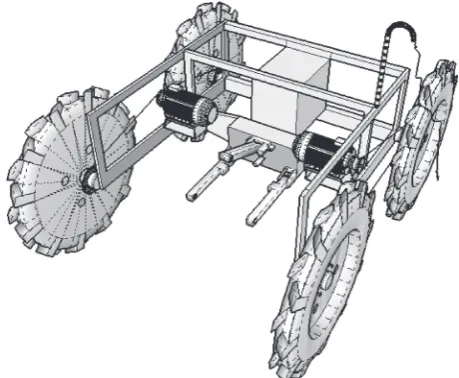
With the aim of practical implementation of con-trolled traffi c farming, this study created a concept of a wide span self-propelled gantry-type machine, the design of which contains primarily power-trains to drive self-propelled chassis, hydraulic hinge mechanism for the aggregation of agricul-tural tools, motion control devices of the machine and others (Fig. 1).
Th e economic eff ect of the controlled traffi c farm-ing introduction was evaluated by comparfarm-ing two technologies of cultivation of agricultural crops on the fi elds having the same geometric shape and acreage.
In one of them, traditional tractor and combine harvester technologies were used in the processes of the soil tillage, seeding, plant care and harvest-ing. During a year, the machines entered the fi eld from 5 to 25 times. Typically, the total area of the tracks caused by tractor wheels exceeded the fi eld area 1.1–2.0 times, 10–15% of the fi eld was exposed to passes from 6 to 20 times, 65–80% 1–6 times and only 10–18 % of the fi eld area was not aff ected by the machine passes (Fig. 2).
In view of the above mentioned circumstances, in conventional farming system the soil density in-creased when compared with the optimal value, both in arable and subarable layers and is rp1 and rpp1
(g·cm–3), respectively, which is usually as one of the main reasons of the shortage of the yield Uf1 (t·ha–1).
[image:3.595.304.532.96.373.2]According to the methodology, the other tech-nology used was controlled traffi c farming. To perform the full range of fi eld operations a single
[image:3.595.61.291.537.726.2]Fig. 1. Design of a wide span vehicle (gantry-type) for the controlled traffi c farming realization
Fig. 2. Deeply compressed wheel tracks, exposed to sheet erosion of topsoil, clearly showing how compaction has af-fected 80% of this fi eld (Tullberg 2004) (a) and the charac-ter of disordered traces of wheeled vehicles on the fi eld (b)
(a)
power module was used – self-propelled wide span gantry-type machine, which moves in permanent tramlines (Fig. 3). Coverage of fi eld surface by ma-chine passes was 5–10%.
Due to the lack of compaction impact on the soil caused by wheels of the self-propelled wide span gantry-type machine, in the fertile fi eld zones soil decompression occurs due to natural soil process-es. Such farming technology leads to substantial changes in soil bulk density both in arable soil layer
rp2and also in subsoil layer rpp2 (g·cm–3). In soil, there is a tendency to renew its equilibrium state, which can be close to optimal values, providing a maximum yield (t·ha–1) of the grown crops.
Th e economic eff ect E obtained from the intro-duction of the controlled traffi c farming system is defi ned primarily by three components:
E = De
h + Des + Dee (1)
where: Deh – the economic eff ect of increasing the yield
of growing crop, €·ha–1; De
s – economic eff ect of saving
seeding material, €·ha–1; De
e – economic eff ect of saving
energy costs, €·ha–1
Let us consider each component of the Eq. (1) separately.
Th e economic eff ect Deh of the increase of crop
yield can be represented as the diff erence between the values of gross output, obtained at using the two examined farming techniques (Figs 2 and 3):
Deh= Deh2 – Deh1 (2)
where: Deh2 – the value of gross output, obtained by
using a controlled traffi c farming technology (€·ha–1)
eh2 = (1 – w1)Uf2Vh2 (3)
where: eh1 – the value of gross output, obtained by using a traditional growing technology (€.ha–1)
eh1 = Uf1Vh1 (4)
where: Vh1, Vh2 – the price of 1 t of the crop yield obtained using the two farming technologies (€·t–1), U
f1, Uf2 – actual yields of the cultivated crops, grown accord-ing to the two farmaccord-ing technologies (t.ha–1); w
i–losses
of the fi eld surface used as an engineering area
RESULTS AND DISCUSSION
Th e methods allowing to express the soil com-paction eff ects of the passes of fi eld machines and tractors with regard to economic consequences of the perspective farming technologies in crop pro-duction are well known.
Th e methods of dynamic programming make it possible to compare the technological attributes of lo-cal resources and they determine the level of impact of anthropogenic activities on the soil and give an economic evaluation of both the developed and im-plemented technologies of crop growing as well as of the entire technological and technical tillage systems.
As a basis of the above-mentioned methods the re-sults obtained by Rusanov (1998) were considered. According to his research, the predicted change of yield of the growing crop depends upon bulk density of the soil, both in its arable and subarable layers:
Uf= Umax(1 – ((Cp|rp – r0|Kp)n+ (C
pp|rpp – r0|Kpp)n))
(5)
where: Uf – real yield of the growing crop obtained in conditions of the soil bulk density in arable soil layer (0–20 cm) rp, and subarable layer (20–40 cm) rpp (t·ha–1); Umax – maximal yield of the fi eld crop obtained in case of the optimal soil bulk density r0 (t·ha–1); C
p, Cpp –
empiri-cal coeffi cients (cm3·g–1); n – exponent; K
p, Kpp –
[image:4.595.65.291.96.363.2]coef-fi cients of recovery of the soil bulk density in arable layer and subarable layer
Fig. 3. Controlled traffic farming and wide span self-propelled gantry-type machine (a) and the character of the tramlines of the wheel-type machines on a fi eld (b)
https://doi.org/10.17221/19/2017-RAE
With regard to the above-mentioned farming technologies, the Eq. (5), respectively, takes the form:
Uf1= Umax(1 – ((Cp1|rp1 – r0|Kp1)n+ (C
pp1|rpp1 – r0|Kpp1)n)),
Uf2= Umax(1 – ((Cp2|rp2 – r0|Kp2)n+ (C
pp2|rpp2 – r0|Kpp1)n))
(6) Taking into account Eq. (3–6) the Eq. (2) takes the form:
Δeh=
( )
1−wi Umax 1−(
Cp2ρp2− ρ0Kp2)
n
+
(
Cpp2ρpp2− ρ0 Kpp2)
n ⎛
⎝⎜ ⎞⎠⎟
⎛
⎝⎜ ⎞⎠⎟
Vh2−Umax 1−
(
Cp1ρp1− ρ0 Kp1)
n+
(
Cpp1ρpp1− ρ0 Kpp1)
n⎛
⎝⎜ ⎞⎠⎟
⎛
⎝⎜ ⎞⎠⎟Vh1
(7)
The economic effect ∆es can be presented as the difference in the costs of seeding material required for the two variants of the farming technologies:
Des= es1 – es2 (8)
where: es1 – price of the seeding material used for the traditional farming technology (€·ha–1)
es1 = usVs (9)
where: es2 – price of the seeding material used for the technology of controlled traffic farming (€·ha–1)
es2 = usVs(1–wi) (10)
where: us – standard seeding rate for seeding of the given growing crop (t·ha–1); V
s – price of the seeding
material (€·t–1)
With regard to (9) and (10), the equation (8) takes the form:
Des = usVswi (11)
Let us justify the effect ∆es of saving energy costs due to the implementation of the controlled traffic farming technology. Reducing energy consumption is due to two components: the reduction of working resistance of the tillage implements and reduction of the costs connected with movement of the wide span self-propelled gantry-type machine, whose wheels interact with the compacted soil tramlines track.
Based on the results obtained in many research ac-tivities focused on wide span self-propelled gantry-type machines, it can be stated that the decrease of the fuel consumption related to 1 ha can reach the value of 10% and even more (Blackwell et al. 2004, 2013; Tullberg et al. 2000, 2007, 2013).
The considered computational procedure allows to estimate the value E related to implementation of the controlled traffic farming system, taking into account the level of exposure to anthropogenic ac-tivities on the soil by using a generalized indicator of the soil bulk density. The indicator of soil bulk density can be considered as a factor of yield of the growing crop.
As an argument of the studied function (1), the indicator wi of the rate of loss of the field area (in relative units) used as an engineering field area was considered.
[image:5.595.304.534.670.757.2]The value of the soil bulk density in studied crop-growing technologies, as mentioned before, will determine the level of crop yield productivity and, consequently, the price of gross output.
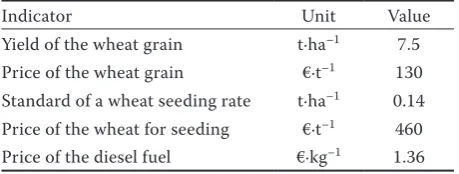
Table 1. Indicators of the wheat growing in Europe
Indicator Unit Value
Yield of the wheat grain t·ha–1 7.5
Price of the wheat grain €·t–1 130
Standard of a wheat seeding rate t·ha–1 0.14
Price of the wheat for seeding €·t–1 460
Price of the diesel fuel €·kg–1 1.36
Therefore, there was examined the nature of the change of the desired function E of the absolute dif-ference of soil bulk density as a result of its decom-paction due to natural soil processes during the transition to the controlled traffic farming system. In this case, it was assumed that both in arable and subarable soil layers the difference of the soil bulk density would be identical
Dr = rp1 – rp2 = rpp1 – rpp2
To calculate the value of the economic effect E of the controlled traffic farming system implementation, the following values of parameters were used on the example of wheat growing in Europe (Table 1).
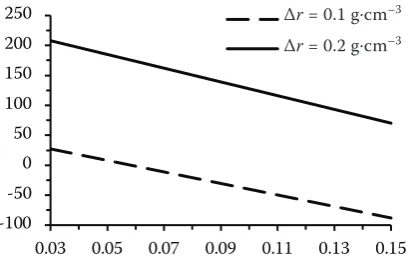
The results of evaluating the effectiveness of con-trolled traffic farming in relation to the saved ener-gy costs, seeding material, and increasing the yield of wheat grain according to (1) are shown in Fig. 4.
Analysis of the Fig. 4 shows that the economic ben-efits that can be obtained by the implementation of controlled traffic farming are directly determined by the losses of the field area under the engineering area
of movement of a self-propelled wide span gantry-type machine will significantly affect the economic performance and controlled traffic farming.
If the loss of the field area used as an engineering area of the controlled traffic farming reach more than 6% and the absolute value of the natural soil decompaction is only Dr = 0.1 g·cm–3, it would be impossible to obtain a positive economic effect only due to the yield increase (curve 1, Fig. 4).
According to our results related to losses of the used area of the field, it is possible to reach the losses of the used area of the field lower than 6% if the wide span gantry-type machine with the width of the tracks at least 8-10 m is used. In this case, the income from gross production will not be less than in traditional agricultural technology at least. Such parameters are currently typical for the experimental wide span self-propelled gantry-type machines, for example ASA-Lift WS 9600 WS (ASA-ASA-Lift, Denmark) with the width of tracks 9.6 m (Pedersen et al. 2013).
More significant economic benefits of the con-trolled traffic farming use will be evident in the case when the soil compaction will become a main obsta-cle to reach high yields of the field crops in the tradi-tional farming technology.
And, if in the conditions of the correct conserva-tion agriculture using the controlled traffic farm-ing the value of the natural soil decompaction is reached at the level Dr = 0.2 g·cm–3, the economic effect due to a significant yield increase will be evi-dent, even with the losses of the field area under the engineering area being 15% (curve 2, Fig. 4).
The value of the economic effect will be greater in the case when a part of the field area allocated as
an engineering area will be smaller. When using the above-mentioned wide span gantry-type machine ASA-Lift WS 9600 WS, the economic benefit of sav-ings of energy costs and seeding material, and in-creasing of yield of wheat will be a minimum of 150 € per each hectare where the wheat is grown.
CONCLUSION
Studies have shown that the economic benefits that can be obtained due to implementation of the controlled traffic farming system are directly deter-mined by the losses of the field area used as an en-gineering area designed to support the moving of a wide span gantry-type machine and other means of mechanization, and may also place additional com-munications.
The management of field operations and organi-zation of the movement of the wide span gantry-type machine and other means of mechanization will significantly affect the economic indicators of the controlled traffic farming system.
The most significant economic effect of the con-trolled traffic farming will be evident on the fields with high anthropogenic degradation of the soil, where the result of crops yield increase due to natu-ral processes of soil decompaction will be essential. The economic effect of the controlled traffic farming allowing to save energy costs, seed and to increase the yield of grown crops by using modern models of self-propelled wide span gantry-type machine, related to growing of wheat, is a mini-mum of 150 € per hectare according to our results. It allows to pay investments for a promising new precision farming technologies.
References
Blackwell P., Mckenzie D, Webb B., Lemon J., Barber P., Fretwell G., Bignell G., Moffat N. (2004a): Compaction of heavy soils by cropping traffic and estimated benefits of tramline farming. In: Agribusiness Crop Updates 2004, Perth: 16–22.
Blackwell P., Webb B., Fretwell G., Moffat N., Chappel L. (2004b): Tramlines for less fuel use, pollution and greener farming! In: Agribusiness Crop Updates 2004, Pert: 26–32. Blackwell P., Hagan J., Davies S., Riethmuller G., Bakker D.,
[image:6.595.71.278.97.227.2]Hall D., Knight Q., Lemon J., Yokwe S., Isbister B. (2013): Implications of Controlled Traffic Farming in WA. Crop updates, grain industry association of Western Australia.
Fig. 4. The results of evaluating the effectiveness of the controlled traffic farming in relation to saved energy costs, seeding material, and increasing the yield of wheat grain for different values of the soil decompaction Dr:
1 – Dr = 0.1 g·cm–3, 2 – Dr = 0.2 g·cm–3
-100 -50 0 50 100 150 200 250
0.03 0.05 0.07 0.09 0.11 0.13 0.15
Δr = 0.1 g·cm3 Δr = 0.2 g·cm3 ∆r = 0.1 g.cm–3
https://doi.org/10.17221/19/2017-RAE
Available at http://www.nacc.com.au/Controlled_Traf-fic_Farming_Technical_Manual.pdf
Bochtis D.D., Sørensen C.G., Busatob P., Hameed I.A., Rodias E., Green O., Papadakis G. (2010): Tramline establishment in controlled traffic farming based on operational machinery cost. Biosystems Engineering, 107: 221–231.
Evans F., Hashim A., Diggle A. (2009): Risk of glysophate resistance in wide-row lupin cropping systems. Agribusi-ness Crop Updates, Perth, 86: 301–315.
Evans T.A., Dawes T.Z., Ward P.R., Lo N. (2011): Ants and termites increase crop yield in a dry climate. Nature Com-munications, 2:262: 10.1038/ncomms1257. Available at: https://www.sciencedaily.com
Galambošová J., Macák M., Rataj V., Godwin R.J., Žitňák M., Vitázková B., Ďuďák J., Chamen T. (2014): Yield perfor-mance of controlled traffic farming permanent tramlines. In: ASABE Annual International Meeting 2014, St. Joseph, USA. Available at http://elibrary.asabe.org/azdez.asp?JID= 5&AID=44685&CID=mon2014&T=2&redirType=techpa pers.asp&confid=mon2014>
Galambošová J., Rataj V., Macák M., Žitňák M., Nozdro-vický L. (2010): Controlled trafic farming and minimum tillage: results of initial experiments and layout of a long term experiment. In: XVIIth World Congress of the
In-ternational Commission of Agricultural and Biosystems Engineering (CIGR). Canadian Society for Bioengine-ering, 2010. Available at https://www.bioeng.ca/index2. php?option=com_sobi2&sobi2Task=dd_download&fid= 359&format=html&Itemid=174>
Godwin R.J., Miller P.C.H. (2003): Technologies for mapping with-infield variability. In: Biosystems Engineering, 84, 393–407.
Isbister B., Blackwell P., Riethmuller G., Davies S., Whitlock A., Neale T. (2013). The Controlled Traffic Farming Tech-nical Manual. It updates the Tramline Farming Systems: Technical Manual Bulletin 4607. Department of Agricul-ture and Food, Western Australia. Available at https:// www.agric.wa.gov.au
Kroulík, M., Kvíz, Z., Chyba, J. (2013): Possibilities of environ-ment and soil protection by means of GPS navigation used in agricultural machinery. In: 5th International Conference
on Trends in Agricultural Engineering 2013, Sept 3, 2013, Czech University of Life Sciences Prague, 2013: 364–367. Pedersen Н.Н., Sørensen C.G., Oudshoorn F.W., Mcphee
J.E. (2013): User requirements for a wide span tractor for controlled traffic farming. International Commission of Agricultural and Biological Engineers, Section V. CIOSTA XXXV Conference “From Effective to Intelligent Agricul-ture and Forestry”, Billund, Denmark, July 3–5, 2013. Rusanov V.А. (1998): Problema pereuplotnenia pochv
dvi-zhiteljami i effektivnye puti jijo reshenija. Moscow, VIM. Tullberg J.N. (2000): Traffic Effects on Tillage Energy. Journal
of Agricultural Engineering Research, 75: 375–382. Tullberg J.N. (2004): Driving a revolution in agriculture.
ECOS, 118: 23–36.
Tullberg J.N., Mchugh A., Ghareel Khabbaz B., Scheer C., Grace P. (2011): Controlled traffic/permanent bed farm-ing reduces GHG emissions. Proceedfarm-ings of 5th World
Congress of Conservation Agriculture incorporating 3rd
Farming Systems Design Conference, Brisbane. Available at https://eprints.usq.edu.au
Tullberg J.N. (2013): CTF impacts: Environment = Economic. In: 1st International Controlled Traffic Farming Conference
Toowoomba, Queensland, Feb 25–27, 2013: 56–58. Tullberg J.N., Yule D.F., Mcgarry D. (2007): Controlled traffic
farming – from research to adoption in Australia. Soil and Tillage Research, 97: 272–281.
Tullberg J.N., Ziebarth P.J., Yuxia Li. (2001): Tillage and traf-fic effects on runoff. Australian Journal of Soil Research, 39: 249–257.
Webb B., Blackwell P., Riethmuller G., Lemon J. (2004): Tramline farming systems: technical manual, Bulletin 4607, Department of Agriculture, Western Australia. Available at https://www.agric.wa.gov.au