Winter wheat yields are influenced by both envi-ronmental and agronomic factors (Sugár et al. 2016). Preceding crop and nitrogen fertilization are the key agronomic determinants of grain yield. Optimal growing conditions contribute to an increase in the technological efficiency of grain production.
The influence of preceding crops on winter wheat grain yield was widely researched (Lehocká and Klimeková 2009, Houšť et al. 2012, Švančárková and Žák 2015, Fordoński et al. 2016). The results of published studies indicate that legumes, perennial crops of the family Fabaceae and winter oilseed rape are the optimal preceding crops for winter wheat. Cereals are less suitable preceding crops because
they strongly degrade soil and increase the risk of pests and disease, in particular fungal infections.
Nitrogen fertilization significantly influences the yield and quality of winter wheat grain. Nitrogen is a mineral nutrient with the greatest yield-forming effect in plant production. Plants that are well supplied with nitrogen produce more tillers and grains but excessive rates of nitrogen fertiliza-tion can lead to lower yields (Kutman et al. 2011, Klikocka et al. 2016).
High nitrogen rates increase grain yield and the content of protein and gluten in grain, but they can also compromise grain quality. When applied in the late growth stages of wheat, nitrogen can
Effects of pre-preceding leguminous crops on yield
and chemical composition of winter wheat grain
Agnieszka PSZCZÓŁKOWSKA*, Adam OKORSKI, Jacek OLSZEWSKI,
Gabriel FORDOŃSKI, Sławomir KRZEBIETKE, Alina CHAREŃSKA
Faculty of Environmental Management and Agriculture, University of Warmia and Mazury in Olsztyn, Olsztyn, Poland
*Corresponding author: [email protected]
ABSTRACT
Pszczółkowska A., Okorski A., Olszewski J., Fordoński G., Krzebietke S., Chareńska A. (2018): Effects of pre-preceding leguminous crops on yield and chemical composition of winter wheat grain. Plant Soil Environ., 64: 592–596.
The after-effects of pre-preceding crops (second year), i.e. legumes and spring wheat, and nitrogen fertilization rate (0, 60, 120 and 180 kg N/ha) on the yield and chemical composition of winter wheat grain were analysed in a field experiment conducted in 2013–2015. Winter wheat was characterized by higher yield when sown after blue lupine (increase of 0.23 t/ha) and faba beans with a determinate growth habit (increase of 0.37 t/ha) than after spring wheat. Grain yield increased significantly with a rise in nitrogen fertilization rate (by 2.03, 3.47 and 4.02 t/ha, re-spectively). The species of pre-preceding crops had no significant effect on the phosphorus, potassium, magnesium and calcium content of winter wheat grain. Winter wheat grown after faba beans with an indeterminate growth habit was most abundant in nitrogen. The applied nitrogen fertilizer rates did not modify the concentrations of phosphorus, magnesium and calcium in winter wheat grain. The nitrogen content of grain increased significantly with a rise in nitrogen fertilization rates. A significant increase in manganese and zinc levels was observed when spring wheat was the pre-preceding crop and the iron content of grain increased significantly when winter wheat was grown after peas and blue lupine.
Keywords: cereals; Triticum aestivum L.; nutrition; Fabaceae
increase the percentage of low-molecular-weight gliadin subunits in grain protein, which deterio-rates the properties of gluten (Johansson et al. 2001, Litke et al. 2018).
The aim of the study was to assess the effects of pre-preceding leguminous crops and nitrogen fertilization rate on yield and chemical composi-tion of winter wheat grain.
MATERIAL AND METHODS
A field experiment was conducted in the growing seasons of 2012/2013–2014/2015 in the Agricultural Experiment Station in Bałcyny (53°35'49.7''N, 19°51'17.3''E). The experiment had a randomized block design with two factors and 4 replications. The first experimental factor was the pre-preceding crop for winter wheat: semi-leafless peas cv. Tarchalska, blue lupine cv. Zeus (with an indeterminate growth habit), faba beans cv. Olga (with an indeterminate growth habit), faba beans cv. Granit (with a determi-nate growth habit) and spring wheat cv. Trappe. The second experimental factor was the rate of nitrogen fertilization: 0 (control); 60 kg N/ha (single application in early spring before the beginning of the growing season); 120 kg N/ha (two applications – 60 kg in early spring and 60 kg two weeks later); 180 kg N/ha (three applications – 60 kg in early spring, 60 kg two weeks later and 60 kg during heading). Nitrogen was applied as ammonium nitrate (34% N).
Winter oilseed rape was the preceding crop for winter wheat cv. Muszelka and spring wheat and selected legume species were the preceding crops for winter oilseed rape. The experimental plots had an area of 30 m2 each. Each year, winter wheat cv.
Muszelka was sown between 10 and 20 September. The yield and the macronutrient and micronutri-ent contmicronutri-ent of winter wheat grain were determined at a certified laboratory of the District Chemical and Agricultural Station in Olsztyn, Poland. The phosphorus content of grain was determined by the vanadium-molybdenum method, calcium and potassium content by atomic emission spectrom-etry (AES), magnesium content by flame atomic absorption spectrometry (FAAS), and total nitrogen content by the hypochlorite method. The micro-nutrient content of grain was analysed by flame atomic absorption spectrometry (FAAS). Grain was mineralized in a mixture of nitric acid and hypochloric acid, and micronutrient
concentra-tions were determined by flame atomic absorption spectrometry (http://oschr.olsztyn.pl/wp-content/ uploads/2018/02/AB-277.pdf ).
The grain yields of winter wheat and the results of chemical analyses were verified statistically. The least significant difference was calculated at α ≤ 0.05 for the yield of winter wheat grain and at α ≤ 0.01 for macronutrient and micronutrient content using the Tukey’s test. All calculations were performed in Statistica v. 10 software (Dell Inc. 2016, Tulsa, USA).
RESULTS AND DISCUSSION
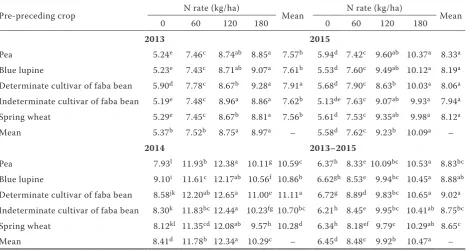
The grain yield of winter wheat was high when the main crop was grown after legumes and spring wheat as pre-preceding crops (Table 1). In all treat-ments, the grain yield of winter wheat was highest in 2014 and lowest in 2013 (Table 1). Winter wheat produced significantly higher yields after blue lupine and the determinate cultivar of faba beans (increase of 0.23 t/ha and 0.37 t/ha, respectively) than after spring wheat. The grain yields in treat-ments where winter wheat was grown after peas and the indeterminate cultivar of faba beans did not differ significantly from those noted in treatments where spring wheat was the pre-preceding crop.
treat-ments, the grain yield of winter wheat increased by 4.02 t/ha on average, relative to control.
According to many authors (Lehocká and Klimeková 2009, Houšť et al. 2012, Švančárkowá and Žák 2015), preceding crops significantly influence winter wheat yields. Kozak and Kotecki (2006) analysed the effect of peas on the development and yield of winter wheat cv. Kobra. Winter wheat plants grown in a treatment where the post-harvest residues of peas (roots, stubble and straw) were incorporated into the soil by plough-ing were significantly taller and were characterized by significantly longer flag leaves, higher 1000 kernel weight, highest grain yield, highest straw biomass and highest total protein content, relative to treatments without pea residues. In a study by Švančárkowá and Žák (2015), winter wheat yields were higher after peas (5.9 t/ha) than after red clover (5.4 t/ha). Peas not only significantly increased yield, but also improved grain quality parameters. In an experiment by Lehocká and Klimeková (2009), winter wheat yields reached 6.5 t/ha after alfalfa and were 0.6 t/ha lower when spring barley was the preceding crop. The lowest yields were observed after peas (5.6 t/ha). The grain of winter wheat grown after spring barley was characterized by the highest processing suitability and optimal technological properties. Houšť et al. (2012) did not report significant differences in winter
wheat yields in three crop rotations (alfalfa, peas, maize grown for silage) with different percentages of cereals (33.3, 50 and 66.6%). In a study by Prusiński et al. (2016), the average yield and protein content of winter triticale grain were higher after leguminous forecrops than after spring barley.
[image:3.595.65.532.127.377.2]Recent research indicates that the grain yield of selected wheat cultivars continues to increase up to a nitrogen rate of 200 kg N/ha. Similar results were reported by Campillo et al. (2010) who found that a fertilizer rate of 200 kg N/ha produced the highest profits in the production of winter wheat. In the work of Tayebeh et al. (2011), winter wheat responded most favourably to a nitrogen rate of 240 kg N/ha. A fertilizer rate of 360 kg N/ha led to a further increase in grain yield, but the difference between treatments fertilized with 360 and 240 kg N/ha was not statisti-cally significant. In the experiments conducted by Sugár et al. (2016), wheat yields peaked in response to 80 and 160 kg N/ha, subject to cultivar. Prusiński et al. (2016) observed that mineral nitrogen fertilizers applied at a rate of 60 to 180 kg N/ha did not induce significant differences in the average grain yield of winter triticale cv. Tulus. In a study by Dogan and Bilgili (2010), the optimal nitrogen rate for winter wheat was 150 kg N/ha, and an increase to 200 kg N/ha did not lead to a significant increase in grain
Table 1. Effects of nitrogen (N) fertilization rates and pre-preceding crops on the yield of winter wheat grain harvested in 2013–2015 (t/ha) (preceding crop – winter oilseed rape)
Pre-preceding crop N rate (kg/ha) Mean N rate (kg/ha) Mean 0 60 120 180 0 60 120 180
2013 2015
Pea 5.24e 7.46c 8.74ab 8.85a 7.57b 5.94d 7.42c 9.60ab 10.37a 8.33a
Blue lupine 5.23e 7.43c 8.71ab 9.07a 7.61b 5.53d 7.60c 9.49ab 10.12a 8.19a
Determinate cultivar of faba bean 5.90d 7.78c 8.67b 9.28a 7.91a 5.68d 7.90c 8.63b 10.03a 8.06a
Indeterminate cultivar of faba bean 5.19e 7.48c 8.96a 8.86a 7.62b 5.13de 7.63c 9.07ab 9.93a 7.94a
Spring wheat 5.29e 7.45c 8.67b 8.81a 7.56b 5.61d 7.53c 9.35ab 9.98a 8.12a
Mean 5.37b 7.52b 8.75a 8.97a – 5.58d 7.62c 9.23b 10.09a –
2014 2013–2015
Pea 7.93l 11.93b 12.38a 10.11g 10.59c 6.37h 8.33e 10.09bc 10.53a 8.83bc
Blue lupine 9.10i 11.61c 12.17ab 10.56f 10.86b 6.62gh 8.53e 9.94bc 10.45a 8.88ab
Determinate cultivar of faba bean 8.58jk 12.20ab 12.65a 11.00e 11.11a 6.72g 8.89d 9.83bc 10.65a 9.02a
Indeterminate cultivar of faba bean 8.30k 11.83bc 12.44a 10.23fg 10.70bc 6.21h 8.45e 9.95bc 10.41ab 8.75bc
Spring wheat 8.12kl 11.35cd 12.08ab 9.57h 10.28d 6.34h 8.18ef 9.79c 10.29ab 8.65c
yield. Litke et al. (2018) found that the grain yield of winter wheat increased significantly with a rise in nitrogen rate. In cv. Skagen, grain yield increased significantly up to nitrogen rate of 180 kg N/ha. The values of grain quality parameters also increased considerably when nitrogen fertilizer was applied at 150 to 210 kg N/ha.
Podolska et al. (2005) analysed the profitability of winter wheat production and concluded that nitrogen fertilization rates higher than 120 kg N/ha were not economically justified because they de-creased the productivity of land, labour and capital. The fertilizer rate of 120 kg N/kg delivered optimal yields, grain quality and profitability.
The evaluated experimental factors induced minor variations in the macronutrient content of winter wheat grain (Tables 2 and 3). The analysed pre-preceding crops did not significantly differenti-ate the concentrations of phosphorus, potassium, magnesium and calcium in grain (Table 2). The highest nitrogen content of grain (14.2 g N/kg DM (dry matter)) was observed in the treatment where the indeterminate cultivar of faba beans was the pre-preceding crop. The grain of winter wheat grown after peas had the lowest nitrogen content
(12.9 g N/kg DM). The observed differences were similar in the remaining treatments.
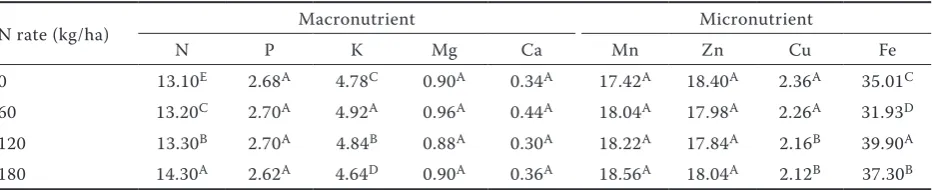
The nitrogen content of winter wheat grain in-creased significantly with a rise in the rate of ni-trogen fertilization (Table 3). The tested fertilizer rates did not contribute to significant differences in the phosphorus, magnesium and calcium content of grain (Table 3). In contrast, Wojtkowiak et al. (2015) demonstrated that a rise in nitrogen rate from 80 to 120 kg N/ha increased the phospho-rus content of spring triticale grain cv. Milewo. Potassium levels were lowest in treatments ferti-lized with 180 kg N/ha. The grain of winter wheat fertilized with 60 kg N/ha was characterized by the highest potassium content (increase of 0.28 g K/kg DM) (Table 3).
[image:4.595.64.532.126.236.2]The manganese and zinc content of grain in-creased significantly when winter wheat was grown after spring wheat. The highest iron concentration in grain was observed when peas and blue lupine were the pre-preceding crops (Table 2). The grain of winter wheat grown after spring wheat and peas was characterized by the lowest copper content, and the grain of winter wheat grown after blue lupine by the highest copper content.
Table 2. Effects of pre-preceding crops on the macronutrient (g/kg dry matter (DM)) and micronutrient (mg/kg DM) content of winter wheat grain (preceding crop – winter oilseed rape)
Pre-preceding crop Macronutrient Micronutrient
N P K Mg Ca Mn Zn Cu Fe
Pea 12.90D 2.65A 4.82A 0.95A 0.40A 17.55B 18.47AB 2.10B 39.00A
Blue lupine 13.50B 2.62A 4.72A 0.90A 0.33A 17.97B 17.90B 2.37A 38.20A
Determinate cultivar of faba bean 13.20C 2.67A 4.80A 0.95A 0.33A 17.55B 16.95C 2.27AB 35.80B
Indeterminate cultivar of faba bean 14.20A 2.63A 4.65A 0.85A 0.30A 17.00B 17.90B 2.30AB 33.80C
Spring wheat 13.50B 2.77A 4.87A 0.97A 0.35A 20.22A 19.10A 2.07B 33.20C A,B,CMeans with the same letter are not significantly different at α ≤ 0.01
Table 3. Effects of nitrogen (N) fertilization rates on the macronutrient (g/kg dry matter (DM)) and micronutrient (mg/kg DM) content of winter wheat grain
N rate (kg/ha) Macronutrient Micronutrient
N P K Mg Ca Mn Zn Cu Fe
0 13.10E 2.68A 4.78C 0.90A 0.34A 17.42A 18.40A 2.36A 35.01C
60 13.20C 2.70A 4.92A 0.96A 0.44A 18.04A 17.98A 2.26A 31.93D
120 13.30B 2.70A 4.84B 0.88A 0.30A 18.22A 17.84A 2.16B 39.90A
[image:4.595.65.532.647.742.2]Manganese and zinc concentrations in winter wheat grain did not differ significantly in treat-ments with various rates of nitrogen fertilization (Table 3). Copper content was highest in treat-ments without nitrogen fertilization, whereas iron content peaked in response to 120 kg N/ha. The macronutrient and micronutrient content of grain was within the reference range for winter wheat grown in the Polish climate (Nogalska et al. 2012).
In conclusion, this study demonstrated that pre-preceding crops had a significant effect on the grain yield of winter wheat. Grain yields increased when winter wheat was grown after blue lupine and de-terminate faba beans. An increase in the rate of nitrogen fertilization significantly increased winter wheat yields. When applied at the rate of 180 kg N/ha in treatments with pre-preceding crops, nitrogen fertilizer increased wheat yields to 10.47 t/ha on average. The nitrogen content of grain increased with a rise in the rate of nitrogen fertilizer. The grain of winter wheat grown after indeterminate faba beans was characterized by the highest nitrogen content. The evaluated pre-preceding crops did not induce significant variations in the phosphorus, potas-sium, magnesium and calcium content of winter wheat grain. The manganese and zinc content of grain increased significantly when winter wheat was grown after spring wheat, and the iron content of grain peaked when peas and blue lupine were the pre-preceding crops. Winter wheat grain was the least abundant in copper when grown after spring wheat and peas. The applied rates of nitrogen ferti-lization did not contribute to significant differences in phosphorus, magnesium, calcium, manganese and zinc concentrations in grain. Winter wheat grain was characterized by the highest copper content in treatments without nitrogen fertilization, and iron concentrations peaked in response to the nitrogen fertilizer rate of 120 kg N/ha.
REFERENCES
Campillo R., Jobet C., Undurraga P. (2010): Effects of nitrogen on productivity, grain quality, and optimal nitrogen rates in winter wheat cv. Kumpa-INIA in Andisols of southern Chile. Chilean Journal of Agricultural Research, 70: 122–131.
Dogan R., Bilgili U. (2010): Effects of previous crop and N-ferti-lization or seed yield of winter wheat (Triticum aestivum L.) under rain-fed Mediterranean conditions. Bulgarian Journal of Agricultural Science, 16: 733–739.
Fordoński G., Pszczółkowska A., Okorski A., Olszewski J., Załuski D., Gorzkowska A. (2016): The yield and chemical composition of winter oilseed rape seeds depending on different nitrogen fertilization rates and the preceding crop. Journal of Elemen-tology, 21: 1225–1234.
Houšť M., Procházková B., Hledík P. (2012): Effect of different tillage intensity on yields and yield-forming factors in winter wheat. Acta Universitatis Agriculturae et Silviculturae Men-delianae Brunensis, 60: 89–96.
Johansson E., Prieto-Linde M.L., Jonsson J.Ö. (2001): Effects of wheat cultivar and nitrogen application on storage protein com-position and breadmaking quality. Cereal Chemistry, 78: 19–25. Klikocka H., Cybulska M., Barczak B., Narolski B., Szostak B.,
Kobiałka A., Nowak A., Wójcik E. (2016): The effect of sulphur and nitrogen fertilization on grain yield and technological qual-ity of spring wheat. Plant, Soil and Environment, 62: 230–236. Kozak M., Kotecki A. (2006): The residual effect of common pea cultivars on growth and yielding of winter wheat. Part III Growth and yielding of winter wheat. Zeszyty Naukowe Uniwer-sytetu Przyrodniczego we Wrocławiu, 546: 159–174. (In Polish) Kutman U.B., Yildiz B., Cakmak I. (2011): Effect of nitrogen on up-take, remobilization and partitioning of zinc and iron throughout the development of durum wheat. Plant and Soil, 342: 149–164. Lehocká Z., Klimeková M. (2009): Yields and selected quality pa-rameters of winter wheat (Triticum estivum L.) in organic crop-ping system as affected by forecrops in the years 2006–2008. Agricultura – Stiinta si Practica, 69–701: 13–18.
Litke L., Gaile Z., Ruža A. (2018): Effect of nitrogen fertilization of winter wheat yield and yield quality. Agronomy Research, 16: 500–509.
Nogalska A., Sienkiewicz S., Czapla J., Skwierawska M. (2012): The effect of multi-component fertilizers on the yield and mineral composition of winter wheat and macronutrient uptake. Journal of Elementology, 17: 629–638.
Podolska G., Krasowicz S., Sułek A. (2005): Economic and quality evaluation of winter wheat cultivation in relation to different nitrogen fertilization levels. Pamiętnik Puławski, 139: 175–188. (In Polish)
Prusiński J., Borowska M., Kaszkowiak E., Olszak G. (2016): The after-effect of chosen Fabaceae forecrops on the yield of grain and protein in winter triticale (Triticosecale sp. Wittmack ex A. Camus 1927) fertilized with mineral nitrogen. Plant, Soil and Environment, 62: 571–576.
Sugár E., Berzsenyi Z., Árendás T., Bónis P. (2016): Effect of nitrogen fertilization and genotype on the yield and yield components of winter wheat. Die Bodenkultur: Journal of Land Management, Food and Environment, 67: 25–34.
Švančárková M., Žák Š. (2015): The grain quality of winter wheat in organic and conventional farming. Acta Fytotechnica et Zootechnica, 18 (special issue): 22–24.
Tayebeh A., Alemzadeh A., Kazemeini S.A. (2011): Wheat yield and grain protein response to nitrogen amount and timing. Australian Journal of Crop Science, 5: 330–336.
Wojtkowiak K., Stępień A., Warechowska M., Markowska A. (2015): Effect of nitrogen fertilization method on the yield and quality of Milewo variety spring triticale grain. Polish Journal of Natural Science, 30: 173–184.