According to the latest Intergovernmental Panel on Climate Change (IPCC) report, the global mean surface temperature has risen approximately by 0.85°C over the past 130 years (1880–2012) (IPCC
2014). The elevated surface temperature has a substantial impact on soil nutrients (carbon (C), nitrogen (N) and phosphorus (P)) in terrestrial ecosystems, resulting in a positive or negative
Warming impacts on carbon, nitrogen and phosphorus
distribution in soil water-stable aggregates
Song GUAN
1, Na AN
1, Jinhua LIU
1, Ning ZONG
2, Yongtao HE
2, Peili SHI
2,
Jinjing ZHANG
1,*, Nianpeng HE
2,3,4,*
1Key Laboratory of Soil Resource Sustainable Utilization for Commodity Grain Bases of Jilin Province, College of Resource and Environmental Science, Jilin Agricultural University, Changchun, P.R. China
2Key Laboratory of Ecosystem Network Observation and Modeling, Institute of Geographic Sciences and Natural Resources Research, Chinese Academy of Sciences, Beijing, P.R. China 3College of Resources and Environment, University of Chinese Academy of Sciences,
Beijing, P.R. China
4Institute of Grassland Science, Northeast Normal University, and Key Laboratory of Vegetation Ecology, Ministry of Education, Changchun, P.R. China
*Corresponding authors: [email protected]; [email protected]
ABSTRACT
Guan S., An N., Liu J.H., Zong N., He Y.T., Shi P.L., Zhang J.J., He N.P. (2018): Warming impacts on carbon, nitrogen and phosphorus distribution in soil water-stable aggregates. Plant Soil Environ., 64: 64–69.
A five-year (2010–2015) field experiment was conducted to investigate warming impacts on organic carbon (OC), total nitrogen (TN) and total phosphorus (TP) contents and their ratios in bulk soil and soil water-stable aggregates in an alpine meadow of the Tibetan Plateau. Compared with unwarmed control, warming had no significant effects on OC, TN and TP contents and their ratios in bulk soil. The contents of OC, TN and TP associated with macroag-gregates and microagmacroag-gregates decreased, whereas those associated with silt + clay fractions significantly increased. The C:N and C:P ratios in macro- and microaggregates and silt + clay fractions decreased, with significant differ-ences for C:P ratio in microaggregates and C:N and C:P ratios in silt + clay fractions. The results indicated that C, N and P were protected chemically in silt- and clay-size fractions under warming, which offset the loss of C, N and P protected physically by macro- and microaggregates. Both physically and chemically protected C decomposition proceeded relatively more rapidly or accumulated relatively more slowly than did N and P. Our results suggest that C, N and P distributions within soil aggregate size fractions influence their net changes in bulk soil under future climate change scenarios.
Keywords: grassland ecosystem; open top chambers; soil nutrient; soil structure; stoichiometry
feedback to climate change (Finzi et al. 2011). Therefore, understanding C, N and P in responses to climate warming is paramount to evaluate the interrelationships between terrestrial biogeochemi-cal cycles and global climate change.
In previous studies, many researchers examined the effects of field experimental warming on C, N and P dynamics in grassland ecosystems. However, no consistent results have been presented so far. Some studies showed that warming did not affect soil organic carbon (OC), total N (TN), and total P (TP) contents (Wang et al. 2014, Yu et al. 2014, Zhang et al. 2015, 2016), whereas other studies found that warming significantly decreased soil OC, TN and TP contents (Li et al. 2011, Rui et al. 2012, Alatalo et al. 2017). Both biotic (e.g., veg-etation biomass, microbial activity) and abiotic factors (e.g., soil moisture, elevational gradient) were considered to contribute to the contradic-tory findings (Wang et al. 2014, Yu et al. 2014).
Soil aggregation is an important process to sta-bilize soil organic matter from mineralization by physical and chemical protections (O’Brien and Jastrow 2013, Zhao et al. 2017, Zhong et al. 2017). The formation and disruption of soil aggregates generally followed the retention and release of soil nutrients (Six et al. 2004, Totsche et al. 2017). Thus, from the point of view of soil aggregates, we might reveal the intrinsic mechanisms of nu-trient retention and release in soil. However, to our knowledge, little information was obtained on the dynamics of C, N and P associated with soil aggregates under climate warming scenarios (Guan et al. 2018).
The Tibetan Plateau, the largest and highest plateau in the world, is vulnerable and highly sen-sitive to climatic change (Li et al. 2017). Previous studies demonstrated that the Plateau has been undergoing significant warming in recent decades, with a magnitude larger than the global average (Ren et al. 2012). Therefore, the objectives of the present study are to examine the responses of soil OC, TN and TP associated with bulk soil and soil aggregate size fractions to climate warming in a Tibetan alpine meadow. The hypothesis of this study is that warming-induced nutrient re-distribution within different aggregate size frac-tions determines their net changes in the whole soil. This study is of great importance for deeper understanding of C, N and P cycles in terrestrial ecosystems under future climate change scenarios.
MATERIAL AND METHODS
Study site and experimental design. The
warming experiment was established in an alpine meadow at the Damxung Grassland Observation Station (30°29'N, 91°05'E, 4333 m a.s.l.), Tibetan Autonomous Region, northwest China. The cli-mate is continental monsoon, with a mean an-nual temperature of 1.3°C and an average anan-nual rainfall of 476.8 mm. The soil was developed from Quaternary deposit and is classified as Inceptisol (USDA Soil Taxonomy) or Cambisol (WRB Soil Classification). The soil texture is sandy loam (67.0% sand, 18.2% silt, and 14.7% clay), with pH of 6.95 and contains 11.3 g/kg organic C, 1.20 g/kg total N, and 0.50 g/kg total P in the top 0−15 cm soil layer. The soil depth ranges from 30 to 50 cm (Zhang et al. 2009). The vegetation is dominated by Kobresia pygmaea, Stipa capillacea, and Carex montis-everestii.
The experiment was initiated in July 2010 and was arranged in a randomized complete block design consisting of five replicates. Two treatments, i.e., unwarmed control (CK) and year-round warm-ing (YW) were chosen for the present study. The conical open-top chambers (OTCs) were used as passive warming devices; they were made of 3 mm thick polycarbonate plastic with 1.0 m in diameter at the top opening, 1.5 m at the bottom and 0.4 m in height. During the experimental period, rain water could flow freely from the sides of the OTCs. The entire area of experimental plots was fenced against herbivores. Soil temperature and moisture at 5 cm depth were monitored synchronously at a half-hour interval.
Soil sampling and analysis. Surface soil samples
(0−20 cm) were collected in June 2015. In each experimental plot, five soil cores were randomly taken and mixed into one composite sample. The field moist soil samples were gently broken up along natural weak planes, sieved to pass through a 5 mm mesh and then air-dried. Visible plant residues were removed manually with tweezers, whereas small root debris were separated from soil by electrostatically charged stick (Kuzyakov et al. 2001).
frac-tions were determined using the H2SO4-K2Cr2O7 oxidation method, TN were measured using semi-micro Kjeldahl digestion method, and TP were measured using molybdate colorimetric method after sodium hydroxide fusion (Lu 2000).
Statistical analysis. Statistical analysis was
per-formed with the SPSS 16.0 software (Chicago, USA). One-way analysis of variance (ANOVA) followed by the least significant difference (LSD) test was used to compare the differences between CK and YW treatments at a significance level of P < 0.05.
RESULTS AND DISCUSSION
The mean monthly rainfall and air and soil tem-peratures at 5 cm depth inside/outside the OTCs recorded during the experimental period were given in detail in our previous study (Guan et al. 2018). On average, warming increased the annual soil tempera-ture by 1.3°C and decreased soil moistempera-ture by 4.70% (v/v). Similar to our observation, other researchers also found that experimental warming resulted in a decrease of soil moisture (Wang and Wu 2013, Wang et al. 2014). Notably, the diameter of the OTCs can affect the edge effect (such as distribution of rainwater or snow) (Shi et al. 2014) and, in turn, the change in soil moisture. Moreover, it was observed that the annual aboveground biomass values were lower under warming (Figure 1), which could result from the warming-induced soil drying as reported by (Fu et al. 2013).
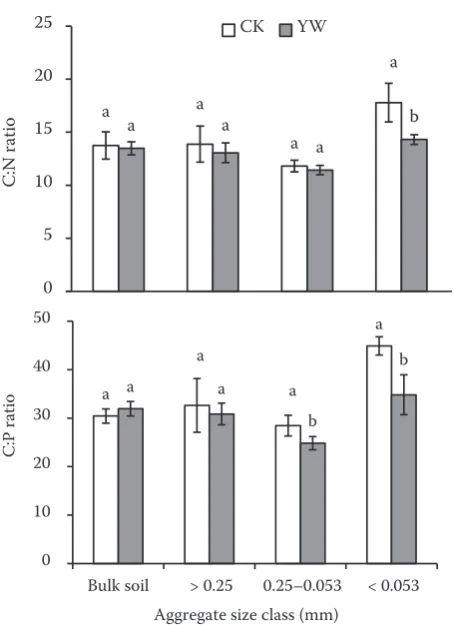
Compared with CK, warming had no significant effect (P > 0.05) on OC, TN and TP contents in bulk soil (Figure 2). Also, warming had no sig-nificant effect on C:N and C:P ratios in bulk soil (Figure 3). Our result was consistent with the findings of previous studies conducted in other grassland ecosystems (Wang et al. 2014, Yu et al. 2014, Zhang et al. 2015, 2016). The insignificant responses of OC, TN and TP contents and their
a a a a a a
a a b
b
b b
0 40 80 120 160 200 240
2010 2011 2012 2013 2014 2015
A bove gr ou nd b iom as s ( g/ m
2) CK
[image:3.595.301.525.223.661.2]YW
[image:3.595.68.289.531.676.2]Figure 1. Annual aboveground biomass during the exper-imental period from 2010 to 2015. Vertical bars represent standard deviation of the mean (n = 5). Different lowercase letters indicate significant differences between treatments (P < 0.05). CK – unwarmed control; YW – year-round warming
Figure 2. Organic carbon, total nitrogen and total pho-sphorus contents in bulk soil and soil aggregate size fractions. Vertical bars represent standard deviation of the mean (n = 5). Different lowercase letters indicate significant differences between treatments (P < 0.05). CK – unwarmed control; YW – year-round warming
a a a b a b
b a
0 5 10 15 20 25 So il org ani c ca rb on (g /k g so il) CK YW a
a a
b a
a b
a 0 0.4 0.8 1.2 1.6 Tot al ni tr og en (g /k g so il) a
a a
b a
a b
a 0 0.2 0.4 0.6 0.8
Bulk soil > 0.25 0.25–0.053 < 0.053
To ta l p ho sp ho ru s (g /k g so il)
ratios to warming in the alpine meadow ecosys-tem were of importance for ecological stability in this region under climate warming scenario. In the previous studies (Wang et al. 2014, Yu et al. 2014), changes in biotic (e.g., vegetation biomass, microbial activity) and abiotic factors (e.g., soil moisture, elevational gradient) were considered to be responsible for the insignificant changes of soil nutrients. The present study, however, has not provided direct evidence to support these previous explanations. Yet, it has proposed a new explanation of the negligible responses of soil nu-trients to warming from the point of view of soil water-stable aggregates. The details are discussed in the following section.
The weight proportions of macroaggregates, microaggregates and silt + clay fractions were 46.3, 40.1 and 12.2% for CK treatment and 42.0, 37.4 and 19.0% for YW treatment, respectively. This suggests
that larger macro- and microaggregates tended to break down into smaller silt- and clay-size frac-tions under warming. The reason is partly related to warming-induced decline in the aboveground biomass (Figure 1). The aboveground sections of plants can decrease the energy of raindrops and runoff (Hudek et al. 2017) and consequently protect soil aggregates from disruption. Among different size fractions of water-stable aggregates, OC, TN and TP contents generally increased with increasing aggregate sizes (Figure 2), indicating that larger water-stable aggregates constituted the predominant nutrient pools of C, N and P. According to the hierarchical theory, microaggre-gates and silt + clay fractions are bound together into macroaggregates by organic binding agents (Tisdall and Oades 1982, Six et al. 2004). Thus, the aggregate hierarchy is essentially an increase of OC, TN and TP contents with increasing size class. On the other hand, the highest C:N and C:P ratios were observed in silt + clay fractions (Figure 3), which was consistent with some previous studies showing that C:N and C:P ratios generally increased with decreasing aggregate sizes (Yang et al. 2007, Fang et al. 2015). This implied that the accumulation rates of C, N and P differed among different aggregate sizes, with C sequestration more than N and P in silt- and clay-sized fractions.
[image:4.595.64.291.92.405.2]Although warming had a negligible impact on nutrient contents in bulk soil, it affected nutri-ent distributions within differnutri-ent aggregate size fractions (Figure 2). Compared with CK, warming decreased macroaggregates-associated OC, TN and TP contents by 12.8% (P < 0.05), 7.09% (P > 0.05) and 8.12% (P > 0.05), and microaggregates-asso-ciated OC, TN and TP contents by 22.4, 19.7 and 11.3% (all P < 0.05), respectively. However, the contents of OC, TN and TP associated with silt + clay fractions significantly (P < 0.05) increased by 46.8, 81.9 and 91.0%, respectively. One of the reasons could be warming-induced soil structure degradation. As indicated above, experimental warming decreased the proportions of macro- and microaggregates whereas it significantly increased the proportion of silt- and clay-size fractions. As a consequence, nutrients were partly transferred into silt- and clay-size fractions due to the disrup-tion of larger aggregates, which in turn increased nutrient contents associated with silt- and clay-size fractions. Physical protection in macro- and microaggregates and chemical protection in silt- Figure 3. Ratios of carbon to nitrogen (C:N) and carbon
to phosphorus (C:P) in bulk soil and soil aggregate size fractions. Vertical bars represent standard deviation of the mean (n = 5). Different lowercase letters indicate significant differences between treatments (P < 0.05). CK – unwarmed control; YW – year-round warming
a a
a
a
a a
a
b
0 5 10 15 20 25
C
:N
ra
tio
CK YW
a
a
a
a
a a
b
b
0 10 20 30 40 50
Bulk soil > 0.25 0.25–0.053 < 0.053
C
:P
ra
tio
Aggregate size class (mm)
a a
a
a
a a
a
b
0 5 10 15 20 25
C
:N
ra
tio
CK YW
a
a
a
a
a a
b
b
0 10 20 30 40 50
Bulk soil > 0.25 0.25–0.053 < 0.053
C
:P
ra
tio
and clay-size fractions were considered two main mechanisms that preserve soil nutrients (O’Brien and Jastrow 2013). Generally, soil nutrients associ-ated with silt- and clay-size fractions were more stable than those associated with macro- and mi-croaggregates (Six et al. 2004, Verchot et al. 2011). Therefore, our results suggested that nutrients were mainly preserved in soil under warming by chemical mechanism, which could offset the loss of nutri-ents protected physically via larger aggregates. The counterbalance resulted in negligible net changes of nutrient contents in bulk soil. In addition, the present result also suggested that soil nutrients losses in microaggregates were more temperature-sensitive than those in macroaggregates.
Compared with CK, the C:N and C:P ratios all decreased in both macro- and microaggregates and silt + clay fractions under warming, with significant differences for C:P ratio in microaggregates and C:N and C:P ratios in silt + clay fractions (Figure 3). This revealed that warming resulted in different accumulation or mineralization rates of C, N and P in size fractions of water-stable aggregates. In both macro- and microaggregates and silt + clay fractions, OC accumulated relatively more slowly or mineralization proceeded relatively more rapidly than did TN and TP, resulting in a decline of C:N and C:P ratios under warming.
In conclusion, warming caused that C, N and P were protected chemically in silt- and clay-size fractions, which offset the loss of C, N and P protected physically by macro- and microaggregates. Both physically and chemically protected C decomposition proceeded relatively more rapidly or accumulated relatively more slowly than did N and P. The distribution of C, N and P within soil aggregate size fractions may regulate their net changes in bulk soil under future climate change scenarios to a long term. However, a long-term and multisite study is needed to verify the present conclusions.
REFERENCES
Alatalo J.M., Jägerbrand A.K., Juhanson J., Michelsen A., Ľuptáčik P. (2017): Impacts of twenty years of experimental warming on soil carbon, nitrogen, moisture and soil mites across alpine/ subarctic tundra communities. Scientific Reports, 7: 44489. Cambardella C.A., Elliott E.T. (1993): Carbon and nitrogen
dis-tribution in aggregate from cultivated and native grassland soils. Soil Science Society of America Journal, 57: 1071–1076.
Fang X.M., Chen F.S., Wan S.Z., Yang Q.P., Shi J.M. (2015): Topsoil and deep soil organic carbon concentration and stability vary with aggregate size and vegetation type in subtropical China. PLoS One, 10: e0139380.
Finzi A.C., Austin A.T., Cleland E.E., Frey S.D., Houlton B.Z., Wal-lenstein M.D. (2011): Responses and feedbacks of coupled bio-geochemical cycles to climate change: Examples from terrestrial ecosystems. Frontiers in Ecology and the Environment, 9: 61–67. Fu G., Zhang X.Z., Zhang Y.J., Shi P.L., Li Y.L., Zhou Y.T., Yang
P.W., Shen Z.X. (2013): Experimental warming does not enhance gross primary production and above-ground biomass in the alpine meadow of Tibet. Journal of Applied Remote Sensing, 7: 6451–6465.
Guan S., An N., Zong N., He Y.T., Shi P.L., Zhang J.J., He N.P. (2018): Climate warming impacts on soil organic carbon frac-tions and aggregate stability in a Tibetan alpine meadow. Soil Biology and Biochemistry, 116: 224–236.
Hudek C., Stanchi S., D’Amico M., Freppaz M. (2017): Quantify-ing the contribution of the root system of alpine vegetation in the soil aggregate stability of moraine. International Soil and Water Conservation Research, 5: 36–42.
IPCC (2014): Climate Change 2014: Synthesis Report. Contribu-tion of Working Group I, II, and III to the Fifth Assessment Report of the Intergovernmental Panel on Climate Change. Geneva, Intergovernmental Panel on Climate Change. Kuzyakov Y., Biriukova O., Turyabahika F., Stahr K. (2001):
Elec-trostatic method to separate roots from soil. Journal of Plant Nutrition and Soil Science, 164: 541–545.
Li C.L., Cao Z.Y., Chang J.J., Zhang Y., Zhu G.L., Zong N., He Y.T., Zhang J.J., He N.P. (2017): Elevational gradient affect functional fractions of soil organic carbon and aggregates stability in a Tibetan alpine meadow. Catena, 156: 139–148.
Li N., Wang G.X., Gao Y.H., Wang J.F. (2011): Warming effects on plant growth, soil nutrients, microbial biomass and soil enzymes activities of two alpine meadows in Tibetan Plateau. Polish Journal of Ecology, 59: 25–35.
Lu R. (2000): Analytical Methods for Soil Agricultural Chemistry. Beijing, China Agricultural Science and Technology Press. (In Chinese)
O’Brien S.L., Jastrow J.D. (2013): Physical and chemical protec-tion in hierarchical soil aggregates regulates soil carbon and nitrogen recovery in restored perennial grasslands. Soil Biology and Biochemistry, 61: 1–13.
Ren G.Y., Ding Y.H., Zhao Z.C., Zheng J.Y., Wu T.W., Tang G.L., Xu Y. (2012): Recent progress in studies of climate change in China. Advances in Atmospheric Sciences, 29: 958–977. Rui Y.C., Wang Y.F., Chen C.R., Zhou X.Q., Wang S.P., Xu Z.H.,
Shi C., Sun G., Zhang H., Xiao B., Ze B., Zhang N., Wu N. (2014): Effects of warming on chlorophyll degradation and carbohy-drate accumulation of alpine herbaceous species during plant senescence on the Tibetan Plateau. PLoS One, 9: e107874. Six J., Bossuyt H., Degryze S., Denef K. (2004): A history of
research on the link between (micro) aggregates, soil biota, and soil organic matter dynamics. Soil and Tillage Research, 79: 7–31.
Tisdall J.M., Oades J.M. (1982): Organic matter and water-sta-ble aggregates in soils. European Journal of Soil Science, 33: 141–163.
Totsche K.U., Amelung W., Gerzabek M.H., Guggenberger G., Klumpp E., Knief C., Lehndorff E., Mikutta R., Peth S., Prechtel A., Ray N., Kögel-Knabner I. (2017): Microaggregates in soils. Journal of Plant Nutrition and Soil Science, 1–33.
Verchot L.V., Dutaur L., Shepherd K.D., Albrecht A. (2011): Or-ganic matter stabilization in soil aggregates: Understanding the biogeochemical mechanisms that determine the fate of carbon inputs in soils. Geoderma, 161: 182–193.
Wang J.F., Wu Q.B. (2013): Impact of experimental warming on soil temperature and moisture of the shallow active layer of wet meadows on the Qinghai-Tibet Plateau. Cold Regions Science and Technology, 90–91: 1–8.
Wang X.X., Dong S.K., Gao Q.Z., Zhou H.K., Liu S.L., Su X.K., Li Y.Y. (2014): Effects of short-term and long-term warming on soil nutrients, microbial biomass and enzyme activities in an alpine meadow on the Qinghai-Tibet Plateau of China. Soil Biology and Biochemistry, 76: 140–142.
Yang Z.H., Singh B.R., Hansen S. (2007): Aggregate associated carbon, nitrogen and sulfur and their ratios in long-term fer-tilized soils. Soil and Tillage Research, 95: 161–171.
Yu C.Q., Shen Z.X., Zhang X.Z., Sun W., Fu G. (2014): Response of soil C and N, dissolved organic C and N, and inorganic N to short-term experimental warming in an alpine meadow on the Tibetan Plateau. The Scientific World Journal, 2014: 152576. Zhang B., Shi P., He Y., Zhang X., Li Q. (2009): The climate feature
of Damxung alpine meadow carbon flux research station on the Tibetan Plateau. Journal of Mountain Science, 27: 88–95. (In Chinese)
Zhang T., Yang S.B., Guo R., Guo J.X. (2016): Warming and nitrogen addition alter photosynthetic pigments, sugars and nutrients in a temperate meadow ecosystem. PLoS One, 11: e0155375.
Zhang X.Z., Shen Z.X., Fu G. (2015): A meta-analysis of the effects of experimental warming on soil carbon and nitrogen dynam-ics on the Tibetan Plateau. Applied Soil Ecology, 87: 32–38. Zhao J.S., Chen S., Hu R.G., Li Y.Y. (2017): Aggregate stability and
size distribution of red soils under different land uses integrally regulated by soil organic matter, and iron and aluminum oxides. Soil and Tillage Research, 167: 73–79.
Zhong X.I., Li J.T., Li X.J., Ye Y.C., Liu S.S., Hallett P.D., Ogden M.R., Naveed M. (2017): Physical protection by soil aggregates stabilizes soil organic carbon under simulated N deposition in a subtropical forest of China. Geoderma, 285: 323–332.