Original Article
Associations of SRD5A2/CYP17/CYP19/VDR
gene polymorphisms with the development and
clinical progression of benign prostatic hyperplasia: a
case-control study in northern Chinese population
Lin-Lin Zhang
1, Yu Song
2, Ling-Ling He
2, Guo-Qiang Chen
3, Ji-Cheng Fu
3, Lei Liu
2, Bao Xi
1, Lei Wang
21Harbin Medical University Daqing School, Daqing 163319, P. R. China; 2Department of Urinary Surgery, Daqing
People’s Hospital, Daqing 163319, P. R. China; 3Department of Urinary Surgery, General Hospital of Daqing Oil
Field, Daqing 163312, P. R. China
Received March 30, 2017; Accepted May 27, 2017; Epub August 1, 2017; Published August 15, 2017
Abstract: This study aims to explore the effect of gene polymorphisms of 5a-reduction enzyme (SRD5A2), steroido-genic cytochrome P-450 17alpha-hydroxylase (CYP17), aromatase cytochrome P450 family 19 (CYP19) and vita-min D receptor (VDR) on benign prostatic hyperplasia (BPH) susceptibility and clinical progress. A total of 452 BHP patients and 501 healthy individuals were selected in Harbin Medical University Daqing School from October 2014 and December 2015 as the case and control groups. All BPH patients received drug treatment and were
subse-quently divided into the progression and non-progression groups based on their therapeutic efficacy. PCR-RFLP was
applied to detect the genotype distributions of SRD5A2/CYP17/CYP19/VDR, which were further tested with Hardy-Weinberg (H-W) equilibrium. Logistic regression analysis was applied to determine the risk factors for BPH progres-sion. Compared with subjects carrying VV genotype and V allele at SRD5A2 V89L, those with LL genotype and L allele at SRD5A2 V89L may have reduced risk of BPH susceptibility or progression (all P < 0.05). Compared with subjects carrying TT genotype and T allele at CYP17 -34T>C, those with CC genotype and C allele at CYP17 -34T>C may have increased risk of BPH susceptibility or progression (all P < 0.05). Compared with individuals carrying FF genotype and F allele at VDRVDR Fok I, those with ff genotype and f allele at VDRVDR Fok I may have increased susceptibility to BPH (all P < 0.05). Logistic regression analysis showed that SRD5A2 V89L and CYP17 -34T>C poly-morphisms and CYP17 -34T>C (TC + CC)/SRD5A2 V89L (VV) combined genotypes were significantly related with
the clinical progression of BHP. These results revealed that SRD5A2 V89L and CYP17 -34T>C polymorphisms were associated with the risk of BPH and its clinical progression.
Keywords:SRD5A2, CYP17, CYP19, VDR, benign prostatic hyperplasia, gene polymorphisms
Introduction
Benign prostatic hyperplasia (BPH) usually
rep-resents the urologic diagnosis that occurs most
frequently in elderly males [1]. It is a histologic
diagnosis which refers to epithelial cell and
smooth muscle proliferation in the prostatic
transition zone [2]. BPH is also a kind of
prolif-erative abnormality of the human prostate,
which is often related with age [3]. BPH occurs
in about 50% of men by the age of 50, the
inci-dence of which usually increases with age [4].
Report suggested that the incidence rate of
this disease is about 2.96 per 1000 man
among patients in their forties, while 34.46 per
The gene encoding steroid 5-alpha reductase
type II (
SRD5A2
) is proved to be located on
chromosome 2p23 and has ive exons and four
introns [12, 13]. Steroidogenic cytochrome
P-450 17alpha-hydroxylase
(
CYP17
) encodes
an enzyme with activities of 17-hydroxylase
and 17,20-lyase, which is a step with rate
limit-ing in the biosynthesis of testosterone [14].
Aromatase Cytochrome P450
family 19
(
CYP-
19
)
is a key enzyme in the estrogen
metabo-lism and
CYP19
polymorphisms usually cause
changes in enzyme activity and can influence
the estrogen synthesis [15]. Vita-min D
recep-tor (
VDR
) belongs to the trans-acting
transcrip-tional regulatory factors family and can
modu-late many biological activities of the endocrine,
immune and neural systems, including
apopto-sis, cell differentiation, calcium and
phospho-rous homeostasis [16].
VDR
polymorphisms
have been proved to be associated with many
diseases such as the leprosy phenotypes and
ovarian cancer [17, 18]. Similarly, the variants
in
SRD5A2
are reported to be connected with
the quality of semen [19]. It is also proved that
variants in
CYP17
and
CYP19
genes are related
with the onset of Alzheimer’s disease [20].
However, little can be found on the genetics
and mechanism of
SRD5A2
,
CYP17
,
CYP19
and
VDR
polymorphisms influencing BPH,
especial-ly in northern Chinese population. In order to
further understand the genetic characteristics
of BPH, this study targets to explore the
asso-ciation of BPH with
SRD5A2
,
CYP17
,
CYP19
and
VDR
polymorphisms among northern Chinese
men, hoping to provide a new sight for the
diag-nosis and treatment of BPH.
Materials and methods
Ethical statement
The present study was performed in
accor-dance with the guidelines established by
Medicine Ethics Review Committee at Harbin
Medical University Daqing School. All patients
have signed written forms of consent.
Study subjects
A total of 452 BPH patients were selected into
the case group in the urological department at
Harbin Medical University Daqing School from
October 2014 to December 2015. The
inclu-sion criteria were as follows: patients who (1)
met the BPH diagnosis criteria recommended
by the 5th International Benign Prostatic
Hyperplasia Advisory Committee in 2001 [21];
(2) had no abnormal echo in abdominal or
rec-tal prostate ultrasound; (3) had a prostate
spe-cific antigen (PSA) concentration greater than 4
ng/mL; (4) had a prostate volume (PV) greater
than 30 mL; (5) had a postvoiding residue (PVR)
greater than 30 mL; (6) went through
pathologi-cal examination of prostate and were confirmed
by two experienced pathophysicians in Harbin
Medical University Daqing School; (7) were
per-manent residents of northern China (lived in
the local community for more than 2 years); (8)
received no formal treatment before this study.
Exclusion criteria were as follows: patients who
(1) were confirmed as prostate cancer and
prostate sarcoma in immunohistochemical
examination; (2) had previous history of surgery
in the prostate, urethra and bladder; (3) had
neurological diseases that may affect the
uri-nary tract functions; (4) had uriuri-nary tract
infec-tion; (5) used medications that may affect the
urinary functions. During the same period, 501
healthy individuals who underwent physical
examinations at Harbin Medical University
Daqing School were enrolled into the control
group. The subjects in the control group were
all permanent residents of northern China
(lived in the local community for more than 2
years) and had no blood relationship with the
case group. Blood samples from all subjects
were collected and detailed clinical data were
recorded.
Treatment regimen and grouping
dynamic maximum urinary flow rate; (2)
pres-ence of complications such as acute urinary
retention, hematuria, urinary tract infection,
bladder stones and renal dysfunction.
Sample collection
Ten ml fasting venous blood were collected
from all subjects in the morning. Ethylene-
diamine tetraacetic acid (EDTA) was added to 4
ml blood samples as anticoagulant and stored
in refrigerator at -80°C. The genomic DNA was
extracted using a conventional phenol
extrac-tion method and was diluted to a final
concen-tration of 10 ng/μl. Two ml blood samples were
used for routine blood examination, which
cov-ered: total cholesterol (TC), low density
lipopro-tein cholesterol (LDL-C), triglyceride (TG), high
density lipoprotein cholesterol (HDL-C) and PSA
concentration. Clinical data, including age,
height, weight, PV, maximum flow rate (Qmax)
and PVR, were obtained from all subjects.
Single nucleotide polymorphism (SNP)
screen-ing and sequencscreen-ing
The candidate loci identified in this study were
5 PV-associated SNPs selected in a previous
prostate cancer genome-wide association
study (GWAS), including
SRD5A2
A49T and
V89L,
CYP17
-34T>C,
CYP19
+19C>T,
VDR
Apa
I and Fok I. The relevant gene sequences were
obtained from Genbank, and their primers were
designed by Oligo 6.0 and Primer 5.0 software.
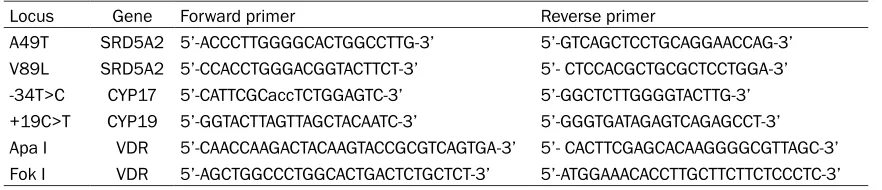
The relevant primers were shown in
Table 1
.
The genomic DNA was extracted using a
phe-nol/chloroform method and analyzed by
poly-merase chain reaction-restriction fragment
length polymorphism (PCR-RFLP). The PCR
reaction system included: 10 ng of template
DNA (batch number: KN1014, C&M Biolabs,
Richmond, CA, USA), 10 × PCR buffer, 15 pmol
of each primer, 0.2 mmol/L dNTPs, 0.12 U Tag
enzyme (batch number: K1321, Shanghai
Runcheng Biotechnology Co., Ltd., Shanghai,
China). The above components were diluted
with double distilled water to a final volume of
15 μl. A touchdown PCR reaction was
per-formed on a C100 PCR apparatus (Bio-Rad,
Hercules, CA, USA). The amplification
condi-tions were: 94°C for 2 min, 94°C for 30 s, 63°C
for 1 min and 72°C for 1 min; and 94°C for 30
s, 57°C for 1 min, 72°C for 1 min and 72°C for
7 min. The amplification products were
trans-ferred to 1.5% agarose gel electrophoresis
(2117 Multiphor II, Bio-Rad, Hercules, CA, USA).
The purity of the amplified bands were observed
under an ultraviolet lamp and the
concentra-tion was estimated. A total of 3 μl of each PCR
amplification product was added with different
endonucleases at the following reaction
condi-tion was as follows: 45 min at 37°C and 15 min
at 85°C. The PCR product was then kept at
4°C. A reverse primer (1 μl) and BDT (1 μl)
were added into purified PCR products using a
Prism BigDyeTerminator (BDT) Cycle Sequen-
cing kit (lot number: N73144, ABI, Thermo
Fisher, Waltham, MA, USA).
Follow-up
[image:3.612.88.529.84.179.2]BPH patients were followed up every 3 months
for 3 to 12 months through phone calls,
outpa-tient service and medical record evaluation.
The follow-up ended in February, 2016.
Altogether, 6 patients were lost to follow-up
and the follow-up rate was 99.50%. Detailed
information about the clinical progression of
BPH was closely monitored, including: (1) Qmax;
(2) the incidence of complications such as
acute urinary retention, hematuria, urinary tract
infection, bladder stones and renal function
impairment.
Table 1.
Primer sequence for each SNP
Locus Gene Forward primer Reverse primer
A49T SRD5A2 5’-ACCCTTGGGGCACTGGCCTTG-3’ 5’-GTCAGCTCCTGCAGGAACCAG-3’ V89L SRD5A2 5’-CCACCTGGGACGGTACTTCT-3’ 5’- CTCCACGCTGCGCTCCTGGA-3’ -34T>C CYP17 5’-CATTCGCaccTCTGGAGTC-3’ 5’-GGCTCTTGGGGTACTTG-3’ +19C>T CYP19 5’-GGTACTTAGTTAGCTACAATC-3’ 5’-GGGTGATAGAGTCAGAGCCT-3’ Apa I VDR 5’-CAACCAAGACTACAAGTACCGCGTCAGTGA-3’ 5’- CACTTCGAGCACAAGGGGCGTTAGC-3’ Fok I VDR 5’-AGCTGGCCCTGGCACTGACTCTGCTCT-3’ 5’-ATGGAAACACCTTGCTTCTTCTCCCTC-3’
Statistical method
SPSS 17.0 software was used for data analysis.
The measurement data were expressed as
mean ± SD. The
t
test was used for comparison
between two groups in normal distribution.
One-way ANOVA was applied for comparison
among multiple groups with variance
homoge-neity and normality. Nonparametric
Kruskal-Wallis rank-sum test was used for comparison
among multiple groups without variance ho-
mogeneity and normality. Count data were
expressed in percentage or rate and were
com-pared using X
2test. The comparison of alleles
and genotypes and the Hardy-Weinberg equi-
librium of alleles were verified using X
2test. The
relative risk was expressed with odds ratio
(OR) and 95% confidence interval (CI). Logistic
regression analysis was carried out to analyze
the risk factors for clinical progression of
BPH.
P
< 0.05 was considered statistically
significant.
Results
Comparisons of baseline characteristics
be-tween the control group and the BPH group
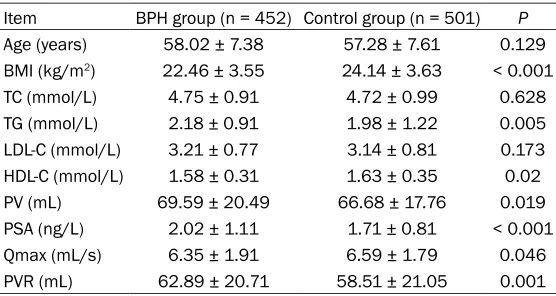
The BMI, HDL-C and Qmax in the BPH group
were significantly lower than those in the
con-trol group (all
P
< 0.05). The levels of TG, PV,
PSA and PVR in the BPH group were
significant-ly higher than those in the control group (all
P
<
0.05). There was no significant difference in
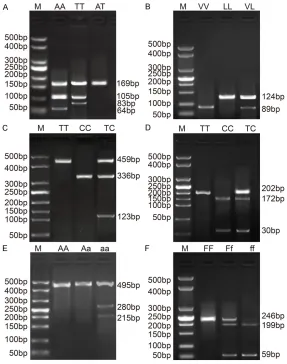
heterozygote (AT) only showed a 169 bp band
(
Figure 1A
).
In the
SRD5A2
V89L locus, VV, VL and LL
geno-types were detected after HYF10VI digestion:
wild-type homozygous (VV) had no digestion
site and only showed a 89 bp band; the mutant
homozygous (LL) only showed a 124 bp band;
the mutant heterozygous (VL) was cut into
bands of 124 bp and 89 bp (
Figure 1B
).
After MspA
1I digestion, the
CYP17
-34T>C site
showed TT, CC and TC genotypes: the wild-type
homozygote (TT) had no digestion site and only
showed a 459 bp band; the mutant
homozy-gote (CC) had one digestion site and was cut
into bands of 336 bp and 123 bp; the mutant
heterozygous (TC) was cut into bands of 459
bp, 336 bp and 123 bp (
Figure 1C
).
After Bsp1286 I digestion, the
CYP19
+19C>T
site showed TT, CC and TC genotypes: the
mutant homozygote (TT) had no digestion site
and only showed a 202 bp band; the wild-type
homozygote (CC) had one digestion site and
was cut into bands of 172 bp and 30 bp; the
mutant heterozygous (TC) was cut into bands of
202 bp, 172 bp and 30 bp (
Figure 1D
).
[image:4.612.91.369.94.242.2]In the
VDR
Apa I locus, AA, Aa and aa
geno-types were detected after Apa I digestion: the
mutant homozygous (aa) and wild-type
homozy-gous (AA) both only showed a 495 bp band; the
mutant heterozygote (Aa) had one digestion
Table 2.
Comparison of baseline characteristics between the
control group and the BPH group
Item BPH group (n = 452) Control group (n = 501) P
Age (years) 58.02 ± 7.38 57.28 ± 7.61 0.129 BMI (kg/m2) 22.46 ± 3.55 24.14 ± 3.63 < 0.001
TC (mmol/L) 4.75 ± 0.91 4.72 ± 0.99 0.628 TG (mmol/L) 2.18 ± 0.91 1.98 ± 1.22 0.005 LDL-C (mmol/L) 3.21 ± 0.77 3.14 ± 0.81 0.173 HDL-C (mmol/L) 1.58 ± 0.31 1.63 ± 0.35 0.02 PV (mL) 69.59 ± 20.49 66.68 ± 17.76 0.019 PSA (ng/L) 2.02 ± 1.11 1.71 ± 0.81 < 0.001 Qmax (mL/s) 6.35 ± 1.91 6.59 ± 1.79 0.046 PVR (mL) 62.89 ± 20.71 58.51 ± 21.05 0.001
Notes: BMI, body mass index; TC, total cholesterol; TG, triglyceride; LDL-C, low density lipoproteincholesterol; HDL-C, high-density lipoproteincholesterol; PV,
prostate volume; PSA, prostate specific antigen concentration; Qmax, maximum flow rate; PVR, postvoiding residue; the t test was performed.
age, TC and LDC-C between the
two groups (all
P
> 0.05) (
Table
2
).
Electrophoresis results of
SRD5A2 A49T and V89L,
CYP17 -34T>C, CYP19 +19C>T,
VDR Apa I and Fok I
site and was cut into bands of 495 bp, 280 bp
and 215 bp (
Figure 1E
).
In the
VDR
Fok I locus, FF, Ff and ff genotypes
were detected after Fok I digestion: the mutant
homozygous (ff) genotype had two digestion
sites and was cut into two bands of 199 bp
and 59 bp; the wild-type homozygous (FF) had
no digestion site and only showed a 246 bp
band; the mutant heterozygous (Ff) had one
[image:5.612.89.376.70.434.2]95% CI = 0.622-0.994,
P
= 0.044). The
distri-bution frequency of
CYP17
-34T>C was
signifi-cantly different between the BPH and control
groups (all
P
< 0.05). Compared with the TT
genotype, the CC genotype may increase the
risk of BPH (OR = 9.064, 95% CI =
2.687-30.580,
P
< 0.001); compared with the T allele,
the C allele also tended to increased the risk of
BPH (OR = 1.584, 95% CI = 1.233-2.035,
P
<
0.001). The distribution frequency of
VDR
Fok I
Figure 1. Electropherogram of PCR products at each gene locus. Notes: A:Electropherogram of SRD5A2 A49T locus after Rsai enzyme digestion, M: Marker; AA: Wild-type homozygote; AT: Mutant heterozygote; TT: Mutant ho-mozygote; B: Electropherogram of SRD5A2 V89L locus after HYF10VI en-zyme digestion; M: Marker; VV: Wild-type homozygote; VL: Mutant heterozy-gote; LL: Mutant homozyheterozy-gote; C: Electropherogram of CYP17 -34T>C locus after MspA1I enzyme digestion, CC: Mutant homozygote; TC: Mutant
hetero-zygote; TT: Mutant homohetero-zygote; D: Electropherogram of CYP19 +19C>T lo-cus after BSP1286 I enzyme digestion, CC: Mutant homozygote; TC: Mutant heterozygote; TT: Mutant homozygote; E: Electropherogram of VDR Apa I locus post Apa I enzyme digestion; M: Marker; AA: Wild-type homozygote; Aa: Mutant heterozygote; aa: Mutant homozygote; F: Electropherogram of VDR Fok I locus post Fok I enzyme digestion, FF: Wild-type homozygote; Ff: Mutant heterozygote; ff: Mutant heterozygote; M: Marker; PCR = polymerase chain reaction.
digestion site and was cut into
bands of 59 bp, 199 bp and
246 bp (
Figure 1F
).
Hardy-Weinberg equilibrium
test for SRD5A2 A49T and
V89L, CYP17 -34T>C, CYP19
+19C>T, VDR Apa I and Fok I
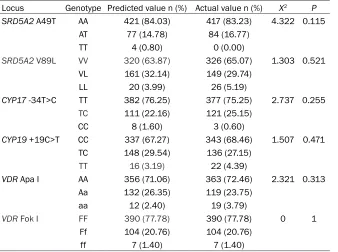
Hardy-Weinberg equilibrium
analysis was carried out for
different loci in the control
group. No significant
differ-ence was found between the
actual and expected values of
SRD5A2
A49T,
SRD5A2
V89L,
CYP17
-34T>C,
CYP19
+19C>
T,
VDR
Apa I and
VDR
Fok I (all
P
> 0.05) (
Table 3
), indicating
that the distribution frequency
of each gene locus is repre-
sentative.
Distribution frequency of
SRD5A2/CYP17/CYP19/VDR
SNPs between the BPH group
and the control group
There was no significant
differ-ence in the distribution
fre-quency of
SRD5A2
A49T,
VDR
was significantly different between the control
group and the BPH group (all
P
< 0.05).
Compared with the
VDR
FF genotype, the ff
genotype may increase the risk of BPH (OR =
1.587, 95% CI = 1.266-2.053,
P
= 0.007);
com-pared with the F allele, the f allele also tended
to increase the risk of BPH (OR = 1.587, 95% CI
= 1.266-2.053,
P
< 0.001) (
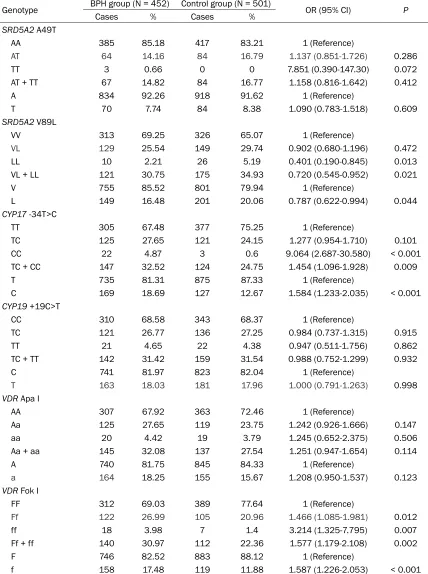
Table 4
).
Relationship between SRD5A2 A49T and
V89L, CYP17 -34T>C, CYP19 +19C>T, VDR
Apa I and Fok I gene polymorphisms and
clini-cal progression of BPH
No significant difference was found in the
distri-bution frequencies of
SRD5A2
A49T,
CYP19
+19C>T,
VDR
Apa I and
VDR
Fok I between the
progression group and the non-progression
group (all
P
> 0.05). The distribution frequency
of
SRD5A2
V89L genotypes and alleles was not
significantly different between the progression
group and the non-progression group (all
P
>
0.05). Compared with the VV genotype, the LL
genotype might decrease the risk of clinical
progression in BPH patients (OR = 0.235, 95%
CI = 0.049-1.123,
P
= 0.049); compared wi-
th the V allele, the L allele might also reduce
in BPH patients (OR = 2.261, 95% CI =
1.546-3.306,
P
< 0.001) (
Table 5
).
Relationship between a combination of
SRD5A2 V89L/CYP17 -34T>C and clinical
progression of BPH
The relationship between various combinations
of
SRD5A2
V89L/
CYP17
-34T>C SNPs and the
risk of clinical progression in BPH patients
was anlyzed (
Table 6
). The distribution
frequen-cy of
SRD5A2
V89L (VL + LL)/
CYP17
-34T>C
(TT) genotype combination was significantly
lower in the progression group (14.4%) than
that in the non-progression group (27.4%),
indi-cating that
SRD5A2
V89L (VL + LL)/
CYP17
-34T>C (TT) genotype combination may be a
protective factor during the clinical progression
of BPH (OR = 0.429, 95% CI = 0.266-0.693,
P
< 0.001). The distribution frequency of
geno-type combination
SRD5A2
V89L (VV)/
CYP17
-34T>C (TC + CC) was significantly higher in the
progression group (32.6%) than that in the
non-progression group (18.6%), indicating that
SRD5A2
V89L (VV)/
CYP17
-34T>C (TC + CC)
genotype combination may be a risk factor
dur-ing the clinical progression of BPH (OR = 2.118,
95% CI = 1.371-3.629,
P
= 0.001). No
signifi-Table 3.
Hardy-Weinberg equilibrium for the representativeness of
SRD5A2
A49T and V89L,
CYP17
-34T>C,
CYP19
+19C>T,
VDR
Apa I and Fok I
Locus Genotype Predicted value n (%) Actual value n (%) X2 P SRD5A2 A49T AA 421 (84.03) 417 (83.23) 4.322 0.115AT 77 (14.78) 84 (16.77)
TT 4 (0.80) 0 (0.00)
SRD5A2 V89L VV 320 (63.87) 326 (65.07) 1.303 0.521
VL 161 (32.14) 149 (29.74)
LL 20 (3.99) 26 (5.19)
CYP17 -34T>C TT 382 (76.25) 377 (75.25) 2.737 0.255 TC 111 (22.16) 121 (25.15)
CC 8 (1.60) 3 (0.60)
CYP19 +19C>T CC 337 (67.27) 343 (68.46) 1.507 0.471 TC 148 (29.54) 136 (27.15)
TT 16 (3.19) 22 (4.39)
VDR Apa I AA 356 (71.06) 363 (72.46) 2.321 0.313 Aa 132 (26.35) 119 (23.75)
aa 12 (2.40) 19 (3.79)
VDR Fok I FF 390 (77.78) 390 (77.78) 0 1
Ff 104 (20.76) 104 (20.76)
ff 7 (1.40) 7 (1.40)
Note: the chi-square test was performed.
the risk of clinical
progression (OR =
0.534, 95% CI =
0.330-0.865,
P
=
0.010). The distri-
bution of genotype
and allele of
CYP17
[image:6.612.91.429.96.348.2]Table 4.
Distribution frequency of
SRD5A2/CYP17/CYP19/VDR
SNPs between the BPH group and
the control group
Genotype BPH group (N = 452) Control group (N = 501) OR (95% CI) P
Cases % Cases %
SRD5A2 A49T
AA 385 85.18 417 83.21 1 (Reference)
AT 64 14.16 84 16.79 1.137 (0.851-1.726) 0.286
TT 3 0.66 0 0 7.851 (0.390-147.30) 0.072
AT + TT 67 14.82 84 16.77 1.158 (0.816-1.642) 0.412
A 834 92.26 918 91.62 1 (Reference)
T 70 7.74 84 8.38 1.090 (0.783-1.518) 0.609
SRD5A2 V89L
VV 313 69.25 326 65.07 1 (Reference)
VL 129 25.54 149 29.74 0.902 (0.680-1.196) 0.472
LL 10 2.21 26 5.19 0.401 (0.190-0.845) 0.013
VL + LL 121 30.75 175 34.93 0.720 (0.545-0.952) 0.021
V 755 85.52 801 79.94 1 (Reference)
L 149 16.48 201 20.06 0.787 (0.622-0.994) 0.044
CYP17 -34T>C
TT 305 67.48 377 75.25 1 (Reference)
TC 125 27.65 121 24.15 1.277 (0.954-1.710) 0.101
CC 22 4.87 3 0.6 9.064 (2.687-30.580) < 0.001
TC + CC 147 32.52 124 24.75 1.454 (1.096-1.928) 0.009
T 735 81.31 875 87.33 1 (Reference)
C 169 18.69 127 12.67 1.584 (1.233-2.035) < 0.001
CYP19 +19C>T
CC 310 68.58 343 68.37 1 (Reference)
TC 121 26.77 136 27.25 0.984 (0.737-1.315) 0.915
TT 21 4.65 22 4.38 0.947 (0.511-1.756) 0.862
TC + TT 142 31.42 159 31.54 0.988 (0.752-1.299) 0.932
C 741 81.97 823 82.04 1 (Reference)
T 163 18.03 181 17.96 1.000 (0.791-1.263) 0.998
VDR Apa I
AA 307 67.92 363 72.46 1 (Reference)
Aa 125 27.65 119 23.75 1.242 (0.926-1.666) 0.147
aa 20 4.42 19 3.79 1.245 (0.652-2.375) 0.506
Aa + aa 145 32.08 137 27.54 1.251 (0.947-1.654) 0.114
A 740 81.75 845 84.33 1 (Reference)
a 164 18.25 155 15.67 1.208 (0.950-1.537) 0.123
VDR Fok I
FF 312 69.03 389 77.64 1 (Reference)
Ff 122 26.99 105 20.96 1.466 (1.085-1.981) 0.012
ff 18 3.98 7 1.4 3.214 (1.325-7.795) 0.007
Ff + ff 140 30.97 112 22.36 1.577 (1.179-2.108) 0.002
F 746 82.52 883 88.12 1 (Reference)
f 158 17.48 119 11.88 1.587 (1.226-2.053) < 0.001
Table 5.
Relationship between
SRD5A2
A49T and V89L,
CYP17
-34T>C,
CYP19
+19C>T,
VDR
Apa I
and Fok I gene
polymorphisms
and clinical progression of BPH
Genotype Progression group (N = 215) Non-progression group (N = 237) OR (95% CI) P
Cases % Cases %
SRD5A2 A49T
AA 190 88.37% 195 82.28% 1 (Reference)
AT 24 11.16% 40 16.88% 0.616 (0.357-1.061) 0.079
TT 1 0.47% 2 0.84% 0.513 (0.046-5.710) 0.58
AT + TT 25 11.63% 42 17.72% 0.611 (0.358-1.042) 0.068
A 404 93.95% 430 90.72% 1 (Reference)
T 37 8.60% 44 9.28% 0.895 (0.566-1.415) 0.635
SRD5A2 V89L
VV 162 75.35% 152 64.14% 1 (Reference)
VL 51 23.72% 77 32.49% 0.621 (0.409-0.943) 0.025
LL 2 0.93% 8 3.38% 0.235 (0.049-1.123) 0.049
VL + LL 53 24.65% 85 35.86% 0.585 (0.389-0.880) 0.01
V 232 53.95% 324 68.35% 1 (Reference)
L 26 6.05% 68 14.35% 0.534 (0.330-0.865) 0.01
CYP17 -34T>C
TT 122 56.74% 173 73.00% 1 (Reference)
TC 76 35.35% 59 24.89% 1.827 (1.210-2.757) 0.004
CC 17 7.91% 5 2.11% 4.821 (1.732-13.42) 0.001
TC + CC 93 43.26% 64 27.00% 2.061 (1.390-3.055) < 0.001
T 320 74.42% 405 85.44% 1 (Reference)
C 110 25.58% 69 14.56% 2.261 (1.546-3.306) < 0.001
CYP19 +19C>T
CC 148 68.84% 172 72.57% 1 (Reference)
TC 58 26.98% 53 22.36% 1.272 (0.825-1.960) 0.275
TT 9 4.19% 12 5.06% 0.872 (0.357-2.127) 0.763
TC + TT 67 31.16% 65 27.43% 1.198 (0.798-1.798) 0.383
C 354 82.33% 327 68.99% 1 (Reference)
T 76 17.67% 65 13.71% 1.080 (0.751-1.554) 0.678
VDR Apa I
AA 145 67.44% 162 68.35% 1 (Reference)
Aa 61 28.37% 64 27.00% 0.939 (0.619-1.424) 0.767
aa 9 4.19% 11 4.64% 0.914 (0.368-2.269) 0.846
Aa + aa 70 32.56% 75 3418.00% 0.959 (0.646-1.424) 0.836
A 351 81.63% 388 81.86% 1 (Reference)
a 79 18.37% 86 18.14% 0.985 (0.702-1.381) 0.929
VDR Fok I
FF 149 69.30% 163 68.78% 1 (Reference)
Ff 59 27.44% 63 26.58% 0.976 (0.642-1.484) 0.91
ff 7 3.26% 11 4.64% 0.696 (0.263-1.843) 0.464
Ff + ff 66 30.70% 74 31.22% 0.976 (0.654-1.455) 0.904
F 357 83.02% 389 82.07% 1 (Reference)
f 413 96.05% 85 17.93% 0.936 (0.663-1.320) 0.706
cant correlation was found between the other
genotype combinations and the clinical
pro-gression in BPH patients (all
P
> 0.05).
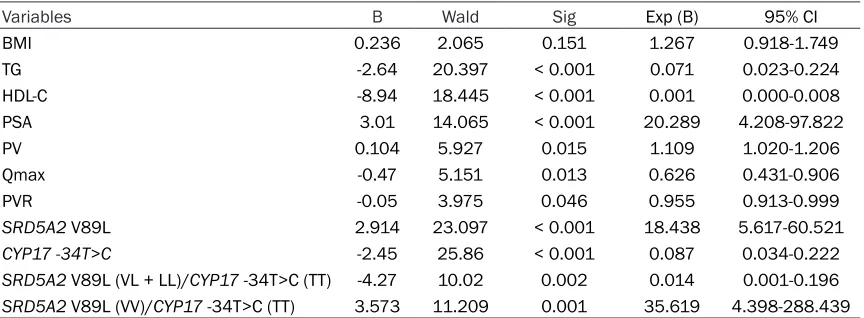
Logistic regression analysis for risk factors for
clinical progression of BPH
A logistic regression analysis was performed
using BPH progression as a dependent
vari-able. The following factors were included in the
analysis as independent variables: varied
fac-tors in clinical data of subjects (such as BMI,
TG, HDL-C, PV, PSA, Qmax and PVR),
polymor-phism of
SRD5A2
V89L and
CYP17
-34T>C, and
the genotype combinations of
SRD5A2
V89L
(VL + LL)/
CYP17
-34T>C (TT) and
CYP17
-34T>C
(TC + CC)/
SRD5A2
V89L(VV). It was found that
PSA, the VV genotype of
SRD5A2
V89L, and
the genotype combination of
CYP17
-34T>C (TC
+ CC)/
SRD5A2
V89L (VV) were all the risk
fac-tors for the clinical progression in BPH patients
(all
P
< 0.05). TG, HDL-C, PV, Qmax, PVR and
CYP17
-34T>C were all protective factors for
the clinical progression in BPH patients (all
P
<
0.05) (
Table 7
).
Discussion
BPH is a common urological problem among
elderly men and is mainly perceived as a
prolif-erative stromal disease featured with lower
uri-nary tract and prostate enlargement symptoms
[23]. Symptoms of BPH will not usually threat
life, however, they often drastically affect life
quality [9]. Previous studies have
demonstrat-ed that the gene polymorphisms were largely
applied into the researches of BPH [24, 25]. For
further supplementation, this paper explored
the association of BPH with
SRD5A2/CYP17/
CYP19/VDR
gene polymorphisms in northern
Chinese population.
[image:9.612.92.524.97.167.2]It was found in this study that the BMI, HDL-C
and Qmax were significantly lower, while the
levels of TG, PV, PSA and PVR were significantly
higher in the BPH group when compared with
those the control group. Consistent with the
Table 6.
Relationship between a combination of
SRD5A2
V89L/
CYP17
-34T>C and clinical
progres-sion of BPH
Combination of genotypes Progression group (n = 215) Non-progression group (n = 237) OR 95% CI P
SRD5A2 V89L (VL + LL)/CYP17 -34T>C (TT) 30 (14.0%) 65 (27.4%) 0.429 0.266-0.693 < 0.001
SRD5A2 V89L (VL + LL)/CYP17 -34T>C (TC + CC) 24 (11.2%) 23 (9.7%) 1.169 0.639-2.140 0.612
SRD5A2 V89L (VV)/CYP17 -34T>C (TC + CC) 70 (32.6%) 44 (18.6%) 2.118 1.371-3.629 0.001
SRD5A2 V89L (VV)/CYP17 -34T>C (TT) 91 (42.3%) 105 (44.3%) 0.923 0.636-1.339 0.672 Notes: OR, odds ratio; 95% CI, 95% confidence interval; the chi-square test was performed.
Table 7.
Logistic regression analysis to determine the related risk factors for clinical progression in
BPH patients
Variables B Wald Sig Exp (B) 95% CI
BMI 0.236 2.065 0.151 1.267 0.918-1.749
TG -2.64 20.397 < 0.001 0.071 0.023-0.224
HDL-C -8.94 18.445 < 0.001 0.001 0.000-0.008
PSA 3.01 14.065 < 0.001 20.289 4.208-97.822
PV 0.104 5.927 0.015 1.109 1.020-1.206
Qmax -0.47 5.151 0.013 0.626 0.431-0.906
PVR -0.05 3.975 0.046 0.955 0.913-0.999
SRD5A2 V89L 2.914 23.097 < 0.001 18.438 5.617-60.521
CYP17 -34T>C -2.45 25.86 < 0.001 0.087 0.034-0.222
SRD5A2 V89L (VL + LL)/CYP17 -34T>C (TT) -4.27 10.02 0.002 0.014 0.001-0.196
SRD5A2 V89L (VV)/CYP17 -34T>C (TT) 3.573 11.209 0.001 35.619 4.398-288.439 Notes: 95% CI, 95% confidence interval; BPH, benign prostatic hyperplasia; BMI, body mass index; TG, triglyceride; HDL-C, high-density lipoproteincholesterol; PV, prostate volume; PSA, prostate specific antigen concentration; Qmax, maximum flow rate;
[image:9.612.92.524.222.381.2]result of our study, Mehmet Murat Baykam et
al. have researched the correlation between
prostatic resistive index and cardiovascular
risk factors in BPH patients, in which HDL-C
and Qmax were demonstrated to be risk factors
of BPH [26]. And it is also reported that levels of
BMI, TG were greater while HDL-C was lower in
BPH patients [27]. Qmax and PVR were
signifi-cantly correlated with BPH [28].
Furthermore, it was also found that in SRD5A2
V89L, compared with the VV genotype and V
allele, LL genotype and L allele may reduce the
risk of BPH and its clinical progression. As
revealed in a previous study,
SRD5A2
is the
tar-get of 5-reductase inhibitor which may affect
the enzyme activity and lead to individual
vari-ability in the efficacy [29].
SRD5A2
can encode
testosterone, a primary androgen in males, into
dihydrotestosterone which is necessary for
the prostatic growth and male external
genita-lia development [13]. Besides, L allele in the
SRD5A2 is connected with reduced
andro-stanediol glucuronide concentrations, and L/L
genotype of V89L polymorphism was
signifi-cantly related to lower concentrations of free
testosterone and testosterone [30]. It was
reported that when compared with the V/V
gen-otype, the L/L genotype makes a 42%
reduc-tion in the activity of 5 a-reductase enzyme
[31].
Another important finding from this study is
that compared with the TT genotype and T
allele at
CYP17
-34T>C, CC genotype and C
allele at
CYP17
-34T>C may increase the risk of
disease and its clinical progression. CYP17 is a
key enzyme in the steroid biosynthesis which
contains a heme prosthetic group at the active
site and it can inhibit the treatment of prostatic
diseases such as BPH [32, 33]. CYP17 enzyme
mediates two steps in steroid hormone
biosyn-thesis, which are 17 a-hydroxylase and 17,
20-lyase activities; CYP17 contains a
single-base pair (bp) T to C polymorphism which can
create a Sp-1 site (CCACC box) at 34 bp
upstream from the beginning of translation and
downstream from the transcription site, which
can provide an additional promoter activity with
increased CYP17 transcription [24]. One study
conducted by Tigli H et al. have demonstrated
that in the risk allele, the T to C transition would
create a new recognition site for restriction
enzyme MspA
1[34]. All of these studies were in
accordance with the result of this study.
This study also found that the
SRD5A2
V89L
and
CYP17 -34T>C
polymorphisms,
CYP17
-34T>C (TC + CC)/
SRD5A2
V89L (VV) combined
genotypes were significantly related with the
clinical progression of BHP.A relevant research
has revealed that SRD5A2-V89L and CYP17-
A1/A2 are involved in the biosynthesis of
tes-tosterone and dihydrotestes-tosterone, V89L
poly-morphism of the SRD5A2 gene has been
proved to be an important determinant of
hypospadias risk, and
CYP17-A1/A2
and
SRD-
5A2-V89L
are both involved in the biosynthesis
of dihydrotestosterone and testosterone, which
are in related with hypospadias [14].
In conclusion, these results have confirmed
that
SRD5A2/CYP17/CYP19/VDR
gene
poly-morphisms are associated with the
susceptibil-ity and clinical progress of BPH. However, there
are still some deficiencies in this study for
vari-ous constraints. For examples, certain
devia-tion in the statistical results may arise due to
limited research time and sample size.
Therefore, further studies are needed to verify
our findings. Nevertheless, this study might
shed some light on the future treatment of BPH.
Acknowledgements
This study was supported by Guiding Science
and Technology Program of Daqing (szdy-20-
15-03).
Disclosure of conflict of interest
None.
Address correspondence to: Lin-Lin Zhang, Harbin Medical University Daqing School, No. 39, Xinyang Road, High-Technology District, Daqing 163319, Heilongjiang Province, P. R. China. Tel: +86-04- 59-8153058; Fax: +86-0459-8153058; E-mail: [email protected]
References
[1] De Nunzio C, Kramer G, Marberger M, Mon-tironi R, Nelson W, Schroder F, Sciarra A and Tubaro A. The controversial relationship be-tween benign prostatic hyperplasia and
pros-tate cancer: the role of inflammation. Eur Urol
2011; 60: 106-117.
management of benign prostatic hyperplasia. J Urol 2011; 185: 1793-1803.
[3] Wang L, Yang JR, Yang LY and Liu ZT. Chronic
inflammation in benign prostatic hyperplasia:
implications for therapy. Med Hypotheses 2008; 70: 1021-1023.
[4] Kapoor A. Benign prostatic hyperplasia (BPH) management in the primary care setting. Can J Urol 2012; 19 Suppl 1: 10-17.
[5] El Ezzi AA, Zaidan WR, El-Saidi MA, Al-Ah-madieh N, Mortenson JB and Kuddus RH. As-sociation of benign prostate hyperplasia with polymorphisms in VDR, CYP17, and SRD5A2 genes among Lebanese men. Asian Pac J Can-cer Prev 2014; 15: 1255-1262.
[6] Gravas S, Bachmann A, Reich O, Roehrborn CG, Gilling PJ and De La Rosette J. Critical re-view of lasers in benign prostatic hyperplasia (BPH). BJU Int 2011; 107: 1030-1043. [7] Park T and Choi JY. Efficacy and safety of
dutasteride for the treatment of symptomatic benign prostatic hyperplasia (BPH): a system-atic review and meta-analysis. World J Urol 2014; 32: 1093-1105.
[8] Ko YH, Chae JY, Jeong SM, Kang JI, Ahn HJ, Kim HW, Kang SG, Jang HA, Cheon J, Kim JJ and Lee JG. Clinical implications of residual urine in Korean benign prostatic hyperplasia (BPH) patients: a prognostic factor for BPH-re-lated clinical events. Int Neurourol J 2010; 14: 238-244.
[9] Ventura S, Oliver V, White CW, Xie JH, Haynes JM and Exintaris B. Novel drug targets for the pharmacotherapy of benign prostatic hyperpla-sia (BPH). Br J Pharmacol 2011; 163: 891-907. [10] Lopez DS, Peskoe SB, Tsilidis KK, Hoffman-Bolton J, Helzlsouer KJ, Isaacs WB, Smith MW and Platz EA. Association of variants in genes related to the immune response and obesity with BPH in CLUE II. Prostate Cancer Prostatic Dis 2014; 17: 353-358.
[11] Konwar R, Gara R, Singh M, Singh V, Chatto-padhyay N and Bid HK. Association of interleu-kin-4 and interleukin-1 receptor antagonist gene polymorphisms and risk of benign pros-tatic hyperplasia. Urology 2008; 71: 868-872. [12] Choi SY, Kim HJ, Cheong HS and Myung SC.
The association of 5-alpha reductase type 2 (SRD5A2) gene polymorphisms with prostate cancer in a Korean population. Korean J Urol 2015; 56: 19-30.
[13] Choubey VK, Sankhwar SN, Carlus SJ, Singh AN, Dalela D, Thangaraj K and Rajender S. SRD5A2 gene polymorphisms and the risk of benign prostatic hyperplasia but not prostate cancer. Asian Pac J Cancer Prev 2015; 16: 1033-1036.
[14] Samtani R, Bajpai M, Vashisht K, Ghosh PK and Saraswathy KN. Hypospadias risk and polymorphism in SRD5A2 and CYP17 genes:
case-control study among Indian children. J Urol 2011; 185: 2334-2339.
[15] Yang L, Wang XY, Li YT, Wang HL, Wu T, Wang B, Zhao Q, Jinsihan D and Zhu LP. CYP19 gene polymorphisms and the susceptibility to breast cancer in Xinjiang Uigur women. Genet Mol Res 2015; 14: 8473-8482.
[16] Poon AH, Gong L, Brasch-Andersen C, Litonjua AA, Raby BA, Hamid Q, Laprise C, Weiss ST, Alt-man RB and Klein TE. Very important pharma-cogene summary for VDR. Pharmapharma-cogenet Ge-nomics 2012; 22: 758-763.
[17] Sapkota BR, Macdonald M, Berrington WR, Misch EA, Ranjit C, Siddiqui MR, Kaplan G and Hawn TR. Association of TNF, MBL, and VDR polymorphisms with leprosy phenotypes. Hum Immunol 2010; 71: 992-998.
[18] Grant DJ, Hoyo C, Akushevich L, Iversen ES, Whitaker R, Marks J, Berchuck A and Schild-kraut JM. Vitamin D receptor (VDR) polymor-phisms and risk of ovarian cancer in Cauca-sian and African American women. Gynecol Oncol 2013; 129: 173-178.
[19] Zhao D, Wu W, Xu B, Niu X, Cui H, Zhang Y, Wang Z and Wang X. Variants in the SRD5A2 gene are associated with quality of semen. Mol Med Rep 2012; 6: 639-644.
[20] Chace C, Pang D, Weng C, Temkin A, Lax S, Silverman W, Zigman W, Ferin M, Lee JH, Tycko B and Schupf N. Variants in CYP17 and CYP19 cytochrome P450 genes are associated with onset of Alzheimer’s disease in women with down syndrome. J Alzheimers Dis 2012; 28: 601-612.
Y, Balaji KN, Balduini W, Ballabio A, Balzan R, Banerjee R, Bánhegyi G, Bao H, Barbeau B, Barrachina MD, Barreiro E, Bartel B, Bartolo-mé A, Bassham DC, Bassi MT, Bast RC Jr, Basu A, Batista MT, Batoko H, Battino M, Bauckman K, Baumgarner BL, Bayer KU, Beale R, Beau-lieu JF, Beck GR Jr, Becker C, Beckham JD, Bédard PA, Bednarski PJ, Begley TJ, Behl C, Behrends C, Behrens GM, Behrns KE, Bejara-no E, Belaid A, Belleudi F, Bénard G, Berchem G, Bergamaschi D, Bergami M, Berkhout B, Berliocchi L, Bernard A, Bernard M, Bernassola F, Bertolotti A, Bess AS, Besteiro S, Bettuzzi S, Bhalla S, Bhattacharyya S, Bhutia SK, Bi-agosch C, Bianchi MW, Biard-Piechaczyk M, Billes V, Bincoletto C, Bingol B, Bird SW, Bitoun M, Bjedov I, Blackstone C, Blanc L, Blanco GA, Blomhoff HK, Boada-Romero E, Böckler S, Boes M, Boesze-Battaglia K, Boise LH, Bolino A, Boman A, Bonaldo P, Bordi M, Bosch J, Bota-na LM, Botti J, Bou G, Bouché M, Bouchecar-eilh M, Boucher MJ, Boulton ME, Bouret SG, Boya P, Boyer-Guittaut M, Bozhkov PV, Brady N, Braga VM, Brancolini C, Braus GH, Bravo-San Pedro JM, Brennan LA, Bresnick EH, Brest P, Bridges D, Bringer MA, Brini M, Brito GC, Bro-din B, Brookes PS, Brown EJ, Brown K, Brox-meyer HE, Bruhat A, Brum PC, Brumell JH, Brunetti-Pierri N, Bryson-Richardson RJ, Buch S, Buchan AM, Budak H, Bulavin DV, Bultman SJ, Bultynck G, Bumbasirevic V, Burelle Y, Burke RE, Burmeister M, Bütikofer P, Caberlot-to L, Cadwell K, Cahova M, Cai D, Cai J, Cai Q, Calatayud S, Camougrand N, Campanella M, Campbell GR, Campbell M, Campello S, Candau R, Caniggia I, Cantoni L, Cao L, Caplan AB, Caraglia M, Cardinali C, Cardoso SM, Carew JS, Carleton LA, Carlin CR, Carloni S, Carlsson SR, Carmona-Gutierrez D, Carneiro LA, Carnevali O, Carra S, Carrier A, Carroll B, Casas C, Casas J, Cassinelli G, Castets P, Cas-tro-Obregon S, Cavallini G, Ceccherini I, Cecco-ni F, Cederbaum AI, Ceña V, Cenci S, Cerella C, Cervia D, Cetrullo S, Chaachouay H, Chae HJ, Chagin AS, Chai CY, Chakrabarti G, Chamilos G, Chan EY, Chan MT, Chandra D, Chandra P, Chang CP, Chang RC, Chang TY, Chatham JC, Chatterjee S, Chauhan S, Che Y, Cheetham ME, Cheluvappa R, Chen CJ, Chen G, Chen GC, Chen G, Chen H, Chen JW, Chen JK, Chen M, Chen M, Chen P, Chen Q, Chen Q, Chen SD, Chen S, Chen SS, Chen W, Chen WJ, Chen WQ, Chen W, Chen X, Chen YH, Chen YG, Chen Y, Chen Y, Chen Y, Chen YJ, Chen YQ, Chen Y, Chen Z, Chen Z, Cheng A, Cheng CH, Cheng H, Cheong H, Cherry S, Chesney J, Cheung CH, Chevet E, Chi HC, Chi SG, Chiacchiera F, Chi-ang HL, Chiarelli R, Chiariello M, Chieppa M, Chin LS, Chiong M, Chiu GN, Cho DH, Cho SG,
Escalante R, Eskelinen EL, Espert L, Esteban-Martínez L, Evans TJ, Fabri M, Fabrias G, Fab-rizi C, Facchiano A, Færgeman NJ, Faggioni A, Fairlie WD, Fan C, Fan D, Fan J, Fang S, Fanto M, Fanzani A, Farkas T, Faure M, Favier FB, Fearnhead H, Federici M, Fei E, Felizardo TC, Feng H, Feng Y, Feng Y, Ferguson TA, Fernán-dez ÁF, FernanFernán-dez-Barrena MG, FernanFernán-dez- Fernandez-Checa JC, Fernández-López A, Fernandez-Zapi-co ME, Feron O, Ferraro E, Ferreira-Halder CV, Fesus L, Feuer R, Fiesel FC, Filippi-Chiela EC, Filomeni G, Fimia GM, Fingert JH, Finkbeiner S, Finkel T, Fiorito F, Fisher PB, Flajolet M, Flami-gni F, Florey O, Florio S, Floto RA, Folini M, Follo C, Fon EA, Fornai F, Fortunato F, Fraldi A, Fran-co R, FranFran-cois A, François A, Frankel LB, Fraser ID, Frey N, Freyssenet DG, Frezza C, Friedman SL, Frigo DE, Fu D, Fuentes JM, Fueyo J, Fujitani Y, Fujiwara Y, Fujiya M, Fukuda M, Fulda S, Fus-co C, Gabryel B, Gaestel M, Gailly P, Gajewska M, Galadari S, Galili G, Galindo I, Galindo MF, Galliciotti G, Galluzzi L, Galluzzi L, Galy V, Gam-moh N, Gandy S, Ganesan AK, Ganesan S, Ganley IG, Gannagé M, Gao FB, Gao F, Gao JX, García Nannig L, García Véscovi E, Garcia-Macía M, Garcia-Ruiz C, Garg AD, Garg PK, Gar-gini R, Gassen NC, Gatica D, Gatti E, Gavard J, Gavathiotis E, Ge L, Ge P, Ge S, Gean PW, Gel-metti V, Genazzani AA, Geng J, Genschik P, Gerner L, Gestwicki JE, Gewirtz DA, Ghavami S, Ghigo E, Ghosh D, Giammarioli AM, Giampieri F, Giampietri C, Giatromanolaki A, Gibbings DJ, Gibellini L, Gibson SB, Ginet V, Giordano A, Giorgini F, Giovannetti E, Girardin SE, Gispert S, Giuliano S, Gladson CL, Glavic A, Gleave M, Godefroy N, Gogal RM Jr, Gokulan K, Goldman GH, Goletti D, Goligorsky MS, Gomes AV, Gomes LC, Gomez H, Gomez-Manzano C, Gó-mez-Sánchez R, Gonçalves DA, Goncu E, Gong Q, Gongora C, Gonzalez CB, Gonzalez-Alegre P, Gonzalez-Cabo P, González-Polo RA, Goping IS, Gorbea C, Gorbunov NV, Goring DR, Gorman AM, Gorski SM, Goruppi S, Goto-Yamada S, Go-tor C, Gottlieb RA, Gozes I, Gozuacik D, Graba Y, Graef M, Granato GE, Grant GD, Grant S, Gravina GL, Green DR, Greenhough A, Green-wood MT, Grimaldi B, Gros F, Grose C, Groulx JF, Gruber F, Grumati P, Grune T, Guan JL, Guan KL, Guerra B, Guillen C, Gulshan K, Gunst J, Guo C, Guo L, Guo M, Guo W, Guo XG, Gust AA, Gustafsson ÅB, Gutierrez E, Gutierrez MG, Gwak HS, Haas A, Haber JE, Hadano S, Hage-dorn M, Hahn DR, Halayko AJ, Hamacher-Brady A, Hamada K, Hamai A, Hamann A, Hamasaki M, Hamer I, Hamid Q, Hammond EM, Han F, Han W, Handa JT, Hanover JA, Hansen M, Ha-rada M, Harhaji-Trajkovic L, Harper JW, Harrath AH, Harris AL, Harris J, Hasler U, Hasselblatt P, Hasui K, Hawley RG, Hawley TS, He C, He CY,
He F, He G, He RR, He XH, He YW, He YY, Heath JK, Hébert MJ, Heinzen RA, Helgason GV, Hensel M, Henske EP, Her C, Herman PK, Hernández A, Hernandez C, Hernández-Tiedra
S, Hetz C, Hiesinger PR, Higaki K, Hilfiker S, Hill BG, Hill JA, Hill WD, Hino K, Hofius D, Hofman
Kon-stantakou EG, Kopp BT, Korcsmaros T, Korho-nen L, Korolchuk VI, Koshkina NV, Kou Y, Koukourakis MI, Koumenis C, Kovács AL, Kovács T, Kovacs WJ, Koya D, Kraft C, Krainc D, Kramer H, Kravic-Stevovic T, Krek W, Kretz-Re-my C, Krick R, Krishnamurthy M, Kriston-Vizi J, Kroemer G, Kruer MC, Kruger R, Ktistakis NT, Kuchitsu K, Kuhn C, Kumar AP, Kumar A, Ku-mar A, KuKu-mar D, KuKu-mar D, KuKu-mar R, KuKu-mar S, Kundu M, Kung HJ, Kuno A, Kuo SH, Kuret J, Kurz T, Kwok T, Kwon TK, Kwon YT, Kyrmizi I, La Spada AR, Lafont F, Lahm T, Lakkaraju A, Lam T, Lamark T, Lancel S, Landowski TH, Lane DJ, Lane JD, Lanzi C, Lapaquette P, Lapierre LR, Laporte J, Laukkarinen J, Laurie GW, Lavande-ro S, Lavie L, LaVoie MJ, Law BY, Law HK, Law
KB, Layfield R, Lazo PA, Le Cam L, Le Roch KG,
Le Stunff H, Leardkamolkarn V, Lecuit M, Lee BH, Lee CH, Lee EF, Lee GM, Lee HJ, Lee H, Lee JK, Lee J, Lee JH, Lee JH, Lee M, Lee MS, Lee PJ, Lee SW, Lee SJ, Lee SJ, Lee SY, Lee SH, Lee SS, Lee SJ, Lee S, Lee YR, Lee YJ, Lee YH, Leeuwenburgh C, Lefort S, Legouis R, Lei J, Lei QY, Leib DA, Leibowitz G, Lekli I, Lemaire SD, Lemasters JJ, Lemberg MK, Lemoine A, Leng S, Lenz G, Lenzi P, Lerman LO, Lettieri Barbato D, Leu JI, Leung HY, Levine B, Lewis PA, Lezoualc’h F, Li C, Li F, Li FJ, Li J, Li K, Li L, Li M, Li M, Li Q, Li R, Li S, Li W, Li W, Li X, Li Y, Lian J, Liang C, Liang Q, Liao Y, Liberal J, Liberski PP, Lie P, Lieberman AP, Lim HJ, Lim KL, Lim K, Lima RT, Lin CS, Lin CF, Lin F, Lin F, Lin FC, Lin K, Lin KH, Lin PH, Lin T, Lin WW, Lin YS, Lin Y, Linden R, Lindholm D, Lindqvist LM, Lingor P, Linkermann A, Liotta LA, Lipinski MM, Lira VA, Lisanti MP, Liton PB, Liu B, Liu C, Liu CF, Liu F, Liu HJ, Liu J, Liu JJ, Liu JL, Liu K, Liu L, Liu L, Liu Q, Liu RY, Liu S, Liu S, Liu W, Liu XD, Liu X, Liu XH, Liu X, Liu X, Liu X, Liu Y, Liu Y, Liu Z, Liu Z, Liuzzi JP, Lizard G, Ljujic M, Lodhi IJ, Logue SE, Lokeshwar BL, Long YC, Lonial S, Loos B, López-Otín C, López-Vicario C, Lorente M, Lo-renzi PL, Lõrincz P, Los M, Lotze MT, Lovat PE, Lu B, Lu B, Lu J, Lu Q, Lu SM, Lu S, Lu Y, Lucia-no F, Luckhart S, Lucocq JM, Ludovico P, Lugea A, Lukacs NW, Lum JJ, Lund AH, Luo H, Luo J, Luo S, Luparello C, Lyons T, Ma J, Ma Y, Ma Y, Ma Z, Machado J, Machado-Santelli GM, Ma-cian F, MacIntosh GC, MacKeigan JP, Macleod KF, MacMicking JD, MacMillan-Crow LA, Mad-eo F, Madesh M, Madrigal-Matute J, Maeda A, Maeda T, Maegawa G, Maellaro E, Maes H, Magariños M, Maiese K, Maiti TK, Maiuri L, Maiuri MC, Maki CG, Malli R, Malorni W, Maloy-an A, Mami-Chouaib F, MMaloy-an N, MMaloy-ancias JD, Mandelkow EM, Mandell MA, Manfredi AA, Manié SN, Manzoni C, Mao K, Mao Z, Mao ZW, Marambaud P, Marconi AM, Marelja Z, Marfe G, Margeta M, Margittai E, Mari M, Mariani FV,
EJ, Orozco H, Ortega AL, Ortona E, Osellame LD, Oshima J, Oshima S, Osiewacz HD, Otomo T, Otsu K, Ou JH, Outeiro TF, Ouyang DY, Ouy-ang H, Overholtzer M, Ozbun MA, Ozdinler PH, Ozpolat B, Pacelli C, Paganetti P, Page G, Pag-es G, Pagnini U, Pajak B, Pak SC, Pakos-Ze-brucka K, Pakpour N, Palková Z, Palladino F, Pallauf K, Pallet N, Palmieri M, Paludan SR, Palumbo C, Palumbo S, Pampliega O, Pan H, Pan W, Panaretakis T, Pandey A, Pantazopou-lou A, Papackova Z, Papademetrio DL, Papas-sideri I, Papini A, Parajuli N, Pardo J, Parekh VV, Parenti G, Park JI, Park J, Park OK, Parker R, Parlato R, Parys JB, Parzych KR, Pasquet JM, Pasquier B, Pasumarthi KB, Patschan D, Pat-terson C, Pattingre S, Pattison S, Pause A, Pavenstädt H, Pavone F, Pedrozo Z, Peña FJ, Peñalva MA, Pende M, Peng J, Penna F,
Pen-ninger JM, Pensalfini A, Pepe S, Pereira GJ,
Pereira PC, Pérez-de la Cruz V, Pérez-Pérez ME, Pérez-Rodríguez D, Pérez-Sala D, Perier C, Perl A, Perlmutter DH, Perrotta I, Pervaiz S, Pe-sonen M, Pessin JE, Peters GJ, Petersen M, Petrache I, Petrof BJ, Petrovski G, Phang JM, Piacentini M, Pierdominici M, Pierre P,
Pierre-fite-Carle V, Pietrocola F, Pimentel-Muiños FX,
Pinar M, Pineda B, Pinkas-Kramarski R, Pinti M, Pinton P, Piperdi B, Piret JM, Platanias LC, Platta HW, Plowey ED, Pöggeler S, Poirot M,
Polčic P, Poletti A, Poon AH, Popelka H, Popova
B, Poprawa I, Poulose SM, Poulton J, Powers SK, Powers T, Pozuelo-Rubio M, Prak K, Prange R, Prescott M, Priault M, Prince S, Proia RL, Proikas-Cezanne T, Prokisch H, Promponas VJ, Przyklenk K, Puertollano R, Pugazhenthi S, Puglielli L, Pujol A, Puyal J, Pyeon D, Qi X, Qian WB, Qin ZH, Qiu Y, Qu Z, Quadrilatero J, Quinn F, Raben N, Rabinowich H, Radogna F, Ragusa MJ, Rahmani M, Raina K, Ramanadham S, Ra-mesh R, Rami A, Randall-Demllo S, Randow F, Rao H, Rao VA, Rasmussen BB, Rasse TM, Ra-tovitski EA, Rautou PE, Ray SK, Razani B, Reed BH, Reggiori F, Rehm M, Reichert AS, Rein T, Reiner DJ, Reits E, Ren J, Ren X, Renna M, Re-usch JE, Revuelta JL, Reyes L, Rezaie AR, Rich-ards RI, RichRich-ardson DR, Richetta C, Riehle MA, Rihn BH, Rikihisa Y, Riley BE, Rimbach G, Rip-po MR, Ritis K, Rizzi F, Rizzo E, Roach PJ, Rob-bins J, Roberge M, Roca G, Roccheri MC, Ro-cha S, Rodrigues CM, Rodríguez CI, de Cordoba SR, Rodriguez-Muela N, Roelofs J, Rogov VV, Rohn TT, Rohrer B, Romanelli D, Romani L, Ro-mano PS, Roncero MI, Rosa JL, Rosello A, Rosen KV, Rosenstiel P, Rost-Roszkowska M, Roth KA, Roué G, Rouis M, Rouschop KM, Ruan DT, Ruano D, Rubinsztein DC, Rucker EB 3rd, Rudich A, Rudolf E, Rudolf R, Ruegg MA, Ruiz-Roldan C, Ruparelia AA, Rusmini P, Russ DW, Russo GL, Russo G, Russo R, Rusten TE,
Sun J, Sun SY, Sun Y, Sun Y, Sun Y, Sundar-amoorthy V, Sung J, Suzuki H, Suzuki K, Suzuki N, Suzuki T, Suzuki YJ, Swanson MS, Swanton C, Swärd K, Swarup G, Sweeney ST, Sylvester PW, Szatmari Z, Szegezdi E, Szlosarek PW, Taegtmeyer H, Tafani M, Taillebourg E, Tait SW, Takacs-Vellai K, Takahashi Y, Takáts S, Take-mura G, Takigawa N, Talbot NJ, Tamagno E, Tamburini J, Tan CP, Tan L, Tan ML, Tan M, Tan YJ, Tanaka K, Tanaka M, Tang D, Tang D, Tang G, Tanida I, Tanji K, Tannous BA, Tapia JA, Tas-set-Cuevas I, Tatar M, Tavassoly I, Tavernarakis N, Taylor A, Taylor GS, Taylor GA, Taylor JP, Tay-lor MJ, Tchetina EV, Tee AR, Teixeira-Clerc F, Telang S, Tencomnao T, Teng BB, Teng RJ, Ter-ro F, Tettamanti G, Theiss AL, TheTer-ron AE, Thom-as KJ, Thomé MP, Thomes PG, Thorburn A, Thorner J, Thum T, Thumm M, Thurston TL, Tian L, Till A, Ting JP, Titorenko VI, Toker L, Tol-do S, Tooze SA, Topisirovic I, Torgersen ML, To-rosantucci L, Torriglia A, Torrisi MR, Tournier C, Towns R, Trajkovic V, Travassos LH, Triola G, Tripathi DN, Trisciuoglio D, Troncoso R, Trouga-kos IP, Truttmann AC, Tsai KJ, Tschan MP, Tseng YH, Tsukuba T, Tsung A, Tsvetkov AS, Tu S, Tuan HY, Tucci M, Tumbarello DA, Turk B, Turk V, Turner RF, Tveita AA, Tyagi SC, Ubukata M, Uchiyama Y, Udelnow A, Ueno T, Umekawa M, Umemiya-Shirafuji R, Underwood BR, Un-germann C, Ureshino RP, Ushioda R, Uversky VN, Uzcátegui NL, Vaccari T, Vaccaro MI, Váchová L, Vakifahmetoglu-Norberg H, Valdor R, Valente EM, Vallette F, Valverde AM, Van den Berghe G, Van Den Bosch L, van den Brink GR, van der Goot FG, van der Klei IJ, van der Laan LJ, van Doorn WG, van Egmond M, van Golen KL, Van Kaer L, van Lookeren Campagne M, Vandenabeele P, Vandenberghe W, Vanhore-beek I, Varela-Nieto I, Vasconcelos MH, Vasko R, Vavvas DG, Vega-Naredo I, Velasco G, Velentzas AD, Velentzas PD, Vellai T, Vellenga E, Vendelbo MH, Venkatachalam K, Ventura N, Ventura S, Veras PS, Verdier M, Vertessy BG, Viale A, Vidal M, Vieira HL, Vierstra RD, Vi-gneswaran N, Vij N, Vila M, Villar M, Villar VH, Villarroya J, Vindis C, Viola G, Viscomi MT, Vi-tale G, Vogl DT, Voitsekhovskaja OV, von Hae-fen C, von Schwarzenberg K, Voth DE, Vouret-Craviari V, Vuori K, Vyas JM, Waeber C, Walker CL, Walker MJ, Walter J, Wan L, Wan X, Wang B, Wang C, Wang CY, Wang C, Wang C, Wang C, Wang D, Wang F, Wang F, Wang G, Wang HJ, Wang H, Wang HG, Wang H, Wang HD, Wang J, Wang J, Wang M, Wang MQ, Wang PY, Wang P, Wang RC, Wang S, Wang TF, Wang X, Wang XJ, Wang XW, Wang X, Wang X, Wang Y, Wang Y, Wang Y, Wang YJ, Wang Y, Wang Y, Wang YT, Wang Y, Wang ZN, Wappner P, Ward C, Ward DM, Warnes G, Watada H, Watanabe Y,
Wa-tase K, Weaver TE, Weekes CD, Wei J, Weide T, Weihl CC, Weindl G, Weis SN, Wen L, Wen X, Wen Y, Westermann B, Weyand CM, White AR, White E, Whitton JL, Whitworth AJ, Wiels J, Wild F, Wildenberg ME, Wileman T, Wilkinson DS, Wilkinson S, Willbold D, Williams C, Williams K, Williamson PR, Winklhofer KF, Witkin SS, Wohl-gemuth SE, Wollert T, Wolvetang EJ, Wong E, Wong GW, Wong RW, Wong VK, Woodcock EA, Wright KL, Wu C, Wu D, Wu GS, Wu J, Wu J, Wu M, Wu M, Wu S, Wu WK, Wu Y, Wu Z, Xavier CP, Xavier RJ, Xia GX, Xia T, Xia W, Xia Y, Xiao H, Xiao J, Xiao S, Xiao W, Xie CM, Xie Z, Xie Z, Xilouri M, Xiong Y, Xu C, Xu C, Xu F, Xu H, Xu H, Xu J, Xu J, Xu J, Xu L, Xu X, Xu Y, Xu Y, Xu ZX, Xu Z, Xue Y, Yamada T, Yamamoto A, Yamanaka K, Yamashina S, Yamashiro S, Yan B, Yan B, Yan X, Yan Z, Yanagi Y, Yang DS, Yang JM, Yang L, Yang M, Yang PM, Yang P, Yang Q, Yang W, Yang WY, Yang X, Yang Y, Yang Y, Yang Z, Yang Z, Yao MC, Yao PJ, Yao X, Yao Z, Yao Z, Yasui LS, Ye M, Yedvobnick B, Yeganeh B, Yeh ES, Yeyati PL, Yi F, Yi L, Yin XM, Yip CK, Yoo YM, Yoo YH, Yoon SY, Yoshida K, Yoshimori T, Young KH, Yu H, Yu JJ, Yu JT, Yu J, Yu L, Yu WH, Yu XF, Yu Z, Yuan J, Yuan ZM, Yue BY, Yue J, Yue Z, Zacks DN, Zack-senhaus E, Zaffaroni N, Zaglia T, Zakeri Z, Zec-chini V, Zeng J, Zeng M, Zeng Q, Zervos AS, Zhang DD, Zhang F, Zhang G, Zhang GC, Zhang H, Zhang H, Zhang H, Zhang H, Zhang J, Zhang J, Zhang J, Zhang J, Zhang JP, Zhang L, Zhang L, Zhang L, Zhang L, Zhang MY, Zhang X, Zhang XD, Zhang Y, Zhang Y, Zhang Y, Zhang Y, Zhang Y, Zhao M, Zhao WL, Zhao X, Zhao YG, Zhao Y, Zhao Y, Zhao YX, Zhao Z, Zhao ZJ, Zheng D, Zheng XL, Zheng X, Zhivotovsky B, Zhong Q, Zhou GZ, Zhou G, Zhou H, Zhou SF, Zhou XJ, Zhu H, Zhu H, Zhu WG, Zhu W, Zhu XF, Zhu Y, Zhuang SM, Zhuang X, Ziparo E, Zois CE, Zo-ladek T, Zong WX, Zorzano A, Zughaier SM. Guidelines for the use and interpretation of as-says for monitoring autophagy (3rd edition). Autophagy 2016; 12: 1-222.
[22] McConnell JD, Roehrborn CG, Bautista OM, An-driole GL Jr, Dixon CM, Kusek JW, Lepor H, McVary KT, Nyberg LM Jr, Clarke HS, Crawford ED, Diokno A, Foley JP, Foster HE, Jacobs SC, Kaplan SA, Kreder KJ, Lieber MM, Lucia MS, Miller GJ, Menon M, Milam DF, Ramsdell JW, Schenkman NS, Slawin KM, Smith JA; Medical Therapy of Prostatic Symptoms (MTOPS) Re-search Group. The long-term effect of
doxazo-sin, finasteride, and combination therapy on
the clinical progression of benign prostatic hy-perplasia. N Engl J Med 2003; 349: 2387-2398.
EMT and benign prostatic hyperplasia (BPH) development. Mol Endocrinol 2012; 26: 1707-1715.
[24] Kumar V, Banerjee BD, Datta SK, Yadav CS, Singh S, Ahmed RS and Gupta S. Association of CYP1A1, CYP1B1 and CYP17 gene polymor-phisms and organochlorine pesticides with benign prostatic hyperplasia. Chemosphere 2014; 108: 40-45.
[25] Lee SH, Kim SK, Yoo KH, Chung JH and Chang SG. Association of LTbetaR gene polymor-phisms with prostate volume in benign pros-tatic hyperplasia in the Korean population. Genet Mol Res 2015; 14: 18607-18615. [26] Baykam MM, Aktas BK, Bulut S, Ozden C,
Deren T, Tagci S, Gokkaya CS and Memis A. As-sociation between prostatic resistive index and cardiovascular risk factors in patients with be-nign prostatic hyperplasia. Kaohsiung J Med Sci 2015; 31: 194-198.
[27] Zhang X, Zeng X, Liu Y, Dong L, Zhao X and Qu X. Impact of metabolic syndrome on benign prostatic hyperplasia in elderly Chinese men. Urol Int 2014; 93: 214-219.
[28] Takada S, Kurita Y, Imanishi T, Otsuka A, Shin-bo H, Furuse H, Nakanishi T, Suzuki A, Takase H and Ozono S. Arteriosclerosis related factors
had no clinical significant correlation with re -sistive index in symptomatic benign prostatic hyperplasia. Urology 2011; 77: 433-437.
[29] Gu X, Na R, Huang T, Wang L, Tao S, Tian L, Chen Z, Jiao Y, Kang J, Zheng S, Xu J, Sun J and Qi J. SRD5A1 and SRD5A2 are associated with treatment for benign prostatic hyperplasia with the combination of 5alpha-reductase inhibi-tors and alpha-adrenergic receptor antago-nists. J Urol 2013; 190: 615-619.
[30] Allen NE, Forrest MS and Key TJ. The associa-tion between polymorphisms in the CYP17 and 5alpha-reductase (SRD5A2) genes and serum androgen concentrations in men. Cancer Epi-demiol Biomarkers Prev 2001; 10: 185-189. [31] Rajender S, Vijayalakshmi K, Pooja S, Madhavi
S, Paul SF, Vettriselvi V, Shroff S, Singh L and Thangaraj K. Longer (TA)n repeat but not A49T and V89L polymorphisms in SRD5A2 gene may confer prostate cancer risk in South Indi-an men. J Androl 2009; 30: 703-710.
[32] Vasaitis TS, Bruno RD and Njar VC. CYP17 in-hibitors for prostate cancer therapy. J Steroid Biochem Mol Biol 2011; 125: 23-31.
[33] Salvador JA, Pinto RM and Silvestre SM. Steroidal 5alpha-reductase and 17alpha-hydroxylase/17,20-lyase (CYP17) inhibitors useful in the treatment of prostatic diseases. J Steroid Biochem Mol Biol 2013; 137: 199-222. [34] Tigli H, Yazici H and Dalay N. Cyp17 genetic