Abstract—It is an oft-made observation in auditory psychology that a tone applied to just one ear will not decrease in loudness over time. Nonetheless its loudness will apparently decrease (“adaptation”) if indicated by the lower magnitude of a same-frequency tone of matching loudness, presented intermittently to the other ear (“simultaneous dichotic loudness balance”, denoted SDLB). In Bulletin of Mathematical Biology, Prof. K.H. Norwich proposes to solve this “mystery of loudness adaptation” through “a mathematical exploration” of two methods for measuring loudness adaptation: monaural presentation, and binaural presentation. Close scrutiny of Dr. Norwich’s analysis reveals, however, a plethora of contradictions, arbitrary decisions, and incongruities. He over-relies on mathematics, ignoring the psychology and physiology literatures. His “exploration” lacks any explication of the interaction of physiological systems with experimental-psychology procedures. Such an explication, however, can be found in a physiology-based, qualitative model by Nizami, which recognizes the possible effects, on loudness, of a neural feedback pathway, the olivocochlear bundle (OCB). An auditory stimulus at one ear induces OCB firing, which “turns down the volume” at the opposite ear. Nizami’s own model can explain, within the context of SDLB procedures, ten known SDLB outcomes. Altogether, “The mystery of loudness adaptation” has a solution which is non-trivial but nonetheless far different from (and far less mysterious than) Dr. Norwich’s “mathematical exploration”.
Index Terms—loudness, adaptation, Simultaneous Dichotic Loudness Balance (SDLB), olivocochlear bundle
I. INTRODUCTION
N the Bulletin of Mathematical Biology [1], Professor K. H. Norwich provides “A mathematical exploration of the mystery of loudness adaptation” (title). The “mystery” in question involves an experimental procedure called “simultaneous dichotic loudness balance”, commonly denoted SDLB. In SDLB, one ear, which Dr. Norwich denotes the “adapting ear”, is exposed to a continuous tone. Meanwhile, the opposite ear, which Dr. Norwich denotes the “control ear”, is intermittently exposed to a shorter tone of
Manuscript received April 21, 2015; manuscript revised April 24, 2015. This work was supported by the author.
L. Nizami is an Independent Research Scholar in Palo Alto, CA, USA (phone: 650-690-0295; e-mail: [email protected]).
the same frequency but adjustable intensity. The intensity of the control-ear tone is adjusted by the listener within adjustment sessions of 5-20 seconds (a fixed value characterizing a given study) until it is just as loud as the adapting-ear tone.
Fig. 1 shows the experiment set-up [2]. “Stickman” sits within a soundproof chamber. Leads (dashed lines) extend to the headphones from outside. Here, Stickman’s right-ear headphone is the “control” headphone, because the lead passes through an attenuator that Stickman can adjust. (Which of left or right is “control” or “adapting” can be changed by simply turning the headphones around). Within an adjustment session (typically 5-20 seconds), Stickman sets the attenuator so that the control tone yields the same contribution to overall loudness as the adapting tone. The final attenuator setting within each adjustment session is recorded by the experimenter.
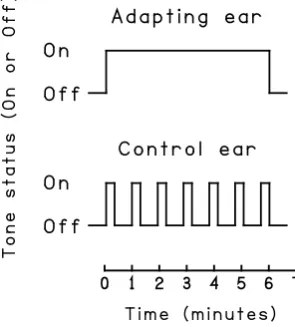
Fig. 2 shows the schedule of the tones [3], in which “The on-off markers do not show the variations in intensity of the comparison [i.e., control] stimulus [here, a tone] during a loudness balance”. Over time, the requisite intensity of the control-ear tone decreases. Fig. 3 shows this decrease [3]. This observation is traditionally (e.g., [2]) taken to mean that the loudness of the tone in the adapting ear diminishes. But, as Dr. Norwich notes, when a tone is presented only in one ear (whether intermittently or continuously), its loudness does not adapt. This apparent contradiction is what Dr. Norwich calls “the mystery of loudness adaptation”.
To solve this mystery, Dr. Norwich proposes to “analyze mathematically” (as he states in his paper’s abstract) the two methods for measuring loudness adaptation, i.e., monaural (one ear) presentation and binaural (two ears) presentation. Dr. Norwich’s mathematical analysis might conceivably offer some new insights. Unfortunately, that does not prove to be the case, as Dr. Norwich’s treatment of loudness adaptation shows considerable confusion, which ultimately renders his algebra meaningless. In particular, he assumes that two different unitless measures are mathematically relatable simply because they are unitless. With unitless quantities being commonplace in science and engineering, errors like Dr. Norwich’s have the potential for great havoc. Let us study Dr. Norwich’s mistakes.
On Mathematical Biology Without the Biology:
A Refutation of K.H. Norwich’s
Mystery of Loudness Adaptation
and A Physiology-Based Replacement
Lance Nizami,
Member, IAENG
Fig. 1. The listener’s role in SDLB (see text).
Fig. 2. Tone presentation during SDLB (see text).
II. NORWICH:MERGING THE TWO “LOUDNESS LAWS”
A. The Growth of Loudness as a Function of Sound-Pressure-Level: the Entropy Equation
Dr. Norwich starts the algebra with the growth of loudness as a function of sound pressure level, and mentions two laws that have traditionally been used to describe loudness growth, the Weber-Fechner logarithmic Law,y=alnx+b, and Stevens’ Law, a power function y=axn. He describes these as “forms of the psychophysical law” ([1], p. 300; original italics) and states that “the two laws can be merged into a single loudness law” ([1], p. 300). “The
psychophysical law” permeates Dr. Norwich’s publications, although it is never clear what it is. Indeed, few people have suggested a merger of the Weber-Fechner Law and Stevens’ Law, probably because those Laws are known to rest upon different assumptions about discriminability of one magnitude of stimulus from another. Krueger [4] discusses this issue, but as a prelude to a detailed effort at unifying the two Laws. Krueger’s paper was accompanied by 31 printed “open peer commentaries” (pp. 267-299 of that particular Journal), whose authors’ demeanors varied from mild
skepticism to disbelief to downright (but polite) ridicule. There was one exception: an enthusiastic endorsement by Dr. Norwich [5], who also promoted his own model.
That model lies at the heart of Dr. Norwich’s treatment of “The mystery of loudness adaptation”, as follows. Dr. Norwich declares, using L for loudness, γ for “a parameter whose value is greater than zero” ([1], p. 300), and φ for the magnitude of a tone, that
(
γ n)
ln
L= 1+ ϕ . (1) For this Dr. Norwich cites one of his papers on his “Entropy Theory of Perception” [6], as well as his dedicated book [7]. He assumes that Eq. (1) applies separately to each ear.
Fig. 3. The empirical course of the magnitude of a tone in the control ear which is judged to evoke an equal subjective contribution to loudness as the (same-frequency) tone in the adapting ear, for the tones of Fig. 2 above. The horizontal dashed line represents the adapting tone’s constant magnitude. The vertical axis is not annotated, because the “adaptation” (here, the drop in decibels below the dashed line) can vary from 0 to 50 dB, depending upon the experiment.
Eq. (1) is curious, because it is almost Dr. Norwich’s “Entropy Equation”, his topic of at least 45 papers. The actual “Entropy Equation” (e.g., [6], [7]) contains a parameter of a priori unknown value, k, which multiplies the logarithm of Eq. (1). Its absence is seemingly unexplained. But to continue: Dr. Norwich ([1], p. 301) notes that “when
γφn
[image:2.595.93.241.315.479.2]B. Does Loudness Growth Follow the Entropy Equation?
Dr. Norwich has no way of knowing, a priori, the limit “when γφnbecomes substantially less than one” ([1], p. 301). That is, as Dr. Norwich himself observes in many papers, the parameters of his Entropy Equation can only be obtained by regression-fitting that equation to growth-of-sensation plots. Without parameter values, Dr. Norwich’s use of any approximation constitutes mere speculation. The Entropy Theory has been in print for 40 years [9] and yet, strangely, neither Dr. Norwich nor his co-authors have altogether done more than a handful of such regression-fits.
The present author, in contrast, evaluated numerous examples (see [8]). The employed loudness estimates included that of Luce and Mo [10], data that Dr. Norwich [1] shows in his Fig. 1 and Fig. 2 as support for the notion that loudness growth is described (and with “near-equivalence”, no less; see [1], p. 300) by “Stevens’ law” and the “Weber-Fechner law”. However, Nizami [8] has demonstrated that (1) the Entropy Equation may actually reduce to a power law for most of a loudness curve, with only the highest loudnesses forming a transitional region, described by the full Entropy Equation, between a power law and a logarithmic law; or that (2) the Entropy Equation may actually reduce to a logarithmic law for most of a loudness curve, with only the lowest loudnesses forming a transitional region, described by the full Entropy Equation, between a logarithmic law and a power law; or finally that (3) the Entropy Equation may apply in its full form to most of the data, reducing to a power law only at the extreme lowest intensities used and reducing to a logarithmic law
only at the extreme highest intensities used.
That is, Dr. Norwich’s attempt to characterize loudness growth as obeying two equations justifies neither equation
post hoc. This point is important, because one equation from Dr. Norwich’s two-equation solution is crucial to his mathematical treatment of the loudness-matching process in SDLB; see Section IV, below. But first, there is an issue that is even more pressing, being fundamental to Dr. Norwich himself at both earlier and later points in his paper. It, too, relates to equations. It is the question of the units of measurement of the magnitude of the auditory stimulus.
III. NORWICH:UNITS OF MEASUREMENT
A. Dr. Norwich’s Units of Intensity: “decibels sensation level”
Referring to Eq. (1), Dr. Norwich continues: “γ is dimensionless, since φ has been defined as a pure number” ([1], p. 300; italics supplied). Dr. Norwich does not actually explain the term “pure number”. It may be unfamiliar to some readers. So: a “pure number” is one having no physical dimensions (i.e., meters, kilograms, seconds). To further understand Dr. Norwich’s parameters γ and φ, we must momentarily backtrack to [1] p. 298, where Dr. Norwich supplies a list of his Abbreviations. He refers to “dB SL”, which he defines as “decibels sensation level; 10 log10φ”.
Now, in the literature (e.g., [11]),
(
0)
010
20 log p p , for p p vel) sation le ibels sen
dB SL (dec
≥
= (2)
where the root-mean-square sound-pressure-level of a tone is denoted p, and p0 is the listener’s absolute detection threshold (i.e., threshold in quiet) for that tone. If we use intensity I rather than pressure p, bearing in mind that in acoustics the square of pressure is proportional to intensity [11], and if we use I0 for absolute detection threshold, then
(
I I)
, for I I . logvel) sation le ibels sen
dB SL (dec
0 0
10
10 ≥
= (3)
To Dr. Norwich, dB SL is 10 log10 φ (see the previous paragraph), hence φ = I/I0, making φ indeed a pure number.
If so, φ=1 for absolute detection threshold (= 0 dB SL).
B. The Units of the Parameters of the Entropy Equation
Continuing: on [1] p. 302, Dr. Norwich states that “the decibel measures in the present study (e.g. A and B) will be expressed in units of sensation level, or dB SL (that is, dB SL = 10 log10 φ)”. This is where the terms A and B first appear. They are not actually defined, however, until they appear again, on [1] p. 305. (They will be dealt with further below.) Regarding “units of sensation level”, Dr. Norwich obviously uses “units” to mean “dimensions”. His usage will be continued here. However, on [1] p. 302’s very next line, Dr. Norwich states that “the units of sound intensity, φ, may be either units of pressure (newton m–2), or units of power (watt.m–2) [sic]”. So, φ now has physical units; it is no longer a pure number.
From this point forward, φ seems to retain physical units. For example, on [1] p. 309, Dr. Norwich refers to “φ (in units of sound pressure)”. If, indeed, φ has units of sound pressure or, alternatively, units of sound intensity, then γ in the term γφn from Eq. (1) is not dimensionless, contrary to Dr. Norwich’s claim on [1] p. 300: “γ is dimensionless, since
φ has been defined as a pure number” (italics added). γ is indeed not dimensionless, because in Eq. (1) the term γφn is added to the number 1, which can have units (dependent upon its context, e.g., one meter, one kilogram) but which, strangely, has never been assigned units in Dr. Norwich’s publications. Therefore, γφn itself must always be unitless, so that γ must have the same units as 1/φn, which is not unitless if φ has units of sound pressure or sound intensity.
Altogether, the units of γ are unresolved. This is crucial, because Dr. Norwich states on [1] p. 301 that “The parameter, γ, will be seen to govern loudness adaptation”. If
φ is unitless, then so is γ; if φ has units that involve stimulus magnitude, thenγ, too, must have units that involve stimulus magnitude. Either way, γ does not have units that involve time. How, then, can γ govern a time-dependent process such as loudness adaptation?
IV. NORWICH:MATHEMATICALLY EXPRESSING THE LOUDNESS-MATCHING PROCESS IN SDLB
. L
Lcontrol= adapting (4) That is, as Dr. Norwich explains, the loudness of the tone in the control ear is adjusted by the listener so that it equals the loudness in the adapting ear [at any given time during SDLB]. However, subsequently Dr. Norwich declares ([1], p. 303) that “Fechner’s law [sic]” applies to “the incompletely adapted control ear which has larger values of
γφn
”, and on [1] p. 304 he further declares that “Stevens’ law” applies to “the adapting ear which has smaller values of
γφn”. Unfortunately, all of this contradicts Eq. (4); that is, if
loudness L is indeed to be given by Eq. (1), then the two ears cannot have different values of γφn during SDLB.
V. NORWICH:MATHEMATICALLY EXPRESSING THE ADAPTATION PROCESS IN SDLB
A. The Time-Dependence of Loudness
But Dr. Norwich continues ([1], p. 304): “The reason for assigning Fechner’s law [sic] in one case and Stevens’ law in the other is because the parameter, γ, decreases with adaptation”. However, Dr. Norwich never assigns γ a specific time-dependence. The latter assignment may have been understandably difficult because, as noted above, γ
does not have units that involve time. Dr. Norwich again continues ([1], p. 304): “Both the adapting ear and the control ear adapt to the tones introduced to them (although we expect the latter to adapt less, since it is stimulated for a shorter time)” (original italics).
Altogether, the latter quotation and the one above it (in the same paragraph) imply that the alleged time-dependence of γ is the same at both ears – and if the ears were reasonably similar physiologically, then why indeed would it differ? But what, then, of φ? Its magnitude in the adapting ear is held constant during adaptation, whereas its loudness-matching magnitude in the control ear empirically decreases over time. Therefore ifγ decreases equally quickly in both ears, then, assuming (as always) that Eq. (1) applies separately to each ear, the control ear’s subjective contribution to loudness will always be lower than the adapting ear’s contribution, during SDLB – that is, γφn (Eq. (1)) will differ at each ear. But, as noted in Section IV, the two ears cannot
have different values of γφn during SDLB. Hence, if γ indeed governs loudness adaptation, as Dr. Norwich states, then it cannot decrease with equal haste in both ears. All of this assumes that the one remaining parameter of Eq. (1), n, remains constant during adaptation; and later on, Dr. Norwich indeed states that it does ([1], p. 304). Altogether, Dr. Norwich contradicts himself.
B. Loudness as a Function of the Logarithm of Stimulus Magnitude: the Algebraic Core of Norwich’s Paper
On [1] p. 304 of Dr. Norwich’s paper we finally arrive at what is indisputably its algebraic core. It reintroduces the logarithmic extreme of the Entropy Equation for loudness,
( )
(
)
( )
(
ln)
[
log( )
γ nlog( )
]
. γ log ln γln
L n n
ϕ ϕ ϕ 10 10 10 10 10 + = = = (5)
Up to this point, Dr. Norwich has implied that this equation applies to the control ear. But it transpires that henceforth he may be referring to either ear, or to both ears, as will be seen. On [1] p. 304, Dr. Norwich states that “It will be useful” to use this logarithmic extreme of Eq. (1). His only actual justification is an implied one, as follows: “We shall make use of the experimental data measured by Jerger (1957)”. This is Dr. Norwich’s first citation of Jerger (here as [12]). Dr. Norwich plots Jerger’s findings in a figure, and claims that they are “corroborated” by Weiler, Loeb, and Alluisi [13] and by D’Alessandro and Norwich [14] (although none of those data were provided). The Jerger data [12] is plotted as adaptation in decibels versus sensation level in decibels (at the adapting ear, as Dr. Norwich notes), for a variety of tone waveform frequencies. Each set of data-points very roughly follows a straight line. It is not immediately clear how this justifies a logarithmic law for loudness, i.e., Eq. (5); in psychoacoustics, loudness and loudness change are not currently measured in decibels.
Note that ifφ has physical units, as Dr. Norwich seems to conclude (see Section III), then the right-hand side of Eq. (5) can indeed be interpreted as a linear equation in sensation level. Nonetheless, loudness as a function of the logarithm of the stimulus magnitude does not seem to emerge from Jerger’s data (which involves loudness only indirectly). As it transpires (below), this is a significant problem.
C. The Extent of the Adaptation Caused by a Fixed-Intensity Auditory Stimulus
Dr. Norwich continues ([1], p. 304): “Our interest initially is in the extent of adaptation produced by an auditory stimulus of fixed intensity, φb, corresponding to a steady
tone at the adapting ear”. With intensity φb and exponent n
both held constant during the sustained tone, Dr. Norwich declares outright ([1], p. 304) that “γ is the parameter that encodes the process of adaptation”. He continues: “We shall deal with γ only at two distinct times: at t = 0, before any adaptation has taken place, it will have the constant value γ0; and at large times it will have the smaller value γ∞, which will govern the maximum degree of adaptation” ([1], p. 304). Dr. Norwich then denotes the loudness for γ0 as L0, and the loudness forγ∞ as L∞. Dr. Norwich then subtracts L∞
from the larger term, L0, while changing the logarithms from base e to base 10 (and noting on [1] p. 304 that “The expression nlnφ does not change during the adaptation process, and so cancels”). Dr. Norwich hence arrives at
(
)
(
)
(
)(
)
[
(
)
(
n)
]
Note well that “decibels of adaptation” is Dr. Norwich’s choice of words, not the present author’s. As Dr. Norwich explains ([1], p. 305), “decibels of adaptation can also be expressed as the difference between the basal sound level of the sustained tone administered to the adapting ear and the balancing sound level of the adjusted tone at the control ear”. That is, according to him ([1], Eq. (12)),
(
γ γ)
B A. log10 0 ∞ = −10 (7)
Here B – A is “the laboratory measure” of “the magnitude of adaptation to any steady tone”, where B is the dB SL of the “sustained tone” (all of this from [1] p. 305). Ipso facto, the term A is the final laboratory setting (i.e., at the asymptote of adaptation) of the magnitude of the loudness-matching tone at the control ear, although Dr. Norwich does not immediately say so. Note well, however, that equating
(
10ln10)
L0−(
10 ln10)
L∞ to 10[
log10γ0−log10γ∞]
in Eq. (6) depends upon ϕbn being in both L0 and L∞ (from Eq.(5)), which mandates that Eqs. (6) and (7) either (a) refer to the adapting ear only, for which ϕ=ϕb even at t=∞, or (b) refer to both ears, but only at t = 0, at which time no adaptation has yet occurred! Neither of these choices seem to make sense, as [the stimulus of magnitude] B is applied at the adapting ear, and [the stimulus magnitude that is] A is established using the control ear.
Note well that Dr. Norwich presents Eq. (6) without derivation. He takes two things lacking physical units – a loudness difference, and a stimulus magnitude difference expressed as a difference in decibels – and simply declares them to be equal. Such a move is unprecedented.
VI. NORWICH:THE MYSTERY OF ZERO MONAURAL ADAPTATION
Several pages of derivatives now appear in Dr. Norwich’s paper ([1], pp. 305-307). They appear to be irrelevant, as readers can verify for themselves. Finally, Dr. Norwich returns to Eq. (7). He states ([1], p. 311) that
∞
− γ
γ0 10
10 10
10 log log “is equal to the difference in sound level at the adapting ear”. Unfortunately, this is illogical, because the actual sound level at the adapting ear is the constant valueφb, as Dr. Norwich had noted himself ([1], p.
305). Nonetheless, Dr. Norwich states that B – A is “the difference between the sound level of the adapting tone (applied to the adapting ear) and the sound level of the matching tone (applied to the control ear)” ([1], p. 311). Altogether then, the left-hand-side of Eq. (7) applies to the adapting ear, whereas the right-hand-side of Eq. (7) depends upon both ears. This is an apparent contradiction, for which Dr. Norwich offers no resolution.
Dr. Norwich ([1], p. 311) then states that
At zero time – i.e. at the instant the adapting tone was begun – there was, of course, no adaptation whatever. If a balancing tone could have been invoked at the control ear at zero time, this tone would also have carried the
sound level B. Therefore, let us regard the quantity B – A on the right-hand side as representing the difference in balancing tone level at the control ear, between zero and some large time (5 to 7 minutes).
(Original italics.) In other words, Dr. Norwich now claims that the right-hand-side of Eq. (7) describes the control ear.
Dr. Norwich then declares that in the “special case” of monaural assessment, A = B = 0, “since the control ear is always maintained in silence” ([1], p. 312). Thereby, Dr. Norwich refers to the adapting ear as the monaural case. But in this circumstance, A = B = 0 is illogical. First, Dr. Norwich originally defined B as the level of the sustained tone at the adapting ear. As such, B cannot be zero for a sustained monaural tone. Secondly, Dr. Norwich originally defined A as the level of the loudness-matching tone at the control ear, after many minutes of a sustained tone to the adapting ear. As such, Ais not defined independently of the SDLB procedure in which it is obtained. But Dr. Norwich seems to ignore such issues.
To continue: Dr. Norwich notes that if A = B = 0, then from Eq. (7), 10 log10γ0−10 log10γ∞=0, from which
0 γ
γ∞= , “implying that no adaptation takes place, which resolves the paradox mathematically” ([1], p. 312). Of course, one is left wondering how a physical paradox can be resolved using mathematics alone; after all, one would expect that a physical paradox could only be resolved through physical insights, obtained through measurement.
VII. ASUMMARY OF NORWICH’S SOLUTION TO “THE MYSTERY OF LOUDNESS ADAPTATION”, AND ITS ERRORS
In his paper [1], Dr. Norwich seeks to solve “The mystery of loudness adaptation”. This “mystery” arises in SDLB, in which the loudness of a steady tone played to one ear (the “adapting ear”) is measured by matching to it the loudness of an intermittent same-frequency tone played to the other ear (the “control ear”). The loudness in the “adapting ear” appears to adapt (i.e., decrease). However, when loudness is judged using that ear only (monaural stimulation), there is no adaptation.
Dr. Norwich’s first step towards solving this mystery is to assume that the growth of loudness as a function of tone magnitude is governed by his Entropy Equation, in two parameters (called γ and n) and in one variable, the “sound intensity” φ. Dr. Norwich then assumes that his Entropy Equation devolves to (1) a power equation (labeled by Dr. Norwich as “Stevens’ law”) for small tone magnitudes and (2) a logarithmic equation (labeled by Dr. Norwich as “the Weber-Fechner law”) for large tone magnitudes.
have units that involve time; and without such units, it is difficult to imagine how it would govern a time-dependent process such as adaptation.
Dr. Norwich then notes that, during SDLB, the loudness in the control ear equals the loudness in the adapting ear. That is, the Entropy Equation should give the same value at each ear. But Dr. Norwich then contradicts himself, by declaring that “the Weber-Fechner law” applies to the control ear, and that “Stevens’ law” applies to the adapting ear, which altogether implies different values of the Entropy Equation for each ear. His rationale for adopting those different equations is that γ decreases during adaptation, and he implies that it decreases with equal haste in both ears –
which cannot be the case during SDLB if γ indeed governs loudness adaptation.
Dr. Norwich henceforth adopts “the Weber-Fechner law”, and implies a justification for it in the data of Jerger [12] and others. But the Jerger data provide no such justification. Dr. Norwich then takes the loudness at time zero, and a later loudness, the matching loudness in the control ear when such loudness has reached an asymptote, and subtracts the later loudness from the initial loudness. He then sets that difference directly proportional to the empirical magnitude of adaptation (in decibels) over the described time span. This move is unprecedented. It has no support in the data of Jerger [12] or others. Dr. Norwich then states that the theoretical loudness difference applies to the adapting ear, whereas the empirical adaptation depends upon both of the ears, and then depends upon the control ear. These are incongruities, for which no explanation is proffered.
Dr. Norwich finally offers his solution to the mystery of loudness adaptation: that the lack of monaural adaptation should be thought of as a unique SDLB situation, one in which the control ear receives no stimulus. He sets adaptation to zero, which, in his equations, infers therefore that loudness does not drop over time. But the whole argument is circular, having been set up in the first place to produce exactly that result.
Altogether, Dr. Norwich provides an incoherent and internally contradictory mishmash of concepts, a plethora that does not explain “The mystery of loudness adaptation” mathematically, assuming that this “mathematical engineering” is even possible.
VIII. DISCUSSION:REGARDING THE USE OF UNITS BY NORWICH (ET AL.)
Despite the incoherence of the conceptual framework that Dr. Norwich [1] attempts to present over the course of 16 pages – such as which ear does what, and according to what equations – it is possible, nonetheless, to identify a particular mathematical error as key. Namely, Dr. Norwich sets a loudness difference, which lacks physical units, equal to a unitless difference in tone magnitudes. But being unitless does not make any things equate-able; that is, two apples do not equal two oranges. (Or three.)
This is not the first time that Dr. Norwich has committed fundamental errors about the proper units of chosen quantities (as exposed, for example, in [15]). In a paper said to derive the Stevens’ Law exponent for the sense of taste
directly from principles of thermodynamics ([16]; an incredible claim in its own right), Dr. Norwich sets the variance in the number of solute molecules present in some volume of solvent to be equal to the variance in the density of the solution. However, although number variance is independent of the volume of the liquid solution being studied, density variance is not (density being defined as number per volume). This mistake is patent. It was followed by another serious error, in which Dr. Norwich assumed, allegedly after the authoritative book by Tolman [17], that variance is the fluctuation measure for solute density in solution. In fact, as Tolman himself explained ([17], p. 509), the appropriate fluctuation measure is the mean-square fractional fluctuation. Thus, Dr. Norwich used quantities having the wrong units, eventually producing a Stevens’ Law exponent that was negative (see [15]). But Stevens’-Law exponents are always positive!
This is not all. Dr. Norwich’s evident lack of deftness with units appears elsewhere, in particular, when crafting equations for auditory psychophysics. McConville, Norwich, and Abel [18] applied Norwich’s Entropy Equation to a well-established laboratory procedure, namely, two-interval forced-choice auditory intensity discrimination. They derived an equation for the Weber fraction, defined as the just-noticeable-increase in tone intensity divided by its base intensity (altogether, a unitless measure), as an equation in five unknowns. In their Table 1 of those unknowns, they listed the units of an unknown called β as s–1 (i.e., inverse-seconds). Given t, representing time, they then listed β/t as unitless. In fact, its units would have been s–2. The McConville et al. [18] equations also included n, the same n
used in [1] and said to be Stevens’ exponent. But close scrutiny of the McConville et al. equations (see [19]) reveals that their n has to be unitless in order to result in an (appropriately unitless) Weber fraction. If so, the equations demand that the units of β be (time)⋅ (intensity)–n, so that β/t would have units of (intensity)–n. In sum, McConville et al. [18] did not comprehend the units of their own parameters.
IX. ANOVEL CONTRIBUTION:APHYSIOLOGY-BASED QUALITATIVE MODEL OF WHAT HAPPENS DURING SDLB
A. The Physiological Substrate: the Olivocochlear Bundle (OCB)
efferents are found at all characteristic (i.e., most sensitive) frequencies of primary afferents, showing a variety of thresholds, thereby allowing smooth and progressive “volume turn-down”.
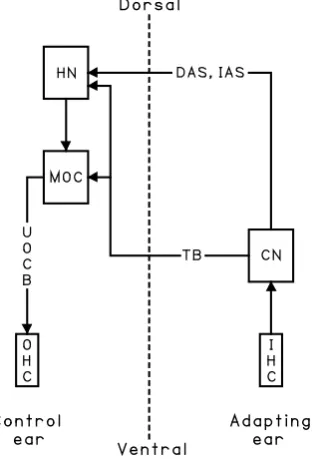
Fig. 4 shows a gross simplification of the OCB pathways from the adapting side to the control side. The vertical dashed line indicates the midline of the head, from under the jaw (ventral) to the top of the crown (dorsal). The relative locations of elements here roughly imitates their actual spatial relations. Boxes are nuclei, i.e., masses of neuronal cell bodies. Lines joining them are bundles of the neuronal conduction-lines, axons, one per cell body. Neuronal-spike-flow direction in axons is indicated by arrows. CN = cochlear nucleus; DAS = dorsal acoustic stria; HN = various higher nuclei; IAS = intermediate acoustic stria; IHC = inner hair cell; MOC = medial olivocochlear nuclei; OHC = outer hair cell; TB = trapezoid bundle; UOCB = uncrossed olivocochlear bundle. Fig. 4 is simplified from a summary in Nizami [21], with later consultation of Guinan [20].
Fig. 4. The pathways that hypothetically allow adapting-ear tones to affect control-ear hearing.
Those pathways from the control side to the adapting side are just the mirror images of what is shown in Fig. 4. The effects of the intensity of stimuli in one ear on the response of the other ear to stimuli has been studied in man, using, as indicators of OCB effect on the other ear, the changes in the stimulus-evoked oto-acoustic emissions (OAEs) there. The results largely support the notion that the OCB has the same qualitative effects in man as in other species ([20], p. 599). There are also two lines of psychophysical evidence for “volume turn-down” in man. First, there is an elevation of the detection threshold for the stimulus given to one ear, caused by activity in the OCB projecting to that ear from the opposite ear (e.g., [22], [23], [24], [25]). Secondly, that selfsame OCB activity can lower the subjective intensity (i.e., loudness) for stimuli that are well above detection threshold [26].
B. The Hypothetical Role of the OCB During SDLB
Fig. 5 illustrates the present author’s interpretation of the hypothetical role of the OCB during SDLB in determining the adapting-ear and control-ear “volume settings” between some maxima and some minima, up to the end of the third adjustment session, as follows. Stimulus at one ear induces efferent OCB firing which “turns down the volume” at the opposite ear. For example, a continuous adapting-ear tone evokes continuous neural firing in the OCB that projects to the control ear (using the pathways of Fig. 4). That firing gradually “turns down the volume” at the control ear (Fig. 5, upper panels) before the second adjustment session. Note well that overall loudness is assumed to consist of equally-weighted contributions from each ear (an assumption that is taken for granted in the literature). The overall loudness in-between presentations of the control-tone is due only to the adapting-ear tone, and does not diminish.
Fig. 5. The hypothetical actions of the adapting and control ears to affect each other’s “average volume setting” (see text), from after the first SDLB adjustment session (see Fig. 2) to the end of the third adjustment session. For simplicity, “adaptation” during the first adjustment session is presumed to be negligible.
[image:7.595.93.252.299.529.2]fourth-from-top, on the left). Thanks to the intervals between adjustment sessions, the adapting ear should recover from the control-ear-induced “volume turn-down” (e.g., Fig. 5, panel third from top on right). During the third adjustment session and ones following it, the amount of “volume turn-down” at the adapting ear increases (Fig. 5, lowest right-hand panel), as follows.
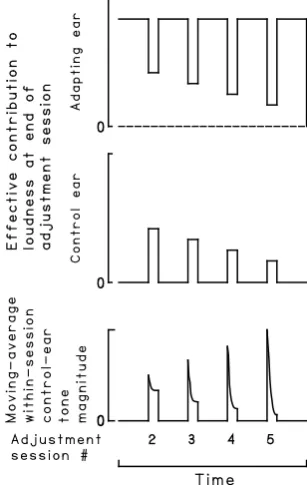
[image:8.595.348.502.238.481.2]Over the successive adjustment sessions, “volume turn-down” at the control ear accumulates, such that the magnitude of the control-ear tone intensity at the beginning of the session must be set increasingly higher to compensate. Fig. 6 shows this behavior.
The bottom of Fig. 6 has a linear time scale, which applies to the whole figure. The figure’s upper and middle panels respectively show the equally-weighted contributions, to loudness, of the adapting ear and the control ear. Zero indicates no tone. In the figure’s lowest panel is the moving-average tone magnitude at the control ear. The average is used here because the listener adjusts the control-ear tone’s magnitude up-and-down during the comparatively brief adjustment sessions. Note again that, in response to a control tone, the adapting ear is desensitized, hence reducing its contribution to loudness. By the end of each adjustment session, that reduced adapting-ear contribution must be matched by the listener, which is done by reducing the moving-average control-ear tone magnitude from its initial high to its final within-session setting. A typical adjustment session lasts from 10 seconds [2] to 20 seconds [3], more than enough time for the OCB to mediate a degree of “volume turn-down”, according to what Guinan [20] calls the “slow” time scale of OCB effects.
Further, the initial upper setting of the control-ear tone magnitude tends to be enhanced during any adjustment session. That is, between adjustment sessions the attenuators that the listener adjusts are customarily reset to maximum attenuation (i.e., minimum control-ear tone magnitude) by the experimenter, plus-or-minus some small amount that is randomly determined. At the commencement of each adjustment session, therefore, the listener must rapidly boost the control-ear tone magnitude.
C. The Effectiveness of This Physiology-Based Qualitative Model
The above model can explain ten documented characteristics of SDLB [27]. That is, the observed monaural vs. binaural dichotomy in auditory adaptation can be explained by a feedback system in which an auditory stimulus in either ear affects the other ear. Thus, Dr. Norwich’s “mystery of loudness adaptation” would seem to be far less mysterious than at first proposed.
X. PROFESSOR NORWICH’S “MYSTERY OF LOUDNESS ADAPTATION”, AND A PHYSIOLOGY-BASED QUALITATIVE
MODEL TO REPLACE IT:SUMMARY AND CONCLUSIONS In “A mathematical exploration of the mystery of loudness adaptation” [1], Dr. Norwich seeks to provide a mathematical explanation for an apparent contradiction. The contradiction is that a tone applied by headphones to just one ear will not decrease in loudness over time, but its loudness will drop when indicated by the lower magnitude of
a same-frequency tone of matching loudness, presented intermittently through the other side of the headphones. The latter loudness drop is called “adaptation”. To summarize: the loudness of a continuous tone declines over time in some experimental cases, but not in others. To solve this “mystery”, Dr. Norwich proposes to “analyze mathematically” the two methods for measuring loudness adaptation, i.e., monaural (one ear) presentation and binaural (two ears) presentation.
Dr. Norwich’s mathematical analysis itself proves full of contradictions, arbitrary decisions, and incongruities. It has the look of circular logic; indeed, so does all of Dr. Norwich’s work on the Entropy Theory (see analyses in [8], [15], [19], [28], among others).
Fig. 6. The hypothetical moving-average control-ear tone-magnitude settings (bottom) during successive adjustment sessions (left to right) during SDLB, and the resulting final adapting-ear and control-ear loudness contributions at each session’s end (middle and top; see text).
In retrospect, none of this should be surprising, as it is difficult to understand how the results of a psychology experiment involving a physiological system (as they all ultimately do) could be explained by a purely mathematical
model, that is, one lacking any further explication of the interaction of the physiological system with the experimental-psychology procedures. Dr. Norwich relies over-much on math, and has a woeful ignorance of the psychology literature, as reflected in his remarkably thin reference list (see [1]), a scarcity which frankly typifies his work on the Entropy Theory (see criticisms in [8], [15], [19], [28]). Indeed Dr. Norwich, a full professor of physiology, seems unaware of the very existence of an auditory efferent feedback system [29]:
known for the senses of taste (tongue to cortex), hearing (cochlea to cortex) etc. However, these pathways are purely afferent in nature.
A similar emphasis on math without experimental grounding may explain why Dr. Norwich’s paper passed peer review at
Bulletin of Mathematical Biology (Editor: Philip Kumar Maini). Indeed, Dr. Norwich’s “mystery” is not the first incidence of Bulletin of Mathematical Biology publishing an erroneous Entropy Theory paper; [6], [30], and [31] all appeared there, although [6] and [31] are indisputably erroneous (see respectively [8] and [28]), and readers can ascertain for themselves that [30] has serious problems, although lack of time prevents the present author from explication. Despite such condemnations of the Entropy Theory (and there are others by others, e.g., [32], [33], [34]), it continues to be published in allegedly peer-reviewed sources (e.g., [35], [36]). It was even proselytized by Dr. Norwich in a journal of conservative religion [37], an act revealing the role of belief (rather than proof) within the Entropy Theory. Scientists and engineers must beware of such false theory, lest it waste their precious time and energy and provide a bad example to their students.
Altogether, the “mystery of loudness adaptation” can be explained by a conceptual model [27], one based entirely on what is known of auditory physiology and of the SDLB procedure, without the use of, or need for, a single equation.
ACKNOWLEDGEMENT
My sincere thanks to Dr. Claire S. Barnes (VA Palo Alto Health Care System) for many helpful insights.
REFERENCES
[1] K.H. Norwich, “A mathematical exploration of the mystery of loudness adaptation,” Bull. Math. Biol., vol. 72, pp. 298-313, 2010. [2] J.D. Hood, “Per-stimulatory fatigue,” Acta Oto-Laryngol. Supp., vol.
92, pp. 26-57, 1950.
[3] J.P. Egan, “Perstimulatory fatigue as measured by heterophonic loudness balances,” J. Acoust. Soc. Am., vol. 27, pp. 111-120, 1955. [4] L.E. Krueger, “Reconciling Fechner and Stevens: toward a unified
psychophysical law,” Behav. Brain Sci., vol. 12, pp. 251-267, 1989. [5] K.H. Norwich, “The Fechner-Stevens law is the law of transmission
of information,” Behav. Brain Sci., vol. 12, p. 285, 1989.
[6] K.H. Norwich, “On the information received by sensory receptors,”
Bull. Math. Biol., vol. 39, pp. 453-461, 1977.
[7] K.H. Norwich, Information, Sensation, and Perception. Toronto, ON, Canada: Academic Press, 1993.
[8] L. Nizami, “A computational test of the information-theory based Entropy Theory of Perception: does it actually generate the Stevens and Weber-Fechner Laws of sensation?,” Proc. World Cong. Eng. (Lecture Notes in Engineering and Computer Science), International Association of Engineers, London, England, 2009, pp. 1853-1858. [9] K.H. Norwich, “Information, memory, and perception,” Inst. Biomed.
Eng. U. Toronto, vol. 17, 1975.
[10] R.D. Luce and S.S. Mo, “Magnitude estimation of heaviness and loudness by individual subjects: a test of a probabilistic response theory,” Brit. J. Math. Stat. Psych., vol. 18, pp. 159-174,1965. [11] W.M. Hartmann, Signals, Sound, and Sensation. New York, NY,
USA: Springer, 1998.
[12] J.F. Jerger, “Auditory adaptation,” J. Acoust. Soc. Am., vol. 29, pp. 357-363, 1957.
[13] E.M. Weiler, M. Loeb, and E.A. Alluisi, “Auditory adaptation and its relationship to a model for loudness,” J. Acoust. Soc. Am., vol. 51, pp. 638-643, 1972.
[14] L.M. D’Alessandro and K.H. Norwich, “Loudness adaptation measured by the simultaneous dichotic loudness balance technique differs between genders,” Hear. Res., vol. 247, pp. 122-127, 2009. [15] L. Nizami, “Fundamental flaws in the derivation of Stevens’ Law for
taste within Norwich’s Entropy Theory of Perception,” in Current Themes In Engineering Science 2009: Selected Presentations at the World Congress on Engineering-2009 (AIP Conference Proceedings 1220): A.M. Korsunsky, Ed. Melville, NY, USA: American Institute of Physics, 2010, pp. 150-164.
[16] K.H. Norwich, “The psychophysics of taste from the entropy of the stimulus,” Percept. Psychophys., vol. 35, pp. 269-278, 1984. [17] R.C. Tolman, The Principles of Statistical Mechanics. Toronto, ON,
Canada: Oxford U. Press, 1962 (reprint of original, Oxford U. Press, 1938).
[18] K.M.V. McConville, K.H. Norwich, and S.M. Abel, “Application of the entropy theory of perception to auditory intensity discrimination,”
Int. J. Biomed. Comput., vol. 27, pp. 157-173,1991.
[19] L. Nizami, “Is auditory intensity discrimination a comparison of entropy changes?,” Proc. 155th Meet. Acoust. Soc. Am., 5th Forum Acust. EA, 9e Cong. Franc. d’Acoust. SFA, 2nd ASA-EAA Joint Conf., Paris, France, 2008, pp. 5739-5744.
[20] J.J. Guinan Jr., “Olivocochlear efferents: anatomy, physiology, function, and the measurement of efferent effects in humans,” Ear Hear., vol. 27, pp. 589-607,2006.
[21] L. Nizami, “On auditory dynamic range,” Ph.D. dissertation, Dept. Psychol., Univ. Toronto, Toronto, ON, Canada, 1999.
[22] J.G. Ingham, “Variations in cross-masking with frequency,” J. Exp. Psych., vol. 58, pp. 199-205, 1959.
[23] D.D. Dirks and C. Malmquist, “Shifts in air-conduction thresholds produced by pulsed and continuous contralateral masking,” J. Acoust. Soc. Am., vol. 37, pp. 631-637, 1965.
[24] D.D. Dirks and J.C. Norris, “Shifts in auditory thresholds produced by ipsilateral and contralateral maskers at low-intensity levels,” J. Acoust. Soc. Am., vol. 40, pp. 12-19, 1966.
[25] B. Blegvad, “Contralateral masking and Bekesy audiometry in normal listeners,” Acta Oto-laryngol., vol. 64, pp. 157-165, 1967. [26] M.C. Botte, C. Baruch, and B. Scharf, “Loudness reduction and
adaptation induced by a contralateral tone,” J. Acoust. Soc. Am., vol. 80, pp. 73-81, 1986.
[27] L. Nizami, “Loudness ‘fatigue’ with two ears but not with one: simultaneous dichotic loudness balance (SDLB) explained,” Fechner Day 2012: Proc. 28th Ann. Meet. Int. Soc. Psychophys., Ottawa, ON, Canada, 2012, pp. 6-11.
[28] L. Nizami, “A warning to the human-factors engineer: false derivations of Riesz’s Weber fraction, Piéron’s Law, and others within Norwich et al.’s Entropy Theory of Perception,” in Advances in Computer Science and Engineering: M. Schmidt, Ed. Rijeka, Croatia: InTech, 2011, pp. 391-406.
[29] K.H. Norwich, “Neurophysiological encoding of the apprehension of physiological events,” in Abstracts of Decision Making: Bridging Psychophysics and Neurophysiology, a workshop held at University of North Texas, Denton, TX, USA, March 18-20,2011.
[30] K.H. Norwich, “Uncertainty in physiology and physics,” Bull. Math. Biol., vol. 43, pp. 141-149, 1981.
[31] K.H. Norwich, C.N.L. Seburn, and E. Axelrad, “An informational approach to reaction times,” Bull. Math. Biol., vol. 51, pp. 347-358, 1989.
[32] A.W. MacRae, “The magical number fourteen: making a very great deal of none-sense,” Percept. Psychophys., vol. 31, pp. 591-593, 1982.
[33] D.R.J. Laming, “Review: Information, Sensation, and Perception by K.H. Norwich,” Perception, vol. 23, pp. 1491-1494, 1994.
[34] F.G. Ashby, “Resurrecting information theory: Information, Sensation, and Perception by Kenneth H. Norwich,” Am. J. Psych., vol. 108, pp. 609-614, 1995.
[35] K.H. Norwich, “Sensation as reduction in uncertainty: a review,”
Cog. Sys. Res., vol. 22-23, pp. 78-88, 2013.
[36] K.H. Norwich, “A physical basis for sensory perception,” Physica A, vol. 414, pp. 61-75, 2014.
[37] K.H. Norwich, “The physics of prayer and the origin of the universe,”