Abstract—In recent years, with the rapid popularization of applications (APP) and mobile devices, the market share of mobile advertisements grows dramatically. Mobile advertisements can reach potential customers ubiquitously based on individual needs. For advertisers, how to enhance the design for satisfying individual’s requirements, and to increase the click through rate (CTR) and further increase customer’s loyalty and repurchase rate have become one of major issues. Therefore, this study aims to identify the important mobile advertisements factors of influencing the customer’s loyalty and repurchase rate, and then to provide advertisers useful information for the design of mobile advertisements. In this work, we attempt to define the potential factors of mobile advertisements, and then employ support vector machine recursive feature elimination (SVM-RFE), correlation based, and consistency based feature selection methods to identify the key attributes to directly improve the customer’s loyalty and repurchase rate. Results can be used to improve the benefits of mobile advertising and to increase the market share of mobile advertising.
Index Terms—Mobile advertisements, Feature selection, SVM-RFE, Consistency-based, Correlation-based.
I. INTRODUCTION
ith the growing market for mobile devices, it led to the rapid development of mobile websites and applications (APP). Thus, mobile advertising also has become one of popular marketing channels. According to 1st half-year of IAB 2014, it pointed out that internet advertising grew to 23.1 billion USD. It increases 15% compared to 2013[19]. Gartner mentioned that mobile advertising market scale will reach 18 billion USD [12] in 2014. It’s also reported that Facebook occupied 49% in the whole mobile advertising market, 1.8 billion USD, in the third quarter of 2013 [21]. The Asian countries including Taiwan, Japan, South Korea paid much attentions to construct information infrastructure and build wireless environment. Thus, in 2012, Asian mobile Ads market reached to $ 7.7 billion [4]. Therefore, lots works aimed to study the value of mobile advertising.
Currently, the related studies focus on possible applications areas and its effects of APP. It’s reported that Manuscript received January 8, 2015; accepted January 22, 2015. This work was supported in part by the National Science Council of Taiwan, R.O.C. (Grant No. MOST 101-2628-E-324-004-MY3).
*L.-S. Chen is an Associate Professor and Dean of Student Affairs Office with the Chaoyang University of Technology, Taichung 41349, Taiwan (phone: 886-4-23323000ext7752; fax: 886-4-23304902; e-mail: [email protected]).
C.-C. Liu is a graduate student with the Department of Information Management, Chaoyang University of Technology, Taichung 41349, Taiwan (e-mail: [email protected] ).
APP has widely applied to education, health care, and so on [32]. In the work of Bristol, he found that there are more than 290 APP are now cancer-related, over 800 APP are associated with diabetes, or even more than 100 APP are about pain management [2]. Moreover, Swartz [31] noted that the clinical information regarding to pediatric health care have been provided in forms of online journals or e-books which can be browsed on the mobile devices. Steven et al. [32] indicated that APP has a positive influence to persuade mobile device users. It can be used to enhance the user interests in brand or brand related products [32]. From available literatures, relatively few works aimed to discover the key factors of clicking mobile advertisements (Ads) and try to increase customer’s loyalty and repurchase rate.
Mobile advertising is another one of new research fields due to the popularization of mobile devices. Therefore, the related works are not as rich and diverse as Internet advertising. Chen and Hsieh [4] tried to discover the design factors for personalizing mobile Ads. Yang et al. [41] presented an integrated mobile advertising model to discover the effects of technology-based and emotion-based evaluations. This work hopes to define and identify the most important factors to influence consumers’ points of reading.
Moreover, because the advertising effects might be calculated by its click amount, for advertisers, it’s important to know the crucial factors that can attract customers. Most of all, the advertisers further know how to improve the customer of loyalty and repurchase rate in mobile advertising, these are able to improve brand recognized and purchase intention. Consequently, the objective of this work is to define and identify the key factors of clicking mobile Ads by using several feature selection algorithms, including support vector machine recursive feature elimination (SVM-RFE), correlation based, and consistency based feature selection methods. The selected important factors can assist advertisers to make their advertising decisions from the viewpoints of customers. Finally, an actual case study will be provided to demonstrate the effectiveness of the proposed methods.
II.LITERATURE REVIEW A.Mobile Advertising
Mobile marketing is a promotional activity designed to deliver message through the use of mobile phones, smart phones and other mobile devices [36]. Ufuoma and Ayesha [37] have referred to the main function of marketing is advertising which plays a very important role between businesses and consumers in providing products and services to facilitate operations. According to Mobile Marketing
Using Feature Selection Approaches to Identify
Crucial Factors of Mobile Advertisements
Long-Sheng Chen*
,
Chun-Cheng Liu
W
ISBN: 978-988-19253-2-9
Association (MMA), mobile advertising could be defined as a form of advertising, with mobile handset, PDA or other wireless communication device to send advertising messages [4]. As companies push for BYOD (Bring your own device) plans, they requests employees to carry mobile devices to work. It has apparently become a trend, so that mobile Ads can have their advertising effectiveness [11]. There are lots of scholars and organizations classified mobile Ads which could be summarized in Table 1.
Companies started to use mobile Ads to promote their products. For examples, Macy used interactive mobile Ads to strengthen their M-commerce strategy. In September 2013, in order to recognize daily sales by utilizing an interactive mobile Ad combining a small puzzle game [26]. From October 2013, McDonald’s has also joined the groups which uses mobile Ads, and released the first Ad which combined social media and rich media technologies, and then placed it in the well-known social networking sites, Facebook and Twitter, as well as National Football League Mobile Sites [26].
Some works related to mobile Ads are described as follows. Kim [23] noted that professionally smartphones and APP can allow mobile Ads readers to enhance trust and to increase the willingness to buy products. Kim and Lee [22] discovered and theorized customer typologies based on Q theory’s subjectivity in a qualitative approach and then verified and generalized sequentially these theoretical definitions and concepts through a combination of the Q and R empirical methods. Their results can be used as an antecedent of theoretical and industrial frameworks and a basic statistical data in advertising marketing and customer relationship management domains. Chen et al. [5] aimed to help mobile advertisers enhance their effectiveness in delivering mobile advertisements in the constantly evolving world of e-commerce. Their research analyzed attributes and concluded that brands, prices, promotions, preferences, and interests are key attributes for both goods and services in designing mobile advertising messages and that time is crucial only for services mobile advertising message design. Bakar and Rosmiza [1] identified the relationships between technology acceptance and purchase intentions on movie mobile advertising among youth Twitter users in Malaysia.
Chen and Hsieh [4] found six customized factors of designing mobile Ads in 2012. José et al. [20] indicated that
entertainment, irritation, and perceived usefulness are three major factors for the youth accepted mobile advertising. Their study also has provided practical guideline for marketing managers to promote products/service to the youth. Yang et al. [41] collected Korean consumers’ information, and build a framework to provide advertisers to predict the efficiency of mobile Ads. From literatures mentioned above, we can find that mobile Ads have attracted lots of big companies’ attentions. So, to identify the crucial factors of clicking mobile Ads has become one of important issues.
B.Feature Selection
Feature selection can be considered as choosing a subset of features that can result in a highest classification performance [38]. Frenay et al. [10] think that feature selection can have some benefits including to reduce the dimension size, to remove irrelevant or redundant features, and to improve the performance of the classification model. Chandrashekar & Sahin [6] pointed out that feature selection allows us to get a better understanding of collected data, to help us increase learning efficiency by reducing the dimension size, and to improve the prediction accuracy. A number of soft computing approaches, such as neural networks, genetic algorithms, decision tree [7], rough sets [35], and correlation analysis [7] have been widely used to remove irrelevant, unnecessary, and redundant attributes. The conventional feature selection methods can be divided into three groups including filters, wrappers, and embedded (hybrid) methods [42].
The filter methods like preprocessor, we can choose a set of higher ranking features and used them to build predict models. Filter methods might use statistical analysis techniques to extract important features without learning methods [9]. The second group involves wrapper based methods which select factors based on the classification performance of learning methods [13]. Filter algorithm initiates the search with a given subset and searches through the feature space using a particular search strategy. It evaluates each variable independently with respect to the class in order to create a ranking. Variables are then ranked from the highest value to the smallest one. Since the filter model applies independent evaluation criteria without involving any classification algorithm, it does not inherit any bias of a classification algorithm and it is also computationally efficient. Wrapper approaches are similar to the filters except that they utilize a classification algorithm. The selected subset S is initialized with the first variable in the ranking, and then the algorithm iteratively tries to include in S the next variable xi in the ranking by evaluating the goodness of that augmented subset. The third group contains embedded (hybrid) methods which combined filter and wrapper methods to achieve better classification performance [17, 33] The features are ranked using distance criterion and then wrapper model is used to evaluate classification model [6, 28, 42]. However, when applying these feature selection to real world, we need to consider computational cost and complexity.
According to the work of Novakovic [28], he evaluated several feature selection methods including Gain (IG), Gain Ratio (GR), Symmetrical Uncertainty (SU), Recursive Elimination of Features (Relief-F), One-R (OR), Chi-Squared TABLEI
THECATEGORYOFMOBILEADVERTISEMENTS[8,18]
1.Message-based
-SMS Advertising -MMS Advertising
2. Web-based
-Keyword Advertising -Banner Advertising
3.Location-based
-Push Location-based Service -Pull Location-based Service
4. APP-based
-In-App Advertising -Ad-watch App
-Quick-Response Barcodes Ads
5.Call-based
-Caller Ring Back Tone -Call To Action
IMECS 2015, March 18 - 20, 2015, Hong Kong
ISBN: 978-988-19253-2-9
(CS). Based on classification performances of Naive Bayes, the experimental results show that OR is the best followed by CS, t GR, SU, IG, and RF. Veronica et al. [39] used five kinds of feature selection methods including Correlation-based Feature Selection (CFS), Consistency-based, INTERACT, IG, Relief-F, Recursive Feature Elimination for Support Vector Machines (SVM-RFE), Feature Selection-Perceptron (FS-P), they found Relief-F has the best performance and IG can have a stable performance. Among them, SVM-RFE can be one of optimal solution for feature selection. Therefore, we use SVM-RFE in this study.
C.SVM-RFE
Support vector machine recursive feature elimination (SVM-RFE) was first proposed by Guyon et al. [14] to aid in gene selection for cancer classification. SVM-RFE is a wrapper approach used in two-class circumstances [30]. It was demonstrated that the features selected by SVM-RFE yielded better classification performance than the other methods mentioned in the study of Guyon et al. [14]. According to the work of Chandrashekar and Sahin [6], SVM-RFE uses the weights of SVM to rank the feature for their removal. Let
w
j be defined as equation (1).)
(
)
(
)
(
)
(
j j
j j
j
w
(1) where
j(
)
and
j(
)
are the mean of the samples in class (+) and (
) and
jis the variance of the respective classes andj
=1 to D. This equation (1) can be employed to be ranking criteria to sort the features. The rank vector w can be used to classify since features rank proportionally contributes to the correlation. A voting scheme could be defined in equation (2).)
(
)
(
x
w
x
D
(2)where w is the rank of the features or weight,
D
(
x
)
is the decision and
is the mean of the data. Hence the rank of the features can be used as classifier weights. The change in the weight wj can be viewed as removing a feature j. It is suggested to use the change in the objective function, a linear discriminant function J which is a function of wj. This concept of using the weights as the ranking and the search is done using the change in the objective function is applied to the SVM classifier to perform SVM-RFE method.There are lots of successful of SVM-RFE to real applications. For examples, Shieh and Yang [34] presented a multiclass SVM-RFE to streamline the selection of optimum product form features. Bolón-Canedo et al. [3] tried to find the most up-to-date feature selections methods for microarray databases. For microarray data, the optimal combination of feature selection methods is SVM-RFE and mRMR (minimum Redundancy Maximum Relevance) [3]. Korkmaz et al. [24] utilized SVM for drug discovery with three feature selection methods including SVM-RFE, wrapper method and subset selection. Maldonado [27] pointed out one advantage of SVM-RFE is the possibility to perform non-linear feature selection. Therefore, SVM-RFE has been employed to a feature selection method is this study [27].
III. IMPLEMENTAL PROCEDURE
The implemental procedure involves 8 major steps. They are to define factors of mobile advertising, design questionnaire, pre-test questionnaire, collect data, prepare data, implement feature selection methods, build SVM classifier, and evaluate results and make conclusions.
The details of the procedure have been provided as follows.
Step 1: Define factors of mobile advertising
In this step, we try to define potential factors of mobile advertisements depending upon available literatures. We survey published works and attempt to define possible factors from related studies. Next, according to these defined factors, we can go to next step to design questionnaire for collecting data.
Step 2: Design questionnaire
In this step, an importance level of the defined factors is measured in this questionnaire. In this questionnaire, customers express the feeling about the level of importance for a certain factor regarding the probability of increasing loyalty, and repurchase rate, respectively. Every single one factor will be expanded into a pair of question items. Q: How would you feel the importance of the title of mobile advertisement?
(A) Very important (B) Important (C) Neutral (D) Unimportant (E) Very unimportant
Step3:Pre-test
The original questionnaire will be issued for pretesting. In this step, according to the feedbacks of respondents, we can modify the questionnaire items.
Step4: Collect data
After pretesting, the modified questionnaire will be issued to target customers, including those who have experiences of watching mobile ads.
Step5: Prepare data
Before implementing feature selection methods, we will code the collected data. After preprocessing, we can analyze the collected examples.
Step 6: Implement feature selection methods Step 6.1 SVM-RFE
In this work, we use SVM-RFE [14]. The algorithm of SVM-RFE can be found as follows.
Inputs:
Training examples
T l
k
X
X
X
X
X
0
[
1,
2,...,
,...,
]
(3)Class labels
T l
k
y
y
y
y
y
[
1,
2,...,
,...,
]
(4)Initialize:
Subset of surviving features
]
,...,
2
,
1
[
n
s
(5)Feature ranked list
[]
r
(6)Repeat until
[]
s
(7)Restrict training examples to good feature indices
)
(:,
0
s
X
X
(8)Train the classifier
ISBN: 978-988-19253-2-9
)
,
(
α
SVM
train
X
y
(9) Compute the weight vector of dimension length(s)
k
k k k
y
x
W
α
(10)Compute the ranking criteria
foralli
w
c
i
(
i)
2,
(11)Find the feature with smallest ranking criterion
)
min(
arg
c
f
(12)Update feature ranked list
]
),
(
[
s
f
r
r
(13)Eliminate the feature with smallest ranking criterion
))
(
;
1
,
1
:
1
(
f
f
length
s
s
s
(14)Output:
Feature ranked list
r
(15)Step 6.2 Consistency based feature selection method [25] This method evaluates the worth of a subset of attributes by the level of consistency in the class values when the training instances are projected onto the subset of attributes. Consistency of any subset can never be lower than that of the full set of attributes; hence the usual practice is to use this subset evaluator in conjunction with a Random or Exhaustive search which looks for the smallest subset with consistency equal to that of the full set of attributes.
Step 6.3 Correlation based feature selection method: This approach evaluates the worth of a subset of attributes by considering the individual predictive ability of each feature along with the degree of redundancy between them. Subsets of features that are highly correlated with the class while having low inter-correlation are preferred [16]. By the way, we use four search methods in correlation and consistency based method. These search techniques can be described as follows.
-Best First Method:
This technique searches the space of attribute subsets by greedy hill climbing augmented with a backtracking facility. Setting the number of consecutive non-improving nodes allowed controls the level of backtracking done. Best first may start with the empty set of attributes and search forward, or start with the full set of attributes and search backward, or start at any point and search in both directions (by considering all possible single attribute additions and deletions at a given point).
-Genetic Search Method:
This technique performs a search using the simple genetic algorithm described in Goldberg (1989)[15]. -Greedy Stepwise Method:
This technique performs a greedy forward or backward search through the space of attribute subsets. It may start with no/all attributes or from an arbitrary point in the space. Stops when the addition/deletion of any remaining attributes results in a decrease in evaluation. It can also produce a ranked list of attributes by traversing the space from one side to the other and recording the order that attributes are selected.
-Linear Forward Selection Method:
This technique is an extension of Best First method. It takes a restricted number of k attributes into account.
Fixed-set selects a fixed number k of attributes, whereas k is increased in each step when fixed-width is selected. The search uses either the initial ordering to select the top k attributes, or performs a ranking (with the same evaluator the search uses later on). The search direction can be forward or floating forward selection (with optional backward search steps).
Step 7: Build SVM classifier by SMO
In this step, we implements Platt’s sequential minimal optimization algorithm for training a support vector classifier [29].
Step 8: Evaluate results and make conclusions
Finally, from the results of from step 6 to step 7, we find the important factors of mobile advertising, understand the internet users’ thinks, and then we can draw conclusions based on them.
IV. RESULTS
A.Define the potential factors of mobile advertisements
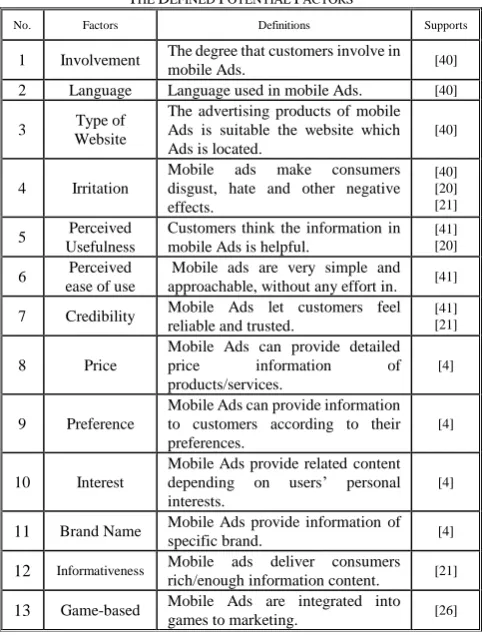
Table 2 defines the whole potential factors of mobile Ads. The factors will be our candidate set for feature selection.
B.Results for increasing customer loyalty
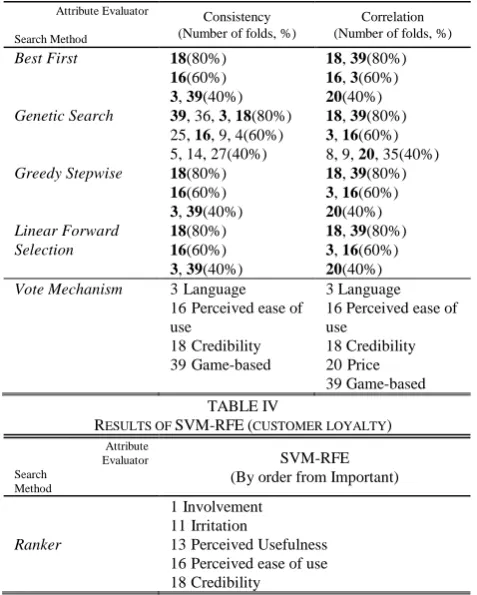
Table 3 summarized the results of correlation based, and consistency based feature selection methods. We first use 4 searching techniques and then a vote mechanism has been utilized to selected important features. In consistency based feature selection method, we found four factors, “Language”, “Perceived ease of use”, “Credibility”, and “Game-based”. And in correlation based feature selection method, we discovered five factors “Language”, “Perceived ease of use”, “Credibility”, “Price”, “Game-based”.
TABLEII
THE DEFINED POTENTIAL FACTORS
No. Factors Definitions Supports
1 Involvement The degree that customers involve in
mobile Ads. [40]
2 Language Language used in mobile Ads. [40]
3 Type of Website
The advertising products of mobile Ads is suitable the website which Ads is located.
[40]
4 Irritation
Mobile ads make consumers disgust, hate and other negative effects.
[40] [20] [21]
5 Perceived Usefulness
Customers think the information in mobile Ads is helpful.
[41] [20]
6 Perceived ease of use
Mobile ads are very simple and approachable, without any effort in. [41]
7 Credibility Mobile Ads let customers feel reliable and trusted.
[41] [21]
8 Price
Mobile Ads can provide detailed price information of products/services.
[4]
9 Preference
Mobile Ads can provide information to customers according to their preferences.
[4]
10 Interest
Mobile Ads provide related content depending on users’ personal interests.
[4]
11 Brand Name Mobile Ads provide information of
specific brand. [4]
12 Informativeness Mobile ads deliver consumers
rich/enough information content. [21] 13 Game-based Mobile Ads are integrated into
games to marketing. [26] IMECS 2015, March 18 - 20, 2015, Hong Kong
ISBN: 978-988-19253-2-9
[image:4.595.308.550.479.797.2]Table 4 lists the results of SVM-RFE. SVM-RFE ranks all factors. We merely pick some top factors. Top 5 factors include “Involvement”, “Irritation”, “Perceived Usefulness”, “Perceived ease of use” and “Credibility”. Compare results of three feature selection methods. They all indicated that “Perceived ease of use”, “Credibility” are important for increasing customer loyalty.
C.Results for increasing repurchase rate
In this subsection, we aim to find the crucial factors for increasing repurchase rate. Table 5 summarized the results of correlation based, and consistency based feature selection methods. In consistency based feature selection method, we found two factors, “Credibility”, and “Informativeness”. And in correlation based feature selection method, we discovered four factors “Credibility”, “Interest”, “Brand Name”, and “Informativeness”.
Table 6 shows the results of SVM-RFE. We merely pick some top factors. Top 5 factors include “Type of Website”,
“Perceived Usefulness”, “Credibility”, “Preference” and “Brand Name”. Compare results of three feature selection methods. They all indicated that “Credibility” is important for increasing re-purchase rate.
D.Results of SVM
In order to evaluate the performances of three feature selection methods. We use the selected important features by
three methods to build SVM. Tables 8 and 9 summarize the results of SVM for loyalty and re-purchase rate, respectively. From these tables, we can find SVM-RFE outperforms correlation based and consistency based methods.
For loyalty data, SVM-RFE can have the best performance when using three important features, “Involvement”, “Irritation”, and “Perceived Usefulness”. For repurchase rate data, SVM-RFE also can have the best performance when using three important features, “Type of Website”, “Perceived Usefulness”, and “Credibility”.
V.CONCLUSIONS
This work tries to define potential factors of mobile advertisements. Then, we employ support vector machine recursive feature elimination (SVM-RFE), correlation based, and consistency based feature selection methods to identify the key attributes to directly improve the customer’s loyalty and repurchase rate. Results indicated that SVM-RFE outperforms correlation based and consistency based feature selection methods.
Moreover, for increasing customer loyalty, we identify RESULT OF CORRELATION BASED AND CONSISTENCY BASED FEATURE
SELECTION METHODS (CUSTOMER LOYALTY) Attribute Evaluator
Search Method
Consistency (Number of folds, %)
Correlation (Number of folds, %) Best First 18(80%) 18, 39(80%)
16(60%) 16, 3(60%) 3, 39(40%) 20(40%)
Genetic Search 39, 36, 3, 18(80%) 18, 39(80%) 25, 16, 9, 4(60%) 3, 16(60%) 5, 14, 27(40%) 8, 9, 20, 35(40%)
Greedy Stepwise 18(80%) 18, 39(80%) 16(60%) 3, 16(60%) 3, 39(40%) 20(40%)
Linear Forward 18(80%) 18, 39(80%)
Selection 16(60%) 3, 16(60%) 3, 39(40%) 20(40%)
Vote Mechanism 3 Language 16 Perceived ease of use
18 Credibility 39 Game-based
3 Language 16 Perceived ease of use
18 Credibility 20 Price 39 Game-based TABLE IV
RESULTS OF SVM-RFE(CUSTOMER LOYALTY) Attribute
Evaluator Search
Method
SVM-RFE (By order from Important)
Ranker
1Involvement 11Irritation
13Perceived Usefulness 16Perceived ease of use 18Credibility
TABLE V
RESULT OF CORRELATION BASED AND CONSISTENCY BASED FEATURE SELECTION METHODS (RE-PURCHASE RATE)
Attribute Evaluator
Search Method
Consistency (Number of folds, %)
Correlation (Number of folds, %) Best First 18(100%) 18(100%)
31(60%) 31(60%) 3, 32(40%) 32, 28, 26, 3(40%)
Genetic Search 18(100%) 18(100%) 31(80%) 32(60%)
32, 26, 20, 14(60%) 31, 28, 27, 26(40%)
Greedy Stepwise 18(100%) 18(100%) 31(60%) 31(60%) 32, 3(40%) 32, 28, 26, 3(40%)
Linear Forward 18(100%) 18(100%)
Selection 31, 32(60%) 31(60%) 20, 3(40%) 3, 26, 28, 32(40%)
Vote Mechanism 18 Credibility 31 Informativeness 32 Informativeness
18Credibility 26Interest 28Brand Name 31 Informativeness 32 Informativeness
TABLE VII
SELECTED FACTORS BY SVM-RFE Dependent
Variables SVM-RFE
(Selected Factors)
Loyalty (Accuracy)
Re-purchase Rate (Accuracy)
1 63% 68%
2 70% 73%
3 73% 79%
4 68% 79%
5 71% 79%
TABLE VIII RESULTS OF SVM(LOYALTY) Feature
Selection
Evaluation
Consistency (+SVM)
Correlation (+SVM)
SVM-RFE (+SVM)
SVM (only)
Accuracy 70% 65% 73% 62%
Precision 70% 65% 74% 62%
Recall 70% 65% 73% 62%
F1-score 69% 64% 72% 62%
Time 0.02s 0.02s 0.02s 0.03s
TABLEIX
RESULTS OF SVM(RE-PURCHASE RATE) Feature
Selection
Evaluation
Consistency (+SVM)
Correlation (+SVM)
SVM-RFE (+SVM)
SVM (only)
Accuracy 76% 76% 84% 63%
Precision 77% 77% 84% 63%
Recall 76% 76% 84% 64%
F1-score 76% 76% 84% 63%
Time 0.02s 0.01s 0.01s 0.01s Attribute
Evaluator Search
Method
SVM-RFE (By order from Important)
Ranker
6Type of Website 13Perceived Usefulness 18Credibility
21Preference 27Brand Name
ISBN: 978-988-19253-2-9
[image:5.595.303.549.561.641.2] [image:5.595.46.284.624.812.2]three important factors. They are “Involvement”, “Irritation”, and “Perceived Usefulness”. Therefore, mobile advertisers need to improve the degree that customers involve in mobile Ads, and avoid to make consumers disgust, hate and other negative effects. Finally, the information contained in mobile Ads should be helpful to customers.
For increasing repurchase rate, we also recognize three important factors. They are “Type of Website”, “Perceived Usefulness”, and “Credibility”. Consequently, advertisers should put their mobile Ads on a suitable website which match the position of marketing products. By the way, the provided mobile Ads should let customers feel reliable and trusted. Moreover, the information in mobile Ads should helpful. For the direction of future works, readers can use another different feature selection method to identify important factors mobile ads. By the way, more examples should be collected for precise analysis.
REFERENCES
[1] Bakar, M. S. A., Rosmiza, B., “Technology Acceptance and Purchase Intention towards Movie Mobile Advertising among Youth in Malaysia,” Procedia - Social and Behavioral Sciences, Vol. 130, pp. 558-567, 2014.
[2] Bristol, T. J., “Nursing school? There's an app for that!,” Teaching and Learning in Nursing, Vol. 9, pp. 203–206, 2014.
[3] Bolón-Canedo, V., Sánchez-Maroño, N., Alonso-Betanzos, A, Benítez, J.M., Herrera, F., “A review of microarray datasets and applied feature selection methods,” Information Sciences, 282, 111–135, 2014. [4] Chen, P. T., Hsieh, H, P., “Personalized mobile advertising: Its key
attributes, trends, and social impact,” Technological Forecasting & Social Change, Vol. 79, pp. 543-557, 2012.
[5] Chen, P. T., Cheng, J. Z., Yu, Y. W., Ju, P. H.,“ Mobile advertising setting analysis and its strategic implications,” Technology in Society, Vol. 39, pp. 129-141, 2014.
[6] Chandrashekar , G., Sahin, F., “A survey on feature selection methods,
Computers and Electrical Engineering,” 40, 16–28, 2014.
[7] Chen, K.-Y., Chen, L.-S., Chen, M.-C., Lee, C.-L., “Using SVM based method for equipment fault detection in a thermal power plant,”
Computers in Industry, 62(1), 42-50, 2011.
[8] Diane, R., “Get Your Business Moving: 9 types of Mobile Marketing,” 2010,
Available:http://harpsocial.com/2010/03/get-your-business-moving-9
-types-of-mobile-marketing/.
[9] Dash, M. and Liu, H., “Feature selection for classification,” Intelligent Data Analysis, 1(3), 131-156, 1997.
[10] Frenay, B., Doquire, G., Verleysen, M., “Estimating mutual information for feature selection in the presence of label noise,”
Computational Statistics & Data Analysis, 71, 832-848, 2014. [11] Gartner, “Gartner Predicts by 2017, Half of Employers will Require
Employees to Supply Their Own Device for Work Purposes,” 2013, Available:http://www.gartner.com/newsroom/id/2466615.
[12] Gartner, “Gartner Says Mobile Advertising Spending Will Reach $18
Billion in 2014,” 2014,
Available:http://www.gartner.com/newsroom/id/2653121.
[13] Guyon, I. and Elisseeff, A., “An introduction to variable and feature selection,” Journal of Machine Learning Research, 3(7-8), 1157-1182, 2003.
[14] Guyon, I., Weston, J., Barnhill, S., Vapnik, V., “Gene Selection for Cancer Classification using Support Vector Machines,” Machine Learning, 46, 389–422, 2002.
[15] Goldberg, D. E., “Genetic algorithms in search,” optimization and machine learning. Addison-Wesley, 1989.
[16] Hall, M. A., “Correlation-based Feature Subset Selection for Machine Learning. Hamilton,” New Zealand, 1998.
[17] Huang, J., Cai, Y. and Xu, X., “A hybrid genetic algorithm for feature selection wrapper based on mutual information,” Pattern Recognition Letters, 28(13), 1825-1844, 2007.
[18] Institute for Information Industry-Foreseeing Innovative New Digiservices, III-FIND, “LBS type of advertising by consumers as an important model for future development of mobile ads,” 2011, Available:http://www.find.org.tw/find/home.aspx?page=many&id=32 1.
[19] Interactive Advertising Bureau, IAB, “2014 Internet Advertising Revenue Half-Year Report,” 2014, Available:http://www.iab.net/media/file/IAB_Internet_Advertising_R evenue_Report_HY_2014_PDF.pdf.
[20] José, M. P., Silvia, S. B., Carla, R. M. and Joaquin, A. M.,“Key factors of teenagers’ mobile advertising acceptance,” Industrial Management & Data Systems, Vol. 113, No. 5, pp. 732-749, 2013.
[21] Kim, Y. J., Han, J., “Why smartphone advertising attracts customers: A model of Web advertising, flow, and personalization,” Computers in Human Behavior, Vol. 33, pp. 256-269, 2014.
[22] Kim, K. Y., Lee, B. G., “Marketing insights for mobile advertising and consumer segmentation in the cloud era: A Q–R hybrid methodology and practices,” Technological Forecasting and Social Change, In Press, Corrected Proof, 2014.
[23] Kim, K. J., “Can smartphones be specialists? Effects of specialization in mobile advertising,” Telematics and Informatics, Vol. 31, pp. 640-647, 2014.
[24] Korkmaz, S., Zararsiz, G., Dincer Goksuluk, D., “Drug/nondrug classification using Support Vector Machines with various feature selection strategies,” Computer Methods and Programs in Biomedice, 117, 51-60, 2014.
[25] Liu, H., Setiono, R., “A probabilistic approach to feature selection - A filter solution,” presented 13th International Conference on Machine Learning, 319-327, 1996.
[26] Lauren, J., Mobile Marketer, “Mobile Marketer reported: Top 10 mobile advertising campaigns of 2013,” 2013, Available:http://www.mobilemarketer.com/cms/news/advertising/168 47.html.
[27] Maldonado, S., Montoya, R., Weber, R., “Advanced conjoint analysis using feature selection via support vector machines,” European Journal of Operational Research, 241, 564–574, 2015.
[28] Novakovic, J., “The impact of feature selection on the accuracy of naïve bayes classifier,” presented 18th Telecommunications forum TELFOR 2010, Serbia, Belgrade, 1113-1116, 2010.
[29] Platt, J., “Fast Training of Support Vector Machines using Sequential Minimal Optimization,” In B. Schoelkopf and C. Burges and A. Smola, editors, Advances in Kernel Methods - Support Vector Learning, 1998. [30] Rakotomamonjy, A., “Variable selection using SVM-based criteria,”
Journal of Machine Learning Research, 3, 1357–1370, 2003. [31] Swartz , M. K., “Coming Soon To an App Near You,” Journal of
Pediatric Health Care, Vol. 28, pp. 285, 2014.
[32] Steven, B., Potter, R. F., Shiree, T., Jennifer A. R., Duane V., “The Effectiveness of Branded Mobile Phone Apps,” Journal of Interactive Marketing, Vol. 25, pp. 191-200, 2011.
[33] Shi, J., Yin, W., Osher, S., and Sajda, P., “A fast hybrid algorithm for large-scale L1-regularized logistic regression,” Journal of Machine Learning Research, 11, 713-741, 2010.
[34] Shieh, M.-D., Yang, C.-C., “Multiclass SVM-RFE for product form feature selection,” Expert Systems with Applications, 35, 531–541, 2008.
[35] Swiniarski, R.-W. and Hargis, L., “Rough sets as a front end of neural-networks texture classifiers,” Neurocomputing, 36, 85-102, 2001.
[36] TechTarget, “What is mobile marketing?,” 2009, Available:http://searchmobilecomputing.techtarget.com/definition/mo bile-marketing.
[37] Ufuoma, A., Ayesha, B. D.,“Mobile advertisements and information privacy perception amongst South African Generation Y students,”
Telematics and Informatics, 2014.
[38] Uysal, A. K. and Gunal, S., “A novel probabilistic feature selection method for text classification,” Knowledge-Based Systems, 36, 226-235, 2012.
[39] Veronica, B. C., Noelia S. M., Amparo, A. B., “An ensemble of filters and classifiers for microarray data classification,” Pattern Recognition, 45(1), 531-539, 2012.
[40] William, F., Chen, J. C. and William, H. R., “The effect of variations in banner ad, type of product, website context, and language of advertising on internet users’ attitudes,” Computers in Human Behavior, Vol. 31,pp. 37-47, 2014.
[41] Yang, B., Kim, Y., Yoo, C., “The integrated mobile advertising model: The effects of Technology- and emotion-based evaluations,” Journal of Business Research, Vol. 66,pp. 1345-1352, 2013.
[42] You, W., Yang, Z., Ji, G., “Feature selection for high-dimensional multi-category data using PLS-based local recursive feature elimination,” Expert Systems with Applications, 41(4), 1463-1475, 2014.
IMECS 2015, March 18 - 20, 2015, Hong Kong
ISBN: 978-988-19253-2-9