Abstract
Agent-based computing represents an exciting new syn-thesis both for Artificial Intelligence (AI) and, more generally, Computer Science. It has the potential to sig-nificantly improve the theory and the practice of model-ling, designing, and implementing complex systems. Yet, to date, there has been little systematic analysis of what makes an agent such an appealing and powerful conceptual model. Moreover, even less effort has been devoted to exploring the inherent disadvantages that stem from adopting an agent-oriented view. Here both sets of issues are explored. The standpoint of this analy-sis is the role of agent-based software in solving com-plex, real-world problems. In particular, it will be argued that the development of robust and scalable soft-ware systems requires autonomous agents that can com-plete their objectives while situated in a dynamic and uncertain environment, that can engage in rich, high-level social interactions, and that can operate within flexible organisational structures.
1 Introduction
An increasing number of computer systems are being viewed in terms of autonomous agents. Agents are being espoused as a new theoretical model of computation that more closely reflects current computing reality than Turing Machines [Wegner, 1997]. Agents are being advocated as the next gen-eration model for engineering complex, distributed systems [Wooldridge, 1997]. Agents are also being used as an over-arching framework for bringing together the component AI sub-disciplines that are necessary to design and build intelli-gent entities [Russell and Norvig, 1995]. Despite this intense interest, a number of fundamental questions about the nature and the use of agents remain unanswered. In particular:
• what is the essence of agent-based computing?
• what makes agents an appealing and powerful concep-tual model?
• what are the drawbacks of adopting an agent-oriented approach?
• what are the wider implications for AI of agent-based computing?
These questions can be tackled from many different per-spectives, ranging from the philosophical to the pragmatic. This paper proceeds from the standpoint of using agent-based software to solve complex, real-world problems. How-ever in the course of this analysis, a number of broader points are made about the general direction and emphasis of future AI research.
Building high quality software for complex, real-world applications is difficult. Indeed, it has been argued that such developments are one of the most complex construction tasks humans undertake (both in terms of the number and the flexibility of the constituent components and in the complex way in which they are interconnected). Moreover, this state-ment is true no matter what models and techniques are applied: it is a consequence of the “essential complexity of software” [Brooks, 1995]. Such complexity manifests itself in the fact that software has a large number of parts that have many interactions [Simon, 1996]. Given this state of affairs, the role of software engineering is to provide models and techniques that make it easier to handle this complexity. To this end, a wide range of software engineering paradigms have been devised (e.g. object-orientation [Booch, 1994; Meyer, 1988], component-ware [Szyperski, 1998], design patterns [Gamma et al., 1995] and software architectures [Buschmann et al., 1998]). Each successive development either claims to make the engineering process easier or to extend the complexity of applications that can feasibly be built. Although evidence is emerging to support these claims, researchers continue to strive for more efficient and powerful techniques, especially as solutions for ever more demanding applications are sought.
In this article, it is argued that although current methods are a step in the right direction, when it comes to developing complex, distributed systems they fall short in three main ways: (i) the basic building blocks are toofine grained; (ii) the interactions are too rigidly defined; or (iii)insufficient mechanisms are available for dealing with organisational structure. Furthermore, it will be argued that:agent-oriented
Agent-Based Computing: Promise and Perils
Nicholas R. Jennings
Dept. Electronic Engineering, Queen Mary & Westfield College, University of London, London E1 4NS, UK.
approaches can significantly enhance our ability to model, design and build complex (distributed) software systems.
The remainder of the paper is structured as follows. tion 2 discusses the essence of agent-based computing. Sec-tion 3 makes the case for an agent-oriented approach to software engineering. Section 4 provides a brief case study to back up the paper’s main arguments. Finally, section 5 outlines an approach for tackling some of the key open prob-lems that need to be addressed if agent-based computing is to reach its full potential.
2 The Essence of Agent-Based Computing
The first step in arguing for an agent-oriented approach to software engineering is to precisely identify and define the key concepts of agent-oriented computing. Here the key def-initional problem relates to the term “agent”. At present, there is much debate, and little consensus, about exactly what constitutes agenthood. However, an increasing number of researchers find the following characterisation useful:an agent is an encapsulated computer system that is sit-uated in some environment, and that is capable offl exi-ble, autonomous action in that environment in order to meet its design objectives[Wooldridge, 1997]
There are a number of points about this definition that require further explanation. Agents are: (i) clearly identifi -able problem solving entities with well-defined boundaries and interfaces; (ii) situated (embedded) in a particular envi-ronment—they receive inputs related to the state of their environment through sensors and they act on the environ-ment through effectors; (iii) designed to fulfill a specific pur-pose—they have particular objectives (goals) to achieve; (iv) autonomous—they have control both over their internal state and over their own behaviour; (v) capable of exhibitingfl exi-ble proexi-blem solving behaviour in pursuit of their design objectives—they need to be both reactive (able to respond in a timely fashion to changes that occur in their environment) and proactive (able to opportunistically adopt new goals) [Wooldridge and Jennings, 1995].
When adopting an agent-oriented view of the world, it soon becomes apparent that most problems require or involve multiple agents, to represent the decentralised nature of the problem, the multiple loci of control, the multiple per-spectives, or the competing interests. Moreover, the agents will need to interact with one another, either to achieve their individual objectives or to manage the dependencies that ensue from being situated in a common environment. These interactions can vary from simple information interchanges, to requests for particular actions to be performed and on to cooperation, coordination and negotiation in order to arrange inter-dependent activities. However, whatever the nature of the social process there are two points that qualitatively dif-ferentiate agent interactions from those that occur in other software engineering paradigms. Firstly, agent-oriented
interactions occur through a high level (declarative) agent communication language. Consequently, interactions are conducted at the knowledge level [Newell, 1982]: in terms of which goals should be followed, at what time, and by whom (cf. method invocation or function calls that operate at a purely syntactic level). Secondly, as agents areflexible prob-lem solvers, operating in an environment over which they have only partial control and observability, interactions need to be handled in a similarly flexible manner. Thus, agents need the computational apparatus to make context-depen-dent decisions about the nature and scope of their interac-tions and to initiate (and respond to) interacinterac-tions that were not foreseen at design time.
In most cases, agents act to achieve objectives either on behalf of individuals/companies or as part of some wider problem solving initiative. Thus, when agents interact there is typically some underpinning organisational context. This context defines the nature of the relationship between the agents e.g. they may be peers working together in a team or one may be the manager of the other agents. In any case, this context influences an agent’s behaviour. Thus it is important to explicitly represent the relationship. In many cases, rela-tionships are subject to ongoing change: social interaction means existing relationships evolve and new relations are created. The temporal extent of relationships can also vary significantly, from just long enough to deliver a particular service once, to a permanent bond. To cope with this variety and dynamic, agent researchers have: devised protocols that enable organisational groupings to be formed and disbanded; specified mechanisms to ensure groupings act together in a coherent fashion; and developed structures to characterise the macro behaviour of collectives [Jennings and Wooldridge, 1998; Wooldridge and Jennings, 1995].
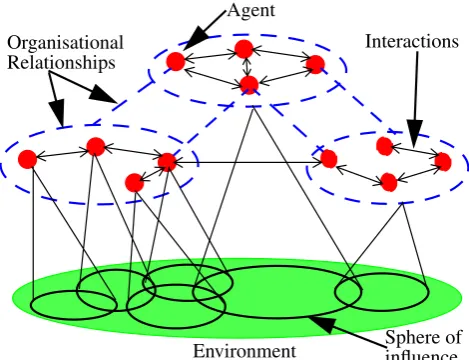
[image:2.595.310.545.522.702.2]Drawing these points together (figure 1), the essential con-cepts of agent-based computing are: agents, high level inter-actions and organisational relationships.
Figure 1: Canonical view of an agent-based system Environment Sphere ofinfluence
Agent
Interactions Organisational
3 Agent-Oriented Software Engineering
The most compelling argument that can be made for adopt-ing an agent-oriented approach to software development is to have a set of quantitative data that showed, on a standard set of software metrics, the superiority of the agent-based approach over a range of other techniques. However such data does not exist. Hence arguments must be qualitative in nature.The structure of the argument that will be used here is as follows. On one hand, there are a number of well-known techniques for tackling complexity in software. Also the nature of complex software systems is (reasonably) well understood. On the other hand, the key characteristics of the agent-based paradigm have been elucidated. Thus an argu-ment can be made by examining the degree of match between these two perspectives.
Before this argument can be made, however, the techniques for tackling complexity in software need to be introduced. Booch [1994] identifies three such tools:
• Decomposition: The most basic technique for tackling large problems is to divide them into smaller, more man-ageable chunks each of which can then be dealt with in relative isolation. This helps tackle complexity because it limits the designer’s scope; at any given instant only a portion of the problem needs to be considered.
• Abstraction:The process of defining a simplified model of the system that emphasises some of the details or properties, while suppressing others. Again, this tech-nique works because it limits the designer’s scope of interest at a given time. Attention can be focused on the salient aspects of the problem, at the expense of the less relevant details.
• Organisation1: The process of identifying and managing the inter-relationships between the various problem solving components. The ability to specify and enact organisational relationships helps designers tackle com-plexity in two ways. Firstly, by enabling a number of basic components to be grouped together and treated as a higher-level unit of analysis (e.g. the individual com-ponents of a sub-system can be treated as a single unit by the parent system). Secondly, by providing a means of describing the high-level relationships between vari-ous units (e.g. a number of components may work together to provide a particular functionality).
Next, the characteristics of complex systems need to be enu-merated [Simon, 1996]:
• Complexity frequently takes the form of a hierarchy. That is, a system that is composed of inter-related sub-systems, each of which is in turn hierarchic in structure,
until the lowest level of elementary sub-system is reached. The precise nature of these organisational rela-tionships varies between sub-systems, however some generic forms (such as client-server, peer, team, etc.) can be identified. These relationships are not static: they often vary over time.
• The choice of which components in the system are primitive is relatively arbitrary and is defined by the observer’s aims and objectives.
• Hierarchic systems evolve more quickly than non-hier-archic ones of comparable size. In other words, complex systems will evolve from simple systems more rapidly if there arestable intermediate forms, than if there are not. • It is possible to distinguish between the interactions
amongsub-systems and the interactionswithin sub-sys-tems. The latter are both more frequent (typically at least an order of magnitude more) and more predictable than the former. This gives rise to the view that complex systems arenearly decomposable: sub-systems can be treated almost as if they are independent of one another, but not quite, since there are some interactions between them. Moreover, although many of these interactions can be predicted at design time, some cannot.
With these two characterisations in place, the form of the argument can be expressed:
• Show agent-oriented decomposition is an effective way of partitioning the problem space of a complex system (section 3.1);
• Show that the key abstractions of the agent-oriented mindset are a natural means of modelling complex sys-tems (section 3.2);
• Show the agent-oriented philosophy for dealing with organisational relationships is appropriate for complex systems (section 3.3);
Having made the case that agents are well suited for engi-neering complex systems, a number of pragmatic issues that will affect whether agents catch on as a software engineering paradigm are examined (section 3.4). Finally, the downside of agent-oriented developments is discussed (section 3.5).
3.1 Merits of Agent-Oriented Decomposition
Complex systems consist of a number of related sub-systems organised in a hierarchical fashion. At any given level, sub-systems work together to achieve the functionality of their parent system. Moreover, within a sub-system, the constitu-ent componconstitu-ents work together to deliver the overall func-tionality. Thus, the same basic model of interacting components, working together to achieve particular objec-tives, occurs throughout the system.
Given this fact, it is entirely natural to modularise the com-ponents in terms of the objectives they achieve2. In other words, each component can be thought of as achieving one or more objectives. A second important observation is that 1 Booch [1994] actually uses the term “hierarchy” for this final
complex systems have multiple loci of control: “real systems have no top” [Meyer, 1988] pg 47. Applying this philosophy to objective-achieving decompositions means the individual components should localise and encapsulate their own con-trol. Thus, entities should have their own thread of control (i.e. they should be active) and they should have control over their own actions (i.e. they should be autonomous).
For the active and autonomous components to fulfil both their individual and collective objectives, they need to inter-act with one another (recall complex systems are only nearly decomposable). However the system’s inherent complexity means it is impossible to know a prioriabout all potential links: interactions will occur at unpredictable times, for unpredictable reasons, between unpredictable components. For this reason, it is futile to try and predict or analyse all the possibilities at design-time. It is more realistic to endow the components with the ability to make decisions about the nature and scope of their interactions at run-time. From this, it follows that components need the ability to initiate (and respond to) interactions in a flexible manner.
The policy of deferring to run-time decisions about compo-nent interactions facilitates the engineering of complex sys-tems in two ways. Firstly, problems associated with the coupling of components are significantly reduced (by deal-ing with them in aflexible and declarative manner). Compo-nents are specifically designed to deal with unanticipated requests and they can spontaneously generate requests for assistance if they find themselves in difficulty. Moreover because these interactions are enacted through a high-level agent communication language, coupling becomes a knowl-edge level issue. At a stroke, this removes syntactic concerns from the types of errors caused by unexpected interactions. Secondly, the problem of managing control relationships between the software components is significantly reduced. All agents are continuously active and any coordination that is required is handled bottom-up through inter-agent interac-tion. Thus, the ordering of the system’s top-level goals is no longer something that has to be rigidly prescribed at design time. Rather, it becomes something that is handled in a con-text-sensitive manner at run-time.
From this discussion, it is apparent that a natural way to modularise a complex system is in terms of multiple, inter-acting, autonomous components that have particular objec-tives to achieve. In short, agent-oriented decompositions aid the process of developing complex systems.
3.2 Suitability of Agent-Oriented Abstractions
A significant part of the design process isfinding the right models for viewing the problem. In general, there will be
multiple candidates and the difficult task is picking the most appropriate one. When designing software, the most power-ful abstractions are those that minimise the semantic distance between the units of analysis that are intuitively used to con-ceptualise the problem and the constructs present in the solu-tion paradigm. In the case of complex systems, the problem to be characterised consists of sub-systems, sub-system com-ponents, interactions and organisational relationships. Tak-ing each in turn:
• Sub-systems naturally correspond to agent organisa-tions. They involve a number of constituent components that act and interact according to their role within the larger enterprise.
• The suitability of viewing sub-system components as agents has already been made (section 3.1).
• The interplay between the sub-systems and between their constituent components is most naturally viewed in terms of high level social interactions: “at any given level of abstraction, we find meaningful collections of entities that collaborate to achieve some higher level view” [Booch, 1994] pg 34. This view accords precisely with the treatment of interaction afforded by the agent-oriented approach. Agent systems are invariably described in terms of “cooperating to achieve common objectives”, “coordinating their actions” or “negotiating to resolve conflicts”.
• Complex systems involve changing webs of relation-ships between their various components. They also require collections of components to be treated as a sin-gle conceptual unit when viewed from a different level of abstraction. Here again the agent-oriented mindset provides suitable abstractions. A rich set of structures is typically available for explicitly representing and man-aging organisational relationships. Interaction protocols exist for forming new groupings and disbanding unwanted ones. Finally, structures are available for modelling collectives. The latter point is especially use-ful in relation to representing sub-systems since they are nothing more than a team of components working together to achieve a collective goal.
3.3 Need for Flexible Management of Changing Organisational Structures
Organisational constructs arefirst-class entities in agent sys-tems. Thus explicit representations are made of organisa-tional relationships and structures. Moreover, agent-based systems have the concomitant computational mechanisms for flexibly forming, maintaining and disbanding organisa-tions. This representational power enables agent-oriented systems to exploit two facets of the nature of complex sys-tems. Firstly, the notion of a primitive component can be var-ied according to the needs of the observer. Thus at one level, entire sub-systems can be viewed as singletons, alternatively, teams or collections of agents can be viewed as primitive
2 Indeed the view that decompositions based upon functions/
components, and so on until the system eventually bottoms out. Secondly, such structures provide a variety of stable intermediate forms, that, as already indicated, are essential for the rapid development of complex systems. Their avail-ability means individual agents or organisational groupings can be developed in relative isolation and then added into the system in an incremental manner. This, in turn, ensures there is a smooth growth in functionality.
3.4 Software Engineering Pragmatics
Having made the case for an agent-oriented approach to designing and building complex systems, the next step is to determine whether it will catch on as a software engineering paradigm. This question is important because the history of computing is littered with good technologies that were never widely adopted. Two key pragmatic issues are relevant here: (i) the degree to which agents represent a radical departure from current software engineering thinking and (ii) the degree to which existing software can be integrated with agents. In general, take-up is more likely if agents are consis-tent with the trends of software engineering (evolution rather than revolution) and if legacy software can be incorporated in a straightforward and clean manner (a brownfield versus a green field scenario).
A number of trends become evident when examining the evolution of programming models from machine languages, to procedural and structured programming, to object-based and declarative programming, onto component-ware, design patterns, and software architectures. Firstly, there has been an inexorable move from languages that have their concep-tual basis determined by the underlying machine architec-ture, to languages that have their key abstractions rooted in the problem domain. Here the agent-oriented world view is perhaps the most natural way of characterising many types of problem. Just as the real-world is populated with objects that have operations performed on them, so it is equally full of active, purposeful agents that interact to achieve their objectives3. Indeed, many object-oriented analyses start from precisely this perspective: “we view the world as a set of autonomous agents that collaborate to perform some higher level function” [Booch, 1994] pg. 17. Secondly, the basic building blocks of the programming models exhibit increasing degrees of localisation and encapsulation [Paru-nak, 1999]. Agents follow this trend by localising purpose inside each agent, by giving each agent its own thread of control, and by encapsulating action selection. Thirdly, ever richer mechanisms for promoting re-use are being provided. Here, the agent view also reaches new heights. Rather than stopping at re-use of sub-system components (design pat-terns and component-ware) and rigidly pre-ordained interac-tions (application frameworks), agents enable whole sub-systems andflexible interactions to be re-used. In the former case, agent designs and implementations are re-used within
and between applications. Consider, for example, the class of agent architectures that has beliefs (what the agent knows), desires (what the agent wants) and intentions (what the agent is doing) at its core. Such Belief-Desire-Intention architec-tures have been used in a wide variety of applications includ-ing air traffic control, process control, fault diagnosis and transportation [Chaib-draa, 1995; Jennings, 1995; Jennings and Wooldridge, 1998]. In the latter case,flexible patterns of interaction such as the Contract Net Protocol (an agent with a task to complete advertises this fact to others who it believes are capable of performing it, these agents may sub-mit a bid to perform the task if they are interested, and the originator then delegates the task to the agent that makes the best bid) and various forms of resource-allocation auction (e.g. English, Dutch, Vickrey) have been re-used in signifi -cant numbers of applications. In short, agent-oriented tech-niques represent a natural progression of current software engineering thinking and, for this reason, the main concepts and tenets of the approach should be readily acceptable to software engineering practitioners.
The second factor in favour of a rapid take up of agents is that their adoption does not require a revolution in terms of an organisation’s software capabilities. Agent-oriented sys-tems are evolutionary and incremental as legacy (non-agent) software can be incorporated in a relatively straightforward manner [Jennings et al., 1993]. The technique used is to place wrapping software around the legacy code. The wrap-per presents an agent interface to the other software compo-nents and thus from the outside it looks like any other agent. On the inside, the wrapper performs a two-way translation function: taking external requests from other agents and mapping them into calls in the legacy code, and taking the legacy code’s external requests and mapping them into the appropriate set of agent communication commands. This ability to wrap legacy systems means agents may initially be
used as an integration technology. However, as new require-ments are uncovered, so bespoke agents may be developed and added. This feature enables a complex system to grow in an evolutionary fashion (based on stable intermediate forms), while adhering to the important principle that there should always be a working version of the system available.
3.5 The Downside
Having highlighted the potential benefits of agent-oriented software engineering, this sub-section seeks to pinpoint some of the inherent difficulties associated with agent-based systems. These problems are directly attributable to the char-acteristics of agent-oriented software and are, therefore, intrinsic to the approach. (These complement the more prag-matic problems that are often associated with agent-oriented projects [Wooldridge and Jennings, 1998].) Naturally, since robust and reliable agent systems have been built, designers have found means of circumventing these problems. How-ever, at this time, such solutions tend to be made on a case by case basis.
Much of the power of agents derives from the fact that they are situated problem solvers: they act in pursuit of their design objectives while maintaining an ongoing interaction with their environment. However such situatedness makes it difficult to design software capable of maintaining a balance between proactive and reactive behaviour. Leaning too much towards the former risks the agent undertaking irrelevant or infeasible tasks (as circumstances have changed). Leaning too much towards the latter means the agent may not fulfill its objectives (since it is constantly responding to short-term needs). Striking a balance requires context sensitive decision making which, in turn, means there can be a significant degree of unpredictability about which objectives the agent will pursue in which circumstances and which methods will be used to achieve the chosen objectives.
Although agent interactions represent a hitherto unseen level of sophistication andflexibility, they are also inherently unpredictable in the general case. As agents are autonomous, the patterns and the effects of their interactions are uncertain. Firstly, agents decide, for themselves at run-time, which of their objectives require interaction in a given context, which acquaintances they will interact with in order to realise these objectives, and when these interactions will occur. Hence the number, pattern and timing of interactions cannot be pre-dicted in advance. Secondly, there is a de-coupling, and a considerable degree of variability, between what one agent first requests through an interaction and how the recipient ultimately responds. The request may be immediately hon-oured as it is, refused completely, or modified through some form of social interchange. In short, both the nature (a sim-ple request versus a protracted negotiation) and the outcome of an interaction cannot be determined at the onset.
The final source of unpredictability in agent-oriented sys-tem design relates to the notion of emergent behaviour. It has
long been recognised that interactive composition—collec-tions of processes (agents) acting side-by-side and interact-ing in whatever way they have been designed to interact [Milner, 1993]—results in behavioural phenomena that can-not be deconstructed solely in terms of the behaviour of the individual components. This emergent behaviour is a conse-quence of the interaction between components. Given the sophistication andflexibility of agent interactions, it is clear that the scope for unexpected individual and group behaviour is considerable.
4 Agents for Business Process Management
This section describes an agent-based system developed for managing a British Telecom (BT) business process [Jenningset al., 1996]. The particular process is providing customers with a quote for installing a network to deliver a particular type of telecommunications service. This process has a num-ber of traits that are commonly found in corporate-wide busi-ness processes. In particular, the process is dynamic and unpredictable (it is impossible to give a complete a priori
specification of all activities), it has a high-degree of natural concurrency, and there is a need to respect departmental and organisational boundaries.
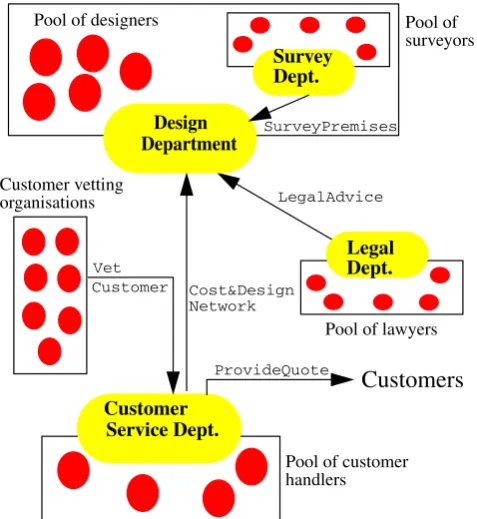
In more detail, the following departments are involved: the customer service division (CSD), the design division (DD), the surveyor department (SD), the legal division (LD) and the various organisations that provide the out-sourced ser-vice of vetting customers (VCs). The process is initiated by a customer contacting the CSD with a set of requirements. In parallel to capturing the requirements, the CSD gets the cus-tomer vetted. If the cuscus-tomer fails the vetting procedure, the quote process terminates. Assuming the customer is satisfac-tory, their requirements are mapped against the service port-folio. If they can be met by an off-the-shelf item then an immediate quote can be offered. In the case of bespoke ser-vices, however, the process is more complex. CSD further analyses the customer’s requirements and whilst this is occurring LD checks the legality of the proposed service. If the desired service is illegal, the quote process terminates. If the requested service is legal, the design phase can start. To prepare a network design it is usually necessary to dispatch a surveyor to the customer’s premises so that a detailed plan of the existing equipment can be produced. On completion of the network design and costing, DD informs CSD of the quote. CSD, in turn, informs the customer. The business pro-cess then terminates.
with one another. In this case, all interactions take the form of negotiations about which services the agents will provide to one another and under what terms and conditions [Faratin
et al., 1998]. The nature of these negotiations varies depend-ing on the context and the prevaildepend-ing circumstances: negotia-tions between BT internal agents are more cooperative than those involving external organisations, and negotiations where time is plentiful differ from those where time is short. Thus, for example, to get a customer vetted, the CSD agent negotiates (in a competitive manner) simultaneously with all the VC agents to determine which of them can perform this service the quickest. This interaction involves generating a series of proposals and counter-proposals and if it is success-ful it ultimately results in a mutually agreeable contract. Generally speaking, the flexible nature of the interactions means the negotiators can tailor their behaviour to the pre-vailing circumstances. Thus, they can both vary the amount of utility they expect from an agreement and relax their con-straints in a context dependent manner.
Thefinal system design task is to characterise the organisa-tional inter-relationships. Here, the following classes are applicable: collections of agents being grouped together as a single conceptual unit (e.g. the individual designers and law-yers in DD and LD respectively), authority relationships (e.g. the DD agent is the manager of the SD agent), peers within the same organisation (e.g. the CSD, LD, and DD
agents) and customer-subcontractor relationships (e.g. the CSD agent and the various VC agents). Explicitly represent-ing such relationships is important because it provides a means of clustering collections of agents so they can be dealt with as a single conceptual unit and because it has a signifi -cant impact on the negotiation behaviour of the participants.
5 Discussion
This paper has sought to justify the claim that agent-based computing has the potential to provide a powerful suite of metaphors, concepts and techniques for conceptualising, designing and implementing complex (distributed) systems. However, against this promise lies the perils that: (i) there is insufficient know-how about building agents that can engage inflexible social interactions; (ii) the means by which social-ity impacts upon individual and collective behaviour is not well understood; and (iii) the way in which organisational relationships impact upon the behaviour of individuals and societies needs to be clarified.
One means of tackling these fundamental issues is to fol-low an approach that proved successful in elucidating the foundational principles and structures of individual (asocial) agents. Newell’s [1982] knowledge level analysis provided the seminal characterisation of intelligent agents—it stripped away implementation and application specific details to reveal the core of asocial problem solvers. Since the aim here is to do the same for social agents, Newell’s basic approach can be re-used. Thus a new computer level needs to be defined. This level can be called the Social Level [Jennings and Campos, 1997]. It should sit immediately above the knowledge level and it should provide the social principles and foundations for agent-based systems. The primary bene-fit of developing a social level description is that it enables the overall system’s behaviour and key conceptual structures to be studied without the need to delve into the implementa-tion details of the individual agents or the specifics of partic-ular interaction protocols. Thus prediction of the behaviour of the social agents and of the overall system can be made more easily.
To this end, a preliminary version of the social level will be outlined (following Newell’s general nomenclature):
• Thesystem(the entity to be described at that level) is an agent organisation.
• Thecomponentsof an agent organisation (the primitive elements from which it is built up) are the agents them-selves and the channels through which they interact. Interactions occur because of the inherent dependencies that exist between the agents (either through the envi-ronment or as a consequence of their adopted goals) [Jennings, 1993]. Thus dependencies are also a primi-tive component. The final component is the organisa-tional relationships that hold between the agents.
[image:7.595.48.287.315.575.2]LegalAdvice
Figure 2: Agent system for managing the quote process
SurveyPremises
Pool of designers
Design Department
Survey Dept.
Pool of surveyors
Dept. Legal
Pool of customer
Service Dept. Customer
ProvideQuote
Customers
Cost&DesignNetwork
Pool of lawyers
handlers
Vet Customer
Customer vetting organisations
• Composition laws define how the components are assembled to form the system. In this case, the agents undertake particular roles in the organisation. These roles define the objectives of the agents and their organi-sational relationships, the channels through which they interact, and the patterns of their interaction. Accompa-nying the roles are the organisation’s rules that define the laid down procedures or the emergent norms. These rules specify, among other things, who can adopt which roles and under what terms and conditions, what should happen if roles are violated, and how role conflicts should be handled.
• Behaviour laws determine how the system’s behaviour depends upon its composition and on its components’ behaviour. These laws indicate how the agents within the organisation should balance their individualistic objectives with those that stem from being part of the organisation. Here no single law is universally best; rather, there is a continuous spectrum from the purely selfish to the altruistic.
• The medium is the elements the system processes to obtain the behaviour it was designed to achieve. In this case, it is the social knowledge that each agent main-tains about the agent organisation and its role therein. This includes, among other things, its social and organi-sational obligations, its mechanisms for influencing other agents and its mechanisms for altering the organi-sational structure.
References
[Booch, 1994] G. Booch. Object-oriented analysis and design with applications. Addison Wesley, 1994.
[Brooks, 1995] F. P. Brooks.The mythical man-month. Add-ison Wesley, 1995.
[Buschmann et al., 1998] F. Buschmann, R. Meunier, H. Rohnert, P. Sommerlad and M. Stahl. A System of Pat-terns.Wiley, 1998.
[Chaib-draa, 1995] B. Chaib-draa. Industrial applications of distributed AI.Comms. of ACM 38(11):47-53, 1995. [Faratin et al., 1998] P. Faratin, C. Sierra, and N. R.
Jen-nings. Negotiation Decision Functions for Autonomous Agents.Int. J. of Robotics and Autonomous Systems 24(3-4):159-182, 1998.
[Gammaet al., 1995] E. Gamma, R. Helm, R. Johnson and J. Vlissides.Design Patterns. Addison Wesley, 1995. [Jennings, 1993] N. R. Jennings. Commitments and
Conven-tions: The Foundation of Coordination in Multi-Agent Systems. The Knowledge Engineering Review 8(3):223-250, 1993.
[Jennings, 1995] N. R. Jennings. Controlling cooperative problem solving in industrial multi-agent systems. Artifi -cial Intelligence 75(2): 195-240, 1995.
[Jennings and Campos, 1997] N. R. Jennings and J. R. Cam-pos. Towards a Social Level Characterisation of Socially Responsible Agents.IEE Proc. on Software Engineering, 144(1):11-25, 1997.
[Jenningset al., 1996] N. R. Jennings, P. Faratin, M. J. John-son, T. J. Norman, P. O’Brien and M. E. Wiegand. Agent-based business process management.Int J. of Cooperative Information Systems 5(2&3):105-130, 1996.
[Jenningset al., 1993] N. R. Jennings, L. Varga, R. P. Aarnts, J. Fuchs, and P. Skarek. Transforming stand-alone expert systems into a community of cooperating agents.Int J. of Engineering Applications of AI 6(4):317-331, 1993. [Jennings and Wooldridge, 1998] N. R. Jennings and M.
Wooldridge (eds.)Agent technology: foundations, applica-tions and markets. Springer Verlag, 1998.
[Newell, 1982] A. Newell. The Knowledge Level.Artificial Intelligence 18:87-127, 1982.
[Meyer, 1988] B. Meyer.Object-oriented software construc-tion. Prentice Hall, 1988.
[Milner, 1993] R. Milner. Elements of interaction. Comms. of ACM 36(1):78-89, 1993.
[Parunak, 1999] H. V. D. Parunak. Industrial and practical applications of DAI. In G. Weiss, editor, Multi-Agent Sys-tems, MIT Press, 377-421, 1999.
[Russell and Norvig, 1995] S. Russell and P. Norvig.Artifi -cial intelligence: a modern approach. Prentice Hall, 1995. [Simon, 1996] H. A. Simon. The sciences of the artificial.
MIT Press, 1996.
[Szyperski, 1998] C. Szyperski.Component Software. Addi-son Wesley, 1998.
[Wegner, 1997] P. Wegner. Why interaction is more powerful than algorithms.Comms. of ACM 40(5):80-91, 1997. [Wooldridge, 1997] M. Wooldridge. Agent-based software
engineering. IEE Proc Software Engineering 144:26-37, 1997.
[Wooldridge and Jennings, 1995] M. Wooldridge and N. R. Jennings. Intelligent agents: theory and practice. The
Knowledge Engineering Review 10(2):115-152, 1995. [Wooldridge and Jennings, 1998] M. J. Wooldridge and N.
R. Jennings. Pitfalls of Agent-Oriented Development.