Abstract—Free and Open Source Software (FOSS) allows users to use, change, and redistribute the source code. Recent changes in the software technologies landscape involve the introduction of FOSS which presents certain benefits and freedom in the use of software that demonstrate high potential towards achieving competitive advantage by institutions of higher learning. Higher institutions of learning stand to gain the benefits in teaching, learning and research in particular by adopting FOSS. Towards determining the possibility of such gains, research efforts can be conducted using interpretive and positivist approaches. This study proposes exploration using the two approaches in the form of case study and survey so that readers can make informed choice that could lead to the development of appropriate frameworks towards addressing the research objectives.
Index Terms—Use of FOSS, research paradigms, Competitive advantage, Technological acceptance models, and use of technologies
I. INTRODUCTION
HIS study seeks to investigate suitable research paradigm for the study of the impact of the use of Free and Open Source Software (FOSS) for competitive advantage with specific reference to South African Institutions of higher learning. FOSS is referred to in this study as software available free of charge or at minimal cost and allows changes or modifications to its source codes. Sowe et al. [26] give various other terms that are used in the literature to refer to FOSS. These include: Free Software (FS); Free and Open Source Software (FOSS); Free, Libre and Open Source Software (FLOSS); and Libre Software (LS). The opposite of FOSS is Proprietary Software (PS) which is usually purchased with licenses at higher cost and changes and modifications are not allowed to the source codes. Both FOSS and PS are developed for various platforms and in different programming languages. These work together to enhance the use of Information and
Manuscript received July 23, 2013; revised August 16, 2013. This work was supported in part by the Tshwane University of Technology, South Africa and the National Research Foundation (NRF).
K. O. Dehinbo is with the Department of Informatics in the Faculty of Information, Communication and Technology, at the Tshwane University of Technology, South Africa. (phone: +27-83-929-7550; e-mail: [email protected] or [email protected] ).
J. O. Dehinbo is with the Department of Web and Multimedia Computing in the Faculty of Information, Communication and Technology, at the Tshwane University of Technology, South Africa. (phone: +27-82-259-4883; [email protected] or [email protected]).
Communication Technologies in various aspects of an organization’s business.
Apart from using Information and Communication Technology in various aspects of an organization’s business, Handzic and Zhou [14:60] argue that it is important for an organization to be able to creatively deploy ICT to gain competitive advantage. This is even more important in this era of knowledge economy where Singh [25] observes that: “to be successful in the emerging knowledge economy, new processes, skills, and techniques that help to generate, manage and handle new knowledge need to be developed and practiced by information specialists”. An example of such new processes, skills, and techniques involve the deployment of the Free and Open Source Software (FOSS) especially in areas previously predominated with the use of PS. The use of FOSS presents certain benefits and freedoms in the deployment and use of the software that seem to demonstrate high potential to enhance the impact of ICT in the society towards achieving competitive advantage by organizations.
FOSS provides free access to the use of a software as well as the opportunity and freedom to inspect, study, modify, extend and distribute the source code of the software [2], [16], [15], [26], [5]. FOSS’s advantages including lower costs and source code access are relevant to higher institutions of learning as they are in the business of uncovering knowledge and imparting such knowledge unto others. More so, most institutions rely on dwindling government funds and various cost saving measures. Furthermore, institutions have to attract quality students and staff to effectively incubate and share knowledge. They thus need competitive advantage to stand out innovatively while also having good financial standing to nurture knowledge growth. The FOSS’s freedoms in the form of cost and ability to inspect and learn from source codes towards improving such codes could contribute to such competitive advantage in the higher institutions of learning. In view of the above, it is thus surprising that many higher education institutions in South Africa are yet to utilize the full benefits of FOSS to derive competitive advantage. Reijswoud and Mulo [22] confirm this by indicating that despite its obvious advantages, FOSS is not on the agenda for many decision makers in developing countries. The question is why are these higher institutions of learning in South Africa not utilizing the full benefits of deploying FOSS for positive societal impact?
In order to enable answering the above question, this
Towards Suitable Research Paradigm for
Assessing the Impact of Free and Open Source
Software (FOSS)
Kehinde O. Dehinbo and Johnson O. Dehinbo
study seeks to explore suitable research paradigms for the study of the impact of the use of Free and Open Source Software (FOSS). Therefore, to achieve the main objective of this study, the following research questions will be addressed:
a.) To investigate the factors that could influence the adoption of FOSS in higher institutions of learning and that should therefore be taken into consideration in a study of the impact of FOSS?
b.) To investigate the benefits and challenges of FOSS in higher institutions of learning especially in the contextual situation of the South African environment?
c.) To investigate how the interpretive and positivist research paradigms can be used to study the impact of the use of FOSS for societal advantage taking root in higher institutions of learning in South Africa?
II. LITERATURE REVIEW
A. Introduction
It is important to review the related literature and discusses previous studies to provide perspectives and establish why this study is unparalleled and important, despite previous related studies. According to Wikipedia [28], a literature review is a text written by someone to consider the critical points of past and current knowledge including substantive findings as well as theoretical and methodological contributions to a particular topic. The purpose of a literature review is to: establish a theoretical framework for your topic / subject area, define key terms definitions and terminology, identify studies, models, case studies etc. supporting your topic and define / establish your area of study [28].
Various research studies have indicated the use value of information technology systems for gaining competitive advantage in the current global digital economy where competition is now global and no longer restricted locally. Bharati and Berg [3] note that one of the primary reasons why organizations are investing in Information Systems (IS) is the improvement of the quality of services which could lead to more customers profits and competitive advantage But furthermore, in this new global digital economy where users directly access services such as tax filing, e-commerce, online banking etc., the possible impact of IS to economic development and societal advantage cannot be over-emphasized. FOSS is an example of IS that can be used for such economic development and societal advantage. In the last decade, Open Source Software has been a subject of extensive research with the main focus on adoption, advantages and disadvantages [20], [1].
The main focus of this study is the research approaches that could lead to societal advantages derivable from the use of free & open source software in higher institution of learning. As a start, these would partly be derivable from the understandings in the contextual appropriation of the background, benefits and limitations of FOSS. To enable appreciation of such background, benefits and limitations of FOSS, we therefore begin with a look at the background of FOSS.
B. Background of FOSS
Ajila & Wu [2] define FOSS as the software that provides free access to the use of software as well provide the opportunity and freedom to inspect study, modify, extend and distribute the source code. Various software under the FOSS phenomena are being developed by lots of individuals free on a volunteer basis. The source code is made available for other people to use and alter which makes it very appealing for developers who do not want to build something from scratch.
It has become usual to purchase software (PS) for use while still forbidden to have access to the source code. This has started to change recently with the introduction of FOSS for personal use and even for organizational use. As highlighted earlier, Handzic and Zhou [14] argue that apart from using IT in various aspects of an organization’s business, it is important to be able to creatively use ICT for competitive advantage and even societal advantage. This is even more important in this era of knowledge economy where Singh [25] indicates that to be successful in the emerging knowledge economy, new processes, skills, and techniques that help to generate, manage and handle new knowledge need to be developed and practiced by information specialists. While these could lead to financial advantages to the organizations, the ripple effect of the know-how experience created in the process, could lead to positive societal advantages from positive changes in the software technologies landscape.
One of the recent changes in the software technologies landscape involves the introduction of the Free and Open Source Software (FOSS). Gallego et al. [12] indicate that FOSS has introduced surprising changes in the software industry thereby radically changing perspectives in development, use and distribution of software. FOSS provides free access to the use of software (without financial cost charges) as well as the opportunity (and/or freedom) to inspect, study, modify, extend and distribute the source code of the software [2], [16], [15], [26], [5].
Looking into the future, Henly and Kemp [15] observe that the scope and appeal of FOSS today shows no sign of diminishing in future. Various studies highlight varied aspects of the FOSS phenomena ranging from available licenses, its opportunities, freedoms, impacts and benefits, it’s acceptance to the risks of using FOSS. First, we highlight the benefits and limitation of FOSS.
C. Benefits of FOSS
Dravis cited in [22] observes that the most often quoted benefit of FOSS in relation to the developing world is the cost saving of buying software and reduced license cost of the software. Exorbitant money is been paid in hard currency to purchase software (PS) and renewing of their licenses. Evans and Reedy [10] as well as Mtsweni and Biermann [21] mentions cost saving as one of the rationale for FOSS adoption. Dudley-sponaugle et al. [8] indicated that FOSS poses benefits such as cost saving on buying software.
policy (Webb cited in [19]). Richter et al. [23] discovered that for many businesses, FOSS adoption is centered on value creation and that benefits not only originate only from cost but also from reliability, flexibility and higher degree of innovation and knowledge. In as much the source code is accessible, knowledgeable users can adjust software to their own taste and needs, fix bugs once they are detected and provide solution on fixing the bugs to all FOSS adopters [10].
Wong and Sayo [29] argue that Total Cost of Ownership (TCO) should be used in making comparisons between FOSS and proprietary software. Tong indicates that TCO also includes maintenance, support and training costs and these may be higher for FOSS. However, in various comparisons, the TCO for FOSS is still lower in cost than that for proprietary software. Furthermore, Russo et al. cited in [11] indicate that calculating the TCO requires consideration of many factors, including software purchase, maintenance, licensing cost, maintenance and upgrade cost, hardware purchase, personnel training and legal and administrative cost.
In essence, Lin [18] implies that for open source software to survive in an institution, basic cost advantage is not enough. However, low cost remain the main driver and primary motives for the adoption of FOSS as most users wants to reduce their costs while still concerned with any other benefits possible. And this brings about other benefits of FOSS system which include access to source code/openness, transparency etc. [6].
According to Evans and Reddy [10], FOSS promotes easy access to intellectual property and allows benefit from it being free. Since the source code is accessible publicly, experience users can adjust to their specific needs, fix bugs once detected [21].
Further demonstration of value includes non-obsolesce as FOSS can be amended instead of buying new ones. Equipment replacement on FOSS-based systems often works well on older equipment with minor modifications to the software. This leads to flexibility. Dehinbo et al. [7] indicate that flexibility and modification are few of the valuable benefits tools that can help in customization.
According to Bouras et al. [4], the fundamental difference between FOSS and proprietary programs is that FOSS programs can be changed and be redistributed by customers. This difference affects many factors, such as support options, flexibility, customizability and costs. Proprietary programs generally do not give the user the right to view, modify, and redistribute a program, and it would not make sense to ignore these vital differences especially in institutions of learning where flexibility is critical to knowledge propagation.
D. Limitations of FOSS
As mentioned above there are many benefits of FOSS for higher institutions of learning to use to gain competitive advantage leading to societal advantage. However the use of FOSS is not without limitations.Accordingly, Shaame et al.
[24] mention that few of the risks in adopting FOSS in higher institution are lack of support, renewal of licensing
costs, and ability to know the origination of a problem and be able to fix such problems. Among the disadvantages of using open source software which will be the advantages of using proprietary software, various authors mentioned poor user support, lack of documentation, fragmentation of software, lack of awareness, poor user support etc. [10], [21].
III. ALTERNATIVE RESEARCH PARADIGMS AND METHODOLOGIES
A. Introduction
In order to provide empirical answers to the research questions in section I and confirm the literature review in the previous section, this section presents the plan or the blueprint of how answers would be sought to address the research problems. This is by presenting the general design techniques and the details of how they can be specifically applied in the study. Some schools of thoughts rely on using quantitative research to answer their research questions while others use qualitative research. We find it necessary to explore both worlds. To explore and cover different possibilities, the overall research design will therefore involve both quantitative and qualitative research.
The research methods will involve elements of survey study and case study. Detailed literature study is used in the preliminary research. Preliminary research is nearly all secondary research done in the library to have a head start when it comes to doing the detailed research. This will involve searching the literature and other established bodies of knowledge to actualize the objectives.
B. Methodologies for Actualizing the Objectives
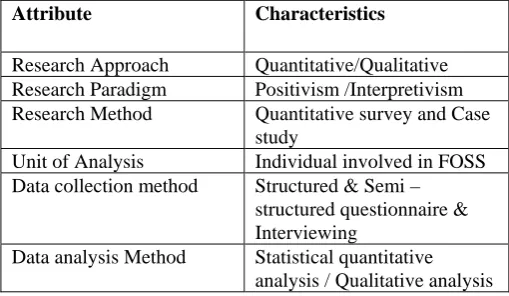
[image:3.595.299.554.557.705.2]Various methodologies usable for actualizing the objectives of the study are presented so that readers can make informed choice in related studies. A summary of the methodologies usable for actualizing the objectives of the study is given below.
TABLE I
SUMMARY OF RESEARCH METHODOLOGIES USABLE
Attribute Characteristics
Research Approach Quantitative/Qualitative Research Paradigm Positivism /Interpretivism Research Method Quantitative survey and Case
study
Unit of Analysis Individual involved in FOSS Data collection method Structured & Semi –
structured questionnaire & Interviewing
Data analysis Method Statistical quantitative analysis / Qualitative analysis
C. Case Study
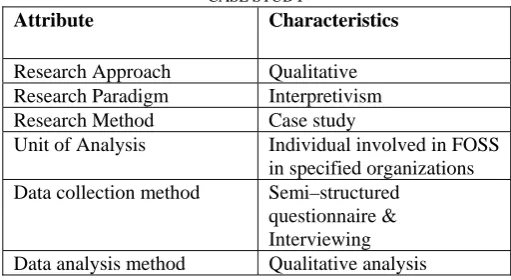
qualitatively. A summary of the case study methodologies as applicable is given below.
TABLE 2
DETAILS OF RESEARCH METHODOLOGIES USABLE FOR THE CASE STUDY
Attribute Characteristics
Research Approach Qualitative Research Paradigm Interpretivism Research Method Case study
Unit of Analysis Individual involved in FOSS in specified organizations Data collection method Semi–structured
questionnaire & Interviewing Data analysis method Qualitative analysis
The population for the case study consists of respondents responsible for using FOSS and making decisions on the deployment and use of FOSS in the computing and Information Technology fields at some South African institutions of higher learning. These involve a range of different practitioners such as given below:
IT Services managers IT Laboratory managers
Head of Departments responsible for system procurement in the academic computing laboratories
Lecturers teaching with IT application systems and programming languages
Specific users of IT application systems
This range of users is aimed at giving different perspectives. This is because different categories of workers would utilize different forms of FOSS.
Purposive sampling and snowballing sampling will be used. Leedy and Omrod [17:206] indicates that in purposive sampling, people or other units are chosen for a particular purpose while in snowballing sampling, a chosen unit will lead the researcher to other respondents. Purposive sampling is combined with snowballing sampling in this study to target known members of the population and yet allow such people to point the researcher to other people that could offer more useful information.
Preliminary research would be done on a FOSS implementation case at a University in a developing country and in a developed country (by means of literature review). Thereafter, the preliminary analysis of data could involve investigating the problems of FOSS (by means of literature review), conducting a SWOT (Strength, Weakness, Opportunities and Threats) analysis of FOSS, conducting a PESTE (Political, Economic, Social, Technology and Environmental) analysis of FOSS and conducting a PORTERS 5 analysis of FOSS. These would provide insights into the interviewing process.
It is assumed that respondents would give truthful information. It is however recognized that some information are very sensitive and respondents may shy away from such. An example relates to the cost of certain software which some respondents may not want to reveal in order to hide
possible inefficiencies in not seeking cheaper alternatives despite such huge costs.
In terms of validity and reliability, the validity and reliability implications of interpretive IS research in this situation are recognized. It is thus acknowledged that this is a subjective view but with detailed and clear context of the view.
The study is specifically delineated to the situation in South African institutions of higher learning. The detailed and clear context of the view presented could guide readers towards desired generalizations and replications of the study.
Research participants would not be exposed to any undue physical or psychological harm [17:101] as there would be no questions asked that would cause such harms. The respondent’s rights to privacy would be protected as confidentiality would be maintained [17:102]. Also, research participants can choose to remain anonymous to protect their identity.
Informed consent would be sought as the research participants would be briefed on the nature of the study to be conducted and be given the choice to either participate or not [17:101]. Furthermore, we subscribe to the idea that the findings of the study would be reported in a complete and honest fashion without misrepresentation [17:102].
D. Survey
A quantitative research approach is usable as an alternative to answer the research questions. Hypotheses are formulated. Survey methodology is usable to test the research hypotheses.
[image:4.595.40.296.112.252.2]The data will be collected using survey questionnaire to be given to the participants. The sampling from the population would be random. The analysis of the data will be done using statistical analysis packages like SPSS and SAS. Analysis to be done would include descriptive statistics like means and frequencies, correlations and regression. Details of the survey study are given below.
TABLE 3
DETAILS OF THE SURVEY RESEARCH METHODOLOGIES USABLE
Attribute Characteristics
Research Approach Quantitative Research Paradigm Positivism
Research Method Quantitative survey and Case study
Unit of Analysis Individual involved in FOSS in specified organizations Data collection method Structured & Semi –
structured questionnaire Data analysis Method Statistical quantitative
analysis
adoption and use. This powerful model allows for a contrast in behavior on the part of the user and is based on four fundamental constructs, which are perceived usefulness (PU), perceived ease of use (PEA), intention to use (IU) and usage behavior (UB).
The other related theories include the Unified theory of acceptance and use of technology (UTAUT). The theory holds that the users intentions to use a system and their usage behavior are influenced by four key constructs: performance expectancy (PE), effort expectancy (EE), social influence (SI) and facilitating conditions (FC) [6]. The above two model namely TAM and UTAUT were selected for this study.
The following constructs could be selected from TAM: perceived usefulness and perceived ease of use. And also from UTAUT, performance expectancy, social influence and facilitating conditions could be selected. Various factors identified in the literature review could be adjudged as usable to measure the various constructs. Insights into such alignment are given below.
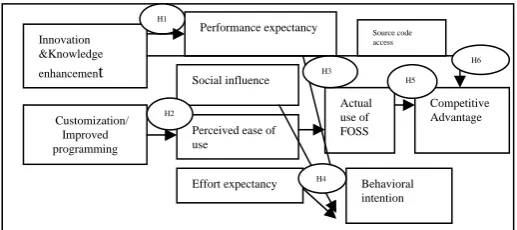
Innovation and knowledge enhancement (from source code access) advantage resulting from the re-distribution of FOSS could be used to estimate performance expectancy and perceive usefulness. Customization and flexibility leading to improved programming could be used to estimate perceived ease of use. Social influence, effort expectancy and behavioral intention could be directly requested from the respondents.
This process would culminate into the formulation of the research hypotheses. These hypotheses would then be tested statistically.
In statistics, the use of hypotheses could enable us to confirm or refute certain assumptions stated in the form of hypotheses. While the below list is not exhaustible, possible research hypotheses that could be formulated and tested include:
H1: Innovation and knowledge enhancement will have a positive influence on performance expectancy and perceive usefulness
H2: Customization and Improved programming will have positive influence on perceived ease of use
H3: Social influence and effort expectancy will have positive influence on behavioral intention
H4: Social expectancy, effort expectancy and perceived ease of use will have positive influence on behavioral intention H5: There is a positive relationship between innovation & knowledge enhancement (from source code access) advantage resulting from the re-distribution of FOSS and competitive advantage resulting from the use of FOS from the use of FOSS.
[image:5.595.305.564.79.194.2]It is generally believed that diagrams depicts more clearly than texts. Therefore, the possible hypotheses are represented on a conceptual model diagram in figure 1 below.
Fig 1: Proposed conceptual framework and Research hypotheses
IV. CONCLUSION
The essence of this study seeks to investigate suitable research paradigms for the study of the impact of the use of Free and Open Source Software (FOSS) for competitive advantage with specific reference to South African Institutions of higher learning. Interpretive and positivist research paradigms are presented as approaches to study the impact of the use of FOSS for societal advantage taking root from higher institutions of learning in South Africa. It is envisaged that the series of research efforts presented could assist to unravel explorations towards arriving at the goal of competitive advantage in organizations and societal advantage in general.
ACKNOWLEDGMENT
The author would like to acknowledge and thank Prof. G.E.M. Ditsa for his guidance on this study. Various other people that provided assistance in one form or the other are also acknowledged and appreciated.
REFERENCES
[1] P. J. Agerfalk, A. Deverell, B. Fitzgerald, and L. Morgan, “Assessing the Role of Open Source Software in the European Secondary Software Sector: A voice from Industry”, In: Proceedings of the first international conference on Open Source systems, Genova, Italy, 2005.
[2] S. A. Ajila, and D. Wu, “Empirical study of the effects of open source adoption on software development economics”, Journal of Systems and Software, vol. 80, no. 1, pp. 1517-1529, 2007.
[3] P. Bharati, and D. Berg, “Managing information systems for service quality: a study from the other side”, Information Technology & People, vol 16, no. 2, pp. 183-198, 2003.
[4] C. Bouras, V. Kokkinos, and G. Tseliou, “Selecting between open
source and proprietary software”, The public administrators’ case, 2002.
[5] D. Cerri, and A. Fuggetta, “Open standards, open formats and open software”, Journal of Systems and Software, vol.80, no.1, pp. 1930-1937, 2007.
[6] F. D. Davis, “Perceived usefulness, perceived ease of use, and user acceptance of information technology”, MIS Quarterly, vol.13, no.3, pp. 319-340, 1989.
[7] K. Dehinbo, P. Pretorius, and J. Dehinbo, “Strategic Analysis towards deriving competitive advantage with the use of FOSS: the case of a South African University, In: Proceedings of the Information Technology New Generations conference, Las Vegas, April 2012. [8] A. Dudley-Sponaugle, S. Hong, and Y. Wang, “The
Social-Economical impact of OSS in developing countries”, Handbook of Research on Open Source Software, pp.102-113, 2007
Social influence
Perceived ease of use
Performance expectancy
Effort expectancy Innovation
&Knowledge
enhancement
Customization/ Improved programming
Actual use of FOSS
Competitive Advantage
Behavioral intention H1
H2
H3
H4
[9] Y. Engestrom, “Expansive Learning at work: toward an activity theoretical re-conceptualization”, Journal of Education and Work, vol. 14, no.1, pp.132 – 156, 2001.
[10] D. S. Evans, and B. J. Reddy, “Government preference for promoting open source software: a solution in search of a problem”, Michigan Telecommunication and Technology Law review, vol 9, 2003 Retrieved 29.08.2009 from http://www.mittlr.org/volnine/evans.pdf [11] B. Fitzgerald, “The transformation of Open Source Software”, MIS
Quarterly, vol. 30, no. 3, pp. 587-598, 2006.
[12] M. D. Gallego, P. Luna, and S. Bueno, “User Acceptance Model of Open Source Software”, Computers in Human behavior, vol. 45, pp.501-517, 2007.
[13] GOVERNMENT INFORMATION TECHNOLOGY OFFICERS’ COUNCIL – GITOC, “Using open-source software in the South African government: a proposed strategy compiled by GITOC”, 2003. [Online]. Available from: http://www.oss.gov.za [Accessed: 16/04/2011].
[14] M. Handzic and A. Z. Zhou, “Knowledge management: an integrative approach”, Oxford: Chandos, 2005.
[15] M. Henley and R. Kemp, “Open Source Software: an introduction. Computer Law & Security Report”, vol. 24, pp. 77-85, 2008. [16] G. Krogh and S. Spaeth, “The open source software phenomenon:
characteristics that promote research”, Journal of Strategic Information Systems, vol. 16, pp. 236-253. 2007.
[17] P. D. Leedy and J. E. Ormrod, “Practical Research: Planning and Design”, 7th edition. USA : Merrill Prentice Hall, 2001.
[18] Y. Lin and E. Zini, “Free/libre open source software implementation in schools: evidence from the field and implications for the future”, Computers & Education, vol. 50, pp.1092-1102, 2008.
[19] L. Moolman, “A characterisation of Open Source Software adoption decisions in South African organisations”, Doctoral dissertation, University of Stellenbosch, 2011.
[20] L. Morgan, and P. Finnegan, “How perception of Open source software influence Adoption: An exploratory study,” in Proc. 15th
European conference on Information systems, St Gallen Switzerland, 2007.
[21] J. Mtsweni, and E. Biermann, “An investigation into implementation of open source software within the SA government: An emerging expansion model”, in Proc. annual research conference of the South African Institute of Computer Scientists and Information Technologists on IT research in developing countries: riding the wave of technology, Wilderness Garden Route, South Africa, 2008, pp. 148-158.
[22] V. Reijswoud, and E. MULO, “Applying Open source software in a development context: expectations and experiences. A case study of a University in Uganda”, E-Learning, vol. 3, pp. 361-372, 2006. [23] D. Richter, 2009. “A comparative Analysis of Open Source usage in
Germany, Brazil and India”, In: Proceedings of the fourth International Conference on Computer Science and Convergence Information Technology (ICCIT’09), pp. 1403-1410, Seoul, South Korea, November 2009.
[24] A. Shaame, K. Shanmugam, and A. Dehghantanha, “An educational framework for free and open source software”, International Journal of Innovation Management and Technology, vol. 4, no. 1, pp.348-355, 2003.
[25] S. P. Singh, “What are we managing – knowledge or information?”, VINE: The Journal of Information and Knowledge Management Systems, vol. 37, no. 2, pp. 169 – 179.
[26] K. S. Sowe, I. Stamelos, and L. Angelis, “Understanding knowledge sharing activities in free/open source software projects: an empirical study”, Journal of Systems and Software, vol. 81, pp. 431-446, 2008. [27] K. Ven, and H. Mannaert, “Challenges and strategies in the use of
Open source software by Independent Software vendors”, Information and Software Technology, vol. 21, pp. 410-452, 2007. [28] Wikipedia, “Literature review from the free encyclopedia”, [Online]
Available from: http://en.wikipedia.org/wiki/Literature_review [Accessed: 16/08/2013].