A User and NLP-Assisted Strategic Workflow for a
Social Semantic OWL 2-Based Knowledge Platform
Abstract
Originating from a multidisciplinary research project that gathers, around the Semantic Web standards and principles, Social Networking and Natural Language Processing along with some Bioinformatics notions, this paper sheds the light on some of the most critical aspects of the correspondingly adopted framework and real-time knowledge architecture and modeling platform. It recognizes the considerable profits of an appropriate fusion between the aforementioned disciplines, especially via the proper exploitation of OWL 2 (Web Ontology Language) features and novelties, typically OWL 2 language profiles. Accordingly, it proposes a distinctive workflow with well-defined strategies for an ontology-aware user and NLP-assisted flexible and multidimensional approach for the management of the abundantly available Social data. Application scenarios related to awareness and orientation recommender systems based on biomedical domain ontologies for childhood obesity prevention and surveillance are explored as typical proof of concept application areas.
1 Introduction
In parallel with the Semantic Web's extremely active research community lies a continuous and exceptionally rising propagation of the Social Web. A remarkable advancement can be made if
a proper methodology for maximizing the cooperation between the two webs can be set. Such a methodology should highly encourage the first Web to bring in its theories and formalisms to the second, in exchange for some of the latter's popularity and proliferation.
An amplified fusion between the Social and the Semantic Webs is indeed a strongly beneficial achievement to both disciplines. It shall solve the foremost problems undergone by each of them, yielding an outcome that by far surpasses the sum of its individual components by endorsing automation, standardization and interoperability, promoting efficient information extraction, querying and aggregations, and providing valuable large data sets to feed the Semantic Web applications from the abundant social networking Web 2.0 sites (SNS). These sites will successively benefit from Semantic Web applications to generate semantically-rich data, and an overall reflection of the henceforth strongly formalized Social Web's network effect on the Semantic Web, boosting its formerly limited usage (Breslin et al., 2009).
By delving into the Semantic Web's main achievements for Social Networking (SN), this research notices a lack in those involving the Semantic Web's advanced findings and relatively complicated vocabularies and grammars, particularly in the endeavors related to OWL 2 (Web Ontology Language) novelties. In addition, it recognizes the major limitations and concerns related to complexity and accuracy when dealing Jinan El-Hachem
Engineering & Computer Science Department Concordia University
Montreal, Quebec, Canada
Volker Haarslev
Engineering & Computer Science Department Concordia University
Montreal, Quebec, Canada
with ontology-aware Natural Language Processing for large amounts of data.
As a consequence, it proposes a promising flexible and multidimensional user and NLP-assisted workflow for social data management encompassing different strategies varying according to prerequisite constraints and concerns. The proposed workflow is highlighted as part of a knowledge architecture and modeling platform that in addition to its possible incorporation of previous efforts, includes formal methods and models for more advanced Semantic Web accomplishments in support of SN.
The paper thus introduces a backbone knowledge base repository while laying a particular emphasis on an anticipated "meta-semantics" model, revealing the numerous advantages it offers such as its particular language and fragment projection capabilities and the considerably gained flexibility whilst addressing a favorable application area along with appropriate corresponding profile reasoning facilities.
Furthermore, the suggested innovative policy for applying ontology-aware pattern-matching grammars for natural language processing, recommends a layered approach that considers preconditioned concerns and constraints to loosen or restrict text parsing procedures. On the other hand, it confers a Web 2.0 user collaboration novelty residing in promoting SN users "rule tagging" assignments that are initiated on account of domain-specific semantic arrangements in the knowledge base repository. This optional user intervention feature determines the semi-automatic as opposed to the fully automatic adopted strategy.
The overall initiative leads to valuable and fruitful foundations of semantically engineered social data for efficient decision support and recommender systems.
Conversely, data and methodologies for relevant application scenarios aiming at awareness and orientation recommender systems based on biomedical domain ontologies are provided to support the different endeavors and provide typical proof of concept application areas.
Following is a summary of the key contributions:
• Highlights on the critical aspects of an
inclusive approach and framework for a knowledge architecture and modeling
platform, in its comprised layers and methodologies
• A flexible and multi-dimensional social
data management strategy
• An analysis of the proposed strategy's sub-approaches encompassing a crucial NLP component
• A description and emphasis on the user's
role in assigning "semantic rule tags".
The rest of this paper is organized as follows: in the next section, we provide an overview of some of the related background work. Section 3 presents a very brief overview of the enclosing knowledge framework and platform; in Section 4, the user and NLP-assisted workflow is portrayed and analyzed; Section 5 exposes OWL 2-supported demonstrating scenarios that endow with recommender systems based on an ontology for childhood obesity surveillance. We finally wrap up with a conclusions section that comprises a closing discussion and highlights on future work.
2 Contextual Background Overview
Description Logics (DL) are a family of knowledge representation languages (Baader et al., 2006) having building blocks consisting of three kinds of entities: concepts, roles and individual names. A DL ontology consists of statements called axioms formed based on the different types of entities and separated into three groups: the set of terminological axioms TBox, assertional axioms ABox, and relational axioms RBox.
While the NLP-related background work will be progressively presented in its related Section 4, we will provide herein some general background information related to OWL 2 novelties on the one hand, and to the main relevant Semantic Web realizations for the Social Web on the other.
2.1 OWL 2 and Description Logics Concepts
mostly be referred to across different sections in this paper.
OWL 2 Profiles (also known as tractable fragments are "trimmed-down" versions of OWL 2 DL; they are the result of a simple trade between all-inclusive expressivity and efficient reasoning. Every fragment addresses a favorable application area; it is therefore essential to identify the target scenario in order to apply the accordingly most favorable profile. In terms of reasoning engines, the regular OWL 2 reasoners are applicable; however, more capable specifically designed ones based on every fragment's constructs have been built.
The main profiles presented for OWL 2 are:
• OWL 2 EL: conceived for the reasoning over large-scale ontologies based on the EL++ family of description logics (Baader et al., 2005). This profile offers OWL's expressive features required by large-scale ontologies such as the "Systemised Nomenclature of Medicine - Clinical Terms" (SNOMED-CT) renowned ontology1
.
• OWL 2 QL: enabling conjunctive
queries' satisfiability based on the DL-Lite family of description logics (Calvanese et al., 2007), conceived specifically for reasoning with large amounts of data organized consistently with relatively simple schemata.
• OWL 2 RL: a forward-chaining rule
processing system supporting conjunctive rules and relying on a rule-based description logics fragment (Grosof et al., 2003) and on parts of OWL Full rule-based implementations (ter Horst, 2005).
2.2 Social Semantic Web Efforts and Ontologies
The main efforts undergone based on a cooperation between the Semantic and the Social Webs have yielded a vast number of interesting SN specifications, ontologies and projects. Some of the main contributions that our framework is set to be compatible with, to reuse and/or extend, are summarized next:
• The Semantically Interlinked Online
Community (SIOC2
) initiative presents an ontology for representing user activities in blogs and forums, thus
1 www.ihtsdo.org/snomed-ct
2www.sioc-project.org
increasing the integration of the information in online communities. SIOC is a description of online-community information. It offers a means to represent "rich data" from the Social Web in RDF (Bojars et al., 2008).
• The Friend-of-a-Friend (FOAF3) is an
ontology for describing people along with their relationships. FOAF can be integrated with other Semantic Web vocabularies and has been established as the most broadly used domain ontology on the semantic web (Miller and Brickley, 2010).
• The Meaning of a Tag (MOAT 4 )
framework allows the association of tags to semantics, via linking them to knowledge base URIs such as DBpedia (Auer et al., 2007), GeoNames5
, etc. (Passant and Laublet, 2008).
3 Introducing the Overall Framework
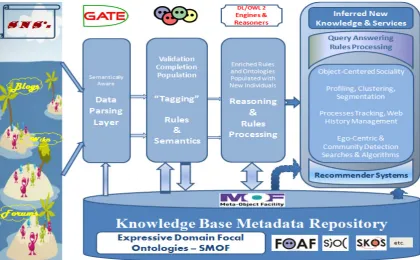
The various efforts described in this paper are all enfolded in an already conceptualized framework for a knowledge architecture and modeling platform that we briefly present herein. Figure 1 provides a high level depiction of its main flow, components and layers.
Having as its core aim the extension of the cooperation between the Social and the Semantic Webs via an underlined use of highly developed and expressive Description Logics-based languages - namely OWL 2, this framework comprises: a knowledge base repository to hold the ontological data, rules and axioms, including specialized domain ontologies, and previously defined social semantic ones; a user and natural language processing-assisted approach to parse and detect semantics from SN Website data (to be explored in the next section), as well as dedicated reasoning capabilities to offer a variety of knowledge and information system services and facilities. Typical reasoning services, typically elucidated in (Baader et al., 2006), like classification and subsumption, satisfiability and instance checking, inference discovery and query answering, rule validation and processing, are the means by which the outcome decision support systems capabilities are attainable. The backbone repository (based on the Semantic Meta-Object-Facility, SMOF (OMG, 2010), another OWL 2
3www.foaf-project.org
4www.moat-project.org
Figure 1- Knowledge-based Architecture and Modeling Platform General Overview
feature) also holds dedicated structures known as meta-semantics structures; they play a crucial role in sorting and grouping the different axioms in the knowledge base, to later allow automatic scaling or downscaling between the OWL 2 sublanguages having varying levels of expressivity. Algorithms and methods that allow this categorization procedure are beyond the scope of this paper, but it is worth noting that this process will have an important impact at the different platforms' levels, notably the NLP-based social data management and ontology population workflow that forms the spotlight of this manuscript.
4 Proposed User and NLP-Assisted Ontology Population Workflow
The proposed strategy that will allow the generation of semantic annotations and the consequent ontological data population is next explored. In a few words, it is a multidimensional and flexible user and NLP-assisted approach relying on SN data constraints and knowledge based prerequisites for automatic or at least semi-automatic domain specific expressive ontology population.
4.1 Online Social Data Sources and NLP Background
The different Web 2.0 platforms such as Twitter6, Facebook7, LinkedIn8, as well as conventional Web logs (blogs), wikis and forums websites all form adequate sources of online SN data to be exploited by our framework, but surely with different levels of availability. Throughout our explored overall framework, we mostly rely on blog and forum posts, due to their accessibility facilities.
The data parsing layer targeting semantic information extraction from the available SN data is based on GATE (the General Architecture for Text Engineering) (Cunningham, 2002). GATE has rapidly grown and evolved to turn into one of the most mature NLP platforms. GATE's effectiveness in ontology-aware language processing has already been demonstrated within several studies and projects, such as KIM9, a platform for Information Extraction using GATE and targeting large-scale semantic annotation and ontology population based on the PROTON 10 lightweight ontology.
6
www.twitter.com
7
www.facebook.com
8
www.linkedin.com
9
www.ontotext.com/kim
10
Some efforts are even directed at more expressive OWL-DL support (Witte et al., 2010). In the scope of our framework, we exploit similar efforts, we further follow our proposed workflow strategy and as a consequence, we reach an automatic or at least semi-automatic creation of the semantic annotations that accordingly lead to the population of our expressive domain ontologies with data compatible with existing relevant SN ontologies (FOAF11, SIOC12, etc.).
4.2 User and NLP-Assisted Workflow for Social Data Management
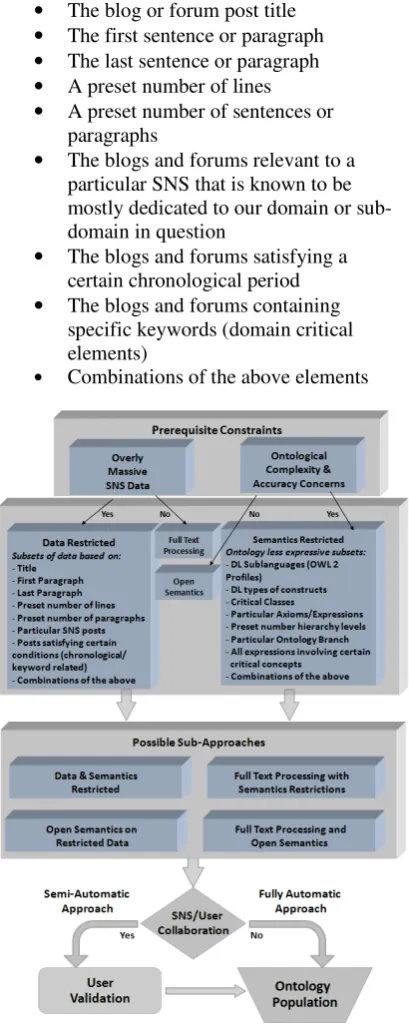
In an ideal situation, a straightforward fully automatic ontology population with instances assigned based on the ontology-aware NLP grammars allows the populated ontology to be readily exploitable by the different OWL reasoners. Constraints and considerations related to the length of the massive social data in question, as well as to the level of expressivity and complexity of the ontology's semantics stimulates the conceptualization and adoption of a more flexible and beneficial strategy and workflow, illustrated in Figure 2, that aims at overcoming or at least limiting the different constraints' significance.
As a particular processing aspect that is proper to our overall previously described framework, a more progressive role held by the SN User is highlighted. A user is accordingly encouraged to explicitly authenticate and even communicate meaningful expressive rules based on provided suggestions. We describe such a role with the terminology of "rules tagging" assignment, enthused by the different SN tagging systems - for instance Flickr13 and Del.icio.us14 - that make it possible for users to tag their photos, documents and webpages with simple descriptive taxonomies.
For a more comprehensive interpretation of Figure 2, we start by considering the main constraints to be taken into account a priori, those being the concerns related to the amount of data to be processed, and the complexity of the ontology grammar.
Unless the availability of massive amounts of data to handle is not deemed problematic,
11
www.foaf-project.org
12
www.sioc-project.org
13
www.flickr.com
14
http://www.delicious.com/
predefined mostly impacting subsets of the original data can be arranged in accordance with:
• The blog or forum post title • The first sentence or paragraph • The last sentence or paragraph • A preset number of lines • A preset number of sentences or
paragraphs
• The blogs and forums relevant to a
particular SNS that is known to be mostly dedicated to our domain or sub-domain in question
• The blogs and forums satisfying a certain chronological period
• The blogs and forums containing specific keywords (domain critical elements)
[image:5.595.306.511.118.632.2]• Combinations of the above elements
Figure 2: Workflow Illustration
• DL particular less expressive
sublanguages, typically the OWL 2 profiles already introduced
• DL specific types of constructs,
assessed as mostly critical for the global flow
• Most significant ontology classes or concepts
• Particular key axioms or expressions • Preset number of levels to go deep in
the ontology hierarchy
• A particular branch or set of branches in
the ontology hierarchy
• The set of axioms and expressions relevant to certain given concept/s
• Proper combinations of the above To note that all these conditions and strategies are made possible through the backbone repository's already introduced "meta-semantics" structures.
As a result of all the above, and based on the presented inputs, constraints and limitations, different scenarios can be arranged, and we end up with one of four "possible sub-approaches" as denoted in the illustration:
• Full text processing and open semantics
approach, which encompasses thorough analysis and semantic matching covering complicated rules and grammars, which increases implementation complexity, performance and accuracy concerns.
• Open semantics on restricted data approach, in which the originally large amount of data to be processed is minimized.
• Full text processing with semantics
restrictions approach, in which we can afford managing large amounts of data, but require a low degree of development complexity, and correspondingly a high accuracy of the attained results.
• Data and semantics restricted approach,
which minimizes the large amounts of processable data, as well as performance and accuracy concerns.
These defined NLP-assisted approaches have corresponding meta structures in our metadata repository. Such structures retain information related to the source data's SNS Web 2.0 platforms, to their related conditions and parameters for data and semantics restrictions.
Having reached this stage, the availability or absence of the SNS user collaboration will determine whether the overall strategy towards ontology population is fully or semi automatic. Back to the role of the user in his "rule tagging" assignment, and to lay more emphasis on this role, we highlight the provisional output resulting from the described NLP strategy, which mainly consists of constructed templates of preliminary non-validated sets of semantics, including identity relations and rules, thus made available in a user friendly questionnaire form to optionally confirm, correct or even add more expressive axioms and details. Although not mandatory, this semi-automatic approach that includes a user intervention is deemed extremely advantageous, especially for the open semantics case where the available NLP technology has severe restrictions upon dealing with somewhat complex and expressive vocabularies and ontologies. Nevertheless, it is the overall flexibility provided at both the data and semantics level that will limit the accuracy concerns encountered in traditional NLP approaches.
5 Proof of Concept and Application Scenarios
Our efforts are being carried out under the scope of parents' awareness and orientation. Useful SNS data sources typically beneficial for our domain are "Mom Bloggers". While these sites are extremely active and abundant, most of our data is extracted based on Babycenter15 (which alone counts more than 20 million users), Canada Moms Blog16, Raising Children Network17, among others.
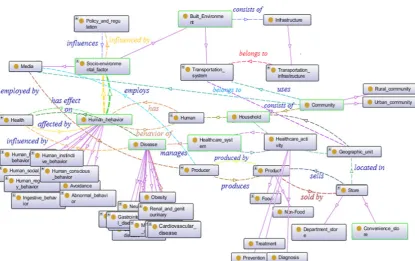
As part of the Brain-to-Society (BtS) (Dubé et al., 2008) research endeavors that call for a whole-of-society (WoS) transformation, centered on the indivudual, the Childhood Obesity [Knowledge] Enterprise (COPE) ontology was conceived (Shaban-Nejad et al., 2011) with the aim of allowing cross-sectional analysis of the obesity domain and consequently generating both generic and customized preventive recommendations. Figure 3 depicts an OntoGraf18 visualization of a partial view of its major concepts and relationships.
15
www.babycenter.com
16
www.canadamomsblog.com
17
www. raisingchildren.net.au
18
COPE’s data sources (mainly relevant to TBox and RBox ontological data, apart from the assertional ABox data generated from our ontology population workflow) are: RAMQ19, Canadian Community Health Survey (CCHS20) (population health database), CARTaGENE21, which offer information on medical history, genealogical data, lifestyles, etc..
The COPE ontology was extended and enriched with OWL 2 constructs to maximize its richness and expressivity and be able to take advantage of different language projection and reasoning facilities provided by our real-time knowledge architecture and modeling platform. It has hence served as a source for our semantically aware NLP grammars and Information Extraction algorithms.
To concretize a possible approach from the already proposed strategic workflow (the data and semantics restricted approach), a hybrid methodology that considers the full ontological data related to childhood obesity risks for posts reported in 2012, performs a first phase of processing in which the filtering of all textual data compliant with the specified data restrictions occurs, and then proceeds to the remaining detailed semantics-based analysis.
19 Régie de l'assurance maladie du Québec:
http://www.ramq.gouv.qc.ca/index_en.shtml 20 Canadian Community Health Survey (CCHS):
http://www.statcan.gc.ca/concepts/health-sante/index-eng.htm
21 http://www.cartagene.qc.ca/index.php?lang=english
Table 1 below provides sample generated semantics (represented in DL axioms) along with their contextual natural language interpretation.
DL Axiom Possible Interpretation ∃hasRegulatoryDietGoal.Self User has a goal/plan to go
on a diet
∃hasDaughter.hasAge(6 m) User is a parent of a 6 months-old baby
∀hasChild.Overweight All user's children are
overweight ∃experienceProblem
(Fatigue ⊓ AbdominalPain)
Is experiencing health problems consisting in fatigue and abdominal pain
livesIn(MarySt,Grimbsy) MarySt lives in Grimbsy
Table 1: Illustrated sample semantics with their contextual natural language interpretation
The rest of the flow depends on an optional user validation phase that will precede the population of our knowledge base with the detected ABox assertional data. Interoperability is ensured through an established link between detected individuals and existing FOAF users within the SIOC communities.
[image:7.595.97.513.70.331.2]and fragments, target advanced and powerful reasoners and rule engines. For example, Pellet (Sirin et al., 2007) can handle OWL 2 DL and RL, RacerPro (Haarslev and Möller, 2001; Haarslev et al., 2008) can manage a subset OWL 2 DL and OWL 2 EL, HermiT (Motik et al., 2007) and FacT++ (Tsarkov et al., 2006) can cope with OWL 2 DL. On the other hand, the Jena framework (2007) and the database Oracle 11g enable the processing of OWL 2 RL rules, whereas Quill (Thomas and Pan, 2009) a TrOWL (Thomas et al., 2010) component provide OWL 2 QL querying capabilities.
6 Conclusions
Apart from providing a maximal set of consistent and accurate semantics, fostering such a user and NLP-assisted workflow can prove to be advantageous at many levels. We can underline a few extra issues, by considering for example the "Open World Assumption" which is evidently appropriate for the context of textual blog information dealt with in this research: a statement or fact not explicitly mentioned in a blog does not disprove its existence. Nevertheless, to deal with certain critical rules and axioms, for which the availability of accurate data is deemed much more valuable for our working framework, an exclusive approach can be embraced in order to possibly "close the world" related to these critical facts. Closing axioms can be identified in our backbone repository, and presented to the user, inviting them to key in their exact input. Furthermore, the intensional reasoning required in any application involving natural language processing presents DL-safety restrictions, due to conclusions referring to unnamed objects. By offering this user rule tagging facility, we can limit the effects of such constraints. In all cases, relying on a collective effort through which rules and semantics are gathered and validated, before becoming instance and ontology enrichment elements is a much more profitable and effective approach.
A well-populated knowledge base, henceforth enriched with semantically engineered social data, is consequently accessible for further extensive reasoning and analysis. The outcome reached surpasses by far the sum of its social and semantic data components, typically leading to significant services and recommender systems.
Taking into consideration the applicable involved reasoning, the opportunity of identifying, creating and expanding social and semantic networks is presented. Implemented algorithms allow opinion mining, detection of ties and similarities between people, leading to connections via shared interests or any possible common ground areas. For instance, semantic networks are initiated based on the algorithms' ability to retrieve people with same or similar goals, tastes, origins, backgrounds, etc., and to further apply advanced reasoning with the intention of providing suggestions, recommendations, possible solutions, feedbacks, openings, and so on. More straightforward Web Social Networks can be deduced through the users' joint actions and interactions, their created, commented upon, linked to, or similarly annotated contents.
Many aspects of the conclusions and findings will thus be related to the concept of "object-centered sociality", which connects people via the common interests associated with their occupations, hobbies, jobs, etc.
Analogous features accessible through this semantically engineered social data and possibly serving the purposes of recommender systems include the ability to perform:
• User profiling, clustering and segmentation based on certain traits and criteria, all of which are endeavors considered closely related to opinion mining undertakings
• Tracking processes to identify a user’s
Web history from different Web 2.0 platforms, outlining this user’s general overall contributions to the Web and reporting their different activities, goals and problems
• Improved quality of the search process,
with ego-centric algorithms and searches to identify a key user’s associated or closely related nodes, as well as community detection algorithms to trace two or more key users’ surrounding community
References
A. Passant, P. Laublet. Meaning Of A Tag: A collaborative approach to bridge the gap between tagging and Linked Data. In Proceedings of the WWW2008 Workshop Linked Data on the Web (LDOW2008), Beijing, China, Apr 2008
A. Shaban-Nejad, D. Buckeridge, D, L. Dubé, COPE: Childhood Obesity Prevention [Knowledge] Enterprise. in Proceedings of AIME 2011, pp. 225-229
B. Grosof, I. Horrocks, R. Volz, S. Decker, Description Logic Programs: Combining Logic Programs with Description Logic, In Proceedings of the 12th Int. World Wide Web Conference (WWW 2003), Budapest, Hungary, 2003
B.Motik, R. Shearer, I. Horrocks, Optimized reasoning in description logics using hypertableaux, in: CADE-07, 2007
D. Calvanese, G.D. Giacomo, D. Lembo, M. Lenzerini, R. Rosati, Tractable reasoning and efficient query answering in description logics: the DL-Lite family, Journal of Automated Reasoning, vol.9, pp. 385-429, 2007
D. Tsarkov, I. Horrocks, FaCT++ description logic reasoner: system description, In Proceedings of the IJCAR 2006, Seattle,WA, USA, 2006
D. Miller, D. Brickley, FOAF Vocabulary Specification, Friend of a Friend Project, http://xmlns.com/foaf/0.1/, 9 August 2010
E. Sirin, B. Parsia, B.C. Grau, A. Kalyanpur, Y. Katz, Pellet: a practical OWL-DL reasoner, Journal of Web Semantics, vol. 5, no. 2, pp. 51-53, 2007
E. Thomas, J. Z. Pan, R-Quill: Reasoning with a Billion Triples, In 8th International Semantic Web Conference (ISWC2009), 2009.
E. Thomas, J. Pan, and Y. Ren, TrOWL: Tractable OWL 2 Reasoning Infrastructure, In Proceedings of the Extended Semantic Web Conference. Springer, 2010
F. Baader, S. Brandt, C. Lutz, Pushing the EL envelope, In Proceedings of the IJCAI 2005, 2005
F. Baader, D. Calvanese, D.L. McGuinness, D. Nardi, P.F. Patel-Schneider, The Description Logic Handbook: Theory, Implementation and Applications, Cambridge University Press, 2006.
H. Cunningham, GATE, a General Architecture for Text Engineering, Journal of Computers and the Humanities, vol. 36, pp. 223-254, 2002
H. J. ter Horst, Completeness, decidability and complexity of entailment for RDF Schema and a semantic extension involving the OWL vocabulary, The Journal of Web Semantics, vol. 3, no.2-3, pp. 79-115, 2005
J.G. Breslin, A. Passant, S. Decker, The Social Semantic Web, Springer, October 2009
Jena - A Semantic Web Framework for Java, URL: http://jena.sourceforge.net, 2007
Object Management Group OMG, MOF Support for Semantic Structures (SMOF) Revised Joint Submission, OMG Document formal/2010-08-06, http://www.omg.org/spec/SMOF/1.0/Source/10-08-06.pdf, 2010
R. Witte, N. Khamis, J. Rilling. Flexible Ontology Population from Text: The OwlExporter, The Seventh International Conference on Language Resources and Evaluation (LREC 2010), pp.3845-3850, May 19-21, 2010, Valletta, Malta.
Systemised Nomenclature of Medicine - Clinical
Terms (SNOMED-CT), URL:
http://www.ihtsdo.org/snomed-ct/
S. Auer, C. Bizer, G. Kobilarov, J. Lehmann, R. Cyganiak, and Z. Ives, DBpedia: A Nucleus for a Web of Open Data. 6th International Semantic Web Conference, November 2007
The KIM Platform, URL:
http://www.ontotext.com/kim/
The PROTON Ontology, URL:
http://proton.semanticweb.org
U. Bojars, J.G. Breslin, V. Peristeras, G. Tummarello, S. Decker, Interlinking the Social Web with Semantics, IEEE Intelligent Systems, vol. 23, no. 3, pp. 29-40, 13 May 2008
V. Haarslev, R. Möller, RACER system description, in Proceedings of the IJCAR 2001, Siena, Italy, 2001.
V. Haarslev, R. Möller, and S. Wandelt, The revival of structural subsumption in tableau-based description logic reasoners, In Proceedings of the 2008 International Workshop on Description Logics, 2008.