pantone 138
pantone 527
Findings 3
Key Messages
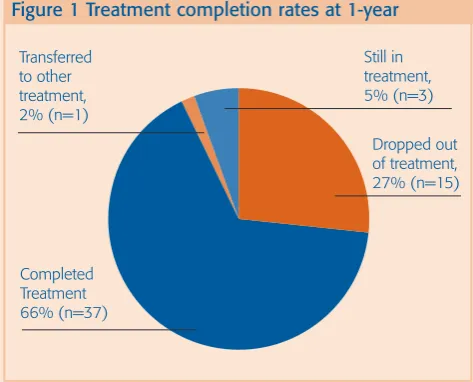
l Two-thirds of participants (66%) completed their index abstinence-based
treatment programme; 27% dropped out before programme completion.
l Only 11% of individuals recruited within the abstinence modality were
female.
l Abstinence from all drugs (including prescribed methadone and
excluding alcohol) increased from 18% at treatment intake to 41% at 1-year.
l Cannabis was the only target drug where no reductions in the numbers reporting use at treatment intake and 1-year were observed.
l The most substantial reductions over the follow-up period was in participants’ cocaine use, in terms of the proportions reporting use, the frequency of use and quantities consumed.
l Levels of involvement in crime reduced across six of the 12 categories
of offences.
l Improvements were observed in nine of the 10 physical health
symptoms, and five of the 10 mental health symptoms.
l The mortality rate of the cohort was 1.2% (1/82).
l Increases in contact with two health and social care services
(GPs and employment/educations agencies) were reported.
abstinence Modality
For the purpose of this study the abstinence modality is defined as being any structured programme which required individuals to be drug-free (including free from any pharmacological intervention) in order to participate in, and remain on, the programme. Such programmes provide intensive psychological support and a structured programme of daily activities which participants are required to attend. Treatment can occur in an inpatient (often referred to as residential rehabilitation) or an outpatient (i.e. structured drug-free day programmes) setting.
Inpatient abstinence-based treatment programmes can differ markedly in their underlying philosophy, programme structure, intensity and duration. Programmes may be either short-term (usually between 4-12 weeks) or long-term (usually between 3-12 months). ROSIE study participants were recruited from the three main types of residential rehabilitation programmes identified in the international literature; 12-step/Minnesota Model
programmes, Christian houses, and a therapeutic community.
In summary, 85% (n=70) of the ROSIE abstinence cohort were recruited from inpatient and 15% (n=12) from outpatient settings.
Research Outcome study in Ireland
(ROsI
E
)
The Research Outcome Study in Ireland (ROSIE) is the first national, prospective, longitudinal, multi-site drug treatment outcome study in the country. The National Advisory Committee on Drugs (NACD) commissioned this research in 2002 as required by the National Drugs Strategy Action 99. The aim of the Study is to recruit and follow opiate users entering treatment over a period of time documenting the changes observed. The contract was awarded to Dr Catherine Comiskey and NUI Maynooth.
The ROSIE study follows participants from the point of commencing a new treatment episode (treatment intake) and monitors progress at time-anchored points; 6 months, 1-year and 3-years after treatment intake. Between September 2003 and July 2004, the ROSIE
study recruited 404 opiate users on entry into three-index treatments; methadone maintenance/reduction (53.2%, n=215) structured detoxification (20%, n=81) and abstinence-based treatment (20.3%, n=82). In addition, a sub-sample of opiate users were recruited from needle-exchanges (6.4%, n=26).These modalities were part of the tender brief from the NACD as they were considered to represent the most widely implemented interventions for opiate users in Ireland.
abstinence cohort: Follow-up rates
Of the 82 people recruited within the abstinence modality, 98% (n=80) were located, and 68% (n=56) successfully completed a 1-year interview. One individual died within the follow-up period, two people withdrew from the study, 21 people were located but not successfully interviewed, and an additional two participants were not located. These 26 people ‘lost’ to follow-up were excluded from the comparative analysis to allow for valid assessment across the two time periods. This is the third paper in the ROSIE Findings series and it provides a snapshot of the outcomes for people in the abstinence modality one year after treatment intake.
sUMMaRy OF 1-yeaR OUTCOMes
MeTHODOLOgy
1. study design
The 404 ROSIE study participants were recruited from both inpatient (hospital, residential programmes & prisons) and outpatient settings (community-based clinics, health board clinics & GPs). Participants had to be over 18 years, commencing a new treatment episode, prepared to consent to the tracking/follow-up procedures, and willing to provide locator information. Treatment agencies participating in the study were purposively (not randomly) sampled to reflect drug treatment in Ireland, and the known geographical spread of provision and range of services. In total, 44 agencies providing approximately 54 services located in rural, urban and inner-city areas of Ireland were involved in the study. In addition, a Research Advisory Group was established by the NACD to support and monitor the research project.
Participants were interviewed at the three time periods using a pre-prepared interview schedule which examined key outcome measures including
l Drug use (drug type, frequency, cost and quantity of drug use)
l General health (a 10-point physical & mental health assessment)
l Social functioning (employment, accommodation, involvement in crime)
l Harm (injecting behaviour & experience of overdose)
l Mortality (participant/contact feedback & checking non-followed-up participants against the General Mortality Register).
In addition to a lifetime measure, measures were taken of behaviours in the 90 days preceding interviews, except for injecting-related risk behaviour variables when 30 days was used. Individuals were asked about their use of 16 substances. This document focuses on the seven most frequently reported problem drugs – referred to as target drugs – (i.e. heroin, methadone (non-prescribed), benzodiazepines (non-prescribed), cocaine powder, crack cocaine, cannabis & alcohol) and reports changes in use patterns at 1-year.
2. Follow-up
Follow-up of participants was assisted by the provision of at least four contacts (locator information) for each person (including a drug treatment contact, family member, GP & others). A small remuneration was provided at 1-year follow-up to acknowledge the ongoing participation of the individual in the study.
3. study limitations
1. Although the findings presented here highlight positive outcomes for study participants, they do not indicate a direct causal relationship between the treatment received and the outcomes observed.
2. The study did not randomly allocate participants to treatment settings/modality or employ a control group (drug users with similar profiles not attending the index treatment).
3. Any individual behaviour change is the result of the interaction of three factors, the person, the environment and the intervention, all of which can influence outcomes but could not be controlled for in this study.
4. Understanding this paper
Data are presented on the 56 individuals recruited within the abstinence modality who completed treatment intake and 1-year follow-up interviews. Only individuals who provided valid answers to each individual question at the two time periods were included in the analysis. Missing data were handled by excluding the cases from the particular analysis. Changes in categorical variables were analysed using the McNemar test. When the results of these tests were found to be statistically significant1 an asterisk (*) was inserted into the frequency
tables and/or graphs. Full details of these tests will form part of the ROSIE Study Technical Report on 12-month Outcomes. Percentages are rounded up. Comparisons of means were analysed using paired-sample t-tests (‡ indicates statistical significance).
5. ROsI
E
Findings series
• ROsIE Findings 1 reported on the 1-year outcomes for the followed-up population (n=305) across all modalities. • ROsIE Findings 2 presented 1-year outcomes for individuals recruited within the detoxification modality.
• ROsIE Findings 3 (this document) reports 1-year outcomes for individuals recruited within the abstinence modality. • ROsIE Findings 4 (forthcoming) will present 1-year outcomes for individuals recruited within the methadone modality. Further issue-based papers will be published in due course.
Profile of Participants at
Treatment Intake
[image:3.595.305.540.226.340.2]The demographic characteristics of participants (n=82) in the abstinence modality are presented in Table 1. The treatment entrants were typically male, on average 27 years-of-age and primarily reliant on social welfare payments. Less than half the cohort were parents of children under 18 years-of-age, most of whom (77%) did not have their children in their care. The majority of entrants had spent some time in prison (72%), and 16% were homeless in the 90 days prior to treatment intake interview.
Table 1 Demographic profile of participants
Gender (% male) 89
Average age (yrs) 27
a Early school leavers (%) 30 b Main source of income (%)
Social welfare 70
Employed 30
b Homeless (%) 16
Ever in prison (%) 72
Parents (%) 47
a Defined as leaving school before 16 years, or before completion of
three years of post-primary education (Education, Welfare Act 2000)
b In the 90 days prior to intake interview
Treatment Completion Rates
[image:3.595.57.290.236.390.2]Figure 1 shows that the treatment completion rate was high; the majority of participants (66%) successfully completed their index treatment. Over one-quarter of the cohort dropped out of treatment (27%) and 2% of participants transferred to another treatment type before completing the index abstinence-based treatment programme. Finally three individuals (5%) were still in their index treatment at 1-year.
Figure 1 Treatment completion rates at 1-year
Still in treatment, 5% (n=3)
Completed Treatment 66% (n=37) Transferred to other treatment, 2% (n=1)
Dropped out of treatment, 27% (n=15)
Treatment status at 1-year
One year after treatment intake, 64% (n=36) of participants reported being in some form of drug treatment. Less then one-quarter of the cohort were on a methadone programme (23%). No participants were in a structured detoxification programme and 5% (n=3) were in a (their index) residential rehabilitation abstinence-based treatment programme. Twenty-three per cent of the cohort attended one-to-one counselling and 37% were in group work - this category includes Narcotic Anonymous (NA) meetings, aftercare, programmes and structured day programmes.
Table 2 Treatment category at 1-year interview
a Treatment at 1-year % n
Currently in Treatment 64 36 Methadone maintenance/reduction 23 13 Detoxification programme 0 0 Residential rehabilitation 5 3 One-to-one counselling 23 13
Group Work 37 21
a Percentages do not sum to 100, as categories are not mutually
exclusive
Drug Use Outcomes
The number of people who reported using heroin, methadone (non-prescribed), benzodiazepines (non-prescribed), cocaine powder, crack cocaine and alcohol in the 90 days prior to interview decreased between treatment intake and 1-year follow-up (see Table 3). Polydrug use in the 90 days prior to interview also reduced; from 66% (n=37) at treatment intake to 41% (n=23) at 1-year. The average number of days in which methadone (non-prescribed), benzodiazepines (non-prescribed), and cocaine were used in the 90 days prior to interview reduced and non-significant reductions were observed in the frequency of use of the remaining substances. In addition, non-significant reductions were observed in the proportions who reported cannabis and in the frequency of its use. The consumption levels of heroin, methadone (non-prescribed), cocaine and cannabis reduced over the time period, as indicated by changes in the mean daily quantity used in the 90 days prior to interview.
[image:3.595.55.292.550.741.2]Table 3 Drug use in the 90 days prior to treatment intake & 1-year interview
% Used Mean days used Mean daily quantity used
Intake 1-year Intake 1-year Intake 1-year
% n % n Mean sd Mean sd Mean sd Mean sd
Heroin (grams) 65 34 42 22* 27.4 32.1 16.6 29.3 0.8 1.0 0.3 1.0 ‡ a Methadone (mls) 36 20 13 7* 9.2 21.3 2.8 12.8 ‡ 14.9 29.6 5.2 14.9 ‡ a Benzodiazepines
(mgs)
37 20 15 8* 10.6 20.4 1.4 5.3 ‡ 48.1 171.4 5.7 23.1
Cocaine (grams) 46 26 14 8* 9.9 18.5 2.0 7.9 ‡ 1.0 1.7 0.3 0.9 ‡
Crack cocaine 21 12 5 3* 3.5 13.6 0.7 4.1 nc nc nc nc Cannabis (joints) 54 26 40 19 31.9 35.4 22.2 35.4 13.7 28.0 2.8 6.2 ‡
Alcohol (units) 60 30 36 18* 17.9 28.8 10.4 23.4 14.1 20.8 8.2 26.4
* McNemar test revealed statistically significant changes. ‡ Paired t-test showed statistical significance. nc (not calculated) Crack cocaine was excluded from
the analysis due to the inconsistency in the way data was reported. a Refers to the use of non-prescribed drugs.
Drug abstinence Rates
[image:4.595.42.296.388.547.2]At treatment intake 18% (n=9) of participants reported that they had not used any drugs (excluding alcohol and/or prescribed drugs) in the preceding 90 days. By 1-year interview this had increased to 41% (n=21) of participants (See Figure 2). Similarly, abstinence from all drugs excluding alcohol, including prescribed drugs such as methadone was also 18% at treatment intake vs. 41% at 1-year.
Figure 2 Illicit drug abstinence rates in 90 days prior to
treatment intake & 1-year interview
0 10 20 30 40 50
1-Year Treatment Intake
% of cohor
t 41%
18%
average amount spent on each drug
The aforementioned changes in reported drug use were accompanied by the following changes in the average amount individuals spent (€)
on a typical drug using day, on four substances:
l A reduction in the average daily heroin spenda from €114.60 at
treatment intake (sd=149.0) to €47.50 at 1-year (sd=177.50) l A reduction in the average daily cocaine powder spendb from €109.20 at treatment intake (sd=190.90) to €18.20 at 1-year
(sd=61.60)
l A non-significant reduction in the average daily crack cocaine
spendc from €62.40 at treatment intake (sd=244.40) to €9.00 at
1-year (sd=50.90)
l A reduction in the average daily cannabis spendd from €5.40 at
treatment intake (sd=10.80) to €1.00 at 1-year (sd=2.20). a Based on a bag of heroin (0.113 grams) costing €20
b Based on 1 gram of cocaine powder costing €110 at intake €66 at 1-year c Based on 1 rock costing €50 and/or the cost of cocaine powder as above d Based on 1 ounce of cannabis costing €110 at intake €100 at 1-year
(cost per joint, 39c at intake 35c at 1-year)
Crime Outcomes
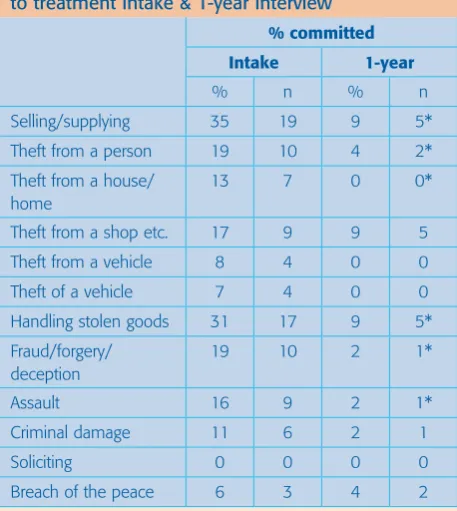
There was a reduction in the percentage of participants involved in acquisitive crime, from 35% (n=19) at treatment intake to 13% (n=7) at 1-year.
The numbers of participants involved in the selling/supplying of drugs in the 90 days prior to interview decreased between treatment intake and 1-year (see Table 4). In addition, the proportion of participants who committed theft from a person, theft from a house/home, handling stolen goods, fraud/forgery/deception and assault also reduced over this time period.
[image:4.595.310.539.486.742.2]Overall, a higher proportion of participants reported no criminal involvement in the 90 days prior to interview at 1-year (76%) compared to treatment intake (43%).
Table 4 Offending behaviour in the 90 days prior
to treatment intake & 1-year interview
% committed Intake 1-year
% n % n
Selling/supplying 35 19 9 5* Theft from a person 19 10 4 2* Theft from a house/
home
13 7 0 0*
Theft from a shop etc. 17 9 9 5 Theft from a vehicle 8 4 0 0 Theft of a vehicle 7 4 0 0 Handling stolen goods 31 17 9 5* Fraud/forgery/
deception
19 10 2 1*
Assault 16 9 2 1*
Criminal damage 11 6 2 1
Soliciting 0 0 0 0
Breach of the peace 6 3 4 2
Risk Behaviour Outcomes
The reduction in participants’ drug use was accompanied by a non-significant decrease in the numbers who reported injecting drug use. At treatment intake 30% (n=17) of the cohort injected a drug in the 90 days prior to interview compared with 20% (n=11) at 1-year. However a reduction in the proportions injecting one of the three most commonly injected substances, benzodiazepines, was observed; from 11% (n=6) at treatment intake to zero per cent at 1-year (see Figure 3).
Although there was no significant decrease in the frequency of injecting drug use (an average of 12.4 days out of 90 at treatment intake (sd=25.6) compared with 9.7 days (sd=24.9) at 1-year) reductions in the average times per day participants injected in the 90 days prior to treatment intake and 1-year interview were observed. At treatment intake participants reported injecting on average 1.3 times per days (sd=2.6) compared with an average of 0.4 times per day (sd=1.0) at 1-year.
[image:5.595.305.539.72.236.2]The proportion of participants who reported an overdose in the previous 90 days remained the same over the two time periods at 4% (n=2).
Figure 3 Injecting drug use by drug type in the 90
days prior to treatment intake & 1-year interview
% of cohor
t
0 10 20 30 40
Any drug Heroin
Cocaine Benzodiazepines*
Treatment intake 1-Year
0%
11%
20%
7%
20% 20%
30% 30%
* McNemar test revealed statistically significant change
There were no changes in participants’ injecting-related risk behaviours. At treatment intake participants reported low rates of borrowing, lending, reusing own injecting equipment, and sharing of injecting paraphernalia (e.g. spoons and filters). With the exception of a decrease in the numbers who reported borrowing, these behaviours remained the same over time (see Table 5).
Table 5 Injecting-related risk behaviour in the 30
days prior to treatment intake & 1-year interview
% reported Intake 1-year
% n % n
Borrowed used needles/ syringes
8 4 2 1
Lent used needles/syringes 2 1 2 1 Reused own needles/
syringes
9 4 9 4
Used filters/spoons after someone
0 0 0 0
Health Outcomes
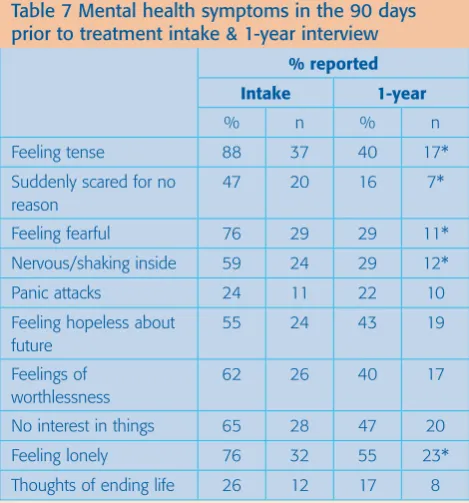
Improvements in both the physical and mental health symptoms of the cohort were evident over the relatively short time period. The numbers of participants who reported nine of the 10 physical health symptoms reduced from treatment intake to 1-year (see Table 6). A non-significant reduction was observed in the numbers who reported the remaining health symptom (chest pains).
[image:5.595.56.290.338.625.2]Some of the most marked reductions were observed in the symptoms associated with opiate withdrawals (such as tremors/ shakes, joint/bone pains, and muscle/pains).
Table 6 Physical health symptoms in the 90 days
prior to treatment intake & 1-year interview
% reported Intake 1-year
% n % n
Poor appetite 63 31 41 20* Tiredness/fatigue 82 41 40 20* Nausea (feeling sick) 49 24 18 9* Stomach pains 42 21 14 7* Difficulty breathing 35 17 17 8*
Chest pains 22 11 16 8
Joint/bone pains 57 28 14 7* Muscle pains 50 25 12 6* Numbness/tingling
arms/legs
26 13 8 4*
Tremors/shakes 51 25 6 3*
* McNemar test revealed statistically significant changes
[image:5.595.304.540.412.644.2]Table 7 Mental health symptoms in the 90 days
prior to treatment intake & 1-year interview
% reported Intake 1-year
% n % n
Feeling tense 88 37 40 17* Suddenly scared for no
reason
47 20 16 7*
Feeling fearful 76 29 29 11* Nervous/shaking inside 59 24 29 12* Panic attacks 24 11 22 10 Feeling hopeless about
future
55 24 43 19
Feelings of worthlessness
62 26 40 17
No interest in things 65 28 47 20 Feeling lonely 76 32 55 23* Thoughts of ending life 26 12 17 8
* McNemar test revealed statistically significant changes
service Contact
[image:6.595.209.525.439.719.2]There was an increase in participants’ contact with two social care services (GPs and employment/education services) from treatment intake to 1-year (see Table 8). In addition, although not statistically significant, participants reported increased contact with housing/homeless services, social welfare services, and hospitals.
Table 8 Contact with health & social care services
in the 90 days prior to treatment intake & 1-year
interview
% reported Intake 1-year
% n % n
Stayed overnight in hospital
7 4 9 5
Treated in A & E 9 5 13 7
Seen GP 30 16 60 32*
Out-patient appointment 20 11 20 11 Contact with social
services
4 2 4 2
Employment/education services
8 4 52 26*
Social welfare services 40 19 45 21 Housing/homeless
services
15 8 23 12
* McNemar test revealed statistically significant changes
Differences Between Those Interviewed
at 1-year and Those ‘Lost’ to Follow-up
Given that almost one-third of the cohort (32%, n=26) did not complete the 1-year follow-up interview, analysis was undertaken to determine whether there were any differences between those interviewed at 1-year and those ‘lost’ to follow-up at treatment intake, which may bias the results in the current document.Table 9 shows the difference (at treatment intake) in key variables between the two groups. Although not statistically significant participants interviewed at 1-year were more likely to be male, to be on social welfare, to have used heroin, cocaine and alcohol in the preceding 90 days, and to have injected a drug in the 90 days prior to treatment intake.
Analysis revealed that those lost to follow-up used cocaine on significantly more days (prior to treatment intake) than individuals interviewed at 1-year.
The intake characteristics and problems of participants
interviewed at 1-year and those ‘lost’ to follow-up were compared using a logistic regression of key variables (age, gender, frequency of heroin use, quantity of heroin used, frequency of cocaine use, number of drugs used, number of days injecting drug use, frequency of alcohol use, previous treatment for drug/alcohol use, treatment setting). The results show that the samples did not differ significantly.
Table 9 Comparison of participant characteristics
at treatment intake between those ‘lost’ to 1-year
follow-up and those interviewed
‘Lost’ Interviewed
(n=26) (n=56)
Gender (% male) 85 91
Mean age (yrs) 26.7 27.6 Age left school (yrs) 15.6 15.3 On social welfare (%) 65 71 Treatment setting
Inpatient (%) 85 86 Outpatient (%) 15 14 Time on waiting list (wks) 4.6 5.2 Rated treatment as very
important (%)
92 96
Used heroin last 90 days (%) 42 65 Mean days used heroin 22.0 27.4 Used cocaine last 90 days (%) 42 46 Mean days used cocaine 12.5 9.9‡
Used alcohol last 90 days (%) 44 60 Mean days used alcohol 17.9 17.9 Injected last 90 days (%) 27 30
[image:6.595.59.293.487.700.2]Conclusion
ROSIE is the first national study to have examined 1-year treatment outcomes for opiate users. The findings presented in this document demonstrate that participation in an abstinence-based treatment programme is followed by positive outcomes in drug use, involvement in crime, and physical and mental health symptoms. These improvements are in line with those observed in similar international studies.
The percentage of ROSIE participants followed-up and interviewed 1-year after treatment intake is comparable with the international literature. A total of 68% of the ROSIE abstinence cohort completed a 1-year interview. The UK NTORS follow-up rate was similar; Gossop et al (1999)1 report a 1-year follow-up interview rate of 67.4% for individuals
recruited within residential programmes. The Australia ATOS study, report a follow-up rate of 78% within the cohort of participants recruited from residential rehabilitation (Teesson et al, 2006)2. However it should be noted that unlike the
ROSIE study and the NTORS study, participants within ATOS were paid for their treatment intake interview which may have influenced the study retention rate.
In terms of treatment involvement at 1-year, the ROSIE cohort compared very favourably with NTORS and ATOS. At 1-year 64% of the ROSIE participants were in some form of treatment. Within NTORS residential rehabilitation cohort, Gossop
et al (1999) report that 60% of participants received some form of treatment during the year and within ATOS, 49% of their residential rehabilitation cohort were in some form of treatment at 1-year (Teesson et al, 2006).
The ROSIE participants reported substantial reductions in the use of cocaine and methadone (non-prescribed) in terms of the numbers reporting use, the frequency of use and the quantities consumed. In addition, the numbers reporting the use of all other target drugs except cannabis reduced significantly. Fifty-eight per cent of the ROSIE participants had not used heroin within the 90 days prior to 1-year interview, this compares very favourably with NTORS where a heroin abstinence rate of 50.5% in the previous 90 days was observed. Within the Australian study the authors reported that 63% of the cohort had been abstinent from heroin within the last month. As in other studies (Gossop et al, 2000)3
disappointing improvements were observed in study participants’ drinking behaviour. Although there was a significant reduction in the percentage of ROSIE participants who reported drinking in the 90 days prior to 1-year follow-up interview as compared with treatment intake interview, reductions in frequency and average daily quantity of alcohol used were non-significant.
The ROSIE cohort reported significant reductions in selling/supplying drugs and in acquisitive crime, comparable with international literature. The proportion of ROSIE participants selling/supplying drugs in the 90 days prior to interview reduced from 35% at treatment intake to 9% at 1-year follow-up. Within NTORS a similar proportion (33%) reported selling drugs at treatment intake but this only reduced to 17% at 1-year follow-up (Gossop et al, 1999). The proportion of ROSIE participants who reported involvement in acquisitive crime in the 90 days prior to interview reduced by 22 percentage points from 35% at treatment intake to 13% at 1-year follow-up. A similar reduction was reported by Gossop
et al (1999); 51% were involved in acquisitive crime at treatment intake this reduced by 25 percentage points to 26% at 1-year follow-up.
In conclusion, results on outcomes at 1-year for individuals recruited in the abstinence modality compare very favourably with other international outcome studies. However, further research is required to assess if improvements observed at 1-year are sustainable in the long-term. The forthcoming results from the ROSIE 3-year follow-up will provide stronger evidence on the effectiveness of abstinence-based treatment programmes and will enable policy makers and planners to make more informed decisions.
References
1 Gossop, M., Marsden, J., Stewart, S. and Rolfe, A. (1999). Treatment retention and 1-year outcomes for residential programs in England. Drug and Alcohol Dependence, 57, 89-98.
2 Teesson, M., Ross, J., Darke, S., Lynskey, M., Ali, R., Ritter, A., Cooke, R. (2006). One-year outcomes for heroin dependence: Findings from the Australian Treatment Outcome Study (ATOS). Drug and Alcohol Dependence 83(2): 174-80.
acknowledgements
This report was compiled and written by Dr Gemma Cox, Dr Catherine Comiskey and Paul Kelly.
The fieldwork for the research was conducted by Dr Gemma Cox, Elaine McGovern, Scott Davies, Scotty McLoughlin, Louise Sheehy, Emma Murphy, Anita Nicholson, Fiona Larkin, Jennifer Cronly, Karin O’Sullivan, Pat Spillane, Helen McLoughlin, Emma Heffernan and Emma White.
The authors would like to thank all those individuals who gave up their time to participate in the ROSIE study. The authors are indebted to the NACD, for its ongoing support and assistance with the study including feedback in the preparation of this document.
The Research advisory group established to support and monitor the research project thus far comprised of the following members (some changes over time): Dr Derval Howley, Dr Ide Delargy, Mr David Keenan, Mr Liam O’Brien, Dr Aileen O’Gorman, Ms Mairéad Lyons, Professor John Strang and Dr Michael Farrell.
This paper should be referenced as follows:
Cox, G., Comiskey, C., Kelly P. (2007) ROSIE Findings 3: Summary of 1-year outcomes: Abstinence Modality. Dublin: National Advisory Committee on Drugs.
Contact details
Mairéad Lyons Dr Catherine Comiskey National Advisory Committee on Drugs ROSIE Project
3rd Floor Mathematics Department
Shelbourne House National University of Ireland
Shelbourne Road Maynooth
Ballsbridge Co Kildare
Dublin 4
Tel: + 353 1 667 0760 Tel: + 353 1 708 3352
Email: [email protected] Email: [email protected] Web: www.nacd.ie Web: www.nuim.ie/rosie
pantone 138 pantone 527
NUI MAYNOOTH
O l l s c o i l n a h É i r e a n n M á N u a d