Transition-based Semantic Role Labeling
Using Predicate Argument Clustering
Jinho D. Choi
Department of Computer Science University of Colorado at Boulder
Martha Palmer Department of Linguistics University of Colorado at Boulder
Abstract
This paper suggests two ways of improving semantic role labeling (SRL). First, we intro-duce a novel transition-based SRL algorithm that gives a quite different approach to SRL.
Our algorithm is inspired by shift-reduce pars-ing and brpars-ings the advantages of the transition-based approach to SRL. Second, we present a self-learning clustering technique that effec-tively improves labeling accuracy in the test domain. For better generalization of the sta-tistical models, we cluster verb predicates by comparing their predicate argument structures and apply the clustering information to the final labeling decisions. All approaches are evaluated on the CoNLL’09 English data. The new algorithm shows comparable results to another state-of-the-art system. The cluster-ing technique improves labelcluster-ing accuracy for both in-domain and out-of-domain tasks.
1 Introduction
Semantic role labeling (SRL) has sparked much in-terest in NLP (Shen and Lapata, 2007; Liu and Gildea, 2010). Lately, dependency-based SRL has shown advantages over constituent-based SRL (Jo-hansson and Nugues, 2008). Two main benefits can be found. First, dependency parsing is much faster than constituent parsing, whereas constituent pars-ing is usually considered to be a bottleneck toSRLin terms of execution time. Second, dependency ture is more similar to predicate argument struc-ture than phrase strucstruc-ture because it specifically de-fines relations between a predicate and its arguments with labeled arcs. Unlike constituent-based SRL
that maps phrases to semantic roles, dependency-based SRL maps headwords to semantic roles be-cause there is no phrasal node in dependency struc-ture. This may lead to a concern about getting the actual semantic chunks back, but Choi and Palmer (2010) have shown that it is possible to recover the original chunks from the headwords with minimal loss, using a certain type of dependency structure.
Traditionally, either constituent or dependency-based, semantic role labeling is done in two steps, argument identification and classification (Gildea and Jurafsky, 2002). This is from a general be-lief that each step requires a different set of fea-tures (Xue and Palmer, 2004), and training these steps in a pipeline takes less time than training them as a joint-inference task. However, recent machine learning algorithms can deal with large scale vector spaces without taking too much training time (Hsieh et al., 2008). Furthermore, from our experience in dependency parsing, handling these steps together improves accuracy in identification as well as clas-sification (unlabeled and labeled attachment scores in dependency parsing). This motivates the develop-ment of a new semantic role labeling algorithm that treats these two steps as a joint inference task.
Our algorithm is inspired by shift-reduce pars-ing (Nivre, 2008). The algorithm uses several transi-tions to identify predicates and their arguments with semantic roles. One big advantage of the transition-based approach is that it can use previously identi-fied arguments as features to predict the next argu-ment. We apply this technique to our approach and achieve comparable results to another state-of-the-art system evaluated on the same data sets.
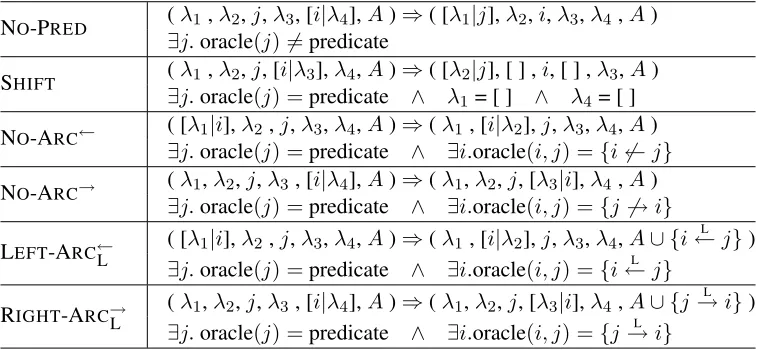
NO-PRED (λ1,λ2,j,λ3, [i|λ4],A)⇒( [λ1|j],λ2,i,λ3,λ4,A) ∃j.oracle(j)6=predicate
SHIFT (λ1,λ2,j, [i|λ3],λ4,A)⇒( [λ2|j], [ ] ,i, [ ] ,λ3,A) ∃j.oracle(j) =predicate ∧ λ1 = [ ] ∧ λ4= [ ]
NO-ARC← ( [λ1|i],λ2,j,λ3,λ4,A)⇒(λ1, [i|λ2],j,λ3,λ4,A) ∃j.oracle(j) =predicate ∧ ∃i.oracle(i, j) ={i6←j}
NO-ARC→ (λ1,λ2,j,λ3, [i|λ4],A)⇒(λ1,λ2,j, [λ3|i],λ4,A) ∃j.oracle(j) =predicate ∧ ∃i.oracle(i, j) ={j 6→i}
LEFT-ARC←L ( [λ1|i],λ2,j,λ3,λ4,A)⇒(λ1, [i|λ2],j,λ3,λ4,A∪ {i
L ←j})
∃j.oracle(j) =predicate ∧ ∃i.oracle(i, j) ={i←L j}
RIGHT-ARC→L (λ1,λ2,j,λ3, [i|λ4],A)⇒(λ1,λ2,j, [λ3|i],λ4,A∪ {j
L →i})
[image:2.612.117.496.60.235.2]∃j.oracle(j) =predicate ∧ ∃i.oracle(i, j) ={j →L i}
Table 1: Transitions in our bidirectional top-down search algorithm. For each row, the first line shows a transition and the second line shows preconditions of the transition.
For better generalization of the statistical models, we apply a self-learning clustering technique. We first cluster predicates in test data using automati-cally generated predicate argument structures, then cluster predicates in training data by using the previ-ously found clusters as seeds. Our experiments show that this technique improves labeling accuracy for both in-domain and out-of-domain tasks.
2 Transition-based semantic role labeling
Dependency-based semantic role labeling can be viewed as a special kind of dependency parsing in the sense that both try to find relations between word pairs. However, they are distinguished in two major ways. First, unlike dependency parsing that tries to find some kind of relation between any word pair, semantic role labeling restricts its search only to top-down relations between predicate and argu-ment pairs. Second, dependency parsing requires one head for each word, so the final output is a tree, whereas semantic role labeling allows multiple pred-icates for each argument. Thus, not all dependency parsing algorithms, such as a maximum spanning tree algorithm (Mcdonald and Pereira, 2006), can be naively applied to semantic role labeling.
Some transition-based dependency parsing algo-rithms have been adapted to semantic role labeling and shown good results (Henderson et al., 2008; Titov et al., 2009). However, these algorithms are originally designed for dependency parsing, so are not necessarily customized for semantic role
label-ing. Here, we present a novel transition-based algo-rithm dedicated to semantic role labeling. The key difference between this algorithm and most other transition-based algorithms is in its directionality. Given an identified predicate, this algorithm tries to find top-down relations between the predicate and the words on both left and right-hand sides, whereas other transition-based algorithms would consider words on either the left or the right-hand side, but not both. This bidirectional top-down search makes more sense for semantic role labeling because predi-cates are always assumed to be the heads of their ar-guments, an assumption that cannot be generalized to dependency parsing, and arguments can appear either side of the predicate.
Table 1 shows transitions used in our algorithm. All parsing states are represented as tuples (λ1,λ2, p, λ3, λ4, A), whereλ1..4 are lists of word indices and p is either a word index of the current predi-cate candidate or @ indicating no predicate
candi-date.λ1,4contain indices to be compared withpand λ2,3contain indices already compared withp.Ais a set of labeled arcs representing previously identified arguments with respect to their predicates. ← and
→indicate parsing directions. L is a semantic role label, andi, jrepresent indices of their correspond-ing word tokens. The initial state is ([ ], [ ], 1, [ ], [2, . . . , n],∅), wherew1andwnare the first and the last words in a sentence, respectively. The final state is (λ1,λ2,@, [ ], [ ],A), i.e., the algorithm terminates
John1 wants2 to3 buy4 a5 car6 Root0
SBJ ROOT
OPRD
OBJ
IM NMOD
A0 A1
[image:3.612.171.443.59.134.2]A0 A1
Figure 1: An example of a dependency tree with semantic roles. The upper and lower arcs stand for syntactic and semantic dependencies, respectively. SBJ, OBJ,OPRD,IM,NMOD stand for a subject, object, object predicative, infinitive marker, and noun-modifier.A0,A1stand forARG0,ARG1in PropBank (Palmer et al., 2005).
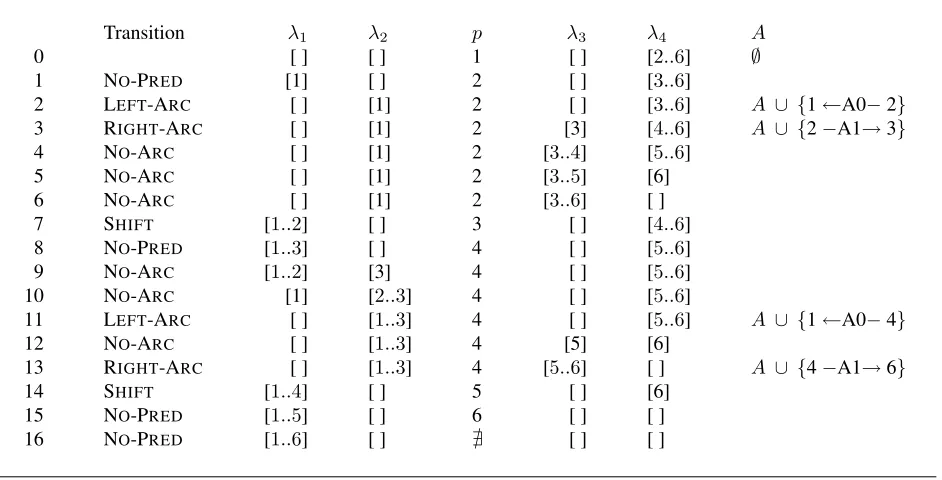
Transition λ1 λ2 p λ3 λ4 A
0 [ ] [ ] 1 [ ] [2..6] ∅
1 NO-PRED [1] [ ] 2 [ ] [3..6]
2 LEFT-ARC [ ] [1] 2 [ ] [3..6] A ∪ {1←A0−2} 3 RIGHT-ARC [ ] [1] 2 [3] [4..6] A ∪ {2−A1→3} 4 NO-ARC [ ] [1] 2 [3..4] [5..6]
5 NO-ARC [ ] [1] 2 [3..5] [6]
6 NO-ARC [ ] [1] 2 [3..6] [ ]
7 SHIFT [1..2] [ ] 3 [ ] [4..6] 8 NO-PRED [1..3] [ ] 4 [ ] [5..6] 9 NO-ARC [1..2] [3] 4 [ ] [5..6] 10 NO-ARC [1] [2..3] 4 [ ] [5..6]
11 LEFT-ARC [ ] [1..3] 4 [ ] [5..6] A ∪ {1←A0−4}
12 NO-ARC [ ] [1..3] 4 [5] [6]
13 RIGHT-ARC [ ] [1..3] 4 [5..6] [ ] A ∪ {4−A1→6}
14 SHIFT [1..4] [ ] 5 [ ] [6]
15 NO-PRED [1..5] [ ] 6 [ ] [ ] 16 NO-PRED [1..6] [ ] @ [ ] [ ]
Table 2: Parsing states generated by our algorithm for the example in Figure 1.
The algorithm uses six kinds of transitions. NO -PREDis performed when an oracle identifieswj as not a predicate. All other transitions are performed when wj is identified as a predicate. SHIFTis per-formed when both λ1 and λ4 are empty, meaning that there are no more argument candidates left for the predicate wj. NO-ARC is performed whenwi is identified as not an argument ofwj. LEFT-ARCL and RIGHT-ARCL are performed whenwiis identi-fied as an argument ofwjwith a labelL. These tran-sitions can be performed in any order as long as their preconditions are satisfied. For our experiments, we use the following generalized sequence:
[ (NO-PRED)∗ ⇒(LEFT-ARC←L|NO-ARC←)∗ ⇒
(RIGHT-ARC→L|NO-ARC→)∗ ⇒SHIFT]∗
Notice that this algorithm does not take separate steps for argument identification and classification.
By adding the NO-ARC transitions, we successfully merge these two steps together without decrease in labeling accuracy.1 Since each word can be a predi-cate candidate and each predipredi-cate considers all other words as argument candidates, a worst-case com-plexity of the algorithm is O(n2). To reduce the complexity, Zhao et al. (2009) reformulated a prun-ing algorithm introduced by Xue and Palmer (2004) for dependency structure by considering only direct dependents of a predicate and its ancestors as ar-gument candidates. This pruning algorithm can be easily applied to our algorithm: the oracle can pre-filter such dependents and uses the information to perform NO-ARCtransitions without consulting sta-tistical models.
1
[image:3.612.75.546.194.434.2]Table 2 shows parsing states generated by our al-gorithm. Our experiments show that this algorithm gives comparable results against another state-of-the-art system.
3 Predicate argument clustering
Some studies showed that verb clustering informa-tion could improve performance in semantic role la-beling (Gildea and Jurafsky, 2002; Pradhan et al., 2008). This is because semantic role labelers usually perform worse on verbs not seen during training, for which the clustering information can provide useful features. Most previous studies used either bag-of-words or syntactic structure to cluster verbs; how-ever, this may or may not capture the nature of predi-cate argument structure, which is more semantically oriented. Thus, it is preferable to cluster verbs by their predicate argument structures to get optimized features for semantic role labeling.
In this section, we present a self-learning clus-tering technique that effectively improves labeling accuracy in the test domain. First, we perform se-mantic role labeling on the test data using the algo-rithm in Section 2. Next, we cluster verbs in the test data using predicate argument structures generated by our semantic role labeler (Section 3.2). Then, we cluster verbs in the training data using the verb clus-ters we found in the test data (Section 3.3). Finally, we re-run our semantic role labeler on the test data using the clustering information. Our experiments show that this technique gives improvement to la-beling accuracy for both in and out-of domain tasks.
3.1 Projecting predicate argument structure into vector space
Before clustering, we need to project the predicate argument structure of each verb into vector space. Two kinds of features are used to represent these vectors: semantic role labels and joined tags of semantic role labels and their corresponding word lemmas. Figure 2 shows vector representations of predicate argument structures of verbs, want and
buy, in Figure 1.
Initially, all existing and non-existing features are assigned with a value of 1 and 0, respectively. How-ever, assigning equal values to all existing features is not necessarily fair because some features have
want 1 1 0s 1 1 0 0s
buy 1 1 0s 1 0 1 0s
A0 A1 ... john:A0 to:A1 car:A1 ... Verb
Figure 2: Projecting the predicate argument structure of each verb into vector space.
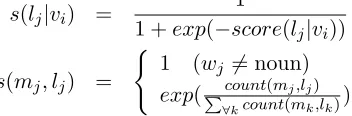
higher confidence, or are more important than the others; e.g.,ARG0andARG1are generally predicted with higher confidence than modifiers, nouns give more important information than some other gram-matical categories, etc. Instead, we assign each ex-isting feature with a value computed by the follow-ing equations:
s(lj|vi) =
1
1 +exp(−score(lj|vi))
s(mj, lj) =
(
1 (wj 6= noun) exp( count(mj,lj)
P
∀kcount(mk,lk))
vi is the current verb,lj is thej’th label ofvi, and mj islj’s corresponding lemma. score(lj|vi) is a score oflj being a correct argument label ofvi; this is always 1 for training data and is provided by our statistical models for test data. Thus, s(lj|vi)is an approximated probability oflj being a correct argu-ment label ofvi, estimated by the logistic function. s(mj, lj)is equal to 1 ifwj is not a noun. Ifwj is a noun, it gets a value≥1given a maximum likeli-hood ofmjbeing co-occurred withlj.2
With the vector representation, we can apply any kind of clustering algorithm (Hofmann and Puzicha, 1998; Kamvar et al., 2002). For our experiments, we use k-best hierarchical clustering for test data, andk-means clustering for training data.
3.2 Clustering verbs in test data
Given automatically generated predicate argument structures in the test data, we apply k-best hierar-chical clustering; that is, a relaxation of classical hi-erarchical agglomerative clustering (from now on, HAC; Ward (1963)), to find verb clusters. Unlike HAC that merges a pair of clusters at each iteration, k-best hierarchical clustering mergesk-best pairs at
2
[image:4.612.336.512.262.320.2]each iteration (Lo et al., 2009). Instead of merging a fixed number ofk-clusters, we use a threshold to dy-namically determine the topk-clusters. Our studies indicate that this technique produces almost as fine-grained clusters as HAC, yet converges much faster. Our algorithm fork-best hierarchical clustering is presented in Algorithm 1.thupis a threshold that de-termines whichk-best pairs are to be merged (in our case,kup= 0.8). sim(ci, cj)is a similarity between clustersci andcj. For our experiments, we use co-sine similarity with average-linkage. It is possible that other kinds of similarity metrics would work better, which we will explore as future work. Con-ditions in line 15 ensure that each cluster is merged with at most one other cluster at each iteration, and conditions in line 17 force at least one cluster to be merged with one other cluster at each iteration. Thus, the algorithm is guaranteed to terminate after at most (n−1) iterations.
When the algorithm terminates, it returns a set of one cluster with different hierarchical levels. For our experiments, we set another threshold,thlow, for early break-out: if there is no cluster pair whose sim-ilarity is greater than thlow, we terminate the algo-rithm (in our case, thlow = 0.7). A cluster set gen-erated by this early break-out contains several unit clusters that are not merged with any other cluster. All of these unit clusters are discarded from the set to improve set quality. This is reasonable because our goal is not to cluster all verbs but to find a useful set of verb clusters that can be mapped to verbs in training data, which can lead to better performance in semantic role labeling.
3.3 Clustering verbs in training data
Given the verb clusters we found in the test data, we search for verbs that are similar to these clusters in the training data. K-means clustering (Hartigan, 1975) is a natural choice for this case because we already knowk-number of center clusters to begin with. Each verb in the training data is compared with all verb clusters in the test data, and merged with the cluster that gives the highest similarity. To maintain the quality of the clusters, we use the same thresh-old,thlow, to filter out verbs in the training data that are not similar enough to any verb cluster in the test data. By doing so, we keep only verbs that are more likely to be helpful for semantic role labeling.
input :C = [c1, .., cn]:ciis a unit cluster. thup∈R: threshold.
output:Cˆ = [c1, .., cm]:cjis a unit or merged cluster, wherem≤n.
begin
1
while|C|>1do
2
L←list()
3
fori∈[1,|C| −1]do
4
forj ∈[i+ 1,|C|]do
5
t←(i, j, sim(ci, cj)) 6
L.add(t)
7
end
8
end
9
descendingSortBySimilarity(L) 10
S ←set()
11
fork∈[1,|L|]do
12
t←L.get(k)
13
i←t(0);j ←t(1);sim←t(2)
14
ifi∈Sorj∈Sthen
15
continue
16
ifk= 1orsim > thupthen 17
C.add(ci∪cj);S.add(i, j) 18
C.remove(ci, cj) 19
else
20
break
21
end
22
end
23
end
24
end
25
Algorithm 1:k-best hierarchical clustering.
4 Features
4.1 Baseline features
Word tokens Features warg,wpred f,m,p,d warg±1,hd, lm, rm, ls, rs(warg) m,p wpred±1,hd, lm, rm(wpred) m,p
Table 3:N-gram feature templates.
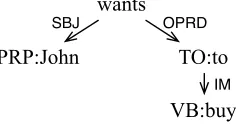
Besides then-gram features, we use several struc-tural features such as dependency label set, subcat-egorization,POSpath, dependency path, and depen-dency depth. Dependepen-dency label set features are de-rived by collecting all dependency labels ofwpred’s direct dependents. Unlike Johansson and Nugues, we decompose subcategorization features into two parts: one representing the left-hand side and the other representing the right-hand side dependencies ofwpred. For the predicatewants in Figure 3, we generate ←−SBJ and −−−→OPRD as separate subcategoriza-tion features.
wants
PRP:John TO:to
VB:buy
SBJ OPRD
IM
Figure 3: Dependency structure used for subcategoriza-tion, path, and depth features.
We also decompose path features into two parts: given the lowest common ancestor (LCA) ofwarg andwpred, we generate path features from warg to the LCA and from the LCA to wpred, separately. For example, the predicate buy and the argument
John in Figure 3 have a LCA atwants, so we gen-erate two sets of path features, {↑PRP, ↓TO↓VB} withPOStags, and{↑SBJ,↓OPRD↓IM}with depen-dency labels. Such decompositions allow more gen-eralization of those features; even if one part is not matched to the current parsing state, the other part can still participate as a feature. Throughout our experiments, these generalized features give slightly higher labeling accuracy than ungeneralized features although they form a smaller feature space.
In addition, we apply dependency path features to wpred’s highest verb chain, which often shares ar-guments with the predicate (e.g., John is a shared argument of the predicatebuy and its highest verb chainwants). To retrieve the highest verb chain, we apply a simple heuristic presented below. The
func-tion getHighestVerbChain takes a predicate,
pred, as input and returns its highest verb chain,
vNode, as output. If there is no verb chain for the predicate, it returns null instead. Note that this heuristic is designed to work with dependency rela-tions and labels described by the CoNLL’09 shared task (Hajiˇc et al., 2009).
func getHighestVerbChain(pred) vNode = pred;
regex = "CONJ|COORD|IM|OPRD|VC";
while (regex.matches(vNode.deprel)) vNode = vNode.head;
if (vNode != pred) return vNode; else return null;
Dependency depth features are a reduced form of path features. Instead of specifyingPOStags or de-pendency labels, we indicate paths with their depths. For instance,Johnandbuyin Figure 3 have a depen-dency depth feature of↑1↓2, which implies that the depth between John and its LCA (wants) is 1, and the depth between the LCA andbuyis 2.
Finally, we use four kinds of binary features: if wargis a syntactic head ofwpred, ifwpredis a syn-tactic head ofwarg, ifwpredis a syntactic ancestor of warg, and ifwpred’s verb chain has a subject. Each feature gets a value of 1 if true; otherwise, it gets a value of 0.
4.2 Dynamic and clustering features
All dynamic features are derived by using previ-ously identified arguments. Two kinds of dynamic features are used for our experiments. One is a la-bel of the very last predicted numbered argument of wpred. For instance, the parsing state 3 in Table 2 uses a labelA0as a feature to make its prediction, wants→A1 to, and the parsing states 4 to 6 use a label
[image:6.612.127.245.319.381.2]Finally, we usewpred’s clusterIDas a feature. The dynamic and clustering features combine a very small portion of the entire feature set, but still give a fair improvement to labeling accuracy.
5 Experiments
5.1 Corpora
All models are trained on Wall Street Journal sec-tions 2-21 and developed on section 24 using auto-matically generated lemmas and POS tags, as dis-tributed by the CoNLL’09 shared task (Hajiˇc et al., 2009). CoNLL’09 data contains semantic roles for both verb and noun predicates, for which we use only ones related to verb predicates. Furthermore, we do not include predicate sense classification as a part of our task, which is rather a task of word sense disambiguation than semantic role labeling.
For in-domain and out-of-domain evaluations, WSJsection 23 and the Brown corpus are used, also distributed by CoNLL’09. To retrieve automatically generated dependency trees as input to our semantic role labeler, we train our open source dependency parser, called ClearParser3, on the training set and run the parser on the evaluation sets. ClearParser uses a transition-based dependency parsing algo-rithm that gives near state-of-the-art results (Choi and Palmer, 2011), and mirrors ourSRLalgorithm.
5.2 Statistical models
We use Liblinear L2-L1 SVM for learning; a linear classification algorithm using L2 regularization and L1 loss function. This algorithm is designed to han-dle large scale data: it assumes the data to be lin-early separable so does not use any kind of kernel space (Hsieh et al., 2008). As a result, it significantly reduces training time compared to typical SVM, yet performs accurately. For our experiments, we use the following learning parameters: c = 0.1 (cost), e= 0.2 (termination criterion),B= 0 (bias).
Since predicate identification is already provided in the CoNLL’09 data, we do not train NO-PRED. SHIFT does not need to be trained in general be-cause the preconditions of SHIFT can be checked deterministically without consulting statistical mod-els. NO-ARC← and LEFT-ARC←L are trained to-gether using the one-vs-all method as are NO-ARC→
3
http://code.google.com/p/clearparser/
and RIGHT-ARC→L. Even with multi-classifications, it takes less than two minutes for the entire training using Liblinear.
5.3 Accuracy comparisons
Tables 4 and 5 show accuracy comparisons between three models evaluated on the WSJ and Brown cor-pora, respectively. ‘Baseline’ uses the features de-scribed in Section 4.1. ‘+Dynamic’ uses all baseline features and the dynamic features described in Sec-tion 4.2. ‘+Cluster’ uses all previous features and the clustering feature. Even though our baseline system already has high performance, each model shows an improvement over its previous model (very slight for ‘+Cluster’). The improvement is greater for the out-of-domain task, implying that the dynamic and clustering features help more on new domains. The differences between ‘Baseline’ and ‘+Dynamic’ are statistically significant for both in and out-of domain tasks (Wilcoxon signed-rank test, treating each sen-tence as an individual event,p≤0.025).
Task P R F1
Baseline AI 92.57 88.44 90.46 AI+AC 87.20 83.31 85.21
+Dynamic AI 92.38 88.76 90.54 AI+AC 87.33 83.91 85.59∗
+Cluster AI 92.62 88.90 90.72 AI+AC 87.43 83.92 85.64
[image:7.612.315.537.537.654.2]JN (2008) AI+AC 88.46 83.55 85.93
Table 4: Labeling accuracies evaluated on the WSJ (P: precision, R: recall, F1: F1-score, all in %). ‘AI’ and ‘AC’ stand for argument identification and argument clas-sification, respectively.
Task P R F1
Baseline AI 90.96 81.57 86.01 AI+AC 77.11 69.14 72.91
+Dynamic AI 90.90 82.25 86.36 AI+AC 77.41 70.05 73.55∗
+Cluster AI 90.87 82.43 86.44 AI+AC 77.47 70.28 73.70
JN (2008) AI+AC 77.67 69.63 73.43
Table 5: Labeling accuracies evaluated on the Brown.
has been evaluated with our exact environmental set-tings. However, Johansson and Nugues (2008), who showed state-of-the-art performance in CoNLL’08, evaluated their system with settings very similar to ours. Their task was exactly the same as ours; given predicate identification, they evaluated their dependency-based semantic role labeler for argu-ment identification and classification on the WSJ and Brown corpora, distributed by the CoNLL’05 shared task (Carreras and M`arquez, 2005). Since the CoNLL’05 data was not dependency-based, they applied heuristics to build dependency-based predi-cate argument structures. Their converted data may appear to be a bit different from the CoNLL’09 data we use (e.g., hyphenated words are tokenized by the hyphens in CoNLL’09 data whereas they are not in CoNLL’05 data), but semantic role annotations on headwords should look very similar.
Johansson and Nugues’s results are presented as JN (2008) in Tables 4 and 5. Our final system shows comparable results against this system. These re-sults are meaningful in two ways. First, JN used a graph-based dependency parsing algorithm that gave higher parsing accuracy for these test sets than the transition-based dependency parsing algorithm used in ClearParser (about 0.9% better in labeled attach-ment score). Even with poorer parse output, ourSRL system performed as well as theirs. Furthermore, our system used only one set of features, which makes the feature engineering easier than JN’s ap-proach that used different sets of features for argu-ment identification and classification.
6 Conclusion and future work
This paper makes two contributions. First, we in-troduce a transition-based semantic role labeling al-gorithm that shows comparable performance against another state-of-the-art system. The new algorithm takes advantage of using previous predictions as fea-tures to make the next predictions. Second, we suggest a self-learning clustering technique that im-proves labeling accuracy slightly in both the do-mains. The clustering technique shows potential for improving performance in other new domains.
These preliminary results are promising; however, there is still much room for improvement. Since our algorithm is transition-based, many existing
tech-niques such as k-best ranking (Zhang and Clark, 2008) or dynamic programming (Huang and Sagae, 2010) designed to improve transition-based parsing can be applied. We can also apply different kinds of clustering algorithms to improve the quality of the verb clusters. Furthermore, more features, such as named entity tags or dependency labels, can be used to form a better representation of feature vectors for the clustering.
One of the strongest motivations for designing our transition-based SRL system is to develop a joint-inference system between dependency parsing and semantic role labeling. Since we have already de-veloped a dependency parser, ClearParser, based on a parallel transition-based approach, it will be straightforward to integrate thisSRLsystem with the parser. We will also explore the possiblity of adding empty categories during semantic role labeling.
7 Related work
Nivre (2008) introduced several transition-based de-pendency parsing algorithms that have been widely used. Johansson and Nugues (2008) and Zhao et al. (2009) presented dependency-based semantic role labelers showing state-of-the-art performance for the CoNLL’08 and ’09 shared tasks in English. Scheible (2010) clustered predicate argument struc-tures using EM training and the MDL principle. Wagner et al. (2009) used predicate argument clus-tering to improve verb sense disambiguation.
Acknowledgments
References
X. Carreras and L. M`arquez. 2005. Introduction to the conll-2005 shared task: semantic role labeling. In Pro-ceedings of the Ninth Conference on Computational Natural Language Learning.
J. D. Choi and M. Palmer. 2010. Retrieving correct se-mantic boundaries in dependency structure. In Pro-ceedings of ACL workshop on Linguistic Annotation. J. D. Choi and M. Palmer. 2011. Getting the most out
of transition-based dependency parsing. In Proceed-ings of the 49th Annual Meeting of the Association for Computational Linguistics: Human Language Tech-nologies.
D. Gildea and D. Jurafsky. 2002. Automatic labeling of semantic roles.Computational Linguistics, 28(3). J. Hajiˇc, M. Ciaramita, R. Johansson, D. Kawahara,
M. A. Mart´ı, L. M`arquez, A. Meyers, J. Nivre, S. Pad´o, J. ˇStˇep´anek, P. Straˇn´ak, M. Surdeanu, N. Xue, and Y. Zhang. 2009. The conll-2009 shared task: Syntac-tic and semanSyntac-tic dependencies in multiple languages. In Proceedings of the 13th Conference on Computa-tional Natural Language Learning: Shared Task. J. A. Hartigan. 1975. Clustering Algorithms. New York:
John Wiley & Sons.
J. Henderson, P. Merlo, G. Musillo, and I. Titov. 2008. A latent variable model of synchronous parsing for syntactic and semantic dependencies. InProceedings of the Twelfth Conference on Computational Natural Language Learning.
T. Hofmann and J. Puzicha. 1998. Statistical models for co-occurrence data. Technical report, Massachusetts Institute of Technology.
C. Hsieh, K. Chang, C. Lin, S. S. Keerthi, and S. Sun-dararajan. 2008. A dual coordinate descent method for large-scale linear svm. InProceedings of the 25th international conference on Machine learning. L. Huang and K. Sagae. 2010. Dynamic programming
for linear-time incremental parsing. InProceedings of the 48th Annual Meeting of the Association for Com-putational Linguistics.
R. Johansson and P. Nugues. 2008. Dependency-based semantic role labeling of PropBank. InProceedings of the 2008 Conference on Empirical Methods in Natural Language Processing.
S. D. Kamvar, D. Klein, and C. D. Manning. 2002. Inter-preting and extending classical agglomerative cluster-ing algorithms uscluster-ing a model-based approach. In Pro-ceedings of the 9th International Conference on Ma-chine Learning.
D. Liu and D. Gildea. 2010. Semantic role features for machine translation. InProceedings of the 23rd Inter-national Conference on Computational Linguistics.
C. Lo, J. Luo, and M. Shieh. 2009. Hardware/software codesign of resource constrained real-time systems. In
Proceedings of the 5th International Conference on In-formation Assurance and Security.
R. Mcdonald and F. Pereira. 2006. Online learning of approximate dependency parsing algorithms. In Pro-ceedings of the Annual Meeting of the European Amer-ican Chapter of the Association for Computational Linguistics.
J. Nivre. 2008. Algorithms for deterministic incremen-tal dependency parsing. Computational Linguistics, 34(4).
M. Palmer, D. Gildea, and P. Kingsbury. 2005. The proposition bank: An annotated corpus of semantic roles.Computational Linguistics, 31(1).
S. Pradhan, W. Ward, and J. H. Martin. 2008. Towards robust semantic role labeling.Computational Linguis-tics: Special Issue on Semantic Role Labeling, 34(2). C. Scheible. 2010. An evaluation of predicate argument
clustering using pseudo-disambiguation. In Proceed-ings of the 7th conference on International Language Resources and Evaluation.
D. Shen and M. Lapata. 2007. Using semantic roles to improve question answering. In Proceedings of the Conference on Empirical Methods in Natural guage Processing and on Computational Natural Lan-guage Learning.
I. Titov, J. Henderson, P. Merlo, and G. Musillo. 2009. Online graph planarisation for synchronous parsing of semantic and syntactic dependencies. InProceedings of the 21st International Joint Conference on Artificial Intelligence.
W. Wagner, H. Schmid, and S. Schulte im Walde. 2009. Verb sense disambiguation using a predicate-argument-clustering model. In Proceedings of the CogSci Workshop on Distributional Semantics beyond Concrete Concepts.
J. H. Ward. 1963. Hierarchical grouping to optimize an objective function. Journal of the American Statistical Association, 58(301).
N. Xue and M. Palmer. 2004. Calibrating features for se-mantic role labeling. InProceedings of the Conference on Empirical Methods in Natural Language Process-ing.
Y. Zhang and S. Clark. 2008. A tale of two parsers: in-vestigating and combining graph-based and transition-based dependency parsing using beam-search. In Pro-ceedings of the Conference on Empirical Methods in Natural Language Processing.