An N-gram frequency database reference to handle MWE extraction in NLP
applications
Patrick Watrin
Centre for Natural Language Processing Institut Langage et Communication
UCLouvain
Thomas François
Aspirant F.N.R.S.
Centre for Natural Language Processing Institut Langage et Communication
UCLouvain
Abstract
The identification and extraction of Multiword Expressions (MWEs) currently deliver satis-factory results. However, the integration of these results into a wider application remains an issue. This is mainly due to the fact that the association measures (AMs) used to detect MWEs require a critical amount of data and that the MWE dictionaries cannot account for all the lexical and syntactic variations inherent in MWEs. In this study, we use an alterna-tive technique to overcome these limitations. It consists in defining an n-gram frequency data-base that can be used to compute AMs on-the-fly, allowing the extraction procedure to effi-ciently process all the MWEs in a text, even if they have not been previously observed.
1 Introduction
Multiword Expressions (MWEs) are commonly defined as “recurrent combinations of words that co-occur more often than expected by chance and that correspond to arbitrary word usages” (Smadja, 1993, 143). Their importance in the field of natu-ral language processing (NLP) is undeniable. Al-though composed of several words, these sequences are nonetheless considered as simple units with re-gard to part-of-speech at the lexical as well as syn-tactic levels. Their identification is therefore essen-tial to the efficiency of applications such as parsing (Nivre and Nilsson, 2004), machine translation (Ren et al., 2009), information extraction, or information retrieval (Vechtomova, 2005). In these systems, the principle of syntactic or semantic/informational unit is particularly important.
Although the identification and extraction of MWEs now deliver satisfactory results (Evert and Krenn, 2001; Pearce, 2002), their integration into a broader applicative context remains problematic (Sag et al., 2001). The explanations for this situation are twofold.
1. The most effective extraction methods resort to statistical association measures based on the frequency of lexical structures. They, therefore, require a critical amount of data and cannot function properly from a simple phrase or even from a short text.
2. Since the syntactic and lexical variability of MWEs may be high, lexical resources learned from a corpus cannot take it into account. The coverage of these resources is indeed too limi-ted when applied to a new text.
To address these two limitations, this article des-cribes how an n-gram frequency database can be used to compute association measures (AMs) effi-ciently, even for small texts. The specificity of this new technique is that AMs are computed on-the-fly, freeing it from the coverage limitation that afflicts more simple techniques based on a dictionary.
We start off focussing on our extraction method, and more particularly on the process via which a candidate structure is statistically validated (Section 2). This presentation principally aims to identify the precise needs of a frequency database reference, both in terms of the interrogation process and in the type of information to be kept in the database. Then, we will address various issues of storage and query performance raised by the design of the frequency
database (Section 3). Finally, Section 4 reports the results of our experiments and Section 5 concludes and open up future perspectives.
2 Extraction process
Our extraction procedure is comparable to those developed by Smadja (1993) and Daille (1995). They use a linguistic filter upstream of the statisti-cal estimation. Unlike purely statististatisti-cal techniques, this solution provides less coverage but greater ac-curacy. It also allows us to assign a unique morpho-syntactic category to each extracted unit (as well as a description of its internal structure), which facili-tates its integration into a more complex procedure.
Concretely, we first tagged the texts to clear any lexical ambiguities1. We then identified all MWE candidates in the tagged text with the help of a li-brary of transducers2(or syntactic patterns). Finally, the list of candidates was submitted to the statistical validation module which assigns an AM to each of these.
2.1 Linguistic filters
In this study, we consider four basic types of nominal structures3 : adjective-noun (AN), noun-adjective (NA), noun-preposition-noun (N prepN), and noun-noun (NN), which are likely to undergo three types of variations : modification (mainly ad-verbial insertion and / or adjectival), coordination, and juxtaposition (e.g. N prepN prepN, N prepNN, etc). This enables us to identify a wide variety of sequences that are labelled byXMLtags which
spe-cify :
– the lexical heads of the various components ; – the adjectival and prepositional dependencies ; – any possible coordination.
This information can be exploited later to carry out the syntactic decomposition of the extracted struc-tures and also to limit the statistical validation to the content words of each structure.
1. The tagging is done with the TreeTagger (Schmid, 1994). 2. To apply our transducers to the tagged text, we use Unitex (Paumier, 2003). The output of the process is a file containing only the recognized sequences.
3. As we work in the field of indexation, we limit our ex-traction to nominal terms.
2.2 Statistical validation
Association measures are conventionally used to automatically determine whether an extracted phrase is an MWE or not. They are mathematical functions that aim to capture the degree of cohesion or association between the constituents. The most frequently used measures are the log-likelihood ratio (Dunning, 1993), the mutual information (Church and Hanks, 1990) or theφ2(Church and Gale, 1991), although up to 82 measures have been considered by Pecina and Schlesinger (2006). In this paper, we did not aim to compare AMs, but simply to select some effective ones in order to evaluate the relevance of a reference for MWE extraction.
However, association measures present two main shortcomings that were troublesome for us : they are designed for bigrams, although longer MWEs are quite frequent in any corpus4, and they require the definition of a threshold above which an extracted phrase is considered as an MWE. The first aspect is very limiting when dealing with real data where lon-ger units are common. The second may be dealt with some experimental process to obtain the optimal va-lue for a given dataset, but is prone to generalization problems. In the next two sections, we present the strategies we have used to overcome these two limi-tations.
2.2.1 Beyond bigrams
A common way to go beyond the bigram limita-tion is to compute the AMs at the bigram level and then use the results as input for the computation of higher order AMs (Seretan et al., 2003). However, our preliminary experimentations have yielded un-satisfactory results for this technique when it is ap-plied to all words and not to heads only. This is pro-bably a side effect of high frequency bigrams such as preposition-determiner (prep det) in French.
Another strategy explored by Silva and Lopes (1999) is the fair dispersion point normaliza-tion. For a given n-gram, which has n−1 dispersion points that define n−1 "pseudo-bigrams", they compute the arithmetic mean of the probabilities of the various combinations rather than attempting to pick up the right point. This technique enables the
authors to generalize various conventional measures beyond the bigram level. Among these, we selected the fair log-likelihood ratio as the second AM for our experiments (see Equation 1), given that the classic log-likelihood ratio has been found to be one of the best measures (Dunning, 1993; Evert and Krenn, 2001).
LogLikf(w1· · ·wn) = 2∗log L(p f 1,k f 1,n f 1) +log L(p f 2,k f 2,n f 2)
−log L(p f,k f 1,n f 1)
−log L(p f,k f 2,n f 2) (1)
where
k f 1= f(w1· · ·wn) n f 1=Avy
k f 2=Avx−k f 1 n f 2=N−n f 1
Avx= 1
n−1 i=n−1
∑
i=1f(w1· · ·wi)
Avy= 1
n−1 i=n
∑
i=2f(wi· · ·wn)
p f =k f 1+Nk f 2 p f 1= k f 1n f 1 p f 2=k f 2n f 2
and N is the number of n-grams in the corpus. Silva and Lopes (1999) also suggested an AM of their own : the Symmetrical Conditional
Probabi-lity, which corresponds to P(w1|w2)P(w2|w1) for a bigram. They defined the fair dispersion point nor-malization to extend it to larger n-grams, as shown in Equation 2.
SCPf([w1· · ·wn]) =
p(w1· · ·wn)2
Avp (2)
where w1· · ·wnis the n-gram considered and Avp is defined as follows :
Avp= 1
n−1 i=n−1
∑
i=1p(w1· · ·wi)∗p(wi+1· · ·wn) (3)
Finally, we considered a last AM : the Mutual Ex-pectation (Dias et al., 1999) (see Equation 4). Its specificity lies in its ability to take into account non-contiguous MWEs such as “to take __ decision” or “a __ number of”, which can also be realized using the heads (see above).
ME(w1· · ·wn) =
f(w1· · ·wn)∗p(w1· · ·wn)
FPE (4)
where FPE is defined as follows :
FPE=1
n[p(w2· · ·wn) +
n
∑
i=2p(w1· · ·wbi· · ·wn)] (5)
It should be noted that the expression w1· · ·wbi· · ·wn, where thebindicates an omitted term, represents all the n (n-1)-grams the candidate MWE comprises. FPE is then able to estimate the “glue” between all the constituents separated by a gap, but this ne-vertheless requires a more complex string matching process.
To summarize, we have selected the three follo-wing association measures for n-grams : the fair log-likelihood ratio, SCPf, and ME. Their efficiency is further discussed in Section 4.
2.2.2 Selection of MWEs
The second problem that arises when one wants to locate all the MWEs in a given text is the classifica-tion criterion. For the log-likelihood ratio, which fol-lows a chi-square distribution once it is transformed as−2∗logλ, a first solution is to base the decision on the p-value. However, significance tests become highly unreliable for large corpora, since the high frequencies produce high scores for the chi-square and all phenomena then appear significant (Kilgar-riff, 2005).
A second technique commonly used in the MWE literature is to select a threshold for the AM above which an analyzed phrase is considered as an MWE. Again, this threshold depends on the size of the cor-pus used and cannot be fixed once and for all for a specific AM. It must be obtained empirically for each application of an MWE extractor to a new text or to a new domain. In order not to resort to a thres-hold, (Silva et al., 1999) suggested the LocalMax al-gorithm that selects MWEs whose AMs are higher than those of their neighborhood. In other words, a given unit is classified as an MWE if g(w1· · ·wn), the associative function, is a local maximum.
3 Reference Building
The integration of MWEs in an NLP system is usually done via a dictionary. MWEs are then re-garded as a sequence of simple words separated by spaces (Sag et al., 2001). As a result, their lexical and syntactic structure is fixed and cannot be used to take into account variation at this level.
Several methods have been proposed to overcome this limitation. Nerima et al. (2006) and Sag et al. (2001) associate each MWE with a feature struc-ture specifying the nastruc-ture of units and the type of fixedness. This approach requires a manual valida-tion of the features when inserting them into the dictionary. Watrin (2007) considers a simpler tech-nique that consists in identifying, for each type of structure, all the possible insertion points and spe-cifying the lexical and syntactic nature of possible modifiers. In this case, each MWE takes the form of a regular expression formalizing all possible varia-tions from the canonical form.
Both solutions enable to consider more MWEs but fail to express all possible variations. For ins-tance, phenomena such as coordination or juxta-position do not seem to be taken into account by the authors mentioned above including Nerima et al. (2006). Moreover, they limit lexical variations to a finite set of canonical structures that have been en-countered and are therefore unable to recognize new candidates.
The notion of reference which we define in this article aims to overcome these two limitations. Ra-ther than providing a list of MWEs that are pre-computed on a corpus, we suggest storing the in-formation needed to calculate various AMs within a database. Hence, we no longer restrict MWEs to a finite set of lexical entries but allow the on-the-fly computation of AMs for any MWE candidate, wha-tever the size of the input text.
3.1 Implementation details
From a computational point of view, this idea in-volves the compression of a large number of lexi-cal structures of order N as well as their absolute frequency. Moreover, the calculation of the various AMs considered in this study also requires the fre-quencies of all structures of order n, strictly lower than N (0<n<N). The second type of
informa-tion can however be inferred from the frequency of the structures of order N, provided the storage and questioning system is efficient enough for real-time applications. The need for efficiency also applies to queries related to the ME measure or the LocalMax algorithm that partly involve the use of wildcards.
This type of search tool can be efficiently im-plemented with a PATRICIA tree (Morrison, 1968). This data structure enables the compression of n-grams that share a common prefix and of the nodes that have only one child. The latter compression is even more effective as most of the n-grams have a unique suffix (Sekine, 2008). Beyond the compres-sion that this structure allows, it also guarantees a very fast access to data insofar as a query is a simple tree traversal that can be done in constant time.
In order to further optimize the final data struc-ture, we store the vocabulary in a table and associate an integer as a unique identifier for every word. In this way, we avoid the word repetition (whose size in memory far exceeds that of an integer) in the tree. Moreover, this technique also enables to speed up the query mechanism, since the keys are smaller.
We derived two different implementations of this structure. The first stores the data directly in me-mory. While it enables easy access to data, the num-ber of n-grams that can be stored is limited by the capacity of the RAM. Therefore, in order to take a huge number of n-grams into account, we also im-plemented a ”disk” version of the tree.
Finally, in order to treat wildcard queries nee-ded by the ME and the LocalMax, we enhanced our structure with a set of indexes to improve access to each word, whatever its depth within the tree. Ob-viously, this mechanism might not be robust enough for a system multiplying the number of wildcards, but it is perfectly suited to the needs of an MWEs extraction process.
3.2 References used
contempora-Reference # 5-Grams # Nodes
500 K 500,648 600,536
1000 K 1,001,080 1,183,346
5000 K 5,004,987 5,588,793
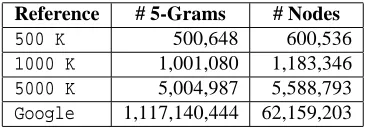
Google 1,117,140,444 62,159,203
TABLE1: Number of 5-grams and nodes in the references used
neity of its language or the nature of the topics co-vered, may impact the performances of a reference when used on a text with different characteristics.
Given these issues, four corpora were selected (cf. Table 1). The first three are made up of articles pu-blished in the Belgian daily newspaper Le Soir in 2009, with 500K, 1000K and 5000K words respec-tively. They share many characteristics with our test corpus. The last corpus is made up of the largest amount of n-grams publicly available for French : the Google 5-grams5 (Michel et al., 2011). Its size reaches 1T words6, and its coverage in terms of to-pic and register is supposedly wider than corpora of newspaper articles only. In a sense, the Google re-ference may be viewed as an attempt to a universal reference.
4 Evaluation
Most evaluations of MWE extraction systems are based on human judgments and restrict the valida-tion process to the n-best candidates. Inevitably par-tial, this method is unable to estimate performance in terms of recall. To overcome these limitations, we use the evaluation method described by Evert and Krenn (2001). They propose an automatic me-thod that consists in computing both recall and pre-cision using various n-best samples. It involves the formation of a golden standard (i.e. a list of MWEs manually identified in a corpus) and a sorted list of MWEs extracted automatically by applying AM on the same corpus. The recall and precision rates are therefore calculated by comparing the n-best (where
n increases from 0 till n in steps of x) to the golden
5. For the purposes of comparison, we also limited the size of the n-grams indexed in Le Soir to 5 words.
6. In order to model a contemporary language, we only kept the frequencies observed in texts written between 2000 and 2008.
standard list7.
4.1 The test corpus
In this study, we use the corpus described in La-porte et al. (2006). It is a French corpus in which all MWEs have been manually annotated. It consists of two sub-corpora :
– the transcription, in a written style, of the Oc-tober 3rd and 4th, 2006 meetings of the French National Assembly (FNA), and
– the complete text of Jules Verne’s novel "Around the World in 80 Days", published in 1873 (JV).
These two sub-corpora respectively contain 98,969 and 69,877 words for a total of 3,951 and 1,103 MWEs8. We limit our evaluation to the FNA cor-pus in order to keep data consistent both in terms of register and time. We assume that these two va-riables have a direct impact on the use of MWEs, a hypothesis that seems to be confirmed by the rate of MWEs in both sub-corpora.
4.2 Extractor Parameters
Before evaluating the performance of each of the above mentioned references, we first assessed the in-fluence of the various parameters involved in the ex-traction process and which affect the performance of the AMs. These parameters are the LocalMax, the smoothing technique, the lemmatization of the MWE constituents (LEMMA)9and the head-driven validation (HDV)10. To select the optimal parame-ters for our extractor, we established an additional reference (1000K words from Le Soir).
7. We build these lists from MWE types to avoid introdu-cing a bias in the evaluation process. Well-recognised high fre-quency MWEs might indeed gloss over poorly recognised low-frequency MWEs.
8. These occurrences correspond to 1,384 MWE types for the FNA corpus and 521 for the JV corpus.
9. The lemmatization of the MWE constituents is based on the assumption that the inflexion of the lemmas implies a dis-persal of the frequency mass (the overall frequency of a lemma is split between its inflected forms) that may affect the behavior of the AMs.
10. The HDV aims to focus on the lexical heads of the MWE candidates. Therefore, function words (prepositions, conjunc-tions, etc.) are ignored and replaced by wildcards in the queries sent to the reference in order to keep the distance information. For instance, from the sequence ministre de l’agriculture (Mi-nister for Agriculture), we derive the form ministre * *
[image:5.612.94.278.60.124.2]10 20 30 40 50 60 70 80
0 10 20 30 40 50 60 70 80 90 100
Precision (%)
MWE (%) Measures -- Precision
Fair Log-Likelihood Mutual Expectation Symmetric Conditional Probability
0 10 20 30 40 50 60
0 10 20 30 40 50 60 70 80 90 100
Recall (%)
MWE (%) Measures -- Recall
Fair Log-Likelihood Mutual Expectation Symmetric Conditional Probability
FIGURE1: Evaluation of AMs
The first step of this selection procedure was to define a baseline. For this purpose, we compared the precision and recall rates of our three AMs (see Figure 1) and kept only the best, namely the
log-likelihood ratio, for the rest of our experiments.
While the ME provides better precision for the top five percent of the extracted units, the log-likelihood
ratio appears more reliable in that it maintains its
efficiency over time (for recall as well as precision). The SCP, for its part, displays more stable results but does not reach sufficient precision.
On the basis of this baseline, we then separately compared the contribution of each of the four para-meters. Results are reported in Figure 2 and detailed in the following subsections.
4.2.1 The LocalMax
Figure 2 shows that the LocalMax significantly improves the precision of the extraction. It emerges as the most relevant parameter at this level.
10 20 30 40 50 60 70
0 10 20 30 40 50 60 70 80 90 100
Precision (%)
MWE (%) Parameters -- Precision
Lemmatization Add Text Smoothing LocalMax Head Baseline
0 10 20 30 40 50 60
0 10 20 30 40 50 60 70 80 90 100
Recall (%)
MWE (%) Parameters -- Recall
Lemmatization Add Text Smoothing LocalMax Head Baseline
FIGURE2: Evaluation of the parameters
ver, unlike other parameters, its application directly affects the recall that falls below our baseline. This may not be a problem for certain applications. In our case, we aim to index and classify documents. The-refore, while we can accommodate a lower preci-sion, we cannot entirely neglect the recall. We thus abandoned this parameter which, moreover, indubi-tably increases the processing time in that it requires the use of approximate matching (see Section 3.1).
4.2.2 The Add-text smoothing
[image:6.612.80.302.66.392.2] [image:6.612.321.543.68.386.2]pro-cess discounts too much probability mass from ob-served events.
We therefore compare this simple method with another one we consider more “natural” : the “add-text” smoothing that adds the text to process to the reference. We view this method as more natural to the extent that it simulates a standard MWE extrac-tion process. In this case, the reference complements the frequency universe of the input corpus as if it for-med a homogeneous whole. Figure 2 demonstrates a clear superiority of the second smoothing procedure over the first one which was therefore discarded.
4.2.3 Lemmatization and HDV
The lemmatization and HDV follow a similar curve with regard to precision, although HDV is bet-ter for recall. Nonetheless, this difference only ap-pears when precision falls below 35%. This does not seem sufficient to reject the lemmatization pro-cess whose computation time is significantly lower than for the HDV. We therefore limit the use of this last parameter to the reference built from Google whose n-grams cannot be lemmatized due to lack of context.11
4.3 Evaluation of the references
The estimation of the parameters allowed us to es-tablish a specific evaluation framework. Two sets of parameters were defined depending on whether they apply to Google (ATS + HDV) or to the references built from Le Soir (ATS + LEMMA). From a prac-tical standpoint, we limited the MWE extraction to nominal units of size inferior to five in order to meet the characteristics of our test corpus (the annotations of which are limited to nominal sequences), on the one hand, and to allow comparability of results on the other hand (the n-grams from Google do not ex-ceed the order 5).
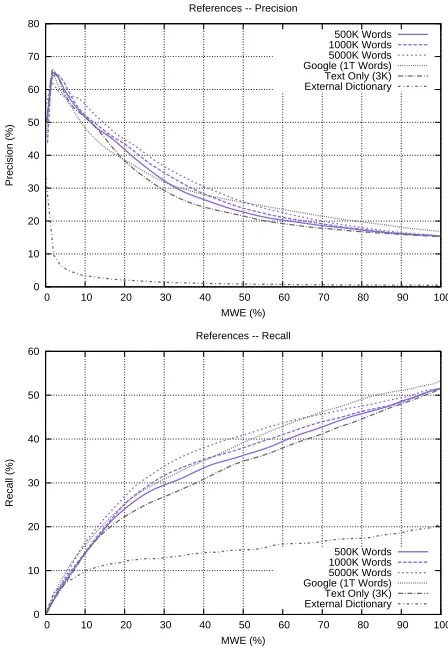
Initially, we considered the extraction of MWEs in the whole evaluation corpus. Results displayed in Figure 3 provide an advantage over the use of a refe-rence with respect to the extraction carried out on the test corpus only. In addition, we see a clear improve-ment in performance with respect to that obtainable with a dictionary of MWEs.12
11. References constructed on the basis of the newspaper Le
Soir have been reindexed from a lemmatized text.
12. The MWE dictionary used in this experiment was
0 10 20 30 40 50 60 70 80
0 10 20 30 40 50 60 70 80 90 100
Precision (%)
MWE (%) References -- Precision
500K Words 1000K Words 5000K Words Google (1T Words) Text Only (3K) External Dictionary
0 10 20 30 40 50 60
0 10 20 30 40 50 60 70 80 90 100
Recall (%)
MWE (%) References -- Recall
500K Words 1000K Words 5000K Words Google (1T Words) Text Only (3K) External Dictionary
FIGURE3: Evaluation on the 100K Corpus
In a second step, we wanted to test the efficiency of our references in the more adverse context of a short text. We randomly selected 3K words of our test corpus to simulate a short text while maintai-ning a sufficient number of MWEs (i.e. 151 nominal MWEs). Results shown in Figure 4 further confirm our first experience and validate our concept of a re-ference in a real application context.
Beyond validating the use of a frequency base, these results also confirm the general idea that the size of the corpus used for the reference matters. The differences between the references of 500K, 1000K and 5000K words showed a continuous improve-ment both in precision and recall. The results obtai-ned with the Google reference are more surprising, since they do not meet that growing trend. Howe-ver, given the number of errors that those n-grams contain (mainly due to the OCR-ization and
[image:7.612.319.543.65.389.2]0 10 20 30 40 50 60 70 80 90 100
0 10 20 30 40 50 60 70 80 90 100
Precision (%)
MWE (%) References (3K) -- Precision
500K Words 1000K Words 5000K Words Google (1T Words) Text Only (3K) External Dictionary
0 10 20 30 40 50 60
0 10 20 30 40 50 60 70 80 90 100
Recall (%)
MWE (%) References (3K) -- Recall
500K Words 1000K Words 5000K Words Google (1T Words) Text Only (3K) External Dictionary
FIGURE4: Evaluation on the 3K Corpus
zation processes), the result remains satisfactory. It even confirms to some extent the importance of size in the sense that preprocessing errors are being miti-gated by the global mass of the frequencies.
5 Conclusion and perspectives
In this paper, we presented an MWE extraction system based on the use of frequency references. We have shown that its use enables MWE extraction on short texts with performances that are at least com-parable to those achieved by standard solutions and far superior to solutions based on the use of MWE dictionaries.
Moreover, as this system has been integrated wi-thin an indexing engine, various issues were rai-sed, some of which constitute avenues for future re-search. First, since our indexer aims at the identifi-cation of entities and terms specific to a given spe-cialty area, the question of data representativeness is of particular importance. It is not clear to what
MWE 500 K 1000 K 5000 K Google
même groupe
0.73 1.44 3.85 1,746.03
nouveaux instruments
3.81 3.3 49.83 2,793.65
lettres de noblesse
33.99 52.43 232.51 27,202.17
TABLE 2: Examples of MWEs candidates whose log-likelihood ratio is not significant on a small corpus and becomes extremely significant on a large corpus. They are compared to the score of an actual MWE.
extent a given reference can be applied to various types of texts. We only noticed that the Google refe-rence, whose features were less similar to the test corpus, nevertheless yielded satisfactory results in comparison with our other references that better fit-ted the test corpus features.
In addition, our results show that the threshold is-sue remains relevant. Although the LocalMax seems to allow better discrimination of the MWE candi-dates, it is not selective enough to keep only the ac-tual MWEs. On the other hand, as the size of the references increases, some results of the AMs based on the log-likelihood ratio reach high values that can no longer be interpreted by a chi-square significance test (see Table 2).
We believe that our references offer an interes-ting perspective to face this problem. The stability of their frequencies makes it possible to define a thre-shold corresponding to a specific percentage of pre-cision and recall (set according to the needs of a gi-ven application). Therefore, as long as the size of the analyzed texts remains limited – which can be controlled –, the efficiency of this threshold should remain constant. Further experimentations on this aspect are however required to determine to what extent this assumption stands true as the size of the analyzed texts grows.
References
K.W. Church and W.A. Gale. 1991. Concordances for parallel text. In Proceedings of the Seventh Annual Conference of the UW Centre for the New OED and Text Research, pages 40–62.
J. da Silva and G.P. Lopes. 1999. A local maxima me-thod and a fair dispersion normalization for extracting multi-word units from corpora. In Sixth Meeting on Mathematics of Language.
B. Daille. 1995. Combined approach for terminology extraction : lexical statistics and linguistic filtering. Technical report, Lancaster University.
G. Dias, S. Guilloré, and J.G.P. Lopes. 1999. Language independent automatic acquisition of rigid multiword units from unrestricted text corpora. Proceedings of the 6th Conference on the Traitement Automatique des Langues Naturelles (TALN1999), pages 333–339. T. Dunning. 1993. Accurate methods for the statistics of
surprise and coincidence. Computational linguistics, 19(1) :61–74.
S. Evert and B. Krenn. 2001. Methods for the qualitative evaluation of lexical association measures. In Procee-dings of the 39th Annual Meeting on Association for Computational Linguistics, pages 188–195.
A. Kilgarriff. 2005. Language is never ever ever random. Corpus linguistics and linguistic theory, 1(2) :263– 276.
E. Laporte, T. Nakamura, and S. Voyatzi. 2006. A french corpus annotated for multiword expressions with ad-verbial function. In Proceedings of the Language Re-sources and Evaluation Conference (LREC) : Linguis-tic Annotation Workshop, pages 48–51.
C.D. Manning and H. Schütze, editors. 1999. Founda-tions of Statistical Natural Language Processing. MIT Press.
J.B. Michel, Y.K. Shen, A.P. Aiden, A. Veres, M.K. Gray, The Google Books Team, J.P. Pickett, D. Hoiberg, D. Clancy, P. Norvig, J. Orwant, S. Pinker, M.A. No-wak, and E.L. Aiden. 2011. Quantitative analysis of culture using millions of digitized books. Science, 331(6014) :176–182.
D.R. Morrison. 1968. PATRICIA—practical algorithm to retrieve information coded in alphanumeric. Jour-nal of the ACM, 15(4) :514–534.
L. Nerima, V. Seretan, and E. Wehrli. 2006. Le pro-blème des collocations en TAL. Nouveaux cahiers de linguistique française, 27 :95–115.
J. Nivre and J. Nilsson. 2004. Multiword units in syn-tactic parsing. In Proceedings of LREC-04 Workshop on Methodologies & Evaluation of Multiword Units in Real-world Applications, pages 37–46.
S. Paumier. 2003. De la reconnaissance de formes lin-guistiques à l’analyse syntaxique. Ph.D. thesis, Uni-versité de Marne-la-Vallée.
D. Pearce. 2002. A comparative evaluation of colloca-tion extraccolloca-tion techniques. In Proc. of the 3rd Inter-national Conference on Language Resources and Eva-luation (LREC 2002), pages 1530–1536.
P. Pecina and P. Schlesinger. 2006. Combining associa-tion measures for collocaassocia-tion extracassocia-tion. In
Procee-dings of the 21th International Conference on Com-putational Linguistics and 44th Annual Meeting of the Association for Computational Linguistics (CO-LING/ACL 2006), pages 651–658.
Z. Ren, Y. L, J. Cao, Q. Liu, and Y. Huang. 2009. Im-proving statistical machine translation using domain bilingual multiword expressions. In Proceedings of the Workshop on Multiword Expressions : Identifica-tion, InterpretaIdentifica-tion, Disambiguation and Applications, pages 47–54.
I. Sag, T. Baldwin, F. Bond, A. Copestake, and D. Fli-ckinger. 2001. Multiword expressions : A pain in the neck for NLP. In In Proc. of the 3rd International Conference on Intelligent Text Processing and Com-putational Linguistics (CICLing-2002), pages 1–15. H. Schmid. 1994. Probabilistic part-of-speech tagging
using decision trees. In Proceedings of International Conference on New Methods in Language Processing, volume 12. Manchester, UK.
S. Sekine. 2008. A linguistic knowledge discovery tool : Very large ngram database search with arbitrary wild-cards. In COLING : Companion volume : Demonstra-tions, pages 181–184.
V. Seretan, L. Nerima, and E. Wehrli. 2003. Extrac-tion of Multi-Word CollocaExtrac-tions Using Syntactic Bi-gram Composition. In Proceedings of the 4th In-ternational Conference on Recent Advances in NLP (RANLP2003), pages 424–431.
J. da Silva, G. Dias, S. Guilloré, and J. Pereira Lopes. 1999. Using localmaxs algorithm for the extraction of contiguous and non-contiguous multiword lexical units. Progress in Artificial Intelligence, pages 849– 849.
F. Smadja. 1993. Retrieving collocations from text : Xtract. Computational Linguistics, 19 :143–177. O. Vechtomova. 2005. The role of multi-word units
in interactive information retrieval. In D.E. Losada and J.M. Fernández-Luna, editors, ECIR 2005, LNCS 3408, pages 403–420. Springer-Verlag, Berlin. P. Watrin. 2007. Collocations et traitement automatique