CUNI: Feature Selection and Error Analysis of a
Transition-Based Parser
Daniel ZEMAN
(1) Charles University in Prague, Faculty of Mathematics and Physics, Institute of Formal and Applied Linguistics, Malostranské náměstí 25, Praha, Czechia
Abstract
We describe the parsing system used at the Charles University (CUNI) for the Hindi Parsing Shared Task 2012. We used the publicly available Malt Parser, which is highly config-urable. A substantial part of the paper describes the configuration that we selected. The parser performs reasonably well in identifying the head nodes. The main weakness is in labeling the dependency relations. We identify the most prominent error types, which should help to improve the parsing accuracy in future.
Title and Abstract in Czech
CUNI: Výběr rysů a analýza chyb parseru založeného na
přechodech
Popisujeme systém pro syntaktickou analýzu použitý na Univerzitě Karlově (CUNI) pro Hindi Parsing Shared Task 2012. Použili jsme veřejně dostupný nástroj Malt Parser, který poskytuje mnoho možností konfigurace. Podstatná část článku se zabývá právě konfigurací, kterou jsme zvolili. Parser dosahuje dobré úspěšnosti při identifikaci rodičovských uzlů. Jeho hlavní slabinou je značkování závislostních vztahů. Popisujeme nejběžnější druhy chyb, což by mělo pomoci v budoucnosti zvýšit úspěšnost parseru.
Keywords:
parsing, dependency, SOV language, malt parser.1 Introduction
Dependency parsing has gradually become standard way of parsing for many languages during the past decade. There have been three multilingual shared tasks in dependency parsing at CoNLL (2006, 2007 and 2009) and two focused on Indian languages, orga-nized at ICON (2009 and 2010). This work on parsing Hindi loosely follows from our contribution to ICON (Zeman, 2009).
2 Data
The data provided are split to three parts: training, development and test. During the preparatory stage, we trained the parser on the training dataset and tested it on the de-velopment dataset. Then the blind test data were released. We retrained the parser on both the training and the development datasets, and applied it to the test data. Note that at this stage, we did not have access to the gold-standard syntactic annotation of the test data and we could not measure the accuracy on the test set. Later on, after the official results were announced, the full test set was released.
From now on, we will refer to the original training data asdtrain, to the development data asdtest, to the combination of dtrain+dtest asetrainand to the final test data asetest.
Tokens Sentences dtrain 268096 12041 dtest 26416 1233 etrain 294512 13274 etest 39775 1828
Table 1: Size of the various datasets.
The data were provided in two file formats and two encodings of the Devanāgarī script. We work exclusively with the CoNLL data format (Buchholz and Marsi, 2006) and the UTF-8 encoding.
Two versions of morphological annotation were provided, corresponding to two tracks of the shared task:GoldandAuto. As suggested by its name, the Gold version contains more information and more accurate information. In the Auto version, values of some token attributes were assigned using automated tools, and values of the (many!) remaining attributes were empty because no automatic tool was available to assign them.
An example of one token from the Gold training data follows (including transliteration): Index Token Lemma CPOS POS Features Head index Dep label 32 िकया कर VM v lex-कर|cat-… 0 main 32 kiyā kara VM v lex-kara|cat-… 0 main Wherein the features consist of a long, vertical-bar-delimited list (here displayed as a table):
lex cat gen num pers case vib tam chunkId chunkType stype voicetype
कर v m sg any या yA VGF head declarative’> active voicetype
The corresponding line of the same token in the Auto data is much simpler: Index Token Lemma CPOS POS Features Head index Dep label
32 िकया _ VM _ _ 0 main
32 kiyā _ VM _ _ 0 main
Slightly more than 1% of the tokens in Hindi are attached non-projectively. As a distinct feature of the Hyderabad treebank, there are special NULL nodes covering words deleted from surface, e.g. in deficient coordinations, as in:
दीवाली के िदन जुआ खेले ं मगर NULL घर मे ं या होटल मे ं.
dīvālī ke din juā khelẽ magar NULL ghar mẽ yā hoṭal mẽ.
Diwali of day gambling play but [do-so] house in or hotel in “They do gamble on Diwali but they do so in house or in hotel.”
The NULL nodes are present also in test input and it is not the task of the parser to introduce them. Approximately 0.4% of all nodes are NULL nodes.
3 Parser
We use Malt Parser v. 1.7.11(Nivre et al., 2007). It is a deterministic shift-reduce parser
where input words can be either put to the stack or taken from the stack and combined to form a dependency. The decision which operation (transition) to perform is made by an oracle based on various features of the words in the input buffer and the stack. The default machine learning algorithm used to train the oracle is a sort of SVM (support vector machine) classifier (Cristianini and Shawe-Taylor, 2000).
Malt Parser has participated in several CoNLL shared tasks in multilingual dependency parsing (2006, 2007 and 2009), as well as in the ICON 2009 NLP tools contest in parsing Indian languages. It achieves state-of-the-art accuracy (or close to it) for many languages, provided its settings, algorithm and feature space are optimized for the given language and dataset. Malt Parser is reasonably fast and it is open-source, freely available for download.
Malt Parser provides several parsing algorithms. They differ in the data structures they use, in the sets of transition operations they allow, and in the precedence of transition types when converting a training tree to a sequence of transitions. The algorithms are as follows:nivrestandard, nivreeager, covproj, covnonproj, stackproj, stackeager, stacklazy, pla-nar, 2planar.We need one of the non-projective algorithms because there are occasional non-projective dependencies in the data. Based on dtest scores, we selected thestacklazy
algorithm.
Malt Parser is also highly configurable with respect to the features considered when se-lecting the next transition. Table 2 gives an overview of features that we used.
Training times depend on the number of features, thus it is much faster to train on the Auto data than on the Gold data. Training Malt parser on the full etrain dataset takes about 2 hours in the Auto version and about 6 hours in the Gold version (tested on 2GHz 64bit Intel Xeon processors with 29GB RAM dedicated to the Java Virtual Machine). Parsing etest took between 30 (Auto) and 45 (Gold) minutes. For the sake of quick probing experiments
FORM LEMMA POS FEATS DEPREL
Stack: top 1 2 3 4
Stack: top−1 5 6 7
Stack: top−2 8 9
Stack: top−3 10
Input: next 11
Lookahead: next 12 13 14 15
Lookahead: next+ 1 16 17 18 19
Lookahead: next+ 2 20 21 22
Lookahead: next+ 3 23
Lookahead: next+ 4 24
Tree: leftmost dep oftop 25 26
Tree: leftmost dep oftop−1 27
Tree: leftmost dep oftop−2 28
Tree: rightmost dep oftop 29
Tree: rightmost dep oftop−1 30
Tree: rightmost dep oftop−2 31
[image:4.420.48.356.71.245.2]String: predecessor oftop 32 33
Table 2: Feature pool for optimization with columns representing data fields and rows representing tokens relative to the stack, input buffer / lookahead, partially built tree, and input string. Features are numbered.
we also used the subset of the first 1000 training sentences. With such limited training corpus, accuracy dropped about 12 percent points down and processing times dropped to just a few minutes.
4 Results
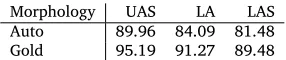
Morphology UAS LA LAS Auto 89.96 84.09 81.48 Gold 95.19 91.27 89.48
Table 3: The official results as measured by the organizers of the shared task. UAS = unlabeled attachment score; LA = labeling accuracy; LAS = labeled attachment score.
5 Error Analysis
In our assessment of typical error patterns we will focus on the Gold track. The (unlabeled) attachment score is very high, which implies that it is difficult to pull out frequent errors. Nevertheless, there is some evidence that coordinations, commonly perceived as hard to parse, still correlate with errors in our data.
[image:4.420.132.275.347.377.2]Besides conjunctions, the second most difficult part of speech is RB (adverb of manner; 89%). If we look at word forms, again, conjunctions are most risky:और,िक,व.
Not surprisingly, attachments to the artificial root node are more difficult (96%) to recog-nize that dependencies inside the tree. For tree-internal arcs, length 1 has 99% accuracy and longer links decrease down to 92%.
While the parser rarely confuses parent selection, its weakness lies in labeling of the dependencies. The nature of the label set used in the Hyderabad treebank excludes certain combinations of dependencies under one parent; in particular, there should not be two siblings both labeledk1. However, the parser has only limited means of learning such constraints. We cannot define a feature that would tell whether we already labeledk1
anything anywhere in the current tree. Labels with the lowest precision and recall are k1 (87%), k2 (76%), k7 (80%), k7t (88%), pof (82%), r6 (92%) and ccof (93%; again, this is coordination). Most of these are typical verb complements.
The most frequent label confusion occurred between r6-k2 (karma of a conjunct verb) and r6 (possessive), presumably because both occur with the postpositionका. Another relatively frequent confusion is between k7p (location-place) and k7 (location other than place).
6 Conclusion
We described our configuration of the Malt Parser used to parse Hindi part of the Hy-derabad Dependency Treebank ver. 0.51. Feature engineering is the key to success in discriminative parsing. One of the main advantages of Malt Parser is that many differ-ent features can be used to describe tokens in the various data structures of the parser. Later in the paper, we evaluated the output of the parser and identified the most frequent error types. Future work should focus on two separate problems: 1. How to improve attachment of coordinations, and 2. How to improve labeling accuracy. For example, coordinations might improve by introducing features that would better port the phrase type to the higher levels. As for dependency labels, a self-standing tagger applied during post-processing could be tested.
Acknowledgements
References
Buchholz, S. and Marsi, E. (2006). CoNLL-X shared task on multilingual dependency parsing. InProceedings of the Tenth Conference on Computational Natural Language Learning (CoNLL-X), pages 149–164, New York City. Association for Computational Linguistics. Cristianini, N. and Shawe-Taylor, J. (2000). An Introduction to Support Vector Machines and Other Kernel-Based Learning Methods. Cambridge University Press, Cambridge, UK. Nivre, J., Hall, J., Nilsson, J., Chanev, A., Eryiğit, G., Kübler, S., Marinov, S., and Marsi, E. (2007). MaltParser: A language-independent system for data-driven dependency pars-ing.Natural Language Engineering, 13(2):95–135.